For a few seconds, nobody moved.
Chapter 2
For a few seconds, nobody moved.
The new house was quiet in that strange way expensive houses can be quiet before they become homes. No clocks ticking. No family photos on the walls yet. No scent of dinner in the kitchen. Just polished floors, fresh paint, and the hollow echo of betrayal.
Mark still held the folder.
Rebecca still wore that small satisfied smile.
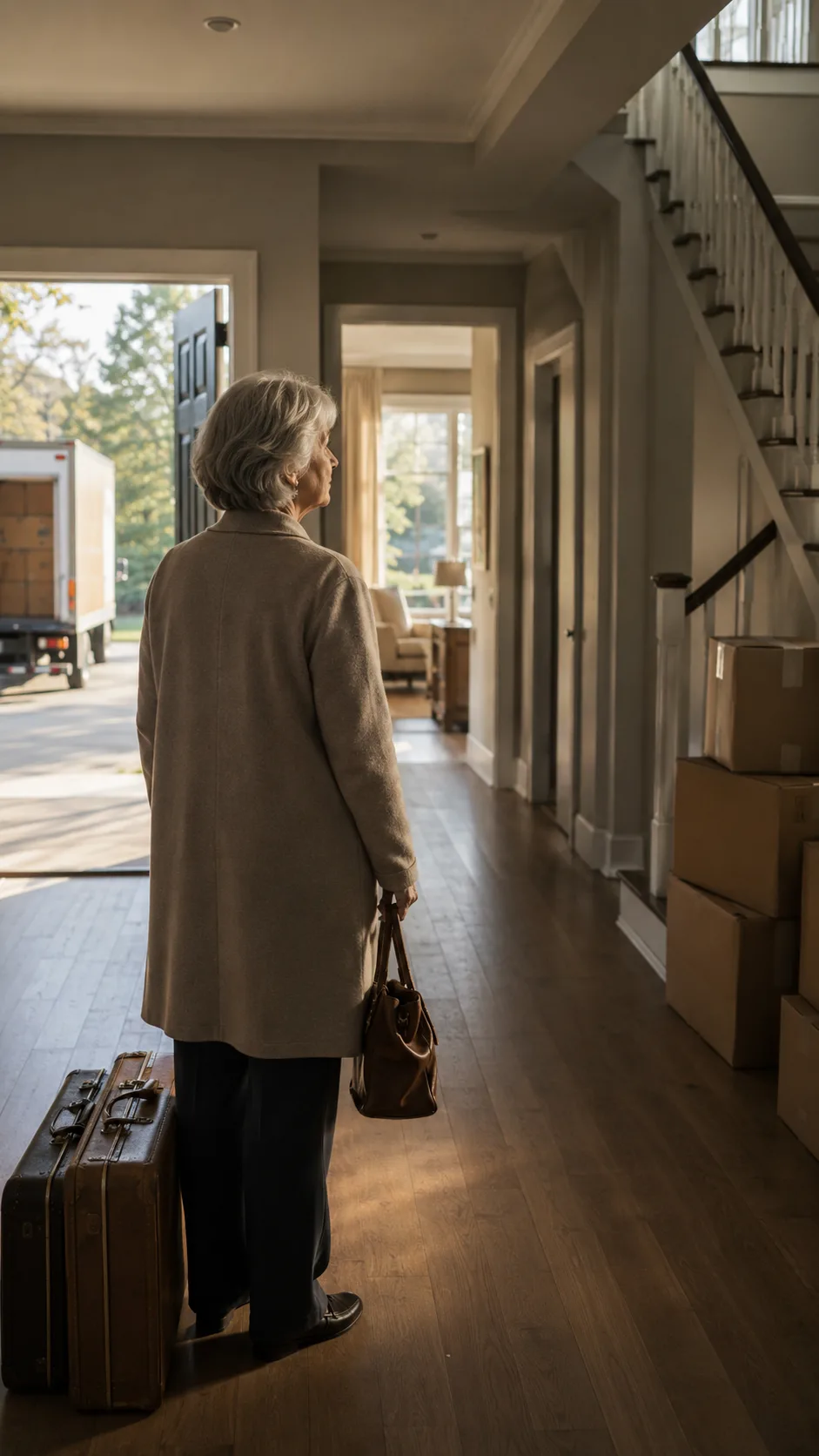
And I still stood beside my suitcases like a guest who had arrived at the wrong address.
“Mom,” Mark said carefully, as if I were a child about to make a scene in public, “please don’t take this the wrong way.”
I looked at him.
I had looked at that face in every stage of his life.
Covered in birthday cake.
Swollen from crying after his father missed one Little League game because of overtime.
Pale and terrified when he crashed my old station wagon at seventeen.
Proud when he held his
college diploma.
Exhausted when he called me after his first business failed.
I had answered every version of him with the same sentence.
“Come home, sweetheart.”
Now he was standing in a house bought with my money, telling me I had no home.
“How should I take it, Mark?” I asked.
Rebecca stepped forward before he could answer.
Her cream sweater was perfect. Her hair was perfect. Her tone was perfect too — the kind of soft voice people use when cruelty wants to pretend it is kindness.
“We’re not abandoning you,” she said. “We’re being realistic.”
Realistic.
That was the word she had used three months earlier when she convinced Mark that my old house was too much for me.
Realistic about the stairs.
Realistic about the roof repairs.
Realistic about my age.
Realistic about how lonely I must feel rattling around in that place after Frank died.
She
had said it over tea at my kitchen table, touching my hand as if she cared.
“You deserve to be with family, Helen,” she told me then. “Not alone in a house full of ghosts.”
Mark had nodded beside her.
“We’ll buy something bigger,” he said. “A fresh start. You’ll have the downstairs bedroom so you won’t need to climb stairs. Rebecca already found a place with a sunny room.”
A sunny room.
I held on to that phrase while I sorted through forty years of marriage.
I donated Frank’s work coats.
I sold the dining table where we had hosted every Thanksgiving.
I wrapped our wedding china in newspaper and gave it to Rebecca because she said it would “look beautiful in the new place.”
The new place.
The family place.
Our place.
Now Rebecca pointed toward the folder in Mark’s hand.
“The residence has medical staff, activities, meals,
transportation. It’s actually very nice.”
“You visited it?” I asked.
Mark swallowed.
Rebecca answered again.
“We took a tour last week.”
Last week.
While I was still packing my husband’s Bible into a box marked “Mom’s Room.”
I looked at my son.
“You toured a nursing home for me before I arrived?”
His jaw tightened.
“It’s not a nursing home.”
“What is it, then?”
“A senior living community.”
I gave a small laugh, not because anything was funny, but because the truth sometimes walks into a room wearing a prettier name.
Rebecca’s smile faded.
“Helen, this reaction is exactly why we didn’t tell you earlier. We knew you’d get emotional.”
Emotional.
I had buried my husband without fainting.
I had signed the closing papers on our home without crying in front of the realtor.
I had packed away the blue mug Frank used every morning and survived the silence it left in the cabinet.
But apparently, I was too emotional to object to being delivered to strangers like unwanted furniture.
Mark opened the folder.
“There’s a private room available starting tomorrow,” he said. “Tonight you can stay at a hotel near the facility. We already booked it.”
My fingers went cold.
“A hotel?”
Rebecca’s eyes flicked toward my suitcases.
“It’s just one night.”
“You don’t even want me sleeping here tonight?”
Mark looked away.
That answer hurt more than the words.
I turned slowly and took in the foyer.
The tall staircase.
The wide hallway.
The sitting room beyond the archway.
The unopened boxes labeled Kitchen, Office, Guest Room, Master Bedroom.
Guest Room.
There it was. Written in thick black marker on three boxes stacked neatly beside the stairs.
I stepped toward them.
Rebecca moved quickly.
“Helen, don’t start digging through boxes.”
I touched the label with two fingers.
“Guest Room,” I read aloud.
Mark exhaled.
“That’s for visitors.”
I looked back at him.
“What am I?”
His face twisted with guilt, but guilt is useless when it arrives after the damage.
Rebecca’s patience broke.
“You’re his mother, not our responsibility for the rest of your life.”
The sentence landed in the foyer like glass shattering.
Mark flinched.
“Rebecca.”
“No,” she snapped, turning on him. “We agreed we were done pretending. She sold her house. She got the money. She helped with the down payment. That was the agreement.”
I stared at her.
Mark’s face went pale.
Rebecca realized too late that she had said too much.
“The agreement?” I asked quietly.
She folded her arms again, but her confidence had slipped.
“I mean, the family agreement. The practical arrangement.”
I nodded.
Practical.
There it was again. Another clean word for something dirty.
I looked at Mark.
“Is that what I was to you? A down payment?”
“No,” he said quickly. “Mom, it wasn’t like that.”
“How was it?”
He opened his mouth.
Nothing came out.
Rebecca stepped closer, voice lowering.
“Let’s not make this uglier than it needs to be. The papers are done. The residence is expecting you. Mark has been under enough stress.”
I looked at my son, and for the first time that day, I saw him clearly.
Not as the boy I raised.
Not as Frank’s son.
Not as the man I kept forgiving because grief made me soft.
I saw a middle-aged man who had let his wife plan my removal and then put his own signature on it.
The grief inside me changed shape.
It became still.
I reached down, picked up my brown leather handbag, and set it on top of my suitcase.
Rebecca’s eyes narrowed.
“What are you doing?”
“Getting my papers.”
Mark frowned.
“What papers?”
I opened the handbag slowly.
The leather creaked in the silence.
Inside were my reading glasses, my wallet, a packet of tissues, Frank’s old fountain pen, and the cream legal envelope I had carried against my hip since closing day.
I had not told Mark I kept copies.
Frank had taught me that.
“Always keep your own copy, Helen,” he used to say. “Especially when people smile too much while asking you to sign.”
At the closing, Mark had been distracted.
Rebecca had been excited.
The attorney had explained everything clearly, but they only heard the parts they wanted to hear.
Yes, proceeds from the sale of my old home would fund the purchase.
Yes, I was contributing the majority of the money.
Yes, for estate planning and tax reasons, the title would be handled in the way my late husband’s trust required.
Rebecca had been checking paint colors on her phone.
Mark had whispered something about furniture delivery.
Neither of them listened when the attorney said the most important sentence in the room.
I pulled out the envelope.
Rebecca laughed once.
“Helen, if this is about receipts, now is not the time.”
I placed the envelope beside Mark’s folder.
“It is exactly the time.”
Mark stared at it.
His eyes changed first.
Not Rebecca’s.
Mark’s.
Because somewhere beneath his cowardice, he knew my husband had never been careless with property. He knew Frank had built our life with receipts, signatures, copies, and records. He knew I was not the helpless old woman Rebecca had described.
“Mom,” he said slowly, “what is that?”
I opened the envelope.
The papers unfolded with a quiet, ordinary sound.
Nothing dramatic.
No thunder.
No music.
Just paper.
But Mark looked as if the floor had shifted beneath him.
Rebecca leaned in.
“What is that supposed to be?”
I put on my reading glasses.
My hands were steady now.
“This,” I said, “is the deed.”
Rebecca blinked.
Mark’s lips parted.
I turned the first page toward them, keeping my finger on the line where my name appeared.
“The house was purchased with my money,” I said. “The trust required my name on the title. Your attorney explained it. You were both in the room.”
Rebecca snatched the page with her eyes but did not touch it.
“No. That’s not—”
“It is.”
Mark whispered, “Mom…”
I looked at him.
“You told me there would be a room for me here.”
He swallowed hard.
Rebecca shook her head.
“This has to be a mistake.”
I smiled then.
Not kindly.
Not cruelly.
Just enough for her to understand that the helpless old woman she had been moving around like furniture was gone.
“No, Rebecca,” I said. “The mistake was yours.”
Her face drained of color.
I picked up Mark’s folder and laid it neatly on top of the deed.
“Nursing home papers,” I said. “Hotel booking. Senior residence brochure. All arranged before I arrived.”
I looked around the foyer one more time.
The boxes.
The staircase.
The open door.
The truck outside waiting to finish unloading my life into a house where they had decided I would not live.
Then I looked at my son.
“So tell me,” I said softly, “who exactly has no room here?”
Mark did not answer.
Rebecca could not.
And for the first time since I stepped through that door, the silence belonged to me.
TO BE CONTINUED, CLICK INTO LINK READ TO PART 3 NOW:
👉 PART 3 👈
Chapter complete
You have reached the end of this chapter.
Continue reading
A few more worlds to get lost in after this chapter.




