PART 3 — THE NAME ON THE DEED
Wednesday, I stopped by the firm.
Chapter 3
PART 3 — THE NAME ON THE DEED
Wednesday, I stopped by the firm.
Force of habit, maybe, or maybe I just wanted to stand in my own kitchen one more time before everything turned over.
Renata met me at the prep station. The kitchen ran around us like a tide. A dozen cooks, the smell of sage and roasting bone, sheet trays stacked nearly to the ceiling.
“Thirty covers plated. Your house, Thursday, noon,” she said. “Two turkeys, the cranberry you like, the cornbread dressing, full staff.”
“And the release?” I asked.
“Standard,” she said. “Every large event ends with an on-site sign-off. The owner of record signs a release at the table before we close out the night. It settles the damage deposit and clears the property. No signature from the owner, no closing the file.”
She gave me a level look.
“The owner of record, which the county system says is one Holly Forsyth.”
“It does say that,” I agreed.
“Daniel
listed himself,” she said. “When my office flagged the mismatch, he told us his elderly mother gets confused about what she owns.”
A beat.
“I didn’t correct him. I figured you’d want to do that part yourself.”
I put my hand over hers on the cold steel counter.
“Renata,” I said. “Thursday, set the dinner exactly as booked. Serve every course. Then during the meal, bring the release to the table and read out who has to sign it. Out loud, so the whole room hears.”
I paused.
“No special favors. No theatrics. Just your ordinary ironclad procedure.”
She smiled the smile of a woman who’d been waiting 15 years to watch me take a room back.
“Procedure,” she said, “is the most ruthless thing in the world. You taught me that, too.”
I left the kitchen feeling, for the first time all week, completely calm. The trap they’d built
had one hinge they didn’t know about, and the hinge had my name stamped on it.
Tomorrow was Thanksgiving.
I heard later how sure they were. Caleb told me, much later, in the quiet way kids tell you things.
By Wednesday night, Daniel and Brooke believed they’d already won. Mom came around. Mom was bringing her pie and her sweet smile. Mom would sit exactly where she was told to sit and sign exactly what she was handed.
They had a script. They had a camera. They had a sad, kind, airtight little play rehearsed down to the last tearful pause. And I was cast as the confused old woman who signs.
They were so confident in the performance, they never once checked the thing it all stood on.
Whose name was on the house they were busy dividing?
Before we get to the part you came for, one question.
When your family decides your life without you, do you fight loud or go quiet and get ready? There’s no wrong answer. Tell me which one you are in the comments.
Then stay with me. Because Thursday is where everything they planned met the one fact they never checked.
They thought Thursday was their ambush. They had no idea it was mine. And I wasn’t bringing a weapon. I was bringing a fact.
Thursday morning, I came to the house early before the crowd. I told myself it was to help. The truth is, I wanted to stand in my own rooms a while.
The dining room was already set. Cardinal Table linens, my old china pattern, candles in the good brass holders. Funny. The things that survive a marriage and a widowhood and end up still on the table.
I was in the hallway when I heard Brooke in the den. She didn’t know I was there. She was talking to Lily, low and tight.
“It’s going to be fine, baby. We’re not going to lose this house. I promise you that.”
Lily said something I couldn’t quite hear.
“Because I grew up with nothing,” Brooke said, and her voice cracked clean down the middle on the word nothing. “Three apartments in two years. I’m never letting you feel that. Never.”
I stood in the hallway with my purse on my arm, and the whole thing got complicated.
She wasn’t a cartoon villain. She was a frightened woman who had decided that my security was the fair price of hers. I knew that exact fear. I’d built an entire company outrunning it.
For one breath, I almost softened. I almost thought, maybe there’s a kinder way to do this.
Then I remembered the words.
“She’s getting confused anyway, so it won’t be hard to sell.”
She had decided to protect her children by erasing me. By telling 30 people I’d lost my mind.
Fear explains her. It doesn’t excuse the brochure.
I straightened my collar and walked toward the kitchen where the first guests were already arriving.
By noon, the house was full. Thirty people, exactly as promised. Cousins I see once a year. Two of Walter’s old golf friends. Marlene in pearls, holding court over by the window.
The Cardinal Table staff moved through all of it in black aprons. Quiet, precise, invisible in the way good service is supposed to be.
Renata stood near the kitchen door with her clipboard, watching the room the way I’d taught her to watch a room. She caught my eye exactly once.
We didn’t nod. We didn’t need to.
I made the rounds like a good grandmother. I admired the centerpiece I had paid for. I let Marlene kiss my cheek and tell me how rested I looked, which is what people say when they mean something else entirely.
Caleb found me by the stairs and hugged me hard around the middle. Lily showed me a loose tooth, wiggling it with great pride. I held onto those two minutes longer than either of them knew.
My purse stayed on my shoulder the whole time. Inside it, folded into thirds, were the deed, the sealed notice, the printed screenshots. I didn’t touch it. I just felt its small, certain weight against my hip.
Daniel kept glancing at the head of the table where a single sheet of paper lay face down beside a good pen. He thought I hadn’t noticed it.
I’d noticed it the second I walked through my own front door.
Brooke smiled at me from across the room. Warm. Sad. Rehearsed.
I smiled right back.
One of us knew what was in my bag. The other one was about to find out.
Renata’s team served the plates at 1:30. Turkey, dressing, the cranberry I like. The room filled up with a good warm noise of 30 people eating.
Daniel stood up at 1:52. I checked my watch on purpose so I’d remember it later.
He tapped his glass with the edge of a knife. The room quieted in that pleased, expectant way.
“Before we go any further,” he said, “I want to talk about something as a family. About Mom and about the house.”
A few heads turned toward me, warm and unsuspecting.
Marlene set down her fork right on cue.
“We’ve all noticed it,” she said, soft and grave. “Holly hasn’t been herself. Forgetting things, out at that cabin all alone.”
She pressed a hand to her chest.
“We love you, sweetheart. We’re just so worried about you.”
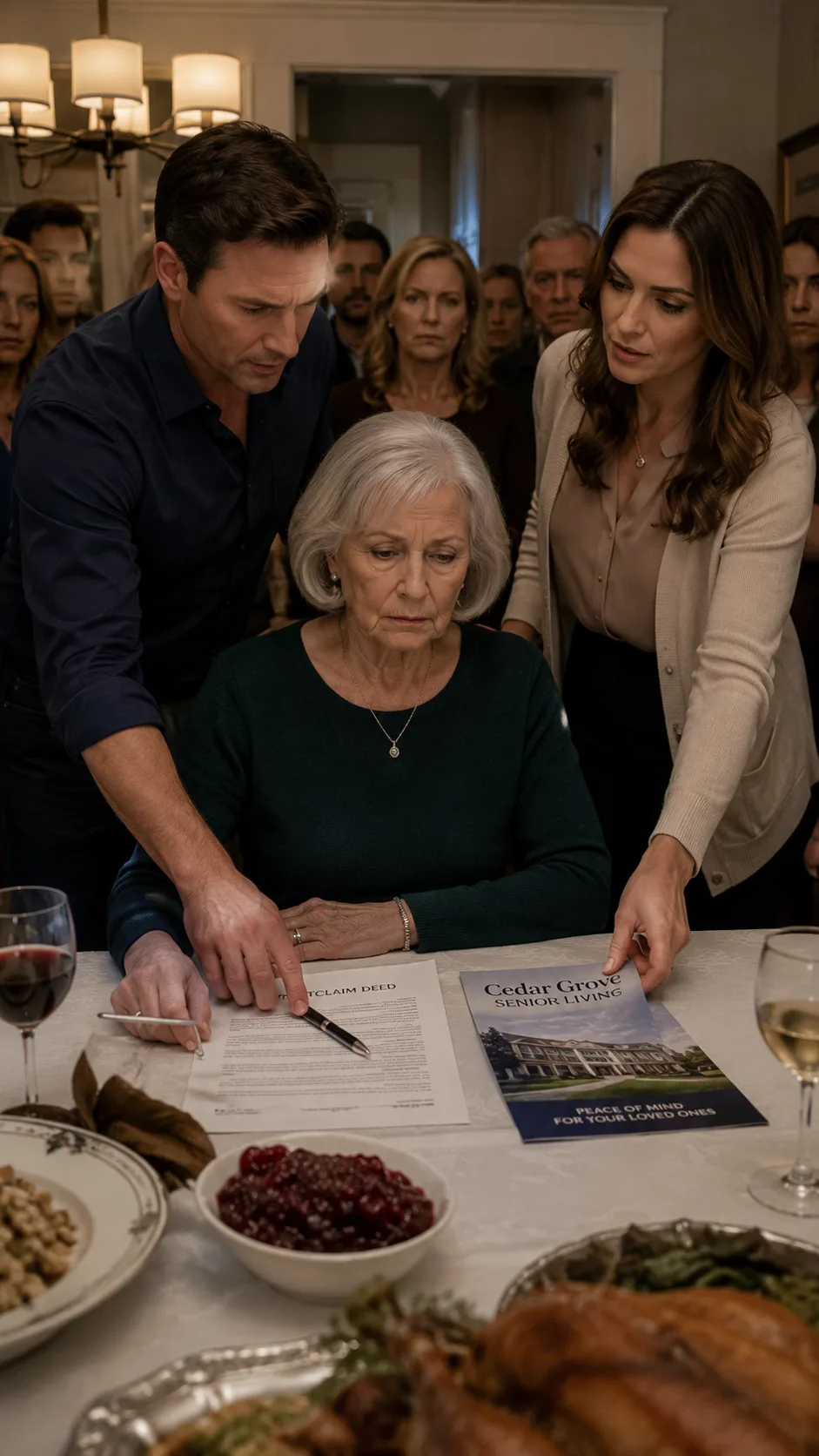
Brooke rose next, dabbing carefully at her eyes. She reached into a tote bag and laid a glossy trifold down on the white tablecloth, turning it so the whole table could read it.
Cedar Grove Senior Living. Smiling strangers playing cards.
“She’s getting confused,” Brooke said gently to the entire room. “We’re only protecting the family home for the children.”
A cousin lifted her phone and started filming, angled right at me. For the memories. For the record.
Thirty faces turned my way, all arranged into that particular softness people wear when they’ve already decided you’re a thing to be pitied.
I set down my fork. I folded my hands in my lap. And I said nothing at all.
Not yet.
Let them finish the play. I wanted every one of them all the way out on the branch before I mentioned, in my ordinary indoor voice, exactly who owned the tree.
Daniel reached for the paper that had been waiting face down by the head of the table. He carried it over to me himself with the pen, like a man bringing his mother a gift.
He set it down beside my plate and crouched low next to my chair so the whole room could see how gentle and loving he was being.
“Just sign this, Mom,” he said, low and kind. “It puts the house in our names, so you don’t have to worry about any of it anymore. We’ll take care of everything. You can finally rest.”
I looked at the paper. A quitclaim deed. Transfer of the property from Holly Forsyth to Daniel and Brooke Forsyth. My name typed neatly on the line, waiting for my hand to make it true.
“For everyone’s peace of mind,” Marlene added from across the table.
The room held its breath.
Thirty people. A camera. A kind son crouched at my chair. A brochure on the tablecloth. Every piece of the play set perfectly in place.
I want you to know exactly how I felt right then.
Not panicked. Not small.
I felt the way you feel when a long, slow ache finally finds its location, and you understand at last precisely where it has been living all this time.
I picked up the pen. I heard Brooke exhale. I saw Daniel’s shoulders drop in relief.
Then I set the pen back down, uncapped beside the paper.
“Before I sign anything,” I said in the most ordinary voice I own, “I believe the caterer needs a signature first. Don’t they, Renata?”
And Renata stepped forward.
Renata crossed the dining room with her clipboard, all business, exactly as I’d asked her to be.
“My apologies for the interruption,” she said to the table, warm and professional. “Company policy. Before we close out an event this size, the property’s owner of record signs our release in person. It clears the damage deposit and signs off the property.”
Daniel stood up.
“That’s me. I booked it.”
“You did call it in,” Renata agreed pleasantly.
She turned a page on the clipboard.
“But the booking flagged a name mismatch with the county property record, so I’ll need the actual owner.”
She read directly off the form, clear enough to carry to the back of the room.
“Owner of record for this address: Ms. Holly Forsyth, sole owner.”
The word sole hung in the air like a struck bell.
A few forks went still. Marlene’s smile froze halfway up her face. The cousin lowered the filming phone an inch, then forgot to raise it again.
“That’s a mistake,” Daniel said, much too loud. “The records are old. It’s basically our—”
I opened my purse. I took out the notarized copy of the deed and laid it on the white tablecloth, right next to the quitclaim they’d brought. Next to the brochure. Next to the good pen.
One page. Crisp county stamp. One single name on the grantee line.
“It isn’t old,” I said quietly, “and it isn’t a mistake.”
Thirty people leaned in to read it.
The whole room had gone very, very still.
I stood up. I didn’t need to, but I wanted to be at eye level with my family when I said it.
I kept my voice low, lower than the room. People had to lean in to hear me.
And they did.
“You told everyone I was hosting Thanksgiving,” I said to Daniel. “You already told everyone. You just forgot to tell the one person it all depended on.”
He started to speak.
I went on, gentle as anything.
“You invited 30 people into my house.”
I let it sit a moment.
“You just forgot to invite the one who owns it.”
Daniel’s face went red, then white.
“After everything we’ve done for you,” he burst out, far too loud now. “We took care of this place. We earned—”
“You lived here rent-free for six years,” I said. “I paid the taxes. I paid the insurance. I never once asked you for a single dollar.”
Brooke was crying now, the kind that performs.
“How can you do this to us at Thanksgiving, in front of everyone?”
I looked at her, and I felt no anger at all. That surprised me more than anything.
“I read the plan, Brooke,” I said. “The one you posted in the family chat by mistake. After the toast, before the wine. She’s getting confused anyway, so it won’t be hard to sell.”
I turned to the table.
“I have a copy. I won’t read you the rest. You all heard plenty of the performance live.”
Silence.
“I’m 68 years old and sharper than this entire table,” I said.
A few people laughed in the nervous kind.
“I am not the confused one in this room.”
No one explodes quite like a person who fully expected to win. Daniel was shaking. I was perfectly calm. That, I think, was the exact moment the room finally understood.
The cousin with the phone slid it back into her pocket. Nobody wanted footage of the confused old woman anymore. Walter’s golf friends were staring at Daniel. One of Brooke’s church friends, invited of course, as a witness to my decline, quietly pushed back her chair.
Marlene tried to climb out of it.
“Now, I never said—I only repeated what Daniel told me.”
“You said I rattle around in too much house, Marlene,” I said. “On the phone, Tuesday night. You had it rehearsed.”
She closed her mouth.
I nodded once toward the doorway.
Estelle had been standing there since 1:00 in a gray coat, holding a single envelope. I’d asked her to come as my guest. She had come as my lawyer.
She walked to Daniel and held the envelope out to him.
“This is a 30-day notice to quit,” Estelle said, calm and clear. “Lawful written notice. You and Brooke have 30 days to vacate the property. It’s all in order.”
Daniel took it because his hand opened before his brain caught up.
“There’s also the small matter of the catering deposit,” Renata added, almost kindly. “$4,500. You signed for the damage liability personally, Mr. Forsyth, when you booked under your own name. That one is yours.”
Thirty days. $4,500.
Numbers you can hold in your hand. Numbers that don’t care how loudly anyone cries at a dinner table.
The play was over. Nobody had to announce it. They could read it plainly on all 30 faces.
I picked up my purse. I left the deed lying on the table for them to read as long as they liked.
I didn’t gloat. There was nothing left in me that wanted to. The ache had found its home and gone quiet.
I bent down to Caleb and Lily, who had watched the whole thing wide-eyed from the end of the table.
“None of this is about you two,” I told them. “I love you both to the moon. I’ll see you very soon, I promise.”
Lily hugged my neck. Caleb, 12 years old and trying so hard to be a man about it, blinked fast and nodded.
I straightened up and spoke to the room, easy and clear.
“The dinner’s all paid for,” I said. “Every bit of it. Please, sit, eat, enjoy yourselves. The turkey’s the best in three counties.”
I let myself smile.
“Marlene will tell you.”
I thanked Renata at the door and squeezed her hand. Fifteen years, and she had handed me back my own room without once raising her voice.
Then I turned to the people still frozen at my table, and I said the last thing I’d come there to say.
“I’m at the cabin until Monday.”
I put on my coat. I walked out my own front door into the cold bright afternoon, got into my car, and drove north toward the lake.
Behind me, 30 people sat at a table I’d paid for, in a house I owned, in a silence I had finally chosen for myself.
I rolled the window down on the highway. The air smelled like the first real snow of the year.
They moved out in 26 days, four days early, I heard, to dodge the formal eviction filing Estelle had ready and waiting. They rented a two-bedroom across town.
Daniel paid the $4,500 himself in three installments because the booking had carried his name on it, and not one single line of it had ever carried mine.
Marlene called me twice in December. The first time to apologize. The second time, when that didn’t get her anywhere, to ask about her share of the house, as though there had ever been one.
I told her there was no share, there was no sale, and there would be no more calls.
I haven’t heard from her since. I find I sleep just fine.
The cousins’ video never went anywhere useful for them, but Brooke’s church friends talk the way people do. Within a month, she had quietly stepped down from the holiday committee she loved. Nobody pushed her out. They simply stopped saving her a seat.
I didn’t put the house up for sale. I didn’t move back into it, either. I had Estelle finish the trust instead.
The house is held now for Caleb and Lily, each to receive it when they turn 25. No one can ever pressure it out of my hands again because there is nothing loose left to sign. It’s locked in the one way I control.
Here’s the part that matters most to me.
I kept the grandchildren. That was the thing I’d been most afraid of losing back at the kitchen table with the cold tea.
I pick them up every other Saturday. Lily finally lost that tooth. Caleb is taller than me now. We make pancakes at the cabin and skip rocks off Walter’s dock, and we don’t talk about that Thanksgiving at all.
Daniel and I speak sometimes, carefully. He has never once said he was sorry, not really. He said he was under a lot of pressure, which is a very different thing wearing sorry’s coat.
I let him keep his version. I don’t need a confession from him. I needed him to learn where the line was.
Now he knows.
The line is bright and it holds.
I still cook Thanksgiving. I want you to know that. I’m not bitter and I never stopped loving my family, but now I cook when I’m asked, not when I’m assigned.
There’s a whole world of difference between those two words, and it took me 68 years to move into it.
Last year, I roasted a turkey at the cabin for six people who all said thank you. Caleb carved it, badly and proudly.
The cabin stayed mine. The house stayed in trust. My name stayed on everything that was ever mine to begin with.
I didn’t stop being family. I stopped being furniture.
If there’s one thing I’d hand you across this table, it’s this.
Kindness without a boundary isn’t love. It’s just a door you forgot to lock.
That’s my story. One text, one quiet no, one name on a deed. If it reminded you that your generosity is yours to give, not theirs to assume, share it with someone who needs to hear it. Comment, subscribe, and I’ll see you next time.
THE END.
Chapter complete
You have reached the end of this chapter.
Continue reading
A few more worlds to get lost in after this chapter.




