PART 2 — THE FAMILY PLAN TO ERASE ME
I set the milk carton down very carefully on the counter.
Chapter 2
PART 2 — THE FAMILY PLAN TO ERASE ME
I set the milk carton down very carefully on the counter.
“Marlene,” I said, “how do you know the dinner’s for 30? I only saw that an hour ago.”
The line went quiet for a beat too long.
“Daniel told me,” she said too fast. “Obviously we talk.”
Of course you do.
We said our goodbyes. I stood in the dark cabin kitchen a long while afterward. The refrigerator humming, the lake black through the window.
Forgetful. Confused. A lot of house for one woman.
She’d used those words like she’d practiced them in the car. Like they were lines in something already written. With my name in the cast list.
I didn’t know the shape of it yet, but I knew the smell. Somewhere, a plan had a script, and my own sister had already memorized her part.
I couldn’t sleep. So I did what I do when Walter feels far away.
I took down his cedar box from the
closet shelf. He kept everything in it. Our wedding photo, the corners gone soft as cloth. The brass key to the very first kitchen I ever rented. A ticket stub from a movie neither of us could ever remember seeing.
The smell of cedar came up like a hand on my shoulder. Under the photographs was the folder.
The deed to the house.
One page, official, a little yellow at the fold.
Grantee: Holly Forsyth.
One name. Mine. Alone.
Walter had put it in my name years ago. For tax reasons we’d long since stopped thinking about. I held it and felt nothing strategic. I wasn’t holding a weapon. I was holding the house where I’d nursed Daniel through chicken pox. Where Walter died in the back bedroom with my hand in his.
I touched the old brass key. I put the deed back under the photographs. I closed the
lid.
I told myself the worst part of this week was a rude text and a sister with a sharp tongue. I made a cup of tea I didn’t drink, and I went to bed.
Outside, the lake was black glass under a half moon. I had a single piece of paper in a cedar box that could end any argument that family could ever start.
I just didn’t know yet that I’d need it.
The call came at 6:00.
My phone rang at 6:02 in the morning. The lake was still gray. I knew before I looked that it was Daniel.
I expected an apology. I want to be honest about that. Some small part of me hoped he’d say, “Mom, I was out of line.”
That is not what I got.
“What did you do?” he said.
No hello. Tight, clipped, almost a hiss.
“Good morning to you,
too,” I said.
“The caterer won’t confirm the booking. They keep asking who owns the house. Why are they asking me that, Mom?”
I sat up slowly and pulled the quilt around my shoulders.
“I haven’t done anything, Daniel.”
“Then why won’t they take my deposit?”
“I don’t know their paperwork,” I said, which was almost true. “Maybe they’re careful about whose property they’re working on.”
“It’s my house,” he snapped.
There it was, out loud at last, said like a fact he’d never once bothered to test.
“Is it?” I said, soft.
Just two words with a hook in them.
A silence. Then faster, louder.
“You know what I mean. Just call them. Tell them it’s fine. Fix this.”
“I’m at the cabin until Monday, Daniel.”
“Mom—”
“You’ll need a caterer,” I said. “I told you that already.”
I hung up.
My hands were perfectly steady. I noticed the steadiness the way you notice the weather. From a little distance, with mild surprise.
He thought the problem was a stubborn vendor. The problem was a question he had never thought to ask in his entire life.
Whose name was on the house?
And the strangest part? I still didn’t fully understand why they were so desperate, so early, with the holidays still more than a week off.
That answer came the very next morning, and it was worse than anything I’d imagined.
I drank my coffee on the dock and thought it through.
Booking a caterer the week before Thanksgiving is close to impossible. Every good kitchen in the county is booked solid by the middle of October. If Daniel had somehow found anyone with an open 30-cover slot this close to the holiday, there was only one firm it could be.
The biggest. The best.
The one whose name I knew better than my own reflection.
That firm has a rule I happen to know cold. For any large private event, the contract has to be signed by the owner of record for the property. Not a guest, not a tenant. The person whose name sits on the deed at the county office. Plus a damage deposit in case 30 people and two turkeys go badly.
It’s a smart rule. It protects the firm from exactly the kind of mess where someone books a lavish party at a house that isn’t theirs.
Daniel had walked straight into that rule. Face first.
He’d given them the address. They’d checked the address against the county record. And the address came back attached to a name that was not his.
He didn’t know the half of why that firm’s paperwork was so particular. He didn’t know that the tired, confused grandmother he kept calling had spent 30 years in that very trade and still knew its rules cold.
But I’m getting ahead of the story. Stay with me.
Because the phone was about to ring a second time. And this time, it would be someone on my side.
The second call came at 8:40. A number I knew by heart.
“Holly, it’s Renata. I’m sorry to bother you on a holiday week.”
Renata Cole runs the firm now. She came up under me years ago. A line cook with steady hands and a stubborn streak I liked the look of. We’ve stayed close ever since.
“You’re never a bother,” I said. “What’s wrong?”
“Probably nothing. A man called yesterday. Daniel Forsyth. He booked a 30-cover Thanksgiving.” A careful pause. “At your address, Holly. Your house.”
I closed my eyes and let it land.
“He gave it as his own,” she went on. “He got irritated when we asked for the owner’s signature, so I held the booking. I wanted to check with you first.”
There was the proof of who Renata was. She could have just taken the money. Instead, she protected my name when I wasn’t even in the room to know it needed protecting.
“Thank you for calling me,” I said.
“Are you all right? He made it sound like you’d lost track of things.”
“I haven’t lost track of anything,” I said. “For the first time in years, I’m seeing it all very clearly.”
She was quiet for a moment.
Then, “I wasn’t about to let a stranger throw a party over your name without asking you first. You taught me that much.”
I almost cried hearing it. Not from sadness, from being finally seen by somebody.
“Hold the booking,” I said. “Don’t confirm a thing. I’ll call you Monday.”
I hung up with a plan beginning to form. I didn’t have all of it yet. The worst piece of it I still hadn’t read.
Brooke texted me directly that afternoon. She almost never did.
“Hi, Mom. I hope the lake is peaceful. When you’re back, can we sit down, just us? I think it’s time we talked about the house. For the kids’ future, we need to eat tacos.”
I read it three times.
The house. Not your house. Not the dinner. The house, like a topic that had been waiting in a folder for me.
Then a second text arrived eight seconds later. A link, no message.
I tapped it.
It opened a glossy webpage.
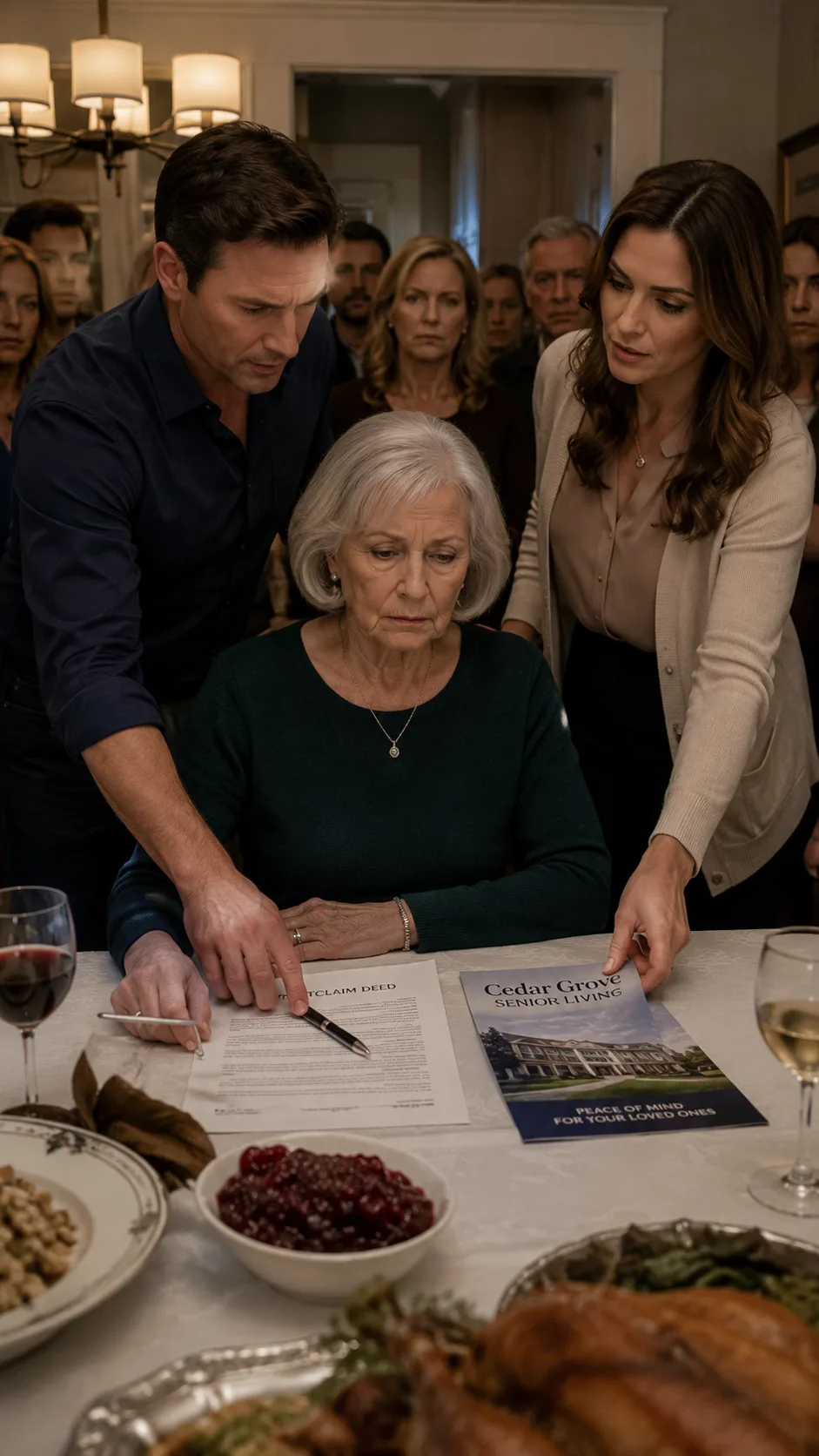
Cedar Grove Senior Living. Gracious Assisted Living for the season of life you’ve earned.
Smiling gray-haired strangers playing cards at a sunny table.
A third text.
“Oops, wrong one, sorry.”
I set the phone face down on the dock railing and watched a heron lift off the water.
Wrong one, of course.
Just like Marlene obviously knew the head count. Just like the whole family had suddenly noticed I was slipping.
The pieces weren’t connected in my head yet, but they were all the same color.
Let me stop here for one second. If you’ve ever gotten a message like that, sweet on the surface with a knife folded inside, you know the exact feeling in your stomach right now. If you do, type “I know that feeling” in the comments. It tells me who I’m really talking to.
Now, let me show you what landed in my phone the very next morning, because that’s where this whole story turns.
It came in at 9:17 the next morning in the big family chat, the one with all 41 people in it. Brooke posted it. I think her thumbs moved faster than her brain.
“Okay, everyone, Mom plan for Thursday. After the toast, before the wine, Marlene opens, gentle, concerned. Then I bring out the Cedar Grove brochure. Keep it loving, keep it sad. She’s getting confused anyway, so it won’t be hard to sell. We’re only protecting the family home. Daniel has the transfer papers ready for her to sign. Don’t let her get cornered into saying no in front of people. She won’t want a scene.”
I read it once. Then I read it again, slower. The way you reread a diagnosis.
Forty-one people, all of them had just seen it.
For about 90 seconds, the message sat there, naked in front of everyone.
Then Brooke again.
“Wait, wrong chat, ignore that, deleting.”
And the message vanished from everyone’s screen.
But not from mine. I’d already pressed the two buttons that take a picture of a screen, twice to be sure.
Saved.
I sat very still at the kitchen table. The lake threw its light across the ceiling. Walter’s old coffee tin sat exactly where it always sat.
They weren’t trying to borrow my house anymore. They were trying to take it. And to take it cleanly, they first had to take me, my name, my mind, my standing in my own family.
The plan was to stand me up in front of 30 witnesses and declare me confused, to slide papers under my hand while everyone watched so that saying no would look like the tantrum of a failing old woman who didn’t know what was good for her.
“She’s getting confused anyway, so it won’t be hard to sell.”
That was the worst of it. Not the rude text. Not the brochure.
It was the casual clerical cruelty of being scheduled for erasure, penciled in like a chore between the toast and the wine.
I didn’t cry. I didn’t call anyone names. I got up and made a pot of tea, and I let it steep the full four minutes.
They didn’t just want my house. They wanted me gone first.
And now I had it. In their own words, saved in two photographs, the script they’d written for me.
I was about to write the ending myself.
Here is what I want you to understand about quiet people. We don’t explode, we clarify.
I didn’t scream into the lake. I didn’t call Daniel and weep down the phone. I poured the tea, I sat, and I let myself feel exactly how much it hurt.
It hurt like a deep bruise you don’t see until something presses on it.
Then I got up and took down the cedar box again. I lifted out the deed, the same single page I’d held two nights before, but I held it differently this time.
Two nights ago, it was a memory. This morning, it was a tool.
One name, mine. Sole owner. No co-signer to argue with, no mortgage to leverage against me. The house was, in the plainest legal sense there is, entirely mine.
For six years, I’d stayed silent about that, terrified of becoming my mother, the kind of woman who waves a deed around like a whip. I had swallowed my own ground just to keep from standing on theirs.
But there’s a difference between using money to control your children and simply refusing to let them take what is yours.
It took me 68 years to learn it. I learned it at a kitchen table with cold tea and a yellowed page in my hand.
I wasn’t going to control anyone. I was just going to stop disappearing.
I photographed the deed, too. Three pictures now lived in my phone. The deed and the two of their plan.
Then I picked up the phone and called the one person who’d known Walter and me for 30 years.
My lawyer answered on the second ring.
Estelle Brandt has been my lawyer and my friend since before either of us had gray hair. She doesn’t waste words. I have always liked that in a person.
I told her everything. The text, the caterer, Marlene’s rehearsed worry, the brochure, the message in the chat. I read it to her word for word off my screenshot.
She was quiet when I finished.
Then, “Holly, you still own the house outright?”
“One name, mine.”
“And they’ve lived there how long? Paying what?”
“Six years. Nothing. No lease, no rent, not a dollar.”
“Then they’re tenants at will,” she said. “No written lease, no fixed term. In this state, you can end that arrangement with proper written notice. Thirty days.”
“Just like that?”
“Just like that. It isn’t dramatic. It isn’t a trick. It’s the oldest, plainest part of property law there is.”
I let out a breath I think I’d been holding since ’97.
“There’s more I can do,” she went on. “We can put the house into a trust. You name the beneficiaries. You set the terms. Then nobody can ever pressure you into signing it away because there’d be nothing loose left to sign. It’s locked in a way that only you control.”
“Caleb and Lily,” I said at once. “The grandchildren.”
“When they’re grown, we can absolutely do that. No secret clauses, no clever ambush, just a notice and a trust. Both of them as ordinary as rain.”
“Estelle,” I said, “how fast can you draw it all up?”
“Come in Monday morning. Bring the deed.”
Monday.
I told them Monday. I always keep my word.
Estelle wanted to handle it the gentle way. I understood why.
“We could mail the notice today,” she said. “Quiet, private, no audience. You never have to sit through that dinner at all.”
It was good advice. It was the advice I would have given to anyone else.
“No,” I said.
“No?”
“They plan to do this in front of 30 people, Estelle. They wanted witnesses. They wanted me cornered and small in a room full of family.”
I looked out at the lake.
“So the truth can come out in that same room. Calmly. In front of those same witnesses.”
“You don’t have to prove anything to those people.”
“I’m not proving anything,” I said. “I’m just going to stop hiding what’s already true.”
She sighed, but I heard the smile inside it.
“You’re going to walk straight into your own ambush.”
“I’m going to keep my word and come for Thanksgiving,” I said. “I’m just going to bring the right paperwork.”
I had one more call to make.
I dialed Renata.
“Confirm the booking,” I told her. “Thirty covers, Thursday. And Renata, I’d like you to run this one yourself. On site. Personally.”
A pause.
“For your family’s dinner?”
“For the dinner at my house,” I said. “I want the owner’s release signed properly, in person, by the owner.”
She understood far more than I’d said out loud.
“I’ll be there at noon,” she said.
I hung up and watched the heron come back to the same flat rock it always chose.
Monday I’d sign. Thursday I’d show up. And I would not raise my voice one single time.
Monday morning, I drove back into town. I kept my word, you see. I’d said the cabin until Monday, and Monday was when I left it.
Estelle’s office smells like old paper and good coffee. I sat across from her for two full hours.
I signed the 30-day notice to quit. We didn’t serve it yet. We dated it, sealed it, and set it aside for Thursday.
I signed the trust documents. The house, every brick of it, would be held for Caleb and Lily until each of them turned 25. I could live in it, rent it, or leave it shuttered as I pleased for the rest of my natural life. After me, it passed straight to the children.
No one could buy it, beg it, or trick it out of my hands. There was simply nothing left to corner me into signing.
Estelle had a notarized copy of the deed made up for me. Crisp, stamped, official. I folded it once and slid it into my purse alongside the sealed notice and a printout of those two screenshots.
Then I texted the family chat, sweet as pie.
“Looking forward to Thursday, everyone. Save me a seat.”
Daniel replied inside a minute.
“So glad you came around, Mom.”
I almost laughed out loud.
He thought I’d folded. He thought a sweet text meant surrender. They were probably congratulating each other right then in some other little chat I couldn’t see.
I let them think it. A quiet woman knows the exact value of a closed mouth.
I had four days. The deed was in my purse. The cedar box stayed home, but its one page came with me everywhere now.
I promised I’d tell you who I really am. Now is the time.
Forty years ago, I was a young widow’s daughter with $80 and a recipe box. I rented a dead restaurant’s kitchen by the hour and cooked for other people’s weddings. I scrubbed my own pans. I drove my own van. I undercharged for years because I didn’t quite believe my work was worth more.
It was worth more.
I built a catering and events company out of that one rented kitchen. I named it after the cardinal that nested outside the first window.
Cardinal Table.
Thirty years of 18-hour days, and it became the firm in our county. The one you booked if you wanted it done right.
Yes, that firm.
The one Daniel had called in a panic. The one Renata runs. The one whose careful paperwork had quietly snagged the whole scheme before it ever reached the table.
I built it from nothing, and my name is still on the door. I catered the mayor’s daughter’s wedding, the hospital galas, the country club’s 50th anniversary. Half the people who’d be sitting at that Thanksgiving table had eaten food I planned, off china I chose, served by staff I personally trained.
I sold off my day-to-day role five years ago and handed the kitchen to Renata, but the rules are still the ones I wrote.
My family saw a tired grandmother who liked her quiet little cabin. They forgot, or they never bothered to learn, that I’d set the tables this whole county learned to copy.
That’s the thing about being underestimated. It’s quiet and it’s lonely, and it is the single most useful disguise a woman can ever put on.
Thursday, I was going to take the disguise off, at my own table, in front of everyone. I just had to survive three more days of being told how confused I was.
To be continued… Click “PART 3” to read the final part: 👉 PART 3 👈
Chapter complete
You have reached the end of this chapter.
Continue reading
A few more worlds to get lost in after this chapter.




