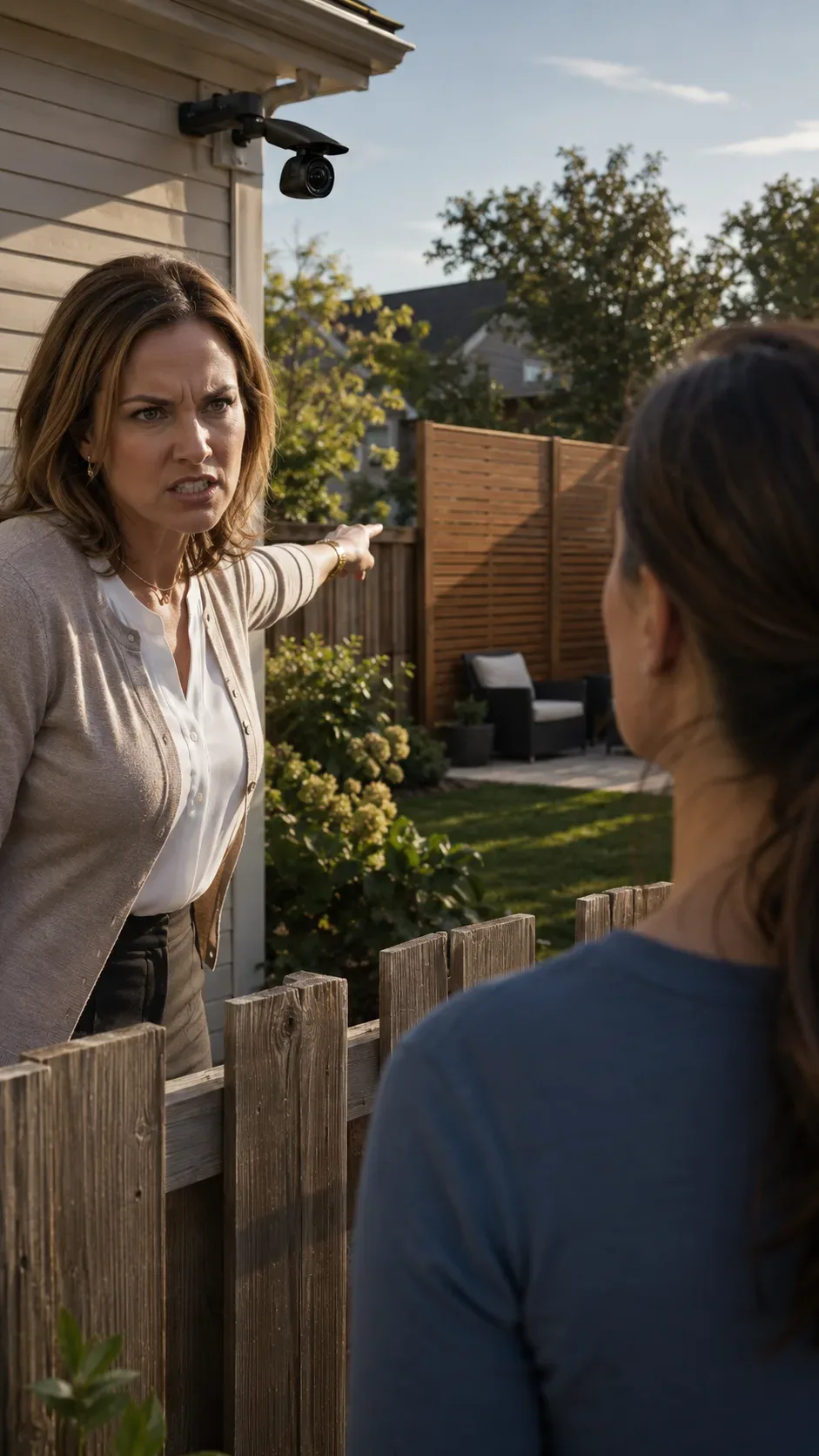
Melissa stared at me as if I had just confessed to doing something wrong.
Chapter 3
Melissa stared at me as if I had just confessed to doing something wrong.
“My camera covers the side of my property too,” she said.
“Then reposition it so it covers your property.”
“You're creating a blind spot.”
“For my backyard.”
“For the area near our fence.”
I looked at her for several seconds.
“If your security system requires a clear view of my patio, you need a different security system.”
Her expression changed instantly.
The controlled irritation disappeared.
Now she was genuinely angry.
“You don't get to decide what I need for security.”
“I get to decide whether you can see into my backyard.”
“You're twisting this.”
“No, Melissa. I'm repeating exactly what you just told me.”
She opened her mouth, then stopped.
For one second, I thought she might finally realize how ridiculous the argument sounded.
Instead she said:
“We'll see what the HOA thinks.”
Then she turned and walked away.
I closed the door.
I wasn't especially worried.
The screen had
been measured and installed specifically to comply with the community requirements.
But I also knew that HOA complaints had a way of becoming exhausting even when you were technically right.
So that afternoon I pulled out everything I'd collected.
Photographs.
Measurements.
Screenshots.
Dates.
The message about Charlie being outside for thirty-eight minutes.
The message about the gate.
The landscaper.
The blue Honda.
Her response when I asked why she was monitoring my visitors.
“Security benefits everyone.”
I printed copies.
I also took several new photographs showing the screen from different angles.
One photograph showed clearly that the screen stood entirely inside my property.
Another showed Melissa's camera above the fence line.
A third demonstrated exactly what the camera had been able to see before the screen went up.
Two days later, the HOA email arrived.
Melissa had formally complained.
Her description was careful.
She didn't write:
My neighbor put up
a screen so I can't see her patio anymore.
Instead, she described the screen as an “unauthorized visual obstruction affecting shared boundary security.”
I read that sentence three times.
Shared boundary security.
It sounded impressive.
Official.
Almost reasonable.
If you didn't know what had actually happened.
The complaint requested that the HOA require me to remove or relocate the screen.
I responded with the photographs, measurements, and relevant section of the community guidelines.
Then I attached screenshots of Melissa's messages.
I kept my response factual.
I explained that the screen had been installed after repeated concerns about a neighboring security camera facing toward my patio and side entrance.
I included the conversation where I had previously asked Melissa to redirect the camera.
I included her comment:
“What are you doing back there that you're so worried about?”
And I included the messages where she commented on who visited, when people
arrived, and how long my dog had been outside.
I didn't write that Melissa was stalking me.
I didn't need to.
The messages spoke for themselves.
For the next week, she barely acknowledged me.
If we were outside at the same time, she looked away.
The camera remained where it was, but the privacy screen blocked most of its view into my patio.
I noticed something else.
The texts stopped.
No dog reports.
No gate updates.
No commentary about cars.
That alone told me the screen was working.
Then the HOA scheduled a meeting.
Melissa attended.
So did I.
I brought a folder containing everything I'd submitted electronically.
There were several board members at the table.
The atmosphere wasn't dramatic.
No courtroom.
No lawyers.
No shouting.
Just neighbors sitting in a community meeting room under fluorescent lights discussing fences, landscaping, parking, and eventually, us.
When our item came up, Melissa spoke first.
She was calm.
Much calmer than she'd been at my door.
She described herself as a concerned homeowner who had invested in security after crime in the surrounding area.
She said her cameras were intended to “protect the general perimeter.”
Then she smiled slightly and added:
“I've always tried to be a watchful neighbor.”
One board member asked:
“Did your neighbor ask you to adjust the camera before installing the screen?”
Melissa paused.
“She mentioned the angle.”
“That wasn't my question.”
Another pause.
“Yes.”
“And did you adjust it?”
“It already covered my property.”
I felt myself getting tense, but I stayed quiet.
The board member turned to me.
I explained what had happened.
The comments about my guests.
The dog.
The landscaper.
The car.
The camera tracking movement while I sat on my patio.
I didn't exaggerate anything.
I didn't need to.
Then I handed over printed screenshots.
A second board member looked through them.
His expression changed slightly when he reached the blue Honda message.
“Who is the blue Honda parked at your house?” he read aloud.
Melissa shifted in her chair.
“I was being neighborly.”
The board member looked up.
“Why did you need to know who the car belonged to?”
“It was unfamiliar.”
“It was parked on her property?”
“Yes.”
“Was it blocking your driveway?”
“No.”
“Was it parked illegally?”
“No.”
Melissa exhaled.
“I don't understand why this is being turned into something sinister.”
Nobody answered immediately.
The meeting continued.
Measurements were reviewed.
Photographs were passed around.
The board confirmed that the screen itself appeared to meet the stated placement and height requirements.
Melissa interrupted.
“But it blocks a section of my camera.”
That was when one board member leaned forward.
He had been mostly quiet until then.
“Ms. Melissa, I want to make sure I understand your complaint.”
She nodded.
“The screen is on her property?”
“Yes, but—”
“And it doesn't physically interfere with your camera?”
“No.”
“It doesn't touch your fence or your house?”
“No.”
“So when you say it blocks your camera, you mean it blocks the camera's view?”
“Yes.”
“Of what?”
Melissa hesitated.
“The side area.”
“Your side area?”
“Both sides, really. The area around the boundary.”
The board member looked at one of the photographs.
Then back at Melissa.
“Why did you object specifically because the screen blocked your camera?”
Melissa crossed her arms.
“Because now I can't see what happens on that side.”
The room became very quiet.
Not dramatically quiet.
Worse.
The kind of silence where everyone has heard exactly what someone just said and nobody wants to rescue them from it.
The board member looked at Melissa.
Then at the photograph.
Then at me.
Finally, he said:
“On her side.”
Melissa blinked.
“I mean the area along the fence.”
“On her side of the fence.”
“It's part of the security perimeter.”
“Your security perimeter extends into her patio?”
“No, that's not what I'm saying.”
But it was.
And everyone in the room knew it.
Melissa started explaining faster.
She talked about motion detection.
Wide-angle lenses.
Shared visibility.
Neighborhood safety.
Blind spots.
Each explanation seemed to make the original problem clearer rather than less clear.
Another board member asked:
“Have you been using the camera to identify visitors at her home?”
“No.”
I slid the screenshot of the blue Honda message across the table.
Nobody said anything.
Melissa looked at it.
Her face changed.
Just slightly.
Then she said:
“I noticed the car.”
“How?”
No answer.
The board member looked at the photograph of the camera again.
I could almost see the moment the entire dispute changed.
This was no longer about whether my screen was aesthetically acceptable.
It was about why Melissa had been so determined to maintain visibility into my property in the first place.
The chairperson gathered the documents.
“We'll review the complaint against the applicable community requirements and notify both homeowners of the decision.”
Melissa immediately started to speak.
“But—”
The chairperson raised a hand.
“We have enough information.”
That was it.
No dramatic verdict.
No applause.
No instant victory.
Just paperwork being collected.
Chairs moving.
The next agenda item waiting.
I stood and gathered my folder.
Melissa did the same.
Outside the meeting room, she caught up with me.
“You made me look like some kind of creep.”
I turned around.
“I submitted your messages.”
“You took them out of context.”
“What context makes asking who visits my house normal?”
She stared at me.
I waited.
She had no answer.
For once, neither did I need one.
I walked toward my car knowing the complaint was now completely out of our hands.
And Melissa had just said more in that meeting than I ever could have said for her.
Click the blue “PART 4” below to read the final part: 👉 PART 4 👈
Chapter complete
You have reached the end of this chapter.
Continue reading
A few more worlds to get lost in after this chapter.




