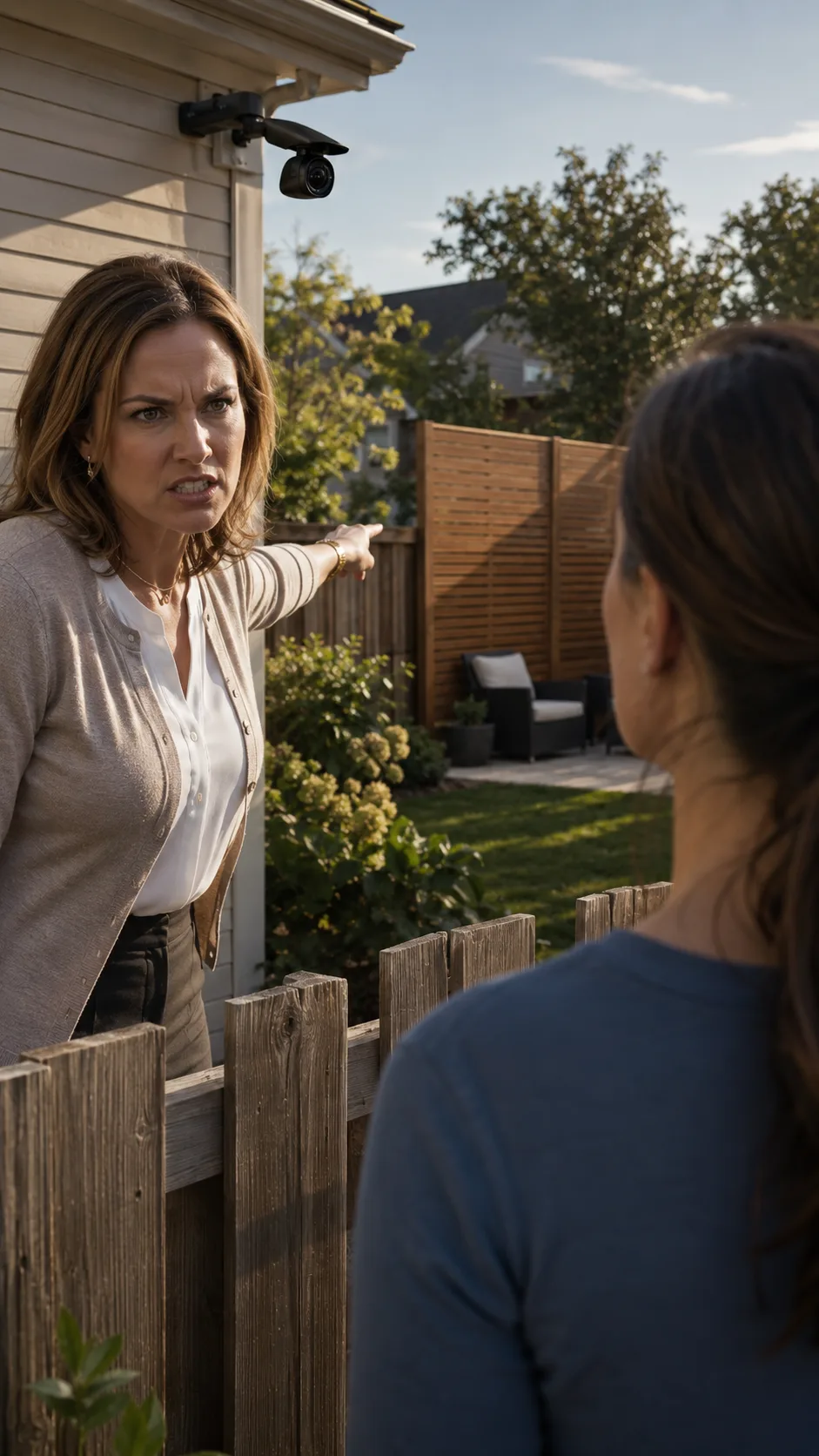
I walked away because I knew that if I stayed at the fence for another minute, the conversation would turn into exactly the kind of argument Melissa could later describe however she wanted.
Chapter 2
I walked away because I knew that if I stayed at the fence for another minute, the conversation would turn into exactly the kind of argument Melissa could later describe however she wanted.
She had already called me paranoid.
I didn't need to give her anything else.
So instead of arguing, I started documenting.
Not dramatically.
Not obsessively.
Just carefully.
I took photographs from my patio showing where the camera was mounted on the corner of Melissa's house. I photographed the angle from different points in my yard. I stood beside my side entrance and took another picture showing how clearly the camera could see that area.
Then I waited.
The next time I sat outside with my coffee, I paid attention.
The camera rotated.
A small mechanical movement.
Almost silent.
But visible.
When I moved across the patio, it moved again.
I wrote down the date and time.
That evening I looked through our HOA rules.
I wasn't trying to become an amateur attorney overnight. I didn't know exactly what privacy law might apply, and I had no interest in pretending that
I did.
What I did know was simpler.
My backyard was mine.
Melissa's security system was supposed to secure her property.
If there was a legitimate reason for her camera to point directly toward my patio, someone besides Melissa could explain it to me.
So I sent a short request to the HOA asking for guidance.
No accusations.
No threats.
Just a description of the camera placement and a question about whether security cameras were expected to be positioned primarily toward the owner's own property.
Then I tried to move on.
Melissa didn't.
Two days later, I got a text from her at 7:14 in the evening.
“Your dog has been outside for 38 minutes.”
I stared at the message.
My dog, Charlie, was lying in the grass under the maple tree, perfectly happy.
I typed:
“He likes being outside.”
Three dots appeared immediately.
Then disappeared.
Then appeared again.
Finally:
“Just thought you should know.”
I didn't answer.
The next afternoon:
“Someone left your side gate open.”
I checked.
The gate was open maybe six inches because I'd been bringing bags of soil into the backyard.
Another message arrived before I could even close it.
“That's dangerous with the dog.”
I closed the gate and put my phone down.
A few days later:
“Your landscaper arrived early today.”
I read that one twice.
There was nothing threatening about the words themselves.
That was what made them unsettling.
Melissa never said:
I'm watching you.
She didn't have to.
Every message communicated the same thing.
I see your yard.
I see who comes into it.
I notice when they arrive.
I notice how long they stay.
After that, I started looking at my phone differently whenever her name appeared.
The messages weren't conversations.
They were reports.
One Thursday evening, two friends came
over for dinner.
We stayed inside most of the night, but around ten we stepped onto the patio for ten minutes.
The next morning Melissa waved at me from her driveway.
“Late night?”
I didn't respond.
She smiled as if we shared some private joke.
By Saturday, I was exhausted by the constant feeling of being observed.
That afternoon, a friend of mine stopped by in a blue Honda.
He stayed for less than an hour.
At 2:23 p.m., my phone buzzed.
Melissa.
“Who is the blue Honda parked at your house?”
I felt something cold settle in my stomach.
This wasn't about a dog.
It wasn't about an open gate.
It wasn't about neighborhood security.
She wanted to know who was visiting me.
I typed carefully.
“Why are you monitoring who visits me?”
I expected her to deny it.
I expected some explanation about seeing the car while taking out the trash or walking to her mailbox.
Her response came almost immediately.
“Security benefits everyone.”
I stared at those three words.
Security benefits everyone.
As if the question had been unreasonable.
As if observing my guests was some kind of public service.
I didn't answer.
Instead, I took screenshots of the entire exchange.
Then I scrolled upward through our conversation.
There were more messages than I'd realized.
The dog.
The landscaper.
The side gate.
The car.
Comments about visitors.
Little observations that had seemed individually irritating but together looked completely different.
I saved all of them.
That evening, I made a decision.
If Melissa wouldn't point her camera away from my patio, I would make the patio impossible for her camera to see.
I had already checked the community rules.
A freestanding privacy screen was permitted as long as it stayed within certain height and placement requirements.
So I measured carefully.
Twice.
The screen wasn't attached to the shared fence.
It didn't cross the property line.
It didn't block a sidewalk, drainage area, or access point.
It stood entirely inside my yard.
By sunset, it was finished.
Tall wooden slats covered the section of patio most visible from Melissa's house.
Nothing aggressive.
Nothing pointed at her property.
No signs.
No messages.
No retaliation.
Just privacy.
For the first time in weeks, I sat down on my patio and couldn't see the camera lens.
I hadn't realized how much tension I'd been carrying until that moment.
I drank a cup of tea outside.
Charlie slept beside my chair.
Nobody texted me to tell me how long he'd been there.
It felt normal.
The next morning, someone knocked hard on my front door.
Not a friendly knock.
Three fast hits.
Then two more.
I looked through the window.
Melissa.
She was standing on my porch with her arms crossed.
I opened the door but stayed inside.
“Morning.”
Her expression made it clear she wasn't there to exchange pleasantries.
“You need to take that down.”
I knew exactly what she meant.
Still, I asked:
“Take what down?”
“The screen.”
She pointed toward the side of my house.
“The privacy screen?”
“Yes.”
“Why?”
Her jaw tightened.
“It's blocking my camera.”
For a second, neither of us said anything.
I honestly wasn't sure I'd heard her correctly.
Not because the words were unclear.
Because I couldn't believe she had said them out loud.
I looked at her.
“You're upset because my privacy screen is blocking your camera?”
“My camera covers the side of my property.”
“Then point it at your property.”
“That's not how the system works.”
I almost laughed.
Not because it was funny.
Because the conversation had become absurd.
“Melissa, the screen is entirely inside my yard.”
“You're creating a problem.”
“For who?”
“For the security system.”
I leaned slightly against the doorframe.
“Your security system shouldn't need an unobstructed view of my patio.”
Her eyes narrowed.
“You're making this much more dramatic than it needs to be.”
I felt something shift inside me.
For weeks, every conversation had followed the same pattern.
Melissa observed something private.
I objected.
Melissa acted as though my objection was the strange part.
The camera wasn't the problem.
My concern about the camera was the problem.
The messages weren't intrusive.
My reaction to them was paranoid.
Now my privacy screen wasn't simply blocking her view.
According to Melissa, I was creating a security problem.
I glanced past her toward the side yard.
From where we stood, I could see the upper corner of her house.
And the camera.
Its lens was partly hidden now behind the new screen.
Exactly as intended.
Melissa followed my gaze.
“You see?” she said. “I can't see that whole area anymore.”
I looked back at her.
“That's the point.”
Her face hardened.
And for the first time, I realized Melissa wasn't embarrassed by what she'd admitted.
She was angry that I had stopped her.
Click the blue “PART 3” below to read the next part: 👉 PART 3 👈
Chapter complete
You have reached the end of this chapter.
Continue reading
A few more worlds to get lost in after this chapter.




