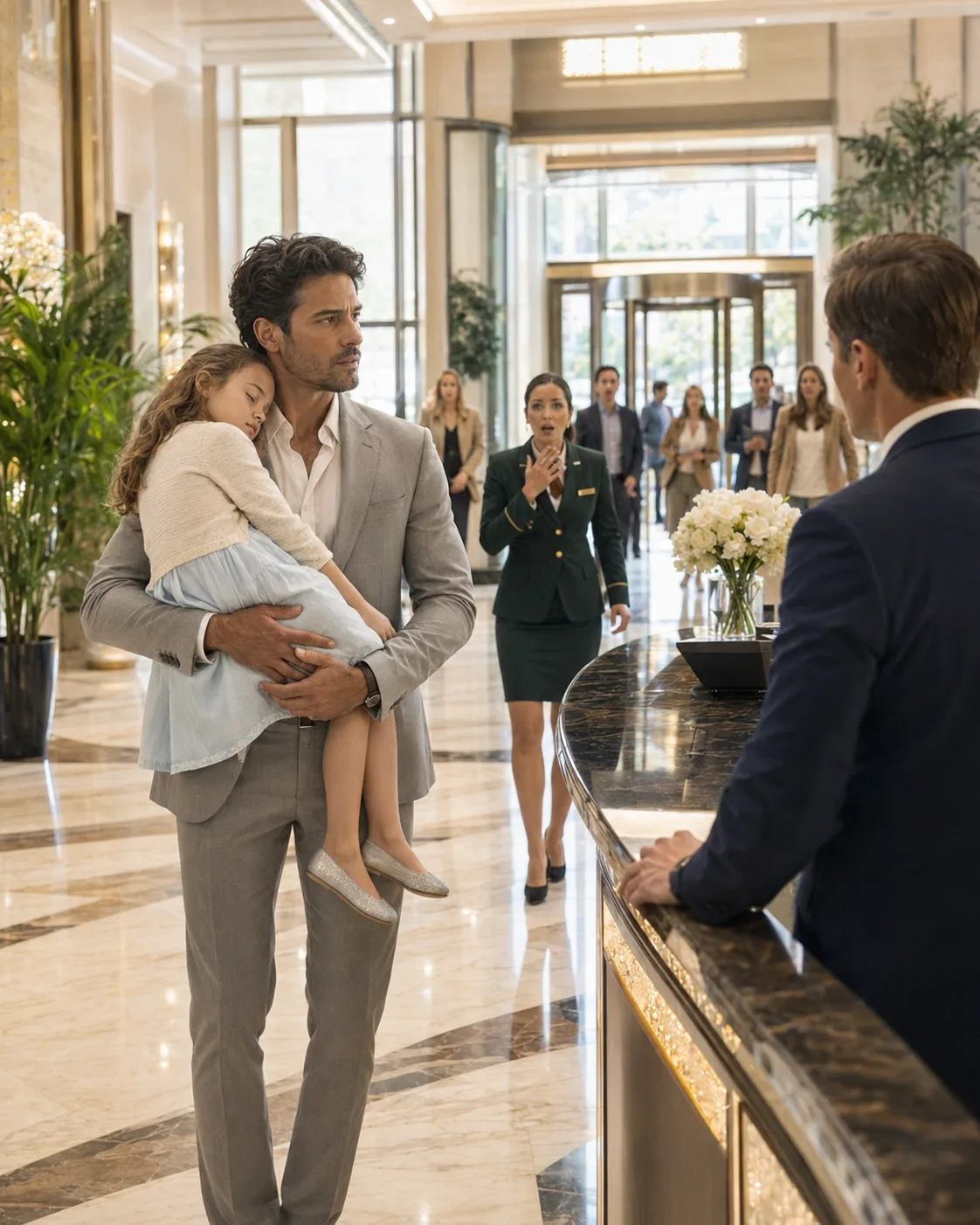
He was denied a room in his own hotel while carrying his sleeping daughter and then the lobby learned his name
Richard lifted his chin.
Chapter 1
Richard lifted his chin.
“Given the hour, the condition of the lobby, and the comfort of our registered guests, I think it would be best if you sought accommodation elsewhere.”
Zoe’s breathing changed against Marcus’s neck. She was not fully awake yet, but she was close.
Marcus lowered his voice. “My daughter is exhausted. I have a valid credit card. I asked for a room. I have not raised my voice. I have not threatened anyone. I have not disturbed your guests.”
Richard smiled without warmth. “Sir, you are disturbing them now.”
The words floated out into the lobby.
This time, everyone heard them.
Marcus looked over Richard’s shoulder at the marble floor, the gold lamps, the winter orchids, the staff uniforms, the place he had built from a dream his father never got to enjoy. He thought of Calvin Johnson standing outside hotel ballrooms at 2 a.m. while drunk guests called him buddy
and tossed him car keys like he was invisible unless useful.
Marcus had promised himself he would build something different.
He had believed he had.
“I’d like your full name and position,” Marcus said.
Richard blinked. “Excuse me?”
“For the record.”
Derek shifted behind the desk.
Richard gave a short laugh. “My name is on my badge.”
“Say it.”
The lobby seemed to hold its breath.
Richard’s face flushed. “Richard Bennett. General Manager.”
Marcus nodded once. “Thank you.”
Then he walked away from the desk.
Not toward the exit.
Toward the seating area beneath the largest chandelier in the lobby.
He sat in a deep blue armchair, settled Zoe carefully beside him, and pulled his phone from his pocket.
Richard watched him.
Derek watched him.
Maya watched him.
Marcus did not call anyone yet.
Not because he was unsure what to do.
Because he needed to know whether what he
had seen was an incident or a culture.
There was a difference.
An incident could be corrected. A culture had to be dug out by the roots.
Zoe opened her eyes.
She looked around the lobby with slow confusion. Then she looked at Marcus.
“Daddy, why are we sitting here?”
He brushed a curl from her forehead. “We’re waiting for a minute.”
“For the room?”
“Maybe.”
She hugged Captain to her chest. “I’m tired.”
“I know, Zo.”
Across the lobby, Richard spoke quietly to Derek. Then he looked toward the far end of the room, where two security guards stood near the entrance to the private elevators.
Marcus saw the nod.
He had seen enough.
Part 2
The two security guards crossed the lobby like men who had been told the story before they entered it.
One was broad and older, with a shaved head and tired eyes. His name
tag read Paul. The other was younger, taller, and eager in a way Marcus disliked immediately. His name was Travis.
They stopped near Marcus’s chair, one on either side, close enough to make their purpose clear.
Zoe sat up straighter.
Her eyes moved from Paul to Travis to Richard, who had followed them across the lobby with his hands clasped in front of him like a man trying to keep the situation elegant while making it ugly.
“Sir,” Richard said, voice low but perfectly audible, “we’ve given you time. You were informed that we cannot accommodate you tonight. This is a private establishment, and you need to leave.”
Marcus looked up at him. “I’m sitting quietly with my daughter.”
“You were asked to leave.”
“You denied me service after providing service to walk-in guests who arrived after me.”
Richard’s jaw tightened. “I won’t debate this in the lobby.”
“That’s convenient.”
A phone appeared in the hand of a woman near the fireplace. Another guest, a college-aged man in a Columbia sweatshirt, angled his phone from his lap. The bartender stopped polishing the glass.
Maya stood at the concierge desk, pale and motionless.
Richard noticed the phones. His face tightened again.
That was when Marcus understood the man completely.
Richard was not embarrassed by what he had done. He was embarrassed that it might be seen.
“Please escort him out,” Richard said.
Zoe turned sharply toward her father.
“Daddy?”
Marcus stood slowly, keeping one hand on Zoe’s shoulder.
“It’s okay,” he told her.
But it was not okay.
Children know the difference.
Zoe looked at Richard. She was small in her rumpled travel sweatshirt and leggings, curls flattened from sleep, Captain clutched under one arm. Her eyes were wide, not frightened exactly, but wounded by confusion.
“Why are you making us leave?” she asked.
The question did not sound dramatic.
It sounded worse.
It sounded honest.
Richard did not answer her.
Zoe looked around the lobby, trying to solve the adult puzzle in front of her. “We didn’t break anything.”
“No,” Marcus said softly. “We didn’t.”
“We didn’t yell.”
“No.”
“We just asked for a room.”
Marcus looked down at her. “Yes.”
Zoe turned back to Richard. “Isn’t your job to help people?”
The question landed harder than any accusation could have.
Paul, the older guard, looked away.
Travis shifted impatiently. “Sir, we need to move.”
Marcus did not move.
He looked at Richard and said, “I want you to say clearly, in front of everyone, why we are being removed.”
Richard’s face darkened. “Because you are refusing to leave after being denied service.”
“Why was I denied service?”
“Because we had concerns.”
“What concerns?”
Derek called from behind the desk, too quickly, “Sir, please don’t make this harder than it has to be.”
Marcus turned his head. “Hard for whom?”
Derek went silent.
Richard stepped closer. “Enough.”
Zoe’s hand found Marcus’s fingers.
He felt her trembling.
That ended the test.
Marcus pulled out his phone and called Thomas Webb.
Thomas was not just the CEO of Johnson Hospitality Group. He was the first executive Marcus had hired when the company had grown too large for him to manage alone. Sixty-two years old, silver-haired, ruthless with budgets, tender with staff who earned his trust, and one of the few people alive who had known Marcus before the magazine covers and private equity offers.
He answered on the second ring.
“Marcus?”
“I’m in the Grand Meridian lobby,” Marcus said.
Thomas’s voice changed. “Are you all right?”
“I’m with Zoe. We were denied a room. A walk-in couple was checked in after us. The manager is having security remove us.”
Silence.
Then Thomas said, very quietly, “Who is the manager?”
“Richard Bennett.”
Another silence. Shorter. More dangerous.
“I’m upstairs in the executive residence for tomorrow’s board prep,” Thomas said. “Do not leave that lobby.”
“I wasn’t planning to.”
“I’ll be down in one minute.”
Marcus ended the call.
Richard watched him with irritation sharpened by uncertainty. “Sir, calling someone won’t change the fact that you need to leave.”
Marcus put the phone back in his pocket. “It already did.”
“Excuse me?”
Marcus looked down at Zoe. “We’re not going anywhere tonight.”
Zoe blinked. “We’re staying?”
“Yes, baby.”
Richard took one step forward. “I am telling you for the last time—”
The elevator chimed.
It was not loud. It was the same soft chime the lobby had heard all night.
But this time, every head turned.
The executive elevator doors opened.
Thomas Webb stepped out first, still adjusting the cuff of his shirt beneath a dark suit jacket. Behind him came Angela Pierce, Chief People Officer, her hair pulled back, tablet in hand, expression grim. Beside her was Eli Grant, general counsel, wearing the face of a lawyer who already knew this would become evidence.
Thomas crossed the lobby without looking left or right.
He walked straight to Marcus.
When he stopped in front of him, Thomas’s face carried something that looked almost like grief.
“Mr. Johnson,” Thomas said, voice clear enough to reach every corner of the lobby. “I am deeply sorry you and Miss Zoe were kept waiting.”
The room went silent one sound at a time.
Derek’s hands slid off the keyboard.
Richard’s mouth parted slightly.
Travis, the younger guard, looked from Thomas to Marcus to Richard with dawning panic.
Zoe tugged Marcus’s hand. “Daddy, who is that?”
Marcus kept his eyes on Richard. “That’s Mr. Webb. He works with me.”
Thomas turned to face the staff.
“This is Marcus Johnson,” he said. “Founder and sole owner of Johnson Hospitality Group. This hotel belongs to him.”
Nobody breathed.
Not in the way people say nobody breathed when they mean the room got dramatic.
Literally, for one strange second, the entire lobby seemed to forget how.
The woman by the fireplace lowered her phone. The bartender stared. The man from Columbia whispered, “Oh my God,” and then covered his mouth.
Derek had gone gray.
Richard did not move.
Thomas continued, his voice level. “He owns the Grand Meridian. He owns this brand. And tonight, carrying his sleeping daughter, he was told he did not belong in his own lobby.”
Richard finally found words. “Mr. Johnson, I had no idea who you were.”
Marcus looked at him.
“I know,” he said. “That is the point.”
Richard swallowed. “Had I known—”
“That is also the point.”
The sentence cut through the room.
Marcus stepped forward, not quickly, not angrily, but with the steady weight of a man who had spent his life learning that anger burns too fast when the work requires fire that lasts.
“You didn’t need to know my name to treat me with dignity,” Marcus said. “You didn’t need to know my bank account, my title, my ownership stake, or my history. You didn’t need to know anything except that I was a father with a tired child asking for a room.”
Richard’s eyes flickered toward Zoe.
Marcus’s voice hardened for the first time.
“Do not look at her now like you suddenly see a child. She was a child when I walked in.”
Richard looked away.
Marcus turned to Derek. “And you.”
Derek straightened as if a string had been pulled through his spine.
“You told me there were no rooms.”
Derek’s lips trembled. “I thought—”
“You thought what?”
Derek said nothing.
Marcus waited.
The waiting was worse than shouting.
Derek’s eyes filled, but whether with shame or fear, Marcus could not tell.
“I made an assumption,” Derek whispered.
“Yes,” Marcus said. “You did.”
He turned back to Richard.
“You backed that assumption with authority. Then you called security when I asked you to explain it. That is not hospitality. That is not leadership. That is not a mistake made under pressure. That is a failure of character in a position where character is the job.”
Richard stiffened. “Mr. Johnson, with respect, I have run this property successfully for five years.”
“Successfully for whom?”
Richard had no answer.
Marcus looked around the lobby. “There are people in this room who saw exactly what happened. Some recorded. Some stayed silent. Some wanted to speak and didn’t know how. I understand all of that. But let’s be clear about something tonight. Silence protects the wrong person when nobody names the harm.”
Maya’s eyes filled at the concierge desk.
Marcus saw it.
But he was not done.
He faced Richard again.
“My father worked hotel security for twenty-two years. He opened doors for men who would not look him in the eye. He stood in lobbies like this one and protected guests who complained when he used the same restroom. He came home every morning tired in a way sleep could not fix.”
The lobby seemed to shrink around his voice.
“I built this company because I believed a hotel could be more than a building where wealthy people feel comfortable. I believed it could be a place where dignity was not reserved for people who arrived wearing proof of it.”
Zoe leaned into his side.
Marcus rested a hand on her shoulder.
“And tonight,” he said, “my daughter watched grown men decide her father looked like a problem before he ever became one.”
Richard’s composure cracked. “I apologize.”
Marcus studied him.
“Do you?”
“Yes. Of course.”
“You apologize because I own the hotel.”
Richard’s silence answered.
Marcus nodded once.
“Richard Bennett, you are terminated effective immediately.”
A small sound moved through the room.
Richard’s face changed from fear to humiliation to anger before settling into something empty.
Thomas turned to Angela. “Please escort Mr. Bennett to collect his personal belongings. Access removed now.”
Angela nodded. “Already in progress.”
Richard looked at her. Then Thomas. Then Marcus.
“You’re firing me in the lobby?”
Marcus’s face did not change. “You removed me in the lobby.”
Richard flinched as if the words had struck him physically.
For a moment, Marcus thought he might argue. But Richard looked around and saw the phones, the faces, the witnesses, the staff he had ruled through fear. Whatever defense he had left abandoned him.
He adjusted his jacket.
It was a small, sad gesture, a man trying to keep one piece of dignity after spending the night denying it to someone else.
Then he followed Angela toward the back office.
Derek remained behind the desk, breathing hard.
Marcus walked toward him.
Derek looked young now. Younger than before. His polished confidence had collapsed into something raw.
“Please,” Derek said quietly. “I need this job.”
Marcus stopped at the counter.
“So did Maya,” he said. “So did Paul. So did every housekeeper upstairs, every cook in the kitchen, every bellman standing outside in the rain. Needing a job is not an excuse to use it to make someone feel small.”
Derek wiped his face quickly. “I’m sorry.”
Marcus looked at him for a long moment.
He thought of his own first job, bussing tables at a steakhouse in Charlotte where a manager once told him to use the service entrance even when he came in as a customer on his day off. He thought of all the young people who learned cruelty because someone rewarded it as professionalism.
“You are suspended pending review,” Marcus said. “Not fired tonight.”
Derek’s head snapped up.
Marcus held his gaze. “But understand me. This is not mercy because you cried. This is accountability because I think you may still be teachable. You will go through retraining. Not customer service scripts. Not brand language. Values. Bias. Power. Dignity. If you return to this desk, it will be because you understand the work differently.”
Derek nodded, tears slipping now. “Yes, sir.”
“And you will write a letter.”
“To you?”
Marcus shook his head. “To yourself. About what you saw when I walked in, what you decided, and what it cost someone else before it cost you.”
Derek could barely speak. “Yes, sir.”
Marcus turned toward the security guards.
Travis looked terrified.
Paul looked ashamed.
Marcus faced Paul first. “You were uncomfortable.”
Paul swallowed. “Yes, sir.”
“Why didn’t you say anything?”
Paul looked down. “Because I thought I’d lose my job.”
Marcus nodded. “That fear is real. But understand this. In my company, protecting someone from being mistreated is not insubordination.”
Paul’s eyes lifted.
Marcus turned to Travis. “And you?”
Travis opened his mouth. Closed it. “I just followed orders.”
Marcus sighed.
History was full of people who believed that sentence cleaned their hands.
“Don’t let that be the best thing you can say about yourself,” Marcus said.
Then he walked to the concierge desk.
Maya stood frozen, tears shining but not falling.
Marcus stopped in front of her.
“You saw it,” he said quietly.
Maya nodded once.
“You knew.”
“Yes,” she whispered.
“Why didn’t you speak?”
Her face folded with shame. “Because Richard writes the schedules. Because my mother’s medical bills are on my kitchen table. Because I’ve seen what happens when people challenge him.” She looked down. “Because I was scared.”
Marcus’s voice softened. “That’s honest.”
“I’m sorry,” she said.
“I’m not asking for your apology. I’m asking for your courage next time. And I’m asking myself why this hotel made courage feel dangerous.”
Maya looked up.
Marcus glanced toward Thomas. “Effective tomorrow, Maya Ellis is interim guest services supervisor while we conduct a full culture review.”
Maya’s mouth opened. “Mr. Johnson, I—”
“You recognized the line tonight,” Marcus said. “Now I’m giving you authority to protect it.”
A tear slipped down her cheek. She wiped it quickly. “I won’t waste it.”
“I know.”
Zoe tugged his sleeve.
Marcus looked down.
“Daddy,” she whispered, “can we please sleep now?”
The sound that moved through the lobby was not laughter exactly. It was release. Relief with a bruise under it.
Marcus bent and kissed the top of her head.
“Yes, baby,” he said. “We can sleep now.”
Thomas stepped forward. “The owner’s suite is ready.”
Marcus looked at him. “No.”
Thomas paused.
Marcus looked toward the desk. “Give us a standard room.”
Thomas understood instantly.
Derek looked up.
Marcus said, “The same kind of room I asked for when I walked in.”
Part 3
The room was on the twelfth floor, not the penthouse.
It had two queen beds, a view of rain sliding down Fifth Avenue, and a small writing desk with a welcome card that had not been prepared for the owner. Marcus preferred it that way.
Zoe was asleep within four minutes.
She did not ask more questions after brushing her teeth. She did not mention Richard or Derek or the guards. She placed Captain on the pillow beside her, crawled under the white duvet, and surrendered to exhaustion with the absolute trust of a child who believed her father had handled the danger.
Marcus stood beside her bed for a long time.
The city glowed beyond the window. Yellow taxis moved like sparks through the wet streets. Somewhere below, the lobby was still awake with consequences.
Marcus should have felt victorious.
He did not.
Victory was too small a word for what had happened. Too clean.
He felt tired. Angry. Sad. Responsible.
A company is not what its founder says in interviews. It is what happens at midnight when the founder walks in wearing a hoodie and nobody knows his name.
His phone buzzed.
Thomas.
Marcus stepped into the bathroom and answered quietly.
“Preliminary review started,” Thomas said. “Angela is pulling employee complaints. Eli is preserving security footage. Richard’s access is gone. Derek has been relieved for the night.”
“Good.”
Thomas hesitated. “Marcus, I’m sorry.”
Marcus leaned against the sink. In the mirror, he saw a man who looked less like the magazine covers and more like his father after a night shift.
“You didn’t deny me a room.”
“No,” Thomas said. “But I was responsible for the people who did.”
Marcus closed his eyes.
That was why Thomas still had his job.
Because he understood responsibility correctly.
“We’ll talk in the morning,” Marcus said. “Full leadership review. Every property. Anonymous staff survey. Guest complaint audit. Bias training is mandatory, but not the kind people click through while answering emails. Real work.”
“Already drafting it.”
“And Thomas?”
“Yes?”
“I don’t want a statement written by legal pretending this was an isolated misunderstanding.”
Thomas exhaled. “Understood.”
“It wasn’t isolated if the system allowed it to feel normal.”
“I know.”
Marcus ended the call and returned to the room.
Zoe had kicked one foot out from under the blanket. He tucked it back in.
Then he sat by the window until dawn.
By morning, the story was online.
Not all of it. Not the full truth. Just fragments.
A video of Marcus standing in the lobby with Zoe beside him.
Richard saying, “Please escort them out.”
Zoe asking, “Isn’t your job to help people?”
Then Thomas stepping from the elevator and saying Marcus’s name.
By 8:00 a.m., the clip had spread across Facebook, Instagram, TikTok, and every local news page that knew outrage moved faster than weather. Captions multiplied. Some were accurate. Some were not. Some turned Marcus into a hero. Some turned Zoe into a symbol. Some argued. Some minimized. Some said people were too sensitive now. Some said this happened every day and only mattered because the man turned out to be rich.
Marcus read none of it.
He sat at breakfast with Zoe in the hotel restaurant, both of them wearing yesterday’s clothes. Zoe ate pancakes shaped like silver dollars and gave Captain a chair of his own. Marcus drank black coffee and watched every staff member approach their table with visible terror.
That bothered him.
He did not want fear replacing disrespect.
Fear was not dignity.
Maya approached near the end of breakfast.
She wore the same uniform as the night before, but her posture had changed. Not entirely. Change does not happen that fast. But there was something steadier in her eyes.
“Good morning, Mr. Johnson,” she said. “Miss Zoe.”
Zoe looked up. “Hi.”
Maya smiled. “I wanted to check whether you needed anything before your meeting.”
Marcus gestured to the empty chair. “Sit for a minute.”
Maya hesitated.
“That wasn’t a test,” Marcus said.
She sat.
Zoe pushed a small plate toward her. “You can have a pancake. They made too many.”
Maya looked at Marcus.
He nodded.
Maya took one pancake with the seriousness of accepting a royal gift. “Thank you.”
Zoe studied her. “Were you scared last night?”
Maya froze.
Marcus started to speak, but Maya answered first.
“Yes,” she said gently. “I was.”
“Because of the mean manager?”
Maya glanced at Marcus. “Because sometimes adults worry that doing the right thing will make bad things happen to them.”
Zoe considered this. “But bad things happened anyway.”
Maya’s eyes softened. “Yes. They did.”
Zoe dipped a pancake in syrup. “Then you should do the right thing next time.”
Maya let out a small breath that was almost a laugh and almost a sob.
“You’re right,” she said. “I should.”
Marcus watched his daughter.
Children could be inconveniently clear.
At 9:30, Marcus walked into the executive conference room on the twenty-first floor.
Thomas was there. Angela. Eli. Regional directors on video screens. Department heads from the Grand Meridian sat around the table looking like students waiting outside the principal’s office.
Marcus did not sit at the head of the table immediately.
He stood by the window overlooking the city.
“My father used to say hotels are honest after midnight,” he began. “During the day, everyone performs. At midnight, people are tired. Guests are impatient. Staff are under pressure. The rules get tested. Last night, this hotel told the truth about itself.”
No one spoke.
Marcus turned around.
“I don’t want anyone in this room using the phrase brand damage today. Not once. The damage did not happen because people saw the video. The damage happened because a father and child walked into our lobby and were treated as if their presence lowered the value of the room.”
Angela wrote something down.
Marcus continued. “We are going to review hiring, training, promotion, complaint handling, security escalation, and every guest denial from the last three years. We are going to find out who felt powerless to speak. We are going to find out who made them feel that way. And then we are going to change it.”
One department head, a man named Chris, cleared his throat. “Mr. Johnson, with respect, there may be concern that staff will feel they can’t enforce standards.”
Marcus looked at him. “What standards?”
Chris shifted. “Guest comfort. Safety. Property expectations.”
“Was I unsafe?”
“No.”
“Was my daughter unsafe?”
“No.”
“Did I threaten anyone?”
“No.”
“Was I loud?”
“No.”
“Then what standard was being enforced?”
Chris looked down.
Marcus let the silence teach the lesson.
“There is a difference between protecting a hotel and protecting a feeling some guests have that certain people should not be near them,” Marcus said. “We will not confuse those again.”
By noon, Richard Bennett’s termination was public.
By evening, Johnson Hospitality Group released a statement written mostly by Marcus himself.
It did not hide behind vague language.
It did not call the incident unfortunate.
It did not say they were disappointed if anyone was offended.
Marcus wrote one sentence three times before leaving it in.
A guest should not have to be wealthy, known, white, polished, or powerful to be treated with dignity at our doors.
The response was immediate and enormous.
Emails poured in. Some from loyal customers. Some from people who said they would never stay anywhere else again. Some from people furious that Marcus had mentioned race. Some from former employees telling stories that made Angela cry behind her office door. Some from guests who had been turned away, ignored, questioned, followed, or made to feel grateful for basic courtesy.
Marcus read those.
Not all. Enough.
One message came from Derek.
It arrived two days later, forwarded through Angela with the subject line Marcus requested.
The letter was not polished.
Marcus appreciated that.
Derek wrote about seeing a hoodie before a father. Seeing worn jeans before a child. Seeing race and class and exhaustion and turning them into a story where Marcus was trouble before he spoke. He wrote that he had spent his whole career learning how to identify “high-value guests” and had never questioned what that made everyone else. He wrote about Zoe’s question. He said it had followed him home.
Isn’t your job to help people?
Derek ended with, I don’t know if I deserve to come back, but I know I don’t want to be the man I was that night.
Marcus sat with the letter for a long time.
Then he forwarded it to Angela.
Put him in the program. No shortcuts. No guarantees.
Three months later, Marcus returned to the Grand Meridian unannounced.
This time it was midafternoon, bright and cold, with sunlight pouring through the glass doors instead of rain. Zoe came with him because she had insisted. She wore a yellow coat, sparkly sneakers, and carried Captain under one arm like an old soldier reporting for duty.
“Are we doing another secret test?” she asked as they stepped from the car.
Marcus smiled. “Something like that.”
“Should you wear the hoodie?”
“I thought about it.”
“You look too fancy today.”
He looked down at his blazer. “Noted.”
The revolving doors carried them into the lobby.
It looked the same at first glance. Marble. Orchids. Jazz. Gold light.
But Marcus felt the difference before he named it.
The room was not tense.
A family stood near the entrance, clearly overwhelmed. The parents looked exhausted, dressed in travel clothes, carrying backpacks and plastic shopping bags. Two children hovered near them, one crying quietly, the other trying very hard not to. Their luggage did not match. Their shoes were wet from slush outside. They looked like people who had spent too much money already and were afraid of spending more.
Maya saw them before they reached the desk.
She crossed the lobby immediately.
Not fast enough to alarm them. Not slow enough to make them wonder whether they belonged.
“Hi,” she said warmly. “Welcome in. I’m Maya. Looks like the city gave you a rough arrival.”
The mother laughed weakly. “That obvious?”
“Only because New York does it to everyone eventually,” Maya said. She crouched slightly to the children’s level. “And you two look like you’ve been very patient.”
The crying child nodded miserably.
Maya signaled discreetly to a bell attendant. “Let’s get you warmed up first. We can sort out the room right after. Hot chocolate?”
Both children looked at their parents.
The father’s shoulders lowered a little. “We don’t want to be any trouble.”
Maya’s smile did not flicker.
“You’re not trouble,” she said. “You’re guests.”
Marcus stood near the far column and felt Zoe’s hand slip into his.
They watched Maya guide the family toward a seating area while another employee brought towels for their wet coats. The parents began explaining something about a canceled rental, a sick grandmother, a reservation mix-up at another hotel. Maya listened like every word mattered.
Zoe leaned against Marcus.
“Daddy?”
“Yeah?”
“Is that what it was supposed to look like?”
Marcus watched the little boy accept hot chocolate with both hands. Watched his mother cover her face for half a second, not crying exactly, just letting relief pass through her privately. Watched Maya pretend not to notice so the woman could keep her dignity.
“Yes,” Marcus said. “That is exactly what it was supposed to look like.”
Maya glanced up then and saw them.
For one second, surprise crossed her face. Then she smiled.
Not the frightened smile staff gave owners.
A real one.
Zoe waved Captain.
Maya waved back.
Near the front desk, Derek stood in a plain training uniform beside an older supervisor. He was not checking guests in alone yet. He was observing, taking notes, listening. When he saw Marcus, his face went pale, but he did not look away.
Marcus nodded once.
Derek nodded back.
It was not forgiveness.
Not yet.
But it was a beginning.
Later, after meetings and inspections and a long conversation with Maya about the new guest advocacy policy, Marcus and Zoe returned to the lobby. The afternoon had softened toward evening. The family from earlier was heading toward the elevators now, children smiling, parents visibly lighter.
The little boy with hot chocolate passed Marcus and stopped.
“Are you the owner?” he asked.
His mother looked horrified. “Eli.”
Marcus crouched. “I am.”
The boy studied him. “This is a nice hotel.”
Marcus smiled. “Thank you.”
The boy pointed toward Maya. “She said we weren’t trouble.”
Marcus looked at Maya, then back at the boy.
“She was right.”
The family continued to the elevators.
Zoe watched them go.
Then she looked at Marcus with the serious expression she used when building a thought from the ground up.
“Grandpa Calvin would like Maya,” she said.
Marcus’s throat tightened unexpectedly.
Zoe had only been three when Calvin died. Her memories of him were soft fragments. A laugh. A rocking chair. Peppermints in his jacket pocket. The way he called her little star.
“Yes,” Marcus said. “He would.”
“Would he like the hotel now?”
Marcus looked around.
At Maya helping a guest find the subway line. At Paul opening the door for an elderly man with the same respect he gave the woman in diamonds behind him. At Derek listening as the supervisor explained something carefully. At the lobby his father had never entered as a guest, becoming, slowly and imperfectly, what Marcus had promised himself it would be.
“I think,” Marcus said, “he would say we’re finally learning.”
Zoe nodded.
Then she held Captain up toward the chandelier. “Captain says he agrees.”
Marcus laughed for the first time in that lobby.
Not politely. Not carefully.
Fully.
Several staff members looked over, startled, then smiled and went back to work.
That night, Marcus did not stay in the owner’s suite.
He and Zoe took a standard room again.
Before bed, Zoe placed Captain between the pillows and looked at her father.
“Daddy?”
“Yes?”
“If somebody doesn’t know you own something, they should still be nice.”
Marcus sat on the edge of the bed. “That’s right.”
“And if they are only nice after they know, that doesn’t count.”
He smiled sadly. “No, baby. It doesn’t.”
She thought about that, then yawned. “I’m glad you didn’t yell.”
“Why?”
“Because then they had to hear you.”
Marcus brushed her curls back.
Outside the window, Manhattan shone through the cold dark, bright and restless and full of doors. Some opened easily. Some did not. Some had to be rebuilt by people who remembered what it felt like to stand outside them.
Marcus turned off the lamp.
In the quiet, he thought of his father walking home at sunrise after another night of being unseen. He thought of the little boy in the lobby holding hot chocolate. He thought of Maya saying, You’re not trouble. You’re guests.
And for the first time since that rainy midnight, the ache in his chest loosened.
Not because everything was fixed.
Everything was never fixed all at once.
But because one room had changed.
One door had opened wider.
One child had seen her father stand in his dignity and refuse to let the world teach her shame.
That mattered.
Sometimes justice looked like a public firing beneath a chandelier.
Sometimes it looked like retraining, policy, apology, and the slow repair of a broken culture.
And sometimes it looked like a tired family walking into a hotel lobby afraid they did not belong, only to have someone meet them halfway and say, with no hesitation at all, welcome in.
THE END
Chapter complete
You have reached the end of this chapter.
Continue reading
A few more worlds to get lost in after this chapter.




