PART 3: THE RIBBON THAT NEVER GOT CUT
For a moment, the salon did not move.
Chapter 3
PART 3: THE RIBBON THAT NEVER GOT CUT
For a moment, the salon did not move.
It breathed.
That was all.
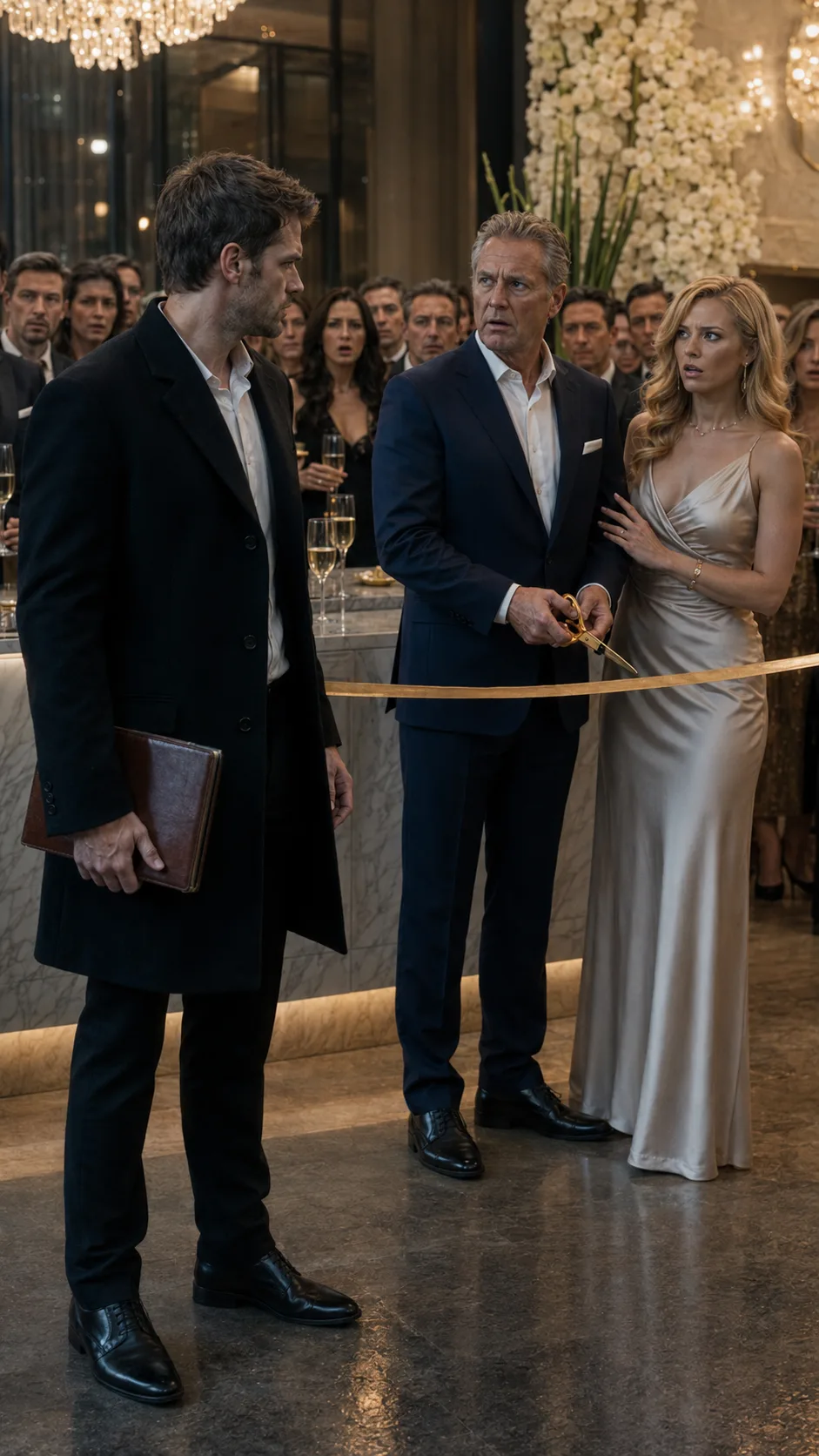
A room full of wealthy guests, champagne glasses, camera lenses, white orchids, gold ribbon, and polished smiles held its breath as I stood in front of my father with my mother’s brown leather folder beneath my hand.
My father said my name like a threat.
“Ethan.”
Brianna’s fingers tightened around his sleeve.
“Rick,” she whispered, “what’s going on?”
Rick.
My mother had called him Richard for thirty-seven years.
She had washed his shirts, remembered his appointments, excused his failures, protected his pride, and died still trying not to hate him. Now a woman half his age called him Rick inside a salon paid for by the house my mother had saved from him.
I looked at Brianna.
Then at him.
“Dad,” I said, loud enough for every guest to hear. “You sold Mom’s house to buy this for her?”
The words landed exactly where I
wanted them to.
On the marble.
On the champagne.
On the gold scissors.
On Brianna’s name glowing behind him.
A few guests shifted. Someone near the back lowered their glass. The photographer stopped adjusting his lens.
My father’s face changed.
Not with guilt.
With anger.
He stepped toward me.
“Lower your voice.”
I did not move.
“You sold Mom’s house,” I said. “You forged my name. And you paid for this.”
Brianna’s hand slipped from his sleeve.
Her expression was still beautiful, but now it was frightened.
My father pointed the scissors downward, his knuckles whitening around the handle.
“Your mother is dead,” he said coldly. “You don’t know what you’re saying.”
The sentence should have broken me.
Maybe a year earlier, it would have.
But grief had changed shape inside me. It was no longer just a wound. It had become a witness.
I opened the folder and pulled
out the sale contract.
The paper made a soft sound against the marble counter.
“This says I signed away the house.”
My father did not look at the contract.
He looked at my hand.
As if he still believed he could intimidate me into putting everything back.
I took out the Father’s Day card next.
The old one.
The stupid one.
The one from when I was nineteen and still thought respect was something a father automatically deserved.
I laid it beside the forged contract.
“The signature came from this,” I said. “You copied it from a card I gave you.”
The room tightened.
Brianna stared at the card.
Then at my father.
“You said this was your money,” she said.
Her voice was not loud, but it cut through the silence.
My father turned quickly.
“Brianna, not now.”
“You told me it was clean.”
“I handled it.”
“You put
my name on this?”
“Don’t be dramatic.”
The second he said it, I almost laughed.
That had been one of his favorite phrases.
Don’t be dramatic.
My mother was dramatic when she cried over bills.
I was dramatic when I asked why he missed my graduation dinner.
The bank was dramatic when they sent notices.
The doctors were dramatic when they explained the cancer.
Everyone was dramatic except the man who created the pain.
Martin stepped forward then.
Quietly.
Precisely.
He placed his black briefcase on the counter and opened it.
My father went pale.
“Martin,” he said. “You don’t need to be here.”
“Yes,” Martin said. “I do.”
The guests had fully turned toward us now. No one pretended to be distracted by champagne anymore. No one laughed. No one asked whether this was a misunderstanding.
A man knows when a room has stopped belonging to him.
My father knew.
Martin removed the trust documents and laid them beside the forged contract.
“The property at 418 Willow Creek Lane was placed in an irrevocable trust by Margaret Miller five years before her death,” he said. “Ethan Miller is the sole beneficiary with exclusive authority to approve any sale.”
My father’s jaw moved.
“That house was family property.”
Martin looked at him over his glasses.
“Not legally.”
A woman near the orchids covered her mouth.
The photographer lifted his camera slightly, then seemed to think better of it.
Brianna took a step back from my father.
Only one step.
But everyone saw it.
My father saw it too.
“Brianna,” he said quietly.
She shook her head.
“No. You told me your wife left you money.”
“My wife left memories,” he snapped. “I turned them into something useful.”
The room recoiled.
Not physically.
But I felt it.
A collective flinch.
Because sometimes cruelty shocks people only when it is spoken elegantly in public.
I looked at him.
“She left a home,” I said.
“She left a burden.”
“She left me the last safe place I ever had.”
His eyes flashed.
“You live in Denver.”
“I lived in Denver because Mom told me to build a life. She never told me to let you sell hers.”
His mouth tightened.
I pulled out the voicemail transcript.
Martin had printed it that morning.
Paper made people listen differently.
I read the line aloud.
“Don’t embarrass yourself today. You don’t understand adult decisions.”
Then I folded the paper once.
“Mom understood them. That’s why she kept the house away from you.”
For the first time, my father had no answer ready.
That was the moment I saw him clearly.
Not as the giant of my childhood.
Not as the man whose anger could fill a hallway.
Not as the husband my mother had built her life around.
Just a man.
A small one.
Standing in a beautiful room paid for by a lie, holding gold scissors he suddenly had no right to use.
He reached toward the papers.
I put my hand flat over the folder.
“Don’t touch what Mom left me.”
My voice was low.
It did not need to be louder.
Brianna looked from my hand to the folder, then to Richard.
“Is this going to shut down the salon?”
He stared at her.
That question told the room everything.
Not, “Did you do this?”
Not, “How could you?”
Not, “What did you do to your son?”
Just the salon.
My father looked wounded by her selfishness, which would have been funny if it had not been so ugly.
“I did this for us,” he said.
“There is no us if I’m tied to fraud.”
Fraud.
There it was.
The word nobody could unhear.
Martin closed one side of his briefcase.
“Formal notices are being sent today to the title company, the broker, the buyer, and the notary. The transaction will be challenged immediately.”
The notary.
That was the word that cracked my father’s control.
His eyes flicked toward a woman near the champagne table.
I followed his glance.
So did Martin.
So did half the room.
The woman looked away too quickly.
Brianna saw it too.
“Oh my God,” she whispered.
Richard tried to recover.
“This is a family matter.”
“No,” Martin said. “This is a legal matter.”
My father turned on me then.
“I’m still your father.”
I looked at the scissors in his hand.
The ribbon behind him.
The salon that wore Brianna’s name.
The guests who had come to applaud him.
“You should have remembered that before you stole from your son.”
He flinched.
Only slightly.
But I saw it.
Brianna reached for the gold scissors.
He did not let go at first.
She pulled once.
The scissors slipped from his hand.
Then she placed them on the counter beside the forged contract.
The ribbon remained uncut.
No one clapped.
No one followed my father when he walked out.
The legal fight lasted seven months.
It began with emergency filings, certified letters, frantic phone calls, and my father’s sudden discovery that consequences have office hours and deadlines. The title company froze the transfer. The broker hired counsel. Cole Horizon Properties tried to claim it had acted in good faith, but good faith became difficult to prove once the notary records, salon lease, forged signature, and Brianna’s LLC all began pointing toward the same small circle of people.
Brianna closed the salon before it ever took its first paid appointment.
For two weeks, the orchids remained in the window, browning at the edges while taped notices gathered on the door. Then the sign came down. The marble counter stayed, useless and expensive, behind dark glass.
My father called me every Monday at first.
I never answered.
His voicemails changed over time.
The first was angry.
“You’ve made your point.”
The second was wounded.
“Your mother would hate seeing us like this.”
The third blamed Brianna.
“She pushed me. She had expectations you don’t understand.”
The fourth blamed grief.
“I wasn’t myself.”
By the fifth, he sounded old.
“I never meant for it to go this far.”
That was the closest he ever came to the truth.
Not sorry he did it.
Sorry it escaped his control.
Martin filed the civil suit. My father avoided prison, but he did not avoid loss. He was ordered to pay restitution, legal fees, and damages tied to the fraudulent transfer. The notary lost her commission and faced charges. The broker settled quietly. Brianna moved to Florida and opened a smaller salon under a different name. She deleted every photo of my father within a day.
The house returned to the trust.
I stood in the kitchen the morning after the final order was signed.
It was colder than I remembered.
The floor was scratched near the pantry. Dust lay on the windowsill. The curtains smelled faintly of storage and winter. Someone had taken my mother’s coat from the hall hook, but one of her scarves remained folded in a drawer, soft and lavender-scented, as if it had been waiting for someone to come back and remember her properly.
The peach preserves were still in the pantry.
For Ethan, if he ever remembers toast.
I opened the jar.
It smelled like sugar and summer.
I did not eat it.
Some things are not meant to be consumed just because they survive.
I put it back.
In April, Mrs. Carter helped me replant the hydrangeas.
She arrived with a shovel, a thermos of coffee, and gossip she insisted was not gossip because “at our age, facts travel faster than lies.”
We planted six bushes along the porch, exactly where the old ones had been.
The dirt was stubborn.
So was I.
My mother’s green gloves stayed on the porch railing while we worked. I did not wear them. They were too small for my hands. But I wanted them there.
Mrs. Carter pointed at the second bush.
“Your mother always said that corner needed blue.”
“She said the pink ones were dramatic.”
Mrs. Carter laughed.
“She said that about your father too, but less kindly.”
I smiled for the first time in days.
A month later, my father came by.
I saw his car stop at the curb.
For a long moment, he just sat there. Then he got out.
He looked thinner. Older. Without Brianna beside him, without the navy suit, without the gold scissors and the warm salon lights, he seemed diminished by daylight.
He stood at the edge of the driveway.
He did not step onto the porch.
“I never meant to lose you,” he said.
The wind chime above the steps moved softly.
My mother had bought it at a flea market years ago and insisted it sounded better when a storm was coming.
I looked at my father.
Then at the driveway where the SOLD sign had once leaned.
“You didn’t lose me,” I said. “You traded me.”
His face folded in on itself.
For a moment, I thought he might apologize.
Really apologize.
Not for the lawyers. Not for the money. Not for being caught.
For her.
For me.
For all the years my mother spent making a home for a man who could only see what it was worth once she was gone.
But he only lowered his eyes.
“I was lonely,” he said.
I nodded slowly.
“So was Mom.”
He had no answer.
He looked toward the house, but not like someone remembering love. More like someone looking at a locked door.
“Can I come in?”
“No.”
The word surprised both of us with how cleanly it came out.
He swallowed.
“I’m still your father.”
“I know.”
“And that still matters.”
“It does,” I said. “That’s why this hurts.”
He stood there for another minute.
Then he turned and walked back to his car.
I watched him leave.
Not because I hated him.
Because I needed to see the driveway empty again.
That summer, I moved part of my design work back to Ohio. I did not sell the house. People told me I should. The market was strong. The neighborhood had changed. The property was worth more than my mother had ever imagined.
They meant well.
But they did not understand.
A house can be an asset.
It can also be testimony.
I repaired the porch boards myself. Badly at first. Then better. I replaced the kitchen light. I cleaned the pantry. I framed the blue-ribbon key my mother had given me and hung it beside the back door.
No plaque.
No quote.
No explanation.
Just the key.
On the first anniversary of the reversed sale, Mrs. Carter brought banana bread and stood with me on the porch as evening settled over Willow Creek Lane.
The hydrangeas had begun to bloom.
Small clusters.
Green pushing toward blue.
“They’re coming back,” she said.
I looked at the flowers.
At the porch.
At the windows glowing warm behind us.
At the house my mother had protected before I even knew it needed protecting.
“Yes,” I said.
And this time, nobody could sign them away.
THE END.
Chapter complete
You have reached the end of this chapter.
Continue reading
A few more worlds to get lost in after this chapter.




