you in a will,” he said. “Five years before she died, your mother placed it into an irrevocable trust.”
I stared at him.
“A trust?”
“Yes.”
“I didn’t know.”
“She asked me not to tell you unless it became necessary.”
“Why?”
Martin looked down at the papers, then back at me.
“Because your father had already tried to borrow against the property.”
The words entered me slowly.
“What?”
“During his second construction failure. He wanted to use the house as collateral.”
I remembered that year. My father coming home late. My mother clipping more coupons. Arguments that stopped when I entered the room. A broken cabinet door in the kitchen that nobody explained.
“She told me it was a slow season,” I said.
Martin’s expression softened.
“She protected you from knowing how often she had to protect herself.”
That sentence hit harder than anger.
It filled me with an old sadness, the kind that does not shout. The kind that sits down beside you and opens every door you were afraid to touch.
Martin slid the trust document toward me.
The property was under the trust. My mother’s signature was at the bottom.
Real.
Steady.
Hers.
Only I had authority to approve any sale. My father had no control. No broker, no buyer, no notary had the right to transfer the house without my consent.
“So the sale is illegal,” I said.
“Voidable,” Martin corrected. “And likely fraudulent.”
He placed the forged contract beside the trust.
“But there is more.”
I did not like the way he said it.
He tapped the notary stamp.
“The same notary who witnessed this signature also notarized the lease for Brianna Cole’s salon.”
I looked up.
“What salon?”
Martin turned his computer monitor slightly.
On the screen was Brianna Cole’s announcement.
Grand Opening.
Ribbon Cutting.
Investors and Special Guests Welcome.
My father was tagged in the photo.
He had commented below it.
Proud to build something beautiful from the past.
From the past.
My mother’s house was now “the past.”
My father had not just stolen from me. He had renamed the theft.
That night, I went back to Willow Creek Lane.
The house was dark.
I unlocked the door with the key my mother had given me. The blue ribbon was still tied around it.
Inside, everything felt disturbed. Not empty. Disturbed.
A home becomes quiet after death, but this was different. This was the silence after strangers touch your things.
In the kitchen, cabinet doors hung open. My mother’s mugs had been boxed. Her recipe cards were scattered across the counter. Someone had thrown away the magnet calendar where she used to circle my flight dates in red pen.
In the pantry, the jar of peach preserves was still there.
For Ethan, if he ever remembers toast.
Her handwriting leaned to the right, like every word was hurrying toward somebody she loved.
I picked up the jar and held it against my chest.
For a minute, I was not thirty-one.
I was six years old, standing on a kitchen chair while my mother spread butter and peach preserves on toast, telling me not to wake my father because he had a hard week.
He always had a hard week.
She always made it easier.
I put the jar back.
Then I opened every drawer.
At first, I did not know what I was looking for. Proof, maybe. Some sign that my father had planned this. Some trace of the path between my mother’s kitchen and Brianna’s marble salon.
In the junk drawer, under rubber bands, old batteries, birthday candles, and menus from restaurants that no longer existed, I found a stack of greeting cards.
Christmas.
Birthdays.
Father’s Day.
I almost closed the drawer.
Then I saw my own handwriting.
The card was from when I was nineteen.
It had a stupid joke on the front. Something about dads and lawn mowers. Inside, I had written:
Thanks for everything, Dad. Love, Ethan.
I stared at the signature.
Then I pulled the forged contract from my folder and placed it beside the card.
My breath stopped.
The signature matched.
Not perfectly. Not naturally.
But enough.
The same E. The same slant. The same long underline beneath Miller.
My father had not forged my name from memory.
He had copied it from a card I had given him when I still believed he was worth honoring.
For a while, I just sat there.
At my mother’s kitchen table.
In the house he had stolen.
Holding proof that my love had become his tool.
The next day, Martin told me we could file quietly.
“We can challenge the transfer, notify the title company, freeze proceeds where possible, contact the broker, and handle this through proper legal channels,” he said.
“Quietly,” I repeated.
“That would be my professional recommendation.”
I looked out his office window at the street below.
Cars moved. People crossed sidewalks. Somewhere downtown, Brianna’s salon was probably being polished for its grand opening. Champagne ordered. Ribbon delivered. Gold scissors waiting.
My father had called again that morning.
I had not answered.
He left another message.
“Don’t embarrass yourself. You’ll regret turning private family matters into a public scene.”
Private family matters.
Forgery.
Fraud.
Theft.
My mother’s life reduced to capital.
“Could we stop the opening?” I asked.
Martin removed his glasses.
“Legally, we can begin proceedings immediately. But stopping the event itself would require steps we may not complete in time.”
“So they cut the ribbon.”
“Possibly.”
“They smile for photos.”
“Possibly.”
“They spend the evening being congratulated for stealing my mother’s house.”
Martin said nothing.
His silence was not agreement.
It was permission to understand the truth.
That evening, Mrs. Carter called me again.
Her voice was shaking.
“Ethan,” she said. “I’m sorry. I thought you should know.”
“What happened?”
“They dug up the hydrangeas.”
I drove there so fast I barely remembered the road.
The bushes were gone.
All six of them.
Dark holes sat along the porch where the roots had been ripped out. Rain had softened the dirt. A trash bag lay split open near the steps. Inside it were broken branches, clumps of soil, and my mother’s green canvas gardening gloves.
Mud still clung to the fingers.
I picked them up.
Something inside me became very still.
My mother had worn those gloves every spring. She said hydrangeas forgave winter better than people did. She talked to them while she pruned them. She used to tell me the blue ones were stubborn and the pink ones were dramatic.
My father had not needed to throw them away.
The buyer had not needed to destroy them before the sale was even final.
But someone had wanted to erase her.
That was when I stopped wanting quiet.
The morning of the grand opening, I put the Father’s Day card, the forged contract, the trust documents, the notary link, and my father’s voicemail transcript into my mother’s brown leather folder.
Martin met me in the driveway.
He looked at the folder in my hand.
“Are you sure?” he asked.
“No.”
That was the truth.
I was not sure of anything except that my mother had spent her life keeping peace for people who never deserved it.
And I was done helping them.
We drove downtown in silence.
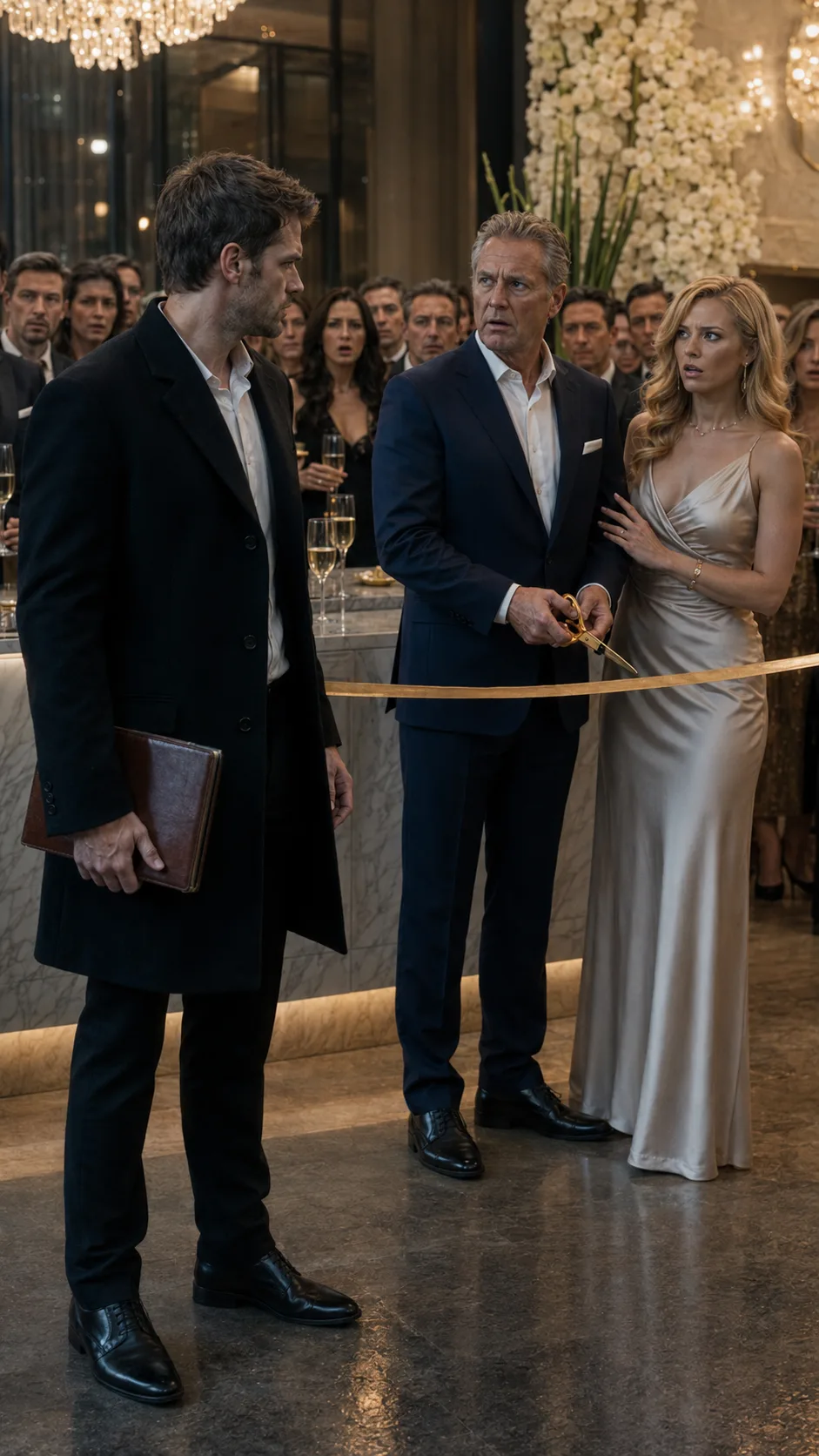
The beauty lounge occupied a corner space under a glass awning. Through the windows, I could see the crowd, the orchids, the champagne bar, the marble, the cameras, the gold ribbon stretched across the entrance.
My father stood at the center of it all.
Brianna beside him.
His hand near her waist.
Gold scissors in his grip.
He looked happy.
Not relieved.
Not conflicted.
Happy.
When he saw me through the glass, the smile slipped from his face.
Martin reached for his briefcase.
I opened the car door.
Inside the salon, someone began counting down for the ribbon cutting.
Three.
Two.
I walked in before they reached one.
My father lowered the scissors.
“Ethan,” he said. “This isn’t the time.”
I looked at the salon he had built with the home my mother protected until her final breath.
Then I placed my brown folder on the marble counter.
“No,” I said. “This is exactly the time.”
To be continued… Click “PART 3” to read the final part: 👉 PART 3 👈