PART 3 — THE LIFE I CHOSE FOR MYSELF
Christmas used to be my favorite holiday.
Chapter 3
PART 3 — THE LIFE I CHOSE FOR MYSELF
Christmas used to be my favorite holiday.
Not for the gifts, not even for the carols or the lights, but for the warmth, the feeling that for just one day the world paused its cynicism and remembered how to be kind.
That year, I celebrated in silence, and it was the most peaceful Christmas I had known in decades.
I heard nothing from them. Not in the weeks leading up to the holiday. Not on the day itself. They did not know I had left. Not really. They may have noticed my bedroom door staying shut, or that the leftover roast was gone, or perhaps that my shawl was missing from the hook by the stairs.
But people rarely notice what is not loudly taken.
They assume presence until it disappears.
From my new condo, the snow fell in elegant silence, touching the lake like a secret it could not hold. I spent the morning wrapped in
a thick blanket, sipping peppermint tea on the balcony.
The neighbor across the hall, Mrs. Carter, a retired literature professor, brought over cranberry muffins and asked if I liked Emily Dickinson. We read aloud to each other, two strangers who had decided not to be lonely.
In the evening, I watched It’s a Wonderful Life for the twentieth time. And for the first time, I realized I was not Mary. I was George. Someone who gave and gave until they forgot they existed outside of giving.
But now I remembered, and it was enough.
Back in Illinois, I imagine it took a while. I was no longer useful. No longer pouring coffee or folding towels or replacing paper towels no one noticed were ever gone. But Christmas morning arrived, and they noticed.
No one had bought my gift. They never did. But my absence made wrapping their own feel unfinished.
Tina asked where I was, maybe with a flicker of concern or guilt. My son might have muttered something like, “She probably went to visit her sister,” forgetting that my sister had passed away six years earlier.
Eventually, they called. I had changed my number. And when the voicemail replied, “This number is no longer in service,” I like to think they paused. Not out of fear, but confusion.
Because people like me, they expect us to always be there, holding the camera, passing the plates, laughing at jokes made at our expense. We are supposed to be the furniture of family.
Until one day, we are not.
A week after Christmas, I mailed them a postcard. Just one. No return address. Just the picture of my lake, calm, snow-dusted, and gently golden under the winter sun.
The message was short.
I found warmth where no one laughs at my
age.
Mildred.
I do not know how they reacted. Whether they read it aloud or folded it quietly and tucked it away like a mistake they could not undo.
I only know that no one came looking. No knock at the door. No apology. No plane ticket.
They had built a home that ran perfectly without me until it did not. But rather than confront that truth, they likely left the postcard on the kitchen table next to unopened coupons and old grocery lists.
It stung them, I hope. Not to punish, but to remind them that love is not a resource to be mined until dry. It is a gift that must be honored, or it will vanish quietly, like I did.
My new mornings began with the sound of the lake tapping gently at the rocks. There was no shouting, no footsteps stomping past my bedroom door, no one sighing when I asked a question, no phones buzzing with texts that said, “Grandma needs something again.”
There was only light. Golden, warm, silent light spilling through my window, as if the lake itself had chosen to greet me.
I had not lived alone in forty-seven years, and yet I had never felt more accompanied.
The condo was small, just two bedrooms and a modest balcony, but every inch of it was mine. I had bought it furnished, but spent hours choosing new curtains, a ceramic teapot, and a set of watercolor brushes I had no idea how to use yet.
My first week, I baked blueberry scones and left them by the front desk for the building staff. A young woman named Janelle from the front office knocked that afternoon just to say, “You made my morning better.”
I almost cried over a sentence I had not heard in so long.
People spoke to me here, not as if I were invisible, not like I was a memory already fading, but like I mattered.
I met George on my third evening while watching the lake turn silver beneath a fading sky. He had white hair, a soft flannel jacket, and a cane he refused to use unless someone made him.
“Wife passed two years ago,” he said. “Kids called for the funeral, then forgot the number.”
I smiled.
“Mine call when the garbage disposal breaks or when they think I owe them something.”
He chuckled.
“So we are the unwanted generation.”
“No,” I said, surprising even myself. “We’re the generation that forgot we were allowed to want something.”
We sat like that for hours, two old strangers who had both been background noise in younger people’s stories, now finally center stage in our own.
George became my first real friend in years. We started meeting every Wednesday afternoon for tea. He brought cookies. I brought old stories. Somehow, neither of us felt lonely anymore.
Days became routines. I woke up early to make cinnamon rolls or banana bread. Some I kept. Some I gave away. In the afternoons, I walked along the lake trail. People nodded. Some even stopped to say hello.
A little boy once ran up just to ask if I was someone’s grandma, and when I said yes, he grinned and gave me a flower.
At seventy-five, I joined a gentle yoga class led by a woman named Teresa, who said age was just a different version of strength.
I believed her.
I started painting with watercolors every Sunday, laughing at my shaky hands and feeling proud of every wild, uneven blossom I managed to create. My memoir took shape slowly, each page a thread pulled back from the parts of myself I had long tucked away for other people’s comfort.
I had no one to cook for, but I had myself to nourish, and for once, that was enough.
One afternoon, George brought chamomile tea and a lemon tart he had made from scratch. We sat on the balcony, the lake sparkling like it had been polished with glass.
“I have not seen you frown in weeks,” he said.
“I have not been told to sit in silence either,” I replied.
He lifted his teacup.
“To freedom.”
I lifted mine too, paused, then said with a smile, “I was denied cake, but now I feast on peace.”
He laughed.
And then we fell quiet. Not the awkward kind, but the kind that wraps around two people like a blanket.
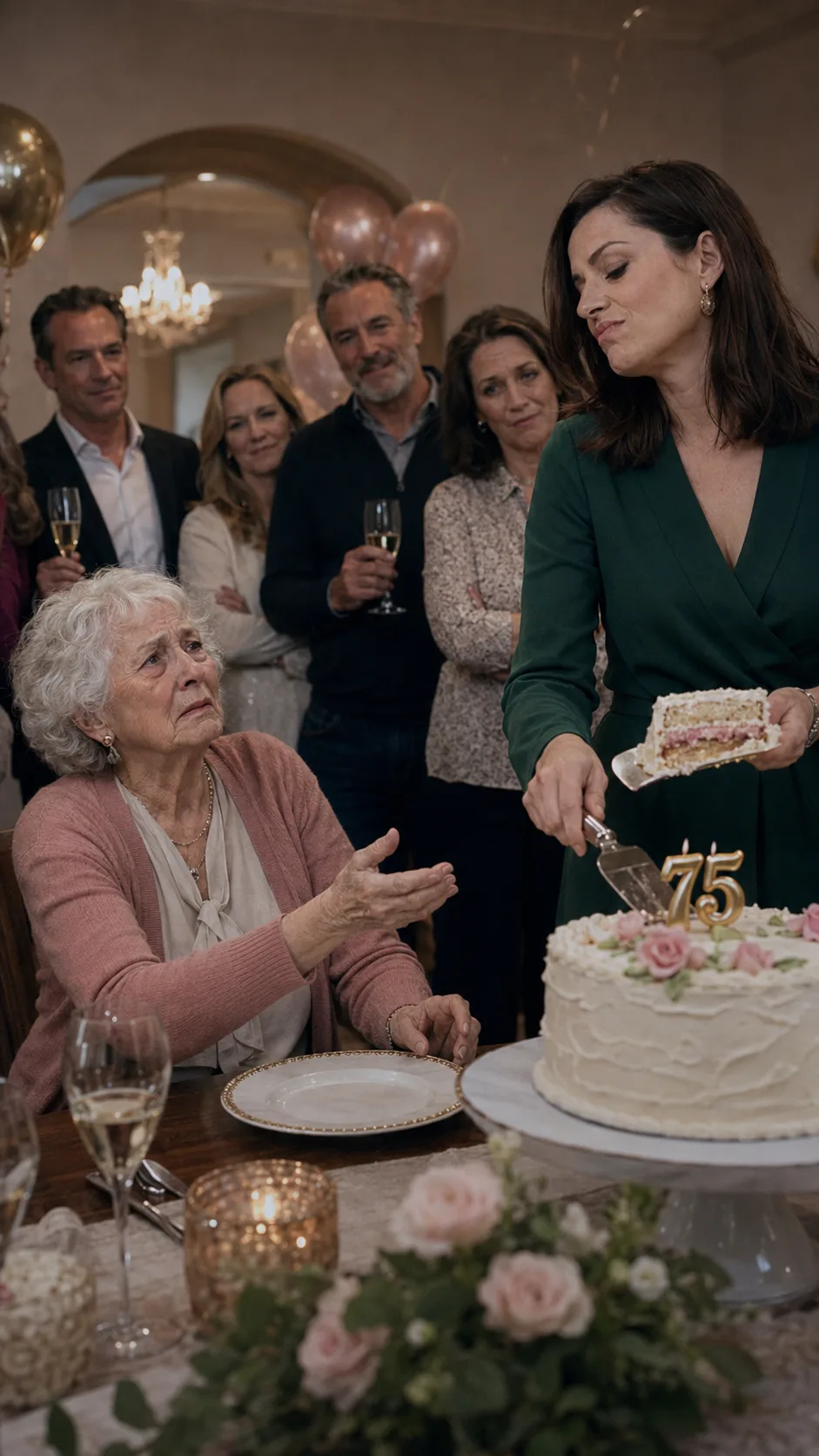
I remembered that day in the kitchen. My hands reaching for a slice of cake. The one with my name in cursive frosting. Tina’s voice like vinegar and honey. The room full of laughter that was not mine.
And now here I was, holding a cup of tea, looking over a lake with someone who saw me, not as a burden, but as a woman still capable of joy.
I had been pushed aside, but I had not broken.
I had simply moved.
It came on a Tuesday, a thick white envelope embossed with a gold insignia and addressed to my former home in Illinois, not from me, but from my attorney.
Inside was a copy of my revised will.
Every word of it was deliberate. Every sentence a quiet undoing of what they had once assumed.
I left nothing to my children. Nothing to my grandchildren. Not the savings I had built over five decades at the bank. Not the condo by the lake. Not even my jewelry, the small sentimental pieces they used to ask about after every family gathering.
Instead, I donated it all to the assisted living home in Michigan, where I now volunteered twice a week, reading to the blind, organizing crafts, and holding hands with people who had stories but no one to listen.
They welcomed me like family.
So I gave back, not out of spite, but out of love finally returned.
My attorney said my family called him four times in one day. He did not answer.
Tina was the first to explode online, of course. She wrote a long, frantic post, dripping with wounded ego.
My grandmother disinherited us after all we did for her. We let her live with us. We celebrated her, and now she gives everything to strangers. How could she be so cruel?
Underneath were dozens of comments. Some agreed with her. Others did not.
One stranger replied, “Did she really live with you, or under you?”
Another wrote, “Older women don’t give away love unless it has been taken for granted first.”
I read it all quietly without comment.
There were no calls. No apologies. No one came looking for me. Not really.
I had stopped expecting that long ago.
I sat at my desk and pulled out a clean sheet of paper. I wrote slowly, carefully, more for myself than for anyone else.
They celebrated without me. I planned without them.
It was not bitterness. It was clarity. It was the final line of a chapter I had waited too long to close.
They had shown me who I was to them: background noise, a placeholder, someone to dismiss when convenient.
Now I had shown them who I had always been. Not a burden. Not a prop. A woman who remembered everything.
I remembered buying Tina’s textbooks when her father forgot. I remembered staying up through fevers. I remembered writing checks when their pride got too thin to ask. I remembered birthdays and allergies and favorite bedtime songs.
But more than anything, I remembered how they made me feel when I asked for nothing more than a slice of cake.
That night, George brought over a small cake he had baked himself. Chocolate, a little lopsided, covered in powdered sugar and a few sliced strawberries.
“No candles,” he said. “Just cake for being alive.”
We shared it on the balcony. The lake hummed under the moonlight. We did not toast. We did not say much. But I smiled after every bite.
Not because it was sweet.
Because it was mine.
My seventy-sixth birthday was different.
There was no awkward silence. No paper plates on kitchen counters. No children elbowing me aside for cake I had bought. No backhanded jokes. No waiting in a hallway for someone to remember I existed.
Instead, I stood in the center of a warm, sunlit room inside the community hall by the lake. Folded chairs filled the space, but no one sat quietly. Everyone moved, laughed, and hugged. The smell of cinnamon rolls and tea floated in the air.
George wore a green sweater I had once complimented. He brought tulips in a mason jar. Joan, the woman who taught watercolor next door, baked a pecan pie. A group of teenagers I tutored in letter-writing class made a giant card with 76 Looks Good On You written in bubble letters across the front.
There were no speeches planned. No forced songs. Only something I had decided to do for myself.
I walked to the little wooden podium in the corner, holding a page torn from my notebook, the one I had started writing in the week I left Illinois. I cleared my throat.
Everyone went quiet, and I read.
“This year, I finally learned that dignity is not like cake. You do not get to slice it for someone else. You do not get to offer someone a bite and take the rest. Dignity is not given. It is claimed.”
There was silence at first. Then hands met hands in a soft wave of applause, gentle but sure, the kind that said, We see you.
I smiled, folded the paper, and tucked it back into the book.
George stepped up beside me and raised a glass of sparkling cider.
“To the woman who chose herself,” he said.
Laughter followed. A few people even wiped their eyes.
I did not cry. I had done enough of that.
Instead, I walked to the large window overlooking the lake. The late autumn sun shimmered on the water like golden thread being pulled across its surface. Trees flamed in amber and red, their leaves like memory falling, but beautiful.
I leaned against the window frame, and for the first time in decades, I felt full. Not from the cake or the cider or the sound of my name being spoken without obligation, but from something else.
A stillness. A peace. A long-overdue sense that I was no longer just counting the days.
I was living them.
And they were mine.
After the guests left and the room returned to silence, I stayed behind, just me and the folded chairs and the leftover pie. George helped me sweep up confetti. We did not say much, but before he left, he placed a note in my hand.
His handwriting was shaky but careful.
If you ever feel like sharing the view from that lakefront window with someone who also chose peace, I’ll bring the coffee.
I laughed softly, folded the note, and slipped it into my purse.
The sun was setting as I stepped outside. Crisp air kissed my face. I tightened my shawl around my shoulders and looked up. A single leaf spun in the air, landed at my feet, then drifted off again with the breeze.
I whispered to no one, but maybe to everything.
“I was just counting the days until I lived them fully.”
If you came here from Facebook because Mildred’s story stayed with you, please go back to the Facebook post, tap like, and leave exactly this short comment: “Respect.” That small action means more than you know, and it helps encourage the writer to keep bringing you more heartfelt stories like this one.
THE END.
Chapter complete
You have reached the end of this chapter.
Continue reading
A few more worlds to get lost in after this chapter.




