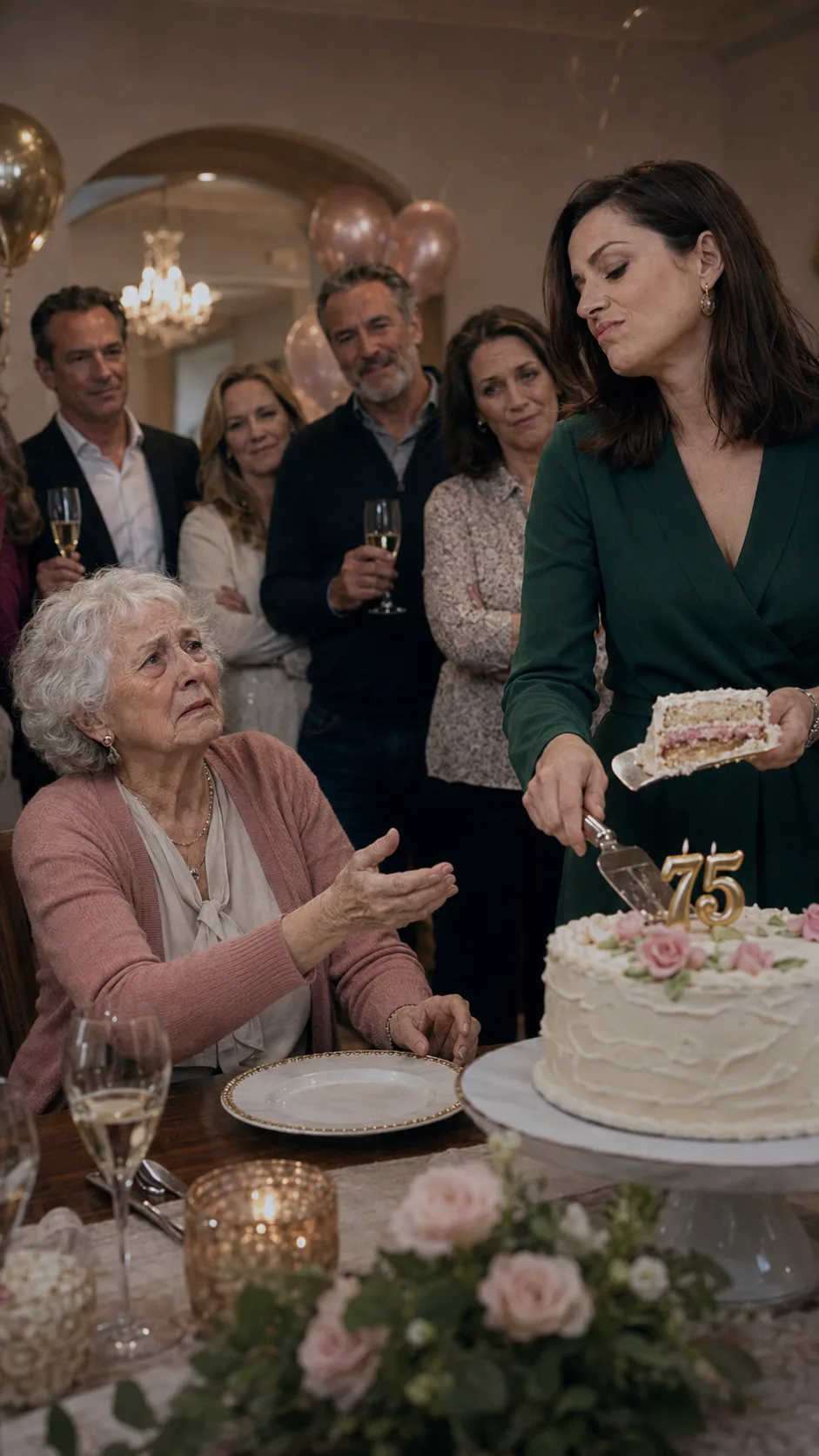
was a few days after my birthday when I pulled out the old folders I kept in a locked chest. There were bank records, letters, and old copies of property deeds. I had learned early in my career: never throw away a paper with your name on it.
One document in particular caught my eye. The deed transfer from my old house. I had sold it and quietly placed the proceeds, what was left after paying everyone’s debts, into an account I never touched, one they did not know existed.
I stared at the number. It was not much, but it was mine.
My entire life had been a stream of small sacrifices made without announcement, made without conditions. But somewhere along the way, they stopped seeing them as gifts. They became expectations. Entitlements. A woman who gave without question became the woman who had no boundaries.
And now they had denied me cake.
They had denied me dignity.
I closed the folder.
That night, I did not sleep. I sat by the window in my tiny room, watching the streetlight flicker against the hedge I once trimmed myself. I remembered my husband’s voice.
“You’re the strongest woman I know, Mildred. But even strong people need to be treated right.”
He had said that when I stayed late at work after a frightening robbery shook the branch. I repeated it aloud just to hear it in the air.
“Even strong people need to be treated right.”
No one had treated me right in a long time.
And suddenly, I knew something. I did not have to explain my goodness. I did not have to beg for their respect. I did not even have to ask them to see me. I had already given more than enough.
The real question was, what would I do with what I had left?
Some wounds do not bleed. They happen in silence, between dinner plates, behind closed doors, in the quiet erasure of a name.
After the birthday party, nothing changed. If anything, the cold got quieter. Meals became moments I was never invited to. No one ever said, “Dinner’s ready, Grandma.” No one asked if I preferred peas or carrots. They just ate, laughed, and talked about their days.
Tina posted her photos online of family meals where I was never in frame. And when they were done, when plates were scraped clean and wine glasses rinsed, I would hear a knock at my door. Sometimes not even that. Sometimes I would simply find a bowl of cold rice or a single slice of meatloaf left on the counter.
No note. No warmth.
I began calling them the nameless meals.
I ate them alone by the kitchen window, sometimes with a napkin, sometimes with just my hands. They never asked how my day went. I suppose they thought I had nothing to say. After all, what could an old woman possibly contribute?
There were no photos of me in the living room. Not on the mantel. Not on the refrigerator. There were photos of baby showers, graduation ceremonies, and beach vacations, but none with me. Even the Christmas card from last year. I took the picture. They never asked me to be in it.
At first, I tried not to mind. I told myself, You are not vain. You do not need to be in pictures to matter.
But then one day, when a neighbor visited, she looked at the wall and asked Tina, “Where’s your grandmother?”
Tina just shrugged and said, “She likes to keep to herself.”
No one corrected her. No one said I was in the next room. No one brought me out to say hello. I was there folding laundry. I heard every word.
One afternoon, I walked past the living room as my great-grandson Jordan played video games with a school friend. He must have been ten or eleven, too old to be so careless, too young to realize the weight of what he was saying.
The friend asked, “Who’s that in the hallway?”
Jordan replied, “That’s just my grandma. She’s old. She doesn’t even remember much anymore.”
They both laughed.
I turned and went back to my room. I did not cry. Instead, I opened the drawer beside my bed, pulled out the navy-blue journal I had kept since moving in, and began to write.
Today, I became invisible. Not because I vanished, but because they decided I was no longer worth seeing.
I started writing more. Every night, under the light of a dim lamp, I recorded what I had cooked, what I overheard, what I remembered from years gone by. Sometimes I wrote about Harold, about the time he surprised me with a picnic in the middle of February just because I had mentioned missing summer.
Sometimes I wrote about Robert as a boy, how he used to bring me daisies from the neighbor’s yard and claim they were stolen love gifts.
And sometimes I just wrote down the things they said to me, not to be bitter, but to remember that I was not making it up, that it had happened, that this erasure was real.
One entry read: Maybe do not say good night anymore. I say it to myself now.
Another read: They threw out my knitting bag and said it was clutter. It had my wedding shawl in it.
And one night, after another quiet dinner of leftovers and laughter from a room away, I wrote: Is this what it means to be a burden? To exist, but without presence?
I tried to leave notes, little reminders that I was still a person. I folded their towels and left a smiley face drawn on a sticky note. No one said thank you. I made muffins one morning and left them on the table. They were eaten. But when I came back in, someone had thrown away the tin with a napkin still inside.
No one asked if they were from me. No one thought to.
That night, I wrote the hardest line of all.
I live in this house, but I do not belong to this family anymore.
And that truth echoed louder than any birthday song they never truly sang for me.
Because it was not about cake. It was not about chairs at a table or pictures on the wall. It was about something deeper, something crueler. I had given them my years, my money, my back, my love. But now I was a ghost, living and breathing and somehow no longer real to them.
And for the first time, I asked myself a question I had never dared to ask.
Do I still want to be here?
Not just in this house, but in this version of my life.
Because I had a name. I had stories. I had a voice that still remembered songs and poems and the exact color of the hydrangeas Harold planted on our third anniversary.
And maybe, just maybe, it was time someone else heard it. Someone who would not laugh or shush or turn away. Someone who would say, “Tell me again, Mildred. I never liked secrets.”
But some things are too sacred to be shouted. Some choices bloom best in silence.
After that night, after my journal page was stained with the words, I live in this house, but I do not belong to this family anymore, I woke up with a strange stillness in my chest. Not sadness. Not even anger. Just a kind of clear knowing.
It was time.
They had forgotten, but I had not.
I still held one final piece of my life before the burden. A property in Springfield. Just a strip of land, nothing glamorous, but mine. It was the land Harold and I bought back when we were young and dreaming of building a vacation cabin. Life took us elsewhere. The cabin never came, but the land stayed.
I had refused to sell it, even when things got tight after Harold died.
Now I called the number of an old contact, a real estate agent named Louise, who had handled the place for years.
“Still holding on to that lot, Mildred?” she asked.
“Not anymore,” I said.
The paperwork took two weeks. I signed documents at the local café so no one would notice if I came and went. I smiled politely at the notary public and did not flinch when she asked if I had family who might help with the process.
“No,” I said. “This one is all me.”
When the sale closed, I opened a new bank account under my name only. The total came to three hundred fifty thousand dollars. I stared at the balance on the screen and whispered, “Hello, old friend.”
It was the largest amount I had seen in my name in over a decade.
It was not revenge.
It was reclamation.
I went online that same night on the old tablet my granddaughter had tossed aside months earlier, saying it was too slow to bother with. It worked just fine.
I looked at properties across the state line, quiet towns, lakefront condos, places where people still said good morning to strangers. I found it by accident. A two-bedroom unit in Michigan overlooking a calm patch of water that caught the sun just right in the photos. Wooden floors. French doors. A balcony just big enough for a rocking chair.
I called.
A man named Ethan answered. He sounded surprised that I was not calling for my adult children.
“No,” I told him. “I’m buying this one for myself.”
His tone shifted.
“That’s rare,” he said. “I like that.”
I paid in full. No loans, no co-signers, no explanations. Just my name on every line.
The next morning, I began packing quietly. No cardboard boxes. Just my suitcase from 1982 and a few reusable grocery bags. It did not take much. A few dresses, my photo albums, the journal, Harold’s watch, my shawl. Everything else they had already claimed or discarded without asking.
The day before I left, I made one last meal, a roast chicken. I left it in the fridge with a note.
Take care. I will not be needing leftovers anymore.
Then, at 2:14 a.m., I ordered a taxi.
I did not wait for sunrise. I did not tell anyone goodbye. I stepped into the back seat, placed my suitcase beside me, and for the first time in years, closed the door without feeling like someone might pull me back.
The car pulled away from the curb. No one noticed. No one chased.
They had celebrated without me.
I had planned without them.
As the taxi turned onto the highway, the lights of the house vanished behind a curve. I did not look back. Instead, I pulled a small piece of cake from my purse, the one I had hidden after the birthday party. A thin, dry slice with too much frosting. I had wrapped it in a napkin and tucked it away, not out of spite, but as a reminder.
I unwrapped it under the soft hum of the taxi and took a bite.
It was not sweet.
It was something else. A memory. A promise. A reclamation.
I swallowed, leaned back into the seat, and chuckled, a sound that startled even me. The driver looked in the mirror and raised an eyebrow.
“Everything okay back there?”
I nodded slowly, then said it aloud, savoring every syllable.
“Let them eat cake.”
To be continued… Click the blue “PART 3” below to read the final part:
👉 PART 3 👈