I went home with my parents, Lila, Martin Bell, and two security guards.
Chapter 3
My wedding gown filled the backseat of the car like a second passenger.
4,638 words
Not because I was afraid Adrian would come to the house, though maybe I should have been, but because my father insisted and I no longer had the energy to reject protection offered in good faith.
My wedding gown filled the backseat of the car like a second passenger. White silk, pearl edging, hidden structure, immaculate except for the faint red mark near the bodice where I had touched my lips after biting them. Blood on silk. Evidence of the moment before I chose myself publicly.
At my parents’ house, my mother wanted to make tea. Lila wanted to open wine. My father wanted a full legal update. Martin wanted to preserve every recording before footage online became edited beyond usefulness. I wanted silence.
“Claire,” my father said when I stood in the foyer unmoving, “what do you need?”
It was the first time anyone asked me that all day
without already deciding the answer.
I looked down at my dress.
“I need to take this off.”
My mother’s face crumpled.
“Of course.”
She helped me upstairs to my old room. The room had not been mine in years, not really, but my mother had kept it tasteful and familiar: pale blue walls, a writing desk near the window, shelves of books, a photograph of Vanessa and me at Lake Tahoe when we were children, both sunburned and laughing. I turned the photograph facedown before my mother began unfastening the row of tiny silk-covered buttons down my back.
Her fingers shook.
“I should have seen what she was,” she whispered.
“She’s your daughter.”
“You are too.”
The answer came too quickly. Too painfully.
“Yes.”
My mother stopped.
The last button opened. The gown loosened around me.
“I know,” she said, and the shame in her voice was older than the
wedding. “I know I protected her too often. I know I asked you to be gracious when she was cruel because it was easier than making her accountable. I thought I was keeping peace.”
“You were keeping her comfortable.”
My mother closed her eyes.
“Yes.”
I stepped out of the dress and stood in a slip while my mother gathered the silk carefully in her arms. For one absurd second, I wanted to apologize for wrinkling it.
Then I remembered the dance.
The microphone.
Adrian’s knees hitting the marble.
No more apologies for surviving.
“I can’t talk about Vanessa tonight,” I said.
“I understand.”
“No. Mom, I need you to really understand. I don’t know when I’ll be able to be in a room with her again. Maybe never. If you try to rush me, if you ask me to forgive her because she’s family, if you turn my pain
into another opportunity to manage her emotions, you will lose access to me too.”
The words came out cleanly.
My mother went very still.
Then she nodded.
“I understand.”
I looked at her until I believed she might.
Downstairs, Martin worked until two in the morning. The legal machine had begun moving before the cake was cleared. Adrian’s firm suspended him within forty-eight hours after evidence reached the managing partners. The merger he had been chasing collapsed. The charitable foundation quietly removed him from consideration. Investigators found enough irregularities in his side entities to turn his confidence into negotiation. The district attorney’s office opened an inquiry. The Securities Division requested documentation because one of the shell entities had touched advisory accounts. My family office initiated a full internal audit to determine who, besides Adrian, had tried to push documents into the wedding stack.
Vanessa’s consequences came faster and slower.
Fast publicly. She was removed from two boards, cut off from family-controlled discretionary accounts, and asked to leave the apartment my parents had subsidized. Her friends divided themselves into those who claimed they had always sensed something wrong and those who disappeared because scandal is contagious when it stains the wrong dress.
Slow emotionally. My parents struggled more with her betrayal than with Adrian’s. Adrian was an outsider. A polished, ambitious, useful outsider, but still outside the bloodline. Vanessa was their child. My sister. The girl whose ballet recitals we had attended, whose scraped knees my mother kissed, whose tears had rearranged entire family dinners. To admit what she had done required them to revisit every smaller cruelty they had excused because it seemed easier at the time.
That reckoning was quieter than the wedding, but deeper.
Vanessa called me twelve times the week after.
I did not answer.
She sent one text first.
You humiliated me.
I stared at it for a long time before laughing so hard I had to sit down.
The second message came an hour later.
You destroyed my life over a man who loved me first.
The third, near midnight.
Please. I’m sorry. I don’t know what I’m doing. Mom won’t answer me. Dad cut me off. Adrian isn’t picking up. I have nowhere to go.
There it was.
The real grief.
Not that she had hurt me.
That the people she expected to catch her had stepped back.
I sent all messages to Martin.
I sent nothing back.
Three weeks after the wedding, I had the dress boxed. I did not preserve it dramatically or burn it symbolically. I had it cleaned, wrapped, and placed in storage because it was an expensive garment and I was not in the business of destroying things simply because men had behaved badly near them. The flowers were gone. The cake had been donated. Every vendor paid. Every legal tie to Adrian severed that could be severed.
The marriage license had truly never been filed.
I had made sure of it.
That decision had been the easiest and hardest part of the plan.
Two months before the wedding, when I finally understood that Adrian’s suspicious documents were not isolated attempts to “streamline family integration” but pieces of a coordinated transfer strategy, I told Lila I wanted to cancel everything.
She came to my house that night with takeout, sweatpants, and rage.
“Then cancel it,” she said. “Burn the whole thing down.”
“I don’t have enough proof.”
“You have enough to know he’s sleeping with Vanessa.”
“Emotionally, yes. Legally, not yet.”
Lila stared at me across cartons of noodles.
“Claire, you sound like you’re prepping for trial.”
“I am.”
“Against your fiancé?”
“Against a man trying to marry me for access.”
She set down her fork.
“Okay. What do you need?”
That was when the plan began. Quietly. Legally. With records.
The first step was the marriage license. Adrian had assumed the administrative side would be handled by my staff because everything else was. He joked that he was too busy to deal with “municipal romance.” I smiled and said I would take care of it. I did take care of it. I made sure the paperwork was prepared but not filed. I confirmed the officiant would not submit anything until both parties signed after the ceremony. I arranged with Martin to have a separate legal witness present in case Adrian attempted to claim otherwise.
The second step was the wedding paperwork. Adrian’s team had gradually inserted “vendor confirmations” into a packet that also contained trust amendments, spousal access authorizations, emergency proxies, and appointment language to entities that looked harmless only if you read them after three glasses of champagne. I read every line. Then I redlined nothing. Instead, I had Martin create a mirrored fraud package that appeared to accept the structure while rerouting every attempted transfer trigger into internal review. If Adrian signed, if Vanessa signed as a related-party beneficiary, if the holding company name appeared in the final packet, the system would notify the board and freeze connected activity.
The third step was proof of motive.
That was the piece I needed most and feared I might never get. Fraud can be built from documents, but intent often hides behind plausible deniability. Adrian was careful in writing. Vanessa less so, but even she understood not to put everything in a text. The cloud recording from his tablet had given us enough to escalate. But public humiliation, vile as it was, gave us something no deposition could have: an open declaration of emotional betrayal in front of witnesses immediately after signing documents that tied Vanessa to Adrian’s financial structure.
He had believed the dance was his victory lap.
It became his confession.
On paper, Adrian never became my husband.
Emotionally, it took longer.
That surprised me.
I thought evidence would cure love. I thought exposure would burn affection clean out of the body. It did not. Betrayal is not a switch. It is an amputation that keeps sending sensation from the missing limb. For weeks, I woke reaching toward a man I hated. I missed the smell of his coffee before I remembered his voice on the recording. I saw a book he had given me and wanted to throw it through a window, then remembered how he had written my name on the first page and cried because the handwriting still looked tender. I found one of his shirts in the laundry room and sat on the floor holding it until Lila came over and took it from me without a word.
I missed the future I had imagined.
I missed the version of myself who believed loyalty given freely would be met with loyalty returned.
I missed the simplicity of not knowing.
But him?
Eventually, I understood I did not miss him.
I missed innocence, and that had never really been his to keep.
The legal proceedings dragged into summer. Adrian’s attorneys tried to frame everything as a private romantic dispute weaponized by a powerful family. That might have worked if not for the documents. Documents have a moral force people underestimate. They do not care who cried harder. They do not care who looked better in photographs. They sit there with dates, signatures, revisions, metadata, entity names, routing numbers, and witnesses. Adrian had built a scheme using paperwork, then seemed offended when paperwork turned against him.
Vanessa tried to save herself by claiming she did not understand the financial components.
In a limited sense, that may have been true. Vanessa was not a lawyer. She did not understand the trust structure fully. She did not know the difference between proxy authority and beneficiary designation. She probably could not have explained the shell entities if someone held a candle under her hand.
But she understood enough.
She understood that Adrian wanted access. She understood that I was the obstacle. She understood that distracting me helped. She understood that signing documents in connection with his entities benefited her. She understood that my father’s health scare created opportunity. She understood that humiliating me publicly was meant to reposition her as the woman Adrian “really” loved while making me look pathetic enough to silence.
Understanding does not need a law degree.
Her attorney arranged one meeting at my parents’ request.
I almost refused.
My father did not pressure me. My mother, to her credit, did not either. She simply said, “I think I need to hear what she says. You do not have to.”
I decided to attend because I had spent too many months watching from behind evidence. I wanted to see Vanessa in a room where performance had nowhere left to stand.
We met in Martin Bell’s conference room on a gray Tuesday morning. Vanessa arrived wearing a navy dress too conservative for her taste, no jewelry beyond small pearl studs, hair pulled back, face pale. She looked like someone dressed by legal advice. Her attorney sat beside her. My parents sat across from her. I sat at the far end of the table with Lila behind me because I had learned not to enter emotional ambushes alone.
Vanessa did not look at me at first.
She looked at my mother.
“I’m sorry,” she said, and began to cry.
My mother closed her eyes, but did not move toward her.
Vanessa faltered.
Then she looked at my father.
“Daddy—”
“No,” he said.
Just that.
No.
Vanessa swallowed the word like glass.
Finally, she looked at me.
For the first time in my memory, my sister had no available mask. No golden smile. No trembling innocence. No wounded outrage. Just a woman who had gambled on everyone loving her too much to hold her accountable and lost.
“I hated you,” she whispered.
Nobody moved.
Vanessa’s attorney shifted slightly, but did not interrupt.
“I hated that everything looked effortless for you,” she said. “School. Law. Dad’s respect. People listened when you spoke. Even when you were quiet, people assumed there was something behind it. With me, they smiled and waited for me to be charming. Adrian saw me. Or I thought he did.”
I said nothing.
“He said you looked down on me.”
“I didn’t.”
“I know that now.”
“No,” I said. “You know it is useful to say that now.”
She flinched.
“I loved him.”
I looked at her.
“Enough to help him steal from me?”
Her face crumpled.
“I told myself it wasn’t stealing if you would still have more than enough.”
There it was.
The sentence beneath every betrayal in wealthy families. You have enough, so what I take does not count. You are strong enough, so what I do cannot break you. You are loved enough, respected enough, secure enough, so my hunger matters more than your boundary.
I leaned forward.
“Vanessa, you did not want Adrian because you loved him. You wanted him because he chose me first, and then he made choosing you feel like winning.”
Tears spilled down her face.
“You don’t know that.”
“I know you.”
For once, she did not argue.
My mother whispered, “Why didn’t you just tell us you were unhappy?”
Vanessa laughed once, broken and ugly.
“Because unhappy doesn’t get attention in this family unless it turns into a disaster.”
The words landed harder than she intended. My father looked away. My mother went very still. Even I felt them.
That was the cruelest part of truth. Sometimes guilty people say true things.
Vanessa had been indulged, yes. Protected, yes. Excused, absolutely. But she had also learned something from us, from the family structure around her, from years of beauty rewarded more quickly than honesty. She had learned that drama earned response and quiet goodness earned expectation.
It did not excuse her.
But it explained the soil where her cruelty grew.
I stood.
“I’m not ready to forgive you,” I said.
She nodded quickly, crying harder. “I understand.”
“No. I need you to hear me. I may never be ready. And if that happens, it will not be because I’m cold or vindictive or unable to heal. It will be because some choices cannot be undone simply because consequences arrived.”
Her mouth trembled.
“I know.”
“I hope someday you become someone who understands what you did without making your understanding another request from me.”
Then I left.
Lila followed.
In the hallway, she exhaled.
“You okay?”
“No.”
“Good answer.”
We walked to the elevator.
“Do you believe her?” she asked.
“I believe she is sorry she lost everything.”
“That’s not the same.”
“No.”
“What about Adrian?”
“I don’t think he’s sorry at all.”
She nodded.
“Probably safer that way.”
Adrian took longer to fall, but he fell more completely. His firm suspended him first, then terminated him after internal review uncovered communications between his private entities and two clients he had not disclosed. The district attorney’s office did not bring the kind of dramatic charges reporters hoped for, but civil actions, regulatory referrals, and professional discipline did enough. His name became difficult. His calls went unanswered. His apartment lease was not renewed. The men who had once clapped him on the shoulder in private clubs began using phrases like “unfortunate judgment” and “complex situation,” which are the polite sounds of doors closing.
He wrote me one letter.
Not an email. A letter on thick paper, probably chosen because he still believed presentation could rescue substance.
Claire,
I have replayed that night more times than you know. I will not insult you by denying what happened. I made choices that hurt you deeply. I allowed ambition and old feelings for Vanessa to cloud my judgment. I understand that what occurred with the documents looks damning, but I hope someday you can see that I was trying to secure a future for us, not steal from you. I wanted to be worthy of the world you came from. I wanted to stand beside you as an equal. I made terrible mistakes in pursuit of that. I am sorry for the public pain. I am sorry for the dance. I am sorry for humiliating you. I never stopped admiring you.
Adrian
I read it once.
Then I handed it to Martin.
“Do you want to respond?” he asked.
“No.”
“Good.”
The phrase “what occurred with the documents looks damning” told me everything I needed to know. Adrian was not sorry for attempting to steal. He was sorry evidence had made the attempt unattractive.
By autumn, the scandal had become one of those stories people mentioned in lowered voices at charity dinners and legal conferences. Some called me brilliant. Some called me ruthless. Some called me lucky. Society pages loved calling women lucky when preparation works. I ignored most of it. My life became smaller for a while. Work. Therapy. Dinner with Lila. Quiet weekends. Long walks. No dating. No public statements. No interviews.
I needed real silence.
Not the kind people mistake for weakness, but the kind that lets you hear yourself again after betrayal has been screaming in your ear.
The house where Adrian and I had planned to live together became mine again slowly. At first, every room contained him. His preferred whiskey glasses. His books. The chair he liked near the library window. The guest towels he had once mocked for being too formal. The kitchen drawer where he kept protein bars. The upstairs closet where one of Vanessa’s earrings had been found by a housekeeper two months before the wedding and where I had stood holding it, telling myself there must be another explanation.
I changed the locks.
Then the sheets.
Then the art.
Then the lighting in the library because Adrian had always said it was too bright, and one evening I realized I liked seeing clearly.
That mattered more than it sounds.
One evening, months later, I stood in that library with a cup of tea and looked at the shelf where I had once hidden the evidence drive behind old casebooks. The room was quiet. The house was quiet. For the first time in a long time, my life was quiet too.
Lila, sprawled on the sofa with her shoes off, looked up from a magazine.
“Do you ever miss him?”
I thought about it honestly.
“Yes,” I said.
She lowered the magazine.
I smiled faintly.
“Not him exactly. The version that made sense before I knew better.”
“That’s fair.”
“I miss being the kind of person who thought love could be recognized by how beautiful it looked from the outside.”
Lila’s eyes softened.
“That kind of person didn’t know what you know now.”
“No.”
“Do you wish she did?”
I considered that.
The old Claire had been trusting, but not stupid. Hopeful, but not empty. She had wanted marriage, family, partnership, beauty. There was nothing shameful in wanting those things. The shame belonged to the people who saw wanting as weakness.
“No,” I said finally. “I just wish someone had protected her sooner.”
Lila sat up.
“You did.”
That sentence stayed with me too.
Sometimes the person who saves you is the future version of yourself who refuses to let the past version keep bleeding.
The biggest red flag had not been Adrian’s secrecy. Not the late nights. Not the unexplained charges. Not even the way Vanessa glowed too brightly around him.
It had been the way he always needed me to doubt my own instincts before I could trust him.
That was the costliest thing he ever tried to take.
He failed.
A year after the wedding, my father invited me to join the board formally.
Not as a symbolic seat. Not as his daughter. As counsel and voting member with governance oversight.
We sat in his office overlooking the city, the same office where I had spent childhood afternoons drawing on legal pads while he took calls in a softer voice so he would not disturb me. He slid the appointment documents across the desk, then leaned back.
“This is not because of what happened,” he said.
“Isn’t it?”
“No. What happened made me recognize what should have been obvious earlier.”
“That I read contracts?”
“That you understand power better than most people who chase it.”
I looked at the documents.
“Dad.”
He waited.
“Vanessa thought your health made you vulnerable.”
His jaw tightened.
“I know.”
“Did it?”
He was quiet for a long time.
“Yes,” he said finally. “But not because of my heart. Because I was still making decisions as if family loyalty could substitute for governance. That was my mistake.”
I respected him more for saying that than for any apology he could have given.
I signed the appointment.
This time, every line belonged to me.
My mother and Vanessa entered a long, painful distance. Not silence exactly. Something supervised by consequences. Vanessa moved out of state for a while, then came back quietly, working somewhere outside the family’s circles. My mother saw her occasionally but stopped carrying messages between us after I told her once that I would not receive them. To her credit, she listened. My relationship with my mother became more honest because it became less managed. We spoke less often but more truthfully. She apologized in pieces, not all at once. I accepted some. Set aside others. Healing, I learned, is not one ceremony. It is maintenance.
Adrian disappeared from my life except in legal updates, then those faded too. His name stopped making my stomach twist by the second year. By the third, I could hear it in a sentence without losing the thread of conversation. That felt like victory in a form no one applauds.
The ballroom remained open, of course.
Life has a strange way of refusing to preserve your trauma as sacred ground. Other weddings happened there. Other brides walked under the chandeliers. Other quartets played. Other men lifted glasses and said romantic things that were probably true. For a long time, I avoided driving past it. Then one winter evening after a board dinner, I asked my driver to take the long way home.
We passed the venue. Lights glowed through the tall windows. Snow fell softly against the awning. A bride and groom stood outside laughing while a photographer arranged her veil.
I waited for pain.
It came, but gently. Like touching a scar and remembering the wound without reopening it.
The driver glanced at me in the mirror.
“Everything all right, Ms. Ellison?”
“Yes,” I said. “Everything’s fine.”
And for once, I meant it.
Four years after the wedding that was not a wedding, I attended another reception in the same ballroom.
Not mine.
Lila’s.
She married a pediatric surgeon named Daniel who adored her with the calm steadiness of a man who had never needed to be the loudest person in a room. Their wedding was small by my family’s standards, only eighty guests, winter flowers, candlelight, a jazz trio instead of a quartet. Lila asked me six months earlier if the venue would bother me.
“Yes,” I said.
“We can choose somewhere else.”
“No.”
“Claire.”
“No. I want to stand there for something good.”
So I did.
I wore a deep green gown and no armor except the kind built over years. When Daniel took Lila onto the dance floor for their first dance, he looked only at her. Not the room. Not the cameras. Not the applause. Her.
I cried then, quietly, without shame.
Halfway through the evening, I stepped out into the hallway near the entrance. The same marble. The same chandeliers visible through the doors. The same air faintly scented with roses and champagne. For a moment, I could see my former self standing there in white silk, tasting blood, listening to the crowd clap for her humiliation.
I wanted to reach through time and take her hand.
I wanted to say: Wait. Let them laugh. Let them clap. Let them mistake stillness for defeat. In five minutes, they will know who you are. In five years, you will know too.
My father found me there.
“You okay?”
“Yes.”
He stood beside me.
After a moment, he said, “I think about that night more often than I tell you.”
“So do I.”
“I think about how close I came to trusting him.”
“I think about how close I came to marrying him.”
“You didn’t.”
“No.”
“You saved yourself first,” he said. “The rest of us were fortunate enough to be nearby.”
I looked at him.
That was the first time he said it exactly right.
Not you saved us.
You saved yourself.
“Yes,” I said. “I did.”
Inside the ballroom, the jazz trio shifted into something warm and bright. Lila laughed, her head tipped back, Daniel’s arms around her. My father offered his arm.
“Dance with your old man?”
I smiled.
“Only if you don’t make a speech about the woman you’ve loved for ten years.”
He winced.
“Too soon?”
“Always.”
Then I took his arm, and we returned to the ballroom.
Sometimes people still ask about that night.
They do it carefully if they know me well, eagerly if they do not. They want the dramatic version. The champagne glass, the sister, the microphone, the groom falling to his knees, the phones ringing, the doors locking, the bride in white turning humiliation into legal precision. They want to know what I felt when I said the marriage license was never filed. They want to know whether Adrian begged. Whether Vanessa screamed. Whether my father threatened anyone. Whether I enjoyed the moment.
I tell them the truth if I trust them.
No, I did not enjoy it.
Enjoyment is not the right word for the moment a life you wanted dies publicly.
I felt pain.
I felt rage.
I felt terror so sharp it became focus.
I felt the strange mercy of preparation.
And underneath all of it, I felt one thing more powerful than revenge.
Recognition.
When Adrian looked up at me from the dance floor, when his confidence broke and he finally saw the woman he had spent years underestimating, I felt recognized. Not by him. His recognition no longer mattered. I recognized myself.
The quiet woman was not weak.
The obedient bride was not blind.
The daughter was not only a name.
The sister was not only someone expected to forgive.
The attorney had read every line.
The woman had heard every instinct.
The truth had arrived late, dressed in silk and humiliation and shattered music, but once it walked into the room, everyone heard it.
Including me.
Especially me.
That is the part I keep.
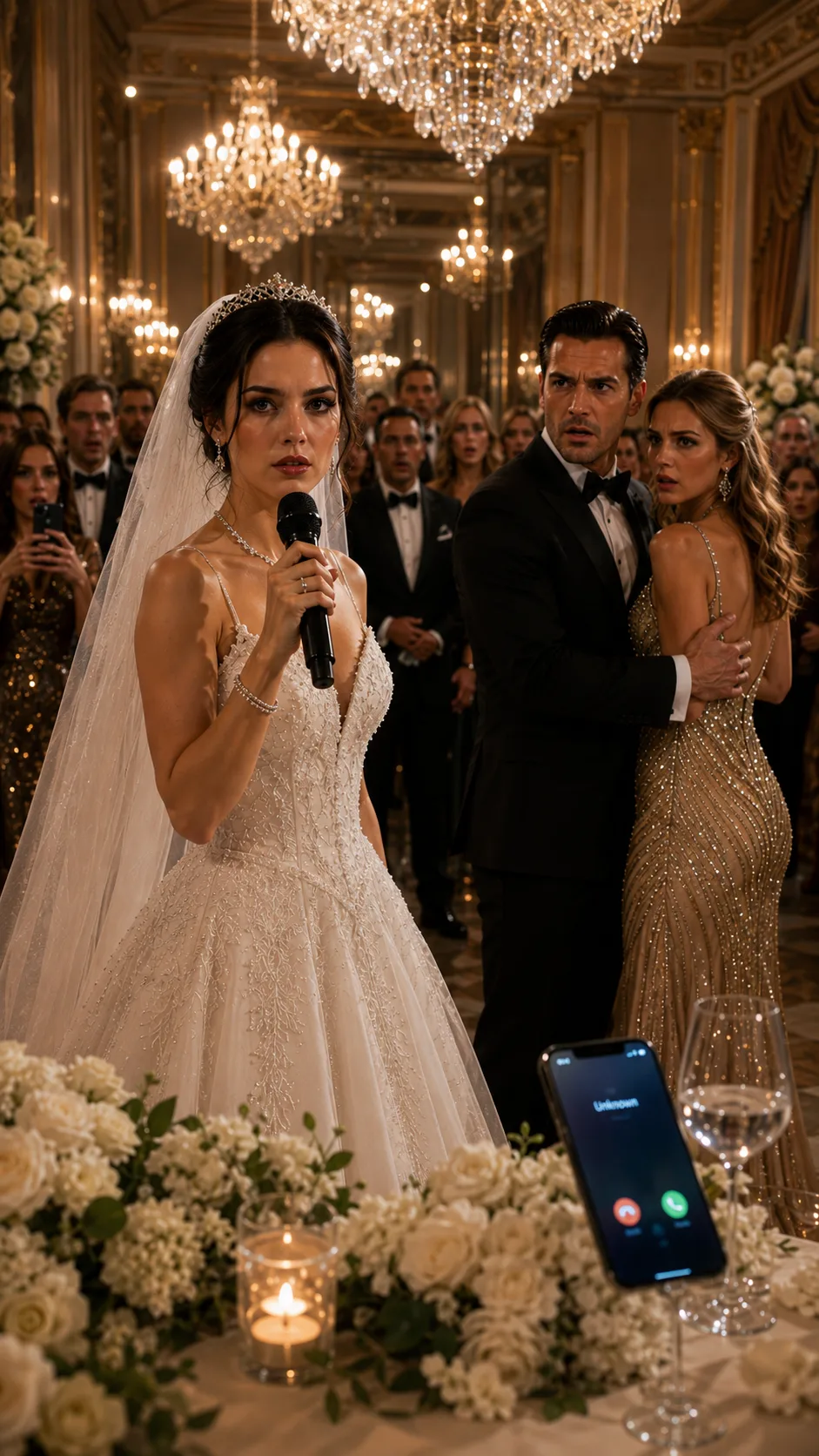
Not Adrian’s face. Not Vanessa’s tears. Not the headlines or the gossip or the strange satisfaction strangers took from seeing polished people exposed. I keep the sound of my own voice through the microphone, steady and clear, saying the sentence that returned my life to me.
The marriage license was never filed.
The fraud package is already with the board.
A woman can lose a wedding and still save herself.
A room can applaud your humiliation and still watch you take back the ending.
And sometimes, when the music does not stop, you stop dancing anyway.
Chapter complete
You have reached the end of this chapter.
Continue reading
Find your next story
A few more worlds to get lost in after this chapter.




