My heels clicked across the marble like a countdown.
Chapter 2
My heels clicked across the marble like a countdown.
3,415 words
Adrian turned Vanessa in a slow circle. Vanessa’s gold dress flashed like a blade. The guests leaned in, hungry and horrified, some pretending to look away while filming from lowered phones. My mother was crying now, one hand pressed to her mouth, confusion and humiliation twisting her face. My father had gone very still.
When I reached the microphone stand, I pulled the microphone free.
The feedback shrieked through the ballroom.
The violins stumbled.
Heads turned.
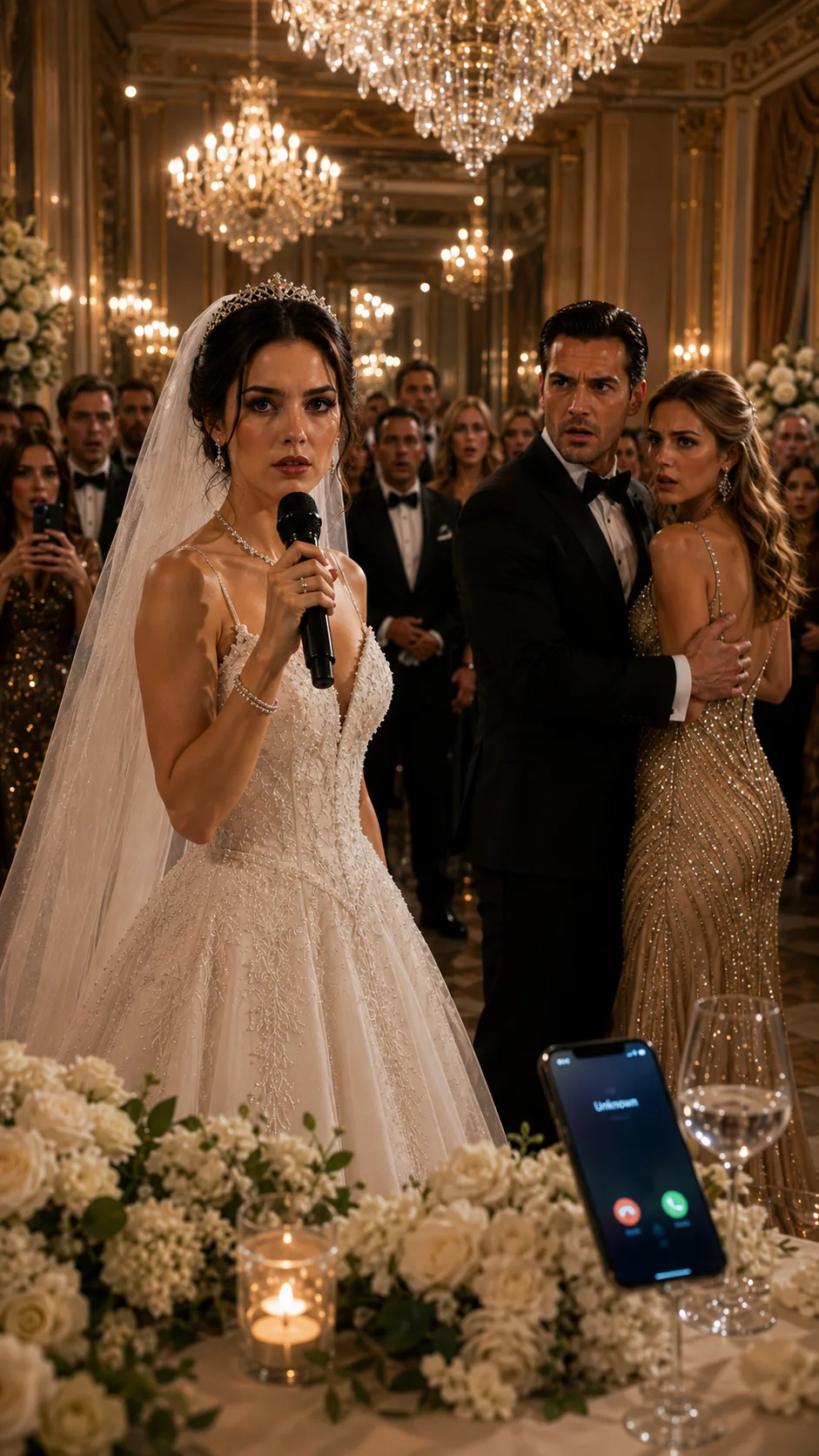
Conversations died.
Adrian finally looked at me. First with irritation. Then amusement. Even then, even after everything, he believed he controlled the ending.
“Sweetheart,” he said, smiling for the audience, “not now.”
Sweetheart.
My hand did not shake.
“Before this dance continues,” I said, and my voice cut through crystal and silk and gossip with terrifying ease, “there’s something everyone here deserves to know.”
Vanessa’s smile faltered for the first time.
Adrian’s hand tightened
on her waist.
Still smug. Still certain. Almost adorable.
He thought I was about to cry. To accuse. To do what he could later call emotional. He thought I would say he had betrayed me, that Vanessa had stolen him, that my heart was broken. All of that was true. None of that mattered as much as what I had brought to the room.
I lifted my chin.
“The marriage license was never filed,” I said, “and the fraud package you both signed this afternoon is already with the board.”
Adrian’s face emptied.
I watched it happen in stages. The color vanished first. Then the arrogance. Then the charm. Then whatever belief had been holding him upright. His fingers slipped from Vanessa’s back. His knees buckled so suddenly that Vanessa stumbled away from him with a cry much uglier than her smile had been.
And while the violins kept playing
three stunned, disjointed measures before finally dying, and three hundred people stared, and my mother pressed both hands over her mouth in shock, Adrian looked up at me from the middle of the dance floor as if he were seeing me clearly for the first time.
Then the first phone in the room began to ring.
It was my father’s.
He looked down at the screen and went still.
Then two men from our family office checked their phones at almost the same moment. Martin Bell, my father’s chief counsel, rose from a table near the front with a slim black folder already in one hand. A board member from Ellison Mercer stood too quickly, knocking his napkin to the floor. One of the reporters near the back stopped pretending to be discreet and began filming openly.
Vanessa took one step away from Adrian.
Then she made her first mistake.
She turned to him and whispered, too sharply, too furiously, “You said she signed everything.”
Every person close enough to hear went silent.
Adrian stared up at her with naked hatred.
Not love. Not loyalty. Not even fear.
Blame.
The ten-year romance he had just declared to the room cracked in half in one glance.
My father rose.
Robert Ellison was not a loud man. He never had been. His power lived in stillness, in patience, in the kind of quiet that made rooms rearrange themselves before he said a word. He had built his reputation by listening longer than men expected and speaking only after they had already given him more than they meant to. At sixty-four, he was broad-shouldered, silver-haired, and elegant in the old-fashioned way, though his body had not fully recovered from the minor cardiac procedure he had undergone five months earlier. He stood slowly, one hand on the table, his eyes fixed not on Adrian, but on Vanessa.
“Lock the doors,” he said.
The ballroom changed temperature.
Private security moved immediately.
Men in dark suits who had looked like part of the background only moments earlier stepped into purpose. The side exits were covered. The main doors were closed. Guests pressed back from the dance floor, suddenly aware they were not simply attending a scandal. They were standing inside something legal, something financial, something with consequences that extended far beyond gossip.
My mother stood next, one hand gripping the tablecloth.
She looked at Vanessa and whispered, “How long?”
Nobody answered her.
So I did.
“Long enough to turn our engagement into an acquisition strategy.”
Adrian pushed himself to his feet. His knees were unsteady, but desperation restored him quickly. Men like him recover fastest when an audience is watching.
“This is insane,” he said loudly, looking around the room for sympathy. “Claire is upset. She’s trying to embarrass us because she misunderstood a joke.”
“A joke?” I asked.
His charm snapped back into place with astonishing speed. It was almost impressive.
“Vanessa is family,” he said. “We were trying to lighten the mood. That’s all. Weddings are emotional. Claire has been under pressure.”
I almost admired the lie.
Not because it was good.
Because it was fast.
“Then maybe you can explain the shell company paperwork you buried inside the wedding authorization packet,” I said. “Or the proxy transfer clauses assigning emergency voting rights to a holding entity controlled by your firm. Or why my sister was listed as a related-party beneficiary on three of the draft agreements your assistant couriered to my apartment.”
A murmur moved through the room.
It was different from the earlier whispering. Less hungry. More frightened. The kind of sound powerful people make when they realize they are adjacent to liability.
Martin Bell reached the dance floor. He did not look at Adrian as a groom. He looked at him as a man standing inside a crime scene.
Adrian’s voice hardened.
“You can’t prove intent.”
“I don’t need to,” I said. “You proved it for me. Publicly. In front of witnesses.”
Martin opened the folder and handed copies to my father, to the chair of our family office board, and to Detective Alan Rusk, the head of a private investigations firm my family used for corporate due diligence. Rusk stood with the relaxed posture of a man who had already heard worse things from people in better suits.
Adrian’s eyes moved from face to face as he realized this had not begun tonight.
It had been building under his feet for months.
He just had not noticed because he never believed I would act.
I met his stare.
“You started planning this the week after our engagement,” I said. “You needed access to my family’s investment arm. You needed my signature on trust restructuring documents. And when that moved too slowly, you hid transfer language inside wedding paperwork, assuming I would sign whatever you put in front of me because I was distracted by flowers and seating charts.”
His laugh came out strangled.
“You sound paranoid.”
“Do I?”
I held out my hand.
Martin placed a tablet into it.
The screen was already unlocked. I tapped once, and Adrian’s voice filled the ballroom through the sound system.
Not from tonight.
From six weeks earlier.
“She’s cautious with anything that looks financial,” Adrian said in the recording, his tone lazy with contempt. “So the legal language has to sit where she won’t expect it. Wedding packet, not board packet. And if she hesitates, Vanessa will keep her distracted. She always does.”
A woman laughed.
My sister.
Then Vanessa’s voice, clear as glass: “Just make sure the wife signs before the wife gets suspicious. After that, she can cry all she wants.”
The room detonated.
People gasped. Someone cursed. My mother sat down so abruptly her chair scraped the floor. One of the society photographers lowered her camera and simply stared, as if even she understood that not every humiliation should become content.
Vanessa looked at me as though she had forgotten who I was.
“You recorded us?”
“No,” I said. “Your own carelessness did. You left his tablet open in my library after brunch. The cloud did the rest.”
Adrian lunged toward me.
Security intercepted him before he took two steps.
He shouted my name, not like a husband, not like a man wounded by betrayal, but like someone whose entire plan had just gone up in flames in public.
“You had no right—”
“No right?” My voice rose for the first time. “You courted me with one hand while sleeping with my sister behind my back with the other. You used my home, my trust, my family name, and my wedding day as cover for fraud. Tell me more about rights, Adrian.”
He stopped fighting.
Not because he was ashamed.
Because he finally understood shame was no longer the threat.
Exposure was.
Vanessa found her voice next, and when she did, the sweetness was gone from it entirely.
“You’re twisting this,” she snapped. “You always do this. You always think you’re the smartest person in the room. Maybe Adrian loved me first. Maybe he should have been with me all along. Did that ever occur to you?”
The cruelty in her face was so familiar that for one strange moment I saw her at fourteen, standing in the doorway to my bedroom with mascara streaks on her cheeks, clutching the pearl necklace she had stolen from my jewelry box and crying not because she was sorry, but because she had been caught.
Vanessa had always wanted what was mine most when other people could see it on me.
Not because she valued it.
Because I did.
Growing up, she borrowed my sweaters without asking, then cried when I wanted them back. She took my perfume and told Mom I was being materialistic. She told boys I liked that I was too serious, too intense, too hard to love, then acted wounded when I stopped telling her things. She learned early that tears were currency and that I, being older, was expected to be generous. My mother excused her because Vanessa was “sensitive.” My father, busy building an empire and loving us in the practical but sometimes distant way of men who believe protection can substitute for attention, often noticed too late. I became careful. Vanessa became charming.
And Adrian had mistaken her charm for softness.
Or maybe he had recognized the hunger underneath and loved it because it resembled his own.
“If he loved you,” I said, “he should have stood beside you without trying to empty my accounts and hijack my family’s voting structure. But neither of you wanted love. You wanted leverage.”
She laughed sharply.
“You think you’re better than everyone because you read contracts.”
“No,” I said. “I think I’m safer than you because I do.”
That line landed harder than I expected.
A few guests actually looked away from Vanessa.
My father stepped forward at last. He held the amended documents in one hand, the ones Adrian thought gave him access and that I had rerouted instead. His voice was calm enough to cut.
“The moment Claire signed these in the presence of counsel, every entity named in your transfer structure triggered internal review,” he said. “Our banks were notified. The board was notified. Your firm’s pending merger review was flagged with supporting evidence. The charitable foundation where you sought a seat has been informed. The district attorney’s office will receive a copy before midnight.”
Adrian’s expression changed again.
This time, it was not theatrical. It was not for the audience.
It was pure fear.
He looked at me the way men look at cliffs they did not notice until they are falling.
“Claire,” he said, and for the first time that night he sounded almost human. “Please. Let’s talk privately.”
I stared at him.
He had humiliated me before the people I loved most. He had declared love for my sister in the center of our wedding reception. He had planned to bind himself legally to me while sleeping with her and quietly rerouting power through companies designed to look respectable from a distance. He had treated my trust like a weakness and my silence like consent.
“We are talking privately,” I said. “This is just the largest private room you’ve ever had.”
For one second, Lila made a sound that might have been a laugh if it had not been strangled by horror.
Detective Rusk approached Martin and murmured something. Martin nodded once and turned toward my father.
“There’s more,” he said.
He handed me another sheet.
I scanned it and felt my stomach turn cold in a new way.
It was a draft email from Vanessa to Adrian from four months earlier. The subject line was simple.
If the board seat opens.
The email was short, but every sentence contained a blade. Vanessa had written that if my father’s health created instability, public sympathy around a wedding would make the family office easier to influence. She suggested accelerating the ceremony timeline “if necessary.” She mentioned that my father’s cardiac scare could be “positioned as a reason for continuity planning.” She said that once Adrian had spousal proximity and emergency proxy rights, I would “follow Dad’s preference for calm” and avoid a public fight.
My father had undergone a minor procedure five months earlier.
It had not been life-threatening.
But they had seen it as an opportunity.
I looked up slowly.
My mother began to cry.
My father did not.
That was worse.
He folded the paper once and handed it back to Martin.
“Remove them,” he said.
Vanessa took a step toward him.
“Dad—”
“Don’t.”
I had never heard that tone in his voice toward either of us.
She stopped as if struck.
For all her cruelty, all her performance, all the times she had used softness to escape consequence, Vanessa had never heard my father close a door so completely. For a second she looked young. Not innocent. Never innocent. But young in the way all selfish people look young when they discover the world has limits.
Adrian tried one last tactic.
He dropped the outrage and reached for softness instead, the old polished charm he used on bankers, journalists, donors, waiters, and anyone he thought could still be manipulated.
“Claire,” he said. “I made mistakes. I did. But I never meant for this to happen like this.”
I almost asked which part he meant. The affair? The theft? The public humiliation? The ten-year declaration to my sister in the middle of our wedding? The false paperwork? The attempt to exploit my father’s medical scare? The fraud package he believed I would sign because he thought flowers could distract me from governance language?
Instead I said, “You mean you never thought I’d fight back.”
He had no answer.
Security escorted him toward the exit. He tried once to twist back toward me, but cameras were everywhere now and he knew any further struggle would only feed them. Vanessa stood frozen until my mother turned away from her.
That was what broke her.
Not the documents.
Not the witnesses.
Not even the possibility of charges.
My mother’s refusal to look at her.
“Mom,” Vanessa whispered.
No one answered.
Security guided her after Adrian.
The ballroom doors shut behind them with a heavy, expensive thud.
For several seconds, no one moved.
The flowers still smelled sweet. The candles still burned. My place card still sat on the sweetheart table next to Adrian’s as though the evening had not ruptured down the middle. The cake stood untouched under a canopy of sugar flowers. The champagne towers gleamed. The dance floor remained open, a perfect circle of marble that had become evidence.
Then the wedding planner, a woman named Elise who either possessed genius or was running on pure survival instinct, approached me very carefully.
“Claire,” she said, her voice soft enough not to trigger panic, “would you like everyone to leave?”
I looked around the room.
At my mother with tear-streaked cheeks.
At my father standing rigid beside the dance floor, every inch of him held together by force.
At Lila, whose horrified face had softened into something fiercer and prouder.
At the guests who had applauded minutes earlier and now looked as if they would have paid anything to become invisible.
At the reporters who understood they had witnessed something that would be whispered about for years.
At the tables, the food, the flowers, the band, the hundreds of decisions I had made for a wedding that no longer existed.
And suddenly I was so tired I thought I might fold in half.
But I did not want to leave in shame.
Not from my own wedding.
Not from a room where I had just survived public cruelty and turned it inside out.
So I set the microphone down and said the truest thing I had said all day.
“No. They can stay for dinner. He’s the one who’s gone.”
A startled laugh escaped somewhere near the back. Then another. The tension cracked, not fully, but enough for people to remember they had bodies. Someone breathed. A waiter shifted. A guest set down a glass too loudly. Even my father let out a breath that sounded dangerously close to a smile.
The quartet, unbelievably, resumed playing.
Not a love song this time.
Something stronger.
Lila came to my side and put her arm around me.
“That,” she whispered, “was terrifying.”
“For me or for them?”
She gave me a watery smile.
“Yes.”
My mother reached me next. Margaret Ellison had spent most of her life making elegance look effortless, but that night she looked stripped down to pain. Her lipstick had faded. Her eyes were red. She touched my face with both hands the way she had when I was small and feverish.
“I’m sorry,” she whispered. “I didn’t see it.”
“Neither did I at first,” I admitted.
That was the part that hurt most later. Not only that Adrian and Vanessa had lied, but how close I had come to making a life inside those lies. How many little instincts I had talked myself out of because truth would have been inconvenient, embarrassing, disruptive. How many red flags I had translated into stress, timing, pressure, misunderstanding. How many times I had told myself Vanessa was only dramatic, not dangerous. How many times I had told myself Adrian was ambitious, not predatory. How many times I had mistaken discomfort for overthinking.
My father came to me last.
For a moment, he did not speak. Robert Ellison, who had negotiated nine-figure acquisitions without blinking and walked senators through tax reform over dinner, stood before his daughter in the ruins of her wedding and looked utterly helpless.
Then he did something he had not done since I was a child.
He kissed my forehead.
“You saved us tonight,” he said.
I should have felt triumphant.
Instead I felt hollow, relieved, furious, embarrassed, and strangely calm all at once. Survival is rarely as satisfying as people imagine from the outside. It does not arrive like fireworks. It arrives like a locked door, a signed document, a phone ringing at the right moment, a sentence finally spoken into a microphone.
Dinner was served.
That was perhaps the strangest part.
The wedding dinner I had spent months selecting was served after the groom was removed by security and my sister disappeared under the weight of her own exposure. Waiters moved carefully through the room with plates of sea bass, filet, roasted vegetables, and truffle potatoes while guests tried to decide how normal to behave. Some left quietly. Others stayed because curiosity had fused them to their chairs. A few came to me with apologies so awkward I almost felt sorry for them.
One of Adrian’s college friends, the same one who had whistled when the dance began, approached me near the bar.
“Claire,” he said, sweating slightly, “I just want you to know I had no idea.”
“I believe you.”
“I mean, I thought it was some kind of, you know, performance thing. Like ironic or playful or—”
“I said I believe you.”
He swallowed.
“Right. Sorry.”
He left before I could ask whether he always applauded things he did not understand.
By ten o’clock, the first article had appeared online. The headline was restrained, probably because the reporter’s editor had not yet seen all the footage.
Ellison Wedding Erupts After Bride Alleges Fraud Attempt.
By midnight, restraint had vanished.
The Bride Who Stopped the Dance.
Society Wedding Turns Into Corporate Fraud Scandal.
Vale Partner Suspended Amid Wedding Night Accusations.
Heiress Bride Reveals Groom’s Alleged Scheme During Reception.
I refused to read most of them.
Chapter complete
You have reached the end of this chapter.
PreviousMy husband thought our wedding night would be the perfect place to humiliate me: three hundred witnesses, society photographers at the edges of the ballroom, my sister glowing in gold as he announced that she—not me—was the woman he had loved for a decade, and a crowd cruel enough to applaud while the bride stood frozen in diamonds and white silkNextMy wedding gown filled the backseat of the car like a second passenger.Read next chapter
Continue reading
Find your next story
A few more worlds to get lost in after this chapter.




