By Saturday afternoon, the rain had washed the city clean, but nothing inside me felt clean.
Chapter 3
By Saturday afternoon, the rain had washed the city clean, but nothing inside me felt clean.
I stood in the ladies’ restroom at the Whitaker Community Arts Center with both hands gripping the edge of the sink. The mirror lights made my face look too pale. Someone had left a smear of lipstick on the counter and a wet paper towel near the trash, curled like a shed skin.
Outside, a string quartet played something soft and expensive.
The donor reception had been planned for months. Evan’s father had built half his reputation on that center. Evan had spent years positioning himself as the next chairman of the foundation board, smiling in photographs with children’s art behind him, saying things like “safe homes build strong futures.”
Safe homes.
I pressed my thumb into the inside of my wrist where his fingers had gripped me Tuesday night. The mark was faint now. Almost gone. That felt unfair.
My knees started shaking.
Not a little. Not in a
delicate way.
I locked myself in the far stall and sat on the closed toilet lid with my head bent forward, breathing through my teeth. My black dress felt too tight at the ribs. I wanted my mother. Not in a poetic way. I wanted her real hands, her chipped coral nail polish, the way she used to say my name when I was pretending not to be sick.
Claire-bear, don’t perform for people who won’t clap when you survive.
I had forgotten that until the blue mug broke.
There was a soft knock on the restroom door.
“Mrs. Whitaker?” a woman said.
I wiped under my eyes with my knuckle. “Yes?”
“It’s Lena. From catering.” A pause. “Your sister is outside. She said she can wait as long as you need.”
My throat closed.
Mara had driven three hours that morning in the old Subaru she refused to sell.
She had brought a garment bag, coffee, and a silence so careful it made me cry before we reached the venue.
I opened the stall door.
Lena stood by the sinks in a white catering shirt and black apron. She was maybe twenty-two, with tired eyes and a tray balanced against her hip. She looked at my face and then away quickly, giving me privacy without leaving.
“My aunt,” she said quietly, “she had a husband like that.”
I went still.
Lena looked at the floor. “Sorry. I shouldn’t.”
“No,” I said. My voice cracked. “Thank you.”
She nodded once and left.
That small kindness nearly ruined me.
I fixed my lipstick badly. Then I walked out.
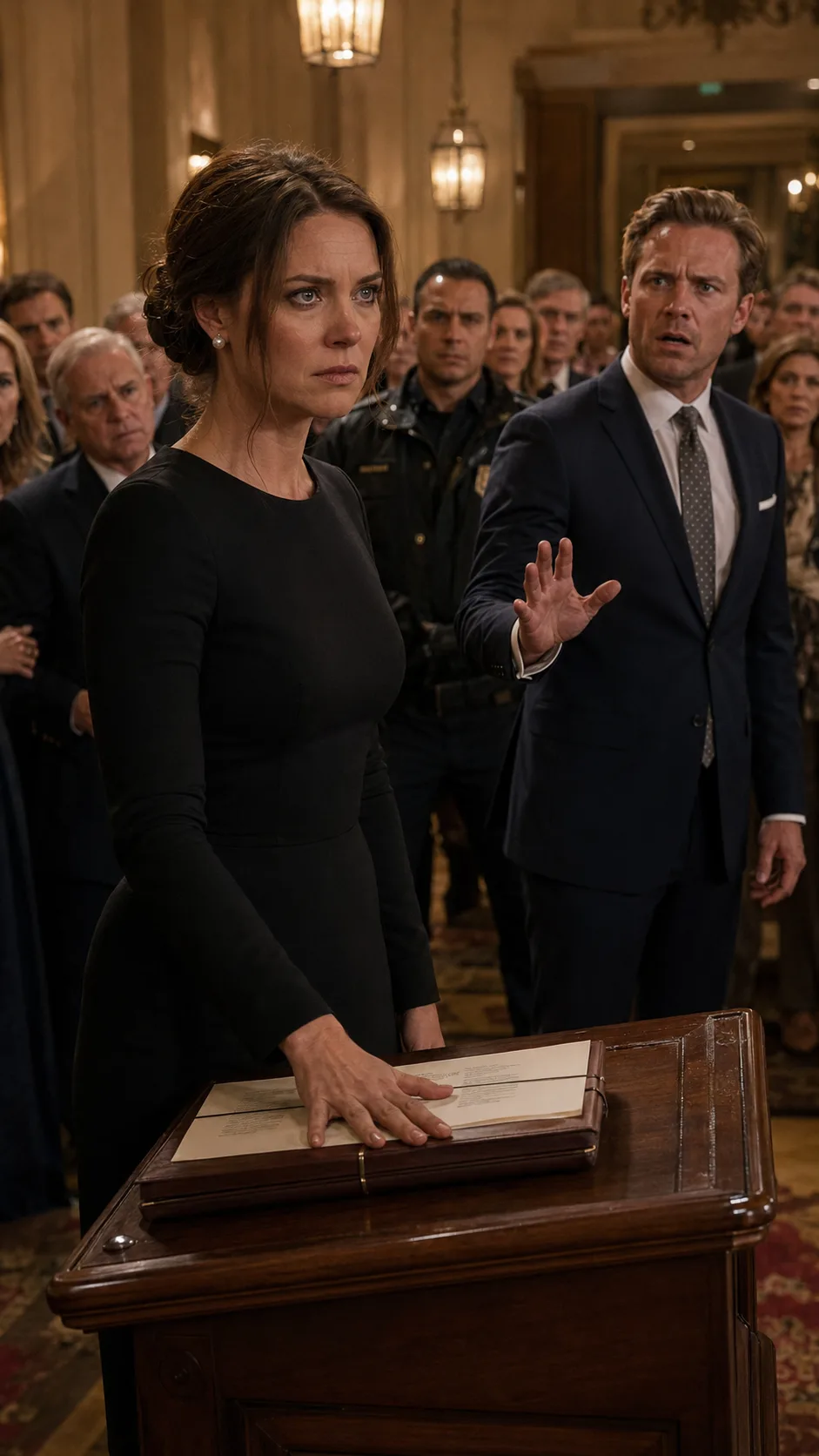
The reception hall was full of people who knew how to pretend. Men in navy suits. Women in pearl earrings. Board members clustered under glass pendant lights. The walls displayed framed photographs of
renovated shelters, after-school programs, smiling families holding donated backpacks.
At the front of the room, Evan stood beside his father, Charles Whitaker, accepting praise.
He had been released Tuesday night without staying in a cell. People like Evan rarely experienced consequences in straight lines. Officer Brooks filed the report. Mark submitted the statement. My attorney filed the emergency petition. But Evan’s lawyer was already moving. His father’s lawyer too.
By Friday, Evan had turned the story into concern.
Claire was struggling.
Claire was fragile.
Claire was being influenced by an old acquaintance with a grudge.
And because society loves a calm man in a tailored suit, some people had started to believe him before I even entered the room.
Mara touched my elbow. “You don’t have to do this here.”
“Yes,” I said. “I do.”
At 5:40, Charles Whitaker stepped up to the podium and tapped the microphone.
The room softened into silence.
“Friends,” he began, “thank you for standing with our family and our foundation during a week of unfortunate private difficulty.”
Private difficulty.
I felt Mara inhale beside me.
Charles continued, “My son and daughter-in-law have been under immense strain. Marriage is sacred, but it is also complicated. We ask for compassion, discretion, and faith in the character of a man many of you have known since he was a boy.”
Evan stood to his right, eyes lowered, playing wounded dignity beautifully.
Then Charles looked straight at me.
“And Claire,” he said, voice warm enough to fool strangers, “we hope you accept the help being offered to you.”
Every head turned.
That was the public part. The gentle cage. The wealthy version of a hand over the mouth.
My pulse beat in my ears.
Mara whispered, “Claire.”
I walked forward.
The sound of my heels on the polished floor seemed too loud. A waiter near the back stopped pouring champagne. Lena stood by the service door, tray held at her waist.
Charles stiffened as I approached the podium.
Evan lifted his chin slightly. Warning me.
I stepped beside the microphone.
“I only need two minutes,” I said.
Charles covered the mic with his hand. “This is not appropriate.”
I looked at him. “Neither was your son calling my doctor to ask whether my records could be corrected.”
The room changed.
Not loudly. Just enough.
A cough stopped halfway. Someone set down a glass. Evan’s face flickered.
Charles removed his hand from the microphone.
I opened the black folder Mara had carried in her purse. Not the whole evidence folder. That was with my attorney. This was simpler.
Cleaner.
A certified copy of the emergency protection order.
A copy of Officer Brooks’s incident report.
A notarized statement from Dr. Patel.
And Mark Delaney’s 2012 witness statement, now attached to a reopened internal review and a civil complaint from Evan’s first girlfriend, whose name I would not say into a microphone because she had already lost enough privacy to the Whitaker family.
Evan stepped toward me. “Claire, stop.”
I looked at him then.
For seven years, I had mistaken survival for obedience. I had thought staying quiet meant staying alive. Maybe sometimes it had. But that night in the kitchen, when the blue mug broke and someone knocked before his hand came down, I understood something ugly and useful.
Silence had protected him too.
I placed the first document on the podium.
The paper made a small sound against the wood.
“This is not a marital misunderstanding,” I said. “This is a record.”
Charles’s face went red. “Turn off the microphone.”
No one moved.
The young sound technician by the side wall looked at me, then looked down at his board and slowly took his hand away from the controls.
A normal man. A stranger. One small refusal.
It steadied me.
I placed the second document down.
“This is a report from Tuesday night.”
Evan’s voice sharpened. “She’s lying.”
Officer Mark Delaney stepped from the rear entrance in uniform.
He was not alone. Officer Brooks was with him, and behind them stood a woman in a gray coat with cropped auburn hair, her face composed in a way I recognized. Not calm. Practiced.
Evan saw her and stopped moving.
The room followed his stare.
Mark did not touch his weapon. He did not raise his voice.
“Mr. Whitaker,” he said, “you’ve been advised not to approach Mrs. Whitaker.”
The woman in the gray coat looked at Evan.
For a second, she was twenty years old again in some college hallway I had never seen, waiting for someone to tell the truth before a powerful family taught her what silence cost.
Evan whispered, “Rachel.”
So that was her name.
Rachel.
The name missing from every story Evan had ever told me.
Charles stepped away from the podium as if the floor had shifted.
Rachel did not speak to Evan. She looked at me.
Then she nodded.
It was not dramatic. It was not forgiveness. It was not sisterhood wrapped in a bow.
It was proof that I had not imagined the pattern.
That was enough.
Evan looked around the room for someone to rescue him. His father. The mayor. The board members. The old donors who had laughed at his jokes and called me quiet like it was a flaw.
No one stepped forward.
Lena, still by the service door, set her tray down very carefully.
The sound of glass touching metal carried through the hall.
Officer Brooks approached Evan. “Sir, you need to come with us.”
He stared at me.
The anger was there. Under the shock. Under the humiliation. Still alive.
“You planned this,” he said.
I thought about the porch light. The blue mug. The folder hidden under dead sheet music. The courthouse hallway where I almost turned around.
“Yes,” I said. “I did.”
After they escorted him out, nobody clapped.
I was grateful for that.
Applause would have made it feel like a performance, and it had cost too much to be entertainment.
Mara found me near the side exit ten minutes later, sitting on a low stone bench behind the building where the caterers took smoke breaks. The evening air smelled like wet concrete and cut grass. My hands were wrapped around a paper cup of coffee Lena had brought me. It had gone lukewarm.
“You okay?” Mara asked.
“No.”
She sat beside me. “Good answer.”
Across the parking lot, the porch lights of nearby townhouses began blinking on one by one. I watched them until my breathing slowed.
My phone buzzed.
A message from Mark.
Rachel agreed to give a full statement. Your attorney has it.
Then another message.
Also, Mrs. Donnelly called the station. She has footage from Tuesday.
I stared at the screen.
Mrs. Donnelly, who never fixed her porch light.
Mara leaned her shoulder against mine. “What is it?”
I turned the phone slightly so she could see.
She read it and let out a breath that was almost a laugh.
The coffee in my cup trembled because my hand did.
I did not know what would happen next. Evan’s father still had money. The foundation still had lawyers. The court dates would come, and so would the mornings when I would reach for fear before remembering I didn’t have to serve it breakfast.
But that night, I went home with Mara.
Before I left the arts center, I dropped the cracked blue mug pieces into the trash bag in my purse. I had brought them without knowing why.
At Mara’s apartment, I placed the largest piece on her kitchen windowsill.
The handle was still attached.
Chapter complete
You have reached the end of this chapter.
Continue reading
A few more worlds to get lost in after this chapter.




