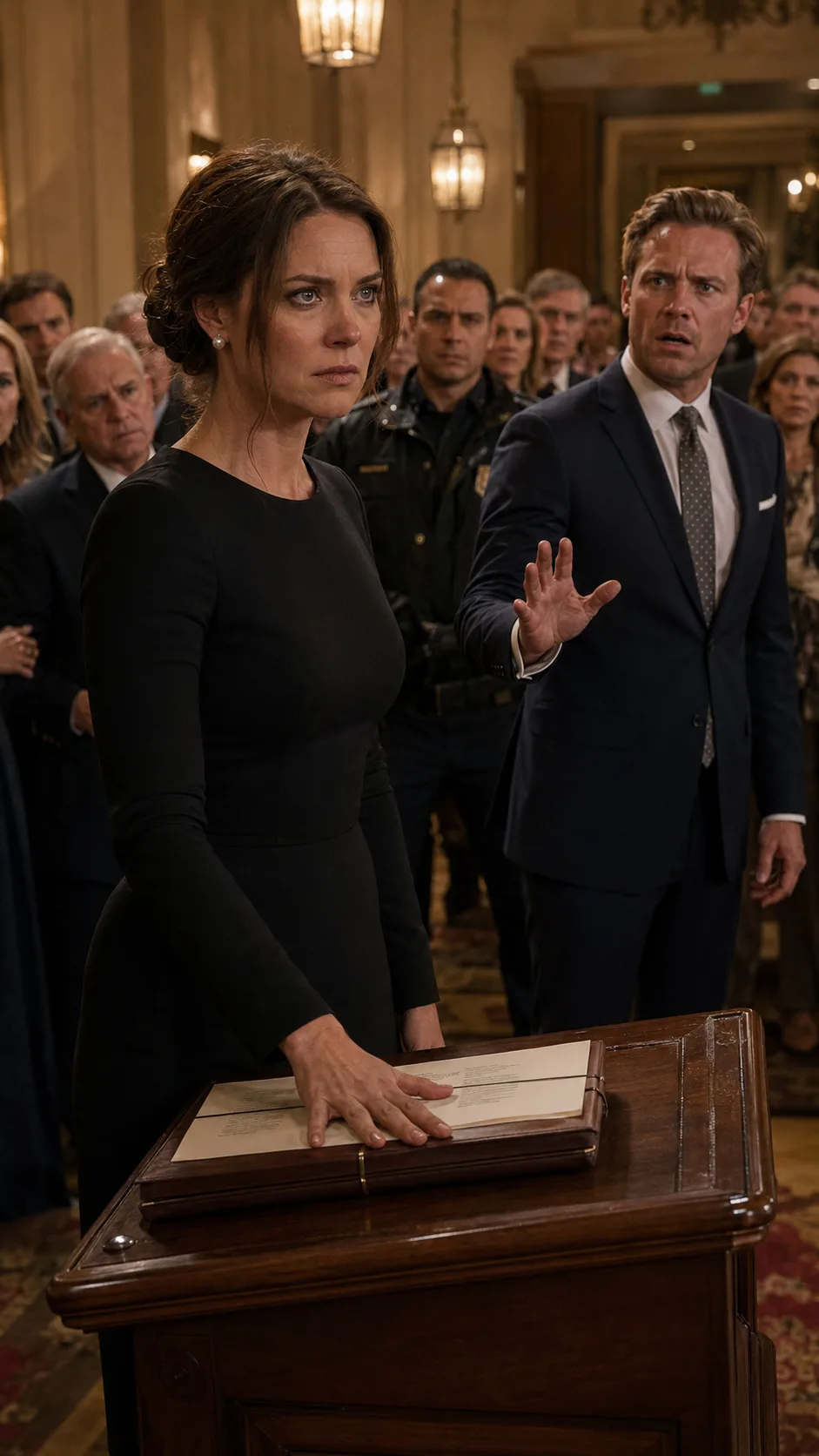
The knock came again.
Chapter 2
The knock came again.
Three firm hits against the old brass plate on the front door.
Evan froze with his hand still lifted.
It should have been funny, maybe, the way a man could stand in his own kitchen wearing a two-thousand-dollar suit and still look like a boy caught stealing from a corner store. But nothing about him felt small. Not then.
His eyes cut toward the hallway.
“Who is that?”
I did not move.
The chicken kept ticking in the oven as it cooled. Rain pushed harder against the glass. My phone was still in his hand, screen dark now, his thumb pressed against the edge like he might crack it by force alone.
Another knock.
“Police department,” a voice called through the door. “Mrs. Whitaker?”
Evan’s face tightened.
Not fear. Not yet.
Recognition.
He whispered, “No.”
That one word landed harder than shouting would have.
He knew the voice.
The air
inside my chest loosened by half an inch.
Evan lowered his hand slowly. “What did you do?”
I wiped my palms on my jeans. “I answered a question.”
“What question?”
“Whether I wanted them to come.”
His laugh came out thin. “You think this is going to help you?”
I walked past him toward the hallway. He grabbed my wrist, not hard enough to leave a mark this time, but enough to remind me that he knew exactly where every old bruise had lived.
“Claire.”
I stopped.
His fingers tightened.
“You open that door, and you don’t come back from it.”
For years, that sentence would have worked. Not because I believed him. Because I believed I would be alone afterward. That is the private math of a trapped woman. You count rent, shame, family questions, court dates, his apologies, your mistakes, the dog you lost because he said he
hated fur on the couch, the friends who stopped asking why you canceled.
Then you divide it by fear and call the answer marriage.
I looked down at his hand around my wrist.
“Let go.”
He leaned closer. “You don’t know what you’re doing.”
“I do.”
“You think Mark Delaney is some hero? You think he’s here because he cares?” Evan’s voice dropped low. “Ask him what happened in 2012.”
My breath caught before I could stop it.
Evan saw it. Of course he did.
His mouth curved. “He didn’t tell you.”
The porch light shone through the frosted glass panel beside the door, turning the hallway a pale yellow. A shadow moved outside. Mark shifted his weight.
“Mrs. Whitaker,” he called. “Are you safe to open the door?”
I looked at Evan.
He released my wrist.
The skin there burned where his fingers had been.
I opened the door.
Officer Mark Delaney stood on the porch in a dark rain jacket over his uniform, water dripping from the brim of his cap. Behind him, a second officer waited near the steps, one hand resting calmly at his side. Mrs. Donnelly’s porch light flickered across the street. Her curtains were open by two inches.
Mark looked first at my face, then at my wrist, then past me.
His expression did not change much, but his voice hardened.
“Evan.”
Evan stepped into the hallway behind me, smoothing his tie as if a camera crew had arrived.
“Mark,” he said. “This is awkward.”
“No,” Mark said. “It isn’t.”
The second officer came closer. She was younger, Black, early thirties maybe, with her hair pulled into a tight bun and rain shining on her shoulders. Her nameplate read R. Brooks.
“Mrs. Whitaker,” she said, “we received a call related to an active safety plan.”
Evan laughed. “A safety plan. That’s dramatic.”
Mark’s eyes stayed on him. “Step back from her.”
“I’m in my own house.”
“Step back.”
Evan’s cheeks colored. He took one step back, slow and insulting.
Officer Brooks turned to me. “Do you need medical attention?”
“No.”
My voice sounded too small.
Evan folded his arms. “She drops a mug, panics, calls some old college friend, and now I have police at my door. Mark, come on.”
Mark did not look at me when he answered. “I’m not here as your old college friend.”
Evan smiled wider. “Right. You’re here as the officer who still owes me.”
The hallway went very still.
Officer Brooks glanced at Mark.
Mark’s jaw set.
I remembered what Evan had said seconds earlier.
Ask him what happened in 2012.
The past stood there with us, wet from the rain.
Mark removed his cap and held it at his side. “Evan, don’t.”
“Don’t what?” Evan said. “Mention that you had a temper too? That you put a guy in the hospital outside Murphy’s Bar because he said something about your sister? You think a badge erases that?”
My stomach folded in on itself.
Mark looked older suddenly. Not guilty. Tired.
“That was investigated,” he said.
“Because my father made calls.”
“Because I reported myself.”
Evan’s face twitched.
That was the first crack.
Mark took one step into the foyer. “You keep telling that story wrong.”
Evan’s eyes flashed. “Get out of my house.”
Officer Brooks lifted one hand. “Sir, lower your voice.”
“My wife is unstable,” Evan said, turning toward her with that polished concern he used at charity brunches. “She’s been under stress. Her mother died, she’s been paranoid, she’s been hiding things—”
I almost laughed again. My mother had been dead five years. He still used her when convenient.
Officer Brooks looked at me. Not at him.
“Mrs. Whitaker, may we come inside?”
I nodded.
Evan moved as if to block them, but Mark looked at his feet, then at his face.
“Don’t make this worse.”
Evan stepped aside.
Inside the living room, everything looked staged for a life we did not have. Cream sofa. Framed wedding photo. Silver bowl of fake pears on the coffee table because Evan liked “clean surfaces.” On the mantle was a picture of us at the mayor’s fundraiser, his hand resting at the center of my back, fingers spread like ownership.
Officer Brooks asked me to sit.
I sat on the edge of the sofa.
Evan remained standing.
Mark stood near the fireplace, his hands visible, careful. “Claire, do you want to give Officer Brooks the folder?”
Evan turned his head toward me.
“What folder?”
I looked at the hallway closet.
That was the first place Evan checked whenever he thought I was hiding something. So naturally, I had stopped hiding things there.
Instead, the folder was inside the piano bench.
The piano had belonged to Evan’s grandmother. He kept it because it looked expensive, though neither of us played. I crossed the room and lifted the bench lid. Inside, under yellowed sheet music, was a brown accordion folder secured with a black elastic band.
Evan stared at it as if it had crawled out of the floor.
I carried it to Officer Brooks.
My fingers slipped once on the elastic. I hated that. I hated that my body still betrayed me in small ways.
Officer Brooks took the folder gently.
Inside were photos. Dates. Emergency room discharge papers. A copy of the credit card statement from the hotel where Evan stayed the weekend he told everyone I had “fallen down the basement steps.” A flash drive. Screenshots. My handwritten notes. A letter from Dr. Anita Patel, who had asked me three times if I felt safe at home before I finally answered with silence instead of a lie.
And there was one sealed envelope marked 2012.
Evan saw it.
The color drained from his face.
“What is that?” he said.
Mark looked at him. “You know.”
I didn’t.
Not yet.
Officer Brooks opened the folder on the coffee table. Her face stayed professional, but her hand paused on the first photograph.
A normal person’s reaction can undo you worse than cruelty.
She swallowed once.
Evan pointed at Mark. “You planted this.”
Mark said nothing.
“You always wanted to ruin me,” Evan snapped. “Ever since college.”
Mark’s voice was quiet. “I wanted you to stop.”
Evan turned to me. “Do you know why he hates me? Did your little savior tell you he watched me hurt someone and said nothing for six months?”
The room tilted.
Mark closed his eyes for half a second.
Then he opened them and looked at me.
“No,” he said. “I didn’t tell you. I should have.”
Evan smiled like he had won.
Mark reached into his jacket and took out a folded copy of an old statement sealed in a plastic sleeve.
“But I brought the report tonight.”
Officer Brooks looked up.
Evan stopped smiling.
Mark placed the document on the coffee table beside my folder.
“Because the person Evan hurt in 2012 was not a man outside a bar,” Mark said. “It was his first girlfriend. And I was the witness who finally testified.”
Chapter complete
You have reached the end of this chapter.
Continue reading
A few more worlds to get lost in after this chapter.




