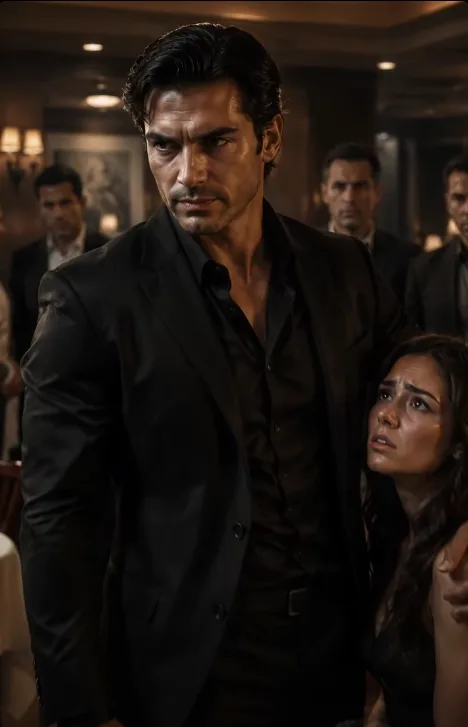
The first thing I noticed was that neither man looked surprised to see me with a bag in my hand.
Chapter 2
The first thing I noticed was that neither man looked surprised to see me with a bag in my hand.
That frightened me more than if they had shouted.
People who shout are still hoping sound will make them powerful. These men did not need sound. They stood in the hallway outside my apartment like they belonged there, like the narrow carpet, the peeling paint, the flickering light above the elevator had all been waiting for them to arrive.
One of them was older, broad through the shoulders, with gray at his temples and a face that looked carved rather than born. The other was younger, maybe thirty, with clean hands, a black coat, and eyes that kept moving without ever appearing nervous.
I locked my door behind me.
It was ridiculous. Almost funny.
As if the lock mattered now.
“You’re Elena Moral,” the older one said.
I tightened my fingers around the strap of my bag. “Who’s asking?”
The younger man’s mouth twitched, not quite a smile.
The older
one did not react at all.
“Someone who knew your father.”
That sentence landed harder than it should have. For most people, a stranger claiming to know their father would have meant history. Old friends. Memories. Stories from before you were born.
For me, it meant danger.
“My father is dead,” I said.
“Yes.”
No apology. No softness. Just confirmation.
I lifted my chin. “Then whatever business you had with him died too.”
The older man looked at me for a long moment, and in that pause I understood something unpleasant. He was not deciding whether I was right.
He was deciding how much truth to give me.
“Business doesn’t die,” he said. “People do.”
The hallway seemed to narrow.
Behind them, Mrs. Alvarez’s door opened half an inch. One of the men glanced that way, and the door closed immediately.
Smart woman.
I took one step toward the stairwell.
The younger man shifted, not blocking me exactly, but making the space smaller. A warning without a hand raised.
My heart was beating so hard I could feel it in my throat.
“You have the wrong person,” I said. “I didn’t know anything about my father’s accounts. I didn’t know his real name until after he died. I don’t have his money.”
“No,” the older man said. “You don’t.”
That was worse.
Because he knew.
He knew I was broke enough that my rent had been paid late twice that year. He knew the small savings account I had built one exhausting week at a time was not enough to save me from anything serious. He knew enough about me to know that I was not useful as a bank.
So why were they here?
“What do you want?” I asked.
The younger man reached inside his coat.
I stopped
breathing.
He pulled out an envelope.
White. Thick. Expensive.
Not a gun. Not a knife. Not yet.
He held it out to me.
I did not take it.
The older man’s voice lowered. “Your father left something that does not belong to you.”
“My father left me nothing.”
“He left you a name.”
I stared at him.
For a second, I thought I had misheard. A name? That was what this was about? Not money, not documents, not some hidden safe full of cash and sins?
A name?
The younger man moved the envelope slightly closer.
“This is an address,” the older man said. “You will go there tonight. You will ask for Luca.”
My stomach turned.
I knew that name.
Not because anyone had told it to me. Not directly. But I had heard it two nights ago in the restaurant, whispered once near the side door by someone who thought I was too shaken to listen.
Luca.
The man at the far table.
The man whose voice had turned a room full of dangerous men into statues.
The man who had said, “Leave her,” and everyone had obeyed.
I looked from the envelope to the men.
“No.”
It came out before I could think better of it.
The younger man’s expression cooled.
The older one sighed, almost patiently. “You misunderstand your position.”
“No,” I said, surprising myself with the steadiness of my voice. “I understand it perfectly. My father lied to me my whole life. Now strangers are showing up at my door, leaving notes about bank accounts I didn’t know existed, telling me I have three days to settle a debt I didn’t make. I’m done being moved around like furniture.”
The younger man stepped closer.
Not fast. Not dramatic.
Just enough.
The older one did not stop him.
I forced myself not to move back.
His gaze dropped to my bag. “You were leaving.”
“I was taking a walk.”
“With all your documents?”
I said nothing.
He smiled then. It was not a warm smile. It was the kind of smile people use when they have found the weak spot in a locked door.
“You’re smarter than your father said.”
My blood went cold.
“You spoke to him?”
The smile disappeared.
The older man looked at the younger one sharply, and the younger man fell silent.
That was the first mistake they made.
And I saw it.
My father had spoken about me.
Maybe not much. Maybe only once. Maybe only at the end, when whatever life he had built in secret was finally closing its hands around him.
But he had mentioned me.
I swallowed.
“What did he say?”
Neither man answered.
The flickering hallway light buzzed overhead.
For one strange second, I was eight years old again, standing outside my father’s office while he spoke in a language he had told me he forgot. Italian, soft and fast, pressed through the gap under the door. My mother had already left by then. My father had been making coffee at midnight, one hand shaking, the other holding the phone too tightly.
When he saw me, he smiled.
Not because he was happy.
Because he wanted me to stop being afraid.
“Go back to bed, Ellie,” he had said.
I had gone.
Children obey because they think adults know what they are doing.
Adults lie for the same reason.
The elevator dinged at the end of the hall.
All three of us turned.
The doors opened.
A man stepped out.
For a moment, the hallway changed shape around him.
He wore a black coat over a dark suit, no tie. His hair was pushed back from his face, and his expression was calm enough to be mistaken for boredom by someone who had never seen true control before.
But I had seen it.
At Carmine’s.
At the far table.
When twenty men forgot how to breathe.
Luca looked first at the two men.
Then at me.
His gaze paused on my bag.
Something unreadable moved through his eyes.
“You were leaving,” he said.
It was not a question.
I wanted to say something sharp. Something brave. Something that proved I was not afraid of him.
Instead, I said, “Your people have a habit of appearing where they’re not wanted.”
The younger man went still.
The older one lowered his eyes.
Luca did not smile.
But for half a second, the severity around his mouth changed, as if I had done something either foolish or interesting.
Possibly both.
“They’re not my people,” he said.
Silence.
The older man looked up too quickly.
That told me everything.
Luca stepped farther into the hallway. “Which means either they followed you here without permission…”
His eyes moved to the older man.
“Or someone sent them.”
The younger man’s confidence disappeared so quickly it almost made him look younger.
The older man said, “Mr. Romano—”
Luca cut him off with one look.
Not a word.
Just a look.
I had never understood how people could be commanded without being touched until that moment.
The older man closed his mouth.
Luca held out his hand.
“The envelope.”
The younger man hesitated.
Wrong choice.
Luca’s gaze shifted to him.
The envelope was placed into Luca’s palm immediately.
He opened it, read the paper inside, and his face did not change.
That made my fear worse.
People react to shocking things unless they already expected them.
He folded the paper once and slipped it into his coat.
Then he looked at me.
“Elena.”
My name sounded different in his mouth. Not softer. Not kinder.
Known.
“I need you to come with me.”
A laugh escaped me, quiet and humorless. “Absolutely not.”
The younger man made a small sound, like he could not believe I had said that.
Luca’s attention did not leave my face.
“You are not safe here.”
“I wasn’t safe two minutes ago because of men like you.”
“No,” he said. “Because of men pretending to be like me.”
That stopped me.
I hated that it stopped me.
The distinction should not have mattered. Dangerous was dangerous. A wolf wearing a cleaner coat was still a wolf.
But the two men in the hallway looked afraid of him.
And I had seen enough fear in my life to know the difference between fear of punishment and fear of exposure.
“What did my father leave behind?” I asked.
Luca’s jaw tightened.
Not much.
Enough.
“A ledger.”
The word moved through the hallway like a match struck in the dark.
The older man closed his eyes briefly.
The younger one cursed under his breath.
Luca looked at him.
The curse died.
I gripped my bag harder. “What ledger?”
“One with names that powerful men would kill to recover.”
“My father had it?”
“Yes.”
“Where is it?”
“If I knew that,” Luca said, “this hallway would be empty.”
My mouth went dry.
The note under my door. The bank digits. The three-day warning. The sudden appearance of men who knew too much. None of it had been about me settling a debt.
It had been about forcing me to look for something.
Something my father had hidden.
Something everyone believed he had given to me.
“I don’t have it,” I said.
“I know.”
I stared at him. “Then why do they think I do?”
Luca’s expression changed at last.
Not much. But enough to let me see the edge of what he was not saying.
“Because your father told them you were the only person he trusted.”
That hurt in a way I was not ready for.
My father had missed birthdays. Lied about business trips. Kept a second life buried under a first one until the grave opened and both spilled out.
But at the end, when the walls closed in, he had said my name.
Trusted me.
Or used me.
I did not know which one was worse.
The older man suddenly moved.
It was small. A shift of weight. A glance toward the stairs.
Luca saw it before I did.
“Don’t.”
One word.
The older man stopped.
The younger man did not.
He turned and ran.
Everything happened fast after that, but not in the way movies make violence fast. There was no chaos. No shouting. No dramatic struggle. The younger man reached the stairwell door, pulled it open, and found another man waiting on the other side.
He froze.
The man in the stairwell smiled politely.
“Evening.”
The younger man stepped back into the hall, pale now.
Luca did not look at him.
He looked only at me.
“You have two choices,” he said. “Stay here, and whoever sent them will send someone less polite. Or come with me, and you will hear the truth before deciding what to do next.”
I wanted to hate how reasonable he sounded.
I wanted him to threaten me because threats were easier. Threats made decisions clean. You resisted or you broke. Those were simple categories.
But Luca Romano did not offer me simple categories.
He offered me a terrible choice and enough truth to know it was terrible.
I looked at the old carpet. The peeling walls. My apartment door behind me, locked as if that meant anything.
Then I looked at the two men who had come for me.
Neither of them would meet my eyes now.
Finally, I looked at Luca.
“You said these aren’t your people.”
“They aren’t.”
“But you knew they were coming.”
“Yes.”
“How?”
His eyes darkened.
“Because the man who sent them called me first.”
My skin prickled.
“Why?”
Luca stepped closer, slowly enough that I could have moved away if I wanted to.
I didn’t.
His voice lowered.
“Because he wanted permission.”
The hallway went very quiet.
I understood then. Not everything. Not even close. But enough.
Someone had asked if they could take me.
And Luca had said no.
I thought of Carmine’s. The man reaching for my arm. Luca’s voice cutting across the room.
Leave her.
Two words then.
One choice now.
I hated him a little for making safety look like a trap.
I hated myself more for recognizing the trap and still wanting to step into it because the hallway behind me suddenly felt like a grave with lights.
I lifted my bag.
“If I come with you,” I said, “I keep my phone. I sit near a door. And nobody touches me.”
For the first time, Luca Romano almost smiled.
Almost.
“Agreed.”
The older man made a rough sound. “Mr. Romano, she doesn’t understand what her father—”
Luca turned his head.
The man stopped speaking.
I realized then that Luca had been gentle with me.
Not kind. Not safe. But careful.
There was a difference.
And I was afraid the difference mattered.
Luca offered me his arm.
I looked at it like it might bite.
Then I walked past him without taking it.
Behind me, I heard that almost-smile in his voice when he spoke to the men in the hallway.
“Tell your employer,” Luca said, “the girl is under my protection now.”
The older man said nothing.
The younger one swallowed.
Luca’s voice dropped.
“And tell him if he sends another man to her door, I will consider it an answer.”
No one asked what question.
No one needed to.
We walked to the elevator in silence.
As the doors slid closed, Luca stood beside me, close enough that I could feel the warmth of him through the cold air trapped in my coat, but not close enough to touch.
For some reason, that made it worse.
I stared at our reflection in the metal doors.
Me, pale and furious, clutching the last pieces of my life in one bag.
Him, composed and unreadable, as if he had walked into my disaster not by accident, but by appointment.
The elevator began to descend.
I did not look at him.
“What did my father do?” I asked.
For three floors, Luca said nothing.
Then, quietly, he answered.
“He tried to save your life before you knew it was in danger.”
The elevator doors opened.
And outside, waiting at the curb, was a black car with the engine already running.
Chapter complete
You have reached the end of this chapter.
Continue reading
A few more worlds to get lost in after this chapter.




