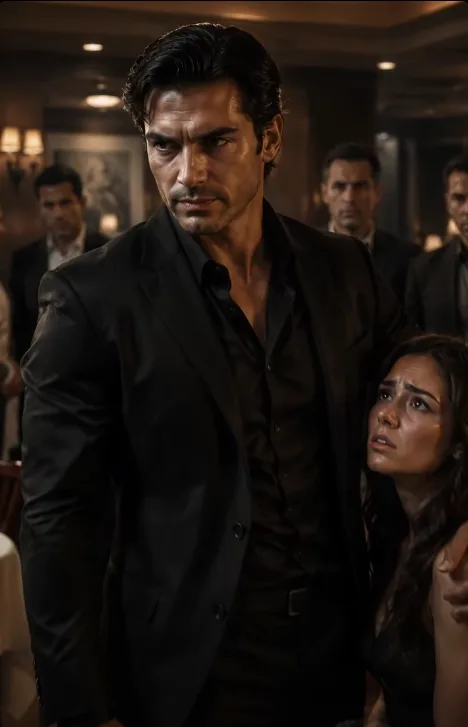
“Touch Her Again and You’re Finished,” the Mafia Boss Warned—Then Pulled Her Behind Him
The night my life went sideways started with the smell of burning oil and the sound of my engine dying in the middle of oncoming traffic.
Chapter 1
“Touch Her Again and You’re Finished,” the Mafia Boss Warned—Then Pulled Her Behind Him
The night my life went sideways started with the smell of burning oil and the sound of my engine dying in the middle of oncoming traffic.
Headlights flared in my rearview mirror, and horns split the November dark around me. For a second, I just sat there, fingers locked around the steering wheel, watching my breath cloud the windshield.
“Come on,” I whispered.
I turned the key again. The engine made a noise that sounded less like a machine and more like a verdict.
I was already 20 minutes late for a meeting with my father’s lawyer. Instead of staying in the broken-down car, I pulled my coat tighter, took my purse, and stepped out into the wind. Somewhere 2 blocks ahead, past the blur of red taillights and steam rising from a manhole, was Carmine’s.
The lawyer had chosen it for the meeting, probably because it was close to his office and he had an expense account. Carmine’s sign appeared out of the murk a block later, red neon buzzing faintly above a dark green
awning. From the outside, it looked like every other Italian restaurant in that part of the city: low brick building, frosted windows lit from within, the faint silhouettes of bottles and glassware on a backlit shelf.
I pushed through the door and took 4 steps inside before I understood that something was wrong.
Not wrong in any visible way. Wrong in the way a room feels when all the sound in it has been carefully removed.
There were 20 men around tables, and not 1 fork was moving. The silence was not the silence of a room mid-conversation that had paused. It was the silence of a room that had been holding very still for exactly as long as it needed to and intended to keep holding.
I stopped because I am not stupid, even when I am acting like I am.
A man stood at the far end of
the room near a table. This table sat apart from all the others, much like a throne sits apart from chairs, and his back was half turned to the door. He was not large in the way that announces itself. He was large in the way that makes you recalibrate a room, the kind of large that is almost entirely stillness organized into the shape of a man.
He was speaking to someone seated at the table nearest to him. The seated man had the look of someone who had recently understood something very bad about his situation.
I did not hear what was being said. I was too far away, and the words were low, even, and deliberate, like water running over flat stone.
Then the standing man turned his head. Not his body. Just his head. I saw his profile: sharp jaw, dark hair pushed back, a quality
of attention I can only describe as total. Whatever he was saying, he was saying it with the entirety of himself directed at the person receiving it.
Then the seated man made a mistake.
I still do not know exactly what he did. He may have reached for something. He may have moved wrong. But 1 of the men at the wall stepped forward, and the woman beside the seated man, whom I had not noticed until that moment, flinched so hard her wine glass tipped and rocked without falling.
The standing man turned fully.
He looked at the woman first. Something moved across his face too quickly to name. Then he looked at the seated man.
He did not step closer to him. He did not raise a hand.
He stood exactly where he was and spoke.
“You touch her again,” he said, “and I bury you tonight.”
He did not raise his voice. He did not need to.
The room dropped several degrees on the strength of 9 words delivered at the volume of normal conversation. Measured. Specific. The kind of sentence that does not require theater because everyone in the room already knows it is not a sentence. It is a fact stated in advance.
Every person in that room looked at the seated man. Every one of them made themselves smaller, stiller, in the particular way of people who have learned that minimizing the space you occupy in a moment like this is the closest thing to safety available.
I looked at him.
I do not know why. I should have looked at the floor, at the door, anywhere other than the man who had just said something that stopped 20 people from breathing. But I looked at his face.
I was trying to understand what I was seeing, what specific category of dangerous this was, and so I watched him the way you watch a storm from inside a window, trying to read it before it reads you, trying to understand the shape of it.
He was already looking at me.
I do not know when he noticed me. Maybe from the moment I walked in. Maybe from the moment I failed to look away. His eyes were dark and still, and they were on my face with the kind of attention that does not feel like observation.
It felt like consideration, like I had been included in a calculation I did not know was happening.
I should have walked out. The door was 4 steps behind me, and no one was between me and it.
I did not.
A man near the wall moved toward me. Large jacket, not quite concealing what it was meant to conceal.
“You walked into a private event,” he said.
“My car broke down.” My voice came out level. “I have no good explanation for this. I need to use a phone.”
He reached for my arm.
“Leave her.”
Two words from across the room.
The man beside me stopped mid-reach.
I looked over. The man at the far table had already turned back to his conversation, back to the seated man, who now sat very carefully, very still, as if 2 words about me were all the attention I required and the matter was handled and the room could proceed.
Another man appeared at my side, an older face like weathered oak, eyes that had seen enough to stop being surprised by most things. He held out a mobile phone without speaking.
I took it. My fingers were not quite steady. I called the lawyer. I rescheduled. I handed the phone back.
The older man walked me to a side door, a specific side exit opening onto a narrow alley along the building’s edge. He held it open for me, not using the front door, and carefully avoided looking directly at me.
“Thank you,” I said.
He said nothing.
The door closed behind me. November hit like something it had been saving up. I stood in that alley for a moment, the cold finding every gap in my coat. I thought about the room, the stillness of it, and the 9 words. I considered what they had cost the air.
I had turned and looked at his face, even as every other person in that room looked somewhere else entirely.
I did not think about the fact that he had already been looking at me.
I should have thought about that.
I walked home in the dark.
That was the last ordinary night I had.
Two days later, someone put a note under my apartment door.
The note was a single sheet of white paper. On it was a 4-digit number: the last 4 digits of my father’s bank account, which I had never told anyone. Beneath that, in careful small handwriting, was 1 sentence.
You have 3 days to settle what he left behind.
My father, Giovanni Moral, born Giovanni Moretti, who had Americanized himself so completely that I had spent my entire childhood believing I was ordinary, had been dead for 11 weeks. He died in his sleep in a house I had never visited, in a city where I had not grown up. He left me exactly 1 thing: the slow revelation that he had been keeping secrets from me since before I had a memory.
Eleven weeks of learning the shape of those secrets.
The debts were part of it, not all.
I packed what I could carry. This is what my life had trained me for. Packing quickly felt like a skill rather than a tragedy. I had a real go bag, the kind 1 assembles after growing up with a mother who leaves on a Tuesday without a note. It is for when a father is present sometimes, but not present during other crucial times, and you learn early that stable is a word for horses and geological formations, not for family.
I had the bag at the door in 4 minutes.
The men were already in the hallway. Not threatening. Not visibly armed, though I would learn those are not the same thing. Two of them in dark coats, with the particular quality of stillness I was beginning to recognize.
Chapter complete
You have reached the end of this chapter.
Continue reading
A few more worlds to get lost in after this chapter.




