PART 4 — MY LIFE WAS FINALLY MY OWN
The family meeting was Garrett’s idea, or so he said.
Chapter 4
PART 4 — MY LIFE WAS FINALLY MY OWN
The family meeting was Garrett’s idea, or so he said.
He called on a Sunday evening.
“Mom,” he said, and his voice had that tired, worn edge people get when their life has finally started demanding arithmetic. “Can we all come by Tuesday afternoon? Just to talk. All of us. Calmly.”
I should have said no.
Instead I said two o’clock.
Part of me still wanted some version of my son back. Not the frightened man who arrived only when bills failed. The boy. The decent parts of the boy. Mothers are slow to surrender the earliest edition of their children.
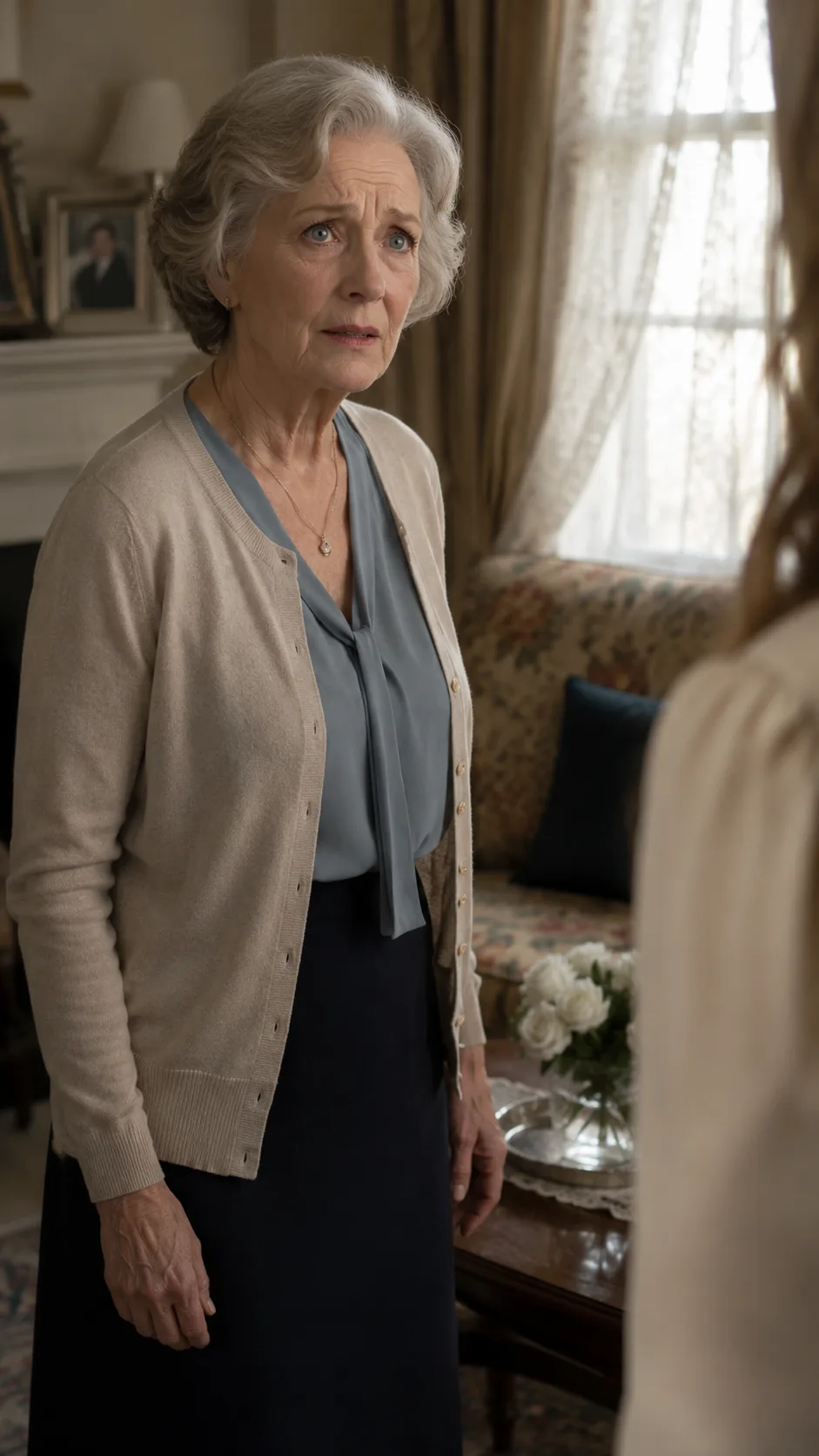
On Tuesday I woke up restless and went out to weed the side bed by the driveway. Gardening had always settled me. Dirt is honest. It gives back only what you put in, and even then only in season. By noon I had showered, fixed myself a sandwich, and changed into a clean cotton blouse and slacks.
At one-forty,
Garrett arrived alone.
He looked worse than the last time. Hollow around the mouth. Shirt not quite tucked in. The expression of a man who had spent two weeks apologizing in all directions and pleasing no one.
“Mom,” he said, standing awkwardly in the foyer. “I wanted to talk to you before everybody got here.”
Everybody?
I frowned.
“What do you mean, everybody?”
He winced.
“Marissa may have invited a few people.”
The cold feeling that moved through me then was not fear. It was fury.
“Who?”
He opened his mouth.
Before he could answer, I heard the first car pull into my driveway.
Then a second.
Then a third.
I went straight to the front window.
In my little cul-de-sac, you do not need binoculars to understand humiliation. Neighbors notice when extra cars line a curb on a Tuesday afternoon. They notice when a family crisis arrives in waves.
Marissa stepped out of the first vehicle in a linen dress and sunglasses, looking like she was attending a charity board meeting. Behind her came Toby and Rebecca. From the second car emerged Marissa’s parents. I recognized her sister Paige from one Christmas five years ago and a brother-in-law I had met exactly twice. From the third car came her brother Curtis and his wife, plus two older family friends whose names I could not remember.
I turned slowly and looked at Garrett.
“What is this?”
He had the decency to look ashamed.
“She thinks,” he said weakly, “that since the situation affects everyone—”
“The situation?”
He looked away.
“The finances.”
I laughed once, so sharply it startled even me.
“Your wife brought an audience.”
“Mom, she said it would help if everyone who was impacted—”
“Impacted?”
I repeated the word as if it smelled bad.
The doorbell rang.
Not
politely. Firmly. Repeatedly.
I opened the door.
Marissa stood there smiling the public smile she used at listing presentations.
“Edith,” she said brightly. “We’re all here so we can talk this through like a family.”
I looked past her at the cluster on my walk and in my driveway. Curious faces. Awkward faces. Faces prepared for spectacle.
No.
Absolutely not.
I stepped onto the porch and closed the door behind me so my answer would not echo through my own hallway.
“You may come in,” I said to Marissa, Garrett, Toby, and Rebecca. “No one else.”
Her smile thinned.
“They came to support us.”
“They can support you from their cars.”
“Edith, don’t be inhospitable.”
“This is my house,” I said. “Hospitality is my decision.”
A flush rose in her neck.
Her father shifted uncomfortably by the mailbox. Paige looked at Rebecca and then away. Toby studied the ground. Only Rebecca met my eyes, and hers were apologetic.
Marissa tried again.
“Everyone here has been affected by your choices.”
“There is no world in which that sentence gets your sister into my living room.”
Silence.
Then I added, very evenly, “If any person I did not invite crosses this threshold, I will call the police and tell them a group of adults is attempting to force a confrontation inside my home. Decide accordingly.”
That did it.
Marissa knew a public scene could cut both ways.
She turned to the others with a smile so brittle it nearly rang.
“We’ll keep this private,” she said. “Why don’t y’all take a short walk and we’ll update you after?”
Her father gave a stiff nod. The rest dispersed in that embarrassed, overcareful way people do when they realize they have agreed to attend something indecent.
I stepped aside only when they were all moving away from the porch.
Inside, I led the four of them into the living room.
Rebecca stayed near the bookshelf. Toby took the armchair by the window. Garrett sat on the couch like a man at the dentist. Marissa remained standing, which told me she meant to control the room.
“Go ahead,” I said. “Explain.”
She folded her hands.
“Your decision has created a chain reaction,” she said. “The mortgage is in default danger. Toby can’t cover his rent. My parents were counting on us to help with assisted living next year. Curtis is between jobs. We all rely on each other, Edith. That’s what families do.”
I looked at Garrett.
“Did you know she was going to make this speech in my house?”
He rubbed a hand over his mouth.
“Mom, can we just hear everybody out?”
I turned back to Marissa.
“You brought witnesses so I would feel ashamed.”
“I brought perspective.”
“No. You brought pressure.”
She sighed, as though I were difficult.
“Fine. Let’s set aside intentions. The point is that you are punishing an entire family over one thoughtless text.”
Rebecca spoke then for the first time.
“It wasn’t one text.”
Everyone looked at her.
Marissa’s voice cooled immediately.
“Rebecca.”
“No,” Rebecca said, and I saw my own stubbornness in her then, clean and bright. “It wasn’t one text. It was years.”
Toby shifted in his chair.
Marissa gave her daughter a warning look, then turned back to me.
“What exactly do you want from us, Edith? A formal apology? A weekly schedule? Gratitude on command?”
I almost laughed at the insult hidden inside the phrasing.
“What I wanted,” I said, “was to be treated like family before I stopped funding you, not after.”
Garrett looked up.
“Mom, we do treat you like family.”
I turned to him.
“Do you?”
He swallowed.
“Yes.”
“All right,” I said. “When was the last time you came here for no reason?”
He stared at me.
“When was the last time you called just because you were thinking of me?”
Nothing.
“Toby,” I said, turning. “When was the last time you visited without needing help?”
He rubbed the back of his neck and said nothing.
“Marissa. Name one act of care you have shown me in the last five years that was not attached to an event, a holiday, or a need.”
Her mouth opened.
Closed.
Opened again.
I answered for her.
“You can’t.”
She drew herself up.
“This is emotional manipulation.”
“No,” I said. “This is inventory.”
I walked over to the side table where I had laid the printed bank summary that morning. I picked it up and held it in my hand.
“One hundred seventy-four recurring payments, transfers, and authorizations,” I said. “That is what your version of family looked like in my name.”
Nobody spoke.
“You are not angry that I was hurt,” I said. “You are angry that your budget noticed.”
That landed so hard the room seemed to go still around it.
Garrett dropped his gaze. Toby’s face went red. Rebecca closed her eyes for a second. Marissa alone stayed upright, though the color had risen in her cheeks.
“That is unfair,” she said tightly.
“No,” I said. “Unfair was being useful enough to finance your life and still too embarrassing to sit at your table.”
Garrett made a low sound that might have been pain.
“Mom—”
I lifted a hand.
“No. You asked for this conversation. You will hear me.”
He fell silent.
I laid the paper down.
“For years I told myself I was helping. Supporting. Holding the family together. But support without respect is tribute. And that is what this became. You built a lifestyle that included my money but not my dignity.”
“That’s not true,” Garrett said weakly.
“Then why did you choose her comfort over my presence with one sentence and no hesitation?”
He had no answer.
“Why,” I continued, “did it take all the money stopping for anyone in this room to ask how I felt?”
No answer to that either.
Marissa crossed her arms.
“So what now? You just blow everything up and call it self-respect?”
I looked at her.
“No. I stop feeding a machine that runs on my guilt.”
She laughed once under her breath.
“You’re being incredibly selfish.”
That word did not hurt the way it once would have.
At seventy-seven, I had finally learned the truth of something women my age often learn too late: the people who live off your sacrifice will call you selfish the first time you rest.
“I am being expensive,” I said. “There’s a difference. You simply no longer care for the price.”
Rebecca looked down to hide a smile.
Marissa saw it and turned sharp.
“This isn’t funny.”
“No,” Rebecca said. “It isn’t.”
Toby spoke suddenly, his voice smaller than usual.
“Grandma… if I really try to do better, does that matter? Or is this all just over?”
I turned toward him, and because he was the only one in the room asking something human instead of strategic, I answered gently.
“It matters,” I said. “Any real change matters. My door is not closed to honesty. It is closed to entitlement.”
He nodded slowly.
Garrett finally stood.
“What do you want me to do?”
It was the same question he had asked before, but something in it had changed. Less outrage. More exhaustion.
“I want you to grow up,” I said. “At fifty-four. I know that sounds humiliating. But there it is. I want you to stop hiding behind Marissa’s comfort, your children’s expenses, and my generosity. I want you to manage the life you chose.”
His face collapsed a little at that.
Marissa stepped in at once.
“This is pointless. We came here to solve a financial crisis, and you’re giving speeches.”
I looked at her squarely.
“Exactly. You came here to solve a financial crisis. I came here to end one.”
She stared at me.
Then she grabbed her purse.
“You’ll regret this,” she said. “When you are alone, you’ll remember today.”
I walked to the front door and opened it.
“Maybe,” I said. “But I would rather be alone than accompanied only by my usefulness.”
Garrett lingered. I could see he wanted to say something that would bridge the distance between us. But bridges are not built in the same hour the fire starts.
“Mom,” he said.
“When you want to talk to me about us,” I said, “and not the bills, call me.”
He nodded once.
Rebecca came last. At the door she hugged me hard and whispered, “I’m sorry.”
“Don’t be,” I whispered back. “Just stay honest.”
After they left, I stood in the entryway and listened to the muffled burst of voices outside as Marissa explained the outcome to her waiting committee in the driveway. Curtains shifted across the cul-de-sac. Somewhere down the block, a lawn mower started.
Normal life resumed around my scandal in under two minutes.
That evening Lorine came over with a bottle of wine and a rotisserie chicken from the grocery store because, in her words, “nobody should survive a family summit on crackers.” We ate in the kitchen and laughed in places where the story wasn’t funny, because sometimes laughter is just your body finding a safe exit.
After that, things changed faster than I expected.
Garrett and Marissa tried a lawyer threat once. Francis ended that with a single letter reminding them that voluntary support is not an enforceable inheritance plan. Garrett sent flowers a week later with a handwritten note that almost moved me until the third paragraph turned into a request for temporary bridge money.
I sent the flowers to church.
Toby took the job with Francis. At first, I suspected he was doing it purely because he was desperate. Maybe he was. But desperation is not always a bad beginning. Two months in, Francis told me Toby showed up on time, listened well, and had a surprisingly good memory for details. Four months in, Toby asked me to lunch and paid for it himself. It was only a sandwich place by the courthouse, but I nearly cried when the check came and he reached for it without performing gratitude.
Rebecca and I grew closer in the quiet way true closeness usually grows. No dramatic declarations. Just steady presence. Calls on Sunday nights. Errands together. Shared book recommendations. Small acts. She moved into her own apartment with used furniture, mismatched dishes, and more self-respect than most people twice her age. I helped her pick out curtains because she asked for my opinion, not my wallet.
Garrett and Marissa sold the townhouse before the end of summer.
I heard that from Rebecca, not from them.
They moved into a smaller place on the other side of town. Marissa took more listings. Garrett, to everyone’s surprise, started keeping a spreadsheet and cooking at home. It turns out even middle-aged men can learn arithmetic when the draft stops clearing.
As for me, I went to the Blue Ridge with Lorine in May and laughed like a schoolgirl over bad coffee at a mountain inn that smelled of cedar and lemon polish.
In June, I booked Italy.
Not someday. Not after the holidays. Not once everybody else settled down. Not once it became more convenient for the people who had spent years making me less convenient for them.
I booked it.
Six months after the text, I was sitting on a terrace in Tuscany with a glass of wine in my hand and warm evening light on my face.
The hills rolled away in soft gold and green. Cypress trees rose like brushstrokes against the sky. Below us, somebody was carrying plates through an open doorway, and somewhere in the square a violin was playing something slow and bright at the same time. Lorine was across from me, writing in a little travel journal she had bought at the airport and already nearly filled.
“You’re smiling again,” she said without looking up.
“I know.”
I did.
I had smiled at things all through the trip. Laundry drying between old stone buildings. An espresso so strong it made my eyes water. A church bell at noon. Two women arguing over peaches at a market stall. The way old cities make you feel both tiny and strangely vindicated for lasting this long.
James should have been there.
That grief did not disappear just because I was happy. It sat beside the happiness, gentler now, like an old ache before rain. I thought of him constantly. I thought of the trip we never took, of all the years after he died when I turned my whole life into a waiting room for other people’s needs. I thought of how astonished he would have been—not that I went to Italy, but that it took me this long to choose myself.
My phone buzzed.
A photograph from Rebecca: her tiny kitchen, now fixed up with a blue runner rug and a basil plant on the windowsill.
Grandma, can’t wait to show you everything when you get back. Hope Italy is as beautiful as you imagined.
I smiled and sent her a picture of the hills.
More beautiful, I typed. And I brought my appetite.
A minute later, the phone buzzed again.
Garrett.
His name stayed on the screen.
Once, that would have pulled me out of the sunset, out of the meal, out of myself. Once, I would have answered on the first ring, heart already racing, mind already reorganizing around whatever he needed.
I looked at the name.
Then I turned the phone face down on the table.
Not from cruelty.
Not from revenge.
Simply because I was in Tuscany, the wine was good, the evening was beautiful, and whatever Garrett had to say could wait until morning.
That was the whole revolution right there.
Not the bank forms. Not the canceled drafts. Not the arguments in my living room.
This.
The ability to let my son be a grown man for one evening while I remained a grown woman in my own life.
Lorine raised her glass.
“To James,” she said softly. “Who would be proud of you.”
I lifted mine.
“To James,” I said.
Then, after a moment, I added, “And to late bloomers.”
She laughed.
The sky deepened over the hills. Somewhere a waiter lit candles. The air smelled faintly of stone, rosemary, and warm summer dust. I sat there in the gathering dusk, an old widow with good shoes, a strong spine, and a life that had finally stopped revolving around the people most eager to spend it.
One hundred seventy-four payments had once connected me to my family.
But in the end, none of those receipts had bought what I was really after.
Peace arrived only when I stopped paying for my place and claimed it instead.
At seventy-seven, under a Tuscan sky James would have loved, I finally understood something that would have saved me years if I had learned it sooner:
Love given freely is a gift.
Love demanded through guilt is a debt.
And I was done living in debt.
I picked up my wine, looked out over the darkening vineyards, and felt the simplest, rarest thing of all settle gently inside me.
My life was finally my own.
THE END.
Chapter complete
You have reached the end of this chapter.
Continue reading
A few more worlds to get lost in after this chapter.