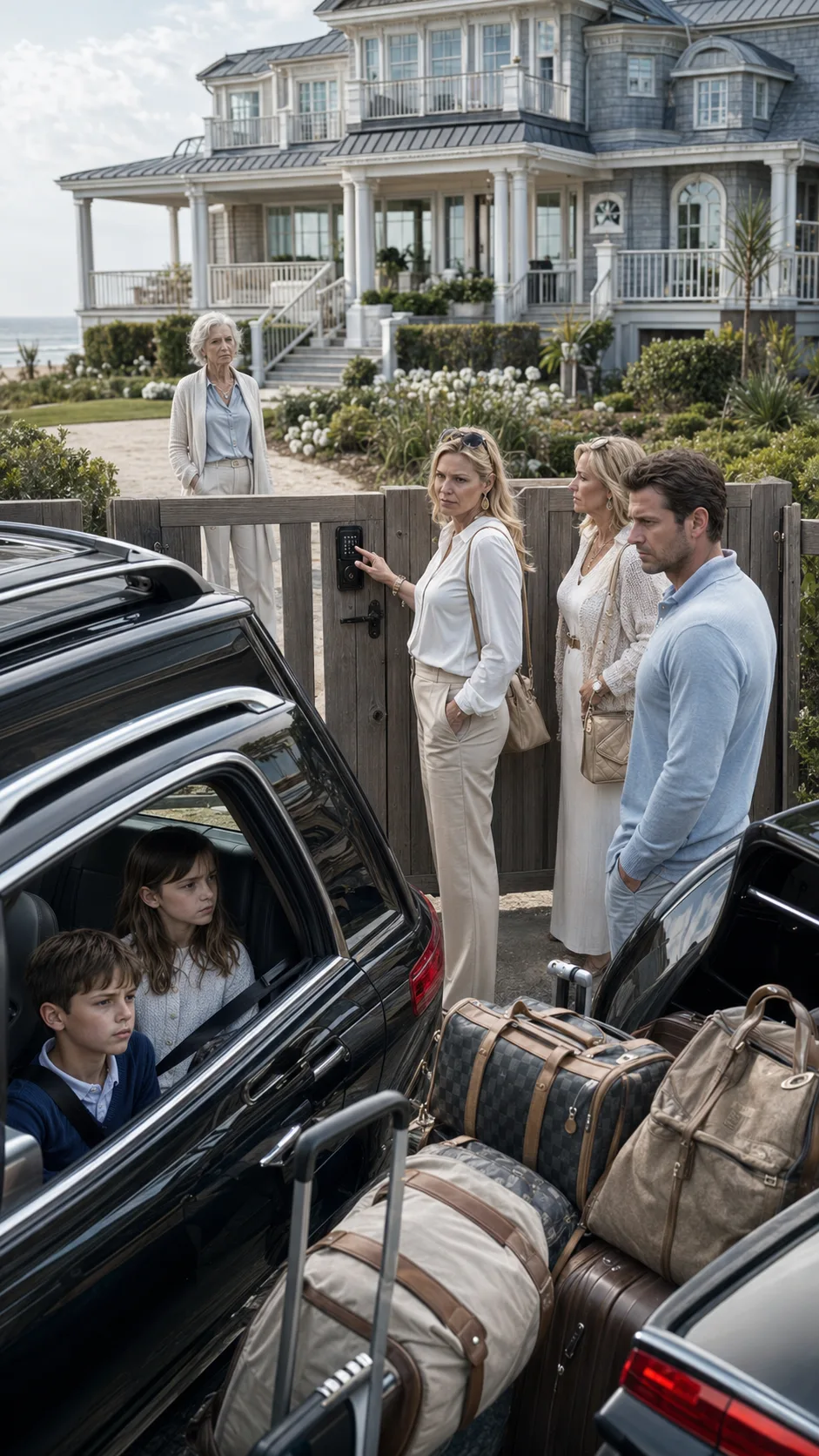
NO ONE KNEW THE BEACH HOUSE SHE TRIED TO CLAIM WAS WHERE MY DAUGHTER LEARNED TO BREATHE AGAIN
— PART 3: THE LOCKED GATE THAT FINALLY HELD
Ethan finally got out.
Chapter 3
NO ONE KNEW THE BEACH HOUSE SHE TRIED TO CLAIM WAS WHERE MY DAUGHTER LEARNED TO BREATHE AGAIN
— PART 3: THE LOCKED GATE THAT FINALLY HELD
Ethan finally got out.
He moved slowly, as if every step required choosing. He looked from the gate to me, then to Vanessa, then to Ron’s truck.
“Mom,” he said.
There were so many things in that one word.
Request.
Warning.
Embarrassment.
Childhood.
I looked at my son through the gate.
“No.”
Vanessa threw up her hands.
“It’s just for a few days.”
“It does not work for me.”
“You don’t even use it that much.”
“I decide how much use is enough.”
“Lily isn’t even here.”
The words came out before she could stop them.
There it was.
The room she intended to take.
The quiet person she intended to displace.
I stepped closer to the gate.
“That is exactly why you are not coming in.”
Ethan closed his eyes briefly.
Vanessa lowered her voice, switching tactics.
“At least let the kids use the bathroom. We can talk inside.”
“No.”
“What are we
supposed to tell them?”
“The truth. That you were told not to come.”
Mason removed one headphone.
“Are we not staying?”
Vanessa glared at me.
“Now look what you’ve done.”
I did not look away.
“No, Vanessa. Look what you did.”
Ron stepped out of his truck then and came to stand near the gate, not close enough to intimidate, close enough to be noticed.
“Everything all right, Mrs. Whitaker?”
“Yes. They’re leaving.”
Vanessa stared at him.
“You called security?”
“I prepared for people who said they were coming anyway.”
Diane muttered, “Unbelievable.”
For a moment, the suitcases sat visible through the car windows like props from an argument that had lost its script.
No one moved.
Then Ethan turned to Vanessa.
“We should go.”
She looked at him as if he had betrayed her.
“We should go?” she repeated. “That’s it?”
He looked tired.
“We were told no.”
I
do not know what that cost him.
Maybe more than I could see.
Vanessa jerked open the driver’s door.
“This is cruel,” she said to me.
“No,” I said. “This is a boundary.”
They left in two cars, less certain than they had arrived.
I stood by the gate until they turned onto the main road.
Ron waited beside me.
“First time?” he asked.
“First time it held.”
He nodded like that made perfect sense.
People often imagine that after a boundary is enforced, everything becomes peaceful.
That is not true.
At least not immediately.
First comes the backlash.
Vanessa texted before they even reached Southport.
I hope you’re proud of yourself. The kids are crying.
I replied:
They are upset because you promised them something that was not yours to promise.
She wrote:
You are heartless.
I did not respond.
Then came Diane:
A woman your age should know
better than to punish children.
Then Vanessa again:
You just ruined spring break.
Ethan called that evening.
I was on the porch with a blanket over my knees, watching the sky darken over the dunes.
“Mom,” he said.
“Yes.”
“She’s furious.”
“I assume so.”
“The kids are upset.”
“I am sorry they were put in that position.”
He was quiet.
“Did you really need security?”
“Yes.”
“That seems extreme.”
“Your wife told me she was coming anyway after I said no. Extreme would have been letting that teach her something useful.”
He sighed.
That sigh again.
Except this time, it did not move me.
“I don’t know how to fix this,” he said.
“That is because it is not yours to fix for everyone else.”
“What does that mean?”
“It means you have spent years trying not to choose, and everyone else has paid for it in different ways.”
He did not answer.
I continued, gently but without softening the truth.
“Your silence is not neutral, Ethan. It never was. It lands somewhere. Usually on me. Often on Lily. Today it landed on Vanessa, and that is why everyone is upset.”
His breath caught slightly.
“I didn’t realize.”
“I know.”
“I should have.”
“Yes.”
We stayed on the line for a while without speaking.
Then he said, “I’ll call you later.”
“Okay.”
That was the first conversation in years where I did not reassure him that everything was fine.
It was not fine.
And finally, I had allowed that fact to exist without covering it.
The financial requests stopped almost immediately, but not because Vanessa accepted anything.
Because I stopped leaving doors open.
When she sent a Venmo request for Mason’s baseball trip, I declined it.
When Ethan mentioned Ava’s summer program was expensive, I said, “I’m sure you’ll make the decision that fits your budget.”
When Vanessa texted that Diane had been “humiliated” at the gate and deserved an apology, I wrote, “I’m sorry she drove so far after being told not to come.”
That one did not go over well.
For two weeks, there were social media posts vague enough to deny.
Some people use boundaries as a weapon and call it strength.
Family means showing up, not locking gates.
Children remember who made them feel unwelcome.
I did not respond.
The old Clara would have wanted to explain. She would have drafted messages. Called Ethan. Asked Lily whether she thought I had been too harsh. Lost sleep over who believed what.
The new Clara made tea and blocked Vanessa’s posts from appearing in her feed.
Lily learned about the gate from Ethan, not from me.
She came over the following Saturday with blueberry muffins from the bakery near her apartment. She set the box on my counter and said, “So. Oak Island.”
I poured coffee.
“So,” I said.
She sat at the table.
“Ethan said Vanessa tried to take everyone down there.”
“Yes.”
“And you changed the gate code.”
“Yes.”
“And hired security.”
“Yes.”
A slow smile appeared on my daughter’s face.
It was the first smile of that kind I had seen from her in months.
Not polite.
Not cautious.
Almost proud.
“Dad would have loved that.”
I laughed then.
A real laugh.
“He would have said I should have done it sooner.”
“He would have changed the code to something insulting.”
“Probably Vanessa’s birthday, just to confuse her.”
Lily laughed too, then grew quiet.
“She was going to put Diane in my room, wasn’t she?”
I looked at her.
“Yes.”
Lily nodded.
“I knew.”
“You never said.”
“Neither did you.”
The truth sat between us.
Not accusing.
Just true.
“I’m sorry,” I said.
She looked surprised.
“For what?”
“For letting it get that far. For letting her talk about the house like you were not part of it. For letting you step back so often.”
Lily’s eyes filled, but she looked down quickly.
“I didn’t want to make things harder.”
“I know.”
“I didn’t want Ethan to feel stuck.”
“He was already stuck. We were just pretending he wasn’t.”
She wiped one cheek with her sleeve.
“I sleep better there.”
“I know, sweetheart.”
“I hate that she knew that and still…”
She did not finish.
She did not have to.
I reached across the table and put my hand over hers.
“No one is taking that room from you.”
For a while, that was enough.
Spring moved slowly into summer.
The Oak Island house filled with ordinary projects. I replaced the torn porch screen. Hired a painter for the steps. Bought new sheets for Lily’s room, pale blue with little white flowers. Cleared out the upstairs closet, where David had stored three broken beach umbrellas and an alarming number of extension cords.
Every time I threw something out, I felt lighter.
Not because I wanted to erase David.
Because I had spent years preserving things simply because he had touched them.
There is love in preservation.
There is also fear.
I kept what mattered.
His old tide chart.
The porch rocker.
The little brass compass he used when teaching the kids about navigation, even though none of us ever needed it to find anything more complicated than the ice cream shop.
But I threw out the broken umbrellas.
Grief did not require storage for rusted metal.
In June, Ethan came to Oak Island alone.
He asked first.
That mattered.
I said yes.
He arrived with a duffel bag and two grocery sacks, one full of actual groceries and one full of apology offerings: coffee beans I liked, lemon cookies from the bakery, and a jar of local honey because he remembered David buying it every summer.
He stood in the kitchen looking uncomfortable.
“I brought food.”
“I see that.”
“I didn’t want to arrive empty-handed.”
“You were invited. That helps.”
He winced.
Fair enough.
We spent the afternoon fixing the side steps. Not because they needed urgent repair, but because men in our family sometimes talk better with tools nearby. Ethan sanded while I painted. The air smelled like salt and latex primer. Pelicans moved low over the water beyond the dunes.
Around four, he said, “I’m sorry.”
I kept painting.
“For what part?”
He let out a breath.
“All of it, I guess.”
“That is broad.”
“I know.”
I dipped the brush again.
“Try specific.”
He sat back on his heels.
“I’m sorry I let Vanessa assume she could use the house. I’m sorry I didn’t say anything when she called it our place. I’m sorry I let you keep paying for things without asking what it was costing you. I’m sorry I treated your help like something that had always existed and always would.”
I looked at him.
That was a better apology.
Not complete, maybe.
But better.
“And Lily?” I asked.
His face tightened.
“I’m sorry I didn’t notice how often she stepped back.”
“She noticed you not noticing.”
He nodded.
“I know.”
“Do you?”
“I’m starting to.”
The waves moved beyond the dunes.
He looked toward the house.
“I thought keeping peace meant not taking sides.”
“And now?”
“Now I think not taking sides is still taking one.”
I put the brush down.
There are moments when a mother sees the adult inside her child take one painful step forward.
That was one.
“Good,” I said.
He gave a tired laugh.
“That’s all I get?”
“For now.”
He accepted that.
Ethan did not leave Vanessa that summer.
Real life is rarely that tidy.
But something shifted in their marriage. I heard it in the fewer requests. In the way he called me before things became crises. In the way he started saying, “That doesn’t work for us,” and sometimes, to my surprise, “That doesn’t work for Mom.”
Vanessa did not like the new language.
Of course she didn’t.
People rarely applaud the closing of accounts they had been drawing from.
In August, she called me for the first time in nearly two months.
“Clara,” she said, voice controlled, “I think we need to clear the air.”
“Do we?”
“Yes. This family cannot function with so much tension.”
“What family?”
There was a pause.
“What do you mean?”
“I mean, whose definition of family are we using? The one where I pay, provide property, and adjust quietly, or the one where people ask before taking?”
She exhaled sharply.
“I don’t know why you insist on making me sound like a criminal.”
“I don’t think you’re a criminal, Vanessa. I think you are used to getting what you want by assuming other people will avoid conflict.”
“That is incredibly unfair.”
“No. It is incredibly accurate.”
She went quiet.
Then, softer, “The kids miss the beach house.”
“I’m sure they do.”
“It was cruel to turn them away.”
“It was cruel to promise them a trip you had no right to promise.”
She said nothing.
I continued.
“I do not dislike your children. But I will not let them be used as emotional leverage against me.”
“That’s not what I was doing.”
“It is exactly what you were doing.”
Her voice changed then, edged and cold.
“You know, Ethan says you’ve always been difficult when you feel out of control.”
That was meant to hurt.
It did, a little.
But not enough.
“If Ethan has concerns, Ethan can discuss them with me directly.”
“You’re pushing him away.”
“No, Vanessa. I am requiring him to stand up.”
She hung up.
I slept well that night.
Boundaries do not make everyone like you.
They do make it easier to recognize who liked only your usefulness.
By fall, Lily had changed in ways so small most people would have missed them.
She bought red shoes.
That may not sound meaningful unless you knew my daughter had worn quiet shoes her whole life. Brown sandals. Black flats. Navy sneakers. Shoes that apologized for existing. The red ones were soft leather, low-heeled, impractical in rain, and absolutely unnecessary.
She wore them to dinner at my house one Sunday.
I looked down and smiled.
“Those are something.”
She lifted one foot.
“Too much?”
“Not remotely.”
She smiled shyly.
“I saw them and thought, I like them. Then I almost didn’t buy them because where would I wear red shoes? Then I heard you in my head saying, ‘So are many worthwhile things.’”
“I said that about peaches.”
“It applied broadly.”
At Thanksgiving that year, I hosted differently.
Not a grand table.
Not the old performance.
Just people who respected the invitation.
Lily came.
Ethan came.
Vanessa did not.
The children were with their father that week. Diane went to her sister’s in Charlotte. Ethan brought a sweet potato casserole he had clearly purchased and transferred into a dish to look homemade. I chose not to mention it.
We ate at four.
No one assigned rooms.
No one asked for money.
No one said “our beach house.”
After dinner, Ethan helped with dishes without being asked. Lily put leftovers into containers and labeled one for herself, which made me smile more than it should have.
Later, we sat in the living room with coffee.
Ethan looked at Lily.
“I owe you an apology.”
She stilled.
“For what?”
“For letting you disappear around Vanessa and the kids. I saw it sometimes and told myself you were just being flexible. That wasn’t fair.”
Lily looked down at her mug.
“I didn’t know you saw it.”
“I did. Not enough. But enough that I should have said something.”
She nodded slowly.
“Thank you.”
Not dramatic.
Not complete healing.
But honest.
Sometimes that is the meal.
That winter, I added Lily’s name to the beach house documents.
Not as owner yet.
Not because I planned to leave the world soon.
Because I wanted clarity while I was alive.
I met with my attorney, a sharp woman named Audrey Patterson who had known David through some county permit dispute years earlier. She reviewed the trust documents and asked practical questions.
“Do you want Ethan to share ownership eventually?”
“Yes,” I said. “But not equally in access. Not until he learns the difference between family and entitlement.”
Audrey smiled.
“That is not standard legal language.”
“Make it sound expensive.”
She did.
The house would pass eventually to both children in trust, with usage protections, maintenance obligations, and a clear provision that no spouse, in-law, or extended family member could claim access without written approval from both trustees. The downstairs room was designated for Lily’s use during my lifetime and protected for her after my death unless she chose otherwise.
When I told Lily, she cried.
Not because of money.
Because of being named.
There is power in being named where you have been quietly erased.
Ethan accepted it.
I think that was when I knew he was changing.
The old Ethan might have said, “That seems complicated.”
The newer Ethan read the papers, nodded, and said, “That’s fair.”
In March, one year after the message, I went to Oak Island alone.
Spring air carried that damp coolness that promises warmth later but has not yet delivered. The island was quiet. Rental signs stood in a few yards. The grocery store had displays of sunscreen and Easter candy, because coastal towns believe in seasonal overlap.
I opened the house, lifted the windows, swept sand from the kitchen, and carried my coffee to the porch.
The ocean was gray-blue, restless but not angry.
I sat in David’s old rocker and thought about the woman I had been when Vanessa’s text arrived.
A woman who nearly wrote three paragraphs to justify owning her own house.
A woman who had mistaken explanation for kindness.
A woman whose no had never changed anything because she always buried it under reasons.
That woman was not gone.
I still understood her.
She had survived loss by staying agreeable. She had kept family near by making herself useful. She had helped because helping was easier than admitting she was lonely.
I did not hate her.
But I no longer let her answer every message.
My phone buzzed while I sat there.
A text from Lily.
Sleeping okay?
I smiled.
I wrote back:
Like the house finally believes me.
She sent a heart.
A few minutes later, Ethan texted too.
Thinking about Dad today. I might come down next month if that works for you and Lily.
If that works.
Four small words.
A question, finally.
Not perfect.
But progress often arrives in small grammar.
I replied:
Ask Lily about dates. Then we’ll plan.
The following month, the three of us spent a weekend there.
Just us.
Ethan fixed the porch screen David had patched badly years earlier. Lily made pancakes shaped like nothing in particular. I sat on the steps with coffee while my children walked down to the beach together, their heads tilted in conversation.
From a distance, they looked young again.
Not children.
But close enough that my heart ached.
That evening, we sat on the porch. Ethan spoke about work. Lily told us about a student who returned an overdue library book with a handwritten apology and a dollar bill “for damages,” though there were no damages. I told them a story about David getting lost in Southport despite insisting he knew exactly where he was going.
We laughed.
No one was pushed aside.
No one performed.
No one arrived with suitcases after being told no.
The house felt like itself again.
I have come to understand that boundaries are not walls built from anger.
They are doors with working locks.
They do not exist to punish everyone outside.
They exist to protect what is allowed inside.
Respect.
Rest.
Truth.
Choice.
A house can survive storms, salt, and time. But families can erode a place more quietly if you let assumptions enter too often through unlocked doors.
Vanessa thought the beach house was the prize.
She was wrong.
The prize was not the porch, the dunes, the downstairs bedroom, or the refrigerator she expected me to stock by Thursday.
The prize was the right to decide what enters my life.
The right to say no without providing a cushion underneath it.
The right to make space for my daughter before she disappeared completely.
The right to stop funding, hosting, smoothing, and explaining things for people who heard me only when access was denied.
If you have spent years adjusting more than you should just to keep things smooth, look carefully at what smoothness has cost you.
Who gets quieter when the room is kept peaceful?
Who pays when everyone says “we”?
Who is expected to understand?
Who is never asked?
And when you finally say no, watch what happens next.
The people who respect you may be surprised.
They may even be hurt.
But they will adjust.
The people who only respected your usefulness will call you cruel.
Let them.
One word showed me the difference.
No.
It looked small on the screen.
It changed everything.
THE END.
Chapter complete
You have reached the end of this chapter.
Continue reading
A few more worlds to get lost in after this chapter.




