PART 2: THE ROOM VANESSA HAD ALREADY DECIDED TO TAKE
That is true, but they do not tell you that some waves arrive while you are doing very ordinary things.
Chapter 2
PART 2: THE ROOM VANESSA HAD ALREADY DECIDED TO TAKE
That is true, but they do not tell you that some waves arrive while you are doing very ordinary things.
Buying milk.
Folding socks.
Seeing his handwriting on a label in the garage.
Hearing a truck downshift on the road and thinking, for one impossible second, he is home.
After David died, the main house in Wilmington became crowded with absence. His boots near the mudroom. His reading chair. His cereal bowl. The old flannel shirt I could not bring myself to wash because it still faintly smelled like sawdust and peppermint.
The beach house was different.
His absence was there too, of course. But the ocean made enough noise to soften it. The wind moved constantly. The house creaked and answered itself. The waves came and went whether I cried or slept or stared at the same page of a book for an hour.
Lily slept better there.
That may sound like a small thing, unless you have watched someone you love stop sleeping.
My daughter was thirty-seven when
David died. She worked as a school librarian, lived alone, kept plants alive with the tenderness of a person who needed something quiet to care for, and carried sadness in ways most people did not notice. She could function through almost anything. She paid bills on time. Remembered birthdays. Wrote thank-you cards. Smiled politely when people said, “Your dad would want you to be happy.”
But sleep abandoned her after the funeral.
At my house, she woke at three in the morning and wandered into the kitchen with her hair in a messy knot, asking if I wanted tea though neither of us wanted anything. Her eyes developed permanent shadows. She lost weight. She stopped reading in bed because, she said, books felt like “rooms with too many doors.”
At Oak Island, she slept.
Not perfectly.
Not every time.
But often enough that I learned not to question miracles that
came quietly.
She would arrive on a Friday evening, put her bag in the downstairs bedroom, open the window just a few inches even in winter, and by ten o’clock she would be asleep with the ocean working in the dark beyond the dunes.
After that, the beach house became more than property.
It became recovery.
It became the one place where my daughter’s nervous system seemed to believe the world could be safe again.
So when Vanessa wrote, We’re spending spring break at your beach house, I did not think first about the refrigerator or the extra sheets or the sand that would be tracked through the hall.
I thought of Lily.
I thought of the downstairs room Vanessa had already assigned to her own mother during a dinner months earlier, as if Lily’s quiet place were simply an available space on a family spreadsheet.
I thought of all
the ways I had let small things slide because I did not want to “make it bigger.”
And I felt, somewhere under my ribs, the old structure of my patience crack.
Vanessa had not always been so obvious.
At first, she was charming.
When Ethan brought her to dinner the first time, she arrived in a soft blue dress with a bottle of wine and a lemon tart from a bakery downtown. She called me Mrs. Whitaker until I told her Clara was fine. She complimented my dining room curtains, asked about the framed photo of David on the sideboard, and said Ethan had told her “beautiful things” about his father.
She had two children from her first marriage, Mason and Ava. Mason was ten then, long-legged and restless, always bouncing a ball or tapping a fork or asking when dessert would be ready. Ava was eight, bright-eyed, dramatic, and charming in the way children learn to be when grown-ups reward performance.
They were not bad children.
I have to say that because it would be easy to make them the villains of a story they did not write.
They were children accustomed to quick attention.
If Mason wanted something, he asked immediately, loudly, and repeatedly. If Ava felt excluded, the entire room knew within seconds. Vanessa responded to them with astonishing speed, cutting conversations short, changing plans, redirecting meals, rearranging seats, finding snacks, promising treats.
At the time, I thought she was simply an attentive mother.
Later, I understood she had built a world where her children’s desires arrived with urgency, while everyone else’s needs were expected to adjust quietly.
Ethan adjusted.
That was his nature.
My son had always been the calm one. As a boy, he walked away from arguments before they grew teeth. If Lily cried because he broke a crayon, he handed her the rest of the box. If another child pushed him at the park, he shrugged and found another swing. Teachers called him easygoing. David called him “steady Eddie,” even though his name was Ethan, because David enjoyed jokes that made no sense after the first telling.
I used to be proud of Ethan’s calm.
I still am, in some ways.
But calm can become cowardice if it depends on other people absorbing every conflict.
Ethan did not like scenes.
He did not like raised voices, hard conversations, ultimatums, or being forced to choose where he stood. He wanted everyone to settle. He thought if he waited long enough, discomfort would resolve itself without requiring him to become the person who said no.
Vanessa found that space in him and moved into it.
I do not know if she did it consciously in the beginning. Not all manipulation starts as a plan. Sometimes people simply discover what works and keep doing it.
The first request for money sounded reasonable.
“We’re a little short this month,” Vanessa said one afternoon in my kitchen, wrapping both hands around a mug of tea. “Just until things settle.”
Things settle.
Those words have probably emptied more bank accounts than any direct demand ever could.
I asked how much.
She gave a modest number.
I wrote a check.
Then came Mason’s baseball registration.
Ava’s dance recital fees.
A car repair Vanessa said could not wait because “the kids need reliability.”
A private tutoring payment because Mason had fallen behind in math.
Groceries after what she called a “payroll timing issue.”
Nothing huge by itself.
A few hundred here.
A little more there.
Sometimes Ethan called. Sometimes Vanessa texted. Sometimes she mentioned something in passing and waited for me to offer, because by then she had learned I often would.
“We’ll need help covering the school payment.”
“We can make it work if you help with the gap.”
“We’re trying to keep things normal for the kids.”
Again that word.
We.
At first, I felt included.
Then I realized I was only included when something needed paying.
One afternoon, after a transfer just under three thousand dollars appeared on my bank statement under the description “temporary adjustment,” I sat down at the dining room table and went through the previous six months.
The pattern looked different on paper.
It always does.
Paper has no tone of voice.
No tears.
No soft smile.
No children in the next room.
No implied guilt.
Just numbers.
$450.
$1,100.
$2,850.
$600.
$300.
$1,750.
I marked each one with a yellow highlighter and felt a slow embarrassment rise in me.
Not because I had helped.
Because I did not remember truly agreeing to most of it.
The requests had arrived already shaped as decisions. My part had been written in before I entered the scene. I had been given the emotional equivalent of a bill.
When I mentioned it to Ethan, we were at my kitchen table after dinner. Lily had left early. Vanessa had taken the kids to a birthday party. It was just my son and me, the dishwasher humming, the light over the sink casting a soft gold circle on the counter.
“Things have been coming up more often,” I said.
Ethan did not ask what things.
That told me enough.
“She’s under pressure,” he said.
“I understand pressure.”
“It’ll settle.”
“You keep saying that.”
“Because it will.”
I folded my hands.
“Ethan, it is not just one tight month. I looked at the statements.”
His face changed slightly.
Not guilt, exactly.
Something like discomfort trying to become patience.
“Mom, you’ve always helped before.”
There it was.
A sentence that sounded harmless until you listened closely.
You’ve always helped before.
As if my past generosity were permanent consent.
“I know,” I said. “That’s part of what I’m thinking about.”
He leaned back and rubbed his jaw.
“I don’t want this to become a thing.”
“It may already be a thing.”
He looked tired then.
And I softened.
That was my pattern.
Someone looked tired, and I decided my need could wait.
“Just talk to Vanessa about asking first,” I said.
He nodded.
But I could tell from the way he nodded that no real conversation would happen.
Ethan believed silence was neutral.
It is not.
Silence always lands somewhere.
In his marriage, it landed on me.
It landed on Lily too, though more quietly.
My daughter had never competed well with louder people. As a child, she would let Ethan choose the movie because he spoke first. She would say she did not mind when cousins took the bigger piece of cake. David used to call her considerate, and she was. But after he died, that consideration became something else.
At family gatherings with Vanessa and her children, I started noticing Lily stepping back before anyone asked her to.
At a seafood restaurant one Saturday, the hostess led us to a table by the window. Ava rushed toward the seat with the best view.
“I want this one.”
Mason dropped into the chair beside her.
Vanessa laughed.
“Looks like the kids claimed the ocean side.”
Lily was standing near the last chair with her hand on the back of it.
“It’s okay,” she said quickly.
No one had asked her.
No one had looked at her.
She had offered the space away before anyone could take it.
Another afternoon, we went to a boardwalk shop near Wrightsville Beach. Mason wanted ice cream. Ava wanted fudge. Lily had been looking at a little bookstore tucked between a surf shop and a place selling beach towels with dolphins on them.
“We’ll do ice cream first,” Vanessa said, already steering the children toward the line.
I glanced at Lily.
She smiled.
“It’s fine.”
There it was again.
Fine.
Okay.
No problem.
Whatever everyone wants.
The words of a woman disappearing in plain sight.
On the drive home, Vanessa talked about how easy the afternoon had been, how well the kids got along, how nice it was when everyone stayed flexible.
Lily sat in the back seat staring out the window.
Not angry.
Not visibly hurt.
Just quiet in that steady way that asked nothing from anyone.
That was what began to frighten me.
She had not been overlooked in one dramatic moment.
She had learned to remove herself before the overlooking began.
At the beach house, the pattern became clearer.
Vanessa first called it “the Oak Island place.”
Then “your beach place.”
Then “the family beach house.”
Then, one day, “our place.”
It happened in conversation so casually I nearly missed it.
“We should bring bikes next time we’re at our place.”
Our place.
The words slid by quickly, wrapped in a discussion about summer traffic and whether the kids needed new bathing suits.
I noticed.
I said nothing.
The second time, she told a neighbor at a cookout, “We’re lucky Clara has this little beach house. The kids love our place down there.”
Our place.
Again.
I looked at Ethan.
He was helping Mason open a soda can and did not react.
Maybe he did not hear.
Or maybe he heard and filed it under easier not to address.
By fall, Vanessa was planning inside sentences.
“My mom will take the downstairs room next time,” she said at dinner. “It’s easier for her knees.”
That downstairs room was Lily’s room. Not legally, not formally, but in every way that mattered. Her books were on the nightstand. Her favorite quilt was folded at the foot of the bed. A little ceramic dish with shells she collected after David’s funeral sat on the dresser.
Vanessa did not look at me when she said it.
She focused on her plate, as if assigning rooms in my house required no conversation.
I waited for Ethan to correct her.
He kept eating.
David used to say a house changes hands twice. Once on paper and once in people’s mouths.
My beach house had not changed hands on paper.
But in Vanessa’s mouth, it had already begun moving.
I almost spoke then.
I wanted to say, “No, Diane will not be taking that room.”
But I looked at Ethan’s tired face, at Mason dropping food on the floor, at Ava interrupting Lily’s story about a book fair, at Vanessa smiling as if everything were settled, and I swallowed the words.
It seemed easier not to make a scene.
Looking back, I can see how foolish that was.
The scene had already been made.
I was just the last person willing to acknowledge it.
When Vanessa’s spring break text came in, everything I had been ignoring gathered in one place.
We’re spending spring break at your beach house. My kids, my mom. Stock the fridge by Thursday.
I held the phone at my kitchen table and thought of David.
Not in a sentimental way.
In the practical way grief sometimes brings the dead back to advise you.
David would have said, “Clara, a locked door is not rude if the person outside was told not to come.”
That sounded like him.
Plain.
Useful.
True.
So I sent no.
And when Vanessa laughed and said they were coming anyway, something in me became very calm.
That evening, I called Ethan.
“I told Vanessa no.”
He sighed.
“They’ve already planned around it.”
“That is not my problem.”
“Mom.”
“Ethan.”
“Don’t make this bigger than it is.”
I looked out at my dark kitchen window, seeing my own reflection in the glass.
“It became bigger when she said she was coming anyway.”
“She probably didn’t mean it like that.”
“She typed it.”
“She’s stressed.”
“So am I.”
He had no answer for that.
I let the silence sit there.
For once, I did not fill it.
“I’m not changing my answer,” I said.
After a pause, he said, “It’ll work itself out.”
“Yes,” I said. “It will.”
Before sunrise, I drove to Oak Island.
I packed lightly. A sweater, jeans, walking shoes, my medication, my checkbook, the deed folder, and a thermos of coffee. The highway was quiet, the sky just beginning to soften when I crossed the bridge. Marsh grass glowed silver. A few boats sat still in the water. The island looked peaceful in that off-season way beach towns have before visitors arrive and claim everything with coolers and folding chairs.
I stopped first at the hardware store.
The same one David used to visit even when he did not need anything. A local place with narrow aisles, storm shutters stacked near the back, fishing line by the register, and a bulletin board advertising house cleaners, church fish fries, lost dogs, and one suspiciously confident teenage lawn service.
The owner, Marlene, recognized me.
“Clara Whitaker,” she said, looking over her glasses. “You down early?”
“Just a few things to handle.”
“Storm prep?”
“Family prep.”
She studied my face for half a second and did not ask more.
Southern women of a certain age know when another woman is done.
I bought a new lockbox, two extra security signs, batteries, and a good flashlight I did not strictly need.
At the house, I walked through each room.
The kitchen.
The porch.
The downstairs bedroom.
The upstairs twin room.
The little hall closet where David kept beach umbrellas tied with bungee cords.
The place was still.
Just as I had left it.
Nothing about the house knew it had been claimed in a text message.
Outside, I changed the gate code.
Then I changed the lockbox code.
Then I removed the spare key from beneath the old ceramic turtle by the porch steps, because once, foolishly, I had told Vanessa where it was “in case of emergency.”
I called the security company after that.
The man who answered introduced himself as Ron. Retired sheriff’s deputy. Local. Practical voice. He listened without interrupting while I explained that family members might arrive after being told not to.
“Do you expect violence?” he asked.
“No. I expect entitlement.”
He paused.
“I’ve handled both.”
He said he would be there by noon.
Then I called my bank.
Not to make a dramatic cut yet.
Just to prevent any automatic transfers or shared payment routes connected to Ethan and Vanessa from moving without my approval.
The woman on the phone was polite and efficient.
“Would you like to remove all third-party scheduled transfers?”
“Yes.”
“Would you like us to add a note that no account information is to be released to family members?”
“Yes.”
“Would you like a verbal passcode?”
“Yes.”
Every yes felt like another window opening.
By eleven-thirty, Ron parked his truck near the side of the driveway and walked the perimeter with me. He was in his late sixties, broad-shouldered, with a clipped gray mustache and a calm that did not need to announce itself. He wore jeans, work boots, and a navy windbreaker with the security company logo.
“Nice place,” he said.
“My husband loved it.”
“Still yours?”
“Yes.”
“Then that’s what matters.”
At noon, I made coffee.
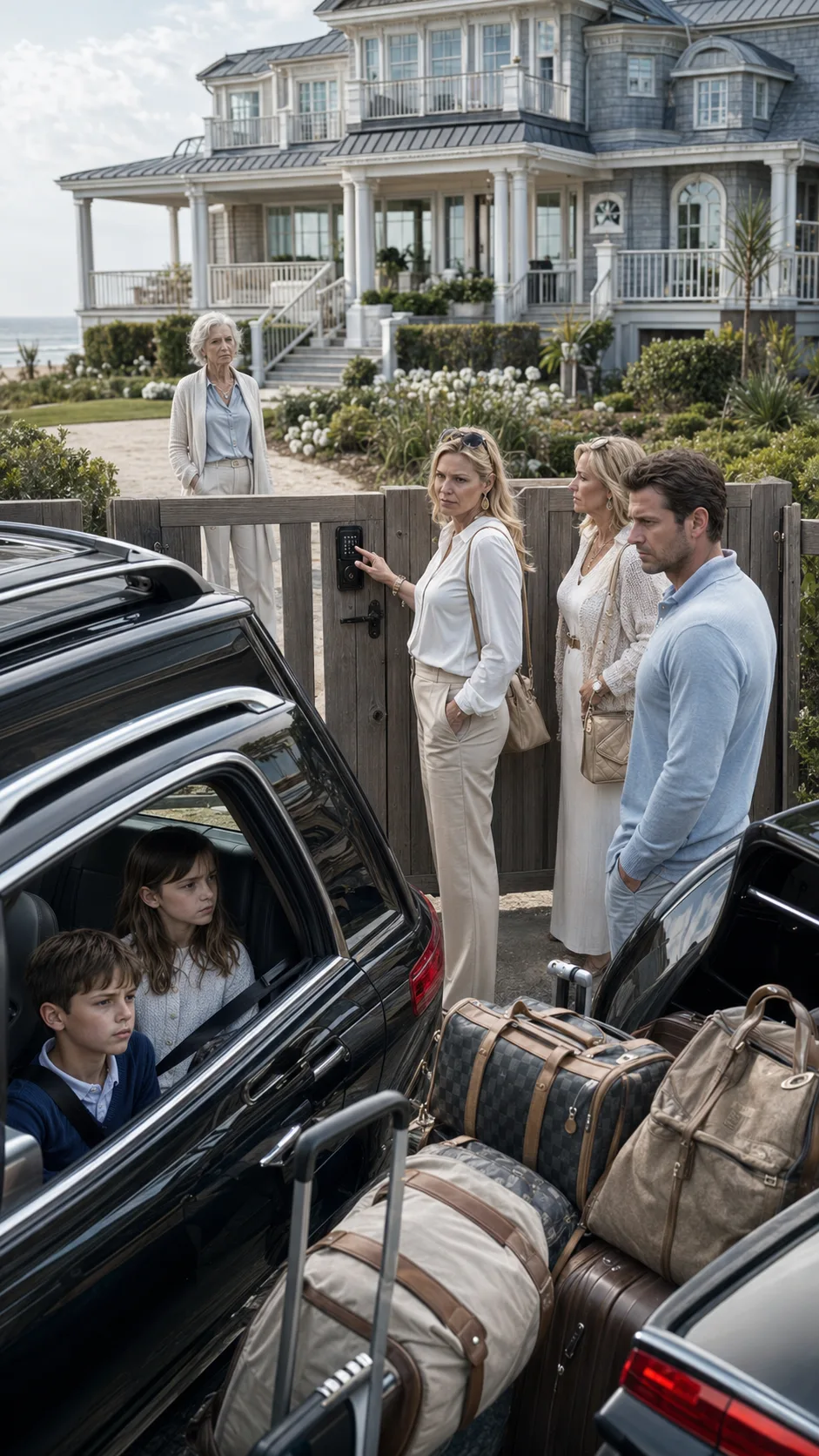
At twelve-twenty, the first car pulled up.
Then the second.
They arrived like people expecting only a small delay.
Vanessa drove the first SUV. Ethan sat beside her. Mason and Ava were in the back with headphones and snack bags. The trunk was packed so full I could see bags pressed against the rear window.
Diane, Vanessa’s mother, drove the second car, a white sedan with a beach umbrella sticking through the gap between the seats. She stepped out wearing white capris, gold sandals, and sunglasses, already looking irritated by the air.
Vanessa got out first.
She smiled when she saw me standing on the other side of the gate.
The smile said, Let’s not be silly.
Then she punched in the old code.
The keypad flashed red.
She tried again.
Red.
Her smile tightened.
“What is this?”
“I changed the code.”
She laughed once.
“Very funny.”
“I told you not to come.”
Her expression shifted.
“Clara, don’t do this.”
“The answer was no.”
“The kids are here.”
“I see that.”
Ava opened the back door.
“Mom, is something wrong?”
Vanessa turned and said too brightly, “Nothing, sweetheart. Grandma Clara is just being a little difficult.”
That did it.
A clean little slice through the last hesitation in me.
“No,” I said, loud enough for Ava to hear. “Your mother was told this house was not available, and she came anyway.”
Vanessa’s face darkened.
“Do not involve the children.”
“You brought them here to use them as leverage. That was your choice.”
Diane came up behind her.
“Clara, this is ridiculous. We drove all this way.”
“You should not have.”
“It’s spring break.”
“I know.”
“The children were excited.”
“They should have been told the truth before they were put in a car.”
To be continued… Click “PART 3” to read the final part: 👉 PART 3 👈
Chapter complete
You have reached the end of this chapter.
Continue reading
A few more worlds to get lost in after this chapter.




