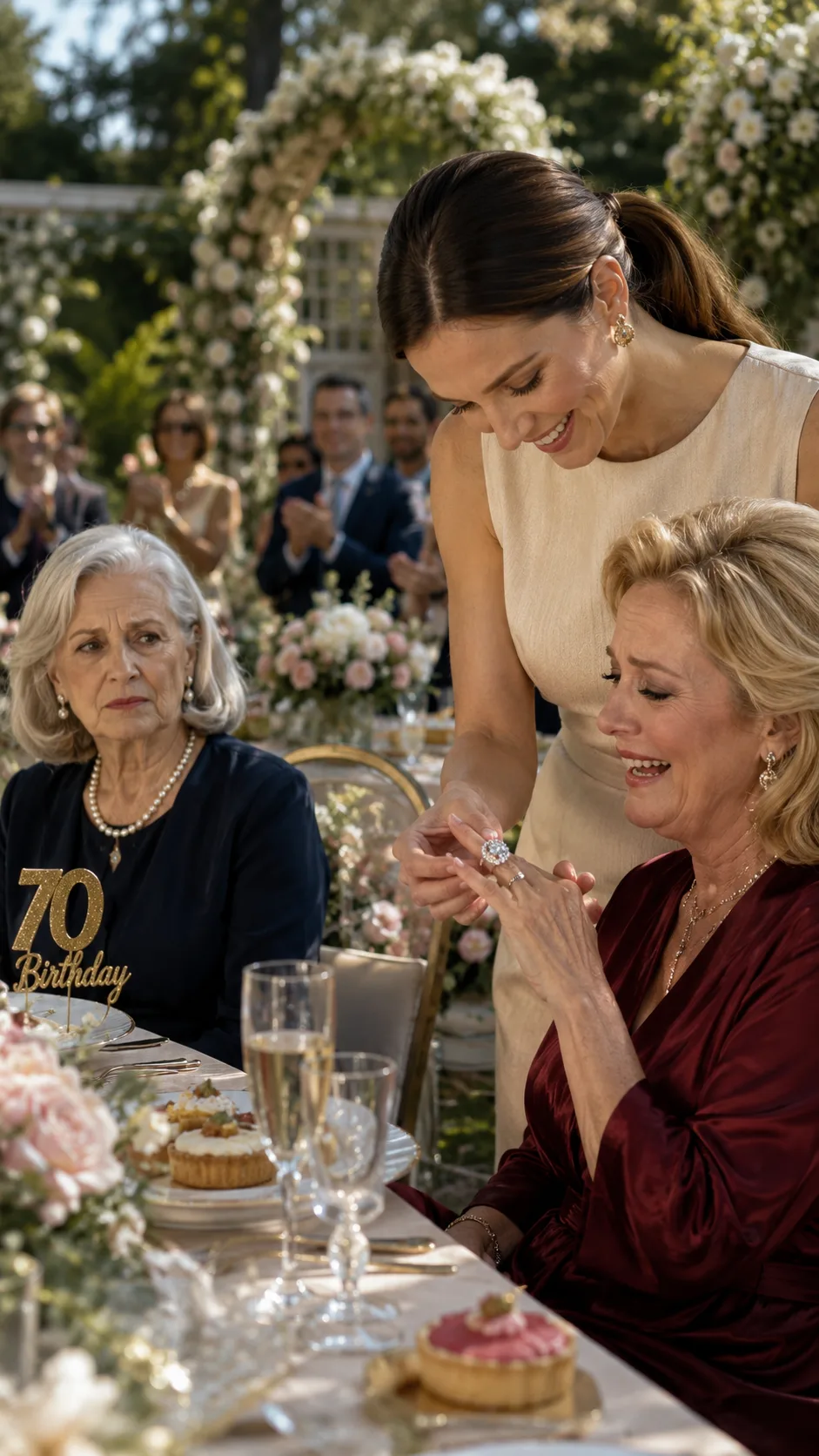
PART 2 — THE LIES SHE SOLD AND THE SUPPORT I QUIETLY WITHDREW
I told him not to be cynical, that Fallon just had ambition.
Chapter 2
PART 2 — THE LIES SHE SOLD AND THE SUPPORT I QUIETLY WITHDREW
I told him not to be cynical, that Fallon just had ambition.
And Warren, kind as he was, let the matter rest. He died three years later, and part of me was glad he hadn’t lived to see how right he had been.
I looked at the bracelet again. Plastic, hollow, pretty on the surface, but made to snap under pressure. Maybe that was the perfect gift after all. A thing that couldn’t carry weight, a thing that wasn’t meant to last.
I poured myself a cup of tea and sat with that thought for a long time. Not angry, not even sad. Just tired. Tired of mistaking politeness for love. Tired of shrinking to fit someone else’s idea of family.
The silence didn’t comfort me anymore. It only reminded me what had slowly faded from my life. Warmth, respect, and the smallest effort to see me as a person.
Three days after the party, I got a phone call from Darlene
Stewart, an old friend from my early years in the community health board. We hadn’t spoken in over six months. I answered, thinking maybe she needed help with one of her programs.
Instead, her voice sounded hesitant. She said she had been listening to a podcast that had been making the rounds among some women’s circles. It was hosted by a woman named Fallon, who described herself as a survivor of emotional control and generational silence.
Darlene didn’t know Fallon was my daughter-in-law until midway through the second episode, but once she did, she felt I should know. I didn’t understand what she meant at first.
Fallon had started a wellness podcast a year earlier. I had even listened to a few episodes when it first launched. Back then, she talked about meditation and time blocking and composting. There was nothing controversial.
But Darlene said the latest episodes were different.
She said Fallon had changed her format into something more personal, more confessional.
After we hung up, I opened my laptop and searched the title Darlene mentioned. Rooted Women. It wasn’t hard to find. The banner showed Fallon sitting cross-legged on a blanket in front of a field of lavender. Her hair was pulled back in a soft bun, eyes closed, smiling as if she were immune to pain.
I clicked on the first of the three newest episodes. They were titled with vague phrases like healing from invisible harm and the weight of unspoken rules.
I listened in silence, and then I heard my own voice. It was a clipped sentence taken from a family dinner last spring when Ellis had tested a new recording mic Fallon had gifted him.
I remembered that evening because I had mentioned Warren’s old camera and how it still worked better than Ellis’s
new one. I had said plainly that not everything old should be replaced just because it looked worn.
A harmless comment, but in the podcast it was stripped of context and played right after Fallon described a woman who constantly belittled her.
I kept listening.
Fallon told stories of a mother figure who made her feel judged and small. She talked about having to smile through backhanded compliments and stifled independence. Each story was framed vaguely enough to avoid legal trouble, but specific enough that anyone who knew our family would understand.
The second episode included audio clips, my laugh, my voice correcting Ellis about a recipe, my advice on refinancing their mortgage made to sound like manipulation.
I closed the laptop. My hands trembled. Not with rage, but with something harder to name. Something like betrayal that had been aged in silence until it became disbelief.
It was never about the bracelet. Not really. That was just the symbol. The podcast was the actual blow, the twist of the knife.
Fallon hadn’t just forgotten me. She had reimagined me, painted me in grayscale so she could shine in color.
I walked to the kitchen and poured a glass of water. The plastic charm from the bracelet still sat near the sink. I looked at it now as a stamp marking where I stood in her version of the story, decorative, hollow, convenient.
And then I wondered how many others had listened, how many had nodded along as she spoke, picturing a bitter old woman who needed to be escaped from.
I thought of Ellis. He had never mentioned the podcast, not once. He had let it spread while I stood in the background of my own life, unaware that someone else was narrating it for me.
It was no longer about what I had received or didn’t receive. It was about what had been taken: my words, my image, my side of the story, without my knowledge, without my consent, and worst of all, without the slightest trace of regret.
I didn’t sleep that night. My body went through the motions of rest, but my mind moved like a machine that wouldn’t power down.
Around four o’clock in the morning, I got up, made tea, and sat at the kitchen table in my robe. I stared at the cabinet across from me, the bottom drawer on the left. That was where I kept all my old financial records. I hadn’t opened it in years.
Warren used to tease me about how obsessively I documented everything. I told him I liked the comfort of paper trails. Back then, I didn’t know one day I’d be using them to count the cost of my own love.
I pulled the drawer open and ran my fingers across the neatly labeled folders. They were sorted by name: Fallon, Ellis, Wedding, Medical, Vehicles, Business Support.
I started with Fallon’s folder. The tuition receipts came first. University of Vermont. Two semesters of bridge courses so she could meet her licensure requirements. I paid directly to the registrar, just over $14,000.
Then came the check I wrote when she didn’t get the scholarship she was counting on. That one was $28,000. Tuition, books, housing, all of it covered. $42,000 in total.
I remember writing that last check. I told her it wasn’t a loan, just a show of faith in her future.
Next came the smoothie shop, Fallon’s first business venture. She had a dream of combining nutrition and community. I believed in that dream. I co-signed on the lease, paid for equipment when the startup loan fell short, and covered payroll for two months when sales were slow. $65,000.
She closed the shop after ten months. She said it was a learning experience.
Then I moved to the IVF receipts. I hadn’t looked at those in years. Three failed cycles, travel expenses to Boston for the specialist, medication not covered by insurance. $36,000 and some change.
I remember the phone call the day she found out she was pregnant. She cried. I cried, too. It felt like something sacred had been fulfilled. I didn’t think once about the cost.
Then the vehicle, a black SUV with leather seats and a built-in navigation system. It was a birthday gift. $38,000.
Ellis wanted to lease something cheaper, but Fallon said she needed something safer for the baby. I wired the down payment and co-signed the loan.
Then the part that made me pause, a folder labeled Emergency. Inside was a copy of a bank transfer I made three years ago. $14,500.
I remembered now. Fallon had come over in tears. Said someone had opened a credit card in her name. She felt violated, unsafe. I offered to help. I never asked for details. I paid it off the same day. I never knew until now that the card had been opened using my name as co-signer.
Last, I opened the folder labeled Home. $70,000. That’s what I contributed toward the down payment on the house they live in now. Fallon said it would make all the difference for them to start in the right neighborhood.
I never once set foot in that house without calling ahead. When I finished tallying the totals, I sat back in the chair. $265,000. Every dollar I gave with an open hand.
And yet none of it protected me from being cast as the villain in a story I didn’t know was being written.
What struck me wasn’t the money itself. I could earn it. I had. What cut deepest was how my silence had become a blank check. Every time I held my tongue, they assumed I agreed. Every time I stayed out of their way, they interpreted it as weakness.
I closed the drawer. The paper trail was clean. No drama, no fingerprints, just numbers. But they said everything. They said I had been more than generous. They said I had given everything I could. And still, somehow, I had ended up with the blame.
By the following Monday, I had listened to all three podcast episodes twice, not because I wanted to, but because I needed to understand exactly how I had been rewritten.
Fallon had created a story that didn’t just exclude me, it replaced me. She spoke with a calm, deliberate voice. Paused between thoughts, let silence fill the gaps like she was offering the listener space to breathe. I could almost admire the technique if it hadn’t been so thoroughly laced with betrayal.
In one episode, she said she had grown up believing that love had to be earned, that affection came with conditions and performance. She talked about the pressure of perfection, the fear of not measuring up, the pain of being dismissed as dramatic whenever she shared her needs.
She didn’t say my name. She didn’t have to.
The stories followed a familiar rhythm: a misunderstanding, a correction, a moment where she felt judged. These weren’t lies exactly. They were distortions, bent truths, real events taken out of their context and left to fester in the open air.
She told one story about a dinner party when I had suggested that the risotto was a little undercooked. I remember the moment clearly. I had smiled when I said it. It wasn’t a judgment. It was a gentle nudge.
That night, she described it as a moment that echoed a lifetime of never being good enough.
I didn’t know feedback could become trauma. I didn’t know mild honesty could be turned into a wound worth publishing.
What caught me off guard wasn’t the exaggeration. It was the production quality. The show had music, sponsor segments. She had built something profitable out of personal pain, and I had unknowingly become the fuel.
There were ads for organic teas, sustainable jewelry, online therapy services. Real businesses were paying her to tell a story where I played the antagonist.
I checked the show’s social media. Comments flooded in. Hundreds of women thanking Fallon for putting their feelings into words. One wrote that the way Fallon described the silent resentment of an older woman who never said thank you mirrored her own childhood.
Another said she had stopped talking to her own mother-in-law after listening to the second episode. They believed her. They didn’t just hear her voice, they trusted it.
I clicked on Ellis’s profile. He had shared the link to the show a week earlier with a caption that read, “Proud of my wife for speaking her truth.” No mention of me. No acknowledgement that he knew the episodes would sting, just blind encouragement.
That moment hit differently. I had raised him to notice things, to think for himself. But here he was, standing behind a narrative that erased nuance, that turned our family history into a monologue.
I remembered something Warren used to say. Truth without context is a weapon. I hadn’t understood what he meant until now.
The podcast wasn’t an outlet. It was a product carefully curated, market tested. Fallon had taken her talent for performance and merged it with the trend of trauma as currency. And she had sold it well.
What remained then was the question that started growing in my chest. Not anger, not even shame, just a cold, steady awareness that I had been participating in this without realizing it. I had given and stayed quiet, funded and stepped back.
I had left space for Fallon to define things, and she had taken that space and made a stage.
I closed the laptop, stood in the middle of the kitchen, and looked around. Nothing in the room had changed, but I had.
Something invisible had shifted. I no longer recognized the version of myself she had drawn, but I could finally see the shape of the woman I had become: the woman who had spent years not wanting to take up space, the woman who was no longer willing to be edited out.
That Friday morning, I stood in front of my bedroom closet with a manila folder in one hand and the phone in the other. The folder was labeled Home, but the contents inside didn’t resemble anything like it.
I had just reviewed the property documents for Ellis and Fallon’s house. The deed was still partly in my name, the automatic payments drawn monthly from my trust account, the numbers staring back at me like a quiet accusation.
I called Ellis. He answered on the third ring, casual as ever, his voice cheerful in that distracted way he had when he wasn’t really listening.
I asked him if he had a minute to talk. He said, “Sure.” I waited for him to ask how I was, but he didn’t.
I told him I had been reviewing my finances and wanted to revisit the house arrangement. There was a pause, a small one, but it landed heavy.
He said if something was wrong, they could look at refinancing, but it would take time. Fallon had cut back her hours to focus on the podcast, and his job had been up and down since spring. He said they appreciated everything I’d done and hoped I understood that it wasn’t easy for young families right now.
I didn’t say much in response, just told him I needed to evaluate things. He said he understood, but I could hear the discomfort in his tone. It was the same tone he used as a teenager when he knew he had pushed too far.
After we hung up, I sat in the den and stared at the shelves. Family photos, graduations, vacations, a black-and-white photo of Warren holding Ellis on his shoulders, both of them laughing at something out of frame.
That was the version of family I still carried, the version that now felt like a painting hung in the wrong museum.
I turned to my laptop and opened a new tab. I logged into my business accounts. I had kept two properties under my name as rental units. David, a friend of Ellis’s, had been doing the landscaping on them for the past five years.
I checked the invoices. The rates were high, above market. I had approved them without much thought back then. I looked at the names on the contracts, the business license, the address, all connected back to Ellis’s consulting work.
It wasn’t direct income for him, but it kept the wheels turning. I realized then how deep the web went. My money wasn’t just supporting their house. It was floating their entire way of living.
Then came the part that turned my stomach. I pulled up Fallon’s name in my QuickBooks system. I had referred her bookkeeping services to three small businesses I used to mentor. I paid her a monthly retainer to handle their paperwork.
One of them, a small flower shop downtown, had emailed me last month about delayed reports. I had shrugged it off at the time. Fallon had been receiving $1,200 a month for maybe six hours of work, sometimes less.
I shut the computer. The air in the room felt too still. Not hot, just close. I stood up and opened a window. The breeze that came in felt like the first real breath I’d taken in days.
It wasn’t just about the money anymore. It was about clarity. The more I looked, the more I saw that I hadn’t just been supporting them financially. I had become the scaffolding of their entire lifestyle. And not once had they stopped to ask if I was all right holding it all up.
I picked up the manila folder again and pressed it flat on the desk. The glass had cracked, not from a sudden blow, but from years of quiet pressure. And now, finally, I was ready to let it break.
By the time Sunday arrived, I had made a list. Not a mental list, not a theoretical one, but a full page, handwritten with a steady hand. At the top, I wrote a title in ink: What I Give, What They Take.
Below it, I drew two columns. I filled them in slowly, without emotion. Facts, numbers, arrangements, habits.
I had spent decades thinking boundaries were rude, that pulling away was cold, that family meant adjusting, absorbing, enduring. I never saw how many little cuts I had accepted, one by one, until they bled into something I could no longer hide.
After breakfast, I walked down the hall to the home office I once used for consulting work. It still smelled like dry paper and printer ink. On the far shelf sat a row of business cards I had saved from years ago when I mentored other women in leadership.
One card stood out. Margaret Chen, estate attorney. I picked it up and called the number without hesitation. She remembered me, said she still had my file in her cabinet.
When I told her I wanted to schedule a meeting, she asked if this was about retirement. I told her not exactly.
We set a time for Tuesday morning. I hung up, then opened my laptop again.
The next three hours were a series of small, deliberate steps. I drafted emails to the three businesses Fallon had been working with. I told them I would no longer be managing referrals and suggested they begin the process of finding replacements. I phrased it neutrally: no blame, just business.
Then I called David, the landscaper who had been billing me well above standard rates. I told him I was reviewing vendor contracts and would be collecting competitive bids starting next month.
His voice dropped. He asked if something had happened. I said only that things were changing, that I was simplifying.
He offered to lower his rates. I thanked him but said I needed to explore other options. For the first time in a long while, I heard hesitation in his silence.
It felt strange how easy it was once I started. I had imagined that pulling away would feel like tearing something vital, but it didn’t. It felt like releasing breath I didn’t know I had been holding.
The last email I wrote was to my accountant. I asked him to begin outlining what the process would look like if I sold my share in the company.
The firm had been running without my daily input for over a year. I had stayed on mostly out of habit and a fear of leaving things unfinished. But suddenly, the idea of letting go didn’t scare me anymore.
That evening I sat by the window with a glass of water and watched the light fade across the yard. The hydrangeas had started to turn, blue giving way to muted purple, then cream.
I remembered planting them with Warren. We had dug into that soil together, arguing over spacing and sunlight. He always said they’d be prettier if I let them grow wild. I insisted on symmetry.
In the fading light, they looked exactly as he would have liked, a little unruly, a little free.
I had always thought strength looked like staying, holding things together, absorbing shocks. But maybe it didn’t. Maybe strength was knowing when to stop, when to step back and let things stand or fall on their own.
The silence in the house no longer felt suffocating. It felt clear, like space had finally opened up for me to move. Not toward anyone, not for anyone. Just forward, just away from what no longer deserved my silence.
To be continued… Click “PART 3” to read the final part: 👉 PART 3 👈
Chapter complete
You have reached the end of this chapter.
Continue reading
A few more worlds to get lost in after this chapter.




