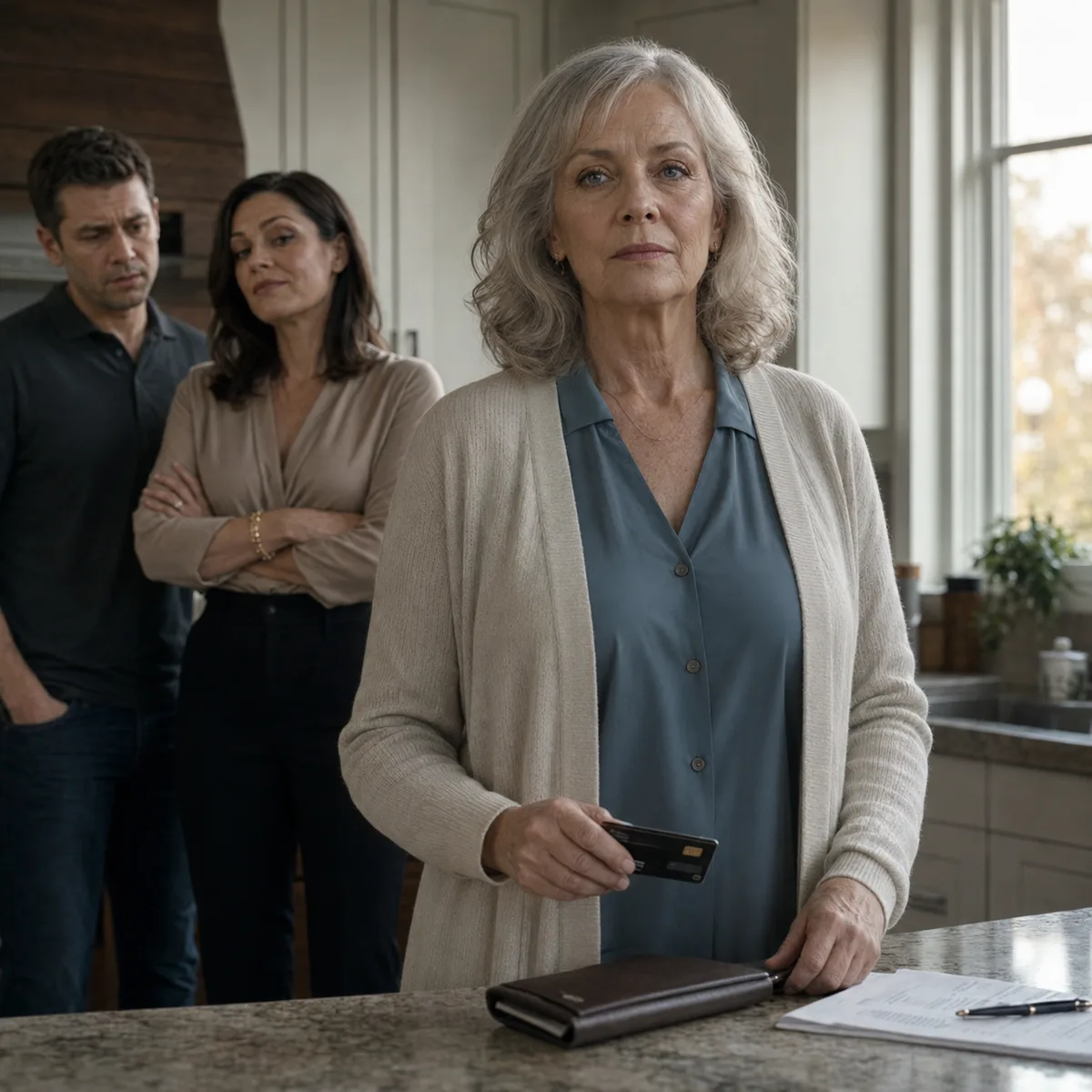
PART 3 — THEY TRIED TO TAKE BACK CONTROL
When I was getting dressed to leave, the doorbell rang.
Chapter 3
PART 3 — THEY TRIED TO TAKE BACK CONTROL
When I was getting dressed to leave, the doorbell rang.
My stomach tightened, expecting Daniel and Lisa.
But it was Dorothy, my neighbor. Sixty-five, widowed, kind-eyed, the kind of woman who knows what loneliness feels like and doesn’t weaponize it.
“I hope I’m not bothering you,” she said. “But yesterday… I heard shouting. I saw your son and his wife here for hours, banging on your door. I almost called the police.”
A strange relief washed over me. Someone had seen it. Someone had witnessed what I’d been surviving in private.
I invited her in. Made coffee. And told her the truth.
Dorothy listened without interrupting, nodding slowly like each detail fit into a pattern she’d already noticed.
When I finished, she exhaled hard.
“Margaret,” she said, “I have to confess something. I’ve been watching for years. I’ve seen them show up in new cars and expensive clothes with the latest phones. And I’ve watched you drive that old car
and shop at discount stores.”
Her words hit me because they weren’t cruel.
They were simply true.
“What struck me most,” she continued, “is I’ve never once seen them do anything for you. Not groceries. Not repairs. Not a visit without wanting something.”
It was like being handed a mirror and finally seeing your own face.
Before she left, Dorothy squeezed my hand.
“Being a good mother doesn’t mean being a doormat,” she said. “You can love your child without sacrificing your dignity.”
At the bank, the manager asked gently if I was worried about fraud or identity theft.
I looked him in the eye and said, “Let’s just say I finally realized my biggest risk is inside my own family.”
He nodded with zero surprise.
“It happens more than people think,” he said. “You’re doing the right thing.”
Afterward, I ate lunch alone at a small Italian place I’d
always wanted to try. I ordered the most expensive pasta on the menu, a glass of red wine, and chocolate cake. The whole bill was fifty-two dollars—less than Daniel and Lisa used to spend on appetizers.
I ate slowly, savoring the taste of choosing myself.
At 1:00 p.m., I sat in Mr. Henderson’s office and told him I wanted to change everything.
He wasn’t shocked. Not even a little.
“Mrs. Margaret,” he said carefully, “are you certain you want to revise your estate plan?”
“I’m absolutely certain,” I said. “He’s already spent too much of it while I’m alive.”
We created new arrangements—charities, shelters, a portion to my sister Ruth, and a smaller portion to Daniel with conditions designed to encourage independence rather than reward entitlement.
When I walked out, I felt lighter.
Then I drove home and found an unfamiliar car in my driveway.
An older woman stood on
my porch, dressed elegantly, posture rigid with practiced authority.
Lisa’s mother.
Patricia.
She smiled like a woman arriving to correct a child.
“Margaret,” she said, “I’m glad you’re home. We need a serious woman-to-woman conversation.”
I let her in—not because I was intimidated, but because I wanted to hear what story Lisa had planted in her.
Patricia sat in my living room like she was conducting an intervention.
“Lisa told me what happened,” she began, voice smooth. “And honestly, I think you’re blowing this out of proportion. Canceling your son’s cards over a simple joke… it’s extreme.”
I folded my hands in my lap.
“Do you give your daughter unlimited access to your credit cards?” I asked.
She blinked. “Well, no, but—”
“Do you pay her rent every month?”
“No, but every family is different.”
“Do you pay for her vacations while you stay home alone?”
Patricia shifted.
“Margaret,” she said, tighter now, “young couples need support. Times are different.”
“Yes,” I said. “Times are different. There are more opportunities than ever. If two educated adults can’t support themselves, that’s not my job to fix.”
Patricia tried guilt.
“Lisa cried for hours,” she said. “She sees you as a second mother.”
“A second mother who’s only good for paying bills?” I asked calmly.
Then she tried fear.
“You could end up alone.”
Then she tried shame.
“What will your church think?”
And finally, when none of it worked, she let the real threat slip out, sharp as a knife.
“There are legal ways,” she said slowly, “to have someone declared incompetent if they behave irrationally with their finances.”
The room went cold.
It wasn’t just manipulation anymore.
It was a power grab.
I stood.
“Patricia,” I said, voice steady, “I strongly suggest you consult a lawyer before you threaten me with that. I just came from my attorney. Protecting yourself from financial exploitation is a sign of competence, not the opposite.”
Her face flickered—surprise, anger, retreat.
“I didn’t mean it like that,” she backtracked.
“Yes, you did,” I said. “And now this conversation is over.”
I walked her to the door in silence. At the threshold, she turned.
“A family war benefits no one,” she said.
“There is no war,” I replied. “There’s just a woman who finally learned her worth.”
When she left, I called Henderson and told him what happened.
He advised me to document everything. Not dramatically. Not with panic. With calm, legal common sense.
That night, for the first time, I felt a flutter of fear—not that I was wrong, but that they might actually go further than I’d imagined.
And when you finally stand up to people who live on your compliance, you learn something fast:
They don’t stop because you ask them nicely.
They stop when they realize you’re no longer an easy target.
The next morning, I did something I never thought I’d do: I scheduled a full evaluation at a private clinic. Not because I doubted myself.
Because I refused to let anyone paint me as unstable for choosing boundaries.
The doctor listened carefully, asked questions, ran assessments, and then looked at me with professional clarity.
“Mrs. Margaret,” she said, “you are demonstrating sound judgment and exceptional clarity. Recognizing financial exploitation and protecting yourself are signs of a healthy mind.”
She gave me a sealed report.
An insurance policy.
When I got home, Dorothy leaned over the fence, eyes wide.
“Margaret,” she said, “an older woman came by yesterday asking about you. She wanted to know if you’d been acting strange.”
My chest tightened.
Patricia was collecting “evidence.”
Building a narrative.
Dorothy’s mouth tightened with anger.
“I told her you seem happier than I’ve ever seen you,” she said. “Because you do.”
I thanked her, and I meant it. Because sometimes salvation looks like a neighbor with a backbone.
That afternoon, Dorothy surprised me with something that felt almost rebellious.
“A cruise leaves Thursday,” she said, eyes bright. “Six days. My sister canceled. Come with me.”
The idea hit me like sunlight through a crack.
Six days where no one asked me for money. No one guilted me. No one threatened me with shame.
“Yes,” I said without hesitation. “I’ll go.”
We booked it.
Six hundred dollars each, all-inclusive.
A fraction of what I’d spent funding their “young people trips” I was never invited to.
The days before the cruise, I packed like a woman learning how to be her own person again. Comfortable clothes. A new swimsuit I’d never dared to buy. A paperback novel. Lipstick.
Then, on Sunday, Daniel came alone.
He looked terrible. Dark circles under his eyes. Clothes wrinkled. A man who had been living on borrowed money and borrowed confidence suddenly forced to face reality.
“Mom,” he said, voice cracking, “please. Just me. No Lisa. No yelling. I need to talk.”
I let him in, but I kept my heart guarded. Love doesn’t mean lowering your defenses when someone has proven they’ll use your softness against you.
He sat on my couch like it was unfamiliar territory.
“I’m desperate,” he said. “The car payment is due tomorrow. If we miss it—”
“How much?” I asked.
“Three twenty.”
“And how much did you earn last month?” I asked, calm as a bank statement.
He hesitated. “About… twenty-eight hundred.”
I let the silence stretch.
“But,” I said.
He swallowed. “But everything’s so expensive. Rent, utilities, food—”
“And the restaurants?” I asked.
He flinched. “Mom…”
“How much did you spend eating out last month?” I pressed.
He looked away. “Maybe… four or five hundred.”
“And subscriptions? Streaming, gym, delivery apps?”
He bristled. “Those are necessities.”
I stared at him for a moment and felt something painful and strange—grief, not for money, but for how deeply he’d been trained to confuse wants with needs.
“Daniel,” I said quietly, “you’re thirty-seven. Why can’t you pay a three-hundred-dollar bill?”
His shoulders sagged. Then the real truth spilled out, ugly and honest.
“Because Lisa has expectations,” he said, voice raw. “Her friends live a certain way. We can’t look poor.”
There it was.
Not survival.
Performance.
And for years, I had been financing the performance.
“Did you ever make a budget?” I asked.
Silence.
“Did you ever consider moving somewhere cheaper?” I asked.
More silence.
“Did you ever cut back so you didn’t have to ask me?” I asked.
He blinked hard, and for the first time I saw something behind his eyes that wasn’t entitlement.
Shame.
He whispered, “I thought you liked helping.”
“I loved you,” I corrected him softly. “And you turned my love into an obligation.”
Tears slipped down his face slowly, not dramatic—just… exhausted.
“I never thought about how it felt for you,” he whispered.
“That’s the problem,” I said. “You never had to.”
He sat there a long time after that, quiet, like he was meeting himself for the first time.
When he finally stood to leave, he said something that sounded like the beginning of adulthood.
“I’ll find a way to pay it,” he said. “I’ll talk to Lisa. For real.”
I didn’t believe him fully. Not yet. But the fact that he didn’t demand money in that moment… it mattered.
On Monday, while I packed for my cruise, Lisa called.
Her voice was different—soft, careful, controlled.
“Margaret,” she said, “could we meet for coffee? Just you and me.”
Curiosity is a dangerous thing, but I agreed. Not because I trusted her, but because I wanted to look her in the eye and see what kind of person lived behind the masks.
We met at a quiet coffee shop near the mall, the kind of place where the Wi-Fi is fast and the chairs are designed to make you leave before you get too comfortable.
Lisa arrived dressed simpler than usual. No flashy jewelry. No designer bag. She looked tired. Real-tired.
She sat down and didn’t waste time.
“I’m sorry,” she said. “What I said was cruel.”
I studied her face. “What changed?”
She took a breath, and for once, the answer wasn’t about feelings. It was about reality.
“The restaurant was humiliating,” she admitted. “But… these past days, without your support, we finally had to look at our finances. And it scared me.”
She leaned forward.
“We made a real budget. Just our salaries. No help. No ‘emergency fund’ from you. And we realized… we spend almost double what we make.”
Double.
There was no way to spin that into “times are hard.”
That was a lifestyle built on a lie.
“We’re moving,” she said quietly. “Cheaper place. Cancelling memberships. Changing everything.”
I watched her, waiting for the angle. Waiting for the punchline.
“And what do you want from me?” I asked.
Lisa’s mouth tightened. “I want to rebuild. If that’s even possible.”
I didn’t soften.
“The relationship we had before is gone,” I said. “It was built on you taking and me giving until I disappeared.”
Her eyes flickered, and for a second I saw real fear—fear of losing the safety net forever.
“Does that mean you’ll never help us again?” she asked.
“It means,” I said carefully, “that help will never be automatic again. If you become independent, if you build your own stability, then maybe one day you’ll have an emergency and I’ll choose to help. But you don’t get to build your life on my money anymore.”
Lisa stared down at her coffee like it might give her answers.
“I don’t know if we even know how to live like that,” she admitted.
“Then learn,” I said. “Because it’s past time.”
We finished in silence. As we stood, Lisa said something I never expected to hear from her mouth.
“Being an adult isn’t just getting married,” she said quietly. “It’s taking responsibility.”
I didn’t respond with forgiveness. I responded with something better: a boundary that didn’t shake.
Thursday, Dorothy and I boarded the cruise. Six days of sea air and sunlight and waking up when I wanted. Six days of eating without calculating the cost. Six days of laughing without someone turning it into leverage.
On the ship, I met women my age with stories that sounded like mine—parents who’d been drained by adult children who confused love with a paycheck. One woman cried as she spoke. Another laughed bitterly. All of us shared the same stunned realization:
We weren’t alone.
When I returned home the following Tuesday, I expected chaos.
Instead, the answering machine held something unfamiliar.
Two messages from Daniel.
Not asking for money.
Just… checking if I’d arrived safely.
And one short message from Lisa.
“Hope you enjoyed your cruise. We’d love to hear about it when you have time.”
On Wednesday morning, Dorothy came over with coffee and pastries to hear all the details. We sat on the back patio, laughing about the karaoke night we’d watched from a safe distance and the ridiculous dance instructor who insisted we “feel the rhythm.”
Then I saw Daniel’s car pull into my driveway.
He sat inside for several minutes before getting out, like he was rehearsing something in his head.
When he finally rang the bell, his face looked different.
Nervous, yes.
But less entitled.
More… human.
“Mom,” he said, “can we talk?”
I stepped aside.
He entered carefully, like he wasn’t sure if he was walking into comfort or consequences.
“Lisa and I moved,” he said quickly. “Smaller apartment. Seven hundred less in rent.”
“How does that feel?” I asked.
He swallowed. “Hard. But… I can sleep now. Knowing we’re paying our own bills.”
He rubbed his hands together, eyes damp.
“We cancelled the expensive gym. Lisa picked up a weekend job. She said… she wants to contribute instead of living off… off other people.”
He looked up, and for the first time in a long time, he held my gaze.
“Mom,” he said, voice raw, “I’m sorry. Not just for last week. For all of it. I treated you like an ATM.”
The words were simple, but they were the first honest ones he’d offered without trying to trade them for access.
“What made you see it?” I asked.
Daniel’s throat worked.
“When we made the budget,” he admitted. “I realized I had no idea what life costs. I’ve been pretending I’m an adult because I have a job and a marriage, but… you were carrying the consequences.”
He took a shaky breath.
“These past few days are the first time in years I’ve felt like a real grown-up. Terrified… but also free.”
I felt something tighten behind my ribs. A grief I’d held down for years finally shifting into something else.
“Mom,” he continued, quieter now, “I know I don’t have the right to ask anything. But… do you think one day we could have a normal relationship? One where I come over because I love you, not because I need something?”
Click the blue “PART 4” below to read the final part:
Chapter complete
You have reached the end of this chapter.
Continue reading
A few more worlds to get lost in after this chapter.




