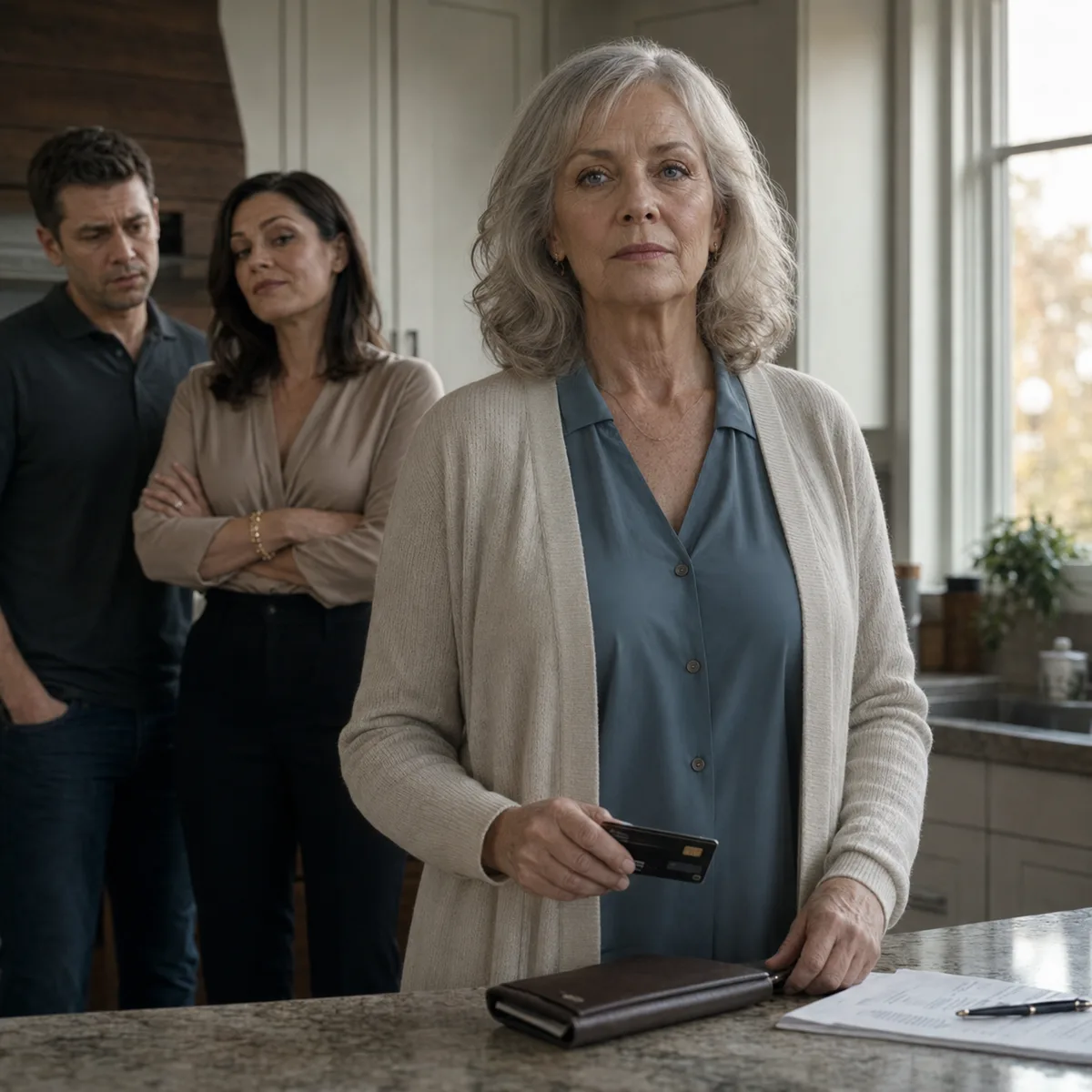
PART 2 — CONSEQUENCES ARRIVED AT MY DOOR
For a second, I expected sadness.
Chapter 2
PART 2 — CONSEQUENCES ARRIVED AT MY DOOR
For a second, I expected sadness.
I expected the familiar ache, the one I’d carried since Daniel moved out and my house got too quiet.
But what rose in me wasn’t sadness.
It was anger.
Hot, clean, unfamiliar anger—like a match struck in a dark room.
Because in that moment I finally understood something I had been refusing to see for years.
They didn’t see me as Daniel’s mother.
They didn’t see me as a woman who had lived a life and earned respect and deserved tenderness.
To them, I was a resource.
A money tree they could shake whenever they felt like spending.
For twelve years, I had been their secret bank.
When Daniel got fired three years ago, I paid his rent for a whole year. Nine hundred dollars a month. Money that came out of my retirement, the money I counted because I knew Social Security wasn’t a magic fountain and my joints
didn’t get younger. He never looked for a new job during that year the way a grown man should. Not seriously. He “applied” the way people apply when they know someone else will rescue them.
When Lisa decided her clothes were “cheap” and “embarrassing,” she dragged me through the mall like a personal sponsor and rang up four thousand dollars on my credit card. She smiled while the cashier folded silk and denim into crisp paper bags. I smiled too, the practiced smile of a woman who tells herself this is what love looks like.
When they “needed” a vacation to Hawaii because “work was stressing them out,” six thousand dollars disappeared from my account. They didn’t invite me, of course. I was too old to walk the beaches, Daniel said. It was a trip for young people.
Young people.
I stayed home alone, watching their sunset photos on Facebook,
feeling like I’d paid admission to a movie I wasn’t allowed to watch.
Six months ago, Lisa decided she needed a brand-new car.
“The one we have is falling apart,” she said in that sweet fake voice she used when she was about to take something. “And if we’re going to start a family, we need something safer for a baby.”
Eighteen thousand dollars. The down payment. Three years of careful savings, wrung out of my life by refusing myself anything that felt indulgent—no new sofa, no weekend trips, no “treat yourself,” no nothing.
I handed it over anyway, because I kept telling myself: I’m helping my family.
But yesterday, after hearing those words, after watching my own son laugh while his wife described me like I was an appliance, something broke.
Not my heart.
My denial.
That night I didn’t sleep. Not because I was crying, but because my
mind was suddenly clear. Like a fog had lifted. Like the air finally came back into my lungs.
At 2:00 a.m., I got out of bed and turned on my old desktop computer. The one Daniel used to tease me about, because I still typed with two fingers and printed everything like it was 1998.
I made decisions.
Big ones.
First, I called the bank’s fraud department and froze every credit card that had their names attached to it. All six cards they’d been using like they were entitled to my lifetime of work.
Then I closed the shared savings account where I’d been depositing money every month for their “emergencies.” Emergencies that somehow always looked like designer shopping sprees and weekend getaways and restaurant tabs big enough to make my stomach clench.
I changed every password.
I removed their access.
I tightened security the way you do after you realize the thief isn’t out on the street—he’s inside your own family.
By 5:00 a.m., the paperwork was done.
I made myself a cup of tea and sat by the window in my favorite chair. The sky outside was still black-blue, and the world looked quiet and honest. The birds hadn’t started yet. The neighborhood was asleep.
For the first time in years, I felt free.
I knew the phone would ring.
I knew Daniel would call, embarrassed and afraid, demanding answers.
And I was ready.
Now, on Tuesday morning, he was living the consequences in real time.
“Mom,” he said, voice shaking, “please don’t do this right now. We can talk later. But I need you to turn them back on. Just for today.”
Just for today.
For twelve years, “just for today” had been the leash around my life.
“No,” I said softly. “No more promises. No more ‘just for today.’ You’re thirty-seven, Daniel. You’re not a child.”
“Are you sick?” he snapped, flipping tactics like a switch. “Is something wrong with your health? You’ve never been this mean.”
Mean.
That word hit me harder than the insult.
Because that’s how they keep you trapped, isn’t it? They label you cruel the first time you stop being convenient.
“You laughing at me yesterday was mean,” I said, and my voice surprised me—cold, steady, unshakable. “Treating me like I’m invisible unless you need money is mean. Making me feel like my only value is what I can pay is mean.”
He breathed hard into the phone. I could picture him now: sitting stiff, eyes darting, trying to keep his face calm while the waiter hovered and Lisa’s mother watched. The fancy gold card that used to make him feel important was now just a piece of plastic.
“Mom, we can’t just sit here,” he hissed. “What do you want us to do—go wash dishes in the back? Call the cops? This is humiliating.”
“Now you know how I felt,” I said. “The difference is, you can fix your humiliation. You can stand up, pay your bill another way, and learn. I couldn’t fix mine because I kept pretending it didn’t exist.”
“Lisa’s crying,” he said, voice cracking. “Her mom is asking what kind of family we are. Everyone’s staring. Please—just this one time.”
Mercy.
Another loaded word. Another attempt to make me responsible for the discomfort they’d earned.
“Mercy is something you earn over years,” I said. “And you lost it yesterday.”
Then I hung up.
My hands shook. Not from fear.
From power.
Because for the first time in twelve years, I had said no and meant it.
The phone didn’t stop ringing. Daniel called back three times. Lisa called. An unknown number—probably Lisa’s mother—lit up my screen. Every call I ignored felt like a brick placed back into the foundation of my own life.
I poured more tea and went to sit on my back porch. The birds finally started, chirping like they didn’t care about credit limits or humiliation or adult children who never grew up. The sun warmed the wooden railing. For a moment, my world shrank to something simple: breath, morning air, and a kind of peace I’d forgotten existed.
Then, at 10:30 a.m., I heard tires crunching into my driveway.
A car door slammed. Then another.
Fast footsteps.
Hard knocking.
“Mom! Open the door right now!”
Daniel’s voice sounded different now—less panic, more rage. Rage is what entitlement turns into when it runs into a locked gate.
“I know you’re in there!” he shouted. “I can see your car!”
Then Lisa’s voice—sharp, demanding, like a woman who believed the world owed her soft landings.
“Margaret! Stop acting like a baby and come out here. Face us!”
Face us.
Like I was the one who had done something wrong.
Like I owed them an explanation for finally protecting myself.
The knocking turned into kicking. I heard the hollow thud of shoes against the wood—my husband’s wood, the front door he’d built himself with calloused hands and pride.
The sound did something to me.
Not fear.
Resolve.
I stayed on the back porch, out of sight, watching birds flutter at the feeder like tiny, fearless things. It struck me how sweet life feels when you stop letting people drain it out of you.
“This is ridiculous!” Lisa yelled. “You made us look like beggars in front of everyone. My mother had to pay. A seventy-two-year-old woman had to pull cash out of her purse because you lost your mind!”
So that’s what happened. Lisa’s mother saved them. Paid the bill. Smoothed over the humiliation.
I imagined it: Daniel’s forced smile. Lisa’s fake laugh. The way they probably spun it to look like a “bank error,” because God forbid the truth be seen.
And of course, their biggest fear wasn’t that they’d broken their mother’s heart.
It was that someone might post the moment online.
“People were recording us,” Daniel shouted. “This is going to be all over Facebook by tonight!”
There it was again—image over integrity.
The yelling stopped for a moment, and I heard them whisper-arguing. Desperate plotting. Lisa suggested something—her voice hissed low and angry. Daniel countered. I caught fragments: “locksmith… no, that’s illegal… don’t be stupid…”
Then Lisa’s tone changed like a magician’s trick. One second, fury. Next second, syrup.
“Margaret,” she called softly. “I know you’re hurt. You have every right. Maybe what I said came out wrong, but you know I didn’t mean it. I was just joking. You know how women are.”
I almost laughed. Not because it was funny. Because it was textbook.
The sweet voice wasn’t remorse. It was strategy.
Daniel copied her tone, suddenly gentle, suddenly reasonable, like they were auditioning for a daytime talk show redemption segment.
“Mom,” he said softly. “We’re sorry. But turning off the cards doesn’t fix anything. It makes everything worse for the family.”
For the family.
Not for me.
For them.
Then Lisa slid in the weapon she loved most: public opinion.
“What will people think?” she called. “At church on Sunday? What will your sister say? What will your neighbors think when they find out you cut off your own son?”
She was trying to drag me back into the cage with shame, because guilt wasn’t working fast enough.
I stood and walked quietly to the side window. I lifted the curtain just enough for her to see my face.
Lisa froze mid-sentence. Her expression flickered—anger, relief, calculation—then the fake smile arrived like a mask.
“There you are,” she said brightly. “Come on, open the door. Let’s talk like family.”
I looked at her for a long moment, and I felt something settle in my chest.
A decision so final it felt like a door closing.
Then I lowered the curtain.
The scream that came from outside was pure frustration—raw, ugly, unfiltered. The pounding on the window started again.
This time, I didn’t flinch.
Because I finally understood: I had been flinching for twelve years. Jumping at their needs, their emotions, their crises, their “just this one times.”
No more.
They left after an hour. Tires. Doors. Silence.
But I knew Lisa.
Silence from her was never surrender.
It was planning.
At 2:00 p.m., the calls started again—numbers I didn’t recognize. First Lisa’s mother, polite and firm, speaking like a woman used to getting her way through “civilized conversation.”
“Margaret, dear, I think there’s been a misunderstanding. I’m sure we can solve this like adults.”
I hung up.
Then my older sister Ruth called from out of state, her voice already shaped by whatever story had been poured into her ear.
“Margaret, Daniel says you’re acting strangely,” Ruth said. “He says you abandoned them at a restaurant and cut them off without warning. Are you feeling okay?”
“I’m feeling better than I have in years,” I said.
Ruth hesitated, the way people do when they want to help you but also want to keep the peace.
“But they’re your family,” she murmured. “Lisa says it was an innocent joke.”
“Innocent jokes don’t sound like laughter in my kitchen while my son agrees I’m only good for paying bills,” I said.
Ruth sighed. “Parents help their kids. That’s normal.”
“Is it normal,” I asked, “to pay a grown man’s rent for a year while he doesn’t look for work? Is it normal to finance vacations you aren’t invited to? Is it normal to be mocked for being generous?”
Ruth went quiet.
Then, softer, she said, “Cutting them off all at once seems harsh.”
“You know what’s harsh?” I said. “Working until you’re sixty-seven so your son can have a future, only to watch him spend it while you’re still alive.”
After that, I unplugged the landline. Put my cell on silent. I needed quiet. Real quiet. The kind that lets you hear your own thoughts.
That evening, I cooked dinner alone. Simple food. Nothing fancy. The kind of meal I’d been eating for years while they posted photos of steak and cocktails.
And I realized something that startled me.
I didn’t feel guilty.
The guilt was gone.
In its place was clarity—bright and sharp like winter air.
I went into my small office and pulled out bank statements. I started adding.
The numbers were worse than my memory.
Ninety-four thousand dollars in six years.
Ninety-four thousand dollars that could have paid for home repairs, medical needs, a small vacation for myself, peace.
Ninety-four thousand dollars exchanged for indifference.
Mockery.
Being treated like a burden.
I found charges that made my hands shake—monthly subscriptions for premium streaming, expensive gym memberships with personal trainers, magazines I never read, services I didn’t even know existed. Tiny drains that added up to a river.
Money leaving my account automatically to fund luxuries I never touched.
That night, I pulled my will from the filing cabinet.
Seven years ago, when I still believed I was “protecting my family,” I’d left everything to Daniel. The house. The accounts. The investments. The life I built.
Now, staring at that paper, I felt something cold move through me.
Why should I reward a man who had already spent half his inheritance while I was still living?
Why should I hand my life’s work to someone who treated me like a machine?
The next morning I called my lawyer, Mr. Henderson, and asked for an urgent appointment.
And I made another call—to my bank manager—for tighter security. Not because I was paranoid.
Because I finally admitted the truth.
My biggest financial threat didn’t wear a mask.
He called me Mom.
Click the blue “PART 3” below to read the next part:
Chapter complete
You have reached the end of this chapter.
Continue reading
A few more worlds to get lost in after this chapter.




