PART 3 — THE LEGACY HIS BETRAYAL CREATED
When they saw me, their leader approached.
Chapter 3
PART 3 — THE LEGACY HIS BETRAYAL CREATED
When they saw me, their leader approached.
He was large, with scars on his hands and the tired confidence of someone accustomed to fear.
“Ma’am,” he said, “are you related to Thomas?”
“I am his mother,” I replied calmly. “And I have a proposal.”
I pulled a signed check from my purse.
“This is the exact amount my son owes you,” I said. “Take it and forget about him forever.”
The men stared at the check in surprise.
They had not expected an elegant older woman to arrive with that kind of money.
“Why would you do this for him?” the leader asked.
“I am not doing it for him,” I said. “I am doing it for my daughter-in-law and my grandchildren. They are not responsible for living with a gambler.”
The man examined the check carefully, then nodded.
“Deal.”
When they left, Laura came out of the house with tears in her eyes.
“Dorothy, I cannot
accept that you paid Thomas’s debts.”
“I did not pay them for him,” I said. “I paid them for you and the children. And it is not free.”
I handed her a document Stanley had prepared.
“It is a property transfer,” I explained. “The house is now in your name. Thomas no longer has legal control over it.”
Then I handed her another document.
“This is a loan agreement. You owe me the amount I paid, but you can repay it in small installments over twenty years.”
It was perfect.
Laura was protected.
The children had a safe home.
Thomas lost his last economic resource.
When he finally returned, he would discover he owned nothing.
That afternoon, Thomas deigned to call me.
His voice sounded desperate and broken.
“Mom,” he pleaded, “I need your help. They’re going to ruin me if I don’t pay. I need money. I need you
to forgive me.”
“Thomas,” I interrupted coldly, “I already paid your debts.”
I heard his sigh of relief.
“Thank you, Mom. I knew you wouldn’t abandon me.”
“I did not do it for you,” I said. “I did it for Laura and the children. And you no longer have a house. It has been transferred to your wife’s name.”
The silence was absolute.
“What?” he whispered.
“The house is no longer yours. Your wife owes me the money, not you. You have nothing more to do with that property.”
His breathing became frantic.
“You can’t do that,” he shouted. “It’s my house.”
“Was it bought with money you stole?” I replied. “Now it belongs to the people you should have protected.”
I hung up without waiting for his response.
The following days were filled with delicious tension.
Thomas showed up at the house, but Laura had already changed the locks.
When he tried to force his way in, she called the police.
The officers arrived and explained that he no longer had a legal right to the property.
“But she’s my wife,” he yelled as they escorted him away. “I have a right to be here.”
“Sir,” one officer said, “your wife has requested a restraining order. You cannot come near this property.”
Restraining order.
Laura had followed my advice exactly.
Now Thomas had lost not only his house, but legal access to his family.
Homeless, jobless, and nearly penniless, he ended up in a cheap motel.
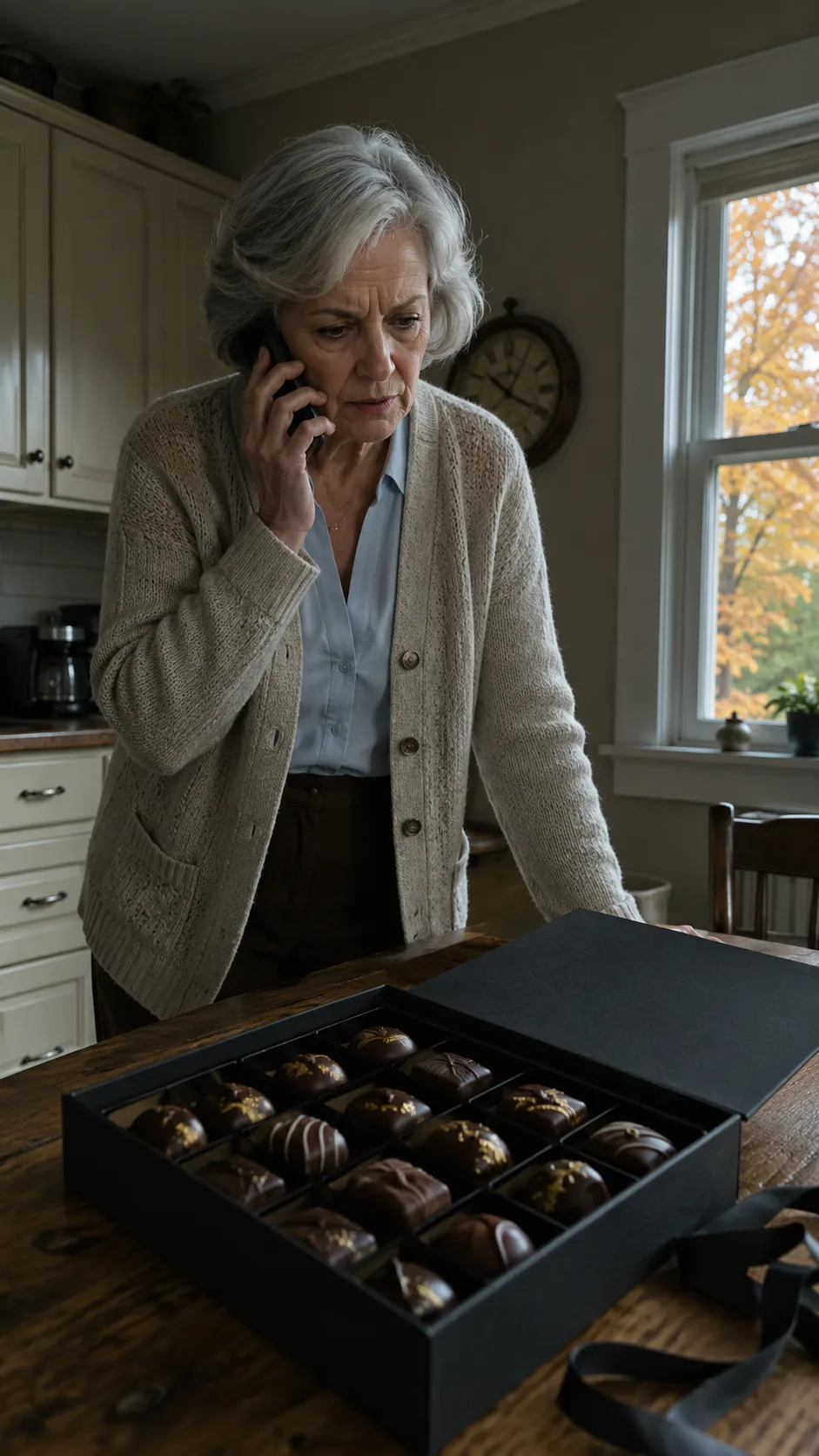
Even that became difficult when the media began following him. Reporters waited outside, asking questions about the chocolates, the debts, and the gambling.
One night, desperate and humiliated, Thomas made what he thought was a clever move.
He created a social media profile and began livestreaming from a dirty motel room.
“My mother is crazy,” he said into the camera. “She is making all of this up because she wants attention. I never meant to hurt anyone. The chocolates were normal. She is manipulating my whole family.”
But the internet does not forgive foolishness.
Viewers flooded him with questions he could not answer.
Why were the children hospitalized?
Why did Laura testify against him?
Why did he run away?
Where was his proof?
His livestream went viral, but not in the way he expected.
It became an example of a man unable to accept responsibility.
The comments were brutal.
“This guy really thinks everyone is stupid,” one person wrote.
“His wife is against him, and he still says it’s all a lie,” another added.
But the moment that sealed his fate came when someone asked, “If you are innocent, why don’t you sue your mother for defamation?”
Thomas went silent.
He could not sue me because he knew I had evidence.
His silence was interpreted by everyone as guilt.
The broadcast ended abruptly when the comments became too much for him.
The next day, clips of his livestream appeared on every news program.
Behavioral analysts discussed his inability to take responsibility. Psychologists explained manipulation patterns on television.
Thomas had accomplished something even the best public relations team could not have done for me.
He destroyed his own reputation completely.
But for me, the most satisfying thing was not his public humiliation.
It was the peace in Laura’s eyes.
The safety my grandchildren felt in their own home.
The quiet I found after moving away from the toxicity that had ruled my life for decades.
Formal justice was still coming.
But poetic justice had already arrived.
The son who wanted my money had none.
The man who scorned my love now begged for forgiveness.
The manipulator had been exposed.
And I, the woman who had lived in silence for forty years, had finally found my voice.
The months that followed transformed me completely.
While Thomas sank further into misery, I flourished.
My apartment became my sanctuary. For the first time in decades, I could breathe without the weight of constant manipulation.
Stanley kept me informed of the legal cases.
“Dorothy,” he told me during one of our weekly meetings, “the district attorney is very interested in prosecuting Thomas. The evidence is strong. The recordings, the medical testimony, the confession, everything forms a solid case.”
He smiled.
“His attorney is already trying to negotiate. He knows he cannot win.”
A guilty plea would mean Thomas would have to publicly admit what he had done.
But what filled me with the deepest satisfaction was watching Laura rebuild her life.
Without the lies, financial stress, and emotional manipulation, she became the strong woman I had glimpsed years earlier.
“Dorothy,” she told me during one of our weekly lunches, “for the first time in years, I feel free. The children are happy. They sleep peacefully now.”
Seeing my grandchildren recover their innocence was worth more than any revenge.
One afternoon, while drinking coffee on my terrace, I received an unexpected call.
It was Natalie.
My sister’s voice sounded embarrassed and heavy with guilt.
“Dorothy,” she said, “I need to talk to you. I need to apologize.”
I agreed to receive her at my apartment.
When she arrived, the difference between us was striking.
I looked elegant, serene, and empowered.
She looked consumed by shame.
“Dorothy,” she began, tears in her eyes, “I knew Thomas had problems, but I never imagined he was capable of this.”
“Natalie,” I replied calmly, “you always knew something was wrong with him. You always justified him. You always protected him from consequences.”
She nodded.
“I know. I was an accomplice. I failed you as a sister. What hurts me most is that when he came to my house after what he did, I let him in. I protected him.”
Her tears were genuine.
Her remorse seemed real.
But the damage had already been done.
“Natalie,” I said without cruelty, but with firmness, “for forty years, you chose to protect Thomas from consequences instead of protecting your sister. I cannot simply forget that because you feel guilty now.”
She left crying.
I felt peace.
For the first time, I had set a boundary without rage, without pleading, and without apologizing.
The criminal trial began six months after the chocolates arrived.
The media covered every detail. Every testimony. Every piece of evidence.
I testified with a serenity that impressed even the most experienced reporters.
“Ms. Dorothy,” the prosecutor asked, “how did you feel when you discovered what your son had planned?”
I looked directly at Thomas.
“I felt liberated,” I replied. “Liberated from forty years of manipulation. Liberated from giving unconditional love to someone incapable of returning it.”
Thomas looked haggard and aged.
His public defender did what he could, but the evidence was overwhelming.
Laura testified.
The doctors testified.
Specialists testified about the chocolates.
Then Thomas tried one final manipulation.
“I loved my mother,” he declared, producing false tears. “This is all a terrible misunderstanding. I never wanted to hurt anyone.”
But his own recordings betrayed him.
When the prosecutor played the audio from Natalie’s house, his version collapsed.
The jury deliberated for barely two hours.
Guilty.
Guilty of attempting to harm me.
Guilty of endangering his children.
Guilty of aggravated fraud.
The sentence was twelve years in prison, with no possibility of parole before serving eight.
When I heard the verdict, I did not feel triumph.
I felt peace.
Justice.
Legal confirmation of what I already knew.
Thomas looked at me as he was taken away.
His eyes no longer held arrogance.
Only desperation and self-pity.
“Mom,” he cried. “You’re still my mother. You can’t abandon me like this.”
I remained still.
Serene.
Watching him walk toward the consequences he had earned.
The civil cases were quickly resolved after the conviction.
The lawsuit for emotional damages resulted in a large judgment that Thomas, of course, could not pay from prison. But the symbolism mattered.
The legal system had officially recognized the harm he caused.
Laura obtained a divorce and full custody of the children. Thomas lost parental rights after being found guilty of endangering them.
My grandchildren were finally protected from their father’s toxic influence.
One afternoon, while organizing my legal documents, I found a letter I had written years earlier and never sent. It was a letter thanking Thomas for being the best son in the world.
I read it and laughed bitterly.
How blind I had been.
How naive.
How disconnected from the truth.
So I wrote a new letter.
This time, to myself.
Dear Dorothy,
For forty years, you confused love with complicity. You confused kindness with permissiveness. You confused sacrifice with virtue.
Today, I celebrate that you have finally learned the difference.
On the day I turned seventy, I hosted a small celebration in my apartment. I invited Laura and the children, Stanley and his wife, Yolanda the stylist, Robert the investigator, and the people who had helped me rebuild my life.
When I blew out the candles, I made a silent wish.
That no woman would have to wait until seventy to find her strength.
That no mother would have to confuse love with self-destruction.
That no grandmother would have to learn her worth through betrayal.
That night, alone in my apartment, I reflected on the journey.
From silent victim to empowered woman.
From selfless mother to someone who valued herself.
From a woman who gave everything and received nothing, to a woman who understood that self-love is not selfishness.
It is survival.
Thomas had wanted to destroy me to take my money.
Instead, he awakened a woman I did not know existed.
Strong.
Intelligent.
Capable.
Formal justice had been served, but the real victory was personal.
I recovered my dignity, my autonomy, and my right to live without fear.
Two years after the sentencing, my life found a balance I had never thought possible.
The wounds healed, not because I forgot, but because I learned how to carry the truth without letting it poison the rest of my life.
My daily routine became a testament to freedom.
I woke up without the anxiety I had carried for decades. I ate scrambled eggs and bacon while reading the financial news because I had decided to learn how to manage my investments myself.
Stanley introduced me to Oscar, an ethical financial consultant, who taught me that money could be a tool of empowerment, not merely survival.
“Dorothy,” Oscar told me, “you have enough capital to live comfortably for the rest of your life and still leave a meaningful inheritance.”
Inheritance.
The word that had motivated Thomas’s crime now meant something different.
I created a trust for my grandchildren, administered by Laura until they turned twenty-five.
I also established a foundation to help older women facing family abuse.
My trauma became a purpose.
The children visited my apartment every weekend.
Seeing their faces light up at my door became the strongest medicine for any remaining sadness.
“Grandma Dorothy,” little Anne once asked me, “why doesn’t Dad live with us anymore?”
Those questions were difficult, but Laura and I learned to answer them with age-appropriate honesty.
“Dad made choices that hurt people,” Laura would say. “Sometimes, when someone hurts others, they have to go somewhere to face consequences and learn.”
The children accepted these explanations with the resilience of childhood.
One afternoon, while playing with them in Central Park, I saw an older woman sitting alone on a bench. She had the lost expression I knew too well.
I approached and began a conversation.
“My name is Yolanda,” she told me.
Not my stylist Yolanda. Another woman with the same name.
“I live with my son and his wife,” she said, “but I feel invisible. They treat me like a burden.”
Her story pierced me.
It was like seeing my past reflected in another person.
I told her part of my experience, not with dramatic details, but with the honesty of someone who had walked through the same darkness.
“Yolanda,” I said, “you do not have to accept being treated like a burden. You have rights. You have value. You have options.”
That conversation became the beginning of something bigger.
I started organizing weekly meetings in my apartment for older women facing similar situations.
We called it the Circle of Strength.
Every Thursday afternoon, my living room filled with stories of survival, mutual support, and women rediscovering themselves.
Stanley helped me formalize the foundation.
We called it the Dorothy Foundation for the Dignity of Older Women.
Our first project was a temporary shelter for older women escaping family abuse. The second was a free legal assistance program.
The media began calling me to discuss elder abuse.
My story had resonated so deeply that, without seeking it, I became a voice for other victims.
“Family abuse does not always leave visible marks,” I said during interviews. “Sometimes it is emotional, financial, and psychological. Sometimes it hides behind the word family.”
One morning, exactly three years after the chocolates, I received a letter from prison.
It was from Thomas.
My first impulse was to throw it away unread, but curiosity won.
I opened it with steady hands.
Dear Mom,
I know I do not deserve your forgiveness, but I need you to know I have been reflecting on what I did.
The letter continued with apologies, expressions of remorse, and promises of change.
But something in the tone felt familiar.
Subtle manipulation.
A request for pity dressed as repentance.
“I have been going to therapy,” he wrote. “The psychologist says I have deep issues from early abandonment, from the death of my biological parents.”
Even from prison, he was still blaming others.
Still unable to assume full responsibility.
Please, Mom, give me a chance to repair the damage I caused. Agree to visit me. I need to see you. I need your forgiveness so I can heal.
I need.
I need.
I need.
It had always been about what Thomas needed.
Never what I deserved.
I showed the letter to my psychologist.
“Dorothy,” she asked after reading it, “how do you feel?”
“Sorry,” I said. “But not for him. I feel sorry because after three years, he still does not truly understand what he did.”
“Are you going to answer him?”
I thought about it for days.
Part of me, the mother I had been for forty years, felt obligated to respond.
But the woman who had risen from the ashes knew that my healing did not depend on forgiving the person who had tried to destroy me.
Finally, I wrote back.
Thomas,
I received your letter. I am glad to know you are reflecting on your actions.
However, my healing process does not require seeing you or forgiving you. I have learned that forgiveness is for the benefit of the one who forgives, not the one who asks for it.
I have built a fulfilling life without you. I have found peace, purpose, and happiness. Your absence is not an emptiness in my life. It is a space filled with tranquility.
I hope you find your own redemption, but my path to healing no longer includes saving you from the consequences of your decisions.
I signed the letter simply:
Dorothy.
Not Mom.
That title had been revoked the day he chose to become my danger.
I sent the letter and felt a profound release.
Laura also rebuilt her life.
She began studying psychology, inspired by everything we had endured.
“I want to help other families identify manipulation before it is too late,” she told me.
Her transformation from silent victim to advocate inspired me.
The children grew healthy and safe. They sometimes asked about their father, but no longer with the anguish they had carried during the worst years.
One afternoon, while reviewing reports from the foundation, I realized something extraordinary.
In two years, we had helped more than two hundred older women escape abusive situations.
Some recovered properties taken by manipulative children.
Others found the courage to report abuse.
All of them rediscovered their dignity.
My private story of survival had become a beacon for other women.
The very act meant to silence me had amplified my voice beyond anything I could have imagined.
That night, looking out over the city from my terrace, I thought about the perfect irony.
Thomas had wanted my inheritance.
Instead, he pushed me to build a legacy far more valuable than money: a foundation that would outlive me and help generations of women find strength.
The woman I had been symbolically died on the day of the chocolates.
The woman born from those ashes was stronger, wiser, and more complete.
I had learned that sometimes, to find the light, you must walk through the deepest darkness.
My revenge was complete, not because Thomas was destroyed, but because I had rebuilt myself.
The best revenge turned out to be living fully.
Without fear.
Without guilt.
Without the shadow of manipulation darkening my days.
Five years after the sentencing, my life reached a fullness I never thought possible.
The foundation had grown into offices in three states, with a team of dedicated professionals. We had helped more than five hundred women regain dignity and autonomy.
One morning, Stanley called with unexpected news.
“Dorothy,” he said, “Thomas is applying for parole. He has served five years, and his lawyer is arguing good behavior.”
My heart sped up for only a few seconds.
Then I remembered who I had become.
“What does that mean for us?” I asked calmly.
“It means there will be a hearing,” Stanley said. “The judge will review his case. You have the right to testify.”
I decided it was time to face Thomas one last time, but from a position of absolute power.
For five years, I had built a new life.
He had remained in a cell, paying for his choices.
The hearing was scheduled for a Tuesday morning.
I arrived at the courthouse with Laura, who was now a licensed psychologist and associate director of my foundation. We dressed professionally, projecting the women we had become.
When Thomas entered the room, his appearance struck me.
Five years of prison had transformed him into a prematurely aged man. His hair was gray. His face was lined. His posture bent with defeat.
There was no trace of the arrogant man who once stood in Natalie’s doorway.
His lawyer argued for parole.
“My client has shown genuine remorse,” he said. “He has participated in rehabilitation programs. He has maintained excellent conduct. He wishes to repair the damage caused to his family.”
When it was my turn to testify, I rose with the serenity of someone who had found peace.
“Your Honor,” I began, “for five years, I have observed the consequences of the defendant’s actions—not only in my life, but in the lives of his children, who have thrived in an environment free from his toxic influence.”
I looked directly at Thomas.
“I have built a foundation that has helped five hundred women facing family abuse. Every one of those stories reminds me why actions must have real and lasting consequences.”
I continued firmly.
“Thomas did not only target me. He endangered his own children. He stole from his family. He lied systematically for years. Early release would send the message that remorse after being caught can erase the gravity of what he did.”
The judge listened carefully.
When Thomas was allowed to speak, he addressed me directly.
“Mom,” he said in a broken voice, “I know I don’t deserve forgiveness, but I have changed. I have spent five years reflecting on my mistakes.”
His words sounded rehearsed.
Calculated.
Designed to create compassion.
But they no longer had power over me.
“Thomas,” I replied calmly, “you lost the right to call me mother the day you chose to become my danger. Five years in prison do not erase forty years of manipulation or the trauma of discovering what you planned.”
Laura’s testimony was devastating.
As a psychologist, she explained the patterns of narcissistic and manipulative behavior she had observed for years.
“The children have prospered without their father’s presence,” she said. “They have developed stability, security, and confidence. His release would be harmful to their progress.”
The prosecutor presented evidence that Thomas had attempted to contact dangerous people from prison, suggesting his gambling issues had not disappeared.
After two hours of deliberation, the judge announced his decision.
“Parole request denied.”
Thomas slumped in his chair.
He would serve the full sentence.
When we left the courthouse, I felt no wild triumph.
Only a deep and peaceful satisfaction.
Justice had prevailed.
That afternoon, during our weekly Circle of Strength meeting, I shared the experience.
“Today, I faced him again,” I told the women. “But not from fear. Not from vulnerability. I faced him from the power I built.”
Yolanda, the woman I had met in Central Park years earlier, raised her hand.
“Dorothy,” she said, “your story taught us it is never too late to reclaim our dignity. You found your strength at seventy. I found mine at sixty-five.”
That night, alone in my apartment, I wrote in my diary:
Today, I closed the darkest chapter of my life. Thomas will remain in prison, but I no longer live in the emotional prison he built for me. I am free. I am powerful. I am whole.
Looking at the illuminated city, I reflected on the path I had traveled.
From silent victim to advocate.
From invisible woman to community leader.
From selfless mother to a woman who understood that self-love is not selfishness.
It is survival.
The transformation had been painful, but necessary.
Like a butterfly that must break its cocoon to fly, I had to destroy the permissive version of myself to become the strong woman I was always capable of being.
The next day, I continued my work at the foundation.
I continued helping other women find their voices.
I continued building a legacy that went beyond revenge.
Because I had learned that the best response to an attempt at destruction is not destruction in return.
It is the construction of something beautiful and lasting.
Thomas had wanted to take my money.
Instead, he awakened a much more valuable inheritance in me: strength, wisdom, and purpose that I now shared with hundreds of women.
Justice does not always come quickly.
But when it comes fully, it changes everything.
Ten years passed since the day that changed my life.
At seventy-nine, I looked at my life with a satisfaction I never thought possible.
The Dorothy Foundation had become a recognized national institution, with shelters in eight cities and legal assistance programs that had helped more than two thousand women.
My grandchildren, now teenagers, visited every weekend.
Anne was sixteen and had decided to study law.
“Grandma,” she told me one afternoon, “I want to be like you. I want to defend people who cannot defend themselves.”
Her younger brother, Charles, was fourteen and carried an emotional maturity far beyond his years.
Laura became a nationally recognized psychologist specializing in family trauma and elder abuse.
Together, Laura and I wrote a book titled It’s Never Too Late: Finding Your Strength After Seventy.
It became a bestseller and was translated into several languages.
One spring morning, while reviewing correspondence in my foundation office, I received a call that pulled me back into the past.
It was the warden of the prison where Thomas was serving his sentence.
“Miss Dorothy,” he said in a grave voice, “I have to inform you that your son passed away last night.”
The news affected me, but not the way I once imagined it would.
I did not feel devastating maternal pain.
I felt a strange mixture of sadness for what could have been and relief that the chapter had finally closed.
“What happened?” I asked.
“It was a sudden heart attack,” the warden said. “The doctors believe he had developed severe heart problems, probably related to stress and depression. He passed in his sleep.”
The irony was absolute.
He had planned for my life to end in a way that looked like a heart attack.
And in the end, his own heart had failed him.
“He left a letter addressed to you,” the warden continued. “He asked that we send it.”
After a moment, I agreed to receive it.
I needed to know his last words, not out of nostalgia, but to close the cycle completely.
The letter arrived two days later.
I opened it with steady hands.
Dear Mom,
I write this knowing I will probably die in this prison. For ten years, I have reflected on what I did and on the monster I became.
I understand now that there is no possible excuse for trying to harm the woman who gave me everything.
I do not seek compassion or absolution. I only want you to know that my last conscious thought was genuine regret for failing you so deeply.
I have followed your work with the foundation from here. Other inmates show me newspaper articles about your achievements. It fills me with a strange mixture of pride and shame. Pride because you are extraordinary. Shame because I almost destroyed someone so valuable.
The letter ended with words that surprised me with their apparent sincerity.
I die knowing the world is better because you survived and prospered. I hope my death brings you the final peace you deserve.
With love and eternal remorse,
Thomas.
After reading it, I put the letter away in my desk.
I did not feel the need to cry.
I did not feel the need to forgive him posthumously.
I simply felt that a very long and painful book had finally reached its last page.
The funeral was small and private.
Laura, the children, Stanley, and I attended.
There were no emotional speeches. No nostalgia polished into lies. It was a sober farewell to someone who had chosen destruction and paid the consequences.
After the service, Anne approached me with the wisdom of her sixteen years.
“Grandma,” she asked, “are you sad?”
“I am at peace,” I said. “Sometimes the deepest sadness is for what never was, not for what was lost.”
That night, alone in my apartment, I wrote the final diary entry about Thomas.
Today I buried the son I adopted forty-seven years ago. But the son I truly loved died ten years ago, on the day he chose to become my danger. Today, I only buried the remains of that decision.
The following months were extraordinarily productive.
Without the shadow of Thomas, without the possibility of future hearings or confrontations, I dedicated myself fully to expanding the foundation.
We created a scholarship program for older women who wanted to resume their studies after escaping abusive situations.
We established a research center on elder abuse, directed by Laura.
Our studies began influencing public policy for the protection of older adults.
My personal experience had become a catalyst for social change.
On my eightieth birthday, we organized a benefit gala for the foundation.
The event brought together politicians, business leaders, academics, and most importantly, hundreds of women whose lives had been transformed by our programs.
During my speech that night, I reflected on the central lesson of my life.
“I have learned that kindness without limits is not virtue,” I said. “It is self-neglect. I have learned that unconditional love must include self-love. I have learned that sometimes, to save yourself, you must be willing to disappoint the people who expect you to sacrifice yourself endlessly.”
The room was silent.
“My story began as a tragedy,” I continued. “But it became a story of rebirth because I chose not to remain only a victim. I chose to transform my pain into power for others.”
When I finished, two thousand people stood in an ovation that lasted five minutes.
But what moved me most were the tears in Anne and Charles’s eyes.
My grandchildren looked at me with admiration earned through example and resilience.
That night, back home, I sat on my terrace and looked over the city.
Ten years earlier, I had been a seventy-year-old woman, vulnerable, manipulated, and nearly destroyed by the person I loved most.
Now I was an eighty-year-old woman with power, respect, and a legacy that would last generations.
The most perfect revenge had turned out to be the construction of an extraordinary life.
Thomas wanted to take my money, but he awakened my true potential.
He wanted to silence me forever, but he amplified my voice until it became a chorus of empowered women.
I wrote in my diary that night:
I do not regret adopting him. I only regret not understanding sooner that kindness should never be practiced at the cost of self-destruction.
My son wanted to destroy me.
Instead, he freed me to become who I was always meant to be.
The story had ended, but the legacy was just beginning.
Every woman who found her strength through our programs was a victory over the kind of thinking that had created Thomas.
Every boundary set, every firm no spoken, every act of self-love was a quiet revolution against a culture that teaches women to give everything and receive nothing.
It had taken me seventy years to find my power.
I used every day after that to make sure other women would not have to wait so long.
That was my true inheritance.
Not money, but wisdom.
Not property, but purpose.
Not revenge, but victory through transformation.
The circle had closed perfectly.
And I was at peace.
THE END.
Chapter complete
You have reached the end of this chapter.
Continue reading
A few more worlds to get lost in after this chapter.




