PART 2 — THE SON I NO LONGER RECOGNIZED
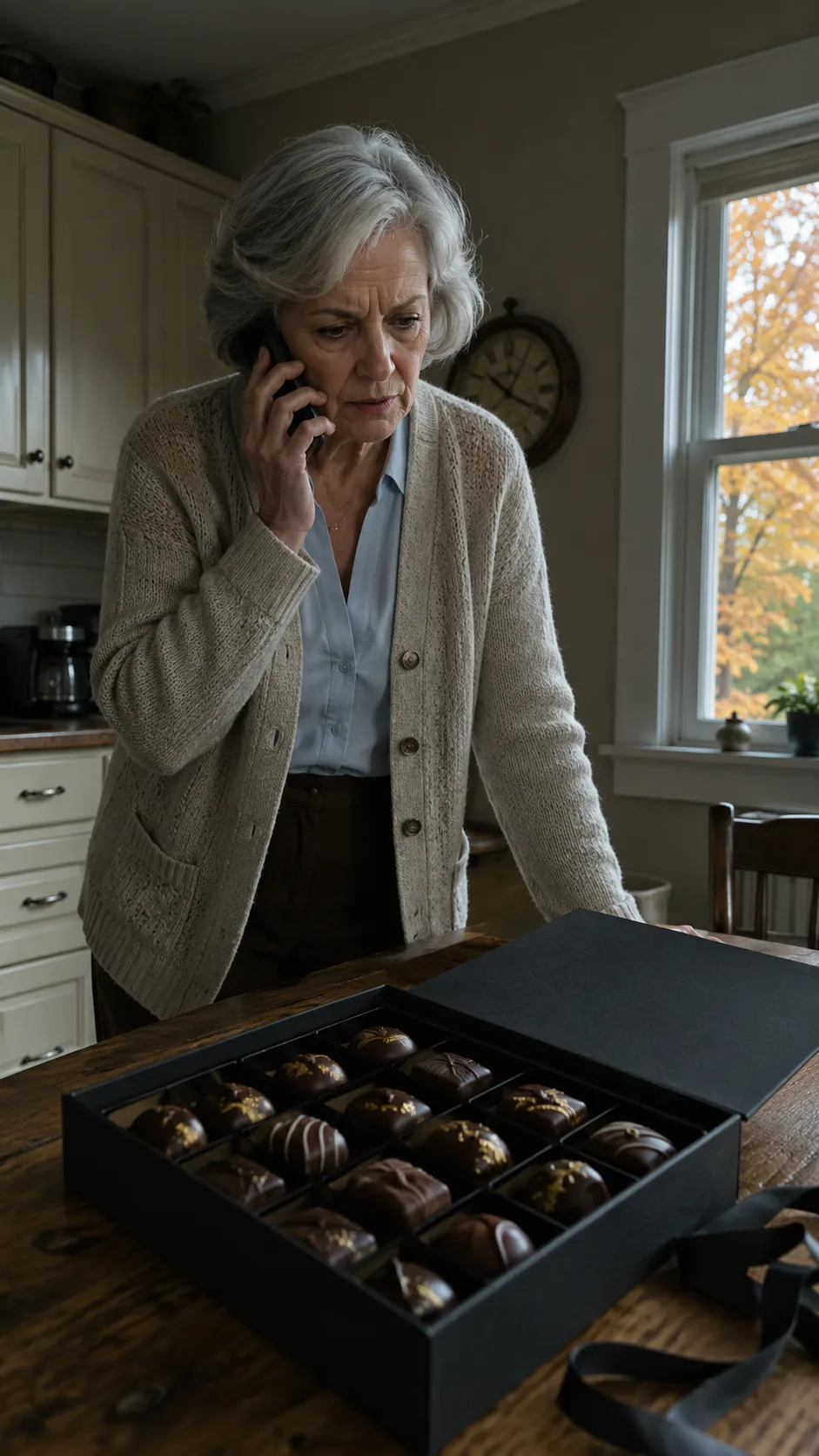
“Thomas, I don’t understand,” I said, trying to remain calm.
Chapter 2
PART 2 — THE SON I NO LONGER RECOGNIZED
“Thomas, I don’t understand,” I said, trying to remain calm.
“I thought you would be happy that I shared your gift with your family.”
But he kept shouting, each question more desperate than the last.
Had I eaten even one chocolate?
Was I absolutely sure I had not tasted a single piece?
Had I given Laura the entire box?
Had the children already eaten any?
His questions were so specific, so urgent, that something cold began to move through my chest.
Why did he care so much that I had not eaten the chocolates?
Why did he sound relieved that I had not touched them, but terrified that I had given them to his own wife and children?
Then he shouted that I was an idiot, that I had ruined everything, and hung up.
I stood in my kitchen with the phone in my hand, trembling.
I did not understand what had happened.
But something inside me, some old maternal
instinct sharpened by years of protecting others, whispered that something was terribly wrong.
That afternoon, Laura called me.
Her voice sounded different.
Worried.
“Dorothy,” she said, “the children got sick after eating the chocolates. We had to take them to the hospital in Staten Island.”
My blood went cold.
“What happened to them?” I asked, my heart in my throat.
“The doctors think it was food poisoning,” she said. “But it’s strange. The chocolates smelled odd when we opened them. The children had already eaten several before we realized.”
My world began to crumble.
The chocolates my son had sent me, the chocolates I had given away with love, had made my grandchildren sick.
But there was something else in Laura’s voice.
Fear, yes.
But also understanding.
As if she had finally seen something that had been hiding in plain sight.
That night, I could not sleep.
The pieces began
to fit together in my mind with brutal clarity.
Thomas’s reaction when he learned I had given the chocolates away.
His desperation to know whether I had eaten any.
His relief mixed with panic.
His specific questions.
And then, like lightning in the dark, the truth struck me.
My son, the child I had raised and loved unconditionally, had sent those chocolates for me.
Only for me.
The following days were a nightmare.
The children recovered, thank God, but the incident left its mark. Laura told me, in a shaking voice, that the doctors had found traces of a dangerous substance in their bodies.
A word I had only heard in crime movies became part of my reality.
For the first time in years, Laura spoke to me without her mask of contempt.
“Dorothy,” she whispered, “I don’t think those chocolates were meant to be shared. I think they were
meant specifically for you.”
Her words confirmed what my heart already knew, but my mind had refused to accept.
Thomas disappeared.
He did not answer the phone. He did not respond to messages. When Laura went to look for him at the Manhattan accounting firm where he worked, they told her he had requested emergency time off.
He had run away like a coward, leaving his wife and children to suffer the consequences of his plan.
But I knew my son.
I knew where to find him.
Whenever Thomas felt cornered, he ran to the same place: the house of his aunt Natalie, my younger sister.
Natalie had always had a weakness for Thomas. She excused him. Protected him. Softened every consequence before it could teach him anything.
I drove to Natalie’s house with my hands trembling on the steering wheel.
Forty years of unconditional love.
Forty years of sacrifice.
Forty years of giving everything I had.
And this was what I received in return.
A son who wanted me gone.
When I knocked on Natalie’s door, she opened it with guilt already written across her face.
“Dorothy,” she murmured. “I didn’t know you were coming.”
But I had already seen Thomas’s car parked near the corner.
“I know he’s here,” I said in a voice I barely recognized.
Thomas appeared behind her like a ghost.
His face was drawn. His eyes were sunken. But what struck me most was his expression.
There was no remorse.
No guilt.
Only resentment.
As if I were the one who had caused the disaster.
“Why?” I asked.
It was the only word I could force out.
“Why did you want to hurt me?”
My voice broke on the last word.
His answer broke something deeper.
“Because you’re a burden,” he said coldly. “Because you’ve always been a burden. Because I need your inheritance, and you never die.”
My inheritance.
Of course.
It came down to money.
The money I had saved for decades by working day and night. The money I had earned by living simply, wearing old coats, cutting coupons, skipping vacations, and taking double shifts so Thomas could have the best education, the best clothes, the best opportunities.
The money I intended to leave him someday, when I died naturally of old age, surrounded by family love.
“But I didn’t know you had that much,” he continued. “Not until I saw the bank documents when you got sick last year. Two hundred thousand dollars, Mom. Two hundred thousand dollars that I need now, not when you’re ninety.”
Two hundred thousand dollars.
Forty years of work.
Forty years of deprivation.
Forty years of putting myself last.
“Besides,” he added, as if he were talking about something perfectly reasonable, “you’re old. What else are you going to do with your life? Why do you need that much money at your age?”
His words were daggers.
Every syllable was a betrayal deeper than the last.
Natalie tried to intervene.
“Thomas, don’t talk like that,” she murmured.
He silenced her with one look.
“Aunt Natalie, you know I’m right. She’s already lived her life. I have a family to support. Children to educate. A future ahead of me.”
“A future built on my body,” I replied, surprised by the bitterness in my own voice. “A future bought with my death.”
He looked at me with contempt, as if I were being dramatic.
“Don’t do this,” he said. “It would have been quick. It would have looked natural. No one would have suspected anything. You would have passed peacefully in your sleep, and I would have inherited what was going to be mine anyway.”
His words revealed the depth of his betrayal.
It had not been an impulse.
Not madness.
Not a moment of weakness.
It had been calculated.
Meticulous.
Cold.
He had chosen the gift. He had chosen the timing. He had chosen my birthday because he knew I would trust anything wrapped in love.
He had planned my death with the same attention I once gave to planning his birthdays.
“And what happened?” I asked. “Why didn’t your perfect plan work?”
His face twisted with frustration.
“Because you’re too foolish to eat chocolates your own son gives you,” he spat. “Because you always have to be the martyr. Always giving everything away. Always playing the selfless saint.”
The irony almost choked me.
The very thing he hated in me—my instinct to give rather than receive—had saved my life.
My habit of sharing had destroyed his plan.
“But the worst part,” he continued, his anger rising, “is that now Laura knows everything. The children got sick because of you. Because of your ridiculous need to share things that were not meant for them.”
He blamed me.
After sending those chocolates, he blamed me for what happened to his own children.
Laura appeared in the doorway during our conversation.
Her face was pale. Her eyes were full of tears.
She had heard everything.
The final confirmation that her husband had not only tried to remove his mother from the picture, but had been willing to risk his own children in the process.
“Thomas,” she said, her voice broken. “How could you? How could you put our children in danger?”
He turned to her with the same coldness he had shown me.
“Because nothing was supposed to happen to them,” he said. “It was meant for her, not for you.”
“But you knew she shares everything with the children,” Laura cried. “You knew there was a chance they would eat them.”
Thomas shrugged.
“It was a calculated risk,” he muttered.
A calculated risk.
The children I loved, the children whose laughter had filled my afternoons, had been nothing more than a calculated risk in his plan.
At that moment, I understood that the son I had raised had died a long time ago.
The man standing in front of me was a stranger.
A dangerous stranger.
“It’s over,” I told him with a calm that surprised me. “Everything is over between us.”
He laughed, bitter and cruel.
“What are you going to do, Mom? Call the police? Report your own son? You know you’ll never do that. You’re too weak.”
For forty years, I had been too weak to tell him no.
Too weak to set limits.
Too weak to see that my unconditional love had helped him become a monster.
But that day, in that house, standing in front of his absolute betrayal, something changed inside me.
“You’re right,” I said. “I have been too weak for too long. But that ends today.”
I turned and walked toward the door.
“Wait and see what a weak woman can do when she finally finds her strength.”
His screams followed me into the street.
He yelled that I was ungrateful. He yelled that I was abandoning him after everything he had done for me.
Everything he had done for me.
The height of his selfishness was almost unreal.
That night, alone in my house, I cried harder than I had cried in decades.
I cried for the son I had lost. For the wasted years. For the love he had betrayed. But most of all, I cried for the woman I had been.
Naive.
Permissive.
Blind to the darkness growing right in front of me.
When the tears stopped, I made a decision.
Thomas was right about one thing.
I had been too weak.
But that weak woman died that night.
By morning, a new Dorothy would be born.
A Dorothy who understood that love without limits is not virtue.
It is complicity.
A Dorothy who had learned that sometimes, to protect yourself, you must become the person your enemies least expect.
My phone rang.
It was Stanley, my lawyer, an old family friend.
“Dorothy,” he said. “Laura called me. She told me everything. Are you all right?”
For the first time in days, I smiled.
“I’m perfect, Stanley,” I said. “And I have work for you.”
The transformation was not immediate, but it was total.
Over the next few weeks, while Thomas believed he had emotionally destroyed me, I was building the foundation of my revenge.
The first step was to move.
I could not continue living in the house where I had raised him. Every corner reminded me of my own blindness. The kitchen table. The hallway with his school pictures. The porch where I once waited for him to come home from football practice.
Stanley helped me find an apartment on the Upper East Side, a penthouse with a sweeping view of Manhattan, marble floors, floor-to-ceiling windows, and a kitchen that looked like it belonged in a magazine.
It cost more in one month than Thomas earned in three.
When I signed the lease, I saw the real estate agent’s surprise.
A sixty-nine-year-old woman in modest clothes, paying cash for a luxury apartment.
“It’s for my retirement,” I told her with a smile. “I decided it was time to give myself a few gifts.”
Retirement.
What a liberating word.
I was retiring from being a victim.
I was retiring from being the mother who gave everything and asked for nothing.
I was retiring from being the woman who confused suffering with love.
The apartment was spectacular, but what I loved most was the study. It was quiet, bright, and private. A place where I could plan. A place where I could think. A place where I could become the strategist Thomas never imagined I could be.
Stanley became my first ally in this new life.
For years, he had handled my basic legal affairs: wills, insurance, small documents.
Now I needed more.
I needed a legal warrior who would help me dismantle the life of the man who had tried to destroy mine.
“Dorothy,” Stanley told me during our first serious meeting, “this is going to be brutal. Thomas will not give up easily. He will fight. He will lie. He will try to manipulate the situation in his favor.”
I leaned back in the leather chair across from his desk and looked him in the eye.
“Stanley, he underestimated me for forty years. Now it is my turn to surprise him.”
The first thing we did was secure my money.
Thomas knew about one account, but he did not know about the other three. He did not know about the certificates of deposit I had renewed every year. He did not know about the stocks I had bought with extra money from weekend jobs.
He did not know that his “simple” mother had built a modest but solid financial empire.
“In total,” Stanley said after reviewing all the documents, “we are looking at almost four hundred thousand dollars, not two hundred thousand like he believes.”
Four hundred thousand dollars.
Forty years of sacrifice turned into power.
Forty years of living like a pauper so I could finally live like a queen.
But money was only a tool.
The real weapon was information.
Stanley hired a private investigator named Robert, a former police officer who specialized in family cases.
What we discovered over the next few weeks left me speechless.
Thomas had not only planned my death for the inheritance. He had debts I knew nothing about.
Gambling debts.
Dangerous debts.
Debts that had made my death urgent in his mind.
My son was not just a man with a violent plan. He was a bankrupt gambler who had wagered his family’s future against my life.
“Here is the evidence,” Robert said, handing me a thick folder full of photographs, documents, and bank records. “Your son owes more than fifty thousand dollars to people who do not accept excuses.”
The photographs showed Thomas in Atlantic City casinos, in betting rooms in Queens, and in late-night meetings with threatening-looking men.
He had mortgaged the house where he lived with Laura without telling her.
He had pawned his wife’s car.
He had emptied the children’s savings accounts to pay interest.
My son had stolen his own family’s future.
“Laura doesn’t know any of this,” Robert continued. “He has been lying to her for months. He told her there were problems at work, that payments were late, that they needed to cut expenses. The truth is, he has been using family money to gamble.”
The information was devastating.
It was also perfect.
Thomas had built his own prison with lies and addiction.
I only had to push the bars.
Meanwhile, he thought he had defeated me.
Three weeks passed after our confrontation at Natalie’s house, and I gave no sign of life. I did not call him. I did not go to his house. I did not make a scene.
In his narcissistic mind, this confirmed his theory.
I was too weak to face him.
But I was working.
Every day from my new apartment, I coordinated with Stanley. Every night, I reviewed Robert’s reports. Every dawn, I planned the next move.
The first phase was psychological.
I needed Thomas to feel in control.
I needed him to believe he had won.
I needed him to grow careless.
Stanley explained the legal process carefully.
“We have evidence,” he said. “The children’s medical records. Laura’s testimony. The recording you made of his confession.”
Yes.
I had recorded the entire conversation at Natalie’s house.
Robert had given me a small device and told me to keep it in my purse.
“But a criminal process will be long and public,” Stanley warned. “There will be media coverage. There will be scandal. Are you ready for that?”
I was more than ready.
After forty years in the shadows, I was ready to step into the light and show the world who Thomas really was.
“Besides,” Stanley added with a small smile, “we also have evidence of fraud, financial manipulation, and misuse of family funds. We can damage him economically before the criminal process even begins.”
Economically.
The word tasted sweet.
Thomas had tried to take my life for money.
Now he was going to lose everything because of money.
During those weeks of silence, I also worked on myself.
I hired Yolanda, a personal stylist who transformed my image completely.
Goodbye to the conservative clothes I had worn out of habit.
Goodbye to the gray, unkempt hair.
Goodbye to the hunched posture of a defeated woman.
When Yolanda finished with me, I barely recognized myself in the mirror. My hair was an elegant brown, cut in a modern style that took ten years off my face. My clothes were sophisticated but not loud. Quality suits. Designer shoes. Discreet, expensive accessories.
“Dorothy,” Yolanda said, admiring her work, “you look like a woman of power.”
A woman of power.
I liked the sound of that.
For forty years, I had been a woman of service.
A woman of sacrifice.
A woman of shadows.
Now it was time to become a woman of power.
The final part of my transformation was the most important.
My attitude.
I hired a psychologist who specialized in helping older women rebuild their confidence.
“Dorothy,” she told me during our first session, “you must stop seeing yourself as a victim. You are a survivor. You are a warrior.”
Those sessions revealed things I had been too afraid to face.
For decades, I had confused love with submission. Kindness with permissiveness. Motherhood with total self-erasure.
I had raised a monster because I had been afraid that setting limits would make me a bad mother.
“True love includes consequences,” my psychologist told me. “If there are no consequences for harmful actions, that is not love. That is complicity.”
Complicity.
For forty years, I had been complicit in Thomas’s transformation.
No more.
The new Dorothy would not be an accomplice to anyone.
One month after our confrontation, I decided it was time to make my first public appearance.
I chose the location carefully: an exclusive art gallery in the city, where a private collection of contemporary paintings was being exhibited.
I wore a black designer suit, high heels that made me feel taller and stronger, and jewelry I had bought that afternoon.
When I arrived in a luxury taxi, the society photographers turned to look. They did not know me, but they sensed I was someone important.
I walked through the gallery with a glass of champagne in my hand, admiring the artwork and speaking with collectors and critics.
For the first time in decades, I felt elegant.
Sophisticated.
Powerful.
Then I saw him.
Thomas stood in the opposite corner of the gallery with Laura.
She looked tense and uncomfortable, clearly out of place in the luxury around her. He was trying to impress a businessman, probably searching for new victims for his schemes.
Our eyes met across the room.
I saw the shock on his face when he recognized me.
The defeated woman he had left crying a month earlier had been replaced by a polished, mysterious version of his mother.
I approached slowly, savoring every step.
When I reached him, I smiled with poisonous sweetness.
“Hello, Thomas,” I said. “What a surprise to see you here.”
His face went pale.
Laura looked at me with a mixture of confusion and admiration.
The businessmen turned toward me with interest.
“Mom,” Thomas stammered. “What are you doing here?”
His voice trembled slightly.
For the first time in his life, my presence intimidated him.
“I’m enjoying my retirement,” I replied, taking a sip of champagne. “I decided it was time to treat myself.”
The word retirement hung in the air like a veiled threat.
One of the businessmen smiled politely.
“Retirement? What are you retiring from?”
I did not take my eyes off Thomas.
“From being too generous,” I said. “Sometimes, when you give too much, people get used to receiving. There comes a point when you have to stop giving and start collecting.”
Collecting.
The word floated between us like a storm cloud.
Thomas knew exactly what it meant.
He knew his time of taking without giving had ended.
He knew the hunt had begun.
And now he was the prey.
The following days were filled with exquisite tension.
Thomas knew something had changed, but he did not know what.
He had seen me transformed into a woman he did not recognize, and it unsettled him.
He began calling obsessively.
I did not answer.
I let his calls go to voicemail, where I could hear his nervousness growing.
“Mom, answer the phone,” he said in one message. “We need to talk. I need to know what you’re planning.”
What you’re planning.
For the first time in his life, he was afraid of me.
Stanley had begun the legal phase.
The first step was a civil lawsuit using all the evidence we had gathered: medical analysis, audio recordings, Laura’s testimony, and statements from the medical staff who treated my grandchildren.
“Dorothy,” Stanley told me, “this lawsuit is going to become a scandal. The media will cover it. Your story may be everywhere.”
“Perfect,” I said.
I wanted the world to know who Thomas really was.
I wanted his neighbors in Connecticut, his coworkers, and his friends to know the truth.
But the civil lawsuit was only the appetizer.
The main course was Robert’s investigation into Thomas’s illegal activities.
Mortgage fraud.
Misuse of family funds.
Unpaid gambling debts.
Tax issues.
Thomas had built a financial house of cards, and it was about to collapse.
“Here are all the documents,” Robert said, handing me three folders. “Your son has been stealing from his family for months. Laura can sue him for marital fraud and recover what he took.”
Marital fraud.
The words sounded delicious.
I decided it was time to speak with Laura.
Despite all our past problems, she was also Thomas’s victim. She had been deceived, manipulated, stolen from, and she was the mother of my grandchildren, the children who had nearly paid the price for their father’s choices.
I invited her to lunch at an elegant restaurant in the city.
When she arrived, I saw the surprise in her eyes. I was no longer the modest, resigned mother-in-law she had known.
I was a woman who had decided to take control of her life.
“Laura,” I said after we ordered, “we need to talk.”
She nodded nervously.
She knew something big was coming.
“I know everything about Thomas’s debts,” I said. “I know about the gambling. I know about the people he owes. I know about the mortgage he put on your house without your knowledge.”
Her face fell.
“How do you know that?” she whispered.
“Because I hired investigators,” I replied calmly. “Because I decided to stop being the victim.”
I handed her one of Robert’s folders.
“Everything is there. Documents. Photographs. Bank records.”
Laura reviewed the papers with tears in her eyes.
Each page was a deeper betrayal.
Her husband had not only targeted his mother; he had been systematically stealing his family’s future to feed his addiction.
“Dorothy,” she said, her voice breaking, “I didn’t know any of this. He told me there were problems at work. He told me we needed to cut back. I never imagined he was destroying our lives.”
“Laura,” I said, taking her hand, “you are not to blame for what Thomas did. He deceived both of us. But now we have the opportunity to get justice.”
I explained the plan.
She could file for marital fraud. She could recover the house. She could protect the children’s future. I would help with legal expenses.
“But,” I said firmly, “I need you to testify. I need you to tell the truth about the chocolates, about his confession, and about everything you have seen.”
She did not hesitate.
“Of course,” she said. “It is the least I can do.”
While we were eating, Thomas entered the restaurant.
It was no coincidence.
He had been following her, worried about a meeting between his wife and his mother.
When he saw us together, documents spread across the table, his face transformed into panic.
He approached with agitated steps.
“What are you doing?” he demanded. “What are you talking about?”
“We are talking about you,” I replied with a cold smile. “Your debts. Your lies. The way you have been stealing from your own family.”
Thomas looked at the documents and his face collapsed.
“Laura,” he pleaded, “don’t listen to this crazy old woman. She’s trying to manipulate you. She wants to separate us.”
Crazy old woman.
Even in total panic, he could not stop insulting me.
“Thomas,” Laura said in a voice I had never heard from her before, a voice full of strength. “I know everything now. I know about the gambling. I know about the debts. I know about the mortgage. I know you have been lying for months.”
He tried to deny it, but she interrupted him.
“And I know what you did to your mother.”
Her words drew the attention of the entire restaurant.
Diners turned toward us, murmuring.
Thomas realized he was being watched and lowered his voice.
“Laura, please,” he whispered. “We can fix this. We can work it out. You don’t need to listen to her. She has always tried to separate us.”
“No,” Laura said firmly. “No more. No more lies. No more manipulation. I am going to protect our children, and that means taking them away from you.”
She stood, picked up her purse, and headed for the exit.
“My lawyers will be in touch.”
Thomas stood beside our table, trembling with rage.
When Laura left, he turned to me.
“This is your fault,” he hissed. “You ruined my marriage. You destroyed my family.”
“I didn’t destroy anything,” I replied calmly. “I only brought the truth into the light. Your marriage was ruined when you became a liar and a thief. Your family was destroyed when you decided to harm the woman who raised you.”
I stood and looked him in the eyes.
“And this is only the beginning.”
His threats followed me into the street.
“You’re going to regret this,” he yelled as I walked toward my taxi. “You’re going to pay for destroying my life.”
Destroying his life.
He had tried to destroy mine, and now he complained because I was defending myself.
That night, Stanley called with news.
“Dorothy, the lawsuit is already in process. The media have started calling. They want interviews. They want your side of the story.”
It was exactly what I expected.
“Schedule them,” I said. “It is time for the world to know the truth.”
The first interview was with Channel 5 News, one of the most-watched programs in the city.
I arrived at the studio impeccably dressed, carrying the confidence of a woman who had found her power.
The journalist received me with curiosity and compassion.
“Miss Dorothy,” she said in front of the cameras, “tell us your story. How did you discover what your son had done?”
I told her everything.
The chocolates.
Thomas’s reaction.
The children’s illness.
His cold confession.
I spoke calmly, without dramatizing, letting the facts carry their own weight.
“How does a mother feel,” the journalist asked, “when she discovers that her son wanted her gone?”
I looked into the camera.
“She feels free,” I said. “Free from an illusion she maintained for forty years. Free to stop protecting someone who never protected her.”
The interview went viral.
Within hours, my story was everywhere.
The comments were overwhelmingly supportive. Hundreds of women wrote to me, sharing their own stories of ungrateful children, toxic families, and love that had been abused.
But the most satisfying part was what happened to Thomas.
His coworkers began to recognize him as the son in the news.
His neighbors looked at him with contempt.
His friends began to vanish.
The scandal followed him everywhere.
At the supermarket, people pointed and whispered. At work, colleagues avoided him. When he stepped outside, he felt the judgment of the entire neighborhood.
But I knew this was only the beginning.
Public humiliation was satisfying, but true justice was still ahead.
The legal process.
The loss of assets.
The collapse of the life he had built on lies.
Thomas had underestimated the woman he had known for forty years.
He thought he could throw me away like a piece of paper.
Instead, he had awakened someone far stronger than he ever imagined.
The legal process advanced like an avalanche.
Stanley filed everything simultaneously: the attempted harm case, family fraud claims, aggravated financial misconduct, and a civil lawsuit for emotional damages.
Thomas woke up one Monday and discovered his life had exploded.
His bank account was frozen while the origin of funds was investigated. His remaining savings were blocked. His wages were garnished to secure civil claims.
Overnight, he was left nearly penniless.
“Dorothy,” Stanley reported with satisfaction, “your son is broke. He cannot afford a strong private attorney. He will have to rely on a public defender.”
A public defender against the best legal team in the city.
The battle was uneven from the start.
But the most delicious part was watching his social world crumble.
My television interview generated such a scandal that reporters began investigating his life more deeply. Soon his gambling debts, coworker scams, and financial lies came to light.
His boss called him into an urgent meeting.
“Thomas,” he said, “the company cannot have its name connected to this scandal. Your employment is terminated, effective immediately.”
Twenty years at the same company, ended by a scandal he created himself.
The people he owed money to saw the news and decided to pressure him faster. They knew that if they did not act quickly, they might never recover a dollar.
They began showing up at his house. They called him at all hours. They made it clear they were not going away.
One night, while I was enjoying a glass of wine in my apartment, Laura called me in tears.
“Dorothy,” she said, sobbing, “men came to the house. They said if Thomas doesn’t pay them tomorrow, they will take everything.”
“Where is Thomas?” I asked.
“He disappeared,” she said. “When he saw them, he ran out the back door. He left me alone with the children.”
Cowardly until the end.
When things became dangerous, he abandoned his family to save himself.
“Laura,” I said firmly, “take the children and go to your mother’s house tonight. Tomorrow morning, we will fix this.”
The next morning, I arrived at Thomas’s house with Stanley and two professional security men.
The men Thomas owed were already there, inspecting the property and calculating what they could take.
To be continued… Click “PART 3” to read the final part: 👉 PART 3 👈
Chapter complete
You have reached the end of this chapter.
Continue reading
A few more worlds to get lost in after this chapter.




