When the Widow Knocked at Midnight, Her Quiet Neighbor Changed the Life She Thought Was Over
My name is Mark Ellison, and on Maple Ridge Lane, most people would probably describe me with words that sound more like a product label than a person.
Chapter 1
When the Widow Knocked at Midnight, Her Quiet Neighbor Changed the Life She Thought Was Over
My name is Mark Ellison, and on Maple Ridge Lane, most people would probably describe me with words that sound more like a product label than a person.
Dependable. Quiet. Keeps the lawn trimmed.
Maybe divorced twice, if they were the kind of neighbors who liked seasoning the truth with gossip.
I was thirty-nine years old, old enough to know that life rarely turns out the way you picture it, and young enough to still resent that fact. Two marriages had come and gone behind me. Saying it out loud made it sound careless, like I had simply misplaced two women the way some men misplace car keys. But it had never felt casual to me. It felt more like standing in the same room twice while the wallpaper slowly peeled away, pretending for too long that nothing was wrong.
My house sat in a quiet part of northern Kansas, where the wind had too much space to think and the sky stretched so wide it made a man feel smaller than he wanted to admit. I worked
in a small office, did numbers and reports and answered emails that seemed to breed overnight. My job wasn’t terrible. That was almost the problem. Terrible things at least give you something to fight. My job simply wore me down gently, politely, one ordinary day at a time.
By evening, I came home to clean floors, television reruns, and a vacuum cleaner I had named George.
Yes, George.
He stood in the living room corner with his cord wrapped neatly around his body, looking more loyal than anyone had a right to expect from an appliance. Once, at work, I made the mistake of saying I needed to “take George out later,” and my coworker nearly cried laughing. I laughed too, because the alternative was admitting that giving a vacuum cleaner a name had been easier than admitting my house felt too quiet.
Next door lived Caroline Hayes.
She was
fifty-nine, a widow for more than twenty years, and the kind of woman who seemed composed even when the world had given her every reason not to be. Her husband, Robert, had died in a car accident when she was still young enough that people didn’t know whether to call her tragic or unlucky. In a small town, grief becomes part of your address. People stop asking because they assume the answer is already written somewhere.
But Caroline never turned sadness into theater. She didn’t demand pity. She didn’t carry Robert’s memory like a weapon. She lived with loss the way some people live with a limp: quietly, permanently, adjusting everything around it without announcing the pain.
For nine years, we had lived side by side without truly entering each other’s lives.
We waved from driveways. We asked polite questions. We borrowed the occasional garden tool. We existed close enough
to hear each other’s lawn mowers and far enough not to know what kept either of us awake at night.
Her house was always tidy. Petunias bloomed along the walkway every spring. Her curtains were washed more often than most people washed their cars. She played old records sometimes, usually Elvis or Frank Sinatra, the music drifting through open windows on warm evenings. Her orange cat, Oliver, sat in the front window like a suspicious old judge.
Nothing about that night should have mattered.
That is how important things usually begin.
They arrive without music, without warning, dressed exactly like any other hour.
I had fallen asleep halfway through a television show I wasn’t watching. George waited in his corner. The ceiling fan turned slowly overhead. The house was dim, still, and familiar. For a long time, I had mistaken familiar for peaceful.
Then came the knock.
Not a pounding. Not panic at first.
Just three firm taps at my door.
I opened my eyes and listened. For a moment, I thought it had come from the television. Some actor in some crime show. Then it happened again, sharper this time, cutting through the silence of the house.
I looked at the clock.
Midnight exactly.
When I pulled back the curtain, Caroline Hayes stood on my porch.
She wore a white bathrobe, damp at the bottom, and slippers that looked soaked through. Her gray-blonde hair was loose and disheveled in a way I had never seen. She looked smaller than usual, not physically, but somehow stripped of all the careful control she wore in daylight.
I opened the door before I fully understood why my heart had started pounding.
“Mark,” she said, her voice barely holding together. “There’s water everywhere. In my kitchen. It won’t stop.”
For one second, I simply stared at her.
Caroline Hayes, who always seemed to know where everything belonged, was standing on my porch at midnight telling me she did not know what to do.
Something in me moved.
Not excitement. Not pride.
Purpose.
“Okay,” I said, already reaching for my shoes. “I’m coming.”
I grabbed a flashlight from the drawer near the door. The air outside was thick and warm, the kind of summer night that presses against your skin like a damp cloth. Across the narrow strip of grass between our houses, Caroline’s home looked exactly as it always had from the outside—neat, still, respectable.
Then I saw the water.
It slipped from beneath the kitchen door in a thin, shining stream, spilling over the porch boards and down the step.
Caroline’s hands shook as she tried to unlock the door.
“I turned the little handles under the sink,” she said quickly. “At least I tried. They wouldn’t move. I can’t remember where the main valve is. Robert always handled that sort of thing.”
The last sentence came out softer than the others.
“It’s all right,” I said. “We’ll find it.”
Inside, the kitchen smelled of wet wood and old pipes. Water sprayed from beneath the sink in a hard, angry rush, hitting the cabinet bottom and spreading across the floor in rippling sheets. Caroline stood in the middle of it with a bucket in both hands, as though she had been trying to negotiate with a flood.
I knelt under the sink and tried the valve.
It wouldn’t turn.
“Stuck,” I muttered. “Main shutoff, then.”
“The basement light is out,” she said.
“Good thing I brought a flashlight.”
She gave me a look that was almost gratitude and almost terror.
The basement door opened with a sigh. Cold damp air rose from below. The steps creaked beneath me as I went down, flashlight beam cutting across cardboard boxes, old paint cans, holiday decorations, and shelves filled with things someone had once thought worth keeping.
At the far corner, half-hidden behind a plastic tub of Christmas ornaments and an old sewing machine, I found the main valve.
It fought me.
For a moment, I thought it might not move at all. Then I planted my feet, gripped it harder, and forced it. The metal groaned, gave a stubborn half-turn, and finally surrendered.
Above me, the terrible rushing sound faded.
When I came back upstairs, Caroline was standing in the kitchen with her robe damp around her ankles, still holding the bucket.
“It’s stopped,” I told her.
She inhaled once, very deeply.
Then her face broke.
Not loudly. Not dramatically. She didn’t sob or collapse. Tears simply began slipping down her cheeks, quiet and helpless.
“I’m sorry,” she whispered. “I didn’t know who else to ask.”
That sentence did something to me.
It opened a place inside my chest I thought had sealed over years ago.
I looked at her—this woman who had carried herself alone for two decades, who trimmed her own hedges and changed her own porch bulbs and kept her grief folded neatly out of sight—and I understood that needing help had cost her something.
“You did the right thing,” I said. “It could’ve been worse. We’ll take care of it.”
She nodded, but I wasn’t sure she believed me.
So I found towels. She brought more. We worked side by side, soaking, wringing, mopping, moving carefully around the ruined cabinet. It was awkward at first, the way people are awkward when intimacy arrives disguised as a household emergency. She apologized too often. I told her to stop. She offered tea. I said it wasn’t necessary. She gave me thick wool socks anyway because my shoes had gotten wet.
“You’ll catch cold,” she said, with the firm tone of someone scolding a child.
“It’s July,” I said.
“Colds do not respect calendars.”
I almost laughed.
That was the first time that night I saw the Caroline I knew return.
When the kitchen was no longer drowning, she led me to the living room. Oliver watched from the arm of the sofa, tail flicking once, unimpressed by both my heroics and my damp socks.
Caroline made tea with mint and lemon. Her hands still trembled slightly, but the ritual seemed to steady her. We sat in the lamplight while the house settled around us.
The silence between us did not feel empty.
It felt like the pause between two songs on an old record, where the needle crackles and you know something is about to begin.
After a while, Caroline looked at me.
“You’ve always seemed steady,” she said. “Not warm exactly. Not cold either. Just… steady.”
I smiled faintly. “That may be the most Kansas compliment I’ve ever received.”
Her mouth softened. “I haven’t felt steady in a long time.”
I didn’t rush to answer. Some confessions don’t want advice. They want a witness.
When I finally left, she stood at the door with the blanket around her shoulders.
“Thank you for answering,” she said. “Most people wouldn’t have.”
“Most people wouldn’t have knocked,” I said.
For some reason, that made both of us quiet.
Back in my own house, the clock read 12:17.
Seventeen minutes.
That was all.
Seventeen minutes from a knock to a valve, from being alone to being needed, from two neighbors sharing a fence to two lives beginning to lean toward each other.
I barely slept.
When I did, I dreamed of water running through walls, of doors opening in the dark, of basements deeper than they should have been.
By morning, the sky looked innocent.
But I knew the night had happened because something in me had changed shape.
My first thought was not coffee. It was not work.
It was Caroline.
At nine, I carried my toolbox across the lawn and knocked on her door.
She answered wearing a blue sweater, her hair brushed neatly again, her face composed but tired.
“You’re early,” she said.
“I run a punctual disaster inspection service.”
Her smile appeared slowly, like sun through cloud. “Do you charge by the flood?”
“Depends whether coffee is included.”
She stepped aside.
The kitchen had dried, mostly. The floor was clean, though the cabinet beneath the sink had swollen in places. I opened it and found the culprit: an old copper pipe corroded near the joint, thin and tired as if it had been waiting years for permission to fail.
“This thing was living on borrowed time,” I said.
Caroline leaned against the counter. “Robert used to say if something still worked, there was no reason to bother it.”
“That philosophy keeps a lot of plumbers employed.”
She laughed. A real laugh, soft and startled.
I worked beneath the sink while she moved around the kitchen, making coffee, setting out a small plate of cookies, pretending not to watch me every few seconds. Tools gave me comfort. A broken pipe had rules. It did not ask whether you were emotionally available. It needed cutting, fitting, tightening. Problems like that were merciful.
She set a mug beside me.
When I reached for it, her fingers brushed mine.
It was so slight that another person might not have noticed.
I noticed.
So did she.
Neither of us moved for one heartbeat.
Then she whispered, “I really didn’t know who else to call.”
I looked up at her.
This time the words did not sound like fear.
They sounded like trust.
“You called the right person,” I said.
Her eyes held mine a moment longer before she looked away.
The new pipe went in cleanly. When I turned the water back on, no leak appeared. Caroline clasped her hands together like she had witnessed a miracle.
“There,” I said. “Your kitchen survives.”
She stepped toward me and hugged me.
It was brief at first, polite enough to excuse. But then her arms tightened, just slightly, and mine did the same. She smelled like lemon tea, soap, and something faintly floral.
“Thank you,” she said against my shoulder. “You have no idea what that means.”
I did not trust myself to answer.
Afterward, we drank coffee at her kitchen table. Oliver appeared only after deciding the crisis had passed and demanded a crumb he did not deserve. Caroline told me about Mrs. Carter trimming her hedges at night, convinced no one saw her. I told her about George the vacuum.
She laughed so hard she had to put down her cup.
When I left, she stood on the porch and waved.
It should have been ordinary.
It wasn’t.
The next morning, I made two coffees instead of one.
I did not think about it too long. Thinking ruins many decent things. I remembered she liked honey and plenty of milk. Then I carried the cups over like a man delivering evidence of an intention he hadn’t admitted yet.
Caroline was watering her petunias with a chipped green watering can.
She turned, saw me, and stopped.
“No repairs,” I said. “Just coffee.”
She accepted the cup carefully. “That sounds dangerously close to a social call.”
“I’ve survived worse.”
She sat on the porch bench, and I sat beside her. The neighborhood woke slowly around us. A dog barked down the street. Somewhere a garage door rattled upward. The sun warmed the railing.
For a while, we said nothing.
Then I asked, “Will you tell me about Robert?”
Caroline looked at me.
Most people would have apologized for asking. I didn’t. The question felt right, and I trusted that she would refuse if it hurt too much.
Instead, she nodded.
“We met when I was twenty-one,” she said. “I was working at a diner outside town. He came in every morning for black coffee and two croissants, always at the same table. He never flirted like other men. He just watched me as if he was trying to understand the weather.”
Her voice changed when she spoke his name. Not younger, exactly. Brighter.
“One morning he left a note on a napkin,” she continued. “It said, ‘You’d look less tired if you smiled once before noon.’ I was furious.”
“Did you smile?”
“I spilled coffee on my apron and smiled by accident. He counted it as victory.”
She told me about sixteen years of marriage. The ordinary parts. The funny parts. The fights over money and paint colors and whether Elvis was better than Sinatra. She told me how Robert taught her to drive a tractor and how she nearly hit a fence post. She told me that he had a laugh people trusted.
Then she told me about the accident.
Rain. A dark road. A curve taken wrong. A phone call that split her life in two.
She stared into her coffee.
“For three weeks, I barely left the bedroom,” she said. “Oliver was a kitten then. He kept climbing on me as if he thought I was broken machinery.”
I let the silence hold her story.
“What made you come back out?” I asked.
She smiled sadly. “A pipe burst in the laundry room. Isn’t that ridiculous?”
“Maybe not.”
“No?”
“Maybe houses know when people need saving.”
She looked at me then, really looked.
“Everything breaks eventually,” she said.
“Not everything,” I answered.
Her eyes shone, but she did not cry.
From that morning on, porch coffee became something we did without naming it. Sometimes I brought it. Sometimes she did. Sometimes she baked. Sometimes we simply sat while the street moved around us.
One morning, she asked about my marriages.
I almost made a joke.
Then I didn’t.
“My first wife and I were young,” I said. “Too young to understand that love is not the same thing as direction. She wanted airports, concerts, rooms full of people. I wanted a quiet house and someone to come home to. Neither of us was wrong. We were just trying to build different lives with the same tools.”
Caroline listened with her hands around her cup.
“And the second?”
“That one scared me more,” I admitted. “Because we made sense on paper. Same routines. Same dislike of crowds. Same idea of peace. But I disappeared into work. I kept telling myself I was building something stable, but she said living with me felt like living with a shadow.”
“Was she right?”
I breathed in.
“Yes.”
Caroline did not pity me.
That was one of the first things I loved about her, though I would not have used the word love then. She did not rush to soften my truth. She respected it enough to let it stand.
“I’m afraid of doing that again,” I said. “Of letting someone get close and then becoming less present when it matters.”
Caroline nodded.
“I’m afraid too,” she said. “That I’ve been alone so long I won’t know how to belong with someone anymore.”
We sat with that.
Fear did not leave.
But it no longer sat alone.
The first time she invited me over for no practical reason, she called and said, “I made apple pie.”
That was all.
Apple pie should not have made a grown man nervous, but I stood in my kitchen for ten minutes wondering whether my shirt looked too intentional.
Her porch had two pumpkins near the steps, one real and one obviously made from an old paint can.
“You came,” she said when she opened the door.
“I respect pie too much not to.”
Inside, her house smelled like cinnamon, butter, and old paper. Oliver sat on the windowsill and inspected me with theatrical suspicion.
We had just sat down when someone knocked.
Caroline’s face changed.
“Mrs. Whitaker,” she said.
“Are we hiding from Mrs. Whitaker?”
“She saw your truck.”
The door opened almost before Caroline reached it.
Mrs. Whitaker entered like a verdict wearing a cardigan. She was seventy-two, widowed, and blessed with the kind of hearing that caught whispers through walls. Her eyes moved from Caroline to me, from me to the pie, and back again.
“Well,” she said.
“Mrs. Whitaker,” Caroline said, polite but strained. “This is Mark.”
“The neighbor,” Mrs. Whitaker said.
I stood. “Guilty.”
Her gaze measured me from shoes to collar. “You look very cleaned up for someone fixing pipes.”
“I try to maintain standards across all professions.”
Caroline lowered her eyes, but I saw the smile she was hiding.
Mrs. Whitaker accepted pie after claiming she could not possibly stay. Then she stayed for forty minutes, asking questions that sounded harmless until they landed.
How often did Mark visit?
Had Caroline been sleeping better?
Wasn’t it nice to have help around?
Did Emily know?
At that last question, Caroline’s fork paused.
“She knows I have neighbors,” Caroline said.
Mrs. Whitaker hummed.
When she finally left, she paused in the doorway.
“You two should come for tea sometime,” she said. “Together.”
The door closed.
For three seconds, Caroline and I stood in silence.
Then we both laughed.
Not polite laughter. Not embarrassed laughter.
The kind that makes you feel caught and freed at the same time.
“She’ll tell everyone,” I said.
Caroline wiped her eyes. “For once, I don’t think I care.”
That sentence mattered.
I fixed her back gate the next Saturday because it squeaked loudly enough to qualify as a neighborhood complaint. She sat nearby with a bowl of screws and made commentary like a radio announcer.
“And now Mark reaches for the wrong tool.”
“I can hear you.”
“That was the intention.”
Afterward, she brought out a cardboard box. Written on the top in faded marker were the words: Robert’s Letters.
She hesitated before opening it.
“You don’t have to,” I said.
“I know.” She ran her hand across the lid. “That may be why I want to.”
Inside were envelopes, neatly bound with ribbon, some yellowed at the edges. She chose one and unfolded the letter carefully.
As she read, her voice trembled.
Not because Robert haunted the room.
Because he belonged there.
I listened while she shared pieces of a life that had come before me. A younger Robert writing from Texas. A younger Caroline waiting by the mailbox. Jokes about bad food, heat, loneliness. Promises written by a man who did not know how little time he would have to keep them.
When she finished, she looked ashamed of her tears.
“I thought reading them with someone else would feel like betrayal,” she said.
“It doesn’t?”
“No.” She touched the paper. “It feels like he is being remembered instead of hidden.”
I held the envelope as though it were fragile enough to bruise.
“Letting someone stand beside your memories doesn’t erase them,” I said. “It means they were real enough to share.”
Caroline reached across the table and took my hand.
We said nothing else for a long time.
Halloween came with porch lights, children in costumes, cider in paper cups, and Mrs. Whitaker’s annual block gathering. I went because Caroline said she might stop by, and by then I had stopped pretending that wasn’t reason enough.
I was sitting near the fire pit wearing a sweater with fake cobwebs and a hat that made me look like I had lost an argument with a scarecrow.
Then Caroline arrived.
The street changed around her.
She wore a white dress inspired by an old Hollywood photograph, her hair softly styled, her lipstick red, her shoulders straight. She did not look like she was trying to be young. She looked like she had remembered she was alive.
People stared.
Caroline saw them.
Then she saw me.
I stood.
“You recognize the costume?” she asked.
“Everyone recognizes the costume,” I said. “But that’s not what I see.”
Her smile softened. “What do you see?”
“You.”
The word came out too simple and too honest.
Caroline’s eyes lowered for a moment.
“Good,” she whispered. “I was hoping someone would.”
Mrs. Whitaker appeared at her side, naturally.
“Well,” she said, examining Caroline. “That is certainly bold.”
Caroline lifted her chin. “It felt better than invisible.”
The old woman’s mouth twitched. “Can’t argue with that.”
Walking home later, Caroline carried her shoes in one hand. The street was quiet except for distant laughter.
“I was terrified,” she admitted.
“You didn’t look it.”
“I was. Then I wasn’t. Then I wondered how much of my life I spent trying not to be seen.”
I wanted to take her hand.
This time, I did.
She looked down at our joined hands, then up at me.
Neither of us let go.
One rainy evening in November, she called and said, “I don’t want to sit alone with the weather tonight.”
That was all she needed to say.
She came over with lemon cookies. I made pasta because it was the only dinner I could manage without turning the kitchen into evidence. We ate at my table while rain tapped the windows and George stood nobly in his corner.
“You really named it George,” Caroline said.
“He’s family.”
“He’s dusty.”
“He’s sensitive.”
She laughed, and I felt absurdly proud.
After dinner, we left the dishes where they were and moved to the couch. The lamp cast a warm circle of light across the room. Outside, rain dragged silver lines down the glass.
For a while, we talked about old movies.
Then we stopped talking.
Her hand found mine.
“Do you ever think this is strange?” she asked.
“Every day.”
She looked at me quickly.
I squeezed her hand.
“Not bad strange,” I said. “Miracle strange.”
Her eyes softened, but there was fear there too.
“I’m almost sixty, Mark.”
“I know.”
“You’re not.”
“I know that too.”
“People will say things.”
“People say things when the weather changes.”
She smiled faintly, then became serious again.
“I’m not looking for a fairy tale,” she said. “I had a marriage. I had a life. I had loss. I’m not asking you to rescue me from any of that.”
“I don’t want to rescue you.”
“What do you want?”
The room became very quiet.
“I want to sit beside you when it rains,” I said. “And when it doesn’t.”
She closed her eyes.
When she leaned her head onto my shoulder, it did not feel dramatic.
It felt like a door gently closing against the cold.
Sunday morning brought the moment I had known would come.
I crossed to Caroline’s house with soup ingredients in one hand and an old movie under my arm. Before I knocked, I heard a woman’s voice inside.
“Mom, you have to understand how this looks.”
The voice was sharp with worry.
Caroline opened the door. Her face was calm, but her eyes told me she had been bracing herself.
Inside stood Emily, her daughter.
She was in her thirties, tall, polished, and tense in the way people become when fear dresses itself as judgment. Her eyes moved over me quickly.
“You’re Mark,” she said.
“Yes.”
“I’m Emily.”
Caroline closed the door behind me.
Emily turned to her mother. “So it’s true.”
Caroline did not flinch. “If by true you mean Mark and I care for each other, yes.”
Emily’s mouth tightened. “Mom, he’s thirty-nine.”
“I can count.”
“This isn’t funny.”
“I’m not laughing.”
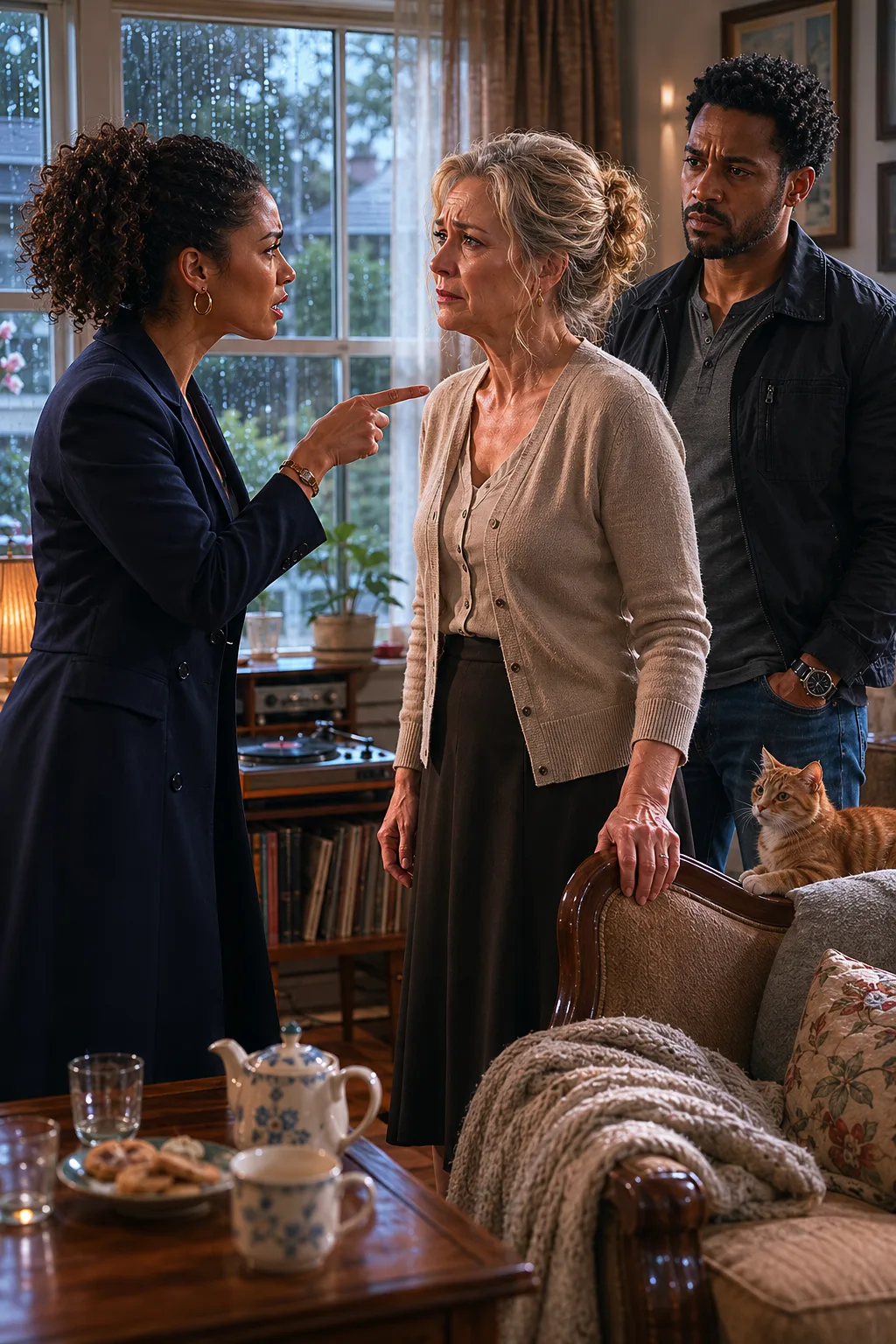
The air changed. The living room, usually soft with tea and records and Oliver’s silent arrogance, became a courtroom.
Emily crossed her arms. “Do you understand what people will say? What the family will think? You’re nearly sixty. He’s younger than some of my friends.”
“And what should I do with that information?” Caroline asked.
Emily blinked.
Caroline stepped forward, not angry exactly, but awake in a way I had never seen.
“Should I return to the sofa?” she asked. “Should I water my flowers, feed the cat, play my records, and make sure everyone is comfortable with the shape of my loneliness?”
“Mom—”
“No. Let me speak.” Caroline’s voice sharpened. “For twenty years, I have been respectable. Quiet. Appropriate. I carried my grief in a way that never inconvenienced anyone. I did not embarrass you. I did not ask too much. I did not make noise.”
Emily’s eyes filled, but Caroline continued.
“Tell me, Emily. Who sits with me when the house is too silent? Who hears the rain and knows it still reminds me of the night your father died? Who was here when my kitchen flooded and I stood there like a frightened old woman holding a bucket because I had forgotten how to ask for help?”
Emily looked away.
Caroline’s voice broke only slightly.
“I am fifty-nine years old,” she said. “And I choose to be alive while I am alive. Is that shameful?”
No one moved.
Even Oliver was still.
Emily’s anger faltered, revealing the fear beneath it.
“I don’t want you hurt,” she said quietly.
Caroline’s face softened.
“I know.” She reached for her daughter’s hand, but Emily didn’t take it yet. “But I have already survived hurt. What I do not want is to survive the rest of my life without living it.”
Emily looked at me then.
“And you?” she asked. “What is this to you? Some comfort? Some phase? Do you like feeling needed by a lonely woman?”
The question struck hard because part of it touched something true.
At first, being needed had mattered. It had woken me. But what sat between Caroline and me now was bigger than usefulness.
“I don’t know what life looks like ten years from now,” I said. “I won’t insult either of you by pretending I do. But I know this isn’t a game. She doesn’t make me feel younger or important. She makes me feel present. And I hope I do the same for her.”
Emily stared at me for a long moment.
Then her shoulders dropped.
“I need time,” she said.
Caroline nodded. “Take it.”
Emily left without slamming the door.
Afterward, Caroline sat down as though her bones had finally remembered their weight.
“I’m sorry,” I said.
“For what?”
“For being the reason that happened.”
She looked up. “You weren’t the reason. You were the witness.”
I sat beside her.
“I meant every word,” she said. “And I’m glad you heard me say it.”
Six months passed.
The town talked, of course.
It whispered first. Then it grew bored. People are only fascinated by other people’s lives until a new roof collapses, a teenager gets engaged, or Mrs. Whitaker’s grandson loses another spelling bee he was expected to win.
Emily came around slowly.
At first, she visited with caution, watching us like someone inspecting a bridge before deciding whether to cross. Then one afternoon she saw Caroline laughing in the kitchen while I burned toast, and something in her face loosened.
Later, she said to me, “If you ever hurt her, I’ll make sure every woman in three counties knows.”
“That seems fair.”
“It is.”
Then she helped Caroline choose new curtains.
That felt like acceptance.
Our life did not become perfect. Perfect is for advertisements and people with no imagination.
We argued about small things. Caroline thought I stacked dishes like a raccoon. I thought she owned too many vases. She said a man who named his vacuum had no right to criticize anyone’s household attachments.
Some mornings we drank coffee on her porch. Some evenings we watched old movies at my house. Sometimes she cried for Robert, and I learned not to be threatened by a dead man who had loved her well. Sometimes I spoke of my failed marriages, and she listened without treating me like damaged goods.
We were not young lovers. We were not a scandal.
We were two people who had been alone in different ways and had finally knocked on the right door.
One morning, spring returned to Maple Ridge Lane.
Caroline stood among her petunias with soil on her hands. I brought coffee out and set it on the porch rail.
“Do you ever think about that night?” she asked.
“The flood?”
“The knock.”
“All the time.”
She smiled toward the flowers.
“I was so embarrassed,” she said. “Standing there in that robe, asking for help like I had no sense at all.”
“You had sense. You came to me.”
She looked at me.
“And you answered.”
Across the yard, George was visible through my living room window, standing in his corner like a silent witness to history.
Caroline followed my gaze and laughed.
“Poor George,” she said. “He lost you.”
“George understands sacrifice.”
She shook her head, still smiling.
Then she reached for my hand.
No music swelled. No one clapped. The sky did not open.
The world simply continued.
A quiet street. A rescued kitchen. A woman who had stopped apologizing for wanting life. A man who had stopped mistaking solitude for safety.
It had begun with water on a kitchen floor.
With a knock at midnight.
With seventeen minutes that turned two separate houses into something shared.
And every morning after that, when Caroline poured coffee and Oliver judged me from the windowsill, I understood the simple miracle of it.
Sometimes life does not return all at once.
Sometimes it seeps back in through the cracks.
Sometimes it arrives barefoot on your porch at midnight, frightened and soaked, asking for help.
And if you are lucky, you open the door.
THE END
Chapter complete
You have reached the end of this chapter.
Continue reading
A few more worlds to get lost in after this chapter.




