When Luca Moretti married Evelyn Shaw, the world called it a perfect match.
Chapter 1
When Luca Moretti married Evelyn Shaw, the world called it a perfect match.
She was polished, beautiful, disciplined, and born for the kind of life Luca had spent decades building. She knew how to move through charity dinners without saying too much. She knew which donors needed flattery, which wives needed distance, and which reporters needed to be ignored with a smile. She turned his enormous Chicago home into something elegant enough for magazines and quiet enough for secrets.
From the outside, she looked like peace.
Luca told himself that was what he wanted.
After Nia, peace seemed like a blessing.
His first marriage had been everything his second marriage was not. Loud with laughter. Messy with feeling. Full of midnight arguments and early-morning forgiveness. Nia Carter had loved him with a warmth that embarrassed the cold rooms he came from. She had challenged him, teased him, trusted him, and believed—foolishly, beautifully—that love could be stronger than the world Luca belonged to.
But
then came the years of trying for a child.
Doctors. Tests. Vitamins. Schedules. Hope folded into disappointment again and again.
Nia never blamed him. Luca never blamed her aloud.
That was what made his betrayal worse.
He did not shout. He did not accuse her across a dinner table. He simply began to withdraw. He came home later. He spoke less. He let silence stand between them until Nia started apologizing for a failure no one had proven was hers.
And behind Luca, always near enough to whisper, stood Salvatore Conti.
Sal was not Luca’s uncle by blood, but he had been beside the Moretti family long enough to be treated like one. He was adviser, fixer, strategist, and poison dressed in a tailored suit. He never said Nia was the problem directly. Men like Sal preferred implication.
A man like you needs heirs, Luca.
Love can make a man
blind.
Some women hide things when they are afraid to lose power.
Luca listened.
That was the sin he would carry for years.
One winter night, while snow pressed against the windows of their penthouse, he told Nia he did not love her the same way anymore. He remembered her holding a cup of tea in both hands. He remembered how carefully she set it down before answering. She did not scream. She did not beg. She only looked at him with a calm that hurt more than anger.
“Is this truly what you want?” she asked.
Luca said yes.
So she left.
Years passed.
He married Evelyn.
He gave her luxury, safety, status, and his name. He remembered anniversaries. He bought jewelry. He sent flowers. He did everything a husband was supposed to do except feel alive beside her.
By their second year together, the silence around children had
become impossible to ignore.
Evelyn never demanded them. Luca never pressed too hard. But the subject lived with them anyway. It sat at breakfast. It walked beside them at family gatherings. It hovered during Christmas parties while other people’s children ran through the halls.
Luca began seeing doctors again in secret.
Two in Chicago. One in New York.
Each appointment ended the same way.
There was nothing wrong with him.
The final doctor, a careful man with silver hair and a voice trained for wealthy clients, looked Luca directly in the eyes and said, “Whatever happened in your first marriage, Mr. Moretti, it was not caused by you.”
The words did not free him.
They condemned him.
Because if the problem had never been him, and if seven years of doctors had never proven it was Nia, then he had abandoned his wife for a suspicion. A whisper. A family myth. A fear that another man had planted and Luca had watered until it killed his marriage.
He returned to Chicago that evening carrying a folder that felt heavier than any weapon he had ever held.
Evelyn was in the dining room, reviewing fundraiser notes by candlelight.
“You’re late,” she said gently.
“Meeting ran over.”
She studied him. “Are you all right?”
Luca almost asked her then. Almost demanded the truth about the one subject they both avoided. But he had built his life on timing, and even grief could not break that habit.
“Long day,” he said.
He sat across from his wife, ate the dinner she had saved for him, and felt his mind drift backward to Nia.
To her laugh.
To her bare feet in his kitchen.
To the way she used to steal strawberries from the carton and read design magazines like they were sacred texts.
To the woman he had failed before he ever understood what failure meant.
What Luca did not know was that Evelyn had a secret too.
Years before she met him, a car accident on an icy road outside Aspen had nearly taken her life. Surgeons saved her, but the damage was severe. When she woke up, she learned she would never carry a child.
At first, Evelyn told herself she would reveal it early.
Then she and Luca kept dating.
Then he proposed.
Then she promised herself she would tell him before the wedding.
Then after the wedding.
Then after the first anniversary.
But every month of silence made the truth harder to speak.
So she smiled, deflected, blamed stress, suggested patience, and watched Luca live inside a lie she was too afraid to end.
Their third anniversary arrived on a cold October Thursday.
Luca booked a table at a new Gold Coast restaurant because he still honored dates, even when the marriage beneath them felt hollow. He brought white roses. He wore the charcoal suit Evelyn liked. He planned to survive dinner first and destroy the evening afterward.
Across the city, Nia Carter returned to Chicago for the first time in years.
She had not come for memories. She had come for business.
Her company, Carter Atelier, had become a name whispered with respect among luxury developers. Nia designed spaces that felt expensive without feeling dead. In six years, she had turned pain into discipline, discipline into work, and work into an empire of her own.
She had offices in New York, Atlanta, and Los Angeles. Projects in Miami, Seattle, and Toronto. Magazines called her style emotionally intelligent, a phrase that always made her laugh.
She had brought her assistant, Priya, and her twin sons because traveling with nearly three-year-old boys required backup, snacks, and the courage of a general.
The meeting ran late. The boys were with Priya. Nia had two hours before her flight.
She should have gone straight to the airport.
Instead, she walked.
Chicago in October still knew where to touch her. The lake wind. The wet streets. The glittering buildings. Every corner seemed to carry a ghost of the woman she had been when she still believed Luca Moretti would protect her from the world he came from.
She stopped outside an elegant restaurant with warm amber light and stone walls.
She checked the time.
Then she texted Priya.
Bring the boys here. We’ll eat before the flight.
Inside, the host saw her ivory dress, her gold earrings, and the quiet authority in her posture, and led her to a table by the window.
Nia ordered water and let herself breathe.
Then the front door opened.
“Mama!”
Micah ran in first, small and fast and delighted by his own existence. He crashed into her chair, and Nia caught him with practiced hands, kissing his forehead, cheeks, and the tiny scar near his eyebrow from a playground accident Priya still felt guilty about.
Mason climbed into the chair beside her with far more dignity.
“I’m starving,” he announced.
“That sounds serious,” Nia said.
“It is serious.”
Priya collapsed into the seat with the exhausted dignity of a woman who deserved a raise.
Nia ordered chicken, fries, fruit, and juice. The boys talked over each other. Priya checked emails. Nia cut food into small pieces and felt the steady peace that came when her children were close enough to touch.
She did not see Luca.
Not at first.
Four tables away, Luca was trying to listen to Evelyn talk about renovations at their Lake Geneva property when the air changed.
He looked up without knowing why.
Then he saw her.
Nia.
For one violent second, the restaurant disappeared.
She was sitting by the window in ivory and gold, her hair gathered back in soft curls, her posture straight, her face calmer and stronger than he remembered. Time had not taken anything from her. It had carved her into someone even more impossible to ignore.
Then she smiled at something Priya said.
Luca’s heart recognized her before his mind allowed it.
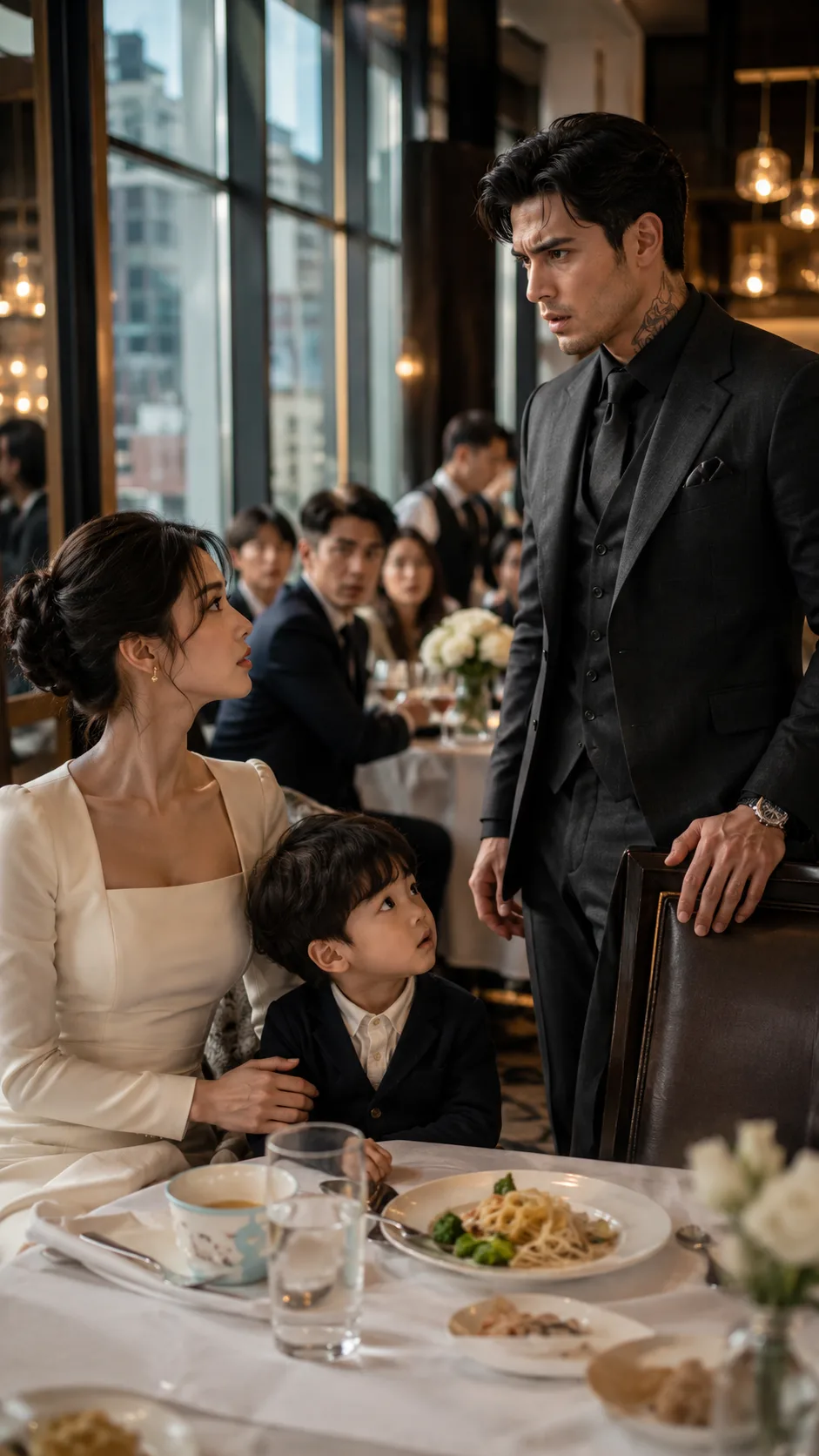
He was still trying to breathe when the two little boys came running toward her.
They threw themselves into her arms with the complete trust of children who had never questioned whether they were loved.
Then one of them turned.
Luca went cold.
The boy’s eyes were his.
Not exactly. Not like a copy. But enough.
The dark gaze. The cheekbones. The serious set of the mouth when concentrating. The lashes Luca’s mother used to say no boy deserved.
Then the second child looked up.
Luca’s fork hit the plate.
Evelyn stopped speaking.
“Luca?”
He stood.
He did not remember deciding to move. He only knew that the chair scraped behind him and blood roared in his ears.
Across the room, Micah tugged Nia’s sleeve and pointed.
Nia followed his finger.
Their eyes met.
The restaurant continued around them. Glasses clinked. A waiter crossed the floor. Someone laughed near the bar.
But Luca and Nia stood still inside a past neither of them had buried.
He saw the exact moment she understood what he had seen.
She did not gasp. She did not panic. She simply became very still.
Then Mason shifted too close to the edge of his chair, and Nia reached out calmly to steady him.
That broke Luca more than the resemblance.
The sight of her mothering children who should have known his voice from birth.
He walked to her table.
Evelyn called his name behind him, sharper this time.
He did not turn.
By the time he reached Nia, both boys were staring up at him.
“Who are you?” Micah asked.
Luca opened his mouth.
Nothing came out.
Nia finished cutting Mason’s food, set the knife down, and lifted her eyes.
“Luca,” she said.
No warmth. No hatred. Just recognition.
“Nia,” he answered, and his voice sounded ruined even to himself. “Can we talk?”
She glanced at the boys, then at the room, then back at him.
“They need to eat,” she said. “And I have a flight.”
“If you want to say something,” she added, “say it here.”
Luca looked at the children again.
“They…”
“Yes,” Nia said quietly.
One word.
It destroyed him.
He sank into the empty chair across from her because standing suddenly felt impossible.
The boys lost interest and returned to their food. Luca stared at them like a man staring at a life he had murdered before knowing it existed.
“I was wrong,” he said.
Nia lifted her water glass. “I know.”
“I had the tests repeated,” he continued. “More than once. They said there was never anything wrong with me. Which means—”
“It was never me either,” she said.
Her voice was calm.
That made it worse.
“For seven years,” she continued, “every doctor told us we were both healthy. I believed them. I believed my body. I believed us.”
Her eyes held his.
“You didn’t.”
Luca had no defense.
“I’m sorry,” he said. “Nia, I am so sorry.”
For half a second, something moved across her face. Not forgiveness. Not love. Only the memory of a woman who had once wanted to believe him.
“I believe that you’re sorry,” she said.
Hope struck him so hard he nearly leaned toward her.
Then she finished.
“And it changes nothing.”
He looked down.
“How old are they?”
“Two years and ten months.”
Almost three.
Three years of first steps, first words, fevers, birthday candles, bedtime songs. Three years of ordinary miracles that would never belong to him in memory.
“They should know me,” he said hoarsely. “When you think they’re ready. I know I have no right to demand anything from you. But they’re my sons.”
Nia was silent.
Micah held up his cup.
“Mama, more juice.”
She poured it carefully, handed it back, and only then looked at Luca again.
“I have spent almost three years making sure their world feels safe,” she said. “Do you understand that?”
“Yes.”
“I will not let your guilt become their storm.”
“I know.”
“I will not allow your old world anywhere near them.”
“It won’t be.”
“I will not watch you appear, disappear, and call that fatherhood.”
“I won’t.”
Mason, who had been studying Luca with uncomfortable seriousness, finally asked, “Why do you look like us?”
The table froze.
Nia turned to him with a gentleness that made Luca ache.
“Sometimes people look alike for important reasons,” she said.
Mason thought about that.
Micah pointed at Luca’s neck. “I like his tattoos.”
Against all reason, Nia laughed.
It was brief. Real. Gone almost immediately.
But Luca felt it like sunlight through a prison window.
Then Nia rose.
“We need to leave.”
Luca stood too. “When can I see them?”
“You’ll hear from my attorney,” she said.
His expression must have shifted because her voice softened by one degree.
“Careful and respectful, Luca. That is the only way this happens.”
He nodded.
“Whatever you need.”
As Priya gathered the bags and Nia helped Mason into his coat, Mason looked at Luca again.
“Bye, tattoo man.”
Luca almost smiled.
“Bye.”
Micah waved like a tiny king.
Nia did not wave.
But as she passed Luca, she paused just long enough to speak quietly.
“You don’t get to fail them.”
Then she walked out with his sons.
Luca stood in the restaurant long after the door closed.
When he finally returned to his anniversary table, Evelyn was waiting.
The white roses lay untouched between them.
Her face was calm in the fragile way glass is calm before it breaks.
Luca sat down.
“There is something I need to ask you,” he said.
Evelyn folded her napkin slowly. “I think there are many things.”
He looked directly at her.
“Can you have children?”
For the first time since he had known her, Evelyn looked truly afraid.
The silence answered before she did.
“Tell me the truth,” Luca said.
Her gaze dropped to the candle flame.
“When I was thirty-one, I had an accident in Colorado. The injuries were severe. They saved my life, but I had a hysterectomy.”
Luca’s jaw tightened.
“You married me knowing that.”
“Yes.”
“And said nothing.”
“I meant to tell you.”
“When?”
“Before the wedding. After the honeymoon. After the first year.” Her voice cracked. “Every month I told myself I would. Every month made it harder.”
“Did you know about Nia?”
“No.”
“Did someone tell you what happened in my first marriage?”
Evelyn hesitated.
That was answer enough.
“Who?”
She closed her eyes.
“Sal.”
Something cold and old moved through Luca.
“He told me you had been hurt before,” Evelyn said. “He said your first wife had kept things from you. He said children mattered to you, but that you were not ready to hear difficult truths all at once. He told me not to rush.”
“And you listened.”
“Yes,” she whispered. “Because it was convenient. Because I was afraid. Because I liked being chosen before you could change your mind.”
Luca looked away.
Outside the window, Chicago glittered as if no one’s life had just collapsed.
“Did you love me?” he asked.
Evelyn’s face changed.
“Yes,” she said. “In my way. But I also loved safety. I loved not being the damaged woman. I loved the life you gave me.”
He believed her.
That made it worse.
By morning, Luca had filed for divorce.
One week later, Sal Conti came to Luca’s office.
The older man arrived as if summoned to discuss business, not the destruction of a life.
Luca did not offer him a drink.
“Did you push me away from Nia?” he asked.
Sal sighed. “Luca—”
“Did you?”
A pause.
Then Sal made the mistake of sounding reasonable.
“I did what was best for the family.”
The room became colder.
“For the family,” Luca repeated.
“She was never right for this life.”
“No,” Luca said. “She was too good for it.”
For once, Sal looked surprised.
“You knew I loved her,” Luca said. “And you fed the doubt that ruined my marriage.”
“Doubt was already there.”
“You made sure it survived.”
Sal’s face hardened. “A man in your position cannot build his future on sentiment.”
Luca leaned forward, his voice low.
“I threw away the only woman I ever loved because I let men like you speak louder than my wife’s pain. And the heirs you thought she couldn’t give me were already mine.”
Sal said nothing.
“I want you out,” Luca said.
“Out?”
“Out of my businesses. Out of my homes. Out of every room where my name is spoken.”
“You would erase thirty years?”
“I’m correcting one mistake.”
Sal left with old disappointment in his eyes.
Luca felt no grief watching him go.
Then came the harder work.
Nia’s attorney called.
The terms were precise and mercilessly fair.
No unannounced visits. No press. No exposure to criminal associates. No overnight stays. No romantic partners introduced. No custody battle if Nia believed the environment was unsafe. Every meeting public. Every boundary hers to set.
Luca agreed to everything.
The first meeting happened in Central Park.
He arrived early, hands tense, chest tight, terrified in a way no enemy had ever made him feel.
The boys were on a blanket with toy cars. Nia sat nearby in a camel coat, sunglasses on, coffee beside her. Priya was there too, pretending to read emails while watching everything.
Micah looked up first.
“Tattoo man!”
Nia removed her sunglasses. “He has a name.”
Micah considered that. “Tattoo Luca?”
Luca laughed.
Just like that, the impossible became slightly less impossible.
The meetings continued.
Parks. Museums. Cafés. Always public. Always structured. Always watched.
Luca never missed one.
He learned that Micah hated blueberries unless they were inside muffins. Mason arranged toy cars by color and became furious when anyone disrupted the order. Both boys loved soccer, bedtime stories, and questions no adult could answer fast enough.
Why is the moon sometimes awake during the day?
Do fish sleep?
Were dinosaurs real or are grown-ups lying?
Luca answered when he could. When he could not, he admitted it.
Month by month, novelty became routine.
Routine became trust.
Trust became something close to grace.
At the same time, Luca began dismantling the parts of his world that could touch his sons.
He sold off interests tied to violence. Cut men loose who had once mistaken fear for loyalty. Let legitimate executives take over businesses that had been managed by intimidation. He lost money. Influence. Old allies.
People whispered that Luca Moretti had gone soft.
They were wrong.
He had become clear.
Nia noticed.
She noticed the names that disappeared. The security that became professional instead of theatrical. The arrogance that left him piece by piece. The way he stopped performing power and started practicing presence.
One afternoon in Brooklyn, Micah fell from his scooter and cried as if betrayed by the universe. Luca lifted him instinctively. Micah wrapped his arms around Luca’s neck and sobbed into his shoulder.
Luca froze.
Not because he did not want it.
Because he wanted it so badly it hurt.
Nia came over with the first-aid kit. Their hands brushed over Micah’s scraped knee.
For one second, the past returned.
So did something else.
Neither of them named it.
By the twins’ fourth birthday, Luca had been present long enough for the word Dad to enter the room without ceremony.
Mason said it first.
Frosting on his mouth, blue candlelight in his eyes, he looked up from his cake and asked, “Dad, can I have the blue plate?”
The kitchen went silent.
Luca turned carefully, as if sudden movement might scare the word away.
Nia stood by the island with a balloon ribbon caught around her wrist.
She met his eyes.
And smiled.
“Yeah,” Luca said, voice rough. “You can have the blue plate.”
That night, after the boys fell asleep in dinosaur pajamas, Luca stood in Nia’s kitchen while she wrapped leftover cake.
“He meant it,” Luca said.
“He did.”
“I didn’t expect it.”
“I know.”
Nia set the foil down.
“You’ve done well,” she said.
From anyone else, it would have sounded ordinary.
From her, it felt like absolution.
“Not enough,” Luca said.
“No,” she answered. “Not enough to erase what happened.”
He nodded.
“But enough to matter now.”
He looked at her then and saw not the woman he had lost, but the woman she had become. Stronger. Deeper. Softer only where she chose to be.
“I will keep showing up,” he said, “whether you ever choose me again or not.”
Nia’s eyes shone, though she did not cry.
“That,” she said, “is the first thing you’ve said that I can believe.”
The true test came later.
Sal did not accept exile quietly.
One September afternoon, Nia left a Manhattan hotel site with the boys and Priya. A black SUV began following them downtown.
Her driver noticed. Then Luca’s security team noticed.
Within minutes, the route changed. Calls moved between phones. The boys knew nothing, laughing in the backseat, but Nia understood enough to feel cold.
Luca was in Chicago when the alert came.
He was on his jet before the second call ended.
No one was hurt. No door was forced. No weapon appeared.
But the message was clear.
Someone wanted Luca to know that his sons could be seen. Reached. Used.
By dawn, Luca had the name.
Sal.
That was the last piece of the old world Luca allowed near his children.
What followed was not dramatic in the way movies make it dramatic.
It was paperwork. Financial records. Federal conversations. Old ledgers opened. Quiet cooperation with prosecutors who had been circling the Moretti network for years.
Luca did not become a saint.
He became a man willing to burn down every part of his kingdom that could one day cast a shadow over his sons.
It cost him money.
Power.
Protection.
It nearly cost him his freedom.
And Nia watched all of it with one question in her eyes.
Is this real?
The answer came through consistency.
In Luca selling the penthouse because too much pain lived in its walls.
In him buying a quieter house near parks and schools.
In him allowing his reputation to crack if it meant his sons would grow up outside the reach of men like Sal.
One night after the SUV incident, Luca sat on Nia’s front steps at two in the morning, tie undone, suit wrinkled, face drawn with exhaustion.
“I should have protected you the first time,” he said. “I won’t fail again.”
Nia sat beside him.
Not touching.
But beside him.
“Love is not the same as access,” she said.
“I know.”
“Fatherhood is not something you earn because you feel pain.”
“I know.”
“If I ever let you near my heart again, it will not be because you suffered. It will be because you changed.”
Luca’s breath trembled.
“I understand.”
For the first time in years, Nia reached for his hand.
Only once.
Only briefly.
But it was enough.
The second time Nia kissed Luca Moretti, it was raining outside a Brooklyn preschool.
There was no violin music. No dramatic skyline. No perfect timing.
Just wet pavement, two arguing boys in the backseat, and Luca handing Nia a cup of coffee because she had mentioned being cold without complaint.
She took it.
Their fingers touched.
“You still remember how I take it,” she said.
“I remember everything.”
Once, that sentence might have sounded like manipulation.
Now, after everything, it sounded like truth.
Nia looked at him for a long time.
Then she stepped forward and kissed him.
It was not young love.
It was better.
Slower. Wiser. Built from wreckage, truth, and years of effort.
From the car window, Micah shouted, “Mason! Mom kissed Dad!”
Mason shoved him aside. “I saw it first!”
Nia laughed so hard she nearly spilled her coffee.
Luca stood in the rain smiling like a man who had finally been given something he had no right to demand.
They did not rush.
That was how Nia knew the change was real.
No sudden ring. No speeches meant to erase the past. No demand that love become forgiveness on command.
They dated like people with children, scars, jobs, boundaries, and memory.
Some nights Luca cooked in Nia’s kitchen while Micah set napkins crooked and Mason corrected him like a tiny judge. Some weekends Nia brought the boys to Luca’s house near the lake and watched him assemble soccer goals while pretending not to notice how much she was watching.
They argued too.
About school. About media. About how much the boys should know. About Luca’s past and what truth children deserved.
But the arguments were different now.
No punishment by silence.
No disappearing.
No making one person carry fear alone.
When the boys were six, Luca and Nia sat them down and explained, gently, that Dad had once hurt Mom badly. That grown-ups could make terrible mistakes. That love required honesty, not just apology.
Micah wanted to know if pizza night was still happening.
Mason asked whether mistakes lasted forever.
Luca answered.
“Some consequences do,” he said. “But people can still choose who they become after.”
Mason thought about that, then nodded.
The proposal came a year later on a Sunday morning.
No orchestra. No cameras. No skyline.
Just pancakes, blueberry syrup on two small faces, sunlight through the kitchen windows, and a house loud with life.
Nia was rinsing dishes when Luca placed a small velvet box on the counter.
She went still.
Micah screamed, “He’s doing a ring thing!”
Mason covered his mouth with both hands.
Luca did not kneel immediately.
He stood before Nia first, because this was not theater. This was truth.
“The first time I married you,” he said, “I loved you, but I was not worthy of you.”
The kitchen quieted.
“I will never ask you to forget what I did. I will never insult you by pretending pain disappears because I regret causing it. But I can promise you this: no voice will ever be louder to me than yours again. No fear will ever be stronger than my faith in us. No version of me will ever leave you alone inside pain.”
His voice broke.
“You gave me sons I did not deserve to know. Then you gave me the chance to become their father anyway. You let me earn my way back to this kitchen, this life, and maybe one day back to you.”
He opened the box.
“Nia Carter, will you marry me again?”
Nia looked at the ring.
Then at Luca.
Then at the two boys clutching each other like the fate of the world depended on her answer.
She laughed through tears.
“Yes.”
Micah screamed so loudly the dog next door started barking.
Mason crashed into Luca’s legs.
Luca slid the ring onto Nia’s finger with shaking hands while the boys cheered like they had negotiated peace between nations.
They married that fall by the lake.
No spectacle. No old-world men. No cameras hungry for scandal.
Only the people who had stayed for truth.
Priya cried through the entire ceremony.
The boys wore navy suits and almost lost the rings because Micah found a frog and Mason decided the frog needed emotional support.
Nia walked down a narrow aisle of white flowers in a simple silk gown, and Luca stopped breathing for a moment.
This time, not from shock.
From gratitude.
During the vows, Luca did not promise perfection.
He promised presence.
Nia promised honesty.
The boys promised to eat cake.
Everyone agreed it was the strongest vow of the day.
Later that night, after the guests had gone and the lake had turned black beneath the moon, Luca found Nia barefoot near the water.
“You disappeared,” he said softly.
“I needed one minute to feel it.”
“And?”
Nia looked out at Lake Michigan.
“For a long time, I thought the great love story of my life was the one that broke me.”
Luca’s chest tightened.
She turned to him.
“But it wasn’t. It was the one we built after the lies were gone.”
He touched her face with a reverence he had not understood when they were young.
“You saved me,” he said.
Nia shook her head.
“No. I saved myself. The boys saved me. You finally decided not to be the man who ruined it.”
Luca smiled.
“Fair.”
She kissed him.
Inside the house, one of the boys called sleepily, “Mom? Dad?”
Nia laughed and took Luca’s hand.
“Coming,” she called.
Together, they walked back toward the light.
Chapter complete
You have reached the end of this chapter.
Continue reading
A few more worlds to get lost in after this chapter.




