When I Came Home, My Daughter Was Hiding Bruises Beneath a Blue Dress
Adrian found the toy rabbit at the bottom of his carry-on before he found the house keys.
Chapter 1
When I Came Home, My Daughter Was Hiding Bruises Beneath a Blue Dress
Adrian found the toy rabbit at the bottom of his carry-on before he found the house keys.
It had been folded between a clean shirt and a box of Japanese tea, wrapped in thin airport paper that had already torn at one corner. One soft gray ear stuck out, bent from the flight. He stood beside the taxi outside his old house in Barcelona and held it for a second longer than he needed to.
Valentina liked things with ears.
Not cats. Not dogs. Ears.
She used to line her stuffed animals along the windowsill and explain their personalities to him with the seriousness of a judge reading a sentence. The rabbit from Paris was “too proud.” The bear from Madrid “could not be trusted with secrets.” The fox he bought her after the divorce was “clever, but lonely.”
This new rabbit had one floppy ear and one upright ear.
She would name it before dinner.
That thought carried him through the front gate.
The taxi pulled
away behind him. Adrian stood alone with his suitcase on the stone path, the afternoon light slipping across the high windows of the house Patricia had insisted on keeping after the divorce. White walls. Black iron balcony. Pale curtains that never seemed to move.
A beautiful house.
Too quiet.
He unlocked the front door and stepped inside.
“I’m home,” he called.
His voice moved through the hallway and came back empty.
No feet on the stairs. No small voice shouting from above. No rush of a child throwing herself into his stomach before he could put his bag down.
Adrian set the toy rabbit on top of his suitcase.
“Valentina?”
A door clicked upstairs.
Patricia appeared at the landing.
She was already dressed to leave, blonde hair shaped into soft waves, sunglasses in one hand, phone in the other. Her lipstick was the red she wore when she wanted people
to think she was calm. Adrian knew that shade. He had seen it at custody meetings, school conferences, and once across a dinner table while she explained why “shared parenting” meant he should be grateful for whatever she decided to give him.
“You’re early,” she said.
“My flight landed early.”
Patricia came down the stairs too quickly. Not running. Patricia never ran. She moved with a tight, clipped speed that made the heels of her shoes sound too sharp against the marble.
“Valentina’s upstairs,” she said. “I’m late.”
“For what?”
“A salon appointment.”
Adrian looked past her. “How was she this week?”
“Fine.”
One word.
Flat.
He reached for the banister. “Patricia.”
She stopped at the bottom step but did not turn fully toward him.
“What?”
“Is she okay?”
Patricia gave him a smile. It did not reach any part of her face that mattered.
“Don’t start.”
He watched her
cross the hall. Her perfume passed him first, expensive and floral, the same one that used to cling to his shirts when they were still married. She opened the front door, then paused with one hand on the frame.
“She’s been difficult,” Patricia said. “Try not to reward it.”
The door closed behind her.
Three seconds passed.
Then Adrian left the suitcase in the hallway and took the stairs two at a time.
Valentina’s bedroom door was open just enough for a strip of pale blue wall to show. He pushed it with two fingers.
She was sitting on the edge of the bed.
The blue dress.
The white collar.
Her hands were folded in her lap, but the fingers were not still. They kept pulling at the hem, twisting fabric into a tight rope. Her feet did not touch the floor. One sock had slipped halfway off her heel.
The room looked normal in a way that made his chest tighten. Books stacked crookedly. A small lamp shaped like a moon. Paper stars taped above the desk. A glass of water untouched on the nightstand.
“Hey, princesa.”
Valentina looked up.
Adrian stopped.
Her eyes were swollen. The skin beneath them looked tender and tired. She had tried to clean her face, he could tell. Children were bad at hiding crying. They missed the corners. They left proof along the nose, the lashes, the red patches near the cheeks.
He crossed the room and knelt in front of her.
“What happened?”
She looked at the hallway.
Then down at her knees.
“Please don’t be mad.”
His hand froze inches from hers.
“I’m not mad.”
“Mommy said not to tell.”
The sentence entered the room and stayed there.
Adrian lowered himself more carefully. His knees pressed into the rug. It had little clouds on it. He remembered buying it because Valentina said she wanted the floor to look like sky.
“Not to tell me what?”
Her fingers tightened.
“Daddy…”
“Show me.”
She shook her head.
He kept his voice even. “You can show me.”
Valentina lifted the edge of the dress.
Not much.
Enough.
Adrian’s body went still before his mind understood what he was seeing.
Marks on her thigh. Dark in the middle. Fading at the edges. Too many to explain away with a fall from a swing or a bump against furniture.
His hand lowered to the rug.
“Who did this?”
Valentina dropped the dress at once.
“Mommy got angry.”
The room seemed to tilt, but nothing moved. The lamp stayed on the table. The paper stars stayed on the wall. The glass of water caught a slice of light.
“What happened?”
“I ruined the cream.”
“What cream?”
“The one in her bathroom.”
Adrian closed his eyes for half a second. When he opened them again, Valentina was staring at him with the same look she used to have when she broke a cup and waited to see whether the world would end.
He reached for her.
She came into his arms too fast.
Too ready.
Her small body shook against his chest. He held the back of her head and looked over her shoulder at the doorway, at the house Patricia had left as if she were only late for a manicure.
The toy rabbit sat downstairs on his suitcase.
Forgotten.
He did not call Patricia.
He called the clinic.
Then the police.
Then his lawyer.
By early evening, Valentina was in a private pediatric emergency room with cartoon fish painted across one wall and real fear sitting between every adult in the room. Dr. Ferrer introduced herself with a quiet handshake and crouched beside Valentina instead of standing over her.
“I’m going to check you very gently,” she said. “Your father will stay right here.”
Valentina looked at Adrian.
He held out his hand.
She took two of his fingers and did not let go.
Dr. Ferrer examined the marks, asked questions, waited when Valentina did not answer, and never once looked impatient. She measured her temperature. Checked her weight. Pressed a stethoscope to her back. The longer the examination went on, the less the doctor’s face gave away.
That frightened Adrian more than anger would have.
At one point, Valentina turned her face toward the pillow and said, “I didn’t mean to spill it.”
Nobody spoke for several seconds.
Dr. Ferrer wrote something down.
Adrian watched the pen move.
Afterward, the doctor asked a nurse to stay with Valentina and led Adrian into the corridor.
“The bruises are consistent with forceful gripping,” she said.
Adrian put one hand against the wall.
“Will you document it?”
“I already have.”
“Good.”
“Mr. Reyes.”
He looked at her.
“There is more.”
The corridor smelled of disinfectant and coffee from a vending machine nearby. Someone had left a child’s sticker on the floor near the baseboard, half-peeled, a little yellow star with one corner folded up.
Dr. Ferrer held the chart against her body.
“Valentina is dehydrated. Her weight is below what I would expect from her last recorded visit. She has signs of repeated vomiting. Her blood work is not normal.”
Adrian heard each sentence and rejected it.
“She was fine last week.”
“Was she?”
He opened his mouth.
No answer came.
“She needs admission tonight,” Dr. Ferrer said. “Observation first. More tests.”
“What are you saying?”
“I’m saying the bruises may not be the only problem.”
Patricia was found the next morning at a spa hotel twenty kilometers outside the city.
Adrian did not know who called the press. He only knew that by noon, a local news site had published a blurred photo of Patricia being escorted toward a police car in oversized sunglasses and a cream blazer.
She did not look frightened.
That was what made him stare.
She looked inconvenienced.
Her lawyer issued a statement within the hour. Misunderstanding. Custody conflict. False accusations. A devoted mother.
Adrian read the words on his phone beside Valentina’s hospital bed and felt nothing but a cold, clean focus.
He gathered everything.
Custody emails where Patricia called Valentina manipulative.
Voice messages where she complained about “the child’s dramatics.”
Receipts proving she had left Valentina with house staff for entire afternoons while claiming “mother-daughter time.”
He sent it all.
He answered questions until his throat hurt.
He signed forms.
He spoke to a child protection officer whose eyes stayed kind but whose pen never stopped moving.
Valentina slept through most of the second day.
Not real sleep.
Hospital sleep.
Broken, sweaty, shallow. Her eyelids fluttered too much. Her fingers sometimes moved as if she were searching for something in a dream. When she woke, she asked for water and then could not keep much down.
Adrian sat beside her and held a plastic cup with a straw.
“Small sip,” he said.
She obeyed.
She always obeyed.
That thought sat badly in him.
On the third day, Patricia’s name was everywhere.
Socialite Mother Arrested.
Luxury Divorce Turns Dark.
Daughter Found Injured in Barcelona Home.
The headlines were ugly, but Adrian did not defend Patricia. He did not care what anyone called her. Let them call her what they wanted. Let the cameras wait outside the courthouse. Let her friends pretend they had always suspected something.
His daughter lay in a hospital bed with tubes taped to her hand.
That was the only fact that mattered.
That evening, Dr. Ferrer came in with two other doctors. They spoke in low voices near the foot of the bed. Adrian caught fragments.
Toxicology.
Compound.
Repeated exposure.
Second panel.
He stood.
“What is it?”
Dr. Ferrer looked at the others, then at him.
“We are running deeper tests.”
“Why?”
“Because something in her system does not match simple dehydration or stress.”
Adrian looked toward Valentina. Her face was turned slightly toward the window. Someone had braided her hair loosely that morning. The braid had come undone at the bottom.
“What kind of something?”
“We do not know yet.”
But Adrian thought he knew.
Patricia.
Of course Patricia.
The woman who could smile with police lights on her face. The woman who left a child alone upstairs with marks under a blue dress. The woman who treated motherhood like a performance and inconvenience like betrayal.
By midnight, Adrian had built the story in his head so completely that it felt like truth.
Patricia had given Valentina something.
To make her quiet.
To make her manageable.
To make her sick enough to control.
He gave another statement to the police. He told them about Patricia’s temper, about the creams and the broken perfume bottles and the time she had screamed at Valentina for touching a silk scarf with sticky fingers. He sent more emails. More messages. More proof.
The police listened.
The prosecutor listened.
The press listened faster.
Valentina did not improve.
On the fourth night, Adrian was standing beside her bed, rubbing one thumb over the corner of her blanket, when the monitors changed sound.
Not slowly.
At once.
A nurse looked up from the counter.
Then moved.
The room filled before Adrian understood why. Shoes on the floor. A hand on his shoulder. A voice telling him to step back. Valentina small beneath the white sheet, the machine lines jumping, Dr. Ferrer entering fast with her hair coming loose from its clip.
Adrian said his daughter’s name.
No one answered him.
The door closed between them.
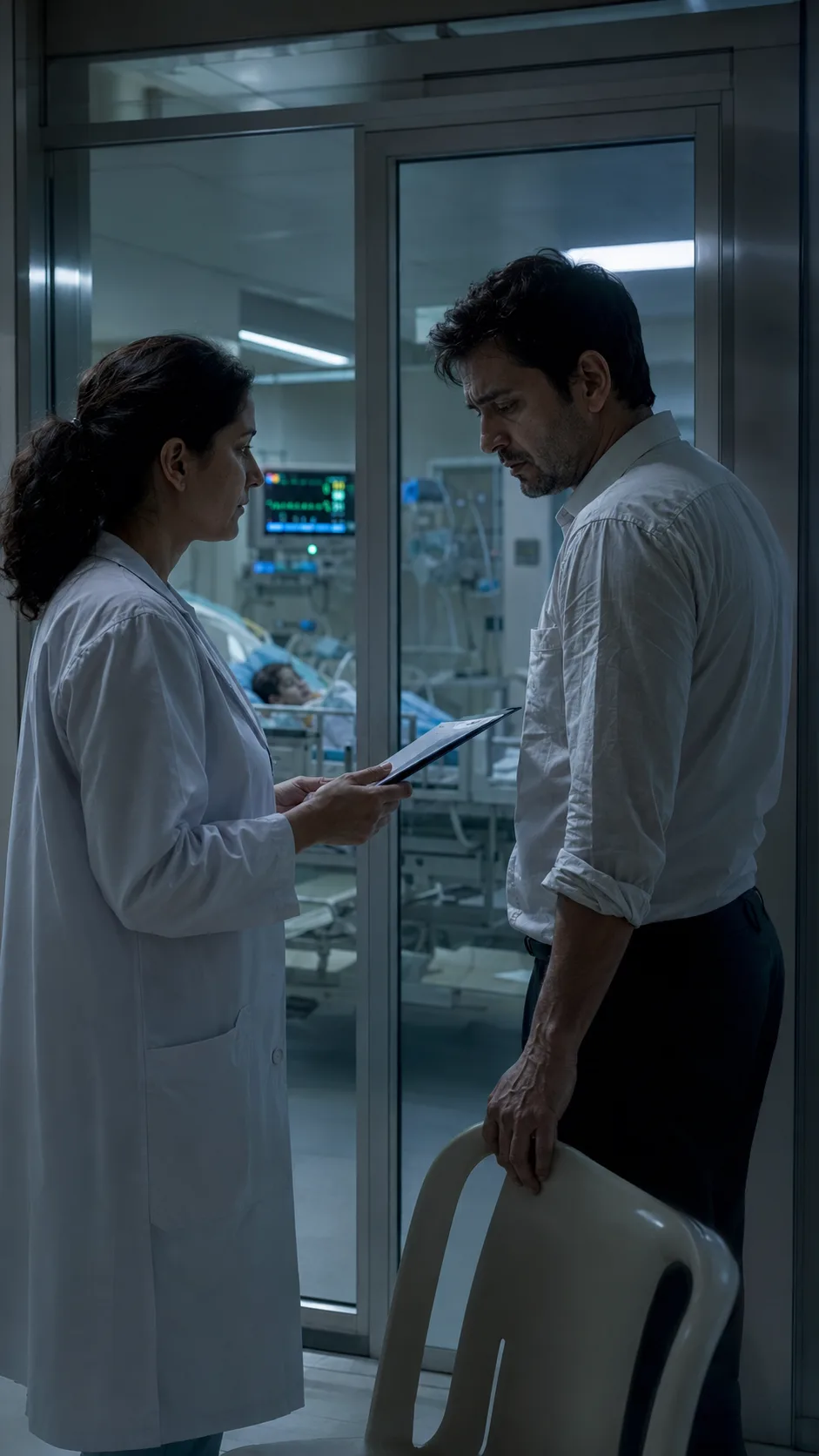
He stood in the corridor with both palms flat against the glass.
A nurse pulled the curtain.
Not all the way.
Enough.
Adrian stepped back until his shoulders hit the opposite wall. His knees bent without permission. He stayed upright because the wall held him.
People passed. A cart rolled by. Somewhere far down the hall, a child laughed at something on a television. The sound did not belong there.
He pressed his hands together in front of his mouth.
No polished prayer came.
Only bargain after bargain without words.
Take my work.
Take the house.
Take every good thing I have left.
Just let her breathe.
The door opened after a time Adrian could not measure.
Dr. Ferrer stepped out.
Her mask hung loose beneath her chin. A strand of hair had fallen across her cheek. She looked at him, and for one terrible second he could not read her face.
“She is stable.”
Adrian bent forward. One hand gripped his own knee.
“She is stable,” the doctor repeated.
He nodded, but the motion did not feel like his.
Then Dr. Ferrer looked down at the file in her hand.
“We identified the substance.”
Adrian straightened.
The corridor light hummed above them.
“Was it Patricia?”
Dr. Ferrer did not answer.
A thin file folder rested against her palm. Blue tab. White label. Valentina’s name printed in black.
Adrian noticed that the label was slightly crooked.
“We found an herbal compound in her blood,” Dr. Ferrer said. “It appears in concentrated sleep tinctures.”
He stared at her.
“Sleep tinctures?”
“Yes.”
“I don’t understand.”
“In your statement, you mentioned a Japanese sleep remedy.”
His face changed before he could stop it.
The doctor saw.
“It was in your list of household items Valentina had access to. You said you sometimes used it when she had anxiety before bed.”
Adrian shook his head once.
“No.”
“Mr. Reyes—”
“No. Not during Patricia’s week.”
“I am not saying during Patricia’s week.”
His hand dropped from the wall.
“Then Patricia took it.”
Dr. Ferrer held the file still.
“She could have. That is for investigators to examine.”
“But?”
The doctor’s eyes did not move away from his.
“The concentration pattern is not consistent with a single short exposure.”
Adrian heard the words and did not let them enter.
“What does that mean?”
“It suggests repeated exposure over a longer period.”
“How long?”
“We cannot give an exact number yet.”
“How long?”
Dr. Ferrer lowered the file by half an inch.
“Months.”
The hallway became too bright.
Adrian blinked.
Nothing changed.
Months.
He took one step back.
His shoulder touched the wall again.
“No,” he said.
The word sounded thin.
“Repeated small doses can accumulate, especially in a child,” Dr. Ferrer said. “The vomiting, the lethargy, the weight loss—”
“No.”
He saw the bottle.
Small. Brown glass. White label printed in Japanese characters he could not read. A colleague in Tokyo had recommended it after a dinner where Adrian complained he had not slept properly in weeks. Natural. Gentle. Traditional. That was what the colleague had said.
Adrian bought three.
One for himself.
Two for later.
Valentina had been restless the first weekend after he came back. Patricia had argued with him on the phone for forty minutes about school pickup. Valentina heard enough to come into his office with her blanket dragging behind her.
“I can’t sleep,” she said.
He made tea.
Not much.
A few drops.
She slept.
He remembered feeling grateful.
That was the first door memory opened.
Then another.
Valentina difficult to wake on Monday mornings.
Valentina rubbing her stomach before Patricia came to pick her up.
Valentina asking for “Daddy tea” because it made the bad thoughts stop.
Valentina asleep on the sofa while he finished emails late at night, one hand still around the mug.
A little more when she was restless.
A little more when he had a call with New York.
A little more when he needed the house quiet.
The thought walked toward him, slow and merciless.
He had never meant harm.
He had also never checked.
“No,” he said again, but now the word had nowhere to go.
Dr. Ferrer’s face softened at the edges. Not enough to save him.
“I do not believe you intended to poison her,” she said.
His breathing caught.
“But intent does not change what happened.”
Adrian slid down the wall until he was sitting on the floor.
The corridor tiles were cold through his trousers. A nurse at the far desk glanced over, then looked away. Dr. Ferrer stayed standing in front of him with the file in both hands.
Inside the room, behind glass and machines and half-drawn curtains, Valentina lived.
That was the only mercy.
The rest arrived piece by piece.
Investigators searched both homes.
Patricia’s bathroom.
Adrian’s kitchen.
The pantry where he kept imported teas.
The drawer beside his bed.
They found the bottles.
One half-empty.
One empty.
One unopened.
The translator messages came next. Adrian had forgotten about them because they had seemed harmless at the time. A few texts sent late at night to an assistant in Tokyo.
Can this be used for children?
What dose is stronger?
Label says three drops, right?
The answers were cautious. Unclear. Recommended professional guidance. Adrian had skimmed them. He had been boarding a flight. He had been late for a call. He had decided he understood enough.
Bank records showed reorders.
Calendar records showed Valentina’s weekends with him.
Medical notes showed fatigue after those weekends.
None of it looked like a mistake once arranged on paper.
Patricia’s lawyer arranged it beautifully.
At the first hearing, Patricia sat with her hair pinned low and no lipstick. She wore navy blue, not cream. Someone had advised her well. She looked smaller without color on her mouth.
Adrian sat across the aisle.
He did not look at her.
The prosecutor spoke first about the bruises. About the statements. About the child’s fear. Patricia’s jaw tightened, but she kept her hands folded.
Then her lawyer stood.
He did not deny everything.
That was how Adrian knew they had found their knife.
“My client accepts that a moment of discipline went too far,” the lawyer said.
Adrian’s hands curled.
“But the life-threatening medical condition that has dominated these headlines did not originate in my client’s home.”
The courtroom changed temperature.
The lawyer lifted a document.
Messages.
Receipts.
Medical timelines.
The Japanese tincture.
Adrian did not move.
He felt every eye turn.
Not all at once. One by one. Press. Lawyers. Court staff. Patricia.
Patricia turned her head.
For the first time since the police car, she did not smile.
Her face was worse than that.
It was relieved.
Adrian had thought the world wanted a monster. Patricia had filled the shape perfectly. Beautiful, vain, cruel enough to grip a child too hard and lie about it. The story had been simple. People like simple. They can hold it in one hand.
But the court did not get simple.
It got Patricia.
It got Adrian.
It got a child harmed by anger in one house and carelessness in another.
Two homes.
One little girl.
The judge read the medical report without raising her voice.
Adrian listened.
Gross negligence.
Repeated administration.
Failure to verify dosage.
Known language barrier.
Child endangerment.
Each phrase landed with no drama at all. That was the worst part. No shouting. No thunder. Just a woman in a black robe reading the shape of his failure in clean legal sentences.
Patricia was sentenced first.
Assault.
Child abuse.
Obstruction.
When the term was pronounced, she made a sound that could have been a laugh or a cough. Then she turned toward Adrian.
“You made me look like the devil,” she said.
The bailiff stepped closer.
Adrian looked at her for a long time.
“I didn’t make you hurt her.”
Patricia’s mouth opened.
Nothing came.
Adrian faced forward again.
That was the last sentence he ever said to her in court.
His own case took longer.
Experts spoke about intent. About cultural misunderstandings. About herbal remedies marketed as safe. About parental exhaustion. About the difference between malice and negligence.
Adrian did not hide behind any of it.
When his lawyer asked if he wanted to make a statement, Adrian stood and placed both hands on the table because his fingers would not stay steady.
“I loved my daughter,” he said.
His voice sounded scraped.
“I also failed to protect her from myself.”
No one moved.
“I thought being the parent she ran to meant I was safe. I thought because I did not raise my hand, I could not be the danger. I was wrong.”
The judge watched him without expression.
Adrian looked down at the papers on the table.
“I accept the sentence.”
The sentence was reduced. Suspended in part. Shaped by cooperation, testimony, lack of intent, the fact that he had been the one to bring Valentina to the hospital.
But it was still a sentence.
The law wrote his failure down.
He deserved that.
Valentina survived.
The first time Adrian saw her after the hearings, it was in a therapist’s office with soft chairs and a wooden box of sand toys no one touched. Valentina sat beside Dr. Morales with both feet tucked under her. She had cut her hair to her shoulders. Or maybe Patricia had cut it before everything. Adrian did not know. Not knowing felt like punishment.
He had brought the toy rabbit.
The one from the airport.
It had stayed in his suitcase for weeks, then in a drawer, then on a shelf where he could see it every morning and hate himself in a new way.
Now it sat in his lap.
Valentina looked at it.
Not at him.
He did not push it toward her.
“Hi,” he said.
She picked at a loose thread on her sleeve.
“Hi.”
The therapist nodded once.
Adrian swallowed.
“I’m sorry.”
Valentina’s fingers stopped.
He had practiced the sentence in many forms. Longer ones. Better ones. Ones that included explanations and context and all the reasons adults use when they are trying to make the unbearable look smaller.
He used none of them.
“I hurt you,” he said. “I did not mean to. But I did.”
Valentina looked at the rabbit again.
“You made the tea.”
“Yes.”
“You said it was safe.”
“I thought it was.”
She turned her head toward the window.
There were plants outside in square cement pots. One had brown leaves at the bottom no one had removed.
“Mommy hurt me too.”
“Yes.”
“You both did.”
Adrian nodded.
The motion cracked something in his throat, but he did not let himself look away.
“Yes.”
The therapist did not rescue him.
Good.
Valentina reached for the rabbit. She did not take it into her arms. She held it by one ear and set it on the cushion beside her.
“His ear is crooked,” she said.
“Yes.”
“He looks tired.”
Adrian pressed his fingers into his palm.
“He had a long trip.”
Valentina looked at him then.
Just once.
Then she looked away.
The months after that did not become a clean story.
Some visits went well.
Some ended after ten minutes.
Sometimes Valentina would ask him a question with no warning.
“Did you know it tasted bad?”
“Why didn’t you read the bottle?”
“Did you like when I slept?”
The last one broke something open in him so sharply he had to press his hand against his mouth. He answered anyway.
“Yes,” he said. “Sometimes I liked that the house was quiet. That is hard to say. But it is true.”
Valentina stared at the floor.
“That’s bad.”
“Yes.”
He did not add but.
There was no but.
He sold the house he had bought after the divorce. Not because it fixed anything. Because every room in it had been arranged around convenience. Office near kitchen. Tea drawer near kettle. Sofa where Valentina had slept while he finished work. He could not keep living inside a map of his own excuses.
He moved into a smaller apartment near the clinic.
Two bedrooms.
No marble.
A balcony with rust at one corner.
On the first night there, he made tea for himself and poured it down the sink after one sip.
For a long time, he drank only water.
Years passed in uneven steps.
Valentina grew taller. Her face changed. The missing tooth came back. She stopped wearing blue for a while, then wore it again one spring as if daring the color to belong to her and no one else.
Patricia sent letters from prison at first.
Valentina did not read them.
Later, she read one.
Then none for a year.
Adrian never asked.
He kept every therapy appointment. Every court requirement. Every parenting class. Every supervised visit. When supervision ended, he did not celebrate. He simply arrived early, sat in the waiting room, and kept both hands visible on his knees until Valentina came out.
Trust did not return like a door opening.
It returned like a child placing one object closer to you on a table.
A pencil.
A book.
A cup.
A story about school.
A complaint about math homework.
One afternoon, almost four years after the blue dress, Valentina came to his apartment during a rainstorm. She was eleven and all elbows, with a backpack too heavy for her shoulders and wet hair sticking to her cheek.
She stood in his kitchen and looked at the kettle.
Adrian turned it off.
“I can make hot chocolate instead,” he said.
She nodded.
He showed her the container. The spoon. The milk. The mug. He had learned to do that. Let her see everything. Let there be no hidden drops, no adult certainty, no trust demanded without proof.
Valentina watched.
Then she sat at the table.
The toy rabbit sat on the windowsill now. Older. One ear still crooked. She had left it there two visits ago and had not taken it back.
Rain moved down the glass.
Adrian placed the mug in front of her and sat across the table.
She did not drink at once.
“You were the one I trusted most,” she said.
Adrian’s hands went still.
There were sentences that could crush a person without being loud.
That was one.
He nodded.
“I know.”
“That made it worse.”
“Yes.”
She turned the mug by its handle.
A small circle of steam lifted between them.
“Mom said you were careless. You said Mom was cruel. Everyone wanted one person to be the bad one.”
Adrian waited.
Valentina looked at him, older than eleven for one second, then exactly eleven again.
“I hated that you told me the truth.”
He looked down.
“But I think I would hate it more if you didn’t.”
The rain tapped the balcony rail.
Adrian’s eyes burned, but he did not cover them. He had promised himself never to hide pain from her in a way that asked her to comfort him.
“I am sorry,” he said.
“I know.”
She took a sip of hot chocolate.
Then she pushed the rabbit toward the center of the table.
“He needs a name.”
Adrian looked at the rabbit.
The crooked ear leaned left. The airport paper was long gone. The fur had flattened where her hands had held it in therapy, in waiting rooms, in silence.
“What name?”
Valentina thought for a while.
“Proof,” she said.
Adrian looked at her.
She shrugged with one shoulder.
“Because he stayed.”
Adrian nodded.
The word hurt.
The word fit.
They sat there until the rain softened and the hot chocolate cooled. Nothing was fixed. Not fully. Not forever. Patricia still existed in the world. The court records still existed. The old house still existed in memory with its marble hallway and its silent stairs.
But Valentina was alive.
She was sitting across from him.
She had named the rabbit.
Adrian reached for nothing. Asked for nothing. Explained nothing.
After a while, Valentina moved her hand across the table and touched his fingers.
Not forgiveness.
Not yet.
Something smaller.
Something alive.
He let it be enough.
THE END.
Chapter complete
You have reached the end of this chapter.
Continue reading
A few more worlds to get lost in after this chapter.




