WHEN HIS CHILDREN FOUGHT TO TAKE HIM HOME, THEIR FATHER REVEALED WHAT HIS PENSION HAD ALREADY BOUGHT
PART 3
The next week, all three of my children showed up at my house.
Chapter 2
WHEN HIS CHILDREN FOUGHT TO TAKE HIM HOME, THEIR FATHER REVEALED WHAT HIS PENSION HAD ALREADY BOUGHT
PART 3
The next week, all three of my children showed up at my house.
That alone would have been funny if it hadn’t hurt so much.
Daniel arrived first, wearing the same navy jacket he wore to church, carrying two cardboard boxes like a man ready to prove something. Claire came ten minutes later with cleaning supplies, freezer meals, and red eyes. Michael pulled up last in his old truck and sat in the driveway for a while before getting out.
Lily came with him.
She ran up the porch steps and hugged me before anyone else could speak.
“You still moving?” she asked against my sweater.
“Yes, sweetheart.”
“Good,” she whispered. “But I still get to visit?”
I kissed the top of her head. “You get your own key.”
Behind her, three adult faces flinched.
Daniel cleared his throat. “Dad, we talked.”
That sentence almost made me laugh. When they were children, “we talked” meant they had broken something and decided who would
confess. Now it meant they had compared guilt and chosen a spokesperson.
I stepped aside to let them in.
My living room was half packed. Ruth’s photograph was still on the mantel, smiling in her blue dress. The recliner where I watched baseball sat near the window. Beside it was a stack of letters tied with string.
Claire noticed them first.
“What are those?”
“Receipts,” I said.
Daniel stiffened. “Receipts for what?”
“Not money receipts.”
I sat down in my recliner, slower than I wanted them to see.
“Memory receipts.”
Michael frowned. “Dad, what does that mean?”
I untied the string.
The first letter was from Daniel, written at age ten in crooked pencil.
Dear Dad, thank you for working nights so I can play baseball.
Daniel’s mouth tightened.
I handed him the paper.
“You left that on my pillow after I missed your game because I picked up an
extra shift.”
He stared at it, his thumb brushing the old pencil marks.
“I forgot about this,” he said.
“I didn’t.”
The second letter was Claire’s. It had glitter on the edges and a drawing of the two of us holding hands.
Dad, when I grow up I will buy you a house with a swing.
Claire’s hand flew to her mouth.
“I was seven,” she whispered.
“I know.”
The third was a picture Michael had drawn after Ruth took him to visit me at the post office. It showed me in a blue uniform, bigger than the building, smiling beside a mailbox.
My dad brings everybody’s letters home.
Michael looked away so fast I knew tears were close.
“I kept everything,” I said. “Every card. Every drawing. Every cheap mug. Every terrible Father’s Day tie. You three were never a burden to me.”
Claire sat on the couch. “Dad…”
I raised my hand.
“Let me finish.”
They went quiet.
“When your mother died, this house became very loud in its silence. I told myself you were grieving too. I told myself not to need too much. Daniel had work. Claire had kids. Michael was finding himself.”
Michael winced.
“I made excuses because fathers do that. We carry the heavy part and call it love.”
Daniel’s eyes were wet now. “We should have done better.”
“Yes,” I said.
The word was not cruel. It was clean.
Claire started crying openly. “I’m sorry.”
I looked at her. “I know you are.”
She shook her head. “No, Dad, I’m sorry because I opened that envelope. I’m sorry because when I saw the number, I felt relief before I felt shame.”
The room held its breath.
Daniel closed his eyes.
Michael whispered, “Me too.”
I nodded.
“That’s why I needed the fund.”
Daniel looked up. “To punish us?”
“No,” I said. “To tell the truth with money when nobody wanted to hear it with words.”
I reached for a folder from the side table. It wasn’t legal. It wasn’t threatening. It was full of photographs.
I opened it to the first one.
An elderly woman sat in a senior center dining hall, smiling at a cupcake with one candle. Beside her sat a volunteer holding her hand.
“Her name is Mrs. Alvarez,” I said. “Ninety-two. Three children. None visited in four years.”
Claire leaned forward.
The next photo showed an old man in a red sweater opening a Christmas gift.
“Walter,” I said. “His son lives fifteen minutes away. Sends a card every other year.”
Michael swallowed hard.
The third photo showed six seniors sitting around a table, laughing over paper plates.
“These are the people my pension bought cake for,” I said. “Bus rides. Warm meals. A nurse visit. A birthday song. Somebody sitting beside them when their family doesn’t.”
Daniel wiped his face with his palm.
“I thought you were just giving money away,” he said.
“I was,” I answered. “To people who understand its real value.”
For the first time, nobody argued.
Lily sat on the arm of my recliner and rested her head against mine.
Then Michael stood up.
“I don’t want your pension,” he said.
Daniel looked at him.
Michael continued, voice rough. “I don’t want your house. I don’t want anything. I just want to know if I can come by on Sundays.”
Claire nodded quickly. “Me too. Not because you’re moving. Not because we feel guilty for a week. I mean… every week.”
Daniel rubbed both hands over his face. When he looked at me, he looked younger than forty-five.
“I don’t know how to fix what I did,” he said. “But I can start by shutting up and showing up.”
I studied them.
There were no grand speeches left in me. No dramatic forgiveness. No instant happy ending that erased years of empty chairs and missed appointments.
Love, when neglected long enough, does not come running back like a movie scene. It limps. It tests the floor. It waits to see if anyone will stay after the guilt wears off.
So I told them the truth.
“You can visit,” I said. “You can call. You can come to dinner. But I am still moving.”
Claire nodded through tears. “Okay.”
Daniel exhaled like the answer hurt but deserved to.
Michael said, “Can we help?”
I looked around my little house, at the boxes, the photographs, Ruth’s blue-dress smile on the mantel.
“Yes,” I said. “You can start with your mother.”
Together, we packed Ruth’s things.
Not quickly. Not carelessly.
Claire folded her scarves. Daniel wrapped her teacups in newspaper. Michael found an old cassette tape of Ruth singing in the kitchen and had to sit down for a while.
Lily labeled the box in careful handwriting: Grandma’s Memories.
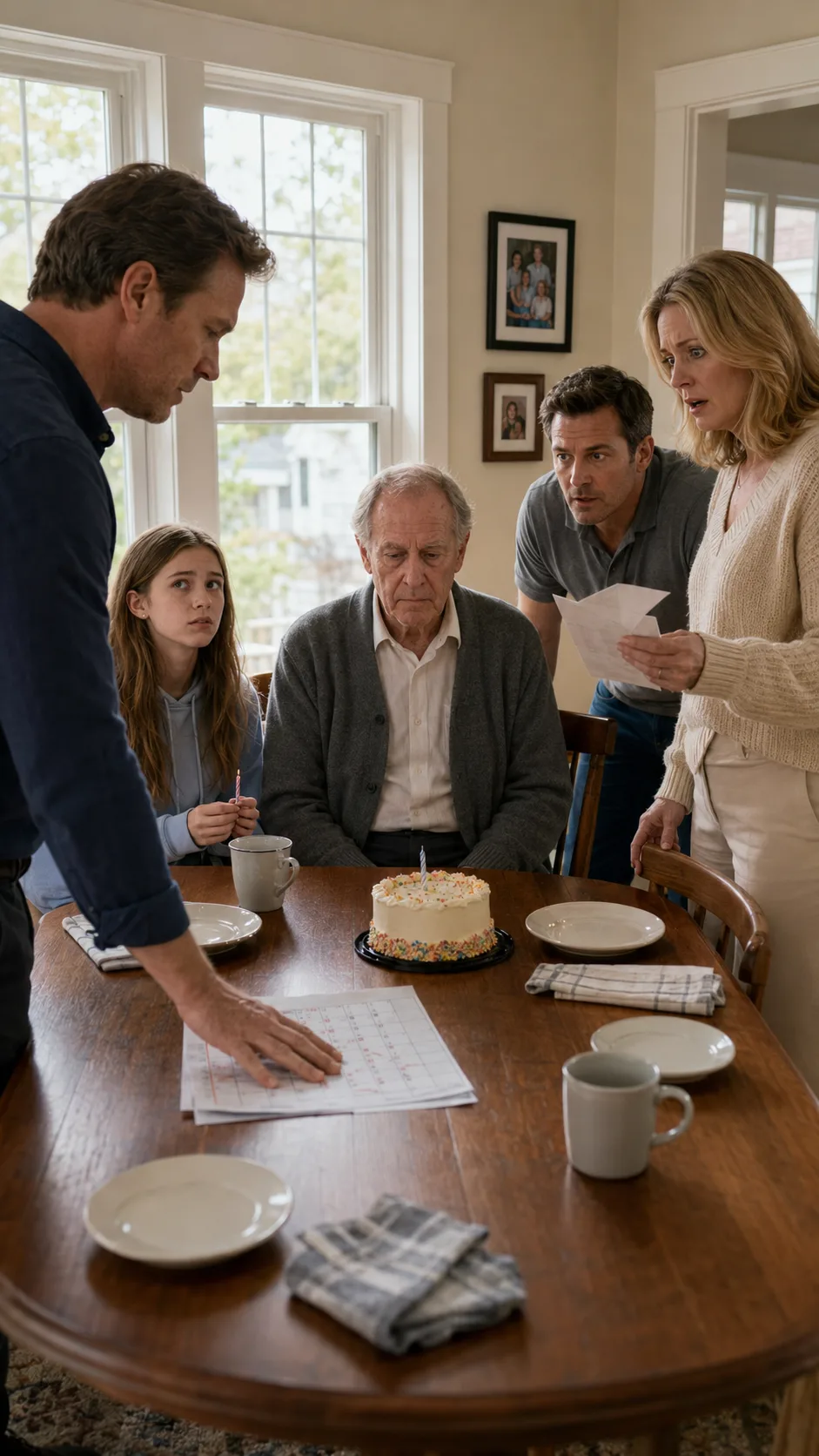
That evening, after the last box was sealed, she brought out the birthday cake from my refrigerator.
It was a little dry by then.
The frosting had cracked at one edge.
The candle was bent.
Lily stuck it into the center anyway.
“Everybody sit down,” she ordered.
And for once, everybody listened.
Daniel lit the candle. Claire turned off the overhead light. Michael stood behind my chair, one hand resting carefully on my shoulder like he was asking permission to be there.
They sang.
Badly.
Lily sang the loudest.
When they finished, the flame trembled in front of me.
I closed my eyes.
I did not wish for my pension back.
I did not wish to be younger.
I did not even wish for my children to become perfect.
I wished that somewhere, in a senior center dining room, Mrs. Alvarez got a cupcake with her name on it. I wished Walter got a Christmas gift wrapped in bright paper. I wished every forgotten father and mother had someone beside them when the candle was lit.
Then I opened my eyes and saw my children waiting.
Not for money.
Not for instructions.
Just waiting.
I blew out the candle.
Two weeks later, I moved into the apartment beside the senior center.
Daniel came the first Sunday with groceries and stayed to fix a squeaky cabinet.
Claire came Wednesday with soup and photos of the kids.
Michael came Friday with a secondhand armchair because he said my new place needed “one ugly thing from home.”
And Lily came whenever she wanted, because she had a key.
The fund stayed exactly where it was.
Every month, my pension went to people my children would never meet.
But one afternoon, I walked into the senior center and found Daniel serving coffee, Claire helping Mrs. Alvarez choose a birthday candle, and Michael arguing with Walter about baseball.
Lily saw me from across the room and smiled.
“See, Grandpa?” she said. “They’re learning.”
I looked at my children.
They were awkward. Late. Imperfect.
But they were there.
And sometimes, after a heart has been ignored for too long, that is where the healing begins.
THE END.
Chapter complete
You have reached the end of this chapter.
Continue reading
A few more worlds to get lost in after this chapter.




