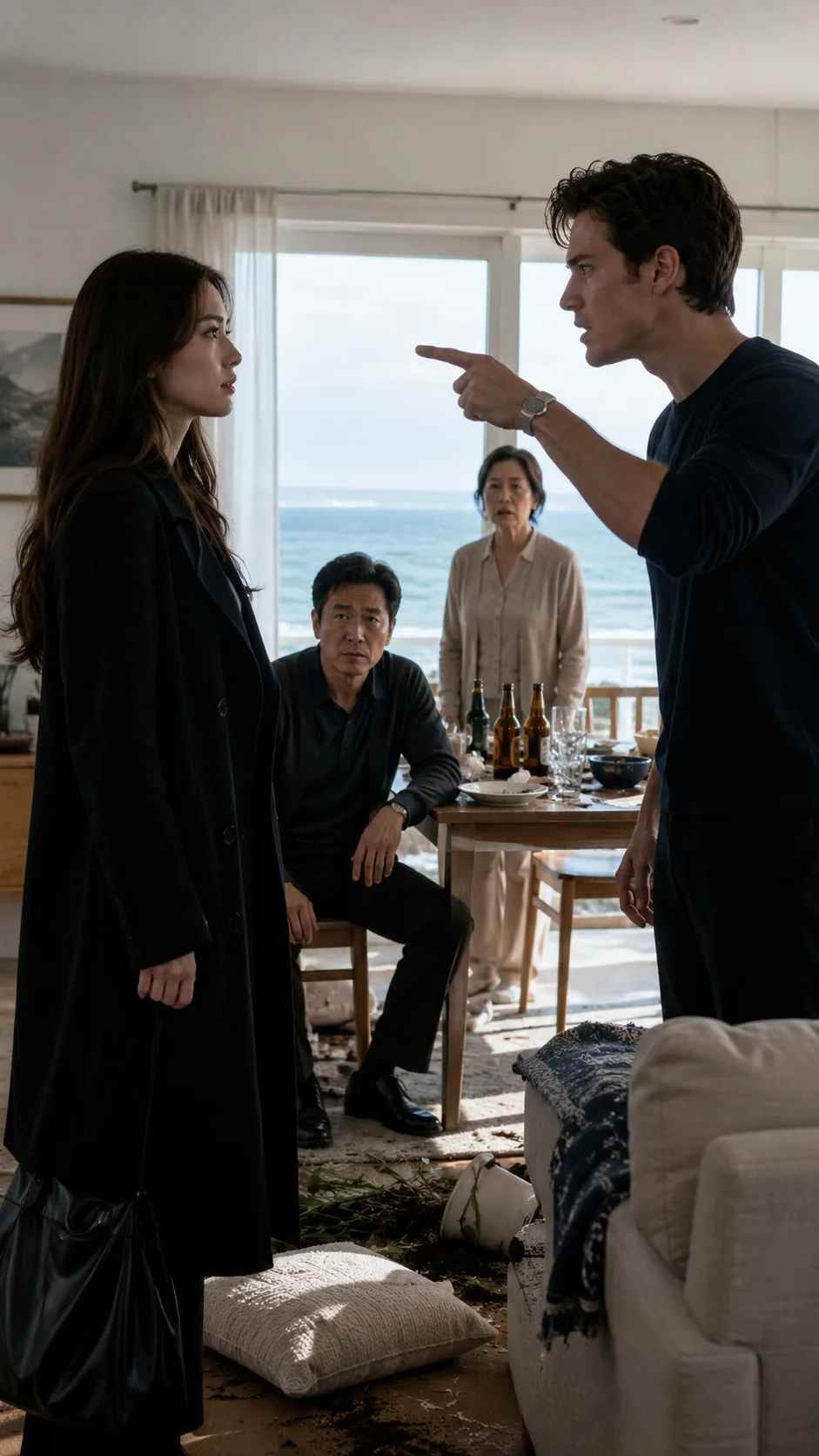
I did not have to touch him.
Chapter 2
I did not have to touch him.
He moved anyway.
My briefcase was by the door where I had set it down when I entered. While they had been turning my parents’ peace into a rental property, I had spent the drive gathering paperwork. I had not come unarmed.
I opened the briefcase and removed a thick manila envelope.
Then I laid it on the coffee table, right on top of the beer cans and food wrappers.
“You’re right,” I said calmly. “Let’s talk about the management plan.”
They stared.
My parents watched as if from underwater.
I took out the first document. The sound of the paper was crisp in the filthy room.
“This is the deed,” I said. “I’ll read the names on it aloud. Robert Monroe. Linda Monroe. My parents. Your parents.” I looked at Jason. “Your name is not here.” Then at Melissa. “Your name is not here. This is not your house.”
Jason scoffed. “A piece of paper. So what? They invited us. We’re family.”
“I’m glad you said that.”
I took out the next document.
“This created the Robert and Linda Monroe Lifetime Trust.”
Melissa’s eyes narrowed at the word trust. To Melissa, trust always meant access to money.
“I’ll explain simply,” I said. “This house is protected. It belongs to Mom and Dad for their entire lives. It cannot be sold. It cannot be mortgaged. It cannot be attached to someone else’s debt. It exists for one purpose only: to provide them with a peaceful home for the rest of their lives.”
I let that settle.
Then I added, “I am the trustee. Which means I have the legal authority to enforce that purpose.”
Melissa’s face changed.
“You,” she said.
“Yes. Me. I did that because I know what can happen when people smell opportunity and mistake kindness for weakness.”
Jason barked a laugh. “This is crap. We’re helping them.”
“Are you?”
I took out the Airbnb printouts and spread them across the table.
“This is the listing.”
Melissa looked at the pages and went still.
“Luxury Seaside Gem,” I read aloud. “Hosted by Jason and Melissa Harper. We manage this beautiful property for its owners.”
I looked up.
“You listed my parents’ home without permission. Four hundred dollars a night. I see three weekends already booked. Twenty-four hundred dollars incoming. Tell me, Jason—how much of that were Mom and Dad actually going to see?”
He said nothing.
“Half? A third? Or were you planning to manage all of it into your own pockets?”
“They said we could!” Melissa shouted. “Mom said it was fine!”
Every eye went to my mother.
She looked down.
“I… I didn’t know,” she whispered. “I didn’t know about a business.”
“Of course you didn’t,”
I said.
Melissa was already shifting, recalculating. “You don’t know what we talked about.”
“No,” I said. “I know better than what you said. I know what you wrote.”
I pulled out the final set of pages.
“You really should learn more about privacy settings, Melissa. Especially on devices other people paid for.”
I held up the printout of the group chat between her and Jason.
For the first time since I walked in, Melissa looked genuinely afraid.
I read aloud.
“Melissa to Jason, Tuesday, 8:15 a.m.: She actually did it. A house. It’s right on the water. We are going there now.”
Jason’s jaw tightened.
“Jason to Melissa, 8:16 a.m.: Holy crap. How much is it worth?”
I continued.
“Melissa to Jason, 8:16 a.m.: Doesn’t matter. It’s ours now. Mom will do whatever I say. She always does.”
The room changed.
My mother made a soft, broken sound.
My father went absolutely still.
I turned a page.
“This one is particularly interesting,” I said, and read the next line. “Melissa to Jason, Wednesday, 9:02 p.m.: He always caves if Mom cries. We can get them to sign a paper. Make it legal. Clara’s too busy playing God in a hospital to notice. We’ll make 20K by summer. Easy.”
I lowered the page.
No one spoke.
The ocean moved faintly beyond the walls.
My father stood up.
He was no longer shaking.
“You said that?” he asked Melissa.
She opened her mouth. “Dad, I didn’t mean—”
“You wrote it,” I said.
I looked from Melissa to Jason to my parents.
“You came here to steal this house. You lied to them. You bullied them. And you were going to use my mother’s tears as leverage.”
Melissa’s face had lost color. Jason looked like a man trying to think his way through consequences for the first time in years and finding himself under-equipped.
“And because I enjoy being thorough,” I said, taking out one last paper, “this is the HOA rule book. Rule forty-three. No short-term rentals. No Airbnb. No management business. So your little scheme is not just immoral. It also violates the homeowners association and exposes Mom and Dad to legal risk.”
I tapped the highlighted line.
“Your business,” I said, “is illegal.”
Then I gathered the pages except for the chat transcript, which I left on the table where everyone could see it.
“You have one hour.”
Jason stepped toward me, puffing himself up again because bluster was the only instrument left to him.
“You think you can boss me around?” he said, voice dropping into what he probably thought was menace. “You think some papers mean anything? We’re here. We’re living here. You’re the visitor.”
“Get out of my way, Jason.”
“Or what? You gonna call the cops? Go ahead. We’ll tell them it’s a family dispute. We’ll tell them you’re crazy.”
I looked at him.
“Please call them. I would love that. I’d be thrilled for you to explain fraudulent rental listings, HOA violations, trespassing, and trust interference to law enforcement.”
He faltered.
He did not understand trusts or trustees or property law. But he understood the shape of a criminal record.
Melissa stepped in next, because Melissa always preferred emotional extortion to physical posturing.
“You are tearing this family apart!” she screamed, tears rising instantly. “You always do this. You hold things over people. You buy things and think you own us.”
“I don’t own you,” I said. “That would require your value to exceed your damage.”
She gasped as if slapped.
“You have everything,” she cried. “You have money, a career, this perfect life, and what do I have? Nothing. Jason is trying. We’re trying. We were just helping. Family is supposed to help family. What is wrong with you?”
It was the old performance, but sharpened by panic. The appeal to fairness. The accusation that boundaries are cruelty. The inversion that allows parasites to see refusal as violence.
Then she turned to our parents.
That was always her last move.
“Mom, Dad, are you really going to let her do this? Throw me out? Your daughter? Your grandchildren?”
She grabbed my father’s arm.
“Daddy, tell her. Tell her she’s being crazy. Tell her.”
My father looked at her hand on his sleeve.
Then he looked at the paper on the table—the one where she had written He always caves if Mom cries.
Slowly, he pulled his arm away.
He did not say a word.
He did not need to.
Melissa’s face cracked.
She pivoted toward Mom.
“Mom,” she whispered now. “Mom, please. Don’t let her do this. She’s hurting me.”
My mother sat at the table looking smaller than I had ever seen her and, somehow, more visible. A whole life of managing around Melissa had worn grooves into her. I could see them suddenly. Years of smoothing, excusing, surrendering, absorbing. Years of telling herself peace was the same as silence.
She looked at Melissa.
Then at me.
When she spoke, her voice was soft, but there was something underneath it I had never heard before. Not strength exactly. Exhaustion finally clearing into truth.
“I… I think you should go, Melissa.”
Melissa blinked.
“What?”
“I think you should do what you need to do, Clara,” my mother said.
She said it to me.
Do what you need to do.
It wasn’t a roar.
It wasn’t dramatic.
It was permission.
It was the end of the old family system spoken in the smallest possible voice.
I nodded once.
Then I looked back at Melissa and Jason.
“The clock is ticking.”
Jason muttered something ugly and stormed toward the guest room. Melissa stood frozen for a second, as if the laws of gravity had changed without consulting her.
Then she followed him.
The house exploded into motion.
Drawers yanked open. Doors slammed. Children whining. The dog barking. Jason cursing. Melissa crying in big loud theatrical gulps even though the audience had already left.
I pulled out my phone.
“What now?” Jason shouted from the hall. “Calling your lawyer?”
“No,” I said. “My locksmith.”
I had found one on the drive.
He answered on the second ring. “Victor’s Lock and Key.”
“Victor, this is Dr. Clara Monroe. I’m at the property on Seaside Drive. I need all the locks changed immediately.”
A beat.
“Can you verify ownership on site?”
“Yes. I have the trust documents and deed. I’m the trustee.”
“I’m ten minutes away.”
“Good.”
I hung up.
Melissa came rushing out, eyes wide now for real.
“You’re changing the locks?”
“Yes.”
“You can’t lock us out!”
“I can,” I said. “And I am.”
For the next half hour, the house filled with sounds of removal.
Bags being dragged.
Children asking confused questions.
The boxer barking until even the dog sounded offended.
Then Victor arrived with a toolbox and the calm of a man who has seen many domestic implosions and learned long ago that the less emotion he brought into them, the better.
He glanced once around the room and decided, wisely, not to ask anything unnecessary.
“Front door, back door, sliding glass,” I told him. “Digital locks. Best you have. No keys.”
“You got it.”
The drill started.
Jason came out carrying a duffel bag and stopped dead when he saw Victor installing the new front lock.
“You’ll regret this!” he yelled at me.
He wanted me frightened. He wanted me pulled back into the emotional fog where he and Melissa always operated best.
But clarity is a kind of armor.
“You are mistaking consequence for revenge,” I said. “They are not the same.”
He just glared and stomped past me.
While Victor worked, I sat at the dining table where Melissa had been “managing” the house and opened my laptop.
I logged into Airbnb.
Found the listing.
Clicked Manage.
Deactivate listing.
A little confirmation box popped up. Are you sure?
Yes.
Then I opened the bookings.
Three weekends.
Three families.
Three deposits Melissa had already mentally spent.
One by one, I canceled them and issued full refunds. In the message box, I wrote the most controlled, professional sentence I could manage: This reservation has been canceled because the listing was posted in error. A full refund has been issued. We apologize for the inconvenience.
I did it three times.
In less than three minutes, Melissa’s entire imagined business evaporated.
She realized it when she burst out of the guest room clutching her phone.
“The bookings are gone!” she screamed. “The money is gone! What did you do?”
“It was never your money,” I said without looking up. “It was theft.”
She stared at me as though I had violated some sacred rule of the universe by declining to subsidize her fantasy one more time.
Then she began to cry again.
By the time Victor finished, a pile of their bags had accumulated on the lawn alongside toys, dog supplies, and the random debris of people who had mistaken a sanctuary for a campsite.
The children, rumpled and confused in mismatched clothes, climbed into the minivan. The dog was loaded in last, barking resentfully from a crate. Jason slammed the trunk and marched to the driver’s seat, but not before pointing at me one more time.
“This isn’t over.”
“It is,” I said.
Melissa wouldn’t look at me. She was crying in the passenger seat, but there was rage beneath it, hot and poisonous. She had lost not just the house, but the script. She could no longer cast herself inside this scene the way she wanted.
Jason rolled down the window.
“You’ll regret this,” he said again, weaker now.
“No,” I said. “I won’t. Boundaries aren’t revenge, Jason. They’re repairs.”
He stared at me for one long second.
Then he slammed the gas.
The van peeled away, leaving a black mark on the road.
Victor finished programming the locks.
“All set, ma’am,” he said. “Default code is zero-zero-zero-zero. You’ll want to change that.”
“I already know what I’m changing it to,” I said.
He nodded, took his payment, and left.
Then it was quiet.
Real quiet.
Not the tense silence of people holding themselves still to avoid the next eruption. The house was empty of them. The air itself seemed to know.
I closed the front door.
The new lock clicked into place with a heavy, satisfying sound.
Safety has a sound.
Sometimes it is a latch.
Sometimes it is a code accepted by a keypad.
Sometimes it is the absence of a person’s voice.
I entered the new code.
Then I opened the sliding glass door.
“Mom. Dad. They’re gone.”
They came back in slowly.
They looked like survivors returning to a room after the fire has been put out, still not sure where it is safe to stand. They took in the mess—the wrappers, the overturned cushions, the ashtray, the scuff on the wall, the stale smell still hanging over everything.
My father put his face in his hands and shook once, hard.
My mother picked up an empty beer bottle, stared at it, and dropped it into the recycling bin.
Then she turned to me.
“I’m so sorry, Clara.”
“What are you sorry for?”
“This,” she whispered. “All of this. Your beautiful gift. We… we let them. I let them.”
“You did nothing wrong,” I said. “You were kind. They were not.”
She nodded, but I could see she didn’t believe it yet.
There is a long delay, sometimes, between innocence and self-forgiveness.
She took a trash bag from under the sink.
My father picked up the broom.
I gathered the cushions from the floor.
And without further discussion, the three of us began to clean.
For two hours, no one said much.
We opened every window.
Salt air flooded through the house.
My father vacuumed dog hair from corners and under the couch.
My mother scrubbed counters.
I washed ashtrays, stacked dishes, stripped beds, wiped down bathroom surfaces that should never have been made dirty in the first place.
We filled bag after bag with garbage.
At some point, I realized we were not only cleaning a house.
We were reclaiming it.
This is the strange thing about violation: after the intruders leave, you still have to remove the shape of them from the space. The wrappers. The smells. The visual evidence. The psychic residue. You clean because cleaning is one of the only ways to tell yourself physically what you now know morally—that the thing has ended, the breach is sealed, the room belongs again to the people it should have belonged to all along.
When we finished, the house was quiet and clean.
My father sat in the armchair by the window—the chair I had bought for him, the one Melissa had posed in for the Airbnb photo—and stared out at the water.
My mother made tea.
She handed me a cup and asked softly, “You’ll stay the night, Clara?”
“I’ll stay.”
That night I slept in the second guest room, the one Melissa and Jason had used. I had put clean sheets on the bed after stripping theirs off. The room smelled faintly of detergent and ocean air. I lay awake for a long time listening to the waves. The house was safe. I had done what needed doing. The problem had been removed.
But I did not feel triumphant.
I felt the way I often feel after a long difficult surgery: relieved, drained, and aware that saving something had required a cut no one in the room would ever entirely forget.
The real fallout started three days later.
I was back in my office at the hospital writing patient notes when my phone buzzed.
A text from my cousin Sarah.
Clara, what is going on? Melissa’s heartbroken. She said you kicked her out of your parents’ house.
I stared at the screen.
Then an email from Aunt Judy.
Clara Monroe, I am hearing the most awful things. Your sister is on the street with her children. You threw them out after all your mother and father have been through. What has gotten into you? Money has made you cruel. You need to call your sister and apologize.
Then another notification.
Melissa had tagged me in a Facebook post.
I opened it.
A picture of her children asleep in the back of the minivan. The caption was a masterpiece of manipulative framing:
My heart is broken. I’ve learned that family means nothing to some people. We were just trying to help my parents, who were given a big empty house they couldn’t manage—and we were thrown out. Kicked out by my own sister. She brought in a strange man to change the locks and threw us out on the street with my children. Please pray for us. Money makes people so, so cruel. I’m just thankful for what really matters. #FamilyFirst #Blessed #Betrayed #Heartbroken
The comments were immediate, predictable, disgusting.
I’m so sorry, Melissa.
Clara always thought she was better than everyone.
Praying for you and those babies.
Melissa had launched her campaign.
She had done what people like her always do: convert consequence into persecution and send it outward fast enough that truth would have to limp behind it.
My phone began to ring.
Aunt Judy.
I didn’t answer.
Then cousin Sarah.
Then another cousin.
Texts stacked up.
Call me.
This is serious.
Your mother is devastated.
What kind of person does that to her own sister?
The flying monkeys had arrived exactly on schedule. That phrase always sounds exaggerated until you’ve lived it. But there is no better term for the people who orbit a manipulator and perform pressure on their behalf without ever examining the original event closely enough to deserve an opinion.
They did not want the truth.
They wanted the old structure restored.
They wanted me back in my assigned role—the competent daughter, the bigger person, the one who would apologize just to make the room tolerable again.
I sat there in my office and thought through my options.
I could post the group chat screenshots.
I could post the Airbnb listing.
I could post the trust documents and the HOA rule.
I could lay out everything and let the family feast on the ugliness.
I could defend myself.
But defense, in situations like that, is often just another form of participation. The second you start explaining yourself to people who are committed to misunderstanding you, you have already accepted the arena they chose.
The only way to win that game is not to play.
So I opened a new email.
I added every relative who had messaged me.
I added Melissa.
I added Jason.
Subject: The House on Seaside Drive.
Then I wrote:
This is the first and last time I will address this matter. The house on Seaside Drive belongs to Robert and Linda Monroe. It is their private property and is held in trust for their exclusive peaceful use. A recent attempt was made to illegally operate a short-term rental business from the property in violation of both the trust and the HOA. That attempt was stopped. The locks were changed to protect the legal owners. Unauthorized entry by any ব্যক্তি will be reported to the police as criminal trespassing. This matter is now closed.
Dr. Clara Monroe.
I read it once.
Sent it.
Then I did what mattered most.
I blocked Melissa.
Blocked Jason.
Blocked Aunt Judy.
Blocked Sarah.
Blocked every number that had rung with accusation instead of inquiry.
Within an hour, my phone went silent.
Not hospital silent.
Not the ordinary silence of an afternoon between calls.
The silence of a door finally locked.
The silence of a boundary holding.
The aftermath still existed, of course. Families do not dissolve their patterns overnight just because one person finally stops participating. But something had changed. The chaos was happening outside the line now. Not in me.
A month passed.
The gossip lost momentum.
No new emails.
No new texts.
The family machine hit the wall I had built and, finding no emotional fuel, moved on to its next softer target.
I spoke to my parents every few days.
At first our conversations were strange.
Quiet.
We did not talk about Melissa or Jason or the confrontation. Some wounds need oxygen before language. We spoke about weather, the view, little daily things.
“It’s sunny today,” Dad would say. “I can see ships way out there.”
“That’s nice, Dad.”
“I think I’ll go for a walk.”
This startled me the first time he said it.
My father had never been a man who went for walks. He went to work. He came home. He fixed things. He slept. Leisure, in our house growing up, had always felt like a luxury with suspicious edges.
My mother told me about a plant she bought.
A fuchsia for the porch.
“The hummingbirds like it,” she said.
Later she told me she was reading a book.
A book.
Not a cookbook, not a coupon circular, not instructions for how to stretch a dollar or solve a household problem. Just a story. She sounded almost embarrassed admitting it.
“I sit on the deck and read,” she said.
I held the phone away from my ear for a second and closed my eyes.
They were healing.
Not dramatically.
Not in a way anyone else would notice.
But I heard it.
The difference between surviving and living is often audible only in small details.
I gave them space.
Then one Saturday, I drove up.
This time I did not bring cake or flowers.
I brought only myself.
The street was quiet when I arrived. The house looked different in ways that had nothing to do with architecture. The lawn was mowed. Bright red geraniums filled the window box. There were no trash bags, no children’s plastic crap on the grass, no cigarettes, no evidence of invasion.
I entered my code.
The lock clicked open.
Inside, the house smelled like salt and coffee.
I found them on the back deck.
My mother was barefoot in a lounge chair with her feet up on the railing, a mug of tea beside her, reading her book. My father stood near the edge of the little yard wearing a clean polo shirt and shorts, adjusting a bird feeder with the same careful hands he had once used to build cabinets for other people. He was whistling.
Whistling.
I had not heard that sound from him since childhood.
My mother looked up first and smiled. Not the nervous smile of someone trying to smooth a room. A real one. It reached her eyes.
“Clara.”
She didn’t jump up to host me.
She didn’t fuss.
She just smiled.
“Hi, Mom. Hi, Dad.”
My father turned and grinned. “Clara-girl, you’re here.”
He hugged me.
Not a brittle grateful hug. A father’s hug. Steady. Warm. Unafraid.
“I made tea,” Mom said. “Pour yourself a cup.”
Inside, the house was clean but lived-in. A newspaper folded on the table. Two pairs of shoes by the door. A cardigan draped over the back of a chair. Not a museum, not a stage set. A home. Their home.
I poured my tea and carried it back outside.
Then I sat in the third chair.
We were quiet for a while.
The ocean moved beyond the rail.
A gull cried somewhere overhead.
My father pointed out a seal near a rock offshore.
“He comes by every morning,” he said. “We call him Barnacle.”
“It’s Bob,” my mother said immediately.
“It is not Bob.”
“It is absolutely Bob.”
They argued gently over the seal’s name.
I sat there holding my tea and listened to my parents bicker about a seal like two people who had finally been granted the right to become ordinary.
That, more than anything else, nearly undid me.
After a while, my mother looked out at the ocean and took a slow breath.
“It smells like salt and safety,” she said softly.
Safety.
That was the word.
I realized then that my parents had spent most of their lives safe enough to continue, but not safe enough to rest. There is a difference. A profound one. They had always been one broken car, one medical bill, one Melissa emergency, one bad month away from panic. Their whole nervous systems had been trained around contingency. Now, perhaps for the first time, they were inhabiting a space in which tomorrow did not automatically threaten them.
The trust protected them.
The locks protected them.
And I finally understood something I wish I had understood much earlier.
I used to think love meant obligation.
I thought love meant fixing and paying and smoothing over and absorbing and being the bigger person forever because someone had to be.
I thought being a good daughter required being an endlessly available sister.
I thought sacrifice, even when it became self-erasure, was evidence of virtue.
I was wrong.
Love is not letting people take everything you build.
Love is not surrender until you are empty.
Love is not financing your own exploitation and calling it family loyalty.
Love is an action, yes—but not always a soft one.
Sometimes love is a deed and a trust document.
Sometimes love is a digital lock.
Sometimes love is standing in a ruined room and saying, No. This ends here.
Sometimes love is giving your parents a porch, the ocean, time enough to argue about the name of a seal, and a door that stays locked against anyone who would call theft by a sweeter name.
I sat back in my chair and drank my tea.
The late light moved across the porch.
My father laughed at something my mother said.
And for the first time in my life, I did not have to fix anything.
I just got to witness what fixing had made possible.
For a long time after that, I kept thinking about the difference between a home and a stage.
Melissa had always needed stages. She needed rooms arranged around her moods, her wants, her crises, her version of injury. She could not move through a space without trying to make it perform her story back to her. Our childhood home had been her stage. Every apartment I rescued her from or paid for became another stage. Even my used sedan, once she and Jason borrowed it and smashed it, became a stage for their helplessness. The blue house was almost instantly transformed into one too—the Airbnb listing, the photos, the wine glass on the porch chair, the captions, the hashtags, the fake heartbreak. Everything was presentation. Everything was narrative. Everything was organized around extracting value from other people’s effort.
My parents had never wanted a stage.
They wanted a home.
The distinction is simple when written and devastating when lived.
A stage is where you perform your needs loudly enough that everyone else rearranges themselves in response.
A home is where you no longer need to do that.
My parents, stripped finally of Melissa’s noise, became more themselves than I had ever seen them. My mother read novels. She bought herbs in clay pots and lined them up by the kitchen window. My father repaired small things that did not need repairing, not because they were broken but because he liked touching wood, liked shaping, liked using his hands for joy instead of survival. He built a little shelf for my mother’s teacups. He sanded and stained it on the back deck like a man rediscovering his own hobbies after decades of laboring only for necessity.
Sometimes, when I visited, I would find them doing nothing.
That sounds so small.
It is not.
To do nothing on purpose is one of the great luxuries of human life. To sit. To look out a window. To drink tea while it is still hot. To start a crossword and leave it unfinished. To decide the afternoon does not need optimizing. They had never really been allowed that before.
Of course, Melissa was not done with us in any spiritual sense. People like her rarely end internally just because a door closes physically. I heard through occasional family leaks that she told versions of the story for months. In some, I was a tyrant drunk on money. In others, my parents had been manipulated by me. In one especially laughable version, she and Jason had been “co-managing” the property with our blessing until I “turned unstable” and changed the arrangement out of spite.
It no longer mattered.
That was the miracle.
The old me would have felt compelled to correct every lie, answer every accusation, prove every fact. But truth does not owe itself to every hungry mouth. Sometimes the most powerful thing you can do is let the manipulator keep performing into an empty theater.
I had my parents.
I had the documents.
I had the locks.
I had peace.
That was enough.
Months later, my father said something to me that I have carried ever since.
We were sitting on the porch at dusk. The sky had gone pearl-gray, and the ocean was the color of steel under cloud cover. He was quieter there than he had been in the rest of his life, but it wasn’t the quiet of suppression anymore. It was the quiet of a man who finally no longer had to defend himself from noise.
“I’m sorry,” he said.
I looked at him.
“For what?”
He kept his eyes on the water. “For making you the grown-up so young.”
I didn’t answer right away.
Because what could I say? That he was right? That I had known it for years? That love and harm often live so close together in families like ours that untangling them takes half a lifetime?
He shook his head slightly.
“You were just a kid,” he said. “And we kept acting like you could carry what we wouldn’t make Melissa carry.”
The honesty of it landed hard.
My father was not a man of grand emotional speeches. That was never his language. So when he named something plainly, it mattered.
I reached over and put my hand on his.
“You were tired,” I said.
“That’s not an excuse.”
“No,” I said. “But it is part of the story.”
He nodded.
That was enough. Not absolution. Not complete repair. But truth spoken aloud in the open air between us. Sometimes that is all the healing available.
My mother’s reckoning came differently.
She did not apologize in one clean sentence the way my father did. She moved through apology in actions, because actions had always been her first language. She stopped defending Melissa in absentia. She stopped softening Melissa’s behavior into adjectives like sensitive or overwhelmed. She stopped asking me, even subtly, to be the one who absorbed the family’s emotional debt.
One afternoon, over tea, she said, “I thought I was keeping peace.”
I waited.
“I think,” she said slowly, “I was just teaching myself to be afraid of upsetting the wrong person.”
That may have been the bravest thing I ever heard my mother say.
Because naming cowardice in yourself after a lifetime of calling it kindness is not easy. It requires its own kind of surgery. To open the old wound and admit that what you called peacemaking was often surrender. To admit that one child’s volatility trained the whole family into false compassion. To realize that your gentleness, untethered from boundaries, became part of the machinery that harmed everyone.
I reached across the table and squeezed her hand.
She squeezed back.
No drama. No tears. No need.
The truth was enough.
As the first year in the blue house unfolded, the place became more and more theirs. Photos went up. My mother found curtains she loved. My father built a small bench for the entryway. They planted herbs and flowers. They developed routines. Morning coffee on the porch. Afternoon walks. Tea on the back deck. On windy nights, my mother liked to leave the bedroom window open just enough to hear the ocean better.
The house settled around them like a body finally unclenching.
And I, strangely, began to unclench too.
For years, I had lived with a kind of background vigilance where Melissa was concerned. A readiness. A bracing. Even when she wasn’t actively asking for something, part of me remained psychologically turned in her direction, waiting for the next request, the next crisis, the next leak of chaos into my life. Once I blocked her and refused the social machinery that usually followed her damage, something in me quieted.
I became aware of just how much energy constant anticipatory defense consumes.
At the hospital, I was still calm under pressure. In the operating room, I was still sharp. But outside of work, I no longer felt like I had one eye on a door that might burst open at any moment.
That is what boundaries give you, when they are real.
Not punishment.
Not triumph.
Space to recover the parts of yourself that survival kept on reserve.
People who have never needed strong boundaries often misunderstand them. They imagine boundaries as dramatic declarations, punishments, ultimatums, or displays of anger. Sometimes they can contain those things. But at their best, boundaries are architecture. They are structure. They are the walls that make peace inhabitable.
Without walls, a house is not generous.
It is exposed.
Without locks, a home is not open-hearted.
It is vulnerable to every person who mistakes kindness for permission.
The day I finally understood this in my bones, I was watching my mother nap in a lounge chair on the deck. She had a blanket over her knees and a book face-down on her lap. My father was inside making tea. The whole scene was so ordinary it would have been invisible to most people. But for me it felt almost holy.
Because she was asleep.
In the middle of the day.
Not because she was sick, not because she had collapsed from exhaustion, not because she had finally reached the point of physically having no choice. She was asleep because she felt safe enough to drift off in the sun.
That is what the house gave them.
That is what the boundary gave them.
That is what I had really bought.
Not square footage. Not ocean views. Not a pretty anniversary gesture.
Safety.
And once you understand that safety is what you have been trying to purchase for the people you love all along, a lot of older confusions fall away.
I no longer felt guilty about Melissa.
I felt sad, sometimes.
Not for the woman she was actively being, but for the fact that some people build such aggressive entitlement around themselves that they eventually become incompatible with every decent form of intimacy. Melissa wanted family without limits, help without gratitude, access without responsibility, love without truth. She wanted permanent exemption. There is no sustainable human relationship built on those terms.
I did not hate her.
That surprises people when I say it, but hatred is more intimate than I was willing to remain. Hate keeps you tethered. It asks you to spend emotional energy in the direction of the person who harmed you. I was no longer willing to do that.
What I had instead was clarity.
Melissa was not confused. She was not merely “going through a hard time.” She was not a misunderstood free spirit. She was a taker. Jason was a taker. Together, they were a system. One created the emotional flood, the other the practical scheme. One manipulated hearts, the other posture and space. One cried, one threatened. The effect was the same.
Once I named that cleanly, my responsibility to them disappeared.
Chapter complete
You have reached the end of this chapter.
Continue reading
A few more worlds to get lost in after this chapter.




