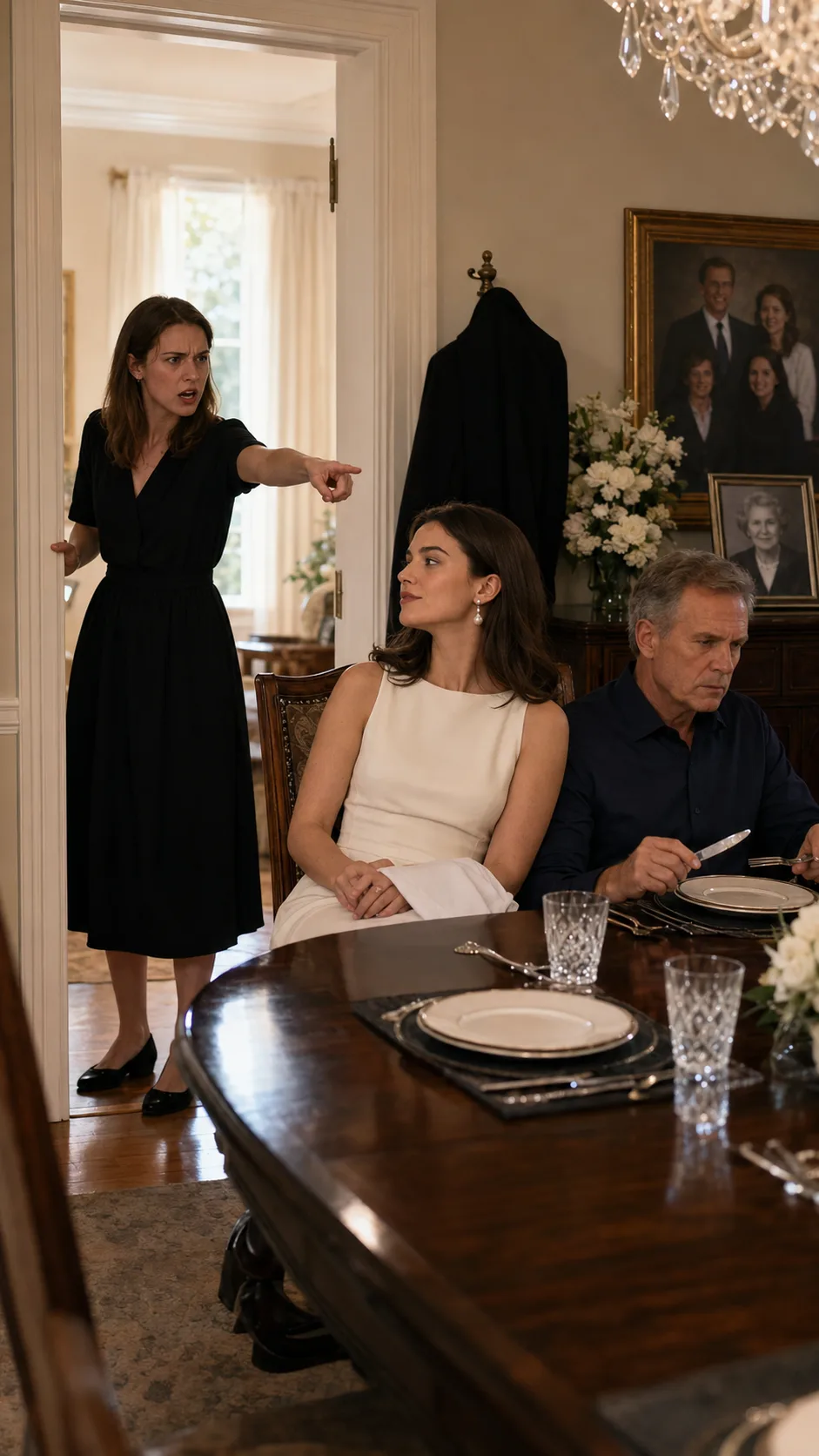
THREE WEEKS AFTER MY MOTHER’S FUNERAL, MY FATHER BROUGHT HOME A YOUNG WOMAN WHO ALREADY KNEW WHERE MY MOTHER SAT — PART 3
PART 3
My father’s fear did not look like panic.
Chapter 2
THREE WEEKS AFTER MY MOTHER’S FUNERAL, MY FATHER BROUGHT HOME A YOUNG WOMAN WHO ALREADY KNEW WHERE MY MOTHER SAT — PART 3
PART 3
My father’s fear did not look like panic.
Richard Carter was too practiced for that.
His fear looked like stillness.
His shoulders squared. His jaw locked. His eyes moved around the dining room, measuring every person present, calculating how much damage had already been done and how much could still be contained.
That was the moment I understood something worse than the affair.
He was not sorry.
He was strategizing.
“Emily,” he said, voice low, “you are grieving. Everyone here knows that. Nobody is going to judge you for being emotional.”
Aunt Diane’s face changed.
Harold looked down at his plate.
Vanessa remained near the doorway with my mother’s pearls still in her ears, one hand pressed against her stomach as if she were the wounded one.
I almost laughed.
Emotional.
That was how men like my father buried women.
Not with dirt.
With words.
Emotional. Confused. Overreacting. Too sensitive. Not ready to accept reality.
I placed the
folder on the dining table.
“No,” I said. “I’m not emotional. I’m prepared.”
Richard’s nostrils flared.
“Do not do this in front of guests.”
“They were Mom’s guests first.”
The silence that followed was sharp enough to cut glass.
I opened the folder and took out the first statement.
“March 3rd,” I said. “Eight thousand four hundred dollars transferred to Lakeview Grand Residences.”
Vanessa’s eyes flicked up.
I looked directly at her.
“That was your apartment, wasn’t it?”
She swallowed.
Richard said, “That was a private matter.”
Aunt Diane’s voice cracked. “While Maggie was sick?”
No one answered.
I took out another page.
“April 18th. Twelve thousand dollars to a furniture showroom. May 9th. Jewelry. June 2nd. Private driver service. June 14th. Resort payment.”
My cousin Lauren covered her mouth.
Harold whispered, “Richard…”
My father’s face flushed.
“You have no idea what your mother and I discussed.”
I pulled my
mother’s notebook from the folder.
“Actually,” I said, “she wrote down exactly what she was afraid to ask you.”
Richard stared at the notebook like it had risen from a grave.
For the first time all night, Vanessa looked genuinely frightened.
Maybe she had thought my mother was just a weak, fading woman in a hospital bed.
Maybe she had never imagined the dead could keep records.
I opened to the page I had marked.
“My mother wrote, ‘Richard says the treatment is too expensive. I want to believe him. But there is money leaving this house for a life I am not part of.’”
Aunt Diane made a sound like something inside her had broken.
Richard gripped the back of his chair.
“That notebook is private.”
“So was Mom’s pain,” I said. “You spent that too.”
Vanessa’s eyes filled.
“I didn’t know about the treatment.”
Everyone turned to her.
Richard’s head snapped in her direction.
“Vanessa.”
“No,” she whispered. “I knew she was sick, but you told me the doctors had stopped trying.”
My skin went cold.
There it was.
Another lie.
I looked at Richard.
“You told her the doctors gave up?”
He said nothing.
Vanessa backed away from him slowly.
“You said she was already gone in every way that mattered.”
Aunt Diane stood so fast her chair scraped hard against the floor.
“How dare you?”
Richard lifted both hands.
“Everyone needs to calm down.”
I stepped closer to him.
“No. You need to answer.”
He looked at me then, and for one brief second, the mask slipped.
Behind the successful father, the grieving husband, the respected man everyone trusted, there was only impatience.
“Your mother was suffering,” he said.
The room went still.
He continued, quieter but colder.
“The treatment was not guaranteed. It would have drained resources. It would have prolonged pain.”
My voice shook. “That was not your decision to make alone.”
“She was my wife.”
“She was my mother.”
His mouth tightened.
“And I was the one living with her decline every day.”
That sentence hit me so hard I almost stepped back.
Because he believed it.
He believed he had been the burdened one.
Not the woman losing weight.
Not the woman smiling through pain.
Not the woman apologizing to nurses for needing help.
Him.
He had made himself the victim of her illness.
I opened the last page.
“This is the hospital estimate,” I said. “The deposit for the treatment was almost the same amount you sent for Vanessa’s apartment.”
Vanessa started crying silently.
“I would have never taken it,” she said. “If I had known—”
I turned to her.
“But you did take the robe. And the chair. And the earrings.”
She flinched.
“I thought he had moved on.”
I stared at her.
“He moved on before she died.”
Richard slammed his palm on the table.
“That is enough!”
“No,” Aunt Diane said.
Her voice was not loud, but it stopped him.
She walked to the table and picked up my mother’s notebook with trembling hands.
“My sister called me in June,” she said. “She asked if a woman could feel her husband leaving before he ever packed a bag.”
Richard looked away.
Diane’s eyes filled with tears.
“I told her grief was making her imagine things. I told her you loved her.”
Her voice broke.
“I helped you make her feel crazy.”
Richard’s face went pale.
The whole room seemed to fold inward.
That was the cruelest part of betrayal.
It did not only wound the person lied to.
It made everyone around them unknowingly help hide the knife.
I looked at my father, and suddenly I was not angry in the same way.
The fire was still there, but beneath it was something colder.
Finality.
I reached into my pocket and took out my house key.
Richard watched me.
“What are you doing?”
I placed the key beside my mother’s notebook.
“I’m done living in a house where Mom’s memory has to compete with your comfort.”
His face changed.
For the first time, he looked like a father.
“Emily.”
“No,” I said. “You don’t get to use my name softly now.”
Vanessa removed the pearl earrings with shaking fingers and set them on the table.
“I’ll leave tonight,” she whispered.
Richard turned to her.
“Vanessa, don’t be ridiculous.”
She looked at him like she was seeing him clearly for the first time.
“You told me she was gone before she died,” Vanessa said. “But she was writing. She was hoping. She was still here.”
Richard said nothing.
Vanessa picked up her purse and walked out.
No one followed her.
My father stood in the dining room surrounded by family, records, my mother’s handwriting, and the chair he had let another woman claim too soon.
He looked smaller than I had ever seen him.
But not small enough for me to pity.
“Emily,” he said again.
I held up one hand.
“Don’t.”
His eyes reddened.
“I loved your mother.”
I shook my head.
“No. You loved being seen as the man who loved her.”
The words landed harder than I expected.
Richard’s mouth opened, then closed.
I pointed to the folder.
“You had every right to stop loving her. You had every right to be tired, scared, lonely, confused. But you did not have the right to lie to a dying woman and spend her chance on another woman’s luxury.”
Aunt Diane began to sob.
Harold turned away.
I looked at all of them, then back at my father.
“I am not angry because you loved someone else,” I said. “I am disgusted because you let Mom die believing she was too expensive, while you were paying for Vanessa to live beautifully.”
Richard’s face crumpled.
Finally.
But I did not feel the relief I thought I would.
His tears came too late to save anything.
For the next few weeks, the family fractured quietly.
No dramatic announcement.
No public scandal.
Just unanswered calls, returned invitations, empty chairs at gatherings where Richard used to be the center of every conversation.
Aunt Diane helped me pack my mother’s things.
We found letters tucked into books. Recipes with notes in the margins. Birthday cards she had saved from me since kindergarten.
In one drawer, I found a sealed card with my name on it.
Not legal papers.
Not money.
Just a card.
Inside, my mother had written in her careful handwriting:
“My sweet Emily, if you are reading this, then there were things I did not have the strength to say. Please do not spend your life begging someone to value what they were careless enough to lose. Love can be real and still not be safe. Choose the life where your heart can breathe.”
I sat on the floor of her bedroom and cried into Aunt Diane’s shoulder.
Not because I had lost my mother.
I had already lost her.
I cried because, even while dying, she had still been trying to save me.
A month later, I moved into a small apartment across town.
It had old floors, noisy pipes, and a kitchen window that caught sunlight every morning.
I placed my mother’s lavender plant on the sill.
I kept her notebook in a wooden box beside my bed.
Richard called often.
At first, I ignored him.
Then one evening, I answered.
He sounded older.
“I sold the downtown apartment lease,” he said.
I looked out the window.
“That was Vanessa’s apartment.”
“I know.”
Silence.
Then he said, “I started seeing someone. A counselor.”
I closed my eyes.
“That’s good.”
“Emily, I don’t know how to live with what I did.”
For the first time, I did not rush to comfort him.
That had always been my role in our family.
The good daughter.
The understanding daughter.
The one who made pain easier for everyone else.
So I said the truth.
“Then don’t make me carry it for you.”
He was quiet for a long time.
“I miss you,” he said.
“I miss who I thought you were.”
His breath caught.
I did not apologize.
Some truths are not cruel.
They are simply overdue.
Six months after my mother’s death, I stood at her grave with white flowers in my hand.
The grass had grown back over the soil. The headstone was clean. Her name looked strange carved in stone, too final for someone whose voice still lived inside me.
Margaret Carter.
Beloved mother.
I knelt and placed the flowers down.
“I found out,” I whispered.
The wind moved through the trees.
“And I chose myself.”
I stayed there until the sun began to lower.
Then I stood, brushed the grass from my knees, and walked back to my car.
For the first time since the funeral, I did not feel like I was leaving her behind.
I felt like I was taking her with me.
Not into the old house.
Not into my father’s regret.
Not into Vanessa’s shadow.
Into my own life.
The one my mother had wanted me to breathe in.
THE END.
Chapter complete
You have reached the end of this chapter.
Continue reading
A few more worlds to get lost in after this chapter.




