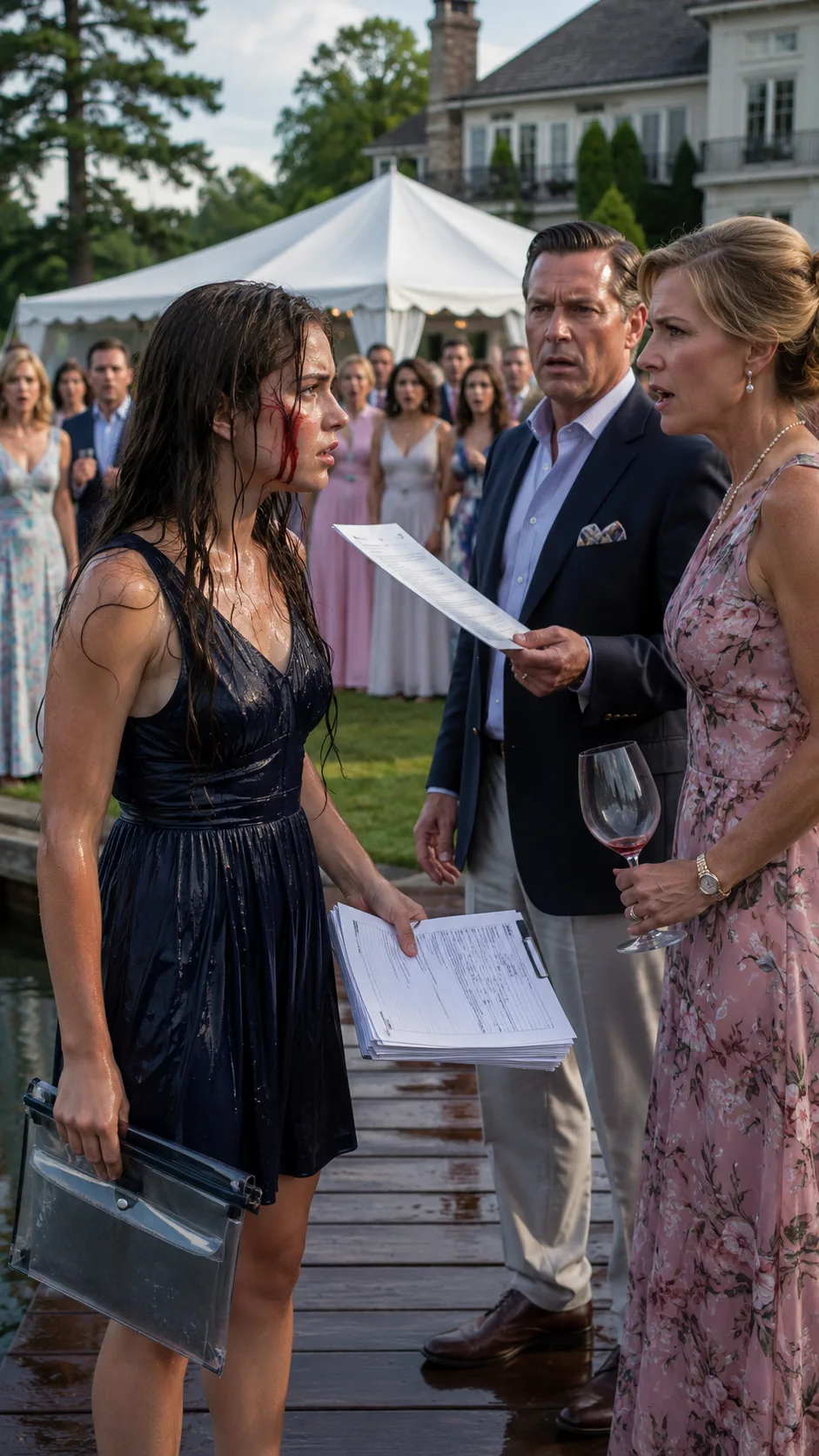
They Threw the Orphan Heiress Into the Lake, But Her Wet Hands Held the Papers That Destroyed Them
The Whitmore estate always looked most beautiful when it was hiding something ugly.
Chapter 1
The Whitmore estate always looked most beautiful when it was hiding something ugly.
From the road, it seemed like the kind of place people whispered about with admiration. A white manor house rose above the lake like a wedding cake, all tall windows, stone balconies, and manicured ivy. The lawn rolled down in perfect green waves toward the water, where a polished wooden dock stretched into the blue like a private promise. Every summer, the Whitmore family hosted its annual lakeside gathering there, and every summer, people came pretending it was about love, tradition, and family.
It was never about any of those things.
It was about being seen.
White tents had been raised across the grass by noon. Florists had tied cream roses around the tent poles. Waiters in black vests carried silver trays of smoked salmon, tiny desserts, sparkling water, and champagne. A string quartet played beneath the shade of an old oak tree. Cousins posed near the lake in soft
pastel dresses and linen suits, laughing with the careless ease of people who had never once wondered whether they were wanted.
Seventeen-year-old Emily Carter stood near the dock and tried not to feel like a stain on the scenery.
Her navy dress was simple, almost too simple for the gathering. It had belonged to her mother, Margaret, who had bought it for Emily the year before the accident. Back then, Margaret had smiled in the dressing room mirror and said, “You don’t need diamonds to look like yourself.”
Emily had believed her.
Now she stood among women wearing diamonds the size of raindrops, and she could hear the whispers even over the music.
“She’s still here?”
“I thought Richard was sending her away after graduation.”
“Poor thing. Though honestly, Vanessa has been generous.”
“Generous?” someone laughed softly. “She’s a charity case with a trust fund.”
Emily held her glass of
water with both hands so no one would see her fingers tighten.
A charity case.
That was what they called her now.
Not Margaret and Daniel Carter’s daughter. Not the girl who used to run barefoot across this lawn with her father chasing her and her mother calling from the porch. Not the child whose birthday parties had once filled this same estate with music, lanterns, and chocolate cake.
Just the orphan.
Just the problem Richard and Vanessa Whitmore had been forced to tolerate.
Her parents had died two years earlier on a rain-slick highway outside Boston. One moment, Emily had been waiting at home, annoyed that they were late. The next, a police officer stood in the foyer with his hat in his hands and his eyes fixed somewhere above her shoulder.
After the funeral, her aunt Vanessa had wrapped Emily in perfume-heavy arms and cried loudly for the
crowd. Uncle Richard had placed a firm hand on her shoulder and told everyone, “She’ll be safe with us. Daniel would have wanted that.”
Everyone praised them.
How noble. How generous. How family-minded.
No one saw what happened after the last guest left.
No one saw Vanessa take away Emily’s room in the east wing because it was “too large for a child.” No one saw Richard move her into the small guest room above the laundry hall, where pipes knocked in the walls at night. No one saw the way they kept her away from family dinners when important guests came, then told people she was “resting” because grief had made her unstable.
They did not let her use her mother’s car.
They did not let her access her own accounts.
They did not let her speak to the estate manager without permission.
When tuition bills came, Richard sighed as if paying them was an act of charity, though Emily later found the checks were drawn from her own trust.
When she asked about her parents’ attorney, Vanessa smiled too brightly and said, “Sweetheart, adults are handling the complicated things.”
Emily had been sixteen then.
Old enough to understand cruelty.
Young enough for them to assume she would do nothing about it.
That had been their mistake.
Because grief had changed Emily, but not the way they thought. It had not made her helpless. It had made her quiet. It had taught her how to listen through doors, how to remember exact words, how to notice when Richard lowered his voice on the phone, how to photograph documents before anyone realized a drawer had been opened.
At first, she had only wanted proof that she was not imagining things.
Then the proof became too heavy to ignore.
A bank transfer from her college fund into Richard’s failing investment company.
Her mother’s signature on a release form dated eight months after her death.
A trust deposit that never reached the trust.
Emails between Richard and a private accountant discussing how to “manage the girl until she turns eighteen.”
And then one sentence, spoken by Richard late one night in his office, when he thought Emily was asleep.
“She’ll sign whatever I put in front of her. She has nowhere else to go.”
That was when Emily stopped waiting for someone to save her.
She found an old business card in one of her father’s leather briefcases. The name was Thomas Hale. Attorney at Law. Her father had once called him the only man in Boston who could read a contract like a weapon.
Emily sent him everything.
For three days, there was no reply.
On the fourth, he called.
His voice had been calm, but underneath it, Emily heard something sharp.
“Miss Carter,” he said, “I need you to listen carefully. Do not confront them yet. Do not sign anything. And from this moment on, keep copies of everything in a place they cannot reach.”
So Emily did.
For six weeks, she smiled when Vanessa insulted her. She stayed silent when Richard reminded her that gratitude was more attractive than defiance. She let them believe she was broken, because broken things did not scare people.
Then the annual gathering arrived.
And with it, Richard’s final plan.
Emily knew because she had found the papers.
A release of claims.
A guardianship settlement.
A statement declaring that she had voluntarily given up any remaining interest in the Carter family estate in exchange for “continued care and educational support.”
Continued care.
Emily almost laughed when she read it.
They had taken her home, her money, her parents’ belongings, her place at the table, and now they wanted her signature to make the theft look clean.
The morning of the gathering, Vanessa came into Emily’s room without knocking.
She wore a pale pink dress and pearls, her blonde hair pinned into a soft twist at the back of her head. She looked elegant in the way expensive people often did when they were preparing to be cruel.
“You’ll stay near the dock today,” Vanessa said, glancing at Emily’s navy dress with visible disappointment. “Do not hover around the main table. Donors and family friends will be here.”
Emily looked up from fastening her shoes. “They knew my parents.”
Vanessa’s smile tightened. “They knew your parents when your parents were alive. Things change.”
Emily stood slowly.
For one second, something moved across Vanessa’s face. Annoyance. Maybe fear. Maybe just surprise that Emily had stopped folding herself smaller.
But then Vanessa’s expression hardened again.
“Richard will speak to you after lunch,” she said. “Be sensible today, Emily. No scenes.”
Emily almost said, I’m not the one planning a scene.
Instead, she said, “Of course.”
By three in the afternoon, the lawn was full.
Emily recognized people she had not seen since her parents’ funeral. Women who had kissed her forehead beside the grave now looked through her as if she were hired help. Men who had once toasted her father now laughed with Richard near the champagne table.
Richard Whitmore was in his element.
He moved through the crowd with a glass in one hand and a practiced smile on his face, accepting compliments on the flowers, the food, the weather, the house.
The house.
Emily watched him gesture toward the manor as if he had built it.
As if her father had not designed the east library himself.
As if her mother had not chosen the blue hydrangeas along the lake path.
As if Emily had not learned to ride a bicycle on the driveway while Daniel Carter ran behind her, laughing, pretending he was too tired to keep up.
“Emily.”
Richard’s voice cut through her thoughts.
He stood a few feet away, perfectly dressed in a navy blazer and cream trousers. The sunlight made his silver watch flash. Beside him, two of Emily’s cousins were watching with badly hidden amusement.
“You’re drifting too close to the family table,” Richard said quietly.
Emily looked past him toward the long table beneath the central tent. Place cards sat before every chair.
Richard Whitmore.
Vanessa Whitmore.
Olivia Whitmore.
James Whitmore.
Catherine Whitmore.
Not one card bore the name Carter.
Not even hers.
Emily turned back to him. “This is my family’s home.”
His smile remained, but his eyes went cold.
“Lower your voice.”
“I wasn’t speaking loudly.”
“You are embarrassing yourself.”
One cousin laughed into her drink.
Emily felt the old heat rise in her throat, the kind that came before tears. For two years, they had counted on those tears. They had counted on her choking, apologizing, retreating.
She swallowed them down.
“I’m not leaving the lawn,” she said.
Richard stepped closer, blocking the guests’ view with his shoulder. “You mistake tolerance for affection. Vanessa and I took you in because it looked better than sending you away immediately.”
Emily’s fingers went numb around her glass.
He leaned closer.
“You should be grateful we gave you a roof at all.”
Emily stared at him.
Behind him, guests were still laughing. The quartet kept playing. A waiter walked past with a tray of champagne, pretending not to hear.
That was the strangest part of cruelty, Emily had learned. It did not always happen in dark rooms. Sometimes it happened in broad daylight while music played and adults chose not to turn around.
Richard’s voice dropped lower.
“You will sign the settlement today. You will do it politely. Then you will leave for school in Maine next week, and you will not come back unless invited.”
Emily’s heart began to pound.
“Is that what you told everyone?” she asked. “That I chose to go?”
His jaw tightened.
“I told everyone what they needed to hear.”
“And the money?”
“What money?”
“My parents’ money.”
For the first time, Richard’s expression cracked.
Only a little.
Only enough for Emily to see she had touched the nerve.
Then his hand closed around her upper arm.
Not hard enough for the guests to gasp. Hard enough for Emily to feel the warning.
“You are a child,” he said. “You own nothing.”
Emily pulled her arm free.
“I own more than you think.”
The smile vanished from his face.
For one suspended second, neither of them moved.
Then Richard shoved her.
It was quick. Ugly. Controlled enough that he could later claim she stumbled.
But Emily felt both his hands strike her chest.
Her heels slid on the dock.
Someone gasped.
The sky tilted.
Then the lake took her.
Cold closed over Emily’s head like a fist.
Sound disappeared. The party became a muffled blur above her. Her dress dragged at her legs, heavy with water. For one terrifying second, panic tore through her chest.
Then her foot struck the side of the dock.
She kicked upward.
Her head broke the surface.
Air rushed into her lungs.
The world came back in pieces: sunlight, screaming gulls, the wooden ladder, shocked faces leaning over the rail, someone saying her name, someone else laughing too loudly.
Emily grabbed the ladder and pulled herself up.
Water streamed from her hair, her sleeves, the hem of her dress. Her shoes slipped against the wet wood. Her palms burned from the rough ladder rungs. By the time she crawled onto the dock, the music had stopped.
Everyone was staring.
Richard stood near the edge, breathing hard. His face was pale now, but his voice came out smooth.
“Emily slipped,” he announced. “Someone get a towel.”
No one moved.
Then Vanessa came forward.
She had been standing near the champagne table when Emily fell. Now she crossed the dock with a glass of red wine in her hand and disgust written plainly across her face.
Emily pushed herself to her feet.
Water dripped from her chin.
Vanessa looked her up and down, then laughed softly.
“Look at you,” she said. “Always desperate for attention.”
Emily said nothing.
Vanessa stepped closer.
“You turn every family moment into a tragedy. No wonder Richard worries about your stability.”
Emily’s chest rose and fell.
“Don’t,” she whispered.
Vanessa’s eyes flashed.
“Don’t what? Tell the truth?”
The glass moved before Emily could brace herself.
Red wine splashed across her face.
The crowd went silent.
It ran down her cheek, into her collar, across the navy fabric her mother had once touched with both hands. The stain spread dark and violent against the wet dress.
Vanessa lowered the empty glass.
“There,” she said. “Now you look exactly how you behave.”
Something inside Emily went still.
Not calm.
Not numb.
Still.
The kind of stillness that comes when the last thread of fear snaps.
Vanessa’s voice sharpened, rising now for the audience she had always wanted.
“Your parents are gone, Emily. Gone. We are not responsible for carrying you for the rest of your life because Daniel made poor arrangements.”
A murmur ran through the guests.
Richard moved in quickly, sensing the danger of Vanessa saying too much. He pulled a folded packet from inside his blazer and held it toward Emily.
“Enough,” he said. “You’ve caused a scene. Sign these papers, and we can end this quietly.”
Emily looked at the documents in his hand.
The settlement.
The lie.
The final theft.
Her mouth tasted like lake water and wine.
Richard’s voice softened in a way that made him sound more dangerous, not less.
“Be smart. No one here is going to take your side.”
Emily looked past him.
At the guests who had known her parents.
At the cousins who had mocked her.
At the white tents glowing in the afternoon sun.
At the house that had been turned into a stage for her humiliation.
Then she bent down.
Richard frowned. “What are you doing?”
Emily reached beneath the dock bench.
Her fingers found the strap exactly where she had hidden it that morning.
The waterproof document pouch slid free with a soft scrape against the wood.
Richard stopped breathing.
Vanessa’s face changed first from disgust to confusion, then from confusion to something almost like fear.
Emily stood again.
Slowly.
Water streamed from her sleeves as she opened the pouch. Inside was a thick stack of printed documents sealed in clear sleeves. Court filings. Bank records. Copies of signatures. Freezing orders. Affidavits. Photographs. Emails. Every ugly thing they had done, made clean and undeniable in black ink.
Richard stared at the folder.
“What is that?”
Emily held the papers against her chest.
“The reason you should have left five minutes ago.”
His face hardened. “Give me that.”
He reached for the folder.
Emily stepped back.
The guests shifted. Someone whispered, “What’s happening?”
Emily’s voice was quiet, but it carried over the water.
“You have five minutes to leave this property before the police arrive.”
For a heartbeat, no one reacted.
Then Vanessa laughed.
It was a brittle sound, too sharp to be real.
“The police?” she said. “For what? Because you fell in a lake?”
Emily pulled the first document from the stack.
“No. For theft. Fraud. Forgery. Misuse of trust funds. And for trying to force me to sign away property that never belonged to you.”
Richard’s mouth opened, then closed.
The color drained from his face so quickly that Emily knew he understood exactly what she held.
Vanessa did not.
Not yet.
She looked at Richard. “Tell her to stop.”
Richard did not answer.
Emily turned the page outward. The text was too small for the guests to read, but the official seal at the top was visible enough. Several people stepped closer. Several others stepped back.
“This is a court order freezing accounts connected to the Carter family trust,” Emily said. “This is a list of transfers from my college fund into Whitmore Holdings. This is a copy of my mother’s forged signature. And this—”
She lifted another page.
“—is the petition naming both of you.”
Vanessa’s empty glass slipped from her fingers.
It struck the dock and shattered.
The sound cracked through the silence.
Richard recovered enough to hiss, “You stupid girl.”
That was when the first black car appeared at the far end of the driveway.
Then another.
The guests turned.
The cars came through the front gate slowly, tires crunching against gravel, dark windows reflecting the bright afternoon. They passed the rose garden, the fountain, the row of hydrangeas Margaret Carter had planted by hand.
Emily watched them approach without blinking.
Richard saw them too.
His posture collapsed by inches.
“Emily,” he said quickly, his voice changing, smoothing, begging without quite becoming a beg. “Sweetheart. This has gone too far. Whatever you think happened, we can discuss it privately.”
“You had two years to discuss it privately.”
“Family matters should not be handled like this.”
Emily looked at him, soaked, stained, and shaking.
“You stopped being my family when you stole from my dead parents.”
A collective breath moved through the crowd.
The cars stopped at the edge of the lawn.
Four doors opened.
Mr. Thomas Hale stepped out first.
He was older than Emily remembered from childhood, with silver hair, a dark tailored suit, and the kind of face that did not waste expression. Behind him came two uniformed officers and two men in gray suits carrying leather briefcases.
The party seemed to split in half as they walked across the grass.
No one wanted to stand too near Richard now.
No one wanted to be photographed beside Vanessa.
That almost made Emily laugh.
For two years, people had watched her humiliation and called it family business. But the moment police cars appeared, everyone suddenly remembered their manners.
Mr. Hale reached the dock and stopped beside Emily.
He did not ask why she was wet. He did not ask why wine stained her face. His eyes took in everything, and his mouth tightened.
Then he looked at Richard.
“Mr. Whitmore.”
Richard forced a smile that trembled at the edges.
“Tom,” he said. “There has been a misunderstanding.”
“No,” Mr. Hale replied. “There has been a crime.”
Vanessa made a small strangled sound.
Richard’s eyes darted toward the guests.
“Lower your voice.”
Mr. Hale did not.
“The court has reviewed enough evidence to authorize immediate protective action over the Carter trust and estate. These officers are here regarding warrants connected to financial fraud, forged instruments, and misappropriation of assets belonging to Emily Carter.”
The name struck the crowd like a thrown stone.
Emily Carter.
Not charity case.
Not unstable girl.
Not poor orphan.
Emily Carter.
The owner.
Richard’s face darkened.
“She’s seventeen,” he snapped. “She doesn’t understand what she’s doing.”
Mr. Hale’s gaze dropped briefly to Emily, then returned to Richard.
“She understood enough to document six weeks of concealed transfers, three forged signatures, and communications with your accountant discussing how to pressure her into signing a release before her eighteenth birthday.”
A woman near the tent covered her mouth.
One of Emily’s cousins whispered, “Dad?”
Richard spun toward him. “Be quiet.”
The lead officer stepped forward.
“Richard Whitmore, we need you to come with us.”
Vanessa grabbed Richard’s arm.
“No. No, this is absurd. She is a disturbed child. She has always been dramatic. Her parents’ death ruined her emotionally. Everyone knows that.”
Emily looked at her aunt.
For two years, that sentence would have crushed her.
Today, it sounded small.
Mr. Hale turned to Vanessa.
“Mrs. Whitmore, we have documentation showing you signed off on restricted account withdrawals using Emily’s guardianship access. You are also named.”
Vanessa’s face went white.
“I never touched those accounts.”
Emily reached into the folder again and pulled out a copy of a bank authorization.
“You used my mother’s middle name as the security answer,” she said. “You thought I wouldn’t know it.”
Vanessa stared at the paper.
Her lips parted, but no words came out.
The beautiful lawn, the shining lake, the expensive tents, the champagne, the polished guests — all of it seemed to fall away. What remained was the truth, ugly and exposed in daylight.
Richard stepped toward Emily suddenly, rage breaking through his fear.
“You ungrateful little—”
The officer moved between them before he could finish.
“Do not take another step.”
Richard froze.
Emily did not move.
She could feel herself trembling now. Her whole body was cold. The wet dress clung to her skin. Her hair dripped onto Mr. Hale’s polished shoes. Wine stung one eye. Her knees felt weak.
But she did not sit down.
She had spent two years being told she was fragile.
She would not give them the satisfaction of watching her fold.
Mr. Hale removed his jacket and placed it around her shoulders.
Only then did Emily realize how violently she was shaking.
Vanessa saw the gesture and seemed to understand, all at once, that the world had changed. She looked toward the guests, searching for sympathy.
No one came to her.
The women who had praised her parties looked away. The men who had shaken Richard’s hand suddenly studied the lake. Even their own children stood frozen, unsure whether to defend their parents or protect themselves.
That was when Emily understood something she would remember for the rest of her life.
Cruel people often seemed powerful because others stood close to them.
But when the truth arrived, that crowd moved away fast.
Richard’s hands were pulled behind his back.
The click of the cuffs sounded impossibly loud.
Vanessa began to cry then, but not the elegant crying she had performed at funerals and charity luncheons. This was messy, panicked, furious crying.
“You can’t do this to us,” she said to Emily. “After everything we did for you?”
Emily looked at the dock beneath her feet.
The same dock Richard had pushed her from.
The same dock where Vanessa had thrown wine into her face.
The same dock her father had once taught her to fish from when she was eight years old and afraid of hurting the worms.
“You lived in my house,” Emily said. “You spent my money. You wore my mother’s jewelry. You told everyone you saved me.”
Vanessa shook her head wildly.
Emily’s voice did not rise.
“You didn’t save me. You underestimated me.”
The officers guided Richard down the dock.
He twisted once to glare back at her.
“This isn’t over.”
Emily met his eyes.
“For you, it is.”
He had no answer.
They led him across the lawn, past the tent, past the champagne table, past the guests who now made room as if he carried something contagious. Vanessa followed under the watch of a female officer, still protesting, still insisting she had done nothing wrong, still trying to make herself the victim of a child she had helped rob.
The doors of the police cars closed one after another.
Heavy.
Final.
The engines started.
Emily stood beside Mr. Hale and watched the cars carry them away from the estate.
For a long moment, no one spoke.
The string quartet did not resume. The waiters stood uncertainly with trays in their hands. The guests stared at Emily as if seeing her for the first time.
Not as a charity case.
Not as a quiet girl near the dock.
As the person who had just taken back the ground beneath all their feet.
One of her cousins stepped forward, pale and shaken.
“Emily,” he began, “I didn’t know.”
Emily looked at him.
Maybe he hadn’t known everything.
Maybe none of them had known enough.
But they had known she was alone. They had heard the jokes. They had watched her be excluded from tables in her own home. They had accepted the story that she was unstable because it was easier than asking who benefited from her silence.
She was too tired to forgive anyone on command.
Not today.
“The gathering is over,” Emily said.
Her voice was not loud, but every person heard it.
“You should all leave.”
No one argued.
That was another difference money made, Emily thought. When Richard had ordered people around, they smiled. When Emily did it, they obeyed because they were afraid of what else she knew.
Guests began collecting purses, jackets, and children. Cars were called. Champagne glasses were abandoned half-full on white linen tables. Cousins stopped posing for photographs. The perfect Whitmore gathering broke apart in awkward silence.
Within twenty minutes, the lawn was nearly empty.
The white tents remained. The flowers remained. The lake kept moving gently against the dock as if nothing historic had happened there.
Emily sat at last on the bench beneath which she had hidden the pouch.
Mr. Hale sat beside her, careful not to crowd her.
“Are you hurt?” he asked.
Emily looked down at her hands.
There were small red marks across her palms from the ladder. Her body ached from the fall. Her face felt sticky from the wine. But the deeper pain, the one she had carried for two years, had shifted.
It was not gone.
Maybe it would never be fully gone.
But it was no longer locked inside her with no witnesses.
“I’m cold,” she said honestly.
Mr. Hale nodded. “An ambulance can look you over. I’d recommend it.”
Emily gave a faint smile. “You sound like my father.”
His expression softened.
“Your father was a better man than most of the people here today.”
Emily looked toward the manor.
The afternoon sun had moved lower, turning the windows gold. For two years, she had looked at that house and felt her stomach tighten. Every hallway had held a warning. Every room had reminded her that she was allowed to exist only as long as she stayed convenient.
But now the front doors stood open.
And for the first time since the funeral, the house looked like it was waiting for her.
“Did he know?” Emily asked quietly.
Mr. Hale glanced at her.
“My father. Did he know Richard would do this?”
The attorney took a breath before answering.
“He worried that some people loved proximity to him more than they loved him. That is why the trust was written the way it was. He wanted the estate protected for you.”
Emily blinked fast.
The lake blurred.
She had been holding herself together for so long that tenderness felt more dangerous than cruelty. Cruelty she knew how to survive. Kindness made her want to break.
Mr. Hale pretended not to notice the tears in her eyes.
“There will be court hearings,” he said gently. “Investigations. Difficult days. But the emergency order gives us control of the estate and the trust records. Richard and Vanessa cannot access the accounts. They cannot remove property. They cannot return here without authorization.”
Emily nodded.
“Good.”
“There is also the matter of guardianship until you turn eighteen. Your parents named alternatives. I’ll walk you through those options.”
Emily gave a small, tired laugh.
“Options,” she repeated.
The word felt strange.
For two years, she had been told what to eat, where to sleep, when to speak, what to sign, who she was allowed to be.
Now there were options.
Mr. Hale stood and offered her his hand.
Emily took it.
Together, they walked up the lawn.
The grass squished beneath her wet shoes. A few remaining staff members looked away politely, though one older housekeeper near the porch gave Emily a look that almost broke her heart. It was not pity. It was relief.
Inside, the foyer smelled of lilies and polished wood.
The same portrait of Margaret and Daniel Carter hung above the staircase. Richard had never removed it, probably because guests liked to comment on how tasteful it was. Emily stopped beneath it.
Her mother smiled down in a pale blue dress.
Her father stood beside her, one hand tucked in his pocket, eyes bright with the amused warmth Emily had missed every day since the accident.
For two years, Emily had hurried past this portrait because looking at it hurt too much.
Now she looked.
“I did it,” she whispered.
No one answered, of course.
But the house was quiet around her.
Not empty.
Quiet.
As if it had been holding its breath too.
Later, after the ambulance checked her and the last guest’s car disappeared beyond the gates, Emily went upstairs. Not to the room above the laundry hall. Not to the narrow bed where she had cried into a pillow so no one would hear.
She walked to the east wing.
To her old room.
The door was locked.
For a moment, old fear moved through her.
Then the housekeeper appeared beside her with a key.
“Miss Emily,” the woman said softly, “I kept it.”
Emily stared at the key in her palm.
Then she unlocked the door.
Her room smelled faintly of dust and lavender. The curtains were drawn. White sheets covered the furniture. Her books still lined one shelf. A framed photograph of her parents sat on the desk, turned facedown.
Emily crossed the room and lifted it.
In the picture, she was twelve, sitting between them on the dock. Her father was laughing. Her mother’s arm was around her shoulders. The lake behind them glittered with summer light.
Emily sat on the edge of the bed and held the photograph against her chest.
For the first time that day, she cried.
Not because Richard had pushed her.
Not because Vanessa had humiliated her.
Not because the guests had watched.
She cried because she had survived long enough to come home.
Downstairs, people were making phone calls. Lawyers were securing rooms. Officers were taking statements. The estate was no longer pretending to be perfect.
Good, Emily thought.
Perfect things were often the easiest places to hide rot.
By evening, the sky over the lake turned violet.
Emily changed into dry clothes and returned to the dock alone. The broken wine glass had been swept away. The boards were still damp where she had crawled out of the water. The white tents stood empty behind her, their fabric moving softly in the wind.
She looked at the place where she had fallen.
Then at the place where she had stood back up.
There would be people tomorrow who called her dramatic.
There would be relatives who claimed they had always suspected something.
There would be lawyers, reporters, statements, courtrooms, and questions.
But none of that frightened her now.
Richard had been wrong.
She had somewhere to go.
She was already standing on it.
Emily looked back at the manor, at the lit windows, at the home her parents had left her and the life others had tried to steal before she was old enough to defend it.
Then she pulled Mr. Hale’s jacket tighter around her shoulders and smiled for the first time all day.
Small.
Tired.
Real.
The lake moved quietly beneath the dock.
And Emily Carter, soaked in the memory of every insult they had thrown at her, finally understood that power did not always arrive loudly.
Sometimes it came back dripping wet, holding evidence in both hands.
THE END.
Chapter complete
You have reached the end of this chapter.
Continue reading
A few more worlds to get lost in after this chapter.