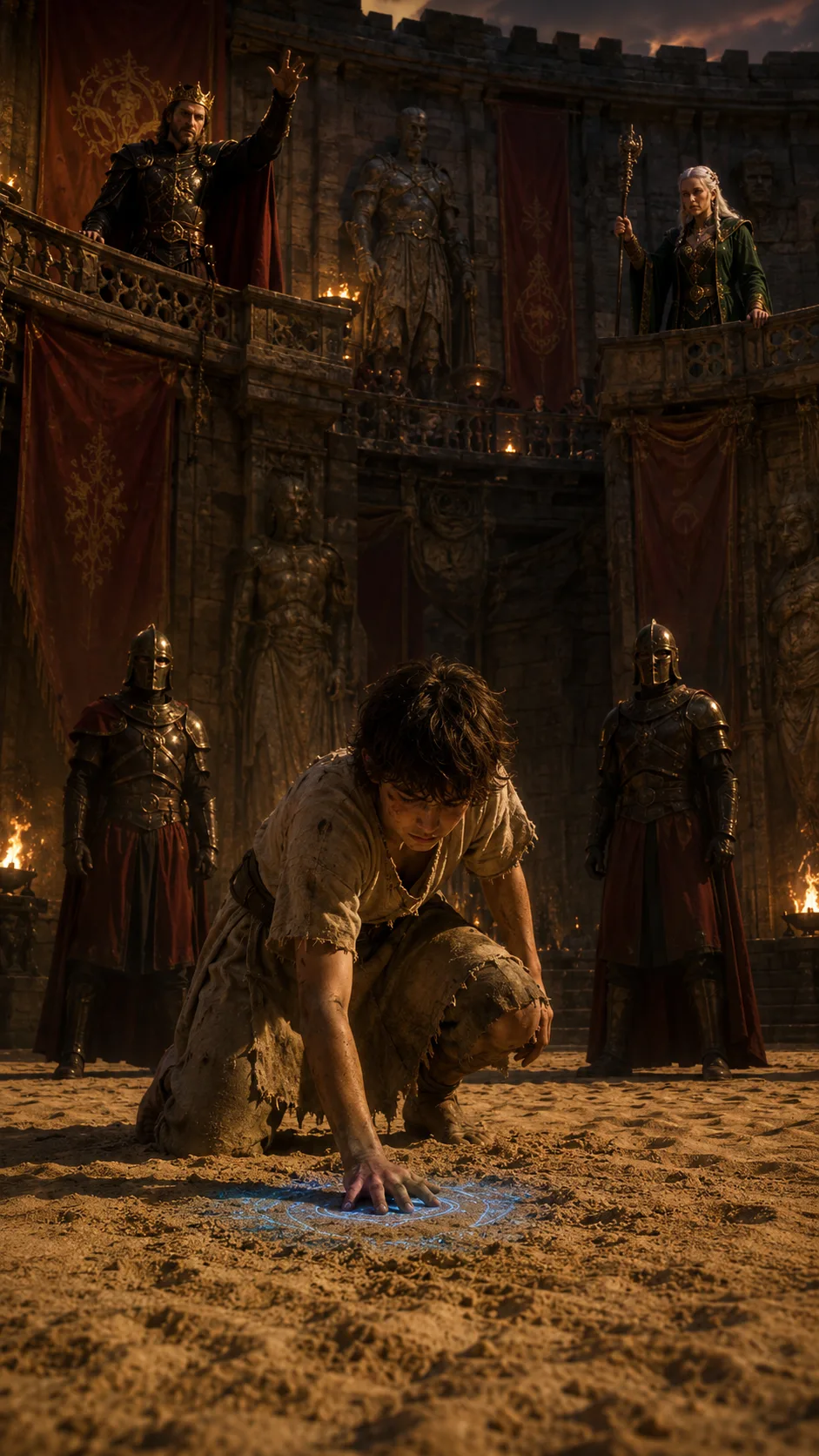
The first thing Orin noticed was not the crowd.
Chapter 1
The first thing Orin noticed was not the crowd.
It was the sand.
It stuck to the bottom of his bare feet in damp, cold patches, as if the arena had swallowed rain long ago and never returned it to the sky. Every step dragged. Every step made the iron grip on his arms tighten as the two guards pulled him through the black gate.
Above him, people laughed from stone balconies.
They did not laugh all at once. That would have been easier. It came in pieces. A man behind a crimson banner. A woman lifting a jeweled cup. A boy not much older than Orin pointing with two fingers while his father leaned down to say something that made the whole row smile.
Orin kept his eyes on the ground.
Not because he was ashamed.
Because the sand had marks in it.
Old ones.
They were buried under footprints, boot tracks, and dried lines left by dragging
chains, but they were still there if a person knew how to look. Curves. Broken circles. Sharp angles half-covered by dust. They made no sense, but they did not look random.
The guard on Orin’s left yanked him forward.
“Walk.”
Orin walked.
The iron gate shut behind him with a sound that moved through his teeth.
He had seen the arena only once before, from the outside wall near the market. It had risen above the city like a dead mountain, all black stone, red banners, and watchfires. Mothers pulled children away from it when they stared too long. Old men crossed themselves without touching their own skin. Palace servants called it the King’s Sand.
The older people called it something else.
The Silent Mouth.
Orin had heard that name from a blind beggar who slept beneath the baker’s awning.
“Never let them take you there,” the beggar had told
him, pressing a crust of bread into his hand though Orin had tried to refuse it. “The arena doesn’t forget blood.”
Orin had not understood.
He understood less now.
King Aureon stood above the arena on the highest balcony, dressed in black-and-gold armor that made him look less like a man than a statue that had learned to breathe. His crown was narrow, sharp, and dark at the edges. Firelight ran along it whenever he moved.
He did not sit.
That meant today was important.
Orin knew that because the city had rules about posture. Merchants sat. Servants stood. Prisoners knelt. Kings chose.
Aureon chose to stand.
The guard on Orin’s right shoved him to the center of the arena and released him so suddenly that Orin nearly fell. He caught himself, toes curling into the sand.
The crowd laughed louder.
Someone threw a fig.
It landed near Orin’s foot,
split open, and rolled twice.
He did not look at it.
On the right balcony, lower than the king’s but still above everyone else, an elderly woman in dark green robes stood beside the carved railing. She held a wooden staff with both hands. Her silver hair had been braided into a crown of its own, though she wore no jewels.
Priestess Maera.
Orin knew her only because everyone knew her. She had walked behind the old king’s coffin. She had stood beside Aureon when the new crown touched his head. She had once refused to bless a war banner, and three captains disappeared from court before the next sunrise.
Now she watched Orin with a face that did not move.
But her fingers did.
One by one, they tightened around the staff.
A trumpet sounded.
Not a bright one.
A low bronze note rolled across the arena and died against the stone statues.
There were twelve of them, built into the walls between the banners. Warrior shapes taller than towers. Stone helmets. Stone blades. Stone hands resting on shields. Their eyes were empty hollows, dark and patient.
Orin looked at them too long.
The left guard struck the back of his shoulder with the wooden shaft of a spear.
“Face the king.”
Orin turned.
King Aureon’s gaze found him from above. It was not a look a man gave to another person. It was a look a butcher gave to a scale.
“This is the boy?” Aureon asked.
The captain of the arena guard stepped forward below the balcony. “Yes, Your Majesty.”
“Name.”
The captain looked down at the parchment in his hand. “Orin. No family name.”
A few nobles laughed at that.
No family name.
As if a missing name were dirt on his skin.
Orin’s hands curled, then opened.
He had once asked the woman who raised him if he had a family name. Mara had been peeling turnips near the stove, her grey sleeves rolled to the elbow. She had paused only for a moment.
“Names are not always gifts,” she had said. “Sometimes they are chains.”
“Do I have one?”
Mara had scraped the knife over the turnip skin.
“You have what you need.”
That had been the end of it.
Mara had died before winter finished. Fever took her voice first, then her hands, then the rest of her. Orin had buried her behind the laundry yard with a flat stone and no priest.
After that, he belonged to doorways, market corners, and alleys behind bakeries.
Until the palace guard caught him with one stolen loaf under his tunic.
One loaf.
Now the king looked down at him as if the loaf had insulted the crown.
Aureon turned to the crowd.
“For five hundred years, this arena has stood silent.”
The crowd quieted at once.
“Once, our ancestors believed the sand could tell true blood from false. They believed stone warriors bowed to rightful command. They believed old magic lived beneath this floor.” His mouth shaped the last word with distaste. “Superstition made kings weak.”
No one moved.
Orin glanced at Maera.
She had lowered her chin slightly.
Aureon lifted one hand. “So today, we remind the city what this arena is now.”
His gaze dropped back to Orin.
“Not a shrine.”
The guards shifted behind him.
“Not a throne.”
The captain’s fingers flexed around his spear.
“A place where the crown decides who matters.”
The crowd erupted.
Cups lifted. Boots struck stone. Nobles leaned over balconies to see the boy better.
Orin stood alone in the sand and counted his breaths.
One.
Two.
Three.
The king waited until the sound pleased him.
Then he spoke again.
“Throw the boy in.”
The guard on Orin’s left grabbed his shoulder. The one on his right kicked the back of his knee. Orin fell forward, catching himself on both hands before his face hit the ground.
Sand filled his mouth.
He spat once.
Not enough to clear it.
The crowd laughed again.
This time, the sound reached his stomach.
He pushed himself up on one knee. The sand under his palm shifted strangely. Not like loose sand. Like something hard lay beneath it.
He looked down.
There was a line under his hand.
A buried curve.
The guard stepped closer.
“Stay down.”
Orin lifted his head.
“I did nothing to your kingdom.”
His voice did not carry far, but it reached the first rows.
A few people stopped laughing.
The guard beside him raised the spear shaft.
“Quiet.”
“Let him speak,” Maera said.
The arena changed at the sound of her voice. Not loudly. Not visibly. But enough that the captain looked up, and the guard lowered the spear a few inches.
King Aureon turned toward her.
Priestess Maera stood at the railing, staff vertical, robes dark against the firelight.
“He is a child,” she said.
Aureon smiled without warmth. “He is a thief.”
“He stole bread.”
“He stole from the palace kitchens.”
“Bread,” she said again.
A nobleman coughed into his sleeve.
Aureon looked at him.
The cough stopped.
Orin stared at the sand beneath his hand.
The buried curve continued past his fingers. Another line crossed it. There were more marks nearby, nearly covered by years of dust and footsteps.
He brushed sand away with his thumb.
A tiny point of blue flashed.
Gone.
His hand froze.
Nobody else seemed to notice.
Aureon’s voice dropped. “You protected rats in the old king’s reign too, Maera.”
“I protected the vows your father made.”
“My father is stone.”
“Stone remembers.”
There.
A change.
It moved across the nobles like a draft under a door. Some looked toward the statues. Others looked at the king. One young lord swallowed, hard enough that Orin saw his throat move from below.
Aureon stepped closer to the edge of the balcony.
The gold on his armor caught the torchlight.
“Let the sand judge him.”
The words landed heavily.
Not because they were loud.
Because everyone knew them.
Even Orin.
The blind beggar had said them once during a storm, half-asleep and shaking under his blanket.
Let the sand judge.
Let the blood answer.
Let the stone obey.
Orin had thought it was only an old rhyme.
The guards moved.
One seized Orin by the back of his tunic and dragged him fully onto the center mark. The cloth tore at the shoulder. Orin twisted, but the second guard caught his wrist and forced his hand downward.
His palm scraped against something sharp hidden beneath the sand.
Not a blade.
A chipped edge of old stone.
Pain flashed bright and quick.
Orin sucked in a breath through his teeth.
The guard released him.
A thin red line crossed the base of his palm.
Small.
Almost nothing.
Aureon looked bored.
Maera did not.
She leaned forward so quickly her staff struck the railing.
“Move him away from the center.”
The captain looked up.
Aureon did too.
Maera’s face had lost its court stillness. Her eyes were fixed on Orin’s hand.
“Now,” she said.
The king’s expression sharpened.
“What did you say?”
Maera took one step along the balcony, closer to the stairs that led down. Two royal attendants moved as if to block her, then thought better of it.
“He is not a sacrifice.”
The crowd made a small sound.
Not a gasp.
Not yet.
Aureon’s fingers closed around the stone railing.
For the first time since Orin had entered the arena, the king looked directly at the sand.
Then at the boy.
Then at Maera.
A slow smile returned to his face.
“Then let him bleed.”
The sentence silenced everything.
Even the torches seemed smaller.
Orin did not understand all of it. He understood enough. He understood the way the guards stopped waiting for orders and shifted their spears. He understood the way Maera’s hand tightened on the staff. He understood that the king had just stepped over a line everyone else could see.
He put his injured palm flat on the sand to push himself up.
The drop fell before he could lift his hand.
It struck the buried mark.
For half a breath, nothing happened.
Then the ground breathed.
The sand around Orin’s fingers sank as if pulled from below. A blue line appeared beneath his palm, thin as thread and bright as a star seen through water.
Orin stared.
The line moved.
It slid through the buried grooves in the sand, turning once, twice, then branching into symbols Orin had never seen but somehow did not feel like strangers. The glow was not fire. It did not burn his skin. It rose around his hand with a warmth that felt like standing near Mara’s stove before winter took her.
The guard nearest him stepped back.
His boot dragged through the sand, but the light did not break.
A second rune sparked.
Then a third.
The captain lowered his parchment.
Maera whispered something Orin could not hear.
The crowd leaned forward.
King Aureon did not move.
The blue lines spread in a circle around Orin’s knees. They passed under the guards’ boots, and both men stumbled backward as if the ground had rejected their weight.
One dropped his spear.
The sound cracked across the arena.
Orin flinched.
The light brightened.
Above him, the first statue opened its eyes.
Not all at once.
A line of blue appeared in the left hollow. Then the right. Dust slid from the stone brow and fell in a thin curtain. People in the nearest balcony stumbled away from the wall.
Someone screamed.
Aureon spun toward the sound.
“Silence.”
No one obeyed.
The second statue’s eyes lit.
Then the third.
The blue moved through the arena walls like water through roots, waking old lines carved too deep for any mason to erase. The crimson banners stirred though there was no wind. Sand lifted in a faint ring around Orin, not enough to blind him, just enough to mark the circle.
He looked down at his hand.
The cut had already stopped.
The rune beneath his palm pulsed once.
Like a heartbeat.
Orin pulled his hand away.
The circle remained.
He stood slowly.
No guard stopped him.
He was still small. His tunic still hung torn from one shoulder. Sand clung to his knees and elbows. He had no sword, no crown, no name anyone in the court respected.
But everyone was looking at him now.
Not through him.
At him.
The nearest warrior statue shifted.
Stone cracked along its neck. Its head lowered by inches, grinding against ancient dust. The sound rolled through the arena, deeper than thunder, older than any voice in the crowd.
The statue bowed.
To Orin.
The second followed.
Then the third.
All around the arena, twelve stone warriors bent their heads toward the boy in the center of the sand.
Aureon backed from the railing.
Only one step.
But the whole court saw it.
Maera raised her staff.
This time, when she spoke, her voice carried without effort.
“Kneel before your true master.”
No one laughed.
A guard near the arena floor dropped to one knee before he seemed to decide to do it. His helmet dipped. His spear lay forgotten in the sand.
Another guard followed.
Then one of the nobles.
Then two servants in the lower row.
It spread badly, unevenly, not like ceremony but like truth finding knees before pride could stop it.
King Aureon looked down at them.
His hand went to the railing again, but missed the carved edge the first time. When he found it, his fingers did not close.
“That is not—”
The words broke.
He tried again.
No sound came.
Orin looked up at him.
The king’s face had gone pale beneath the crown.
Not white. Not empty.
Exposed.
The crown no longer looked like it belonged to him.
It looked like something he had borrowed from a room he had locked behind him.
Maera descended the stone stairs slowly. No one blocked her. The guards who had stood at the stairwell moved aside without looking at the king.
Her staff touched each step.
Stone.
Wood.
Stone.
Wood.
Orin stayed where he was.
The glowing circle held around his feet. It did not spread beyond him now. It did not need to.
Maera reached the sand and stopped outside the ring.
For a moment, she did not bow.
She studied his face.
That frightened him more than the guards had.
“Who was your mother?” she asked.
The arena listened.
Orin swallowed. “Mara.”
“Mara what?”
He looked down.
“I don’t know.”
Maera’s expression changed by almost nothing. Only her mouth tightened. Only her eyes lowered once to his torn sleeve, then to his hand, then back to his face.
“She raised you?”
Orin nodded.
“Did she give you anything?”
Orin thought of the cracked wooden bowl in the laundry yard. The blanket with a burned corner. The flat stone behind the kitchens.
Then he remembered the cord around his neck.
He had worn it so long he no longer noticed its weight.
He reached beneath his tunic and pulled it out.
A small piece of dark metal hung from the cord. Not a coin. Not jewelry. A broken half of something round, carved with lines that had always seemed meaningless.
Maera’s staff lowered.
A sound moved through her breath.
Behind her, King Aureon stepped forward again.
“No.”
The word came too quickly.
Too bare.
Maera held out her hand. “May I?”
Orin hesitated.
Then he placed the metal piece in her palm.
She turned it toward the blue light.
The runes beneath Orin’s feet flared so bright the entire arena turned blue-white for one sharp second. People cried out and shielded their faces.
When the light settled, the piece in Maera’s hand had changed.
Not changed.
Completed.
Lines of blue filled the broken metal, revealing the outline of a royal seal split in half. A sun behind a tower. A blade pointed downward. Words around the edge in the old script.
Maera read them without looking away.
“Blood of the First Vow.”
Aureon slammed his hand on the railing.
“That relic was destroyed.”
Maera turned toward him.
“No,” she said. “It was hidden.”
Something in the king’s face betrayed him before his mouth could stop it.
A small thing.
A blink.
A tightening at one corner of his jaw.
But the whole court was watching now.
Aureon saw it happen. He saw eyes leave the boy and climb toward him. He saw nobles who had applauded a moment earlier lower their cups. He saw the captain of the guard turn halfway, not toward command, but toward accusation.
Maera did not raise her voice.
“Your father had a daughter.”
The arena went still.
Not silent. Still.
Even the torches seemed to hold their shape.
Aureon’s lips parted.
Maera continued. “She vanished the night before your coronation.”
“That is a lie.”
“She carried the seal.”
“No.”
“She carried a child.”
Aureon’s hand curled against the railing.
Orin’s throat tightened around air that would not move.
A child.
The words did not enter him cleanly. They struck and stayed outside, waiting for him to open some door he did not have.
Maera looked back at him.
“Mara did not give birth to you,” she said.
Orin’s fingers closed around the cord hanging from his neck.
“She protected you.”
The arena tilted.
Not truly. The sand remained sand. The statues remained stone. But the place Orin had stood in the world shifted under his feet.
Mara’s hands at the stove.
Mara scraping turnips.
Mara saying names could be chains.
Mara keeping him away from palace roads.
Mara coughing into cloth and telling him to never sell the metal piece, not even for bread.
She had known.
Orin looked up at the king.
Aureon was already looking at him.
Not at his tunic. Not at his bare feet. Not at the dirt on his face.
At his blood.
“You brought him here yourself,” Maera said.
That was the worst of it.
The king had not been defeated by an army. Not by a rival lord. Not by a secret council whispering behind doors.
He had ordered the last heir of the First Vow into the only place in the kingdom that could still recognize him.
He had done it in front of everyone.
Aureon drew himself upright.
It almost worked.
The armor helped. The crown helped. The height of the balcony helped. For one thin moment, he looked like a king again.
“Seize the priestess.”
No one moved.
The command hung over the arena and found no hands willing to carry it.
Aureon looked to the captain.
The captain stared down at the glowing circle.
“Captain.”
The captain removed his helmet.
It took longer than it should have. The leather strap caught. His fingers shook once. He freed it and tucked the helmet beneath his arm.
Then he knelt.
The sound of his armor striking sand was quiet.
It reached every balcony.
Aureon turned to the guards beside him. “You will obey your king.”
One of them looked at Orin.
Then at the bowed statues.
Then at Maera.
He lowered his spear point to the stone floor.
Not a kneel.
But not obedience.
Aureon saw that too.
His mouth tightened until it looked cut into his face.
Orin stepped out of the glowing circle.
The light followed him for one pace, then faded behind him, leaving the runes dim but awake.
He expected someone to stop him.
No one did.
He walked across the sand toward the fallen spear.
The guard who had dropped it earlier shifted back, giving him space. Orin looked at the weapon. It was too large for him. Too heavy. It belonged to men who knew how to make other people move.
He did not pick it up.
Instead, he picked up the split metal seal from Maera’s palm and tied it back around his neck.
The arena watched that more closely than they had watched the spear.
Aureon’s voice came from above.
“What do you want?”
The question scraped.
It was not kindness. It was calculation trying to dress itself in royal cloth.
Orin looked up.
He thought of bread.
He thought of Mara’s grave behind the laundry yard.
He thought of the blind beggar who said the arena remembered blood.
He thought of every person in the upper seats who had laughed when he fell.
“I want the gate opened,” Orin said.
The king stared.
“For yourself?”
Orin turned toward the black iron gate where he had entered.
“No.”
The word carried because the arena carried it.
Aureon’s eyes narrowed.
Orin faced the lower tunnels beneath the balconies. Servants stood there in clusters, half-hidden in shadow. Kitchen boys. Stable girls. Old cleaners with bent backs. People who had watched the show because the palace gave them no other place to put their eyes.
“For them.”
No one breathed for a second.
Then a kitchen girl stepped forward from the tunnel.
She could not have been more than fourteen. Her sleeves were rolled, her face smudged with ash. She looked first at the king, then at Orin, then at the open sand between them.
One step.
Then another.
A guard moved to block her.
The nearest statue turned its stone head.
The guard stopped.
The girl crossed into the arena.
Then an old servant followed.
Then two boys from the stables.
Then a laundress with a basket still hooked over one arm.
People did not rush. They came carefully, as if expecting the world to change its mind. The black gate opened from the inside when the captain gave the order. Its hinges screamed against five hundred years of ceremony.
Aureon shouted something.
No one answered it.
Maera stood beside Orin while the servants crossed the sand. She did not touch his shoulder. She did not tell him what he was. She did not ask him to kneel, speak, swear, or forgive.
That was why he trusted her enough to look at her.
“Was my mother a princess?”
Maera’s face softened in a way the court had probably never seen.
“Yes.”
Orin nodded once.
The word did not fit anywhere yet.
Maybe later.
“What was her name?”
“Elyra.”
The name moved through the arena.
Some of the older nobles bowed their heads.
Orin held it carefully.
Elyra.
A name he had never been given.
A name that had been taken from him before he could speak.
Above them, Aureon removed his crown.
Not fully. His hands rose as if to touch it, then stopped. He could not take it off. He could not keep wearing it. So he stood with both hands near his head, trapped beneath the weight.
The boy in the sand looked away first.
The sun had almost gone behind the western wall. Torchlight took over the arena, turning stone gold and shadow red. The blue runes beneath the sand dimmed, but they did not disappear.
For the first time in five hundred years, the Silent Mouth had spoken.
And everyone had heard.
By morning, the city knew.
Not because the nobles told it correctly. They did not. Some said the priestess tricked the crowd. Some said old smoke from the torches made people see things. Some said the statues had only shifted because the west wall cracked.
But servants talk before nobles write.
Guards talk before kings sleep.
By sunrise, the markets knew the boy’s name. By noon, children were drawing blue circles in dust with sticks. By evening, someone left fresh bread beside Mara’s grave behind the laundry yard.
Orin found it there two days later.
He went alone.
No crown. No guard. No royal cloak.
Just the repaired tunic Maera had given him and the metal seal beneath it, warm against his chest.
The flat stone was still where he had placed it. Weeds had grown along one side. Someone had cleaned away the old ash.
He set the bread down.
“You should have told me,” he said.
The wind moved through the laundry lines.
No answer came.
He sat beside the grave until the light changed.
After the arena, people wanted him to become many things quickly.
A banner.
A weapon.
A story they could use.
Maera refused them all.
“The boy will eat first,” she told the council when they gathered in the lower hall and argued about succession, regency, vows, and public order. “Then he will sleep. Then he will decide which of you is worth hearing.”
No one enjoyed that.
Orin did.
Aureon did not die that week. He was not dragged through the streets. The kingdom did not become clean because statues had bowed. Real things were harder than arena miracles.
He was confined to the west tower under guard rotation chosen by the captain, not by the court. His crown was sealed in a cedar box and placed beneath the old altar where twelve stone hands had once sworn the First Vow.
When he passed Orin once in the corridor days later, Aureon looked thinner without the balcony beneath him.
He stopped.
Orin stopped too.
For a moment, the man seemed ready to speak.
Perhaps to deny.
Perhaps to bargain.
Perhaps to say the unfinished words from the arena in a different shape.
Orin waited.
Aureon looked at the seal around his neck.
Then at the floor.
He moved aside.
That was all.
It was enough.
The arena remained open after that, but not for blood.
The sand was cleared by people who volunteered instead of prisoners ordered under whip and threat. The old runes were uncovered, mapped, and left untouched. Children were allowed to stand at the edge and look down, though Maera made them keep their hands behind their backs.
Orin returned there one month after the gate opened.
No crowd waited. No banners snapped. No king stood above him.
Only Maera, the captain, and the twelve statues watching from the wall.
He walked to the center mark and placed his palm over the rune.
It glowed once.
Softly.
Like recognition, not command.
The nearest statue bowed its head.
Orin did not bow back.
He looked at the open gate, at the city beyond it, at the road that led past the market and the baker’s awning and the laundry yard and the grave behind it.
Then he stepped out of the circle.
The sand stayed quiet.
So did he.
Chapter complete
You have reached the end of this chapter.
Continue reading
A few more worlds to get lost in after this chapter.