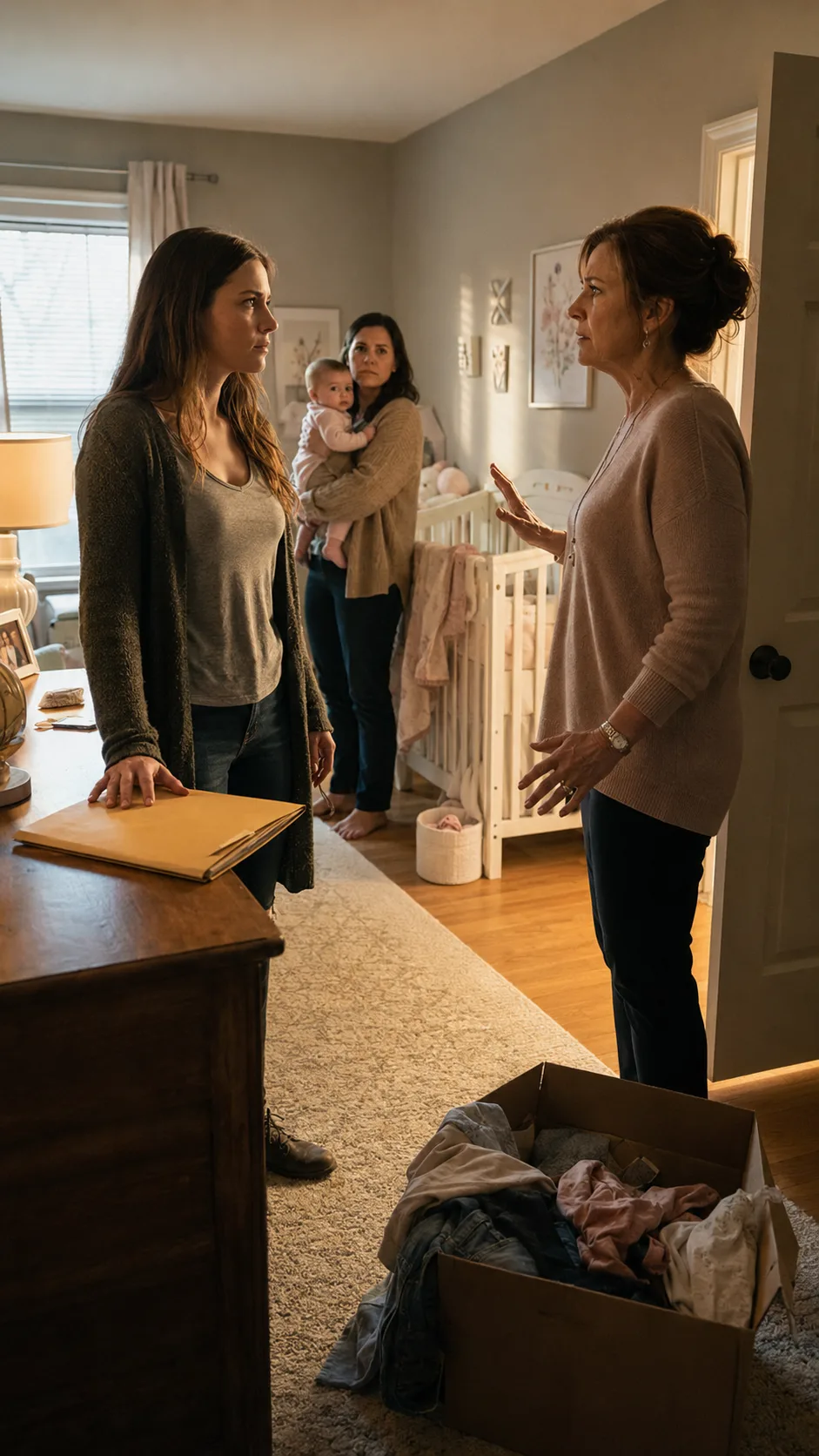
The first thing Emma Whitaker saw when she pushed open her bedroom door was not the crib.
Chapter 1
The first thing Emma Whitaker saw when she pushed open her bedroom door was not the crib.
It was the sleeve.
A gray sweatshirt sleeve hung over the edge of a cardboard box on the carpet, twisted like someone had grabbed the shirt by one arm and dragged it out of a drawer without bothering to fold it. The sweatshirt had belonged to her since college. The cuff was frayed, and there was still a tiny bleach spot near the wrist from the night she had stayed up helping Madison dye curtains for an apartment Madison abandoned three months later.
The box sat where Emma’s laundry basket used to be.
Her jeans were inside. Her work blouses. A framed photo of her and her grandfather, face-down, glass cracked across the corner. A bottle of perfume with no cap. Two paperbacks, spine bent. Her life, packed by hands that did not love it.
Then she saw the crib.
White wood. Pale blanket. Stuffed rabbit near the pillow.
It
stood against the far wall, under the window where Emma’s bed had been for seventeen years.
Madison stood beside it with the baby pressed to her shoulder. She had one hand cupped protectively over the baby’s back, the way she did whenever she wanted people to remember she was a mother before they remembered anything else about her.
Diane Whitaker, Emma’s mother, stood in the doorway between Emma and the room.
“This room belongs to the baby now,” Diane said.
Emma still had her car keys in her hand.
They dug into her palm.
No one had warned her. Not in the family group chat. Not by phone. Not even through one of Diane’s fake-soft messages that always began with Honey and ended with you need to understand.
She had come home after a twelve-hour shift at the property management office with a bag of groceries in the trunk and
a headache sitting behind her left eye. She had planned to shower, change, eat something standing up in the kitchen, and finish reviewing an insurance document she had avoided all week.
Instead, her room had been turned into a nursery.
Madison adjusted the baby higher on her hip.
“Don’t just stand there,” she said. “You’re letting the heat out.”
Emma looked at her sister.
Madison had always known how to sound inconvenienced by other people’s pain. She was thirty-two, two years older than Emma, but the family had never treated age like responsibility. Madison’s mistakes arrived wrapped in needs. Emma’s needs arrived wrapped in criticism.
Diane lifted one hand, palm forward.
“Before you start,” she said, “we already talked about this.”
Emma looked past her.
The dresser was still there. Dark wood. Brass handles. A scratch near the top drawer from when Emma had been fourteen and tried to move
it alone because Madison wanted the bigger closet. Their grandfather had sanded the dresser, stained it, and carried it upstairs with Emma’s father while Diane told everyone not to scuff the wall.
The little brass dish sat on top of it.
Emma used to drop her keys there every night.
Now the dish held a pacifier.
That was the detail that moved something inside her.
Not the crib.
The pacifier.
Small. Rubber. Pale blue. Placed right where her keys belonged.
Her father appeared in the hallway behind Diane with a dish towel over one shoulder, although no one had been doing dishes. George Whitaker always found something to hold when he did not want to choose a side.
“Your sister needs help,” he said.
Emma turned her head just enough to see him.
“I didn’t say anything.”
“You were about to.”
Diane’s mouth tightened.
“Don’t use that tone with your father.”
The baby stirred against Madison’s shoulder. Madison rocked once on her heels, glancing toward the crib like the room already belonged to her, like Emma had walked into the wrong place.
Emma stepped into the room.
Diane’s hand stiffened but did not touch her.
“Emma.”
Emma stopped beside the box.
Her black work shoes were inches from a pile of her clothes. A white blouse lay partly under the cardboard flap, one sleeve pressed into the carpet. It had a tiny coffee stain near the hem. She remembered washing it twice before giving up.
Madison looked down at the box as if seeing it for the first time.
“We didn’t throw anything away.”
“No,” Emma said.
The word came out flat.
Madison blinked.
Diane lowered her hand and crossed her arms.
“We had to move quickly. The baby hasn’t been sleeping. Madison can’t keep climbing stairs with him in that tiny guest room.”
“The guest room has a bed,” Emma said.
“It has boxes,” Madison said.
“Your boxes.”
Madison’s face changed, quick and ugly, then smoothed again when the baby made a small sound.
Diane stepped in before her older daughter had to answer.
“This is not the time to be selfish.”
There it was.
Emma almost smiled.
Not because anything was funny.
Because she had known the word was coming.
Selfish was the word Diane used whenever Emma did not immediately surrender something she had paid for, fixed, carried, scheduled, signed, or cleaned. Selfish meant Emma had hesitated. Selfish meant Madison had cried first. Selfish meant Diane had already rewritten the event in her head and needed Emma to play the villain.
Emma looked at the crib again.
“When did you move my bed?”
Diane’s eyes flickered.
“Yesterday.”
“I was at work yesterday.”
“We know.”
Madison looked toward the window.
George folded the dish towel once. Then again.
Emma noticed the new curtains then. Cream with tiny stitched stars. Madison had hung them on Emma’s curtain rod. The old blue curtains Emma bought after getting her first full-time job were gone.
“Where is my bed?”
Diane exhaled through her nose.
“In the garage for now.”
“For now.”
“Don’t repeat everything.”
Emma turned toward her father.
“You carried it?”
George looked at the dish towel.
“It was too heavy for your mother.”
The answer sat there with all the things he had never said.
Emma nodded once.
Madison shifted her weight.
“Look, I’m sorry your stuff got moved, but I have a baby. You’re barely here. You work late, you eat takeout, you leave before breakfast. It’s not like you use the room the way a normal person uses a room.”
A normal person.
Emma bent and picked up the framed photo from the box.
The glass crack ran across her grandfather’s face.
She held it by the edges.
No one spoke.
Her grandfather, Henry, had been the only person in the house who never treated Emma’s usefulness as a personality flaw. When she was twelve, he taught her how to patch drywall after Madison slammed a door into it. When she was sixteen, he let her sit beside him while he paid bills and explained what late fees did to a family. When she was twenty-four, he put a hand on the kitchen table and said, “You keep rescuing people who call you difficult after they are safe.”
Three months before he died, he asked her to drive him to his attorney.
Diane thought it was for his will.
It wasn’t.
Emma set the cracked frame on the dresser beside the pacifier.
Diane saw the glass.
Her face tightened again, but not with apology.
“Accidents happen when people don’t keep their things organized.”
Emma looked at her.
“My room was organized.”
“You had too much.”
“I had what fit.”
Madison gave a small laugh.
“You sound like we put you on the street.”
Emma turned to her sister.
“You put my bed in the garage.”
Madison opened her mouth, then shut it.
Good.
Diane moved closer.
“No one is putting you anywhere. You can sleep on the couch until we figure something out.”
“The couch.”
“It’s a perfectly good couch.”
Emma looked past Diane toward the hallway. Aunt Carol stood near the stairs now, pretending she had only come up to check on the noise. She had one hand on the banister, chin lifted, eyes bright with the kind of attention people call concern when they want to stay for the whole scene.
Behind her, George stayed silent.
Emma looked back at the dresser.
The brass dish.
The pacifier.
The cracked frame.
The box.
The crib.
The room had been rearranged without her, but nothing in it had moved beyond recognition. That was what made it worse. It was still her room. It had simply been taught to reject her.
Diane softened her voice.
That was never a good sign.
“Honey, you’re almost thirty. You have to stop clinging to a childhood bedroom.”
Emma turned her keys over in her hand.
“I pay the property tax.”
Madison rolled her eyes.
“You help Mom and Dad with bills. Congratulations.”
“I pay the insurance.”
Diane’s expression sharpened.
“Because you insisted on handling paperwork after your grandfather died.”
“Someone had to.”
George’s gaze lifted.
Not much.
Enough.
Diane caught it and looked at him.
“George.”
He looked away.
Emma placed her keys in her coat pocket.
Madison bounced the baby gently, although he had not fussed.
“Can we not do this in front of him?”
Emma watched her sister’s hand move over the baby’s back.
Madison had used that baby as a shield since the day she came home from the hospital. Sometimes she needed help. Sometimes she needed money. Sometimes she needed the better bedroom. Every request arrived with a tiny warm body in her arms, as if refusal would be cruelty.
Emma did not blame the baby.
That was the part nobody would understand later.
She never blamed the baby.
She blamed the adults standing around him.
Diane pointed toward the box.
“You can move that to the living room for tonight. Tomorrow we’ll sort through what you actually need.”
“What I actually need.”
“You don’t need all of this.”
Emma crouched and picked up her cracked photo again.
The glass edge nicked her thumb. Not deep. Just enough for a thin red line to appear. She wiped it on the side of her jeans before anyone could notice and turn that into something else.
Aunt Carol spoke from the hallway.
“Maybe everyone should take a breath.”
Emma looked at her.
Aunt Carol stopped.
Diane turned.
“Carol, please.”
That please meant stay out of it unless you agree with me.
Carol pressed her lips together.
Madison shifted closer to the crib.
“The baby’s things are already set up.”
Emma stood.
“Yes.”
“So moving it all back would be ridiculous.”
“Yes.”
Diane’s shoulders relaxed slightly. She thought she heard surrender.
Emma reached for her bag.
It was still on her shoulder. She had never put it down. The leather strap had left a mark on her coat, and the zipper was half open from when she had pulled out her car keys earlier.
Inside was the tan legal folder.
Plain. Thin. Almost boring.
It had spent two years in the bottom drawer of Emma’s desk at work and three days in her bag because the bank had asked for additional copies after Diane tried to refinance the house without telling her.
That was the mini twist Diane did not know Emma already knew.
Three days earlier, Emma had received a call from a woman named Patricia at Ridgeline Bank.
“Ms. Whitaker,” Patricia said, “we need to confirm whether you authorized Diane Whitaker to inquire about a home equity line of credit.”
Emma had been standing in the office break room, holding a paper cup of coffee that tasted burned.
“No,” Emma said.
There was a pause.
“Then we have a problem.”
Diane had walked into a bank branch with George, Madison, and a folder full of household bills, acting as if ownership was a family feeling instead of a legal fact. She told the loan officer that the house was “basically ours” and that Emma “handled documents for convenience.” She tried to list George as the primary applicant.
The bank pulled the deed.
Then they called Emma.
Emma did not confront Diane then.
She printed everything instead.
The deed. The tax statements. The transfer agreement Henry had signed before he died. The letter from his attorney. The mortgage satisfaction record. The bank’s inquiry note. A copy of Diane’s attempted application, with Diane’s signature under a statement that said she had authority to act on behalf of the property owner.
She brought the folder home because she had decided that if Diane tried one more thing, Emma would stop correcting her privately.
Now Emma unzipped the bag.
Diane saw the motion.
“What are you doing?”
Madison laughed, short and sharp.
“What, did you bring receipts to a nursery?”
Emma pulled out the folder.
Diane’s face changed.
Not enough for anyone else to notice, maybe. But Emma saw it. The eyes first. They dropped to the folder and stayed there half a second too long.
George saw it too.
The dish towel stopped moving in his hands.
Emma stepped to the dresser and placed the folder flat beside the cracked photo.
One soft thud.
The baby turned his head.
Madison looked between Emma and Diane.
“What is that?”
Diane spoke before Emma could.
“Nothing.”
Emma kept her hand on the folder.
“Then let’s open it.”
Diane took a step forward.
Emma did not move back.
The room changed by inches. Diane was still in the doorway. Madison was still beside the crib. George still stood in the hall. Aunt Carol still gripped the banister.
But the center of the room shifted to the dresser.
To the folder.
To Emma’s hand on top of it.
Diane lowered her voice.
“Do not embarrass this family.”
Emma looked at her mother’s hand, hovering near the folder.
“This family moved my bed into the garage.”
Madison snapped, “Because my son needed a real room.”
Emma turned her head.
“He needed a safe room. You chose mine because you thought I would take it.”
Madison’s lips parted.
The baby made a soft sound.
Diane reached for the folder.
Emma pressed her palm down.
“Read the name.”
Diane froze.
Aunt Carol moved one step closer in the hallway.
George’s eyes stayed on the folder.
Diane’s jaw worked once.
“This house was never yours.”
Emma pulled the folder closer to herself, opened the flap, and slid the top page out with two fingers.
She did not rush.
There was no need.
The deed lay on the dresser, black print on white paper, sharp under the warm lamp light.
Madison leaned forward.
“What is that supposed to prove?”
Emma turned the page so the printed header faced the room.
Diane did not look.
That was how Emma knew she already understood.
“Look at it,” Emma said.
Diane’s hand tightened at her side.
George stepped into the bedroom doorway behind her.
For the first time since Emma came home, he entered the room.
“Diane,” he said.
His voice was small.
Diane turned on him.
“Don’t.”
One word.
A warning.
George stopped.
Emma looked at him.
He did not come farther.
Not yet.
Madison adjusted the baby, but her eyes were on the paper now. She shifted closer to the dresser, enough to see the first line, not enough to stand beside Emma.
Emma tapped the top of the page once.
“The legal owner is listed here.”
Diane’s face hardened.
“Your grandfather was confused at the end.”
The room stilled.
Not loudly.
Not like movies.
A tiny sound came from the lamp shade where the chain touched the base. The baby breathed against Madison’s sweater. Somewhere downstairs, the refrigerator clicked on.
Emma looked at her mother.
“He drove himself to breakfast that morning.”
“He was old.”
“He beat Dad at chess that night.”
George’s mouth tightened.
Diane did not look at him.
Emma pulled out the next paper.
“The transfer was notarized.”
Diane said, “You manipulated him.”
Aunt Carol inhaled.
Madison looked at her mother.
That was the first crack.
Not the deed.
Not the folder.
Madison looking at Diane as if hearing a new version of an old story and not knowing which one would cost her more.
Emma slid the notarized transfer beside the deed.
“My grandfather transferred the house to me because I had been paying the mortgage arrears for eighteen months.”
George closed his eyes.
Diane’s head snapped toward him.
“You told her?”
George opened his eyes.
“No.”
Emma reached into the folder and took out the payment records.
“I found the notices in the laundry cabinet.”
Madison frowned.
“What notices?”
Diane said, “This is not your business.”
Madison’s face flushed.
“I live here.”
“You needed help,” Diane said.
“I needed the room,” Madison said. “Not whatever this is.”
Emma almost laughed then, but it would have sounded wrong.
So she placed the payment records on the dresser.
One page.
Then another.
Then another.
The room had never looked smaller.
Diane’s raised hand lowered until it hung at her side.
Emma spoke to Madison now.
“Six years ago, Mom and Dad fell behind. Grandpa covered the first two months. Then he found out they had taken money from his account without asking.”
George flinched.
Diane’s face went pale around the mouth.
Aunt Carol whispered, “Diane.”
Diane turned.
“Stay out of it.”
Emma continued.
“He was going to sell the house. I asked him not to. I paid the arrears, then the insurance, then the taxes. He transferred ownership to me because he said this house needed one person who would protect it from panic.”
Madison stared at her.
“You own the house?”
Diane slammed her palm on the dresser.
Not hard enough to shake the lamp.
Hard enough to make the pacifier roll in the brass dish.
“No,” she said.
The baby jerked slightly.
Madison stepped back, holding him tighter.
Diane noticed and lowered her hand.
Too late.
Emma picked up the pacifier and set it beside the dish.
A small action.
Everyone watched it.
Then she pulled out the final page.
The bank inquiry.
Diane saw it and stopped breathing through her mouth.
Emma placed it on top of the deed.
“Three days ago, you tried to borrow against this house.”
George looked at Diane.
Madison whispered, “Mom?”
Diane’s eyes did not leave the paper.
Emma turned the bank note toward the room.
“You signed that you had authority from the owner.”
Diane’s voice came out thin.
“I was trying to help this family.”
“No,” Emma said. “You were trying to use a house you don’t own.”
Madison looked from the crib to the papers to Diane.
“The nursery,” she said.
Diane did not answer.
Madison’s voice sharpened.
“Did you know?”
Diane pointed at Emma.
“She has poisoned all of you with paperwork.”
Emma lifted the deed.
“My name is at the top.”
Diane stepped toward the dresser.
Emma stayed where she was.
George moved then.
Not dramatically. Not fast.
He stepped between Diane and the dresser, his back half-turned to Emma, one hand slightly raised.
Diane stopped.
The movement was so small that nobody would have noticed it from the hallway.
But Emma noticed.
So did Diane.
For once, George had chosen where to stand.
Aunt Carol came into the room fully now. She stood near the door, eyes on the deed.
“Let me see it,” she said.
Emma handed her the copy, not the original.
Diane made a sound in her throat.
Carol read the first page. Then the second. Her lips pressed together until they almost disappeared.
“She owns it,” Carol said.
Madison sank onto the edge of the crib mattress before remembering she could not sit there with the baby. She straightened quickly, cheeks coloring.
The baby reached for her necklace.
No one moved to help her.
Diane looked at George.
“You let this happen.”
George’s shoulders lowered.
“I watched it happen.”
Diane stared at him.
He looked older than he had ten minutes earlier.
Emma picked up the house keys from the brass dish.
The pacifier sat beside them.
She held the keys in her hand and felt the teeth press into her palm.
Diane pointed at her.
“You would throw your nephew out?”
Emma looked at the baby.
He blinked at her with Madison’s necklace in his fist.
“No.”
Madison looked up.
Emma turned back to her mother.
“I’m not throwing out a baby.”
Diane seized on that.
“Then stop this.”
Emma shook her head once.
“I’m throwing out the lie that you get to take from me because you say family.”
Diane’s mouth opened.
Nothing came.
Emma looked at Madison.
“You can use the guest room tonight. Tomorrow, we move the crib there. Your boxes leave first.”
Madison’s eyes darted toward Diane, then back.
“Okay,” she said.
Diane turned on her.
“Madison.”
Madison held the baby closer.
“I said okay.”
Another shift.
Quiet.
Permanent.
Diane’s face worked through several expressions and landed on the one she used in public when she wanted people to think she had been wounded.
Emma had seen that face at school meetings, at funerals, at bank counters, at family dinners when a server forgot lemon in her water.
It did not work on the deed.
Aunt Carol handed the copy back to Emma.
“You should put that somewhere safe.”
“It is,” Emma said.
Diane looked at the folder.
Then at Emma.
“That is not—” She stopped. Swallowed. Tried again. “I never agreed—”
Emma waited.
Diane did not finish.
The room held the unfinished sentence like smoke.
George took the dish towel off his shoulder and set it on the dresser. Then, as if realizing where he had placed it, picked it back up and folded it once more.
“I’ll bring the bed in,” he said.
Emma looked at him.
He did not ask Diane.
Madison shifted the baby and stepped away from the crib, leaving space around it like she had finally remembered it was sitting in someone else’s room.
Diane remained by the doorway.
Not blocking it now.
Just standing there.
Emma put the deed back into the folder, lined up the papers neatly, and closed the flap. Her thumb brushed the cracked photo of her grandfather.
She picked it up again.
This time she removed the broken glass from the frame carefully, piece by piece, and placed the shards on the dresser beside the folder.
No one offered to help.
That was fine.
Downstairs, the house sounded different.
Every step carried.
George and Emma brought the bed back from the garage after dinner. The mattress smelled faintly of cardboard and dust. Madison took the crib apart in silence while Aunt Carol held the baby in the hallway. Diane stayed in the kitchen, opening and closing cabinets with no purpose anyone could name.
At one point, Madison stood by the doorway with a screwdriver in her hand.
“I didn’t know about the bank,” she said.
Emma tightened a bolt on the bedframe.
Madison waited for more.
Emma did not give it to her.
Madison looked down.
“I thought you were just being dramatic.”
Emma fitted the slat into place.
“You usually do.”
Madison flinched.
Not much.
Enough.
The guest room was crowded, but the crib fit once Madison’s boxes were moved into the basement. She complained once, then stopped when George picked up a box labeled Madison Winter Coats and asked why a baby needed three bins of old shoes in his room.
By ten-thirty, Emma’s bed was back against the wall under the window.
The old blue curtains were gone. Diane claimed she did not know where they were. Aunt Carol found them in a trash bag near the laundry room door and washed them without asking.
Emma slept badly that night.
Not because of guilt.
Because the house kept settling around the shape of what had finally been said.
The next morning, Diane did not come down for breakfast until Emma had already made coffee.
George sat at the table with his hands around a mug.
Madison fed the baby in the high chair they had squeezed into the breakfast nook. The baby slapped the tray once and laughed at the sound.
Emma poured coffee into her travel cup.
Diane entered wearing the same pink sweater from the day before.
Her eyes went to Emma’s bag.
The folder was not there.
Emma had taken it to a safe deposit box before sunrise.
Diane seemed to know it.
“You humiliated me,” Diane said.
Emma screwed the lid onto the cup.
“No. I corrected you in the room where you tried to erase me.”
George looked into his mug.
Madison did not speak.
Diane’s face tightened.
“I am your mother.”
Emma picked up her keys.
“You are also my tenant.”
The baby slapped the tray again.
A tiny sound.
A small hand.
A clean morning light coming through the kitchen window.
Diane sat down slowly.
For the first time Emma could remember, no one rushed to soften the sentence for her.
Over the next month, the house changed without becoming cruel.
Emma had a lease drawn up. Month-to-month. Below market, because she was not trying to punish anyone. Clear rules, because she was done paying for confusion. George signed first. Madison signed after reading every line twice. Diane left the paper on the counter for three days, then signed at midnight and slid it under Emma’s door like an apology she refused to name.
The nursery stayed in the guest room.
Emma bought Madison a smaller bookshelf for the baby’s things, and Madison, after a long silence, said thank you without adding anything sharp to the end of it.
George fixed the scratch on the bedroom wall from moving the crib out.
Aunt Carol brought a new frame for the photo of Emma and her grandfather. Plain black wood. Strong glass.
Diane stopped calling the house “ours” when Emma was in the room.
Sometimes she slipped when talking on the phone.
Emma did not correct her every time.
Only when it mattered.
Two weeks later, Emma found the pacifier in the brass dish again. Madison must have set it there while changing the baby near the dresser.
Emma picked it up and carried it to the guest room.
Madison stood by the crib folding tiny shirts.
“Sorry,” Madison said. “Habit.”
Emma placed the pacifier on the changing table.
“It doesn’t go in my dish.”
Madison nodded.
No defense.
No joke.
No couch.
Emma went back to her room and set her keys in the brass dish.
The sound was small.
It belonged there.
Chapter complete
You have reached the end of this chapter.
Continue reading
A few more worlds to get lost in after this chapter.