The first thing I noticed was not the suitcases.
Chapter 1
The first thing I noticed was not the suitcases.
It was her shoes.
My grandmother stood on my porch at 5:30 in the morning wearing brown leather flats, the kind with thin soles and little bows on top, the kind she wore to church potlucks and doctor appointments because she still believed “presentable” mattered even when nobody was looking. Snow had packed itself into the seams. One shoe was half off her heel. Her right sock was wet through.
Behind her, the street was empty except for the fading red smudge of my parents’ taillights turning the corner.
They did not stop.
They did not look back.
Grandma held both suitcase handles like she was trying not to fall off the earth.
“Sorry to bother you, sweetheart,” she said.
Her voice came out small.
My hand stayed on the doorknob. The cold hit my face so hard my eyes watered, but I did not move for one full second
because my mind could not make the picture behave. My grandmother was seventy-eight years old. The temperature on my phone said -38°F with wind chill. She was wearing a thin navy coat with one missing button and a scarf I had bought her three Christmases ago. Snow clung to the wool like ash.
“Grandma.”
“I know it’s early,” she said. “Your mother said you wouldn’t mind.”
The sentence made a clean, quiet place inside me go still.
Not loud. Not dramatic.
Still.
I stepped outside barefoot onto the frozen mat and grabbed both suitcases with one hand. With the other, I took her elbow. Her sleeve felt brittle with cold.
“Inside.”
“Oh, I can carry—”
“Inside.”
She crossed my threshold like she was entering a stranger’s home.
That hurt worse than the cold.
My grandmother had taught me how to make biscuits in that small yellow kitchen on Maple Street
when I was six. She had kept every school photo I ever hated. She had sent five-dollar bills in birthday cards long after I was grown, always folded once, always tucked behind the message so I would “find a surprise.” She had sat through my law school graduation with a tissue balled in one hand and a paperback in her purse because ceremonies bored her but she would rather die than miss mine.
Now she stood on my entry rug apologizing for dripping snow.
I shut the door and locked it.
Her hands shook so hard she could not unzip her coat.
“Let me.”
“No, no, I’m making a mess.”
“You’re not.”
“I didn’t know where else—”
“You’re not.”
The second time I said it, she stopped talking.
I helped her into the living room. My house was not large. One bedroom, one office, a living room with a secondhand
couch, too many case files on the coffee table, and a radiator that clanked like it was always about to give up. That morning, it looked like a fortress.
I wrapped her in the thickest blanket I owned and placed a space heater near her feet. Her toes were white at the edges when I peeled off her socks.
She looked away.
“I’m sorry,” she said again.
I stood from where I was crouched beside her chair.
“Don’t say that.”
She pressed her lips together.
The kettle screamed in the kitchen. I made tea the way she liked it: black, sweet, too hot, with one splash of milk. She held the mug with both hands, but the tremor in her fingers sent ripples across the surface.
I took it back and held it for her while she drank.
Her first sip clicked against her teeth.
“Did they tell you why?” I asked.
She stared down into the steam.
“Your father said the house was too crowded.”
There were four bedrooms in that house.
“Your mother said the stairs were becoming a liability.”
They had moved her into the upstairs room.
“Then they said you had more room. More patience.”
More use.
That was what they meant.
My parents never said ugly things plainly when ugly things could be wrapped in concern. My mother could make abandonment sound like logistics. My father could make cruelty sound like fatigue. They had spent my entire adult life acting like my boundaries were proof of some defect in me.
Elena is so difficult.
Elena always has to make things legal.
Elena thinks she’s better than everyone now.
I did not think I was better.
I just wrote things down.
That was the difference between us.
Grandma’s suitcase sat near the door, one upright, one tipped slightly open. A pale blue nightgown peeked from the broken zipper. On top of the smaller suitcase was a plastic grocery bag tied in a knot. Inside were her pill bottles, a hairbrush, a photo album, and a half-empty pack of butter cookies.
They had packed her life like leftovers.
I walked to the entryway and picked up the grocery bag. The pill bottles clacked together.
“Did they pack your insulin?”
Grandma blinked.
“I don’t know.”
I emptied the bag onto the dining table.
Blood pressure medication. Arthritis medication. Cholesterol medication. Two prescriptions from last month. No insulin. No glucose monitor. No extra socks. No medical file. No emergency contact card. No winter boots.
My hand closed around the back of a chair.
“Did Dad know?”
“He was the one who carried the bags.”
The chair scraped softly under my grip.
Grandma flinched.
I let go.
“I’m not mad at you.”
“I know.”
She did not sound like she did.
My phone was on the counter. I picked it up.
“Sweetheart,” Grandma said, “please don’t start anything.”
I turned.
She had the blanket pulled to her chin. Her hair, usually pinned neatly, had come loose around her face. She looked smaller than she had ever allowed herself to look.
“It’ll make things harder,” she said.
I looked at the wet socks on the floor. The grocery bag full of incomplete medication. The two suitcases by my door. The cold still pressing itself against my windows.
“No,” I said. “Harder is what happens to them.”
The first call was to Marisol, a home health nurse I had met during a guardianship case two years earlier. She answered on the fourth ring with a voice thick from sleep.
“I need you,” I said.
“For you?”
“For my grandmother.”
She was at my house in forty minutes with a medical bag, wool hat pulled over her curls, and no questions until Grandma was under a heated throw with her blood sugar checked and her feet wrapped in dry socks.
The second call was to a locksmith.
The third was to Peter Lang, a forensic accountant who drank terrible coffee and had never once failed to find money someone thought they had hidden.
He answered with, “Who died?”
“Not yet.”
A pause.
“I’m listening.”
By sunrise, my kitchen table had become a command center.
Grandma dozed in the recliner, her breathing steadier. Marisol sat beside her making notes with a pen that had a tiny sunflower taped to the end. The locksmith changed my front lock and added a deadbolt. Peter arrived at 7:12 with two coffees, a laptop, and the expression of a man who had already decided somebody was guilty.
I gave him copies of what I had.
Three months earlier, Grandma had changed her will.
I had not drafted it. That would have crossed lines I did not cross. But I had arranged for an attorney I trusted to meet with her, alone, away from my parents. I had done that after Grandma called me one evening and asked what “power of attorney” meant when someone kept using it without showing her the paper.
That was the first crack.
She had sounded embarrassed.
“I’m sure it’s nothing,” she had said. “Your mother just handles things now.”
“What things?”
“Bills. The bank. The insurance.”
“Did you sign anything?”
“I sign what they put in front of me.”
I had driven to see her the next day.
My mother had opened the door in a linen blouse and gold earrings at two in the afternoon.
“What a surprise,” she said, which meant she hated surprises.
“I came to take Grandma to lunch.”
“She’s resting.”
“Then I’ll wait.”
My mother’s smile stayed in place.
“That isn’t necessary.”
I stepped inside anyway.
My father had been in the den watching financial news with the volume too high. He barely looked up.
“Don’t start,” he said.
I had not said a word yet.
That was how I knew there was something to start.
Grandma came downstairs ten minutes later wearing lipstick, pearl earrings, and that same navy coat. She smiled too brightly when she saw me.
At lunch, she told me about missing bank statements.
Checks she did not remember writing.
A new “household contribution” my parents had explained to her after moving her into the upstairs room.
“How much?” I asked.
She folded her napkin.
“Oh, not much.”
“Grandma.”
Her fingers picked at the edge of the paper napkin until a tiny white curl tore free.
“Four thousand a month.”
Her pension was just under three.
That was the day I stopped pretending the family was messy.
Messy was late birthday cards and passive-aggressive casseroles.
This was theft.
The new will removed my father as executor. It placed Grandma’s remaining assets in a protected trust for her care. It also required a full accounting of any withdrawals from her accounts over the previous five years. My parents did not know that last clause existed.
They would.
Peter scanned the statements Grandma had brought me in a folder hidden beneath old church bulletins. He worked quietly while Marisol checked Grandma’s pulse again.
“This is sloppy,” Peter said after twenty minutes.
“Sloppy how?”
He turned his laptop toward me.
“Same transfer amount every month, labeled caregiver reimbursement, but it goes to your mother’s personal account. Then there are larger withdrawals after pension deposits. Some checks are signed, but the signatures look inconsistent.”
“How large?”
He clicked.
The number on the screen did not make noise.
It did not need to.
I looked over at Grandma sleeping under my blanket.
Peter lowered his voice.
“Elena.”
“I see it.”
“This is not misunderstanding money.”
“I know.”
His cursor hovered over one transfer.
“And this one was yesterday.”
My body went cold in a different way.
“Yesterday?”
“Five thousand. Memo says temporary relocation expense.”
I laughed once.
No humor in it.
They had paid themselves to abandon her.
By ten that morning, I had called Adult Protective Services, Grandma’s attorney, her bank’s fraud department, and a detective I knew well enough to be honest with but not well enough to be accused of using favors.
My mother called at 10:36.
I let it ring.
She called again at 10:38.
Then my father.
Then my mother sent one text.
Don’t make this ugly.
I stared at it while Grandma ate toast in tiny bites.
The next message came from my father.
We need to discuss boundaries.
I put the phone face down.
Grandma watched me from the recliner.
“They’ll say I’m confused,” she said.
I looked up.
Her eyes were clear.
“They always say that when I don’t agree.”
Marisol paused with the blood pressure cuff in her hand.
Grandma looked at her.
“I’m old, not empty.”
Nobody spoke for a second.
Then I walked to the table, picked up a notepad, and wrote that sentence down.
For two weeks, my parents stayed quiet in public and loud in private.
Quiet meant they did not call Grandma. They did not ask if she had warm clothes. They did not ask whether she needed insulin. They did not ask whether the woman who had raised their children was sleeping safely at night.
Loud meant messages.
My mother sent photographs of my childhood bedroom, now converted into a storage room, with captions like: See? No space.
My father sent articles about caregiver burnout.
Then my aunt Diane called.
“I don’t want to get involved,” she said, which meant she had already chosen a side.
“Then don’t.”
“Elena, your mother is beside herself.”
“Grandma is alive.”
“That’s unfair.”
“No. Leaving her outside before dawn in weather that can kill a person is unfair.”
A pause.
“Your father says she wanted to go.”
“Did he?”
“He says she insisted.”
“Ask him why he packed two suitcases and forgot her insulin.”
The line went quiet.
There it was.
The place where excuses hit an object they could not move around.
Diane lowered her voice.
“Is that true?”
“I have pictures.”
Another pause.
“I didn’t know.”
“I know.”
She did not apologize. Not then. People rarely apologized at the exact moment they discovered they might have backed the wrong monster. They usually needed time to rearrange themselves first.
My mother did not.
She escalated.
Three days later, she posted on Facebook.
No names. Just enough performance.
Heartbroken when adult children isolate elders from loving family. Please pray for us.
There were sad-face emojis.
There were comments from church friends.
Stay strong, Denise.
So sorry you’re going through this.
Family can be so cruel.
Grandma saw it because Diane, who claimed she did not want to get involved, sent me a screenshot at 6:11 a.m.
I found Grandma in the kitchen, fully dressed, staring at the toaster.
She had been staying in my office, which I had turned into a bedroom with a rented hospital bed and a quilt she recognized from my couch. She had started sleeping through the night again. Her hands still trembled, but less. The purple at the tips of her toes had faded. She had asked for yarn the day before.
That morning, she wore lipstick.
The Facebook post was open on the counter.
“I didn’t isolate anyone,” she said.
“No.”
“I would have answered if they called.”
“I know.”
She touched the edge of the phone with one finger.
“Why would she write that where people could see?”
Because people like my mother did not want truth.
They wanted witnesses.
I closed the phone.
“Because she thinks public makes her safe.”
Grandma looked at me.
“Does it?”
“No.”
That afternoon, Grandma signed a statement with her attorney present. Not mine. Hers. Mr. Bellamy was eighty-one, sharp as wire, and had represented half the older women in our county who wore pearls while quietly outliving bad men.
He sat at my dining table with a recorder between them and asked Grandma questions slowly, clearly, without leading her.
“What is today’s date?”
She answered.
“Where are you?”
She answered.
“Who brought you here?”
“My son and daughter-in-law left me here.”
“Did you ask to be left here?”
“No.”
“Did you understand where you were going before they put you in the car?”
“They said Elena had more room.”
“Did you want to leave their house that morning?”
Grandma looked down at her hands.
The recorder caught the radiator clank in the background.
“No,” she said.
Mr. Bellamy nodded once.
“Do you feel safe here?”
She looked at me.
Then at Marisol.
Then at the blanket folded over the chair.
“Yes.”
That was the statement that would matter later.
Not because it was dramatic.
Because it was clean.
Facts are often quiet until they are placed in the right hands.
The bank froze two accounts pending investigation at 9:42 on a Tuesday morning.
At 10:08, my father called seventeen times.
At 10:31, my mother left a voicemail.
Her voice had no tears in it.
“Elena, this has gone far enough. You are confused, and you are hurting your grandmother. Call me before we have to involve the authorities.”
I saved it.
At 10:36, I forwarded it to the detective.
At 11:02, my father texted:
You have no idea what you’ve done.
I typed back one word.
I do.
Then I blocked them.
Grandma spent that afternoon knitting a crooked square of purple yarn. She had meant to make a scarf. It came out like a potholder. She laughed at it, a short rusty laugh that made Marisol grin from the kitchen.
I stood in the hallway and listened.
For the first time since she arrived, my house did not sound like triage.
It sounded like someone living.
The doorbell rang two weeks after they left her.
I knew before I looked.
Some part of me had been waiting for that exact sound.
It was 8:14 in the morning. The sky was still the color of tin. Snow from the night before had crusted over the bushes. My coffee sat untouched on the counter. Grandma was in the living room with a blanket over her knees, watching a cooking show and criticizing the host’s pie crust under her breath.
Marisol was off that morning.
Officer Grant stood in my hallway.
He was not there to arrest anyone. Not yet. He was there because Adult Protective Services had requested police presence for an attempted welfare confrontation after my parents informed the caseworker they intended to “retrieve” Grandma.
Retrieve.
Like luggage.
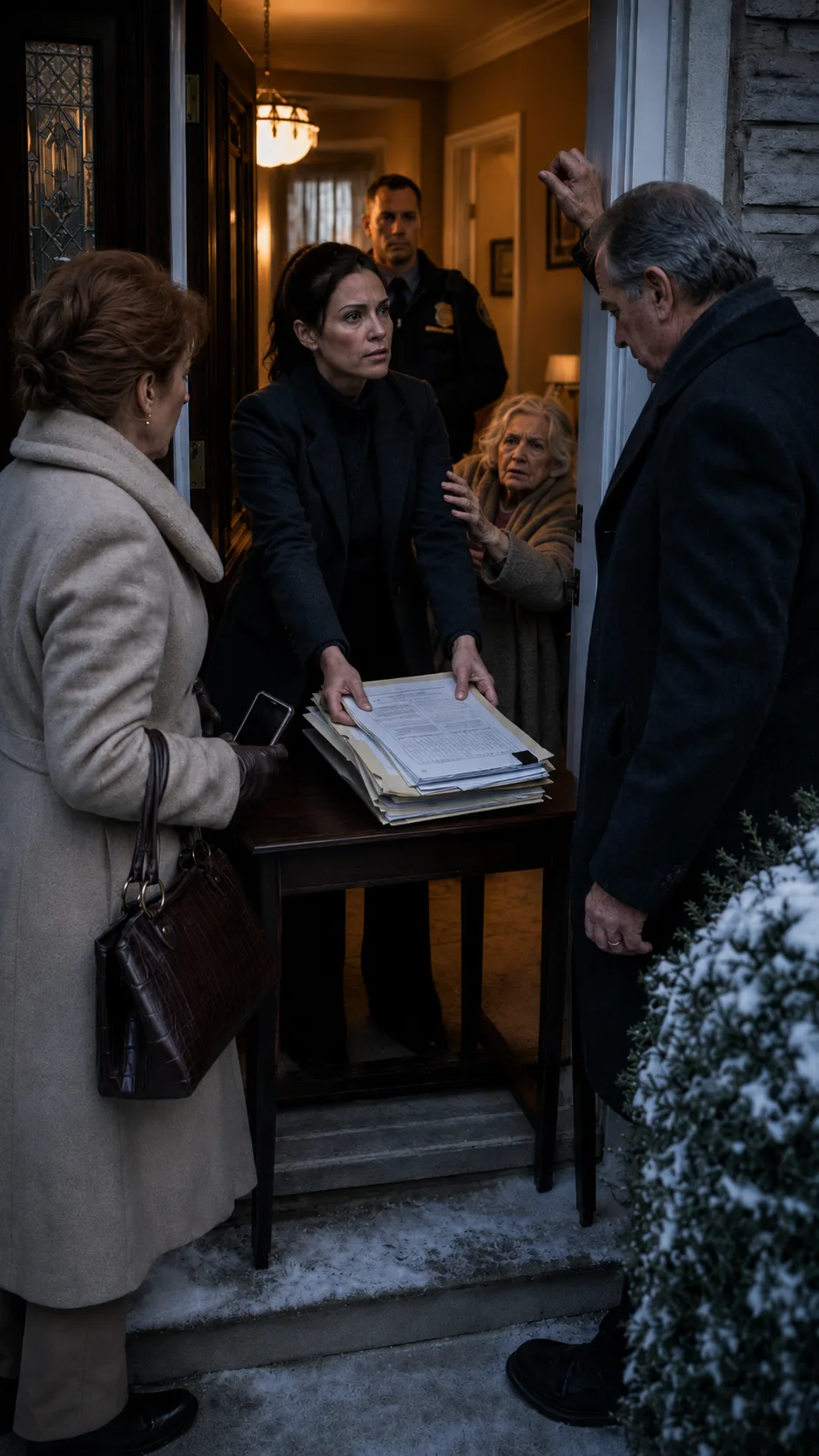
I had placed a small wooden table at the threshold before they arrived.
On it sat the folder.
Bank records. Complaint forms. Transfer histories. Grandma’s statement. The missing medication list. Photos from the morning she arrived. The temperature report. Copies, not originals.
I had learned young never to hand desperate people the only copy of anything.
The doorbell rang again.
Then pounding.
“Elena!” my father shouted. “Open this door right now!”
Grandma’s knitting needles stopped.
I turned from the hallway.
“Stay seated.”
She did not argue.
Officer Grant moved beside the wall, not hidden, not visible from the peephole.
I opened the door with the chain still on.
My parents stood on my porch in coats expensive enough to look warm. My mother wore cream wool, pearl earrings, and a face arranged for audience. My father wore black and looked like he had not slept.
Good.
My mother’s phone was already in her hand.
“Where is she?” my father said.
No greeting.
No asking.
Just ownership.
“She is inside.”
“Move.”
“No.”
His jaw shifted.
“Elena, you are making this worse.”
My mother lifted her phone higher.
“For the record,” she said, “we are here to check on a vulnerable elder who is being kept from her family.”
I looked at the phone.
Then at her pearls.
Then at my father’s fist tightening near the doorframe.
She had chosen a performance again.
This time, I had staged the room.
Behind me, Grandma sat in the recliner where they could see her clearly, wrapped in a thick gray blanket. Her hair was brushed. Her feet were in wool socks. Her glucose monitor sat on the side table beside a cup of tea and two butter cookies on a plate.
She looked at them.
They did not look at her first.
They looked at the officer when he stepped into view.
My mother’s phone dipped.
Only an inch.
Enough.
“What is he doing here?” my father asked.
Officer Grant did not answer.
I unhooked the chain.
My mother’s mouth tightened like she thought that meant she had won.
I opened the door wider but did not step aside.
My body stayed in the center of the threshold.
There was only one way into my house.
Through me.
The small wooden table sat between us, its legs half on my entry floor, half near the porch. The folder lay closed on top.
My father glanced at it.
“What is this?”
I placed my hand on the folder.
“Something you should have read before you came here.”
My mother gave a thin laugh.
“We’re not interested in your little legal games.”
“No,” I said. “You were interested in her bank account.”
That hit.
Not loudly.
Better than loud.
My father’s eyes moved from my face to the folder.
My mother’s phone lowered another inch.
“Elena,” she said. “Careful.”
I pushed the folder open.
The first page was a transfer record.
Five thousand dollars.
Temporary relocation expense.
Dated the morning they left Grandma on my porch.
My father’s name sat beside the authorization.
My mother’s account sat beside the deposit.
I turned the page so it faced them.
The paper made a small dry sound against the wood.
Grandma shifted behind me.
Officer Grant stayed still.
My mother stared at the page.
For once, she did not speak quickly enough.
My father recovered first.
“That is private financial information.”
“It is evidence.”
“It is out of context.”
“Then put it in context.”
He looked at me.
I slid the next sheet forward.
Three years of monthly transfers.
Caregiver reimbursement.
Household contribution.
Medical expense.
All routed to the same personal account.
My mother’s fingers tightened around the phone.
The screen went dark.
I looked at her hand.
“Recording stopped?”
Her mouth flattened.
“You have no right to do this at the door like some kind of spectacle.”
I almost smiled.
Almost.
“You brought the phone.”
My father stepped closer.
The table stopped him.
“You think a few papers make you powerful?”
“No.”
I pushed one more document forward.
Grandma’s signed statement.
“Her words do.”
He looked past me then, finally, at his mother.
“Mom,” he said, and there was something in his voice I had heard before. Not love. Not concern. Command dressed up as softness. “Tell her you want to come home.”
Grandma’s hands tightened around the edge of her blanket.
The room went small.
My mother turned her phone toward Grandma again, quick and sharp.
“Tell them, Margaret. Tell them Elena is confusing you.”
Grandma looked at the phone.
Then at my father.
Then at the suitcase still sitting near my hallway closet because she had not yet been ready to unpack it fully.
One of the handles was cracked.
She inhaled once.
“I am not confused.”
My mother blinked.
Grandma’s voice was thin, but it did not shake.
“You left me.”
My father’s face hardened.
“We were overwhelmed.”
“You left me outside.”
“We knew Elena would—”
“You forgot my medicine.”
My mother dropped the phone to her side.
Nobody moved.
The snow outside clicked softly against the porch railing.
Officer Grant took one step forward.
Not much.
Enough.
I lifted the complaint form from the folder and placed it on top.
“Read the papers,” I said. “You left her in minus thirty-eight.”
My father looked down.
He did not touch the page.
I slid it closer.
“Now tell them why you dumped her here.”
The words did not echo.
They landed.
My mother’s head turned toward the street. Across the way, Mrs. Alvarez from number 12 stood in her driveway with one gloved hand on her car door, pretending badly not to watch. Behind her curtain, another neighbor moved.
Public.
My mother had always loved public when she could control it.
This was different.
Her phone hand dropped fully to her side.
My father’s fist lowered from the doorframe.
That was the moment.
Not the papers.
Not the officer.
Not even Grandma’s statement.
It was my father lowering his hand because there was nowhere left to put it.
“You’re destroying this family,” my mother said.
Grandma stood.
I turned half a step, but she shook her head once.
She walked slowly, one hand on the back of the chair, then the wall, then my arm. The blanket stayed around her shoulders. Her socks made no sound on the rug.
When she reached me, she placed her hand over mine on the folder.
Her skin was warm.
“You did that,” she said to my mother.
My mother opened her mouth.
No sound came.
Grandma looked at my father next.
“I raised you better.”
His face changed.
Only for a second.
A crack through stone.
Then he looked away.
Officer Grant spoke for the first time.
“Mr. and Mrs. Ward, you need to step back from the residence.”
My father’s chin lifted.
“She’s my mother.”
“She is an adult with capacity,” Officer Grant said. “She has stated she does not wish to leave.”
My mother tried to gather herself.
“This is manipulation.”
Officer Grant looked at Grandma.
“Ma’am, do you want them inside this house?”
Grandma’s fingers tightened on my hand.
“No.”
The word was quiet.
It closed the door harder than any lock.
My father stared at her.
At me.
At the folder.
Then at the officer.
His lips pressed together until they went pale.
My mother took one step backward first. Her heel slipped slightly on the snow. She caught herself against the porch railing. There was no dignity in it. Just leather gloves on icy metal and a phone hanging uselessly from her hand.
My father did not help her.
He was still staring at the papers.
Peter had told me once that people always looked at the document they could not explain. They searched it like it might change while they watched.
It did not.
Officer Grant escorted them down the steps.
My mother turned once.
“You’ll regret this.”
Grandma’s hand stayed on mine.
I looked at my mother across the small wooden table, across the folder, across every year she had mistaken my silence for permission.
“No,” I said. “I won’t.”
Their car was parked at the curb.
Different SUV than the one that had driven away two weeks before. Black, spotless, heated leather seats. My father opened the driver’s door. My mother stood beside the passenger door for a moment, looking back at the house like she expected someone to call her name.
Nobody did.
The car started.
This time, I watched until their taillights disappeared.
Then I shut the door.
The house did not burst into celebration.
Real endings rarely do.
Officer Grant took a statement in my kitchen while Grandma sat at the table with both hands around a mug of tea. The folder remained by the door. Snow melted in tiny dark spots on the entry rug where my parents had stood close enough to threaten but not close enough to enter.
Grandma kept glancing at the suitcases.
“I should unpack,” she said.
“Only what you want.”
She nodded.
A long minute passed.
“Could we throw away that blue nightgown?”
“The one in the broken suitcase?”
“It never fit right.”
I carried both suitcases into the office. We opened them on the bed. Half the clothes had been packed wrong. Summer blouses. One slipper. Three church bulletins. A framed photo of my grandfather wrapped in a towel. No winter boots.
At the bottom of the smaller suitcase, under the photo album, we found a sealed envelope.
My name was written on it in Grandma’s careful hand.
I looked at her.
She looked at the envelope, then away.
“I wrote that before I changed the will,” she said. “In case I lost my nerve.”
I did not open it.
Not then.
I put it in the top drawer of my desk.
Some things do not need to be read while the person who wrote them is still sitting beside you.
The investigation took months.
Not because the truth was complicated.
Because paperwork moves like an old animal. Slow, stubborn, and easily distracted unless someone keeps pulling it forward.
Peter finished the accounting in six weeks. The total was worse than the first screen had suggested. My parents had taken enough to pay off credit cards, remodel their kitchen, fund two vacations they had called “necessary stress relief,” and cover a luxury car lease my mother insisted was “for medical transport.”
Grandma had been upstairs eating toast for dinner while they drove her money to brunch.
The bank restored part of it after the fraud claim. The rest went through civil court. Criminal charges came later, smaller than I wanted but real enough to leave marks.
Financial exploitation of an elderly adult.
Neglect.
Endangerment.
My father took a plea because men like him hate jury boxes more than they hate guilt. My mother fought longer. She wrote letters. She called relatives. She cried in the courthouse hallway where people could see.
The judge did not look impressed.
Aunt Diane started visiting on Thursdays with soup and gossip. She apologized on her third visit while washing bowls in my sink.
“I should have asked more questions.”
“Yes.”
She dropped the sponge.
I handed it back.
She nodded.
That was all we needed from each other.
Grandma stayed with me through spring.
Then summer.
By autumn, my office had stopped pretending to be temporary. Her hospital bed was replaced with a real one. She chose yellow curtains. She put a ceramic bird on the windowsill and complained my towels were too rough. She learned to use the streaming remote but refused to remember the name of any platform.
“Put on the one with the murders,” she would say.
“There are eight.”
“The British one.”
“There are twelve.”
“The one with the garden.”
That narrowed it to nine.
She unpacked slowly.
Not all at once.
A sweater one week. Her books the next. The photo of my grandfather by the bed. The butter cookie tin on the kitchen counter. The pearl earrings in a shallow dish near the bathroom sink.
The cracked suitcase stayed in the closet until the first snow.
Then she asked for it.
I brought it to the living room.
She ran her hand over the handle.
“They packed this so badly.”
“They did.”
“My blue nightgown was ugly.”
“It was.”
She smiled.
The heater clanked.
Outside, the first snow of the season slid against the windows, soft and harmless from where we sat.
Grandma opened the suitcase and removed the last thing inside: the scarf I had bought her three Christmases ago. The one she had been wearing that morning.
She folded it once.
Then again.
“Keep this somewhere else,” she said.
“Where?”
“By the door.”
I looked at her.
She did not explain.
She did not have to.
I placed the scarf in the entryway drawer beneath the spare keys and above a stack of grocery coupons she insisted were useful.
Months later, a final court order arrived.
My parents were barred from contacting Grandma directly. Restitution was ordered. The house they said was too crowded went on the market. My mother’s Facebook became very quiet. My father stopped sending articles about caregiver burnout.
Grandma read the order at the kitchen table.
She took longer than she needed to because she liked to read every word.
When she finished, she slid the papers back to me.
“Will they be all right?” she asked.
I could have said no.
I could have said they deserved worse.
I could have said all the things that had lived under my tongue since that morning on the porch.
Instead, I looked at the butter cookies on the counter, the yellow curtains in the office, the wool socks drying on the radiator, the legal folder now stored in a locked cabinet instead of waiting by the door.
“They’ll be somewhere else,” I said.
Grandma nodded.
“That’s all right, then.”
That night, I found her in the entryway.
She stood by the door in her slippers, not going anywhere, one hand resting on the drawer where the scarf was kept.
“Do you want tea?” I asked.
“In a minute.”
I stayed in the hallway.
She opened the drawer, touched the folded scarf, and closed it again.
Then she turned the deadbolt herself.
Once.
Firmly.
Click.
Chapter complete
You have reached the end of this chapter.
Continue reading
A few more worlds to get lost in after this chapter.