The iron bell rang once before the council doors opened.
Chapter 1
The iron bell rang once before the council doors opened.
I stood beneath the archway with my cloak still damp from the morning mist, my boots dark with mud from the lower courtyard, and one thin crimson scroll hidden against my ribs. The guards at either side did not lower their spears for me. They had done it for visiting dukes, for foreign envoys, even for merchants who brought jewels wrapped in velvet.
Not for me.
One guard looked at the torn hem of my cloak. The other looked at the empty place above my shoulder where my house banner used to hang.
“Name,” the first guard said.
“Elara Veyne.”
His jaw worked once.
He glanced at the black slate tablet in his hand, then back at me. He knew the answer before he asked the question. Men like that always did. They only asked so they could hear you say the thing they were about to take.
“No such
house is listed for audience today.”
“My summons came from the High Council.”
“There is no High Council summons under Veyne.”
The second guard shifted his spear just enough to narrow the gap between them.
Behind the doors, I could hear the muffled roll of voices. Nobles. Priests. Commanders. The old families of Valcaryn gathered in the grand hall of the ancients, dressed in gold thread and wolf fur, waiting to witness the final cut.
I kept my hand still beneath my cloak.
The scroll pressed against my side.
Warm from my body.
Older than any of them.
“Then list me under the dead,” I said. “They remember us better.”
The first guard’s eyes moved.
Not much.
Enough.
The doors opened from inside before he could answer.
Elder Maeron stood beyond them in robes of dark wine and ash-gray silk, his white beard trimmed square, his fingers wrapped around a
carved staff that had outlived three kings. He did not smile when he saw me. He had never been a smiling man. But his gaze dropped once to my cloak, to the careful way I held my left arm across my ribs, and then returned to my face.
“She enters,” he said.
The guards stepped aside.
No apology.
No bow.
The hall swallowed me whole.
The grand hall of the ancients had been carved from the mountain before Valcaryn had a crown. Its ceiling rose higher than the bell tower. Its pillars were black stone veined with bronze, each one marked with the old victories of the realm. Along the back wall stretched the kingdom records, thousands of names cut into slabs taller than houses.
Each name meant something.
Land.
Rank.
Protection.
Blood.
Mine was still there.
Small compared to the royal line, smaller still compared to the war houses,
but there, near the eastern families: Veyne of Starfall Gate.
My father used to lift me so I could touch the lowest letters.
“Stone remembers what men deny,” he told me.
I was seven.
My hands were covered in berry stains.
That was the last day I saw him smile in that hall.
Now General Kael stood beneath the record wall in polished black armor, a crimson military cloak falling from one shoulder. He had not aged gently. The scar along his jaw had thickened. His hair was shorter than I remembered, cut close like a soldier who trusted no one near his throat.
He had been my father’s closest commander once.
He had eaten at our table.
He had carried me on his shoulder through the harvest square when I was small enough to believe height meant safety.
He looked at me now like I was a stain he had ordered scrubbed away.
“Lady Elara,” he said.
Several nobles turned at the title.
He heard it too.
His mouth settled into a thinner line.
“Forgive me,” he said. “Elara. The old forms no longer apply.”
A few men near the west benches laughed under their breath.
Not loud.
They were too careful for loud.
I walked down the center aisle without looking at them. The stone beneath my boots had a crack near the fifth step, one I remembered from childhood. I had tripped over it once while chasing my brother through a council session. My mother had caught my sleeve before I fell. She had pressed one finger to her lips and pulled me behind a pillar while my father pretended not to see.
The crack was still there.
My brother was not.
Kael waited until I reached the lower steps.
Then he turned to the council.
“Let the record show,” he said, “that Elara Veyne has answered the final summons of her dissolved house.”
Dissolved.
The word moved through the room like a draft under a locked door.
Elder Maeron’s fingers tightened around his staff, but he said nothing.
Kael took one slow step toward the record wall.
“For twenty years, the remnants of Starfall Gate have lived under royal mercy. They held no seat. No guard. No claim. Yet still, rumors were allowed to breathe. Old servants spoke. Border captains hesitated. Priests kept unnecessary candles burning.”
His eyes found mine.
“And mercy became confusion.”
I stood alone at the bottom of the steps.
No banner.
No advocate.
No living kin the council would admit.
Kael raised his hand toward the royal scribe.
The scribe was younger than me. Barely. His cheeks had not yet hardened into the look court men wore when they learned how expensive kindness could be. He held an iron stylus in both hands and kept his gaze on the floor.
Kael said, “Strike the name.”
The scribe did not move.
Kael did not raise his voice.
“Now.”
The stylus touched stone.
The sound was small.
A scrape.
One hard line through the first letter of my name.
My fingers curled once beneath my cloak.
I did not move.
The scribe dragged iron through the second letter. Chips of black stone fell onto the ledge below. No one spoke. Nobles watched through lowered lashes. A priest pressed his thumb to the chain at his throat. One court lady in silver set her fan against her mouth, but her eyes stayed open.
Kael wanted witnesses.
He always had.
He had not brought me here to erase me in private. He had brought me beneath the record wall so the old families could see the last Veyne become no one.
“Your father,” Kael said, still facing the council, “defied emergency law during the succession crisis. Your mother hid royal correspondence. Your brother fled conscription at the northern gate.”
“My brother was twelve,” I said.
The words left before I weighed them.
Kael turned.
The hall shifted with him.
“He carried Veyne blood,” Kael said. “That was enough.”
The scribe stopped scraping.
Kael noticed.
“Continue.”
The iron moved again.
My brother’s face came to me in fragments. Not the portraits. Not the memorial coins Kael had banned after the second winter. Real things. His sleeve torn from climbing the west tower. His habit of stealing sugared almonds from the kitchens and hiding them in my mother’s sewing basket. His voice outside my door the night soldiers came.
Do not open it, Elara.
Not for anyone.
The stylus struck the final curve of my name.
Elder Maeron looked at me across the hall.
No gesture.
No signal.
Only one blink, slow and heavy.
I had waited sixteen years for that blink.
The decree had reached me three nights ago in a fish barrel.
It came through the river market wrapped in waxed linen and packed beneath salt cod. The courier had not known what he carried. He only knew he had been paid by an old woman with a cracked voice and a ring he would not describe.
I had opened it alone in the kitchen of the abandoned east chapel, with rain falling through the broken roof and a candle stub burning blue at the wick.
The scroll was crimson.
The seal was older than any seal I had seen in court.
Not my father’s.
Not my mother’s.
Not even King Orren’s, whose death had broken the realm into factions and emergency laws.
It bore the mark of the first line.
The root crown.
The blood decree.
Inside, in ink darkened almost brown with age, the old king had written one clause before the succession crisis ended his reign.
If the council invokes war law against the bloodline while the heir remains unrecognized, all such laws stand void before the root crown until blood is answered by blood.
I had read it six times before my hands stopped shaking.
Then I found the second page.
The list.
The names.
My mother’s name was there.
Not as a witness.
As heir.
And beneath hers, written in the same hand, was mine.
Kael knew part of it. That was why my mother died under guard. That was why my father was tried without public record. That was why my brother vanished before his thirteenth winter. Kael had spent half his life using emergency law to bury a bloodline the council had never been allowed to examine.
But he had never found the decree.
He had never found the root seal.
And he had never believed I could.
The scribe stepped back from the record wall.
A pale wound ran through my name.
Kael looked at it with the satisfaction of a man closing a gate.
“Let it be entered,” he said, “that the name Veyne carries no standing in Valcaryn. No inheritance. No appeal. No protection under blood law.”
A murmur rose from the benches.
Not surprise.
Relief.
That was what cut deepest.
Relief that I would stop being inconvenient.
Relief that the missing heir stories could end.
Relief that the old war could finally become a clean paragraph in the archives.
Kael descended the steps toward me.
He stopped close enough for the metal plates of his armor to catch the torchlight across my cheek.
“You were spared more than your house deserved,” he said.
I looked past him to the record wall.
One letter of my name still remained untouched.
The last one.
A.
My mother used to say it meant beginning in the old tongue.
Kael followed my gaze and smiled.
“Finish it,” he called.
The scribe lifted the stylus again.
My hand came out from beneath my cloak.
Not fast.
The hall saw the crimson scroll before Kael did.
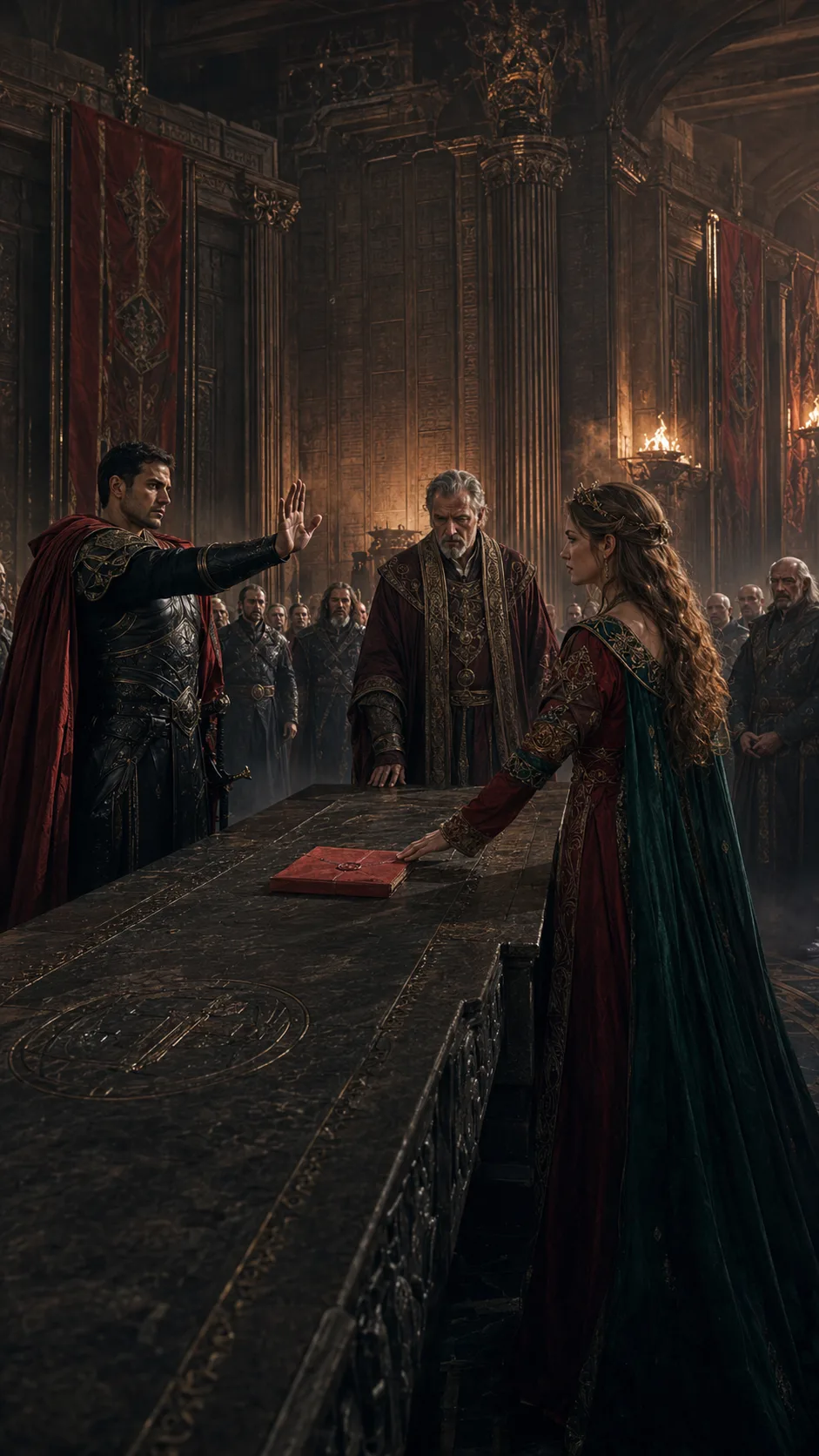
I took one step toward the council table.
The guards near the pillars shifted. Kael’s hand rose, palm out, the same command he had used to silence battlefield charges and courtroom objections.
“Remove her from the hall.”
Two soldiers started forward.
I set the scroll on the black stone table.
Flat.
The wax seal faced Elder Maeron.
For one breath, nothing moved except torch smoke.
Then Elder Maeron’s fingers separated on the head of his staff.
Kael looked down.
The color left his face in a narrow band around the mouth.
He knew the seal.
Of course he knew it.
All men who steal thrones study the locks.
“Do not touch that,” he said.
No one obeyed.
I slid the decree one inch farther across the table.
The wax caught the firelight.
The root crown glowed red.
A noble near the front stood halfway, then sat back down when his wife gripped his sleeve.
Kael stepped toward the table. His armor scraped against the stone edge as he reached across it.
Elder Maeron moved before his hand landed.
One step.
The old man’s body came between Kael and the decree.
It was not a large movement.
It did not need to be.
The hall understood before anyone explained it.
Kael had commanded soldiers, scribes, border lords, priests, widows, and children. But not Elder Maeron. Not in that hall. Not before the record wall.
“Step aside,” Kael said.
Elder Maeron looked at him.
His voice was dry as parchment.
“No.”
The word struck the table harder than a fist.
Kael’s hand stayed suspended over the decree.
Then, slowly, he drew it back.
The scribe still stood at the wall with the stylus lifted. The final letter of my name waited beneath the iron point.
Elder Maeron picked up the scroll.
The wax seal rested beneath his thumb.
Kael leaned in. His voice dropped low enough that only the nearest benches could hear, but stone carries what men try to hide.
“That decree died with the old line.”
Elder Maeron did not look at him.
He broke the seal.
The crack echoed once.
The red wax split down the root crown.
A sound moved through the hall. Not a gasp. Not yet. More like cloth shifting across a hundred knees.
Elder Maeron unfolded the first page.
His eyes moved across the clause.
He stopped.
Read it again.
His left hand gripped the parchment edge.
Kael’s jaw worked once.
“Read only what bears current standing,” Kael said.
Elder Maeron turned the page.
The second page opened.
The list faced him.
I watched the old man’s eyes move down the names.
King Orren.
Princess Serath.
My mother.
Then me.
Maeron’s mouth tightened. The deep lines around it seemed to cut farther into his face.
He lifted the parchment.
Not toward me.
Toward the council.
“The root seal is intact,” he said.
The priest nearest the east bench stood.
Kael turned on him. “Sit down.”
The priest did not sit.
Elder Maeron continued.
“The decree predates the emergency laws invoked against Starfall Gate.”
Kael’s hand dropped to the pommel at his belt. Not drawing. Not yet. Just touching it, like a man checking whether the ground beneath him was still there.
Elder Maeron’s voice carried higher.
“Any law raised against the unrecognized bloodline stands void until the blood is answered before council.”
No one laughed now.
The woman in silver lowered her fan completely.
The scribe at the wall slowly lowered the stylus from the final letter of my name.
Kael turned to the benches. “This is a dead relic. A ceremonial scrap. It has no force.”
Elder Maeron turned the second page outward.
The royal list faced the hall.
Not close enough for every noble to read, but close enough for every noble to see the names arranged beneath the root crown.
“Then why,” Maeron said, “was it hidden from the archive?”
Kael’s mouth opened.
Closed.
I stepped to the table.
Every eye moved with me.
The hall that had watched my name being cut from stone now watched my hand rest beside the broken seal.
I did not raise my voice.
“My father did not defy the crown,” I said. “He protected the heir from men who were using war law to hunt her.”
Kael’s eyes snapped to mine.
I kept going.
“My mother was not hiding royal correspondence. She was carrying succession proof. My brother did not flee conscription. He was taken before he could be named.”
The nearest guards looked at each other.
Small.
Quick.
Enough.
Kael saw that too.
“You have no witness,” he said.
Elder Maeron laid the decree flat on the table.
“I witnessed the first seal,” he said.
The hall froze around that sentence.
Kael turned back to him.
“You were a junior keeper.”
“I was keeper enough to know what I was ordered to forget.”
The priest at the east bench removed his chain from around his throat and set it on the table before him.
One noble followed.
Then another.
Metal touched stone in small, separate sounds.
Kael looked from one bench to the next as if counting exits.
I looked at the record wall.
My name was wounded but still there.
The final letter untouched.
Elder Maeron lifted the decree once more.
“Elara Veyne,” he said, and the hall seemed to draw itself tighter around the name, “is entered under the bloodline of Serath, daughter of Orren, last sealed heir of Valcaryn.”
The scribe’s stylus slipped from his hand.
It struck the floor and rolled once.
Kael did not move.
For the first time since I entered, he looked smaller than his armor.
I turned to him.
He had spent sixteen years making my family sound like ash. A traitor father. A hiding mother. A vanished brother. A girl kept alive only because killing children left stains even loyalists noticed.
But the decree sat open between us.
Stone remembered.
So did parchment.
So did old men with tired hands.
“The bloodline never ended,” I said.
Kael’s fingers opened at his belt.
His hand fell away from the sword.
No one ordered it.
No one needed to.
The guards at the pillars stepped back from me.
Not far.
Enough.
Elder Maeron faced the scribe.
“Restore the name.”
The young man did not move at first.
Then he bent, picked up the stylus, and climbed the record steps with care. He pressed the iron point beneath the scarred letters and began carving a line not through my name, but under it.
Recognition.
Temporary, until the council completed the rites.
But public.
Alive.
Kael stood in the center of the hall while the sound of iron on stone returned.
This time it did not erase.
This time it held.
A bench scraped.
Lord Arven, who had taken my father’s eastern farms after the trials, stood with both hands gripping the rail before him.
“If this is accepted,” he said, “then every judgment under war law must be examined.”
Elder Maeron did not look away from the decree.
“Yes.”
Another noble stood.
“And the properties?”
“Yes.”
The priest spoke from the east bench.
“And the prisoners named during the crisis?”
Elder Maeron looked at Kael then.
“Yes.”
Kael’s throat moved.
There it was.
Not fear shouted across a room. Not collapse. Something quieter. The first visible crack in a wall that had taught the whole kingdom to lean on it.
I thought I would feel larger when it happened.
I did not.
I felt the weight of my cloak.
The old mud drying on my boots.
The scroll’s missing warmth against my ribs.
The empty places where my family should have stood.
Elder Maeron rolled the decree halfway closed, leaving the broken seal visible.
“General Kael,” he said, “you will surrender command of the hall guard until the council reviews the emergency years.”
Kael gave a short laugh.
No one joined him.
He looked to the soldiers.
“Captain.”
The captain near the east pillar stared at the open decree for one second too long.
Then he removed his hand from his sword belt.
Kael saw it.
His laugh stopped.
The nobles did not move toward me. They were not brave all at once. No court becomes clean because one secret is opened. They watched, measured, recalculated. Some had taken land. Some had signed orders. Some had stayed silent for so long silence had become their estate.
But their eyes no longer slid past me.
That was the first punishment.
Being seen.
Kael took one step back from the table.
The torchlight moved across his scar.
“This council will regret this,” he said.
Elder Maeron folded the decree carefully.
“No,” he said. “This council already did.”
Kael had no answer for that.
Two guards approached him. Not with drawn steel. Not with ceremony. One stood at his left, one at his right, close enough to make the meaning plain.
Kael looked at me once as they guided him from the center aisle.
Not defeated in the way songs prefer.
Not begging.
Not ruined enough for anyone who had lost what I had lost.
But no longer untouchable.
That had to be enough for the first breath.
The doors opened.
Kael walked out beneath the same arch I had entered through.
No one announced him.
The hall remained standing after he was gone.
That surprised me most.
As a child, I thought evil men carried the walls with them. That when they fell, ceilings cracked and pillars shook and bells rang until birds fled the towers.
But the hall stayed.
The torches burned.
The long table held its scars.
The record wall waited.
Elder Maeron came around the table and stopped beside me. He looked older up close. Not grand. Not carved from law. Just a man with ink stains near his thumbnail and grief sitting in the folds of his face.
“I should have spoken sooner,” he said.
“Yes,” I said.
He accepted it without lowering his eyes.
A servant brought a small velvet case from the archive chamber. It was blue once, maybe, before dust and years turned it gray. Maeron opened it with a brass key.
Inside lay a thin circlet of dark gold.
Not the crown.
Not yet.
A recognition band.
The kind worn before blood rites, before oaths, before the realm decided whether truth was convenient enough to honor.
He lifted it, then paused.
“May I?”
I looked at the record wall.
The scribe was still working. He had finished the line beneath my name and begun smoothing the worst of the strike marks. They would never fully disappear. Even from where I stood, the damage showed.
Good.
Let them see where the iron had been.
I bent my head.
Maeron placed the circlet on my brow.
It was colder than I expected.
Lighter too.
The nobles bowed unevenly. Some deep. Some just enough to survive the room. The priest from the east bench was first to kneel. Others followed in a wave that broke halfway and corrected itself.
I did not thank them.
The council session lasted until the torches burned low.
Names were called.
Orders sealed under Kael’s command were gathered.
Archive doors opened that had not opened in my lifetime. Scribes ran with armfuls of ledgers. Captains were told to hold their posts but obey Maeron until the first review. Three nobles requested private counsel and were denied in public.
I stood through all of it.
Not because I was strong.
Because sitting felt too close to vanishing.
Near dusk, when the high windows turned bronze and the last of Kael’s loyal officers had been escorted out, Elder Maeron brought me a small bundle wrapped in linen.
“This was kept in the lower archive,” he said. “Misfiled.”
No one misfiles a dead child’s belongings for sixteen years.
I took it anyway.
Inside was my brother’s wooden horse.
One leg missing.
I knew the break. I had thrown it at him during a fight over sugared almonds. He had laughed until our mother came in and made us both scrub the kitchen steps.
A folded scrap of cloth lay beneath it.
His handwriting, crooked and hurried, crossed the inside.
Do not open it, Elara.
Not for anyone.
I closed my hand around the horse until the broken edge pressed into my palm.
Maeron did not speak.
Good.
There were no words that could stand there.
The first review took eleven days.
The second took a month.
By winter, the emergency laws had been suspended. By spring, the lands taken under them were named before the council. Some returned quickly. Others fought like wolves over bones. Kael demanded trial by command right, then withdrew the request when three captains agreed to testify about the northern gate.
He was stripped of title before the first thaw.
Not dragged through the streets.
Not locked in some dark tower for songs to enjoy.
He was placed in a stone residence outside the western wall with no command, no seal, no council voice, and no record except the one he could not edit.
Each morning, by order of Elder Maeron, a scribe read aloud the names removed under his emergency decrees.
My father’s name took its turn on the fifth morning.
My mother’s on the sixth.
My brother’s was read on the ninth.
I attended that one.
Kael stood behind the iron garden rail, dressed in plain gray wool, his once-polished hands folded before him. When my brother’s name was spoken, his jaw tightened the way it had in the hall.
But his hand had no sword to fall to.
I did not speak to him.
There are doors you close by walking past them.
In midsummer, the blood rites were held in the grand hall of the ancients.
The banners had changed by then. Crimson remained, but Starfall green hung beside it, brought from a sealed chest in the old chapel crypt. The cloth was faded at the edges. One corner had been repaired with thread that did not match.
I wore it anyway.
The crack in the fifth step had been filled with pale stone. I noticed as I walked over it.
A poor repair.
Visible.
I almost smiled.
The kingdom records had been restored as much as stone allowed. My name still carried scars through the middle letters. The scribe had offered to recarve the whole section.
I refused.
Let the children ask.
Let their parents answer.
Elder Maeron stood behind the council table, the crimson decree open before him under glass. He looked smaller than he had the first day, but steadier. Men sometimes grow lighter after setting down a burden they carried too long.
He asked if I claimed the bloodline.
I said yes.
He asked if I claimed the duties bound to it.
I looked at the benches.
At the noble houses waiting to see whether I would be merciful, useful, dangerous, decorative.
At the priests who had recovered their voices.
At the young scribe who had cut my name and then restored it, standing pale near the record wall.
At the empty place where my family should have been.
“Yes,” I said.
The circlet was removed.
The crown placed in its stead was heavier.
Not beautiful.
Not kind.
Old gold. Root-shaped. Built to remind the wearer that crowns do not float above blood; they grow out of it, with all the dirt still clinging underneath.
When the hall bowed this time, it moved as one.
I did not look for Kael among them.
He was not there.
After the rite, I walked alone to the back wall.
No guards followed.
No elder stopped me.
I climbed the three narrow record steps and touched the lowest letters of my name, the way my father had lifted me to do when I was seven.
The stone was cool.
The scar was rough beneath my fingertips.
I pressed my thumb against the final letter.
A.
Beginning.
Outside, the bells started ringing across Valcaryn.
Inside, the stone remembered.
Chapter complete
You have reached the end of this chapter.
Continue reading
A few more worlds to get lost in after this chapter.