They Erased Her From Every Family Reunion Until She Owned The Gala Hall Where Their Names Were Finally Called Aloud
Doris Preston was tightening a brass hinge on an old ballroom door when her phone buzzed against a stack of sandpaper.
Chapter 1
Doris Preston was tightening a brass hinge on an old ballroom door when her phone buzzed against a stack of sandpaper.
She let it buzz.
The hinge had taken three hours to loosen, four cracked knuckles, and one tiny screw that had rolled under a cabinet and vanished like it owed her money. She had learned not to answer messages with wet varnish on her fingers or anger sitting too close to her throat.
The phone buzzed again.
This time, she looked.
Unknown number.
No, not unknown.
Just deleted.
Rachel Preston.
Doris stared at the screen, one hand still holding the screwdriver, the other smeared with dark walnut stain. The workshop behind her smelled of sawdust, metal filings, lemon oil, and coffee that had gone cold before noon. Outside, downtown traffic coughed past the boarded windows of The Landing, the old event hall everyone in town had once called a demolition case.
Rachel’s message sat there, bright and casual.
Hey Doris! Aunt Cheryl wanted to confirm your address in case you
want to come this year. No pressure lol.
Eight years.
Not one invitation.
Not one correction in the group chat.
Not one cousin saying, “Hey, did anyone tell Doris?”
And now there it was.
No pressure lol.
Doris placed the screwdriver on the workbench with care. Too much care. The metal clicked once against the wood and rolled half an inch before stopping beside a chipped ceramic mug that said World’s Okayest Boss. Jasmine had given it to her after their first booked wedding at The Landing, back when the roof still leaked in the women’s restroom and the bride’s uncle kept asking if the ceiling stain was “part of the rustic charm.”
Doris read Rachel’s message again.
The room did not move.
Her family had always been good at making cruelty look like manners. They did not slam doors. They closed them gently and claimed the wind did it.
They did not insult you at the table. They asked if you were “still doing that little furniture thing” while passing the mashed potatoes. They did not announce that you had been removed from the reunion list.
They simply stopped telling you when the reunion happened.
At first, Doris had believed it was a mistake. Her mother had said Memorial Day plans were “still messy.” Her aunt Cheryl had posted old photos from “a girls’ brunch,” except every woman in the Preston family had been wearing matching yellow T-shirts with Preston Strong printed across the chest. The year after that, nobody mentioned anything until Doris opened Facebook at midnight and saw thirty-seven photos of cousins standing around a rented lake house, each holding a red plastic cup and smiling as if family meant everyone.
Everyone except her.
By the fourth year, Doris stopped pretending confusion was kinder than truth.
They
had erased her.
Politely.
Efficiently.
With matching shirts.
She had been twenty-five the last time she attended a Preston reunion. She arrived late because a dresser delivery ran over, and Aunt Cheryl greeted her with a hug that touched only fabric.
“There’s our little artist,” Cheryl had said, loud enough for the table. “Still rescuing broken things?”
Doris had smiled because she had not yet learned that silence could be sharper than politeness.
Her father had been standing near the grill, wearing the Preston Insurance polo he handed out to employees at company picnics. He did not correct Cheryl. Her mother stirred lemonade in a glass pitcher and watched the ice spin.
Doris stayed forty-two minutes.
After that, the invitations stopped.
The group chat quieted. The photos continued. Her birthday texts became shorter. Her cousins got married, had babies, bought houses, changed jobs, hosted showers, and Doris learned about all of it through posts that began with So blessed to have the whole family together.
The whole family.
She looked at Rachel’s message until the screen dimmed.
A sound came from the far end of the ballroom.
“Tell me you’re not answering that face-first,” Jasmine called.
Doris turned.
Jasmine Rivera stood beneath the central archway, holding a clipboard against her chest. She wore black trousers, pointed flats, and the expression of a woman who could organize a wedding, fire a vendor, and stop a drunk uncle from making a speech without smudging her eyeliner. A thin strip of painter’s tape was stuck to her sleeve.
Doris slid the phone into her back pocket.
“Rachel texted.”
Jasmine’s eyebrows lifted. “Rachel as in cousin Rachel?”
“Rachel as in ‘your reclaimed wood thing is so brave’ Rachel.”
“Oh.” Jasmine walked closer. “What does she want?”
Doris wiped her hands on a rag. The stain had already sunk into the creases of her fingers. “Aunt Cheryl wants my address. In case I want to come this year.”
Jasmine’s mouth flattened.
“No pressure?”
Doris took out the phone and showed her.
Jasmine read it, laughed once without humor, and handed it back. “They heard.”
“Maybe.”
“No maybe.” Jasmine looked around the ballroom. “People know The Landing is yours now. The mayor’s office booked December. The hospital foundation called yesterday. That real estate magazine wants a feature. Your family didn’t suddenly discover manners. They discovered your calendar.”
Doris slipped the phone away again.
The Landing stretched around them in layers of unfinished beauty. The grand staircase had been restored first, because Doris refused to let anyone walk into the place without looking up. The old brass railings had been black with grime when she bought the building. Now they glowed softly beneath protective cloth. Half the chandeliers had been rewired. The marble bar, once covered in graffiti and gum, shone under a coat of polish so clear it looked wet.
There were still problems. A stubborn breaker box. One cracked tile near the west service door. A radiator that hissed like it was keeping secrets.
But the bones were magnificent.
Doris had seen that before anyone else did.
Her family had not seen much of anything.
Jasmine tapped the clipboard against her palm. “What are you going to do?”
Doris looked toward the archway.
A memory arrived without asking.
Aunt Cheryl, eight years ago, lifting a paper plate and saying, “We all just worry about you, sweetheart. Not everyone can make a life from hobbies.”
A cousin laughing.
Her father not looking up.
Her mother smoothing the edge of the picnic tablecloth.
Doris picked up the screwdriver.
“I’m going to host a gala.”
Jasmine stared at her.
“Here?”
“Here.”
“For your family?”
“For Memorial Day weekend.”
Jasmine’s face changed slowly. First confusion. Then comprehension. Then the dangerous gleam of a woman who knew exactly how much damage elegance could do.
“That’s their reunion weekend.”
“Yes.”
“And you want to invite them here.”
“Yes.”
Jasmine lowered the clipboard. “Doris.”
“I know.”
“No, I don’t think you do.”
“I do.”
“You’re not hosting dinner. You’re building a courtroom with floral arrangements.”
Doris turned the brass hinge in her hand. “Maybe they need one.”
Jasmine did not answer right away. The old radiator hissed near the wall. Somewhere upstairs, a worker dropped something metal, cursed, and went quiet.
At last, Jasmine said, “If we do this, we do it perfectly.”
Doris looked at her.
Jasmine pointed the clipboard toward the ballroom. “Not good. Not impressive. Perfect. Let them choke on the napkin folds.”
For the first time that day, Doris smiled.
Small.
Dangerous.
“Perfect,” she said.
The invitations went out on thick cream cardstock with gold raised borders.
Doris chose the paper herself. Aunt Cheryl had always loved heavy invitations, the kind that made ordinary people feel temporarily aristocratic. Cheryl judged weddings by envelope weight. She once told a bride’s mother that digital RSVPs made a marriage look “unprepared.”
So Doris ordered engraved envelopes.
Hand-addressed.
Wax-sealed.
Formal enough to make every Preston relative believe they had been chosen for something exclusive.
The card read:
You are cordially invited to an annual gala evening at The Landing.
Memorial Day Weekend.
Formal attire required.
Dinner, music, and a special presentation.
At the bottom, in smaller script:
Hosted by D. Preston Hospitality Group.
Not Doris.
Not yet.
Two days after the first envelopes arrived, Doris’s phone became a museum of sudden affection.
Aunt Cheryl: Darling, what a gorgeous invitation. So proud of you.
Uncle Doug: Heard you’ve been busy. Great job kid.
Rachel: This looks AMAZING. Can I bring Tyler? He does lifestyle content.
Her mother: Your father and I would love to attend. We miss you.
Doris read that one three times.
We miss you.
Her thumb hovered over the screen.
Missed people got phone calls. Missed people got invitations. Missed people were not cropped out of reunion planning and tucked away like an embarrassing receipt.
She locked the phone.
Daniel came over that night carrying takeout noodles, two bottled teas, and the quiet concern he wore whenever Doris pretended she was only being practical. He found her sitting on the ballroom floor under the central chandelier, shoes kicked off, spreadsheets spread around her like legal evidence.
“You know,” he said, setting the bags down, “most people plan family events with seating charts, not psychological warfare.”
Doris did not look up. “It’s not warfare.”
Daniel sat across from her. “What is it?”
“A gala.”
“Doris.”
She leaned back on her palms. The chandelier above them was still missing three crystal drops. They had replacements arriving Tuesday. “They ignored me for eight years. Now they want to clap because I’m useful.”
Daniel opened a container of noodles and placed it in front of her. “That doesn’t mean you owe them a performance.”
“I know.”
“Do you?”
She picked up chopsticks and tapped them once against the container.
Daniel waited.
The worst thing about Daniel was that he did not fill silence for her. He let it sit there until it became honest.
Doris looked toward the staircase.
“I want them to stand in what I built,” she said. “I want them to look around and understand that all the things they dismissed paid for every light above their heads. I want my mother to see the doors she walked past. I want my father to hear people call me the host without flinching.”
Daniel’s jaw shifted.
“I want Cheryl to know she walked in because I let her.”
There.
That was the ugly part.
Daniel reached across the papers and took her stained hand.
“You’re allowed to want that.”
Doris looked down at their hands.
His thumb moved once over her knuckles. The smallest thing.
“But after they see it,” he said, “what do you want left?”
Doris had no answer.
The RSVPs came in fast.
All of them yes.
Every aunt. Every uncle. Every cousin who had avoided her in grocery aisles and liked her posts only after The Landing appeared in a local magazine. Even second cousins Doris barely remembered sent cheerful notes about how “long overdue” it was to reconnect.
No one mentioned the missing years.
Not one.
Aunt Cheryl called three days before the gala.
Doris let it ring twice before answering.
“Hello?”
“Doris, sweetheart.” Cheryl’s voice came coated in sugar and control. “I just wanted to check a few details.”
Doris set down a linen sample. “Details?”
“Well, since so many of us are attending, I thought perhaps I could help with the family portion.”
“There is no family portion.”
A pause.
A tiny one.
“Oh.” Cheryl recovered quickly. “Of course. I only meant, I’ve organized our reunions for years, so I know how these things go.”
“I know you do.”
Something shifted at the other end.
Cheryl heard the edge.
Doris let it stay.
“Well,” Cheryl said, “you must have been very busy all this time.”
“Yes.”
“We would have loved to know more.”
Doris looked at the framed permit on her office wall. The first legal proof that The Landing was hers had hung crooked for six months because she liked remembering the day she put it up with shaking hands.
“You had my number.”
Cheryl made a small sound. Not quite a laugh.
“Families get complicated.”
“Only when people lie politely.”
Silence.
On the desk, a tiny brass place card holder sat beside a list of table numbers. Doris touched it with one finger.
Cheryl’s voice returned, lower now. “I hope this event isn’t going to be uncomfortable.”
Doris smiled without warmth.
“Wear something formal.”
She hung up.
The night before the gala, Doris walked The Landing alone.
Not because there was work left. There was always work left. Buildings like The Landing never finished becoming themselves. But the room was ready.
The ballroom had transformed.
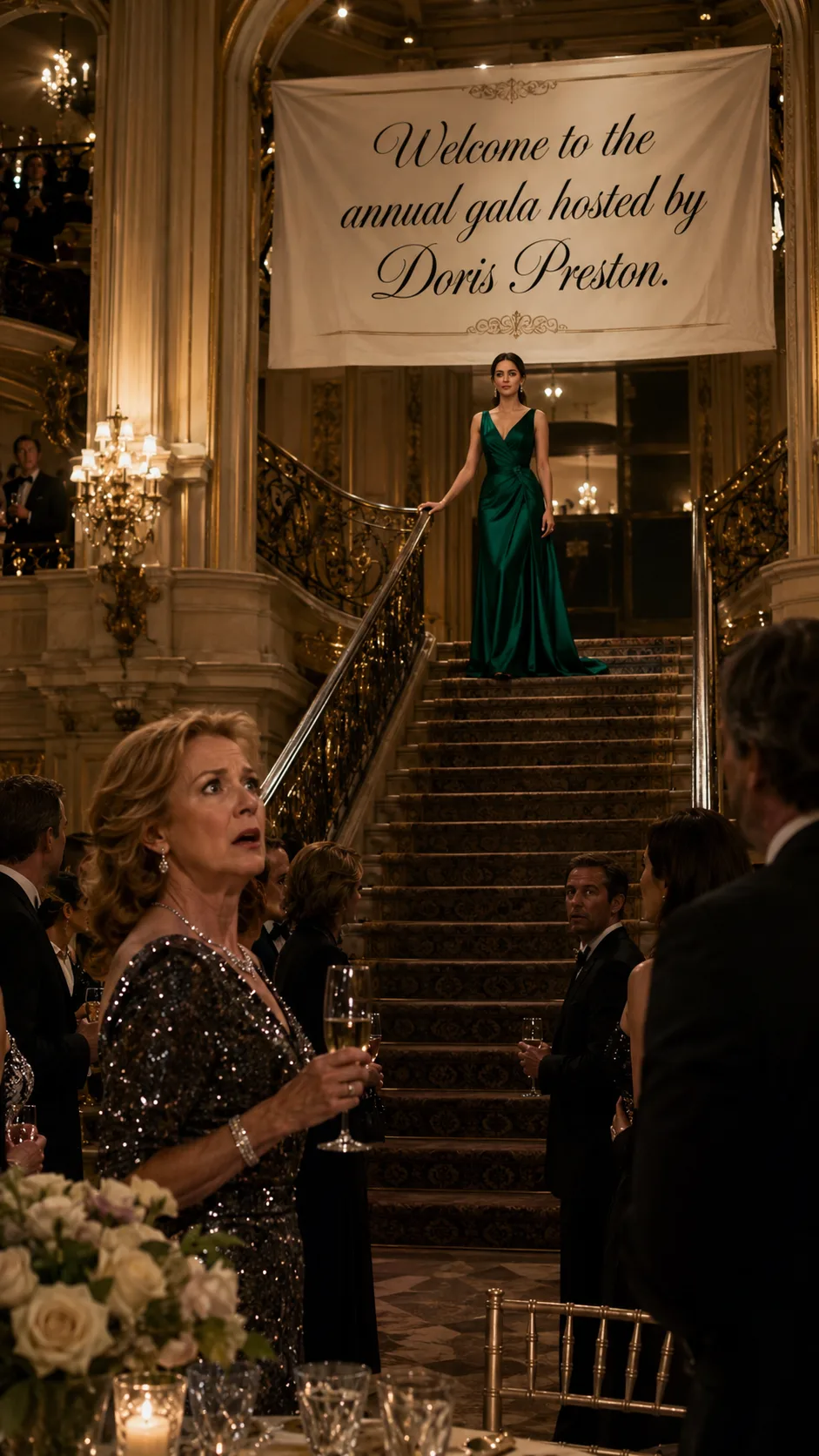
White linen covered every round table, each pressed until even the folds looked intentional. Crystal glasses caught the chandelier light. Low floral arrangements filled the air with lavender, cream roses, and clipped greenery. The bar gleamed beneath rows of polished coupes. The stage waited under soft amber lighting. A string quartet platform sat near the entrance. The grand staircase rose at the far end, broad and golden, with the central archway above it covered by a long velvet curtain.
Behind that curtain hung the banner.
Jasmine had argued about the fabric for three days.
“White silk,” she insisted. “Black script. No glitter. No cheap victory.”
Doris had agreed.
The banner read:
Welcome to the annual gala hosted by Doris Preston.
Not D. Preston Hospitality Group.
Not The Landing.
Her name.
Full.
Unhidden.
Daniel found her standing beneath it just after midnight, though the curtain concealed every word. He carried two paper cups of coffee from the all-night diner around the corner.
“You should sleep,” he said.
“I will.”
“That’s not true.”
“No.”
He handed her a cup.
She took it. The lid was crooked. A drop of coffee sat on the rim, trembling.
Daniel looked up at the covered banner.
“Do you want me near the stage tomorrow?”
“No.”
“Near your parents?”
“No.”
“Near Cheryl, holding holy water?”
Doris almost laughed.
Almost.
“I need to do it alone.”
Daniel nodded.
He never mistook support for rescue.
They stood under the archway, two cups of coffee steaming into the quiet ballroom. The air smelled of wax, flowers, old wood, and something sharper beneath Doris’s ribs.
After a while, Daniel said, “Your mother called me.”
Doris turned.
“When?”
“Yesterday.”
“Why?”
“She asked if you were okay.”
Doris looked away. “That’s new.”
“She sounded small.”
Doris took a sip of coffee. Too hot. She swallowed anyway.
“What did you say?”
“I said you were busy.”
“Thank you.”
“She asked if tonight was meant to punish them.”
Doris’s fingers tightened around the cup.
Daniel continued, “I told her I wasn’t the one she should ask.”
The velvet curtain stirred faintly from the ventilation system.
Doris watched it move.
“She knew,” Doris said.
Daniel did not ask what.
“She knew they stopped inviting me. All of them knew. My father too. They let Cheryl run everything because it was easier than arguing. They let me disappear because I made the table awkward.”
The paper cup dented under her thumb.
“I used to bring repaired things to reunions. A chair for Aunt Linda. A refinished frame for Grandma. One year I fixed Uncle Doug’s camping stove while everyone laughed at how I always had tools in my car.”
Her mouth stopped.
The ballroom hummed around her.
Daniel waited.
Doris set the coffee on a nearby table.
“Tomorrow, they’ll sit at tables I built.”
The first guests arrived at 5:41 p.m.
A glossy SUV pulled to the curb, tires kissing the wet pavement. Aunt Cheryl stepped out wearing a silver sequined dress and the expression of a woman prepared to be admired. Her husband Chad followed, smoothing the front of his tuxedo. Their sons came next, both in identical navy suits, both glancing up at The Landing’s restored facade with the cautious respect people gave money when they were not yet sure who owned it.
From behind the tinted glass of the mezzanine office, Doris watched.
She wore emerald satin, a simple gown with clean lines and a low back that made no apology for elegance. Her hair was pinned at the nape of her neck. Pearl studs. No necklace. No extra shine.
She did not need armor that looked like armor.
Jasmine stood near the entrance below, greeting guests with a black folder and a smile sharp enough to cut ribbon.
“Welcome to The Landing. Name, please?”
Cheryl lifted her chin. “Cheryl Harris. Preston family.”
“Of course.” Jasmine checked the list. “Table three.”
Cheryl glanced past her. “Is the host here yet?”
Jasmine’s smile did not move. “She’ll make herself known.”
Cheryl blinked.
Good.
More cars arrived.
Uncle Doug came with a tie that sat too short over his stomach. Cousin Rachel arrived in a champagne dress with Tyler, the influencer boyfriend, who began filming the exterior until Jasmine’s assistant stepped in and told him no recording without approval. Rachel laughed too loudly and tucked the phone into Tyler’s jacket pocket like she had planned to respect the rule all along.
At 6:08, Doris’s parents arrived.
Her father wore a dark suit and the same striped tie he saved for funerals, weddings, and company award dinners. Her mother wore navy with pearls. Real pearls. The ones she kept for occasions she called “proper.”
Doris stood very still behind the glass.
Her mother paused at the entrance and looked up at the building, not with Cheryl’s hungry appraisal, but with something quieter. She touched the clasp of her purse twice before going inside.
Doris’s father placed a hand lightly at her back.
They walked through doors Doris had sanded until her fingertips cracked.
Inside, the family performed admiration badly.
They spoke in lowered voices while pretending not to be impressed. They touched the backs of chairs. They looked at chandeliers. They read the menu cards. They asked waitstaff where the original owners had found such a beautiful venue, only to be told, again and again, “Ms. Preston restored most of it herself.”
Ms. Preston.
Doris watched the words land.
Cheryl heard it from a server carrying sparkling water and frowned into her glass.
Rachel heard it near the flower wall and stopped mid-pose.
Uncle Doug heard it at the bar and looked down at the polished mahogany as if it might accuse him.
Doris’s mother heard it from Jasmine.
“She restored the staircase personally?” her mother asked.
Jasmine glanced up toward the mezzanine glass.
“Among other things.”
Doris stepped back from the window.
Her pulse beat in her wrists, but her hands stayed calm.
At 6:37, Jasmine came up through the service stairs.
“The room is full,” she said.
Doris nodded.
“Your aunt asked me if we could move her closer to the stage.”
“No.”
“Your cousin asked if we could turn the lights up for photos.”
“No.”
“Your uncle Doug has told three people he always knew you’d make something of yourself.”
Doris looked at her.
Jasmine lifted one hand. “I didn’t stab him with a cocktail pick. Growth.”
Doris exhaled once.
Jasmine softened. “You ready?”
Doris looked toward the hallway leading to the staircase.
“No.”
Jasmine offered the microphone.
“Good. Ready is overrated.”
Downstairs, the quartet shifted into a slower piece. Waiters cleared appetizer plates. Glasses caught the light. Conversations rose and fell, thinner now, strained by curiosity. The covered banner hung above the central archway like a sealed verdict.
Doris moved into position behind the staircase wall.
Through the carved railing, she could see Aunt Cheryl at table three, leaning toward Rachel with her mouth tight.
“She’s certainly learned presentation,” Cheryl said.
Rachel glanced around before answering. “Do you think she actually owns it?”
Cheryl’s laugh came sharp and small. “People exaggerate. She probably manages events here.”
Doris’s fingers rested on the banister.
The brass was warm from the lights.
Rachel’s boyfriend Tyler murmured, “The website lists her as founder.”
Cheryl turned.
“What website?”
Tyler showed her his phone under the table.
Cheryl stared at the screen.
Her mouth shut.
A few chairs away, Doris’s mother looked toward the archway again. Her father adjusted his tie. Nobody at the table reached for the bread.
At 6:45, Jasmine stepped onto the stage.
She tapped the microphone.
Once.
Twice.
The room answered with silence.
“Ladies and gentlemen,” Jasmine said. “Thank you for joining us at The Landing tonight.”
Polite applause. Uneven. Eager from people who wanted to be seen appreciating wealth before they understood its source.
Jasmine waited.
The applause died.
“We have one special presentation before dinner service continues.”
Cheryl straightened.
Rachel picked up her champagne.
Doris stood behind the staircase, still hidden.
Jasmine turned toward the archway.
“Please direct your eyes to the main banner.”
A staff member at the side wall pulled the cord.
The velvet curtain dropped.
It did not flutter.
It fell with a heavy, final rush, red fabric sliding down both sides of the arch like theater curtains revealing the only scene that mattered.
The white silk banner appeared beneath the chandelier light.
Welcome to the annual gala hosted by Doris Preston.
For half a second, nobody understood.
The room tried to remain itself.
Chairs. Glasses. Flowers. Music stands. Candlelight.
After that half second, the name did its work.
Doris Preston.
Rachel’s champagne glass tilted in her hand. Bubbles ran over her knuckles and dripped onto the tablecloth. She did not move.
Uncle Doug lowered his drink without setting it down, so it hung uselessly near his belt.
Cheryl’s face tightened from the jaw upward. Her red mouth parted. Closed. Opened again.
Doris’s father looked at the banner long enough for the color to leave his cheeks. Her mother gripped the edge of the table with both hands, pulling the linen out of line until a fork slid toward her lap.
Someone near the back said, “She’s hosting?”
Someone else answered, “No. Look at the name.”
Tyler, unable to help himself, breathed, “Oh, this is brutal.”
Rachel hit his arm under the table.
The room stayed frozen.
A violinist lowered her bow.
One candle near table five flickered hard beneath a draft from the fallen curtain.
Jasmine did not smile.
“Please welcome,” she said, “Doris Preston.”
The staircase lights came on.
Doris stepped into view at the top landing.
The gown caught the chandelier light in a deep green flash, not bright enough to be flashy, not dark enough to be hidden. She placed one hand on the brass rail and looked down at them.
All of them.
Aunt Cheryl, who had stopped inviting her.
Uncle Doug, who said she would be lucky to sell coffee tables at flea markets.
Rachel, who once called her workshop “cute” in the same tone people used for toddlers with crayons.
Her father, who treated silence like discipline.
Her mother, who had known and looked away.
Nobody clapped.
That was the best part.
Applause would have given them somewhere to hide.
Doris started down the stairs.
One step.
Two.
Her heel struck the carpeted runner with soft precision. Every sound in the room seemed to lean closer to hear it. She did not rush. She did not pause long enough to look theatrical. She simply descended as if the building recognized her weight.
At table three, Cheryl rose too fast.
The legs of her chair scraped across the marble with a harsh metallic shriek.
Several guests flinched.
“Doris,” Cheryl said, her voice too loud, too bright. “Sweetheart, you should have told us.”
Doris stopped halfway down.
Her hand remained on the rail.
“Told you?”
Two words.
Cheryl’s lips moved.
No answer came.
Doris looked at her for one breath more and continued.
At the foot of the stairs, Jasmine handed her the microphone.
Doris took it.
Her fingers did not tremble.
Daniel stood near the west column, dark suit, hands folded in front of him. He made no move toward her. His eyes stayed steady on her face.
Doris lifted the microphone.
“Good evening.”
No one replied.
A plate settled somewhere on a tray with a faint clink. A server froze near the kitchen doors and looked at Jasmine for instruction. Jasmine gave the smallest shake of her head.
Doris looked around the ballroom.
“I know some of you expected a reunion tonight.”
Aunt Cheryl’s hand tightened around her clutch.
Doris continued.
“That would make sense. Memorial Day weekend. Formal clothes. Familiar faces. People pretending the last few years were only scheduling conflicts.”
Her mother looked down.
Doris saw it.
She did not stop.
“I wasn’t invited to the last eight family reunions.”
Nobody moved.
“There was no fight. No announcement. No honest sentence. Just silence, which is convenient because silence lets everyone pretend they didn’t do anything.”
A man from table six coughed into his fist. He was one of Cheryl’s sons. Doris could not remember which one. That used to bother her.
Not anymore.
“I used to think maybe I had misunderstood,” Doris said. “Maybe the message went missing. Maybe someone forgot. Maybe adults who spoke so often about family would not leave one person to find out through photographs online.”
Rachel set her glass down with both hands.
The tablecloth already held a small champagne stain.
Doris turned slightly toward the banner.
“But after enough years, a person stops calling an erasure an accident.”
Her father’s jaw shifted.
Cheryl found her voice again. “Doris, this is hardly the place—”
“It is exactly the place.”
Cheryl stopped.
Doris did not raise her voice. She did not need the room to fear volume. She needed them to hear the floor under their shoes.
“Every chair in this room was chosen by me. Every light above you was restored by contractors I paid after I rewired half this building with my own hands. The bar you admired tonight was sanded for seventy-two hours because the wood beneath the damage was still good.”
She looked toward Uncle Doug.
“The doors you walked through were not replaced. I kept them. I repaired the split panels, filled the cracks, stripped off old paint, and rebuilt the hinges.”
Her stained hands had done that. Her hands were clean tonight, but she could still see the varnish that lived beneath memory.
“When you removed me from your tables, I built my own.”
A small sound came from her mother.
Not a sob.
A breath caught too late.
Doris did not look away from the room.
“This gala is not an invitation to pretend nothing happened. It is not a request to be welcomed back. It is not a performance for approval from people who could not answer a text unless they heard my name had become useful.”
Rachel’s face flushed red.
Tyler looked down at his lap.
Cheryl stood rigid beside her chair, glittering like something expensive and brittle.
Doris lowered the microphone an inch.
“Cheryl.”
A ripple moved across the tables.
Cheryl’s chin lifted by habit.
Doris looked directly at her.
“You asked Jasmine whether the host would make herself known.”
Cheryl’s fingers tightened around the clutch.
“I am known here.”
Nobody breathed loudly.
Doris turned toward her parents.
“Dad.”
Her father looked up.
“You once told me stability mattered more than pride. I believed you. I built stability from scraps, contracts, sawdust, and late invoices.”
He swallowed.
“Mom.”
Her mother pressed a napkin between her fingers.
“You kept every reunion photo album in the hall cabinet. You knew which years I disappeared from them.”
The mother’s napkin folded under pressure until the corner bent.
Doris let the silence sit between them.
No one rescued anyone.
At last, Doris raised the microphone again.
“This gala isn’t a reunion.”
She turned slightly so the banner framed her from behind.
“It’s a reminder.”
A glass struck the edge of a plate near table three. Cheryl’s hand had slipped.
Doris spoke the final line to the room, not as a threat, not as a plea, but as a fact that had finally found the correct lighting.
“If you leave someone off the list long enough, do not be surprised when one day she owns the hall where your names are checked at the door.”
The silence that followed did not belong to shock alone.
It belonged to recognition.
Jasmine took one slow step forward and accepted the microphone when Doris lowered it. Doris did not bow. She did not smile. She did not ask for understanding.
For several seconds, nobody moved.
Finally, Daniel began clapping.
One pair of hands.
Measured.
Clear.
Jasmine joined him.
A server near the back added two uncertain claps, stopped, saw Jasmine continue, and resumed. A few guests who were not Prestons joined next. Applause moved through the room, but the family table did not know what to do with their hands.
Aunt Cheryl sat down.
Not gracefully.
Her chair creaked beneath her.
Doris walked past the first row of tables. People parted without being asked. Her emerald gown brushed the edge of a gold chair, making the smallest whisper of fabric against metal.
Rachel stood halfway.
“Doris—”
Doris did not stop.
Her mother reached for her from the table, fingers lifting an inch off the linen.
Doris saw.
She kept walking.
Not because she had nothing to say.
Because she had said enough for one night.
Dinner resumed badly.
The chicken went cold at several tables. Guests cut into it because not eating would draw attention, but eating after the truth had been served required coordination nobody possessed. Forks hovered. Napkins were folded and unfolded. People reached for water too often.
Doris stayed near the bar with Daniel and Jasmine.
From there, she watched the Preston family rearrange themselves around shame.
Cheryl whispered rapidly to Chad, who nodded without understanding. Rachel kept checking her phone even though there was no service in the thick-walled ballroom unless you stood near the west window. Uncle Doug approached twice, changed direction twice, and spent seven minutes pretending to study the cocktail menu.
Doris’s parents remained seated.
Together.
Small.
Her mother had not touched dessert when the servers brought it.
At 8:12, Aunt Cheryl came to the bar.
She carried her dignity like a tray about to tip.
“Doris,” she said.
Doris placed her glass of water on the marble. “Cheryl.”
The absence of aunt landed.
Cheryl’s nostrils flared.
“I think tonight has become unnecessarily harsh.”
Jasmine, standing three feet away, turned her attention to a stack of napkins with theatrical discipline.
Doris looked at Cheryl’s sequined dress. Up close, one thread had pulled near the waist. Silver beads hung loose by the seam.
“Unnecessary?”
Cheryl’s smile appeared and failed. “We are family. Families drift. It happens.”
“Drift requires movement on both sides.”
“You were difficult to reach.”
“You had my number.”
Cheryl’s eyes flashed.
Daniel shifted slightly beside Doris, not forward, only enough to make himself visible.
Cheryl noticed.
“I hope you don’t plan to humiliate your parents further,” she said.
Doris tilted her head.
That was Cheryl’s genius. Even cornered, she could always locate someone else’s wound and press around it.
“My parents can speak for themselves.”
“Can they?” Cheryl’s voice lowered. “Your mother has barely said a word all evening.”
Doris looked past her.
At table three, her mother sat with her hands folded in her lap, staring at the banner like it had lowered itself inside her chest.
Cheryl followed Doris’s gaze and seized the opening.
“She is not well, Doris. None of us are getting younger. You may feel powerful tonight, but one day you’ll regret turning one misunderstanding into spectacle.”
Doris picked up her water.
Took one sip.
Set it down.
“One misunderstanding didn’t last eight years.”
Cheryl had no answer ready for that.
A server passed behind them carrying coffee cups. One cup rattled on its saucer. The sound cut through the space between the two women.
Cheryl straightened.
“You always were stubborn.”
“No,” Doris said. “I was available. You just preferred me quiet.”
Cheryl’s cheek tightened.
She walked away first.
That mattered.
At 9:30, Rachel tried.
She approached near the dessert table with Tyler hovering behind her like bad lighting.
“Hey,” Rachel said.
Doris waited.
Rachel held her phone in both hands. “I just want to say, I had no idea it was that bad.”
Doris looked at the phone.
Rachel turned it screen-down against her thigh.
“I mean, I knew you weren’t coming, but Cheryl always said you were busy.”
“I was busy.”
Rachel nodded too fast. “Right. Yeah. Of course. I just mean, I never wanted you to feel excluded.”
Doris looked at her.
Rachel swallowed.
“Okay. That sounded awful.”
“Yes.”
Tyler shifted behind her.
Rachel tried again. “I posted some stuff years ago that probably hurt you.”
“Probably?”
Rachel’s fingers pressed around the phone case.
“It hurt you.”
Doris said nothing.
Rachel looked down at the champagne stain on her dress from earlier. It had dried into a faint mark near her waist.
“I’m sorry,” she said.
It was not perfect. It was not large enough. It was not eight years rebuilt.
But it had edges.
Doris nodded once.
Rachel stood there for another moment, waiting for a hug, or absolution, or a smoother version of herself to arrive.
None did.
She left.
By 10:15, the room had softened into smaller conversations. The non-family guests, donors, vendors, and local business partners approached Doris with careful admiration. Several congratulated her. Two asked about bookings. One older woman from the arts council squeezed her arm and said, “I wish I’d done something like that at your age,” before asking for the December availability.
Life, inconveniently, continued.
At 10:43, Doris’s father came to the bar alone.
He stood beside her without speaking. The stripe in his tie was slightly crooked. She remembered being fourteen and watching him fix that same tie in a hallway mirror before a client dinner. She had asked if she could come. He said business was not for children.
“Beautiful place,” he said.
Doris looked forward. “Thank you.”
“You did good work.”
She almost laughed.
Almost.
Good work.
The phrase was a nail used where a beam was needed.
“Yes,” she said. “I did.”
He nodded.
The bartender moved away without being asked.
Her father placed both hands on the edge of the marble bar. His nails were trimmed square. His wedding ring looked loose.
“I should have called,” he said.
Doris looked at him.
He kept his eyes on the bottles behind the bar.
“I should have asked. I saw the photos too. Your mother did. We let Cheryl handle things because she always handled things.”
Doris studied his profile.
Same nose. Same tired line near the mouth. Older than the man she had been angry at in her head.
“That was easier,” Doris said.
“Yes.”
The word cost him more than excuses would have.
He turned at last.
“I don’t know what to say that doesn’t sound small.”
Doris held his gaze.
“Small is better than false.”
He nodded once.
“I am sorry.”
A staff member laughed softly across the room. The sound felt misplaced and ordinary.
Doris did not hug him.
He did not ask.
Her father stepped back.
“Your mother wants to talk.”
“I know.”
“She’s afraid you won’t let her.”
Doris looked toward table three.
Her mother had finally stood. She was near the central archway now, looking up at the banner. Not reading it. She knew the words. Her hands hung at her sides, empty.
Doris walked toward her.
The room seemed to shift around that walk. Not dramatically. No heads whipped around. But conversations thinned again. Family members noticed. Cheryl noticed from near the coat check. Rachel noticed and stopped pretending to study a centerpiece.
Doris’s mother did not turn until Doris stood beside her.
For a while, they looked at the banner together.
Up close, the silk held tiny wrinkles from the drop. One corner had folded slightly under the weight of the rod. Jasmine would hate that when she saw it later.
Her mother spoke first.
“I kept a box.”
Doris said nothing.
“A box of things you made.” Her mother’s voice barely carried past the archway. “The little blue shelf from high school. The picture frame with the uneven corner. The carved bird you said looked more like a potato.”
Doris’s hands remained at her sides.
“I kept them in the guest room closet.”
“Why?”
Her mother’s mouth pressed shut.
That one word had too much room inside it.
At last, she said, “Because I didn’t know how to be proud of something I didn’t understand.”
Doris turned her head.
Her mother’s eyes stayed on the banner.
“That is not an excuse.”
“No.”
“I was your daughter.”
Her mother nodded.
“You were.”
Doris waited.
Her mother reached into her small navy purse and pulled out a photograph.
Old.
Slightly bent.
She held it out.
Doris did not take it at first.
The photo showed Doris at seven years old, sitting at the end of a picnic table in a crooked paper birthday hat. In front of her sat a grocery-store cake with one candle too many because somebody had bought the wrong number pack. She remembered that birthday. They had forgotten until late afternoon. Her mother cried in the kitchen that night when she thought Doris had gone to sleep.
Doris took the photo by the corner.
“I brought it because I didn’t know what else to bring,” her mother said.
The photo trembled slightly in Doris’s fingers.
Her mother looked at her.
“We didn’t see it properly,” she said. “You. What you were building. What we were letting happen.”
Doris stared at the little girl in the birthday hat.
The little girl smiled anyway.
Always anyway.
Her mother continued, “I’m not asking you to forgive me tonight.”
Doris looked up.
Good.
That was the first right thing.
Her mother’s fingers closed around her empty purse clasp.
“I want to earn a conversation when you are ready.”
Across the room, Cheryl watched them with her lips pressed into a line. She looked older under the chandelier light. Not defeated. Cheryl would never allow that word near her. But reduced.
Doris tucked the photograph against her palm.
“I’ll think about it.”
Her mother nodded.
No reach. No forced hug. No performance for the room.
She stepped away and returned to Doris’s father.
The gala ended after eleven.
Guests left in clusters. Coats were fetched. Cars were called. Compliments were offered in careful tones. Several relatives avoided Doris completely. That suited her.
Cheryl left without goodbye.
At the door, Jasmine handed her a small black favor box like every guest received.
Cheryl stared at it.
“What’s this?”
“Vanilla-sage candle,” Jasmine said. “Hand-poured by Doris.”
Cheryl’s hand twitched.
For one second, she looked as if she might refuse it.
Jasmine’s smile sharpened.
Cheryl took the box.
Rachel hugged Doris near the entrance, awkward and brief. Uncle Doug attempted a joke about needing furniture repairs, thought better of it mid-sentence, and said, “Good night,” instead. Her father shook Daniel’s hand too firmly. Her mother did not touch Doris again.
Before leaving, she looked once more at the banner.
Doris saw her lips move.
Not words for the room.
Maybe for the girl in the crooked birthday hat.
Maybe for herself.
After midnight, The Landing belonged to workers again.
Staff stripped linen from tables. The florist collected vases. Jasmine walked the room barefoot, heels dangling from two fingers, still issuing instructions with queenly exhaustion. Daniel rolled up his sleeves and helped stack chairs despite wearing a suit that cost more than the first table saw Doris had bought secondhand.
Doris stood in the center of the ballroom holding the old photograph.
Above her, the banner remained.
Jasmine came to stand beside her.
“Do you want it taken down?”
Doris looked up.
White silk. Black script. Her name stretched across the room with no apology.
“No.”
Jasmine nodded. “Framed?”
“Yes.”
“Gold frame?”
“Black.”
Jasmine smiled. “Better.”
Daniel approached carrying two folded tablecloths. “You okay?”
Doris looked at him.
That question had changed shape over the years. At first, it meant Are you hurt? Later, it meant Do you need me to intervene? Tonight, it meant Are you still standing inside yourself?
She handed him the photograph.
He looked at it carefully.
“Nice hat,” he said.
“It was terrible.”
“It has personality.”
“It had structural problems.”
He laughed.
Doris took the photo back and slid it into the inner pocket of her clutch.
One of the servers called from across the room, asking where extra glass racks belonged. Jasmine answered without turning.
Doris walked to the archway and touched the velvet curtain pooled in a red heap near the wall. The fabric was heavier than it looked. She gathered one fold and let it fall.
A curtain could hide a name.
It could also reveal one.
The following morning, Doris returned to The Landing at 8:20 with her hair in a loose knot and yesterday’s makeup washed clean except for a small stubborn trace of mascara near one eye.
The ballroom looked plain in daylight. Less magical. More honest.
A few chairs sat out of place. One rose petal had dried near the stage. The air smelled faintly of extinguished candles, mop water, and leftover champagne.
Near the front doors sat a small white box.
No delivery label.
Doris knew before she picked it up.
Her mother’s handwriting appeared on the envelope taped to the lid.
Doris carried it to the bar and opened it there.
Inside was a cheap gold-plated frame. Not elegant. Not matched to anything in The Landing. The kind of frame sold near checkout aisles beside batteries and greeting cards.
Inside it was the same birthday photo.
A folded note lay underneath.
Doris opened it.
Six words.
We should have seen you sooner.
No excuse.
No paragraph.
No family history polished into justification.
Doris read it once. Twice.
She placed the note beside the frame and stood behind the bar until sunlight reached the marble.
Jasmine arrived twenty minutes later with iced coffee and a croissant wrapped in paper.
She saw the frame.
Said nothing.
Daniel came in after her carrying a toolbox because the west service door had started sticking again. He saw the frame too.
“Where do you want it?” he asked.
Doris looked at the framed business license on the office wall. The first proof of ownership. Still slightly crooked, though she could have fixed it any time.
“Beside the license.”
Daniel nodded.
He mounted the cheap frame there, level and careful.
A week later, the banner came back from the framer in matte black wood. Doris hung it in the entry hall, above the old marble ledge where guests checked in. Beneath it, she installed a small brass plaque.
Monroe Hall.
Established by the daughter left off the list.
Jasmine read it and let out a low whistle.
“Subtle.”
Doris adjusted the plaque by a fraction of an inch. “I’ve matured.”
“No, you’ve branded the wound.”
“Same thing.”
Bookings increased after the gala.
Some guests had talked. Of course they had. Prestons could keep people out of reunions, but they could not keep gossip from wearing formal shoes and walking straight into town. The story traveled through brunches, charity boards, church basements, private texts, and one terrible TikTok Rachel posted and deleted within twelve minutes.
The Landing became known for elegance first, scandal second.
Doris accepted both.
Aunt Cheryl did not call.
She did, however, stop hosting Memorial Day reunions.
Rachel told Doris this three months later over coffee at The Landing, sitting stiffly on a restored chair as if good posture might compensate for the past.
“Cheryl says she’s taking a break,” Rachel said.
Doris poured cream into her coffee. “That sounds peaceful.”
Rachel looked at the plaque in the entry hall.
“Everyone saw it.”
“I know.”
“Some people think it was harsh.”
Doris stirred once. “Some people were comfortable.”
Rachel nodded.
That conversation did not repair a family.
It opened a door.
Narrowly.
Doris did not rush through it.
Her parents came by in October.
Not together at first. Her father visited to drop off a box of old tools from his garage. He claimed he was cleaning. Doris found his initials engraved on one chisel and knew better. Her mother came two weeks later with the blue shelf Doris had made in high school. One corner still leaned wrong.
They did not become perfect.
Perfect was for invitations.
They became present.
Awkwardly. Unevenly. Sometimes poorly.
Her mother learned not to fill silence with excuses. Her father learned to ask about work without using the word stable like a weapon. Doris learned she could let them stand in the doorway without handing them the keys.
Memorial Day came again.
No reunion invitation arrived.
Instead, Doris opened her inbox to find a request from the city arts council. They wanted to host an annual crafts scholarship fundraiser at The Landing for students without traditional degrees.
Doris accepted before finishing her coffee.
On the night of the fundraiser, the ballroom filled with young makers, carpenters, welders, textile artists, and designers who carried their ambition in callused hands and thrifted jackets. No one asked if their work was a phase. No one asked when they planned to get serious.
Near the entrance, a teenage girl stopped beneath the plaque.
Her hair was pulled into a messy bun. A streak of blue paint crossed her wrist. She read the words twice.
“My family thinks this stuff isn’t real work,” the girl said to no one in particular.
Doris stood nearby with a clipboard.
She looked at the girl’s paint-stained hand.
“It is,” Doris said.
The girl turned.
Doris smiled and handed her a program.
At the check-in table behind them, the framed banner caught the light.
And nobody covered the name.
THE END.
Chapter complete
You have reached the end of this chapter.
Continue reading
A few more worlds to get lost in after this chapter.




