The invitation card bent slightly at the corner before I reached the ballroom doors.
Chapter 1
The invitation card bent slightly at the corner before I reached the ballroom doors.
I noticed it under the gold light of the Hawthorne Grand lobby, where a pianist in a black jacket played something soft beside a vase of white orchids taller than my shoulder. The card had been printed on cream paper, heavy enough to feel expensive, with my name centered in raised gold letters.
Emily Carter.
Not Miss Carter. Not guest of. Not plus one.
Just my name.
I smoothed the corner with my thumb and slipped it back into my clutch before the doorman could see me doing it. My hands looked steady. That helped. People trusted steady hands more than steady words.
The lobby smelled like polished marble and lemon wax. A bellhop pushed a brass luggage cart past me with one squeaking wheel. Three women in satin gowns laughed near the elevator, their bracelets clicking together as they lifted their glasses.
I had not worn diamonds.
That was
the first thing Vanessa would notice.
The second would be the dress.
Deep emerald satin, simple neckline, no designer label visible. My hair was pinned low, but a few brown strands had already slipped loose near my ear because the taxi driver had kept the window open for half the ride. My mother would have tucked them back for me. She used to do that with two fingers, fast and gentle, like fixing a stitch.
My mother had been gone for four years.
Vanessa Reed had taken less than four months to move into her closet.
The ballroom doors stood open at the end of the hallway. Beyond them, crystal chandeliers threw warm light across champagne towers, white roses, gold-trimmed chairs, and executives in dark suits. The Hawthorne Grand always knew how to make money look innocent.
A young woman at the check-in table smiled without looking up.
“Name?”
“Emily
Carter.”
Her finger moved across the tablet. Once. Twice.
The smile thinned.
I waited.
She checked the paper list beside her, then the tablet again. A man with silver cufflinks leaned in and said something too low for me to hear. The woman’s eyes flicked to my clutch.
“Do you have your invitation?”
I placed the cream card on the table.
Her eyebrows lifted before she could stop them.
The silver-cufflink man picked it up, read it, and handed it back with both hands.
“Welcome, Miss Carter.”
There it was.
The small sound of a lock turning.
I walked into the ballroom with my clutch against my ribs and my chin level. The orchestra was near the far wall, three violinists and a cellist playing under a screen that showed the Hale Meridian logo in silver. The company had built half the luxury apartments on the east coast, bought three
hotel chains, and buried enough lawsuits to make its annual charity gala feel like a joke told in silk gloves.
Tonight was not charity.
Tonight was the chairman’s private anniversary dinner. Fifty years of Hale Meridian. A hundred and twenty invited guests. Investors, board members, legacy families, reporters kept behind velvet ropes, and the kind of people who were never asked to show proof at doors.
I saw Daniel Hayes near the champagne tower.
He had changed his tie.
That was the kind of detail my mind kept even when I asked it not to. Daniel used to wear navy ties to make his eyes look brighter on camera. Tonight he wore black, narrow, expensive, the knot perfect. His hair was combed back with too much shine. He was laughing with two men from the acquisitions team, one hand resting on the stem of his champagne flute.
Beside him stood Vanessa.
My stepsister.
Silver gown. Diamond earrings. Bare shoulders. Hair swept high to show the long line of her neck. She wore our mother’s pearl bracelet on her right wrist.
Not her mother.
Mine.
She saw me before Daniel did.
Her smile held for half a second too long.
Then she touched Daniel’s sleeve.
He turned.
The violin music kept playing.
I could have gone straight to the glass table in the center of the ballroom. That was where the black leather folder sat, closed, beside a row of champagne flutes nobody had touched. I could have waited beside it and said nothing until Chairman Hale arrived.
That had been the plan.
Plans looked cleaner in offices.
They looked different under chandeliers, with the man who left you standing ten feet away, and the woman who stole your mother’s bracelet lifting her glass like she had been expecting you.
Daniel excused himself from the men beside him and crossed the marble floor.
Vanessa followed, slower.
People noticed. They always noticed motion from people who mattered.
Daniel stopped close enough for me to smell the expensive mint on his breath.
“What are you doing here?”
I looked past his shoulder at the black folder.
“Attending.”
His eyes dropped to my dress.
“Who invited you?”
I opened my clutch and took out the cream card.
He looked at it.
Didn’t touch it.
Vanessa did.
She plucked it from my fingers as if it had dirt on it. Her nails were pale pink, rounded, perfect. She read my name, then turned the card over, then held it up toward the light like a counterfeit bill.
“Cute,” she said.
A woman behind her gave a soft laugh, then covered it with her glass.
Daniel’s jaw moved once.
“Emily, this is a private event.”
“I know.”
“You can’t keep doing this.”
I looked at him then.
“Doing what?”
Vanessa stepped between us before he could answer. The bracelet slid down her wrist and caught on the bone. My mother’s pearls. My mother’s clasp. My mother’s tiny scratch near the third pearl, from the Thanksgiving she dropped it against the sink and laughed until she cried.
Vanessa followed my eyes.
Then she smiled with all her teeth.
“Still staring at old things?”
I did not answer.
She leaned closer, lowering her voice enough to pretend this was private.
“You were not on the family list.”
“I didn’t come as family.”
Daniel let out a breath through his nose.
“Don’t make a scene.”
That almost made me laugh. Not because it was funny.
Because Daniel had learned that phrase from my stepfather.
Don’t make a scene meant swallow it.
Don’t make a scene meant let them take the chair, the office, the credit, the house, the bracelet, the name.
Don’t make a scene meant everyone else had already agreed on the lie.
The first year after my mother died, Vanessa and her father, Charles Reed, told everyone I had “stepped back” from the family business. That was how they described removing my access badge, freezing my email, and giving my office to Vanessa because she “understood public relations better.”
The second year, they sold my mother’s shares into a trust I had never seen.
The third year, Daniel proposed.
Not to me.
To Vanessa.
I found out from a photo on the company’s internal announcement feed. Daniel smiling. Vanessa’s hand on his chest. My mother’s bracelet on her wrist.
The fourth year, a retired accountant named Margaret Liu called me from a blocked number and asked if I still had the blue folder my mother kept under the cedar chest.
I did.
That was when the door opened.
Not all the way.
Just enough.
Margaret had been my mother’s closest friend at Hale Meridian before she resigned “for personal reasons.” She met me in a coffee shop under the train station, wearing a gray coat with one missing button, and slid a stack of photocopied documents across the table.
“Your mother never sold her voting shares,” she said.
The paper cup between us had a lipstick mark on the lid. Not mine.
I looked at the documents.
Signatures. Dates. Trust amendments. Board notices. A transfer clause buried inside an estate addendum.
My name appeared three times.
Charles Reed’s appeared twelve.
Daniel Hayes appeared once.
That was enough.
“Why now?” I asked.
Margaret stared at the window behind me.
“Because Richard Hale is retiring,” she said. “And if they push the succession vote tonight, they bury it forever.”
So I came.
Not with a lawyer. Not with shouting. Not with a camera.
With an invitation card and the second document inside my clutch.
Vanessa waved the cream invitation in front of Daniel’s chest.
“Where did she get this?”
Daniel took it at last. His fingers tightened around the top edge, bending the corner I had tried to smooth.
“This isn’t funny.”
“It wasn’t meant to be.”
He looked over my shoulder toward the check-in table. The woman there suddenly found the floral arrangement very interesting.
Daniel lowered his voice.
“You need to leave.”
“No.”
One word.
It landed badly.
Vanessa’s face changed. Not much. Just enough for the skin near her mouth to tighten.
The old Vanessa would have raised her voice. The new Vanessa had learned how powerful women humiliated people in rooms with donors. They did it softly first. They made the target look unstable before calling anyone cruel.
She turned halfway toward the nearest guests.
“I’m sorry,” she said, bright enough for them to hear. “My stepsister has been having a difficult time.”
The room adjusted.
Not openly. Not all at once.
A man near the bar lowered his glass. Two women near the flower wall leaned closer. One of Daniel’s colleagues looked at me, then quickly away, the way people do when they want the story but not the responsibility.
Vanessa placed one hand on her chest.
“She has been confused about family matters since her mother passed.”
My fingers rested on the clasp of my clutch.
Click.
The sound disappeared under the violin music.
Daniel touched Vanessa’s elbow.
“Enough.”
But he didn’t stop her.
He never stopped her when the lie helped him.
Vanessa tilted her head.
“Did you print the card yourself?”
I looked at Daniel.
He looked down.
There.
A crack.
Small, but there.
He knew something. Maybe not all of it. Maybe not enough. But enough to avoid my eyes when Vanessa held up the invitation.
“Answer her,” Daniel said.
My mouth felt dry, so I picked up a champagne flute from the table beside me and held it without drinking.
“No.”
Vanessa laughed once.
“Then who invited you?”
Before I could answer, Charles Reed appeared behind her.
My stepfather had always moved like a man arriving at his own portrait unveiling. Tall, silver-haired, navy suit, gold watch, smile cut to fit donors and judges. He kissed Vanessa’s temple, shook Daniel’s hand, then looked at me as if I were a stain no one had told housekeeping about.
“Emily.”
“Charles.”
Vanessa’s eyes sharpened at the missing Dad.
Charles noticed too.
His smile remained.
“This is not the place.”
“It never is.”
His hand went to Vanessa’s shoulder. Possession disguised as protection.
“You’ve been warned about disrupting company events.”
That was for the crowd.
A man behind him shifted. Someone whispered, “Is that her?” The words moved fast, passing behind glasses and shoulders.
I set the champagne flute down untouched.
The base clicked against glass.
Charles looked at my clutch.
For the first time that night, something real crossed his face.
Not fear.
Calculation.
He knew.
Maybe Margaret had not been the only person watching the old files. Maybe Charles had noticed the transfer request. Maybe someone at the chairman’s office had called him before I arrived.
Daniel saw Charles look at the clutch and looked too.
Vanessa did not. She was still performing for the room.
“She shouldn’t be here,” she said. “Security can handle it.”
Charles did not answer immediately.
That was another crack.
The violinists reached the end of their piece. The last note thinned into the chandelier light and vanished. For one second, the ballroom had no music. Only glass, breath, fabric, the soft buzz of expensive people waiting to see which side was safe.
Charles turned to the nearest security guard.
“Please escort Miss Carter out.”
Polite.
That made it worse.
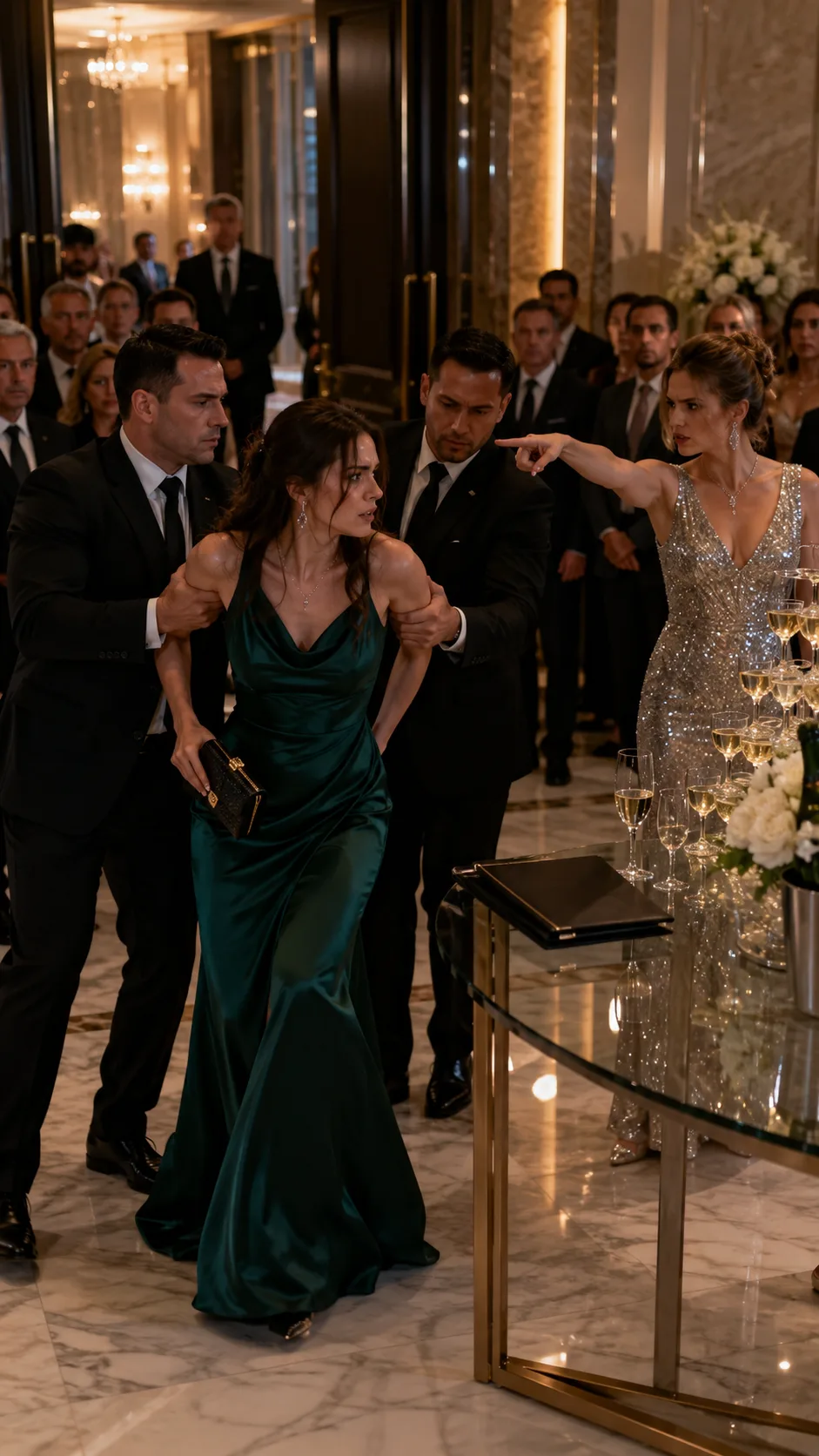
The guard approached from behind a marble column. Another came from near the door. Both wore black suits and earpieces, their faces trained into nothing.
I looked toward the glass table in the center of the room.
The black folder still sat there.
Closed.
Chairman Hale had not arrived yet.
Daniel stepped in front of me, blocking my path.
“Don’t do this.”
“Move.”
His eyes flicked to the clutch again.
“What’s in there?”
I took one step around him.
He caught my wrist.
Not hard enough to bruise. Hard enough for the people watching to understand he believed he had the right.
“Emily.”
I looked down at his hand.
He released me.
Too late.
A woman near the flower wall saw. So did one of the men from acquisitions. So did a server carrying a tray of empty glasses, who froze long enough for one glass to slide against another.
Vanessa’s voice cut in.
“She came here to embarrass us.”
Us.
That word put Daniel back beside her.
Charles adjusted his cuff.
“Enough.”
The first guard took my left arm.
The second reached for my right.
I shifted my weight so I wouldn’t stumble. My heel scraped across the marble, a thin ugly sound that carried too far. Daniel held my invitation card in one hand. Vanessa stepped aside to give the guards room, lifting the hem of her silver dress as if I might brush against it.
“She doesn’t belong here,” Vanessa said.
A few guests turned fully now. Reporters behind the velvet rope raised their phones, then lowered them when a staff member shook his head.
Daniel lifted the cream card in front of my face.
“You really thought anyone would believe this?”
The guard on my right pulled.
My clutch pressed against my ribs.
Inside it, under my lipstick and a folded tissue, was the original voting transfer notice my mother had signed eight days before she died. Not a photocopy. Not a scan. The original. Margaret had kept it inside a cookbook for four years because my mother had asked her to hide one thing no one could amend later.
I had planned to give it to Chairman Hale quietly.
Quiet was gone.
The guards moved me past the champagne table. Vanessa walked beside us for two steps, smiling without showing teeth now. Daniel followed, still holding my invitation. Charles stayed near the center of the room, letting other people do the touching.
That was always his gift.
The champagne tower trembled as my hip brushed the edge of the glass table. One flute tipped, leaned, and settled back with a tiny ring.
No one moved to help.
Not one person.
Then the ballroom doors opened.
The sound was not loud. Just the soft pull of brass handles and the low complaint of hinges.
But the room heard it.
Everyone did.
Chairman Richard Hale entered without announcement.
He was smaller than his portraits made him look, leaner, older, with white hair combed back and a black suit that did not need shine to look expensive. He wore plain cufflinks. No pocket square. No smile.
Behind him walked a young assistant carrying a black leather folder against his chest.
Charles turned first.
Daniel’s hand froze around my invitation card.
Vanessa’s finger, still half-raised from pointing, stayed in the air for one ugly second too long.
The guards stopped pulling, but they did not let go.
Chairman Hale looked at them.
Then at me.
His eyes moved to my left arm, where the guard’s hand still held my sleeve.
The guard released me.
The second guard followed.
My skin kept the shape of their fingers for a second after their hands were gone.
Chairman Hale walked forward. The guests parted without being asked. A champagne flute disappeared from someone’s hand onto a nearby table. The reporters behind the velvet rope leaned in.
Charles smiled.
“Richard, there’s been a misunderstanding.”
Chairman Hale did not look at him.
“Emily Carter.”
My name crossed the ballroom cleanly.
Not loud.
Clean.
Every whisper stopped trying to be hidden.
I straightened the shoulder of my dress with two fingers.
“Yes, Chairman Hale.”
He turned his head toward the guards.
“Why is the new controlling shareholder being dragged out of her own party?”
The room did something strange.
It did not gasp.
It emptied.
Not of people. Of certainty.
Daniel’s face did not change all at once. First his mouth loosened. Then his eyes dropped to the card in his hand. Then his thumb moved over my name as if the raised gold letters might rearrange themselves into someone safer.
Vanessa took half a step back.
Charles did not move.
That made him look worse.
Chairman Hale reached the glass table and held out his hand. His assistant placed the black folder into it. The chairman opened it with two fingers, turned the first page, and laid it flat beside the untouched champagne flutes.
Paper against glass.
A small sound.
Enough.
“This board received amended ownership confirmation at 6:10 this evening,” he said.
Charles spoke then.
“Those documents are under review.”
Chairman Hale turned one page.
“No.”
One word.
Charles’s jaw tightened.
Vanessa looked at her father for the first time that night.
Chairman Hale slid the folder across the glass toward the front row of guests. Not toward me. Toward them.
That was the punishment.
Not secrecy.
Witnesses.
“The review ended before dinner.”
Daniel stepped closer, but not too close.
“Chairman, I think there’s a mistake.”
Chairman Hale looked at him.
Daniel stopped speaking.
The chairman tapped the bottom of the page.
“Read the name.”
Nobody moved.
For a second I thought he meant me.
Then I saw where his finger rested. The ownership confirmation. The voting control line. My mother’s transfer clause, activated by Charles’s unauthorized attempt to consolidate the trust before the succession vote.
Charles had tried to swallow the last piece.
He had triggered it instead.
Daniel looked at the page.
His lips parted.
Nothing came out.
Vanessa moved toward the table, her bracelet flashing under the chandelier.
“That can’t be real.”
I opened my clutch.
The clasp clicked louder this time.
People heard it.
I removed the original notice and placed it on the glass beside Chairman Hale’s folder. The paper had softened at the fold. My mother’s signature sat at the bottom in blue ink, the loop on the C slightly broken where her hand had trembled near the end.
Vanessa stared at it.
Then at the bracelet on her own wrist.
For the first time, she covered it with her other hand.
Chairman Hale did not touch my document. He didn’t need to.
His assistant leaned in, checked the page, and nodded once.
Charles’s gold watch caught the light as his hand curled at his side.
“This is family business,” he said.
“No,” I said.
My voice came out even.
The room turned.
I looked at the folder, then at Charles, then at Daniel, still holding my bent invitation card like it had become evidence against him.
“It was company business when you removed my access badge.”
The server near the champagne tower stopped breathing through his tray.
“It was company business when you transferred my mother’s shares through a trust I never signed.”
Charles’s eyes hardened.
“Careful.”
I placed my palm flat beside my mother’s signature.
“It became everyone’s business when you dragged me out in front of them.”
Vanessa’s mouth opened.
Closed.
Daniel set the invitation card down on the glass table, slowly, as if returning something stolen in a church.
Chairman Hale looked toward the reporters.
“Cameras may stay off,” he said. “Pens may move.”
A few people bent over notebooks.
Charles saw them.
That was when his face changed.
Not completely. Men like Charles did not collapse in public. They edited themselves. But his shoulders lowered half an inch, and his eyes moved from the chairman to the investors to the board members standing near the flower wall.
The room no longer belonged to him.
Chairman Hale turned to me.
“Miss Carter, the emergency vote will proceed with your voting control recognized.”
Vanessa grabbed Daniel’s sleeve.
He did not look at her.
That was crueler than anything he could have said.
Chairman Hale closed the folder halfway, leaving my mother’s signature visible.
“Mr. Reed,” he said, “you will wait outside until counsel arrives.”
Charles gave a short laugh.
No one joined him.
The security guards who had held my arms moved toward him now, but stopped at a respectful distance. Not touching. Not yet. Just there.
Charles looked at them.
Then at me.
For four years, I had imagined that moment bigger. Louder. Maybe with shouting. Maybe with some perfect sentence I would deliver while everyone watched him fall apart.
Instead, I noticed the old coffee stain on his cuff.
A tiny brown dot near the seam.
Human. Ugly. Ordinary.
Vanessa spoke my name.
Not Emily.
Not stepsister.
Not family.
“Em.”
I looked at her.
She held up her wrist, where my mother’s pearl bracelet sat too tight against her skin.
“I can explain this.”
I reached out.
She flinched before my fingers touched the clasp.
I unhooked the bracelet myself.
The pearls slid into my palm, warm from her wrist.
“No,” I said.
The word did not need anything after it.
Daniel picked up the invitation card again, then seemed to remember it was mine. He held it out.
The corner was bent beyond smoothing.
I took it anyway.
Chairman Hale gestured toward the center table, where nameplates had been arranged for the board dinner. Someone moved quickly to change one. Someone else removed Charles Reed’s card and carried it away with two fingers.
The orchestra did not start playing again.
The absence was better.
Charles walked out between the guards without being touched. Vanessa followed two steps behind him, one hand bare at her side. Daniel stayed where he was until the assistant asked him to move away from the table.
He did.
The guests watched all of it.
Not kindly.
Not cruelly.
Worse.
Clearly.
By the time the emergency vote began, the champagne had gone flat.
I sat at the center table with my mother’s bracelet in my clutch and her signature in front of me under a clear document sleeve. Chairman Hale sat to my left. Margaret Liu appeared fifteen minutes later through a side door, wearing the same gray coat with the missing button. She did not come to my table. She stood near the back wall, hands folded, and nodded once when I saw her.
The vote lasted twenty-two minutes.
The consequences took longer.
Charles Reed resigned from all board duties before midnight. By morning, the company’s legal counsel had frozen his executive access and opened a review into the trust transfers. Two days later, his portrait was removed from the Hale Meridian leadership wall. They left the hook in place for a week, a small brass mark on white plaster.
Vanessa deleted her engagement announcement first.
Then her company profile.
Then every photograph where my mother’s bracelet was visible.
Daniel sent one message.
I’m sorry.
There was no punctuation.
I did not answer.
A week after the gala, I returned to the Hawthorne Grand to sign the final ownership documents in a private conference room on the third floor. No chandeliers. No champagne tower. Just a long walnut table, a pot of coffee going cold, and a chair that wobbled every time someone shifted their weight.
Margaret sat across from me with a folder open.
“You don’t have to keep the company,” she said.
“I know.”
“You could sell.”
“I know.”
She looked at my wrist.
I had not worn the bracelet.
It sat in my clutch, wrapped in a clean handkerchief. I still wasn’t ready to put it on. Maybe I never would be. Some things were not meant to be worn just because they were returned.
Chairman Hale signed the last page and slid the pen toward me.
The pen was heavier than it looked.
I wrote my name once.
Emily Carter.
No title.
No borrowed last name.
No one else’s permission attached.
When I left the hotel, the same doorman held the glass door open for me. He did not recognize me at first. Then he did, and his posture changed.
“Good afternoon, Miss Carter.”
Outside, a taxi waited near the curb with one window half-open. The air smelled like rain on hot pavement and the flowers from the lobby being changed for the afternoon.
I took the bent invitation card from my clutch.
The corner was still creased.
I did not smooth it this time.
I kept walking.
Chapter complete
You have reached the end of this chapter.
Continue reading
A few more worlds to get lost in after this chapter.