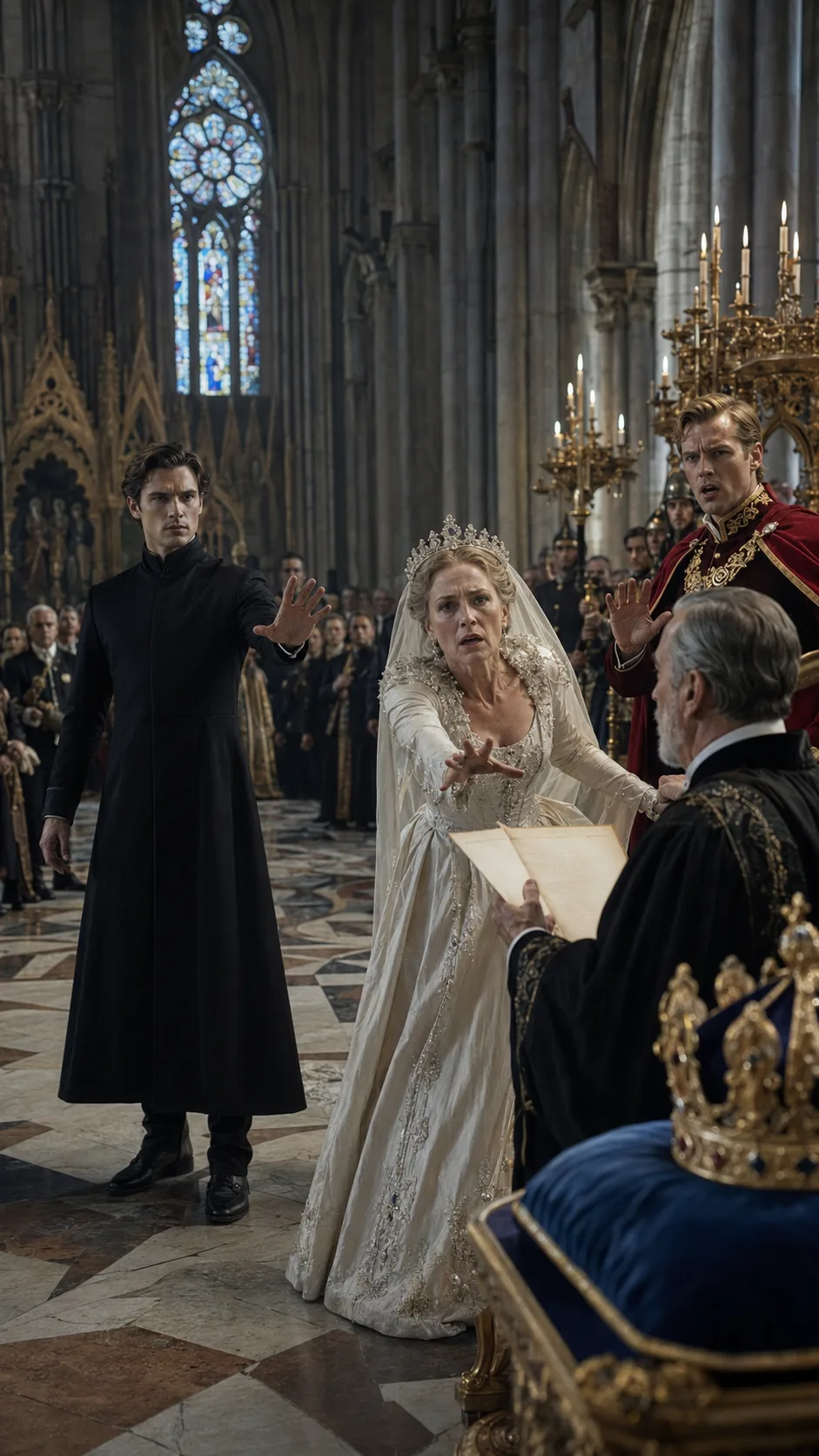
They Called Him the Illegitimate Prince Until the Dead King’s Letter Forced the Crown to Kneel Before Him
Everyone in the Kingdom of Valoria believed Prince Adrian was the shame King Alistair had failed to bury.
Chapter 1
Everyone in the Kingdom of Valoria believed Prince Adrian was the shame King Alistair had failed to bury.
They did not say it loudly in front of the palace gates.
They did not write it in official records.
They did not carve it into stone.
But every servant knew. Every noble repeated it behind silk fans. Every child born inside a titled house learned the same cruel lesson before they learned the names of the provinces.
Prince Adrian was not a real prince.
He was the king’s mistake.
The boy with no rightful mother.
The son born from scandal.
The child who should have stayed hidden behind locked doors and lowered curtains.
At royal banquets, Adrian was seated far from the high table, close enough to see the gold plates but too far to touch the power they represented. At winter ceremonies, when the royal family stood beneath the banners of ancient kings, he was placed half a step behind the cousins, dukes, and distant heirs, as if
his blood had to be kept away from theirs. In official portraits, he was always positioned near the edge of the frame, half-shadowed, never at the center.
And on the morning of his older brother’s coronation, the palace finally made its hatred official.
Prince Edward, golden-haired, polished, adored, and raised since birth to inherit the throne, would be crowned before the entire kingdom.
Prince Adrian would not stand beside him.
He would not wear the silver sash of royal blood.
He would not be announced by the Master of Ceremonies.
He would not even sit with the royal family.
By command of Queen Helena, Adrian was placed in the eighth row, behind foreign envoys, behind military commanders, behind the noble families who had spent years whispering that he was lucky the queen had not thrown him out of the palace altogether.
He was given a plain black coat instead of
ceremonial robes.
No jewels.
No sword.
No royal crest.
Just a seat at the back of the cathedral, where the unwanted could watch history happen without being allowed to touch it.
Adrian arrived without protest.
That was what everyone noticed first.
No anger. No public humiliation. No desperate attempt to prove himself.
He walked into the Grand Cathedral of Valoria with his shoulders straight, his dark hair brushed back neatly, his face calm in a way that made some of the nobles uncomfortable. At twenty-one, he had the same gray eyes as the dead king, though no one liked admitting it. He had the same quiet stillness, the same way of looking at people as if he heard the words they had swallowed.
The court hated that about him.
A bastard should look ashamed.
Adrian never did.
As he passed the first rows, conversations softened. Fans paused. Gloved fingers tightened
around prayer books. The women of the House of Mirelle turned their heads just enough to pretend they were not staring. Lord Varyn, who had once publicly called Adrian “a palace shadow,” smirked into his wine-colored scarf.
At the front of the cathedral, Queen Helena stood beneath the golden canopy, wearing mourning white embroidered with pearls. She had dressed as a grieving widow, but there was no grief in her eyes.
There was victory.
After twenty years of careful cruelty, the son she had despised was finally being erased.
Edward stood beside her, magnificent in a crimson coronation cloak, his blond hair shining beneath the cathedral’s painted glass. He looked like the prince from every tapestry, every royal song, every childhood story told to common children who wanted to believe kings were chosen by heaven.
He saw Adrian take his place in the eighth row.
Then he smiled.
Not for the crowd.
For Adrian.
A small smile. Sharp. Private. The kind of smile a man gives when he believes the final door has closed.
The bishop lifted his hands, and the cathedral bells began to ring.
Their sound rolled across the capital like thunder.
Outside, thousands of people filled the streets, waiting for the first glimpse of their new king. Blue and gold banners hung from every balcony. Children sat on their fathers’ shoulders. Merchants closed their stalls. Soldiers stood at attention along the avenue leading to the palace.
Inside, the high nobles of Valoria rose as one.
Adrian remained seated until the old duke beside him hissed, “Stand.”
He stood.
The coronation began.
It should have been Edward’s greatest hour.
It should have been Adrian’s final humiliation.
Instead, it became the morning Valoria learned that the most dangerous truth in the palace had been sitting quietly in the eighth row.
Adrian had been taught silence before he was taught politics.
His mother, Lady Marianne, died when he was seven. Before that, she had lived in the eastern wing of the palace, in rooms that smelled of lavender, ink, and rain on stone. She was not a queen. She was not born into one of the old noble houses. She had no army, no council faction, no ancestral castle.
But King Alistair had loved her.
That was the first crime.
The second was that she gave birth to Adrian.
No one ever said when the whispers began. Whispers in palaces had no beginning; they simply appeared one day, already wearing perfume and jewels, already seated at dinner tables, already passing from one mouth to another as if they had always existed.
Lady Marianne had trapped the king.
Lady Marianne had lied about the child.
Lady Marianne had brought shame into the royal bloodline.
Queen Helena never needed to accuse her directly. Helena was too skilled for that. She smiled in public. She sent flowers when Marianne fell ill. She allowed Adrian to attend ceremonies, but never in a place of honor. She never raised her voice. She never had to.
A queen did not need to strike when an entire court would do it for her.
After Marianne’s death, Helena ordered her rooms emptied within three days.
Adrian remembered standing in the hallway while servants carried out trunks of gowns, books, letters, and small painted boxes. One maid wept quietly as she folded a blue shawl Adrian’s mother had worn every winter.
Helena saw the tears.
“Burn it,” the queen said.
The maid froze. “Your Majesty?”
“Burn it,” Helena repeated. “The palace has no need to preserve sentimental clutter.”
Adrian had been too young to stop them.
He watched smoke rise from the courtyard that evening, black against the violet sky, carrying away the last traces of the only person who had ever held him without fear.
That night, King Alistair came to his room.
The king did not wear his crown. Without it, he looked older, softer, almost breakable. He sat on the edge of Adrian’s bed and placed a hand over his son’s small fingers.
“I am sorry,” he said.
Adrian did not answer.
At seven years old, he had already learned that adults often apologized for pain they had no intention of stopping.
Years passed.
Edward grew brighter.
Adrian grew quieter.
Edward was trained for admiration. He learned how to wave from balconies, how to smile at ambassadors, how to make a crowd believe he had noticed each of them personally. Every tutor praised his confidence. Every commander praised his posture. Every noble mother praised his beauty and whispered that her daughter would be lucky to marry such a prince.
Adrian was trained by omission.
If Edward received three tutors, Adrian received one retired scholar with trembling hands and no influence. If Edward trained with the royal guard, Adrian practiced in the old courtyard with damaged swords. If Edward studied statecraft with the council, Adrian read discarded reports from the archive after midnight.
He learned more that way.
He learned which noble houses were drowning in debt.
He learned which generals smiled at the king but wrote private letters to foreign courts.
He learned which grain routes failed every winter and why the palace never fixed them.
He learned that a kingdom was not held together by crowns, speeches, or bloodlines.
It was held together by the people no one at court bothered to notice.
Stable boys.
Tax clerks.
Border nurses.
Harbor inspectors.
Old soldiers with missing fingers.
Widows who knew which officials stole bread money before famine season.
Adrian listened to them.
That was his secret education.
The court thought they had pushed him into shadows.
They never realized shadows had ears.
The only person in the palace who seemed to understand this was King Alistair.
In public, he was distant. Too distant. Painfully distant. He allowed Helena to control seating charts, guest lists, ceremonies, and punishments. He allowed Edward to stand beside him at every official appearance. He allowed the court to believe Adrian had been tolerated out of mercy, not accepted out of love.
But sometimes, late at night, Adrian would find a candle burning in the royal study.
A servant would appear at his door and say, “His Majesty requests your presence.”
Those nights were the only time Adrian felt like a son.
The king would show him maps, treaties, old royal decrees, letters from border governors, reports from villages Edward never bothered to pronounce correctly.
“Tell me what you see,” Alistair would say.
At first, Adrian thought the king wanted answers.
Later, he understood the king wanted judgment.
Once, when Adrian was sixteen, he looked over a report about drought in the southern province of Maren and said, “The council is lying.”
The king looked up.
Adrian tapped the page. “They say the wells are dry because of poor rainfall, but grain exports from Maren increased last month. Someone is redirecting water to private estates. The farmers are thirsty because the nobles are watering vineyards.”
The king watched him for a long moment.
Then he smiled sadly.
“You see the kingdom more clearly than men twice your age.”
“Then why do you let them call me useless?”
The question escaped before Adrian could stop it.
Silence filled the room.
King Alistair leaned back in his chair. The candlelight sharpened the lines around his eyes.
“I have made mistakes,” he said.
Adrian almost laughed.
Mistakes.
That was what powerful men called wounds when they did not want to name the knife.
“Am I one of them?” Adrian asked.
The king’s face changed.
“No.”
The answer came so quickly, so fiercely, that Adrian forgot how to breathe.
Alistair stood and crossed the room. For a moment, he looked less like a king than a father who had reached the edge of his own endurance.
“You are not my mistake,” he said. “You are the only thing in this palace that still reminds me what truth looks like.”
“Then tell them.”
The king looked toward the locked cabinet beside his desk.
“I will.”
“When?”
Alistair closed his eyes.
“When it can no longer be buried.”
Adrian hated that answer.
He hated it for years.
Then the king died.
The official announcement came at dawn on a cold spring morning.
His Majesty King Alistair IV had passed peacefully in his sleep after a sudden fever.
The bells rang thirty-three times.
The kingdom wore black.
Queen Helena appeared on the palace balcony with Edward beside her, one handkerchief pressed delicately to her lips. Her face was pale. Her grief was perfect. Edward stood tall, solemn, tragic, already half a king.
Adrian stood behind them, unseen by the crowd.
No one asked him to speak.
No one asked whether he had said goodbye.
He had not.
The previous night, he had been denied entry to the king’s chamber.
“His Majesty must rest,” Queen Helena had told him, blocking the door with two guards at her side.
“He asked for me,” Adrian said.
Helena’s expression did not move.
“His Majesty is dying. Do not make this about your need for attention.”
Edward, standing behind her, looked amused.
Adrian tried to push past.
The guards stopped him.
He heard his father coughing behind the door.
Then a voice, faint but unmistakable:
“Adrian…”
The guards held him harder.
By morning, the king was dead.
Three days later, the council confirmed Edward as heir.
No debate.
No investigation.
No delay.
The coronation was scheduled for the first full moon after the mourning period, a speed that made even some old nobles exchange glances. But Helena controlled the council. Edward controlled the guard. And Adrian, according to the official decree read aloud before the court, held “no legal claim to succession due to the unresolved irregularities of his maternal standing.”
Unresolved irregularities.
That was what they called his mother.
That was what they called him.
During the council session, Edward leaned back in the heir’s chair and said, “Brother, you may keep your rooms for now. I would not want anyone to accuse me of being cruel.”
The nobles laughed softly.
Adrian looked at him.
“For now?” he asked.
Edward’s smile widened.
“After the coronation, I intend to make the palace respectable again.”
Queen Helena lowered her eyes, pretending to disapprove.
But she did not stop him.
Adrian said nothing.
That disappointed them. He could see it. They wanted anger. They wanted him to shout, threaten, break something, make himself look unstable. They wanted one last scene they could use to remove him permanently.
So Adrian gave them silence.
He bowed.
Not deeply.
Just enough.
Then he walked out of the council chamber with every noble eye burning into his back.
That night, he packed nothing.
He did not run.
He did not beg foreign ambassadors for protection.
He did not gather loyal servants and whisper of rebellion in cellars.
He simply opened the lowest drawer of his desk and removed the small silver dagger King Alistair had given him years before. The dagger was plain, almost severe, except for the royal crest engraved beneath the hilt.
A lion standing before a broken crown.
Adrian pressed his thumb against the engraving.
For years, he had thought the dagger was an apology.
Now he wondered if it had been a warning.
The coronation morning arrived bright and cold.
Valoria dressed itself in celebration.
The capital was washed clean before sunrise. Streets were covered with blue carpets. Flower petals filled the fountains. Musicians played from balconies. Priests burned incense on the cathedral steps while soldiers kept the crowds back with polished spears.
Inside the Grand Cathedral, power arranged itself by rank.
The oldest noble houses took the front rows.
Foreign rulers sat beneath embroidered banners.
The council occupied a raised section near the altar.
The royal family sat under a golden canopy, every seat marked with a name except one.
Adrian’s name was not there.
A young attendant, cheeks flushed with embarrassment, approached him near the entrance.
“Your seat, Your Highness.”
He held out a card.
Row Eight. Seat Twelve.
Behind Lord Varyn.
Beside a tax minister from the northern coast.
Adrian took the card.
The attendant could not meet his eyes.
“I am sorry,” the boy whispered.
Adrian looked at him for a moment, then said quietly, “Do not apologize for orders you did not give.”
The boy’s face tightened with gratitude.
That, more than the insult, hurt.
Even servants pitied him now.
Adrian walked to the eighth row.
Every step seemed designed for public shame. The aisle was long. The cathedral was full. The whispers rose and fell like insects in summer grass.
“There he is.”
“No sash.”
“Helena finally did it.”
“After today, he will be sent away.”
“Edward should have done it years ago.”
Adrian sat.
Ahead of him, Edward stood at the altar with the bishop.
The crown of Valoria rested on a cushion of blue velvet. It was older than the palace, older than the current dynasty, a heavy circlet of gold set with seven dark sapphires, each one said to represent a province that had bent the knee to the first king.
Edward glanced back once.
His eyes found Adrian.
Then his gaze dropped deliberately to Adrian’s plain black coat.
Edward’s mouth curved.
Adrian looked away.
Not because he was afraid.
Because he had finally understood something his father had tried to teach him.
A man who needed to humiliate others to feel like a king had already confessed he was not one.
The ceremony began with prayers.
Then came the oaths.
Edward repeated them beautifully.
“I swear to guard the borders of Valoria.”
His voice rang clear.
“I swear to protect the weak, honor the law, preserve the bloodline, and rule not for myself, but for the kingdom.”
Adrian almost smiled at that.
Helena noticed.
Her eyes narrowed.
The bishop lifted the crown.
The cathedral held its breath.
Edward lowered himself to one knee.
Outside, the bells waited.
Inside, history bent toward a lie.
Then the doors opened.
Not gently.
Not with the careful timing of a late noble trying to avoid notice.
The great bronze doors of the cathedral swung inward with a sound like thunder cracking stone.
Every head turned.
At the far end of the aisle stood Lord Cedric Vale, Royal Advocate of the Crown.
He was seventy years old, thin as a blade, dressed not in ceremonial velvet but in the severe black robes of legal authority. His white hair was windblown. His face was pale. In one hand, he held a leather case. In the other, a sealed letter.
The seal was black wax.
Marked with the private signet of King Alistair.
The bishop froze with the crown still in his hands.
Queen Helena stood so fast her pearls struck against her collarbone.
“This ceremony is sealed,” she said, her voice sharp enough to cut through the incense. “No one enters without royal permission.”
Lord Cedric did not bow to her.
That was the first shock.
He walked forward.
The second shock was that the palace guards did not stop him.
Instead, two older captains stepped aside.
Edward rose slowly from his kneeling position.
“What is the meaning of this?” he demanded.
Lord Cedric stopped at the foot of the altar.
He looked up at the crown.
Then at Edward.
Then at Queen Helena.
Finally, his eyes moved to the eighth row.
To Adrian.
The entire cathedral followed his gaze.
Adrian did not move.
Lord Cedric’s voice carried through the vaulted chamber.
“Before his death, His Majesty King Alistair IV placed a final legal instruction in my custody. By royal law, it was to be opened only at the moment the crown passed to the next sovereign.”
Helena’s face went white beneath her powder.
“There is no such document,” she said.
Cedric lifted the sealed letter.
“There is.”
Edward laughed once, too loudly.
“An old man arrives with a piece of wax and expects a kingdom to kneel? Remove him.”
No one moved.
Edward looked at the guards.
“I said remove him.”
Still, no one moved.
That was when the first ripple of fear passed through the cathedral.
Power was shifting, though no one yet knew where it would land.
Lord Cedric broke the black seal.
The sound was small.
The effect was enormous.
Helena stepped down from the canopy.
“Cedric,” she said, and for the first time in Adrian’s life, there was something almost pleading in her voice. “Think carefully.”
The old lawyer looked at her.
“I have thought carefully for twenty-one years.”
The cathedral became so silent that Adrian could hear the flame of the altar candles flickering.
Cedric unfolded the letter.
His hands trembled, but his voice did not.
“To the Council of Valoria, the High Clergy, the Royal Guard, and any citizen who hears these words after my death…”
The moment he read the first line, Adrian knew.
That was his father’s voice.
Not the voice from balconies.
Not the voice from decrees.
The real one.
The tired, steady voice from the study after midnight.
“If this letter is being read, then I have failed to speak the truth while I lived. Let my final command do what my fear could not.”
Edward stared at the letter as if it had become a snake.
Helena whispered, “Stop.”
Cedric continued.
“For twenty-one years, my son Adrian has borne a disgrace that was never his. He was called illegitimate. He was excluded, insulted, and treated as a stain upon this house. I allowed this cruelty to continue because I believed silence would keep him alive.”
Adrian’s fingers tightened around the edge of his seat.
Around him, people shifted away as if truth might burn.
Cedric read on.
“But the stain was never Adrian’s.”
Edward’s face hardened.
“The child born outside rightful blood was not Adrian.”
A gasp moved through the cathedral.
Helena swayed.
Edward took one step back.
Cedric’s voice grew colder.
“Years ago, during the winter of rebellion, Queen Helena delivered a son. That child did not live beyond his first night.”
Someone cried out.
Helena’s lips parted, but no sound came.
“To preserve her claim to power, and to prevent the collapse of her faction, the queen conspired with Lord Varyn, Mistress Selene of the nursery, and three members of the old household guard to exchange the dead infant with a living child taken from a noble servant family.”
Lord Varyn shot to his feet in the front row.
“This is treason!”
Cedric turned toward him.
“Yes,” he said. “It is.”
The old lawyer reached into the leather case and removed three folded documents.
“Signed confession of Mistress Selene before her death. Blood record of the royal physician. Private correspondence bearing Queen Helena’s cipher. All sealed by the late king and witnessed by the former Archbishop.”
Edward’s beauty seemed to collapse from the inside.
“No,” he said.
No one answered him.
Cedric turned back to the letter.
“The boy raised as Prince Edward is not of my blood.”
The cathedral erupted.
Nobles stood. Priests crossed themselves. Foreign ambassadors leaned toward one another with wide eyes. Guards gripped their weapons. Somewhere near the altar, a lady fainted, though no one had room to care.
Edward grabbed the bishop’s arm.
“Crown me.”
The bishop recoiled.
“Your Highness—”
“Crown me now!”
His voice cracked.
That crack did more damage than any accusation.
Kings did not beg for crowns.
They received them.
Queen Helena rushed toward Cedric and tried to seize the letter.
Adrian moved before he thought.
He stepped into the aisle.
“Do not touch it.”
His voice was not loud.
But it cut through the chaos.
For one frozen second, everyone turned to him.
Helena stared down the aisle at the boy she had spent two decades trying to reduce to a rumor.
“You,” she said.
The word was full of poison.
Adrian walked forward.
Slowly.
Not because he wanted drama.
Because every step carried the weight of every year he had been told not to take up space.
The eighth row.
The seventh.
The sixth.
Past the nobles who had laughed at him.
Past the women who had refused to let their daughters dance with him.
Past Lord Varyn, whose face now shone with sweat.
Past the commanders who had once denied him military training.
Past the councilmen who had signed away his future without meeting his eyes.
He reached the altar.
Edward stood above him on the coronation step, breathing hard.
For the first time, they looked less like brothers than strangers who had been forced into the same portrait.
“You knew,” Edward said.
Adrian shook his head.
“No.”
“Liar.”
“If I had known,” Adrian said, “I would not have spent my life asking why my father was ashamed of me.”
That struck something.
Not in Edward.
In the room.
Because for all the scandal, all the law, all the blood records, there was a human truth beneath it that even the cruelest noble could understand.
A boy had been made to carry another person’s lie.
Cedric lifted the letter again.
“There is more.”
Edward lunged.
A guard caught him.
Not roughly. Not yet.
But enough.
The cathedral saw it.
The golden prince restrained at his own coronation.
Cedric read the final passage.
“My last instruction is this: the crown shall not pass to the son they placed before the world, but to the son they tried to erase. Let Adrian, my trueborn blood and rightful heir, be crowned under the laws of Valoria. Let those who falsified the royal line stand trial. Let no one mistake silence for consent again.”
Then Cedric lowered the letter.
He faced the altar.
His voice, older but stronger than before, filled the cathedral.
“Your Majesty left one final instruction: crown the son they tried to erase.”
No one breathed.
The words settled over the room like judgment.
Adrian stared at the crown.
For years, he had imagined that if the truth ever came, he would feel triumph.
He did not.
He felt grief.
For his mother, whose name had been dragged through mud to protect a queen’s lie.
For his father, who had loved him but lacked the courage to save him sooner.
For the child Edward had once been, raised on stolen certainty until truth destroyed him in front of a kingdom.
And for himself.
For the boy in the muddy courtyard.
For the teenager with a bruised face.
For the prince in the eighth row who had walked into the cathedral expecting to be erased and instead found the dead king waiting in ink.
Queen Helena sank into the nearest chair.
“This cannot happen,” she whispered.
Adrian looked at her.
For twenty-one years, he had imagined what he would say if she ever lost power before him. He had sharpened speeches in his mind during lonely dinners. He had pictured accusations, curses, questions.
But standing there, he found that hatred had exhausted itself.
“You burned my mother’s shawl,” he said quietly.
Helena flinched.
It was not the accusation she expected.
Adrian continued, “You erased her rooms. You let them call her a liar. You taught an entire kingdom to spit on the grave of a woman whose only crime was being loved by the king.”
Helena’s face twisted.
“She was nothing.”
“No,” Adrian said. “You needed her to be nothing. Because if she was something, then everything you did becomes what it always was.”
He stepped closer.
“Fear.”
Edward laughed bitterly.
“Listen to yourself. One letter and you already sound like a king.”
Adrian turned to him.
Edward’s eyes were wet, furious, humiliated beyond control.
“You think they will love you?” Edward demanded. “They bowed to me yesterday. They will bow to you today. That is all this is. Theater. Blood. Wax. A dead man’s guilt.”
Adrian looked at the nobles.
Many lowered their eyes.
Edward smiled cruelly.
“You see? They do not care who you are. They care who holds the crown.”
Adrian did not deny it.
That was the first reason the room began to believe him.
“You are right,” he said.
Edward’s smile faltered.
Adrian turned toward the entire cathedral.
“You are right,” he repeated, louder. “Many people in this room would have bowed to Prince Edward if the letter had never been opened. Many of you laughed when I was seated behind your sons. Many of you used the word illegitimate because it was safer than questioning why a queen needed a child hated.”
The silence deepened.
Adrian looked from face to face.
“I will remember that.”
A cold fear moved through the nobles.
Then he added, “But I will not rule by revenge.”
That surprised them more.
“I know what it is to live under a lie written by people with power. I know what it is to have your name taken from you while everyone pretends procedure makes cruelty respectable. So hear me clearly.”
He turned toward Cedric.
“If the law names me heir, then the law will also judge those who broke it. Not rumor. Not mob violence. Not private vengeance. Trial.”
Cedric bowed his head.
“As the rightful heir commands.”
Edward spat, “Rightful heir.”
Adrian faced him again.
“You were raised to believe the crown was yours. That lie was done to you before you were old enough to choose it.”
For a moment, Edward looked almost wounded.
Then pride returned.
“Do not pity me.”
“I do not,” Adrian said. “But I will not pretend the queen’s crime began with you.”
Helena stood abruptly.
“My crime?” she hissed. “You foolish boy. You think blood makes a king? Blood is nothing without power. I held this kingdom together while your father hid in guilt and your mother played at innocence.”
Adrian’s expression did not change.
“You held your position together. Not the kingdom.”
Helena raised her hand.
Perhaps she meant to slap him.
Perhaps she only meant to point.
She never got the chance.
Captain Rowan of the Royal Guard stepped between them.
The cathedral gasped again.
Rowan had served Queen Helena for fifteen years. He had escorted her through riots, ceremonies, funerals, and council disputes. He had once dragged a drunken noble out of a banquet for insulting her dress.
Now he bowed to Adrian.
“Your command, Your Highness?”
Helena looked at him as if he had driven a dagger into her heart.
Adrian glanced at Cedric.
“By law, can the coronation proceed?”
Cedric answered, “Yes. The succession challenge was delivered before the crown touched Edward’s head. The bishop may crown the lawful heir.”
The bishop looked terrified.
Adrian almost felt sorry for him.
Almost.
Edward shook off the guard’s hand.
“You think they will accept you?” he said. “A prince they were trained to despise? A shadow? A scandal?”
Adrian looked at the crown again.
Then he looked beyond it, through the open cathedral doors, where he could see a strip of daylight and hear the distant noise of the waiting crowd.
“No,” he said. “Not today.”
That honesty stunned even Cedric.
Adrian stepped onto the coronation platform.
“I do not expect love from a kingdom that has been taught to hate me. I do not expect loyalty from a court that survived by lying. I do not expect trust from people who have only ever seen me pushed aside.”
He knelt before the bishop.
“But I will give them truth. And if truth is not enough to make me loved, it will at least be enough to make this crown clean.”
The bishop’s hands trembled as he lifted the crown.
For one terrible second, Adrian thought of running.
Not from fear of Edward.
Not from Helena.
From the weight.
A crown looked smaller from the eighth row.
Up close, it looked like a sentence.
Then he remembered his father’s voice.
A king does not wear gold because he is worthy. He wears it to remind himself that the kingdom is heavier than his own pain.
The crown descended.
Cold gold touched Adrian’s dark hair.
The bells outside began to ring.
Not the planned coronation peal.
A confused, uneven thunder as the bell keepers realized history had changed while their hands were already on the ropes.
Inside the cathedral, Cedric knelt first.
An old man in black robes bending with visible effort.
“Long live King Adrian of Valoria.”
For one heartbeat, no one moved.
Then Captain Rowan knelt.
Then the bishop.
Then one of the foreign queens.
Then the northern tax minister from the eighth row.
The nobles followed slowly, unwillingly, beautifully afraid.
Lord Varyn remained standing.
Adrian saw him.
So did the guard.
Varyn’s knees struck the marble a moment later.
Finally, only Edward and Helena stood.
Edward looked at the kneeling court as if the world had betrayed him personally.
Helena looked at Adrian with hatred so pure it seemed almost holy.
“You will regret this,” she said.
Adrian stood beneath the weight of the crown.
“No,” he replied. “I regret that my father waited until death to tell the truth. I regret that my mother died hearing lies outside her door. I regret that a stolen child was raised to believe cruelty was birthright. But this?”
He looked around the cathedral.
The court kneeling.
The old letter open.
The false coronation broken.
The eighth row empty behind him.
“This is the first thing in my life I do not regret.”
Helena was arrested before the altar.
Not dragged.
Not struck.
Adrian would not give the court a spectacle of violence to replace the spectacle of truth. He ordered her escorted with dignity, because dignity given to the guilty proved more power than humiliation given to the innocent.
Edward was not imprisoned that day.
That surprised everyone.
Perhaps Edward most of all.
Adrian ordered him confined to the west wing until the trial determined what he had known, what he had hidden, and what crimes were his rather than his mother’s.
Edward laughed when the order was given.
“You still want to seem merciful.”
“No,” Adrian said. “I want to be just. There is a difference. You never learned it.”
The words landed harder than any slap.
By sunset, the truth had reached the streets.
At first, the capital did not believe it.
Then the cathedral doors opened, and King Adrian stepped out wearing the crown.
The crowd fell into stunned silence.
For years, they had seen him from afar, if they noticed him at all. The dark-haired prince at the edge of ceremonies. The rumored bastard. The royal embarrassment. The boy never mentioned in official songs.
Now he stood at the top of the cathedral steps as the lawful king.
Behind him, Queen Helena was escorted into a sealed carriage.
Behind her, Edward stood between two guards, no crown on his head, no crimson cloak on his shoulders.
The people began whispering.
Then shouting.
“What happened?”
“Where is Edward?”
“Is it true?”
“Is he the king?”
Adrian raised one hand.
The noise did not stop immediately.
He waited.
That was something King Alistair had taught him.
Weak men demand silence.
Strong men can survive waiting for it.
Slowly, the crowd quieted.
Adrian looked out over thousands of faces.
He had no prepared speech. Edward’s speech was probably folded somewhere inside the cathedral, full of polished promises and empty grandeur.
Adrian had only the truth.
“For twenty-one years,” he said, “you were told I was a shame to this kingdom.”
His voice carried down the steps.
“You were told my mother dishonored the crown. You were told I had no rightful name. Today, before the law, the church, the guard, and the council, those lies ended.”
The crowd shifted like a living sea.
“I will not ask you to change your hearts in one morning. A kingdom cannot unlearn a lie simply because a crown changes heads.”
Some people lowered their eyes.
“But I swear this: no child in Valoria will be punished for the sins of the powerful. No name will be erased because the truth is inconvenient. No throne will be protected by burying the innocent beneath scandal.”
He paused.
“And my mother’s name was Marianne.”
The silence after that was different.
Softer.
“She was not a stain. She was not a mistake. She was loved. She was lied about. And from this day forward, her name will be restored to the royal record.”
A woman in the crowd began to cry.
Not loudly.
But others heard it.
Adrian continued.
“My first decree as king is not against a person, but against a lie. The archives will be opened. The succession records will be examined. The council will answer before public law. And every person involved in falsifying the royal bloodline will face trial.”
He looked back once toward the palace.
“Valoria has had enough secrets.”
That was the sentence the people remembered.
Not the legal claim.
Not the blood record.
Not even the dead king’s letter.
Valoria has had enough secrets.
By morning, it was written on pamphlets across the capital.
By the end of the week, farmers were repeating it in village markets.
By the end of the month, it was painted on the walls of the old council hall where Lord Varyn was tried.
The trials lasted forty-seven days.
Mistress Selene’s confession revealed the child swap in precise detail. Queen Helena’s physician admitted the queen’s baby had died before dawn. Lord Varyn confessed only after Cedric presented letters written in Helena’s private cipher, promising him control of the southern trade routes in exchange for silence.
Helena never confessed.
Even when the evidence became undeniable, she sat in court wearing black silk and said nothing except, “I did what queens must do.”
Adrian attended every day.
Not from the throne.
From a plain chair beside the judges.
The nobles hated that. They wanted him distant, symbolic, safely royal. Instead, he listened to testimony like a man who understood that law meant nothing if the wounded never got to watch the powerful answer.
Edward testified on the thirty-first day.
The courtroom was packed.
He entered without royal colors, wearing a dark coat with no crest. For the first time in his life, people looked at him without certainty. Some pitied him. Some despised him. Some simply wanted to see how a fallen prince walked.
He walked like a man stepping over broken glass and pretending not to bleed.
Under questioning, he admitted he had heard rumors of forged records.
He admitted Queen Helena had once warned him never to ask about the night of his birth.
He admitted he had known Adrian was treated unjustly.
But he denied knowing the full truth.
When Cedric asked why he never questioned the cruelty, Edward looked toward Adrian.
For a long moment, neither man spoke.
Then Edward said, “Because it benefited me.”
No excuse.
No tears.
Just the first honest sentence Adrian had ever heard from him.
The courtroom went silent.
Cedric asked, “Did you believe Prince Adrian deserved what was done to him?”
Edward’s jaw tightened.
“No.”
“Then why did you participate?”
Edward looked away.
“Because if he was nothing, then I was everything.”
Adrian closed his eyes.
That was the palace in one sentence.
Helena was sentenced to life confinement in the northern abbey, stripped of title and name in the royal line.
Lord Varyn was stripped of land and imprisoned.
The surviving guards involved in the exchange were tried according to their roles.
Edward was banished from succession and removed from royal privilege, but Adrian did not imprison him.
Instead, he gave him a choice.
A small estate near the western coast under supervision, or service in the public restoration office, helping return lands and titles stolen under Helena’s faction.
Edward stared at him when the offer was made.
“You want me to repair what I helped break?”
“Yes.”
“That is cruel.”
Adrian shook his head.
“No. Cruelty would be locking you away where you never have to see the damage.”
Edward hated him for that.
But he chose service.
Years later, some would say King Adrian had been too merciful.
Others would say he had been colder than they understood.
Because every day Edward sat in a public office, signing corrections to records, returning property, facing citizens who had suffered under the court that raised him, he lived inside the truth he had once avoided.
Adrian never called it revenge.
But he never denied that justice could have teeth.
Three months after the coronation, the royal portrait hall was changed.
The old painting of Queen Helena was removed from the central gallery and placed in the archive of disgraced regents.
Edward’s coronation portrait, unfinished when the truth emerged, was locked away.
And in the place where Adrian’s childhood portrait had once hung half-shadowed at the edge of a corridor, a new painting was unveiled.
Lady Marianne stood beside King Alistair, not behind him.
Her hand rested on the shoulder of a young Adrian.
Below the frame, engraved in gold, were the words:
Marianne of Valebrook, Beloved of the Crown, Mother of King Adrian I.
Adrian stood before the painting alone after the ceremony ended.
No court.
No guards.
No applause.
Just him and the mother whose name had finally come home.
He reached into his coat and removed the old silver dagger his father had given him.
For years, he had carried it like a question.
Now he understood.
The broken crown beneath the lion was not a symbol of shame.
It was the old crest of the first king of Valoria, used before the royal line became obsessed with purity and power. It meant the crown could break, but the kingdom must survive.
Adrian placed the dagger beneath his mother’s portrait.
Then he whispered, “They know your name now.”
Outside, the bells began to ring for evening prayer.
This time, they did not sound like thunder.
They sounded like an answer.
King Adrian ruled for forty-three years.
The beginning of his reign was not easy. Nobles tested him. Foreign courts mocked Valoria’s scandal. Old factions tried to paint him as a weak king born from palace chaos. There were riots in two provinces, three assassination attempts, and one failed rebellion led by men who believed Edward would be easier to control.
They were wrong.
Adrian had grown up unwanted in the most dangerous house in the kingdom.
He knew how to survive rooms full of enemies.
More importantly, he knew how to listen to people who had no reason to flatter him.
He reformed the council.
Opened the royal archives.
Created inheritance protections for children born outside noble approval.
Punished officials who used scandal to steal property.
And every year, on the anniversary of his coronation, he refused to sit in the front row of the cathedral.
Instead, he walked to the eighth row.
Seat Twelve.
The first year, the court thought it was symbolic.
The second year, they thought it was theatrical.
By the fifth year, they understood.
The king was reminding them.
Power could place a man in the back.
Truth could call him forward.
And no throne built on lies was ever as safe as it looked.
On the last night of his life, when King Adrian was old and his hair had turned silver, he asked to be taken not to the throne room, but to the portrait hall.
His daughter, Princess Clara, heir to the crown, walked beside his chair.
She was twenty-six, sharp-eyed, stubborn, and loved by the people because she had inherited her father’s habit of listening before speaking.
“Father,” she said softly, “you should rest.”
Adrian looked up at Marianne’s portrait.
“I spent too much of my youth resting in places others chose for me.”
Clara smiled sadly.
He reached for her hand.
“When they crown you,” he said, “do not let them make the ceremony too clean.”
She frowned.
“What does that mean?”
“It means every crown has blood under it somewhere. Every dynasty has a locked room. Every court has a lie it calls tradition.” His grip tightened. “Open the rooms. Question the traditions. And if anyone tells you silence protects the kingdom, ask them who benefits from being protected.”
Clara knelt beside him.
“I will.”
Adrian looked once more at his mother’s name.
Then he closed his eyes.
The next morning, Valoria mourned.
Not because a flawless king had died.
Adrian had never pretended to be flawless.
They mourned because a boy once seated behind the nobles had become the king who forced nobles to answer to the people. Because the prince called illegitimate had made law more legitimate than blood. Because the child they tried to erase had written so deeply into the kingdom that no one could remove him again.
At Clara’s coronation, the cathedral was full.
The crown rested on blue velvet.
The bishop lifted it.
And before he placed it on her head, Clara turned toward the eighth row.
Seat Twelve was empty.
By her order, it would remain empty at every coronation forever.
Not as an insult.
As a warning.
For every future ruler.
For every courtier who thought cruelty became lawful when spoken politely.
For every queen, prince, minister, or noble tempted to hide a crime beneath ceremony.
The empty seat said what Adrian’s life had proved.
The person you push to the back of the room may be the only one history came to crown.
THE END.
Chapter complete
You have reached the end of this chapter.
Continue reading
A few more worlds to get lost in after this chapter.