The first coin hit the bottom of the coffee tin at 6:12 in the morning.
Chapter 1
The first coin hit the bottom of the coffee tin at 6:12 in the morning.
Arthur Vale heard it from the bench outside St. Bartholomew’s, where the stone still held last night’s cold. A woman in running shoes had dropped it without slowing down. She did not look at him. Her ponytail swung once, clean and bright under the streetlamp, and then she was gone.
Arthur looked at the tin.
One quarter.
He smiled at it the way a man smiles at a joke only he understands.
The tin was not his. It belonged to a young man named Nico who slept three benches down and tied a red grocery bag around his left shoe when it rained. Nico had gone to the shelter breakfast line before sunrise and left the tin behind. Arthur had moved it away from the curb so nobody would kick it into the street.
That was all.
A bus hissed at the corner. Steam rose from a grate. Somewhere nearby,
a delivery truck reversed with three sharp beeps, and a bakery door opened long enough to release the smell of butter.
Arthur buttoned the top of his coat.
The coat had been black once. Good wool. Italian. The sleeve lining still held, though the cuffs had frayed and the shoulders were stained from last night’s rain. It had belonged to him for twenty-seven years, longer than some marriages, longer than most partnerships, longer than the restaurant that now carried his name in gold letters above a marble entrance six blocks away.
L’Aurelian.
The newspapers liked to call it a jewel box.
Arthur had called it impossible.
Not at first. At first it had been a dead tailor shop with cracked tile, two mice in the wall, and a landlord who wanted six months up front. He was thirty-one then, with one borrowed suit, burned wrists from kitchen steam, and a
wife who could make a room feel warmer by entering it.
Marianne had stood in the center of that ruined space and said, “Put the bar there.”
Arthur had laughed.
“There’s no plumbing there.”
“Then move the plumbing.”
She always said things as if the world were waiting to obey.
Now the world had obeyed too much.
Arthur reached into his coat pocket and touched the folded envelope inside. The paper was thick. Cream-colored. His lawyer had insisted on it, as if paper weight could make betrayal feel more official.
The envelope carried three names.
Dorian Vale.
Miles Crewe.
Elaine Porter.
His son. His general manager. His public relations director.
The people who had spent eighteen months convincing the board that Arthur was too old to understand his own company. The people who smiled on camera when they opened the Boston location. The people who quietly removed his portrait from
the private dining room last winter and told the staff it was part of a “brand refresh.”
Arthur had not argued.
He had listened.
That was one gift age gave a man. People mistook silence for weakness and filled it with useful evidence.
A taxi rolled through a puddle near the curb. Dirty water splashed Arthur’s trousers below the knee.
He looked down.
The stain spread slowly.
A woman carrying flowers stepped around him with careful distance. Her perfume trailed after her, expensive and clean. She held white lilies wrapped in brown paper and pressed her phone between cheek and shoulder.
“No, no, he’ll love the table,” she said. “It’s L’Aurelian. They don’t make mistakes.”
Arthur watched her disappear toward Madison Avenue.
His left hand tightened around the envelope.
They did make mistakes.
They had made one that morning.
They believed he would arrive through the private entrance.
At seven-thirty, the side door of L’Aurelian opened for deliveries.
Two men rolled in crates of fennel, blood oranges, and green glass bottles of sparkling water. Arthur stood across the street beneath a black awning and watched. The rain had weakened to a mist that clung to windows and hair. Taxis slid past with their lights on. The restaurant’s brass door handles had already been polished; even from across the street, he could see his reflection break across them.
He could have crossed then.
He could have tapped the glass, asked for Sofia in reservations, asked for Chef Bernard, asked for any of the old names that still knew his.
Instead, he stayed where he was.
A busker near the subway stairs played a saxophone with one glove missing. The music bent low and thin through the morning. A paper cup sat at his feet, dotted with coins.
Arthur looked at the cup.
The city had a strange devotion to containers.
Cups for pity. Glasses for wine. Envelopes for lies.
At eight-fifteen, his phone vibrated.
It was an old flip phone, scratched along the edge. Dorian hated it.
“You’re impossible to manage with that thing,” his son had said the last time they met.
Arthur had opened it.
“I was never meant to be managed.”
The message on the screen came from Beatrice Hawn, his attorney.
Board has gathered. Dorian believes you are out of state. Confirming vote at noon unless you appear.
Arthur typed with one thumb.
I’ll appear.
Then he closed the phone and crossed the street.
A young hostess stood just inside the glass doors, arranging menus in a leather folder. She looked up as Arthur approached, and her face changed before she reached the handle.
Not fear.
Calculation.
She opened the door only halfway.
“Good morning,” she said. “Deliveries are through the side entrance.”
Arthur removed his hat.
His hair was white and damp, flattened unevenly across his forehead. He had shaved that morning in a train station restroom using a cracked mirror and a dull razor. A narrow strip along his jaw had escaped the blade.
“I’m here for lunch,” he said.
The hostess blinked once.
“We open at eleven-thirty.”
“I know.”
“Do you have a reservation?”
Arthur looked past her at the room.
The dining room had changed again. New chandeliers. New chairs. The old walnut bar remained, though. Marianne had been right about moving the plumbing. The bar caught the morning light like honey.
“My name is Arthur Vale.”
The hostess looked down at the tablet in her hand. Her thumb moved across the screen.
“I don’t see that reservation.”
“It may be under Vale Holdings.”
That name did something.
Only a little.
Her eyes lifted, but not with recognition. With caution.
“One moment.”
She closed the door gently but firmly, leaving Arthur outside beneath the awning.
Through the glass, he watched her speak to a man near the host stand. The man wore a dark suit and held a phone like a weapon. Miles Crewe. General manager. Forty-four, handsome in a narrow way, with the calm face of someone who had learned to apologize without meaning it.
Miles glanced toward the entrance.
For half a second, Arthur saw recognition cross his face.
Then Miles smiled.
Not at Arthur.
At the hostess.
He said something. She nodded. Then she returned to the door.
“I’m sorry,” she said through the small opening. “Mr. Crewe says there is no reservation under that name.”
Arthur put his hat back on.
“Please tell Mr. Crewe I’ll return at lunch.”
The hostess hesitated.
“Sir, we have a dress code.”
Arthur looked down at his coat, his stained trousers, his soaked shoes.
Then he looked at her.
“Yes,” he said. “I noticed.”
He walked away before she found another sentence.
At eleven-twenty-nine, Arthur returned.
The rain had stopped, but the city had not dried. Water clung to the cuffs of his trousers. His shoes gave a soft wet sound each time he stepped. He had spent the hours between breakfast and lunch walking the old blocks of his life: the first apartment over the laundry, the alley where he once smoked with line cooks after sixteen-hour shifts, the hospital where Marianne had folded her hands over his and told him not to let Dorian sell the soul of the place.
Arthur had made promises before.
Some he kept late.
A black car waited outside L’Aurelian when he arrived. Then another. Then two more. A man in a navy coat helped an older woman onto the curb. A couple posed beneath the gold-lettered sign, laughing while the doorman held the entrance open behind them.
Nobody stopped them.
Nobody asked whether they belonged.
Arthur stepped toward the door.
The doorman’s smile ended before Arthur reached the mat.
“Sir.”
Arthur kept walking.
“Sir, wait.”
Arthur’s hand closed around the brass handle.
The doorman moved too slowly.
The door opened.
Warm air touched Arthur’s face first. Then the smell of roasted garlic, polished wood, citrus peel, expensive perfume, and flowers changed every three days.
He stepped inside.
Three steps.
Only three.
“Stop. Don’t take another step.”
The words cut through the restaurant before Arthur had taken a fourth.
A fork paused halfway to a mouth.
A glass hovered near painted lips.
A server stopped beside table twelve with a silver tray balanced on one hand.
Arthur stood just past the entrance, water darkening the marble beneath him.
He did not turn around.
He had chosen this door for a reason.
Miles Crewe crossed the floor quickly but not urgently. Urgency looked common. Miles understood that. He had built his career on making ugly things appear tasteful.
He stopped in front of Arthur.
Between him and the dining room.
“This isn’t a shelter,” Miles said. “You need to leave.”
Arthur looked at him.
Miles’s face remained smooth, but a small pulse moved near his temple.
“You remember me,” Arthur said.
The words were quiet enough that only Miles heard them.
Miles’s smile stayed in place.
“I remember many people.”
“No,” Arthur said. “You remember me.”
Miles’s eyes flicked toward table six, then toward the private corridor behind the bar. The board members would be upstairs soon. Dorian might already be in the cellar room where they held discreet meetings and louder celebrations.
Miles lowered his voice.
“Mr. Vale, this is not the time.”
Arthur smiled slightly.
“So you do remember.”
Miles stepped closer.
“Leave through the front. Now. I can have a car brought around.”
“I came for lunch.”
“You came dressed like that.”
Arthur looked down at himself.
A thread hung from his left sleeve. He touched it once, then let it be.
“I came dressed honestly.”
Miles’s nostrils moved.
Around them, the room had stopped pretending.
The dining room of L’Aurelian was built to keep people apart in comfort. Tables were spaced generously. Conversations stayed low. Displeasure arrived through glances, not volume. Even the laughter had a trained softness to it.
Now every table leaned toward the entrance without moving.
A woman in a pale dress at table four lifted her fingers beneath her nose.
Her name was Celia Arden. Arthur did not know that yet. He only saw the gesture.
“God,” she said to the man beside her. “He smells like the street.”
Arthur heard her.
So did Miles.
Miles gave no sign that he disapproved.
That told Arthur enough.
A younger waiter appeared to Arthur’s right. He was tall, well-groomed, with a sharp jaw and a uniform so crisp it looked new. Arthur had seen him once before from a distance, laughing behind the service station while an older busboy cleaned spilled wine alone.
His name tag read Evan.
Evan looked at Arthur’s shoes first.
Then his coat.
Then his face.
The order was not accidental.
Miles raised one hand slightly, not quite a command.
Two servers moved behind him. One dragged a chair into Arthur’s path. Another adjusted a second chair beside it. The movement was clean, silent, practiced. A barrier appeared where there had been open floor.
Arthur looked at the chairs.
They were new. Cream leather. Too pale for a restaurant. Someone had chosen them for photographs, not use.
Marianne would have hated them.
A memory came to him without invitation: Marianne standing in the original room with dust on her skirt, arguing against white seating.
“People spill,” she had said.
“That’s why we clean.”
“No. That’s why we choose things that can survive people.”
Arthur almost laughed.
Miles mistook the movement of his mouth.
“You find this amusing?”
Arthur looked back at him.
“No.”
Evan stepped forward.
“Sir, you’re disturbing guests.”
Arthur turned to the waiter.
“I’m standing.”
“You’re blocking service.”
“The chairs are blocking service.”
A few guests shifted. Someone almost laughed and swallowed it.
Evan’s jaw tightened.
Miles shot him a look.
But young men who want applause rarely wait for permission twice.
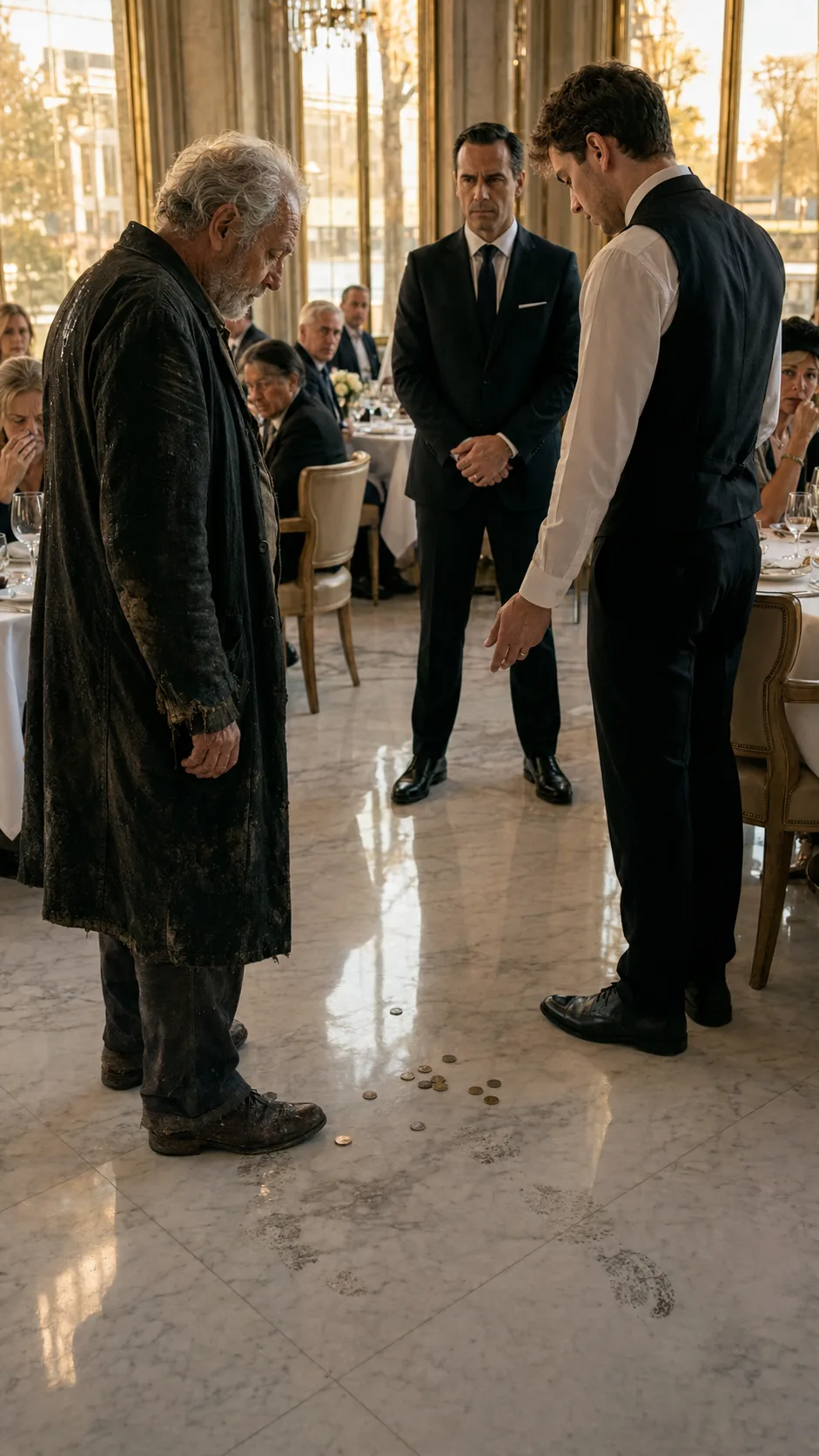
Evan reached into his trouser pocket.
Arthur watched the hand.
Not afraid.
Interested.
Evan pulled out coins.
For one small second, even Miles looked surprised.
Then the waiter opened his fingers.
The first coin struck the marble.
Clink.
The second followed.
Clink.
The third bounced once, rolled in a crooked line, and came to rest near Arthur’s left shoe.
The room heard everything.
A spoon touched porcelain at the far end of the dining room and sounded indecently loud.
Arthur looked down at the coins.
A penny. Two quarters. A dime. A nickel. A restaurant worth more than some apartment buildings had reduced its judgment to eighty-six cents.
Evan tipped his chin toward the floor.
“Take it.”
Arthur did not move.
Evan glanced at the guests.
He enjoyed that glance. Arthur saw it.
“And go.”
The room settled into the sentence.
Some faces turned away. Not because they disagreed. Because agreement had become uncomfortable to look at directly.
Celia Arden lowered her hand from her nose.
Miles folded both hands in front of him and waited.
The old rhythm of restaurants returned to Arthur for a strange moment. Wait for the guest to decide. Wait for the sauce to split. Wait for the critic to take the first bite. Wait for a son to call. Wait for a wife to breathe again.
He had spent his life waiting in useful ways.
This was not one of them.
Water dripped from his coat.
A drop landed beside the coins.
Tiny sound.
Huge room.
Evan’s smile weakened.
Miles saw it and shifted his weight.
Arthur raised his head.
He looked at Evan first.
The waiter held his posture, but his fingers twitched near his thigh.
Arthur looked at Miles.
Miles’s mouth had become a line.
Then Arthur looked past them both, across the dining room. Table by table. Face by face. The man near the window who had leaned back to enjoy it. The woman in pale silk. The couple who had stopped touching hands across the table. The older gentleman who stared into his wine as if Burgundy could hide him.
Arthur memorized them without effort.
Age had taken things from him.
Not that.
Miles stepped forward half a pace.
“Sir.”
Arthur reached inside his coat.
The movement was slow. No one could mistake it for violence. Still, the waiter flinched.
Arthur removed the cream envelope.
Its edge had softened from the damp, but the seal remained intact.
Miles looked at it.
The blood left his face in stages.
Arthur held the envelope between two fingers.
“Mr. Crewe,” he said, “you should have read the bylaws before you moved my portrait.”
No one spoke.
A chair creaked under someone near the bar.
Miles’s lips parted once.
Arthur turned the envelope outward.
The name printed across the front was visible now.
ARTHUR ELIAS VALE
Founder and Majority Owner
Vale Hospitality Group
Evan stared at it.
Then at Arthur.
Then at Miles.
Celia Arden’s hand moved toward her throat.
Arthur stepped around the coins without touching them. The wet print of his shoe passed beside Evan’s polished one. The waiter moved back without being asked.
That was the first honest thing he had done all day.
Miles tried to recover.
“Mr. Vale, I can explain.”
Arthur stopped.
“Can you?”
Miles looked toward the staircase.
Too late.
Footsteps sounded from above.
Dorian came down first.
Arthur’s son wore a charcoal suit, no tie, and his mother’s eyes. That had been the hardest part for years. Dorian could look cruel with Marianne’s eyes, and Arthur still had to remind himself not to search them for her.
Behind him came Elaine Porter, tablet pressed to her chest, and two board members Arthur had once trusted enough to invite into his home.
Dorian stopped halfway down the stairs.
“Dad.”
The word crossed the dining room like a dropped glass.
Arthur looked at him.
Dorian’s gaze moved over the coat, the shoes, the coins, the wet marks on the marble, Miles’s rigid face, Evan’s lowered hand.
His jaw shifted.
Not concern.
Calculation.
Arthur had seen that expression when Dorian was twelve and broke Marianne’s blue vase, then placed the pieces under the housekeeper’s cart.
“Dad,” Dorian said again. “Why are you here like this?”
Arthur looked at the coins.
Then back at his son.
“You mean why didn’t I use the back entrance?”
Dorian descended the remaining stairs. He kept his voice low, but the room had already learned to listen.
“This is unnecessary.”
“No,” Arthur said. “It became necessary.”
Elaine reached Dorian’s side and whispered something.
Arthur saw the tablet screen reflected in the glass of the wine cabinet.
Board vote agenda.
Removal of Arthur Vale as controlling executive authority.
Arthur turned to the nearest server.
“What is your name?”
The young woman froze. She held a water carafe against her apron with both hands.
“Maya, sir.”
Her voice shook once on the title.
“Please bring a chair to table one.”
Miles moved.
“Mr. Vale—”
Arthur did not raise his voice.
“Not one of those.”
Miles stopped.
Maya looked between them.
Arthur pointed toward the old walnut bar.
“In the storage room behind the bar, there are four original oak chairs. High back. Dark leather. My wife chose them in 1989. Bring one.”
Maya stared at him.
Then she looked at Miles.
Miles said nothing.
She moved.
Fast.
The dining room watched her disappear through the service door.
Arthur stood in the center of the room with the envelope in his hand, coins behind him on the floor, water drying slowly around his shoes.
Dorian came closer.
“Dad, we were trying to protect the company.”
Arthur looked at him.
“From whom?”
Dorian’s mouth tightened.
“You haven’t been present.”
“I have been present enough.”
“You disappeared for three weeks.”
“I walked.”
“That is not an answer.”
“It is the one you earned.”
Dorian glanced at the guests. Publicness did not suit him unless he controlled it.
Arthur knew that too.
Maya returned carrying the oak chair.
It was heavier than she expected. An older busboy moved to help her, but she shook her head once and kept walking. She set it at table one, near the center of the dining room, where sunlight fell across the white linen.
The chair looked wrong among the new cream leather.
Good.
Arthur walked to it and placed one hand on the back.
The leather had cracked near the left edge. Marianne had once caught her ring on that crack and cursed in French badly enough to make the bartender cough into his sleeve.
Arthur sat.
Not heavily.
Not theatrically.
Just sat.
The room adjusted around him.
Miles remained near the entrance. Evan stood beside the coins like a man who had lost instructions. Dorian and Elaine stood near the stairs with the board members behind them.
Arthur opened the envelope.
He removed the first document.
“Eight months ago,” he said, “Mr. Crewe authorized the removal of twelve senior staff members without board approval. Six of them had been with this restaurant more than fifteen years.”
Miles swallowed.
Arthur placed the page on the table.
“Five months ago, Ms. Porter instructed the public relations team to describe me as retired in all press materials, though no retirement agreement exists.”
Elaine’s grip tightened around her tablet.
Arthur placed another page down.
“Three months ago, Dorian presented a proposal to restructure ownership of Vale Hospitality Group in the event I was declared incapacitated.”
Dorian stepped forward.
“That was planning.”
Arthur looked at him.
“You scheduled the vote for noon.”
No one moved.
Arthur’s voice stayed even.
“You scheduled it while telling the board I was in Maine.”
Dorian’s eyes flicked to Miles.
Arthur followed the glance.
“There it is,” he said.
Two words.
Dorian looked back at him.
Arthur removed the last page.
“This morning, before I entered my own restaurant, Mr. Crewe told the hostess there was no reservation under my name. Then he allowed a member of staff to throw coins at my feet.”
Evan’s face went red.
“I didn’t know who he was.”
Arthur turned to him.
“That is not an excuse. That is the confession.”
Evan looked down.
At last.
Arthur lifted the page.
“This is a notice of immediate suspension pending review for Miles Crewe, Elaine Porter, and Dorian Vale from all operational authority within Vale Hospitality Group.”
Dorian’s face changed then.
Not much.
Enough.
“You can’t do that.”
Arthur placed the page on the table.
“I already did.”
Elaine stepped forward.
“The board hasn’t voted.”
“The board can vote on lunch specials today if it wants.” Arthur looked toward the two men behind her. “Control shares remain mine. You both knew that. You hoped I would not appear.”
One board member adjusted his cuffs.
The other found sudden interest in the floor.
Arthur leaned back.
The oak chair gave a faint creak beneath him.
For a moment, the restaurant was only sound: distant traffic, the hum of refrigeration behind the bar, a glass settling in a rack somewhere in the kitchen.
Then Celia Arden spoke.
Not to Arthur.
To her husband.
“We should go.”
Arthur looked at her.
She froze halfway out of her chair.
“No,” he said. “Finish your lunch.”
Her mouth opened.
No words arrived.
Arthur turned to Maya.
“Please ask Chef Bernard to send out the staff meal first.”
Maya blinked.
“The staff meal, sir?”
“Yes.”
Arthur looked toward the kitchen doors.
“For the dining room staff. All of them. They will sit before service continues.”
Miles made a sound.
Arthur did not look at him.
“There will be no service in this room until the people who work here have eaten.”
No one knew what to do with that.
That was all right.
Arthur did.
Chef Bernard came out two minutes later with flour on his sleeve and murder in his eyes. He was sixty-three, round at the shoulders, bald except for a gray fringe, and had been arguing with Arthur since the Clinton administration.
He stopped when he saw the coat.
Then the coins.
Then Dorian.
“Arthur,” he said.
Arthur nodded.
“Bernard.”
The chef looked at Evan.
One look.
Evan stepped back as if struck by heat.
Bernard turned toward the kitchen and shouted, “Staff meal to the floor. Now.”
Movement erupted behind the doors.
Plates came first. Not porcelain for guests. Plain white kitchen plates. Then bowls of lentils, roasted chicken, bread torn by hand, salad with too much parsley because Bernard always added too much parsley when annoyed.
Maya carried plates with another server. The busboy brought chairs. Two line cooks came out uncertainly, then more staff followed.
Guests stared.
Some stood to leave. Some sat because leaving would require walking past Arthur.
Dorian’s face had gone hard.
“You’re making a spectacle.”
Arthur looked at his son.
“No. I’m ending one.”
The staff sat in clusters at the empty tables, awkward at first, then hungry enough to stop pretending. A dishwasher with silver hair took bread with both hands. A pastry assistant laughed once when soup nearly spilled on his sleeve, then covered his mouth. Maya sat at table three and kept looking at Arthur as if waiting for the trick.
There was no trick.
Arthur watched them eat.
His own stomach tightened at the smell of roasted chicken, but he did not ask for a plate.
Dorian stepped close enough that only Arthur and the nearest tables could hear.
“You’re humiliating me.”
Arthur looked up at him.
“You heard the coins hit the floor and found yourself in the sentence.”
Dorian flinched.
Small.
Real.
Arthur saw Marianne in his eyes then, not in their shape, but in the pain behind them. It lasted less than a second.
Dorian covered it.
“You abandoned this place.”
Arthur’s hand rested on the cracked leather arm of the old chair.
“I buried your mother.”
Dorian’s mouth shut.
Arthur looked toward the bar.
“She asked me not to sell. She asked me not to let this place become a room where money was treated better than people.” He looked back at his son. “I failed for a while.”
Dorian said nothing.
Arthur picked up one of the documents and slid it toward him.
“You will keep your shares. You will lose your authority. For one year, you will work outside the group. No title. No office. No introductions made through my name.”
Dorian stared at the page.
“And then?”
“Then we see who you are without a door opened for you.”
The words sat between them.
Dorian did not pick up the document.
Miles did speak then.
“Arthur, please.”
Arthur turned.
Miles had lost the polish. His suit remained perfect, but the man inside it looked badly arranged.
“My wife is ill,” Miles said. “I need this position.”
Arthur studied him.
A line cook lowered his fork.
Maya looked down at her plate.
Arthur stood.
The room followed the movement.
He walked back toward the entrance. The coins still lay on the marble, scattered near the wet prints. Evan stood a few feet away, face drained and eyes fixed on the floor.
Arthur bent slowly.
His knees objected. His back tightened. He picked up the coins one by one and placed them in his palm.
Nobody helped.
Good.
He closed his fist around them and turned to Miles.
“You needed the position,” Arthur said. “You did not need to become this.”
Miles’s face crumpled in a way he tried to stop.
Arthur held out the coins to Evan.
The waiter stared.
“Take them,” Arthur said.
Evan’s hand rose slowly.
Arthur dropped the coins into his palm.
“They are yours. You spent them.”
Evan closed his fingers.
His throat moved.
“I’m sorry.”
Arthur looked at him for a long second.
“No,” he said. “You are caught.”
Evan’s eyes dropped.
Arthur returned to the oak chair and took his coat off at last.
The room saw the suit beneath it then.
Old, yes.
But tailored.
Dark blue. Handmade. The cufflinks were plain silver, engraved with M.V. on one side and A.V. on the other. Marianne had given them to him on the night L’Aurelian served its first dinner to twelve guests and one critic who hated the soup but loved the bread.
Arthur folded the wet coat over the back of the chair.
Maya appeared beside him with a napkin.
He looked at her.
She held it out.
Not for polish.
For kindness.
Arthur took it.
“Thank you.”
She nodded once and returned to her plate.
The afternoon moved strangely after that.
Guests left in uneven waves. Some apologized to nobody. Some avoided the entrance, as if the coins had infected the floor. Celia Arden did not finish her wine. Her husband left a black card on the table, then took it back when no server came.
Bernard fed the staff until the kitchen ran out of bread.
Dorian stayed near the stairs, one hand on the railing, reading the suspension notice again and again. Elaine made two phone calls from the hallway and spoke in a voice that grew smaller each time. Miles sat at the bar without ordering anything.
Arthur signed six documents at table one.
At two-thirty, Beatrice Hawn arrived in a gray coat and sensible shoes. She stepped inside, saw the staff eating, saw Arthur in the old chair, saw Dorian with the paper in his hand.
“You made it messy,” she said.
Arthur looked at the marble floor, where the wet prints had begun to fade.
“Yes.”
Beatrice sat across from him and opened her briefcase.
“Good.”
By four, the restaurant was closed for the day.
Not for repairs.
For training, the sign said.
Arthur wrote the sign himself on plain paper. His handwriting had become less steady, but the words were clear enough. Maya taped it to the front door from the inside.
Evan asked whether he should leave.
Arthur told him no.
The waiter stood near the service station with the coins still in his pocket. He had washed his hands twice and touched nothing.
Arthur gathered the staff in the dining room.
No speech had been planned. He disliked speeches. They made people stand too straight.
So he kept it simple.
“No guest in this restaurant is worth more than anyone who works in it,” he said. “Anyone who disagrees may leave before we reopen.”
No one moved.
Bernard crossed his arms.
“Finally.”
A few people laughed.
Small laughter.
Human.
Arthur looked at the room Marianne had helped him imagine. The walnut bar. The flawed chair. The windows full of late afternoon light. The cream leather seats he still hated. The faces of people who had been taught to serve invisibly and were now being asked to sit in their own room.
His chest tightened.
He did not name it.
Later, when the staff had gone and the kitchen lights dimmed one by one, Arthur found Dorian still at table six.
His son had removed his jacket. His shirt sleeves were rolled to the forearm. For the first time all day, he looked less like an executive and more like a boy who had broken something and run out of places to hide the pieces.
Arthur sat across from him.
Neither spoke for a while.
Outside, taxis moved through reflected gold. Inside, the restaurant smelled of bread, lemon, damp wool, and old wood.
Dorian placed the suspension notice on the table.
“I thought you didn’t trust me.”
Arthur looked at the paper.
“I didn’t.”
Dorian gave a short laugh without humor.
“That’s honest.”
“It’s late.”
Dorian rubbed both hands over his face.
“I thought if I controlled it, I could prove I deserved it.”
Arthur watched him.
“And did you?”
Dorian looked toward the entrance.
The place where the coins had been.
“No.”
The word had no defense inside it.
Arthur leaned back.
The old chair creaked.
For a moment, neither of them was ready to be kind.
That was also honest.
Dorian looked at him then.
“Mom would have hated today.”
Arthur’s eyes moved to the bar.
“No,” he said. “She would have hated the reason for it.”
Dorian nodded.
He did not apologize.
Not yet.
Arthur did not ask.
Some things said too soon were only another performance.
At the door, Dorian paused.
“What happens now?”
Arthur looked at his son’s hand on the brass handle.
“Now you leave by the front.”
Dorian understood.
His fingers tightened once.
Then he opened the door and stepped out onto the sidewalk without a car waiting, without Miles, without Elaine, without anyone holding an umbrella over his head.
Arthur watched through the glass until the crowd took him.
The next morning, Nico found his coffee tin back beside the bench outside St. Bartholomew’s.
Inside sat eighty-six cents and a folded napkin from L’Aurelian.
Arthur had written only one sentence on it.
Choose things that can survive people.
Chapter complete
You have reached the end of this chapter.
Continue reading
A few more worlds to get lost in after this chapter.




