he was “done being disrespected by small men,” Savannah covered their rent.
“They raised me.”
When her mother added a second credit card to Savannah’s account “only for groceries,” and later used it for a pearl necklace, Savannah paid the bill without asking.
“It’s family.”
Family had become the word everyone used when nobody wanted to say debt.
She approved the orchid invoice before starting the car.
One tap.
Five thousand dollars.
Gone.
A tiny green confirmation appeared on the screen.
Savannah stared at it for a moment, then placed the phone face down on the passenger seat.
Three days later, she found out about the party from Instagram.
It was her cousin Valerie who posted it.
Savannah had just returned home from work, still wearing her blazer, when the notification appeared at the top of her screen.
Valerie tagged you in a story.
Savannah opened it casually, expecting a meme, a birthday post, maybe another photo of Valerie’s toddler smearing yogurt across a table.
Instead, a video filled the screen.
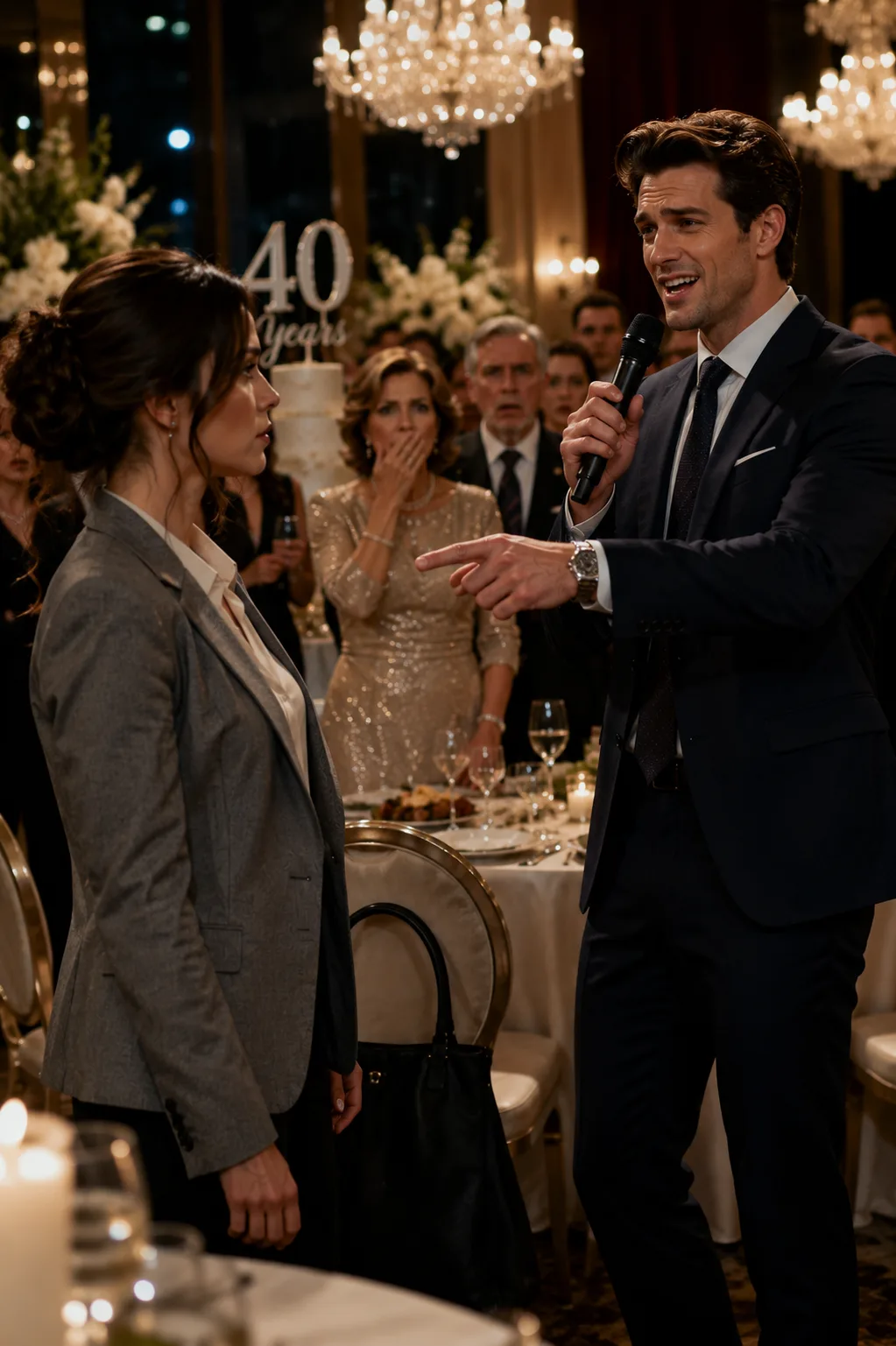
Silver balloons shimmered under chandeliers. White orchids lined a stage. Her parents stood beneath a glowing arch at the Lakeside Hotel, smiling as guests applauded. Nolan held a microphone and raised a champagne glass toward them. A four-tier cake stood behind him, white and gold, exactly like the sample Savannah had chosen from the hotel catering catalog.
The video caption read:
Forty years of love. The whole family came to celebrate.
Savannah watched it twice.
The whole family.
Her thumb hovered over the screen.
Another clip loaded.
Her mother in a champagne-colored gown Savannah had paid for last month.
Her father in a black tuxedo.
Nolan in a navy suit.
Savannah recognized that suit immediately because Nolan had sent her a text three weeks earlier.
Need something decent for a client thing. Can you spot me?
She had transferred two thousand dollars.
In the video, Nolan clinked glasses with their father and said something Savannah couldn’t hear because the band was playing too loudly. Her mother laughed, touching his arm.
Savannah sat down slowly on the edge of her sofa.
No missed invitation.
No forgotten email.
No call.
No text.
No “we thought you were busy.”
She opened her messages and searched for “anniversary.”
Nothing from her mother except invoices.
Nothing from her father except a thumbs-up emoji after she paid the venue balance.
Nothing from Nolan except a request for gas money, two photos of the Mercedes at a car wash, and one message that said:
You’re the best, Sav.
She stared at that one longest.
Savannah stood.
She did not change clothes. She did not fix her makeup. She did not remove her badge from the office lanyard still tucked inside her bag. She simply picked up her car keys, grabbed her laptop bag, and walked back out of her condo.
The Lakeside Hotel was twenty-two minutes away.
She made it in seventeen.
The valet looked confused when she pulled up in the rain and stepped out wearing office clothes instead of evening wear.
“Good evening, ma’am. Are you here for the Reed anniversary?”
Savannah looked toward the hotel’s glass doors. Through them, she could see warm light, gold trim, and a sign that said Private Event.
“Yes,” she said. “I paid for it.”
The valet gave a nervous smile, unsure whether that was a joke.
It wasn’t.
Savannah walked through the marble lobby, past the fountain, past the concierge desk, past two women in sequined dresses taking selfies beneath a chandelier. Her heels clicked against the floor, sharp and steady.
Near the ballroom entrance, a young hostess checked a guest list on a tablet.
“Name?”
“Savannah Reed.”
The hostess scrolled.
Her smile faded slightly.
Savannah watched her thumb move once. Twice. A third time.
“I’m sorry,” the hostess said. “I don’t see—”
Savannah looked past her.
The ballroom doors were open.
Inside, two hundred people were laughing under a ceiling dripping with crystal light. The band played a soft jazz standard. Servers moved between tables with trays of champagne. Silver balloons spelled out forty above the cake table. White orchids framed the stage in thick, expensive clouds.
Her orchids.
Her money.
Her family.
The hostess lowered her voice. “Maybe the name is under someone else?”
Savannah took one step forward.
The hostess moved instinctively aside.
The room noticed her slowly.
First one cousin near the bar.
Then an aunt at table four.
Then two of her father’s old coworkers.
Conversation thinned like a candle being snuffed under glass.
Savannah stopped just inside the ballroom.
Her mother saw her first.
The smile on Margaret Reed’s face didn’t fall all at once. It froze in place, stiffening at the corners until it no longer belonged to a mother celebrating forty years of marriage, but to a woman watching a secret enter through the front door.
Her father, Harold, looked at Savannah, looked at her clothes, then looked away.
That hurt more than it should have.
Not Nolan.
Nolan looked delighted.
He stood near the cake with a wireless microphone in one hand and a champagne flute in the other. His navy suit fit well. Too well. He had probably bragged about it all evening.
“Savannah?” he said into the microphone.
The band stumbled, then stopped.
Nolan turned toward the guests with a grin wide enough to make strangers comfortable and family dangerous.
“Well, this is unexpected.”
A few people gave awkward little laughs.
Savannah did not move.
Her mother stepped down from the small stage.
“Savannah,” she said, voice tight. “What are you doing here?”
Savannah looked around the room once.
The flowers.
The cake.
The photographer.
The band.
The champagne.
The family members who had eaten and smiled and toasted inside a room bought with her silence.
“I saw Valerie’s video,” Savannah said.
Valerie, seated near the center aisle, lowered her phone.
Margaret’s eyes flicked toward her, quick and sharp.
Savannah caught it.
“So I came to ask something.”
Nolan lifted the microphone again. “You could have called.”
“I did call,” Savannah said. “For weeks. About the venue, the food, the flowers. Everyone answered those calls.”
Several guests shifted in their seats.
Her father cleared his throat.
“Savannah, this isn’t the place.”
She turned to him.
“No?”
Harold’s jaw worked once. He was still holding his champagne glass. His thumb rubbed nervously along the stem.
Savannah pointed lightly toward the stage. “This is the place I paid for.”
The silence changed.
It became heavier.
A server near the champagne tower stopped pouring and held a bottle in midair.
Margaret moved closer, her smile returning in pieces. “Sweetheart, don’t make this unpleasant. We were going to celebrate with you privately.”
Savannah looked at her mother’s gown. Champagne silk. Beaded sleeves. Pearl earrings.
“You told me you wanted the whole family together.”
Margaret swallowed.
“Yes, well—”
“I’m family.”
Nobody answered fast enough.
That was answer enough.
Nolan laughed.
Not a big laugh. Not yet. A small, practiced one. The kind he used when he wanted the room on his side before he sharpened the knife.
“Oh, come on, Sav. You’re not doing this.”
Savannah turned to him.
“I’m asking why I wasn’t invited to the anniversary party I funded.”
Nolan rolled his eyes.
The microphone was still on.
Everyone heard the little breath of irritation that escaped him.
“You always do this,” he said.
“What?”
“Walk in like everybody owes you a standing ovation because you wrote a check.”
Savannah’s fingers tightened around the strap of her laptop bag.
A tiny movement.
Nolan saw it and smiled.
He smelled weakness because he had been trained to mistake patience for it.
“I didn’t ask for applause,” she said. “I asked for a seat.”
There it was.
A clean sentence.
Too clean for Nolan to dodge.
Margaret turned to the guests and laughed lightly, desperately. “She’s been working too hard. You know how Savannah is.”
Savannah looked at her.
“How am I?”
Margaret blinked.
Nolan stepped forward before his mother had to answer.
“You’re intense.”
A few relatives looked down at their plates.
“You make people uncomfortable.”
Savannah tilted her head.
“By paying their bills?”
His smile sharpened.
“By making sure everyone knows you pay them.”
One of her uncles shifted in his chair. Aunt Denise whispered something to her husband. The photographer lowered his camera halfway, then raised it again.
Savannah noticed everything.
The old habit of competent people.
They read rooms because nobody reads them.
“I never told anyone what I paid for,” Savannah said.
Nolan gestured around the ballroom with the microphone. “You just did.”
A few guests murmured.
He had the room now. Or thought he did.
Savannah looked at her father again.
“Did you know I wasn’t invited?”
Harold kept his eyes on the champagne in his glass.
“Your mother handled the list.”
Margaret flinched.
Nolan laughed into the microphone.
“That’s not an answer, Dad.”
The room gave another uneasy ripple of laughter. Nolan enjoyed it. He lived for that sound, for public charm wrapped around private rot.
Savannah looked from her father to her mother.
Margaret’s face had lost its color beneath the makeup.
“Mom?”
Margaret stepped closer, voice low now. “Please. Not here.”
“Why not here?”
“Because people are watching.”
Savannah nodded once.
“They were watching when you celebrated without me.”
Margaret’s mouth opened, then closed.
Nolan clapped once, loud and mocking.
“Wow. Great performance.”
Savannah slowly turned back to him.
He had come two steps closer, close enough now that his cologne cut through the scent of orchids and candle wax. The microphone hung near his chest.
“You know,” Nolan said, scanning the guests as if hosting a comedy roast, “this is exactly why we didn’t invite her.”
“Nolan,” Margaret said.
But she didn’t step between them.
She never did.
Nolan lifted the microphone again.
“She can’t just do something nice. It has to become a Savannah Reed production.”
Savannah’s face did not change.
That irritated him.
He wanted tears. A raised voice. A trembling hand. Something he could point to and say, See? This is why.
She gave him nothing.
He stepped closer.
“You want the truth?”
Savannah looked directly at him.
“Yes.”
Nolan’s grin widened.
The microphone captured the small wet sound of his breath before he spoke.
“You’re just an ATM for the family.”
The room went dead.
Not quiet.
Dead.
The band’s pianist lifted his hands from the keys. A fork slipped against a plate somewhere near the back. One of the balloons behind the cake swayed gently from the air-conditioning vent.
Savannah stood still.
Three seconds passed.
Four.
Nolan’s grin held.
Then her parents laughed.
Her mother covered it with one hand, too late.
Her father lowered his face, shoulders shaking once, the way men laugh when they don’t want to admit they find cruelty accurate.
Margaret touched Nolan’s sleeve.
“Oh, stop,” she said.
But she was smiling.
That was the sound Savannah would remember.
Not Nolan’s line.
Their laughter.
It didn’t explode inside her.
It landed.
Heavy.
Final.
For years, she had carried the family like a structure with no visible foundation, paying quietly, absorbing quietly, repairing quietly. She had mistaken usefulness for belonging because nobody corrected her. She had accepted gratitude when it came only in the form of more requests. She had translated “Savannah can handle it” into “Savannah is loved.”
Now the translation sat in front of her with a microphone.
An ATM.
That was the job title.
The cake knife gleamed on the table behind Nolan.
The orchids glowed white under chandelier light.
Her mother’s smile flickered when she realized Savannah had not moved.
Nolan frowned slightly.
It was the first honest expression he had worn all night.
“Sav?” he said, microphone lower now.
Savannah set her laptop bag down on the nearest chair.
Slowly.
The small thud carried through the room.
She reached into the side pocket and took out her phone.
Nolan’s frown deepened.
“What are you doing?”
Savannah unlocked the screen.
Her thumb did not shake.
She opened her contacts and pressed one name.
Marcus Hale. Private vehicle retrieval. The number was saved from a year ago, when Nolan had ignored three parking tickets and the city almost towed the Mercedes while Savannah was in Toronto closing a deal.
The call connected on the second ring.
“Marcus,” Savannah said. “It’s Savannah Reed.”
Nolan’s smile disappeared.
A few guests leaned forward.
Savannah kept her eyes on her brother. “The Mercedes-Benz GLE currently in Nolan Reed’s possession is no longer authorized for his use.”
Nolan took one step toward her.
“Are you serious?”
Savannah angled her body away from him without looking away.
“Yes,” she said into the phone. “It’s registered in my name. Insurance is under my company account. He does not have permission to drive it after tonight.”
Her mother’s hand flew to her chest.
“Savannah.”
Nolan lowered the microphone completely.
“You’re embarrassing yourself.”
Savannah spoke into the phone. “The vehicle is in the valet lot at Lakeside Hotel, Chicago.”
Harold stepped forward at last.
“Put the phone down.”
Savannah looked at him.
For one second, she saw the man who used to check under her bed for monsters when she was six. The man who taught Nolan to ride a bike and forgot Savannah had asked for the same thing. The man who accepted rent every month and never once asked whether his daughter was sleeping enough.
“No,” she said.
Marcus said something on the other end.
Savannah listened.
“Tonight,” she replied. “Yes. Immediately.”
Nolan’s face reddened.
“That car is how I get to work.”
Savannah ended the call.
“You work remotely three days a week and quit your last client meeting because they wouldn’t validate parking.”
A sound moved through the room.
Not laughter.
Recognition.
Nolan heard it and turned slightly, scanning faces that no longer fully belonged to him.
Savannah opened her banking app.
Margaret saw the screen and seemed to understand before anyone else.
“Don’t,” she said.
Savannah tapped.
The first automatic payment appeared.
Riverside Towers Rent — Harold and Margaret Reed.
Scheduled monthly transfer.
Savannah tapped “cancel.”
A confirmation window appeared.
Are you sure?
She pressed yes.
Margaret moved forward. “Savannah, we can discuss this privately.”
“No.”
The word was quiet.
The room heard it anyway.
Savannah tapped again.
Nolan Reed Auto Insurance.
Cancel.
Yes.
Margaret’s credit card authorization.
Remove.
Yes.
Family phone plan.
Remove linked payment.
Yes.
Medical bill installment.
Pause payment.
Yes.
Her father stared at the phone as if watching oxygen leave the room.
Nolan pointed at her, the microphone dangling from his other hand. “You can’t just cut everybody off because your feelings got hurt.”
Savannah looked up.
“My feelings didn’t get hurt.”
He scoffed.
She turned the phone screen outward for one second, not close enough for anyone to read details, just enough for her parents to see the list of payments.
“My role got clarified.”
Nobody spoke.
Savannah placed the phone against her palm and looked at her mother.
Margaret’s eyes had gone shiny, but Savannah knew that look. It was not sorrow. Not yet. It was calculation dressed as panic.
“Where are we supposed to live?” Margaret asked. “Your father can’t go back to work. The lease—Savannah, that lease is due next month.”
Savannah watched a candle flicker inside a glass holder on the nearest table.
A drop of melted wax slid down and hardened in place.
“I paid through the end of this month,” she said.
“You would put your parents on the street?”
Harold’s face tightened at that, like he disliked the ugliness but not enough to stop using it.
Savannah’s gaze moved to him.
“For four years, I paid for an apartment I was never invited to visit without being asked to bring something.”
Margaret flinched.
“That is not fair.”
“Neither was laughing.”
A heavy silence.
Nolan threw the microphone onto the cake table. It bounced once, making a sharp sound through the speakers.
Several guests startled.
“You think money makes you better than us?” he said.
Savannah picked up her laptop bag from the chair.
“No.”
She slid the strap over her shoulder.
“It made me useful to you.”
Nolan opened his mouth.
Nothing came out.
Savannah turned toward the ballroom doors.
Her mother grabbed her wrist.
Not hard.
Just enough.
For years, that touch had stopped Savannah. At grocery stores. In living rooms. At hospital desks. In parking lots after Nolan’s emergencies. It always said: don’t make this harder for us.
Savannah looked down at her mother’s hand.
Margaret let go.
“Please,” she said.
Savannah waited.
A strange thing happened.
For the first time, she waited not for an apology but for proof.
Any proof.
Her mother looked at Nolan. Then at Harold. Then at the guests. Her lips parted. Her eyes moved to the orchids behind Savannah’s shoulder.
The orchids.
Even now.
Savannah nodded once.
There it was.
She stepped away.
Nolan followed her down the center aisle between the tables.
“You’re going to regret this,” he said.
Savannah stopped.
The room held its breath again.
She turned back.
“Maybe.”
Nolan looked thrown by that. He had expected a sharp comeback. A courtroom line. Something polished.
Savannah gave him something simpler.
“But I won’t finance it anymore.”
A woman at table seven covered her mouth. Valerie had stopped recording now, her phone lowered into her lap. Aunt Denise stared at the floor. Nolan’s friends near the bar avoided his eyes.
Savannah looked at her parents one last time.
The cake stood behind them, untouched.
The number forty glowed in silver above their heads.
“Happy anniversary,” she said. “This is the last beautiful night I buy for you.”
She walked out.
No one followed.
Not at first.
The lobby felt colder than the ballroom. The music did not resume behind her. Savannah crossed the marble floor with her laptop bag against her hip and the dull ache in her feet suddenly louder than anything else.
The valet hurried forward.
“Ma’am?”
“My car,” she said.
He looked at the ticket, then at her face, and decided not to ask questions.
Behind her, the ballroom doors opened.
Nolan came out fast, tie crooked now, microphone gone.
“Savannah!”
She did not turn.
He caught up near the fountain.
“You can’t take the Mercedes,” he said.
“I already did.”
“I have meetings.”
“No, you have habits.”
His jaw tightened.
“Do you know how this makes me look?”
Savannah finally faced him.
The hotel lobby lights were harsher here. Without the warm chandelier glow, Nolan looked younger. Smaller. The expensive suit did not carry him as well.
“For once,” she said, “exactly how you are.”
His hand flexed at his side.
“You always thought you were better than me.”
Savannah studied him.
All those years, she had tried to rescue him from shame. She had paid bills before they became final notices. Sent money before he had to beg too clearly. Let him borrow success until he believed it was his reflection.
“No,” she said. “I thought you were my brother.”
That landed badly.
His eyes moved away first.
The valet pulled up Savannah’s car.
Not the Mercedes GLE Nolan drove. Her other car. A black sedan she actually used for work.
Nolan saw it and understood the difference. One car was hers. One had only been borrowed.
Borrowed things can be returned.
Savannah stepped toward the sedan.
Her phone buzzed.
Marcus.
Vehicle located. Retrieval team arriving in twenty minutes.
She showed Nolan the message.
His face changed.
Not anger first.
Fear.
“You sent them here?”
“You heard me make the call.”
“There are people inside.”
“Yes.”
“My friends are inside.”
“Yes.”
He stared at her.
For once, no charming joke came.
Savannah got into the car.
Nolan bent near the window as it lowered.
“Savannah, wait.”
There it was.
The voice he saved for emergencies.
The one that had worked for years.
She looked straight ahead through the windshield.
The valet stood awkwardly by the curb, holding an umbrella neither of them was using.
Nolan’s voice lowered. “Come on. It was a joke.”
Savannah turned her head slowly.
“Was it?”
He looked toward the doors.
Inside, silhouettes moved behind frosted glass. Their mother had probably sent someone to see what was happening. Their father was probably still standing near the cake, explaining to guests that Savannah was stressed from work.
Nolan forced a laugh.
“You know how I talk.”
“Yes,” she said. “Now everyone does.”
She raised the window.
He stepped back.
The glass slid up between them.
Savannah drove home through rain that made the city lights smear across the windshield like wet gold.
At 10:42 p.m., her phone began exploding.
Mom.
Dad.
Nolan.
Mom again.
Aunt Denise.
Valerie.
Nolan.
Unknown number.
Nolan.
She parked in her building garage and sat there as voicemail after voicemail arrived.
The first was from her mother.
“Savannah, this has gone far enough. Call me immediately.”
Delete.
Nolan.
“You humiliated me in front of everybody. They took the car from valet, Savannah. From valet.”
Delete.
Her father.
“You need to calm down. Your mother is crying.”
Delete.
Aunt Denise.
“Honey, I don’t know what happened, but maybe don’t make permanent decisions while emotional.”
Savannah let that one play until the end.
Then deleted it too.
Upstairs, her condo was quiet. Too quiet, maybe. Floor-to-ceiling windows showed Chicago shining under rain. On the kitchen counter, a stack of work contracts waited beside a bowl of green apples she kept buying and forgetting to eat.
Savannah took off her heels at the door.
One blister had opened.
She walked barefoot to the kitchen, opened her laptop, and searched her accounts.
Not because she needed proof.
Because she needed distance.
Numbers were clear. Numbers didn’t pretend.
Rent.
Utilities.
Insurance.
Phone plans.
Emergency transfers.
Designer purchases categorized as “family help.”
Nolan’s failed fitness app.
Nolan’s failed marketing course.
Nolan’s car repairs.
Harold’s dental work.
Margaret’s boutique charges.
Vacation deposits she had been told were “just for a weekend away to breathe.”
Six years.
Three hundred and seventeen thousand dollars.
The total sat at the bottom of the spreadsheet like a body.
Savannah stared at it until the screen dimmed.
Her phone buzzed again.
This time, a text.
Mom: You hurt us deeply tonight.
Savannah typed nothing.
Another text.
Mom: Families help each other.
Savannah looked at the spreadsheet.
Yes.
They do.
She closed the laptop.
The next morning, Margaret arrived at Savannah’s building at 9:03 a.m.
The concierge called first.
“Ms. Reed, there’s a woman here saying she’s your mother.”
Savannah stood in her kitchen wearing a navy robe, coffee untouched beside her hand.
“Saying?”
The concierge paused. “Yes, ma’am.”
Savannah almost smiled.
“Send her up.”
Margaret stepped out of the elevator five minutes later wearing oversized sunglasses, a beige coat, and fury polished into respectability.
She did not ask to come in.
She entered.
Savannah closed the door behind her.
“How dare you,” Margaret said.
Savannah walked back to the kitchen island and picked up her coffee.
“Good morning.”
“Don’t you good morning me. You made your brother look like a criminal.”
“They retrieved a car he didn’t own.”
“He was humiliated.”
Savannah looked at her mother over the rim of the mug.
“Was he?”
Margaret removed her sunglasses.
Her eyes were red, but her makeup was perfect.
“You enjoyed it.”
“No.”
“You did. You stood there like some judge, canceling things in front of everyone.”
Savannah set the mug down.
The sound was small.
Margaret kept going.
“Your father barely slept. Nolan is devastated. People are calling. Do you know what they’re saying?”
“No.”
“They’re saying we used you.”
Savannah said nothing.
Margaret’s face tightened.
“Say something.”
Savannah walked to the drawer beside the oven and removed the printed folder she had prepared before dawn.
She placed it on the island.
Margaret looked at it.
“What is that?”
“Open it.”
Her mother hesitated.
Savannah waited.
Margaret opened the folder.
Bank statements.
Transfers.
Receipts.
Credit card summaries.
Rent confirmations.
Insurance documents.
A clean, ugly paper trail.
Margaret turned the first page.
Then the second.
Her expression shifted slowly from offense to confusion, from confusion to something thinner.
Savannah watched the exact second the total appeared.
Three hundred and seventeen thousand dollars.
Margaret touched the page with two fingers, as if the number might move.
“This can’t be right.”
“It is.”
“Some of these were gifts.”
“Yes.”
“And some were emergencies.”
“Most emergencies had Nolan’s name on them.”
Margaret closed the folder halfway, then opened it again, like a person checking a wound.
“You never said it was this much.”
Savannah looked at her.
“I kept waiting for someone to ask.”
“Ask what?”
“If I was tired.”
Margaret’s mouth closed.
Outside the window, rain tapped lightly against the glass.
Savannah leaned her hip against the counter.
“You all noticed when I stopped paying within twelve hours. You didn’t notice what it cost me in six years.”
Margaret’s face crumpled slightly, but Savannah stayed where she was. She had seen tears used as curtains too many times.
“You’re successful,” Margaret said. “We thought you were fine.”
There it was.
The family math.
Savannah had money, therefore Savannah had no needs.
Savannah solved problems, therefore Savannah did not have problems.
Savannah survived, therefore Savannah was not wounded.
“You thought I was fine because fine was convenient,” Savannah said.
Margaret pressed her lips together.
“You sound cruel.”
Savannah looked toward the folder.
“No. I sound finished.”
Her mother’s hand rested on the papers.
For a moment, Savannah thought something might break open between them. Something honest. Something late but real.
Then Margaret said, “Your father and I still need somewhere to live.”
Savannah looked at her mother.
Really looked.
The beige coat. The pearl earrings. The perfectly styled hair. The woman who had taught Savannah to write thank-you cards after birthdays, to send flowers to grieving relatives, to never embarrass family in public.
The woman who had laughed.
Savannah pushed the folder gently toward her.
“There are resources in there. Budget planners. Lease options. The name of a financial counselor. I booked one consultation and paid for it.”
Margaret stared.
“You paid for one more thing?”
“Yes.”
“Why?”
Savannah paused.
Because even now, some part of her still put cushions on the ground before letting people fall.
“Because I’m not cruel,” she said.
Margaret’s eyes filled again.
Savannah opened the door.
Her mother did not move.
“Savannah.”
Savannah waited.
Margaret looked smaller now.
“Your brother didn’t mean it.”
Savannah held the door.
“You laughed like he did.”
Margaret’s face went still.
There was no defense left in the room that could survive that sentence.
She picked up the folder and left without another word.
By noon, Harold called.
Savannah let it ring once.
Twice.
On the third ring, she answered.
“Dad.”
His breath crackled through the speaker.
“Can we talk like adults?”
Savannah looked at the city beyond her office window. Staff moved behind her glass wall, carrying folders, laptops, coffee cups. Her assistant, Lena, glanced in through the door but did not interrupt.
“Go ahead.”
“You blindsided us.”
Savannah closed her eyes for a moment.
“Interesting word.”
“You don’t just cut off family.”
“You don’t laugh at your daughter being called an ATM.”
He sighed.
“I didn’t laugh at you.”
“Yes, you did.”
A pause.
“I was uncomfortable.”
Savannah opened her eyes.
“Your discomfort sounded like laughter.”
He said nothing.
She let the silence stand.
Harold cleared his throat. “We never asked you to do all of that.”
Savannah felt the sentence arrive before its weight did.
It entered quietly.
Then it split something old.
“You’re right,” she said.
“I mean, we appreciated it, but—”
“No. You’re right.”
He stopped.
Savannah turned away from the window.
“You didn’t ask. I volunteered because I thought one day someone would notice I was loving you.”
Harold breathed once.
Not a word.
Just air.
She continued.
“I thought if I paid the rent, you’d stop worrying. If I helped Nolan, he’d grow up. If I made Mom’s anniversary beautiful, maybe she’d look at me the way she looks at him.”
“Savannah—”
“I was wrong.”
Her father’s voice lowered. “Your mother is fragile.”
“So was I.”
The sentence hung there.
Harold did not know what to do with it.
He had never had to.
Competent daughters are not supposed to announce fractures. They are supposed to hold dishes, wire money, send reminders, make reservations, and arrive early with a sweater in case their mother gets cold.
Savannah checked the time.
“I have a meeting in six minutes.”
“Can we come over tonight?”
“No.”
“Savannah.”
“No.”
Another silence.
This one colder.
“Then when?” he asked.
“When you have something to say that isn’t about what you lost.”
She ended the call.
At 1:00 p.m., the Forbes article went live.
Savannah didn’t see it first. Lena did.
Her assistant knocked once and entered with a tablet in one hand and a face she was trying very hard to keep professional.
“It’s out,” Lena said.
Savannah looked up from a contract. “What is?”
“The Forbes interview.”
“Oh.”
Lena placed the tablet on the desk.
Savannah looked at the headline.
Savannah Reed Built a Consulting Empire by Seeing What Other Companies Missed
Beneath it was a photo of her in a black suit, standing in her office with the skyline behind her. She remembered the photographer asking her to smile and her refusing politely. The published photo caught her looking slightly away from the camera, hand resting on a conference chair, mouth neutral, eyes focused beyond the glass.
She read the first paragraph.
Then the second.
The article mentioned her discipline, her early years, her decision to build her company without investors, her reputation for rescuing failing corporate transitions. It quoted a client calling her “the person you bring in when excuses are over.”
Savannah stopped reading there.
Lena cleared her throat gently.
“There’s more.”
Savannah scrolled.
Halfway down, the interviewer had written:
Reed speaks about success with careful restraint, but her employees describe a leader who remembers birthdays, pays emergency childcare stipends from her own pocket, and once flew overnight to help a junior consultant prepare for a presentation after a family crisis.
Savannah stared at that sentence.
She did remember that.
A junior consultant named Maribel. Eight months pregnant. Crying in an airport bathroom because her father had collapsed and the biggest presentation of her life was the next morning. Savannah had flown to Dallas, rewritten half the deck beside her at 2:00 a.m., and stood in the back of the room while Maribel presented.
Nobody in her family knew that story.
They had never asked what kind of boss she was.
What kind of friend.
What kind of woman she became when she wasn’t paying their bills.
Lena touched the doorframe. “Congratulations, Savannah.”
Savannah nodded, but did not speak.
After Lena left, Savannah locked her office door.
She sat behind her desk, tablet still glowing.
The magazine had understood something her parents never tried to learn.
That was the part that finally cut.
Not the money.
Not the Mercedes.
Not even the joke.
The absence.
Thirty-four years of being visible only when useful.
Her phone buzzed.
Nolan.
She declined.
It buzzed again.
She declined again.
The third time, he sent a text.
Nolan: You win. Happy?
Savannah typed back.
No.
She stared at the word before sending it.
Then added:
I just stopped losing.
She sent it.
The reply came almost immediately.
Nolan: You’re really going to abandon us?
Savannah looked at the Forbes article. At her own name. At the woman in the photo who had built rooms no one could exclude her from.
She typed:
No. I’m returning responsibility to its owners.
Nolan didn’t answer.
For three days, the family noise continued.
Some relatives called Savannah selfish.
Some called her brave quietly and only through texts they probably deleted afterward.
Valerie apologized for posting the video, which made Savannah laugh once because the video was not the wound. It was the mirror.
Aunt Denise sent a long message about forgiveness.
Savannah did not respond.
On Friday, the Lakeside Hotel emailed the final invoice.
Remaining balance: zero.
The event had been paid in full.
Of course it had.
Savannah printed the receipt, folded it once, and placed it inside a new folder labeled Final Family Expenses.
Inside it, she added one page.
A list.
No more rent payments.
No more vehicle access.
No more credit cards.
No more emergency loans without written terms.
No more emotional blackmail disguised as family unity.
No more laughing.
She stared at the last line.
Then she crossed it out.
Not because it wasn’t true.
Because she could not control whether they laughed.
Only whether she paid for the room.
A week later, Margaret left a voicemail.
Savannah almost deleted it.
Instead, she listened.
Her mother’s voice sounded different. Less polished. More tired.
“I went to the counselor,” Margaret said. “The one you paid for.”
A pause.
“He said your father and I have been living like our comfort was your obligation.”
Another pause.
Savannah stood in her kitchen, hand resting on the counter.
Margaret inhaled unevenly.
“I don’t know how to be your mother without needing something from you. That is a terrible thing to say. But I think it’s true.”
Savannah closed her eyes.
“I’m not asking for money,” Margaret continued. “I’m not asking you to fix anything. I just wanted you to know I heard myself yesterday. And I didn’t like the sound of me.”
The voicemail ended.
Savannah did not call back.
Not yet.
Some doors should not open just because someone finally knocks correctly.
Two weeks after the party, Nolan’s name appeared on her phone again.
This time, she answered.
He didn’t speak at first.
Savannah stood on her balcony, wrapped in a coat, city wind pulling loose strands of hair across her cheek.
“What do you want, Nolan?”
His breath was rough.
“I sold the watch.”
She frowned slightly.
“What watch?”
“The one you gave me for graduation.”
Savannah remembered it. Stainless steel. Not too expensive by her current standards, but expensive back then. She had saved three months for it.
“Why?”
“To make rent.”
She said nothing.
“I thought you’d want to know I didn’t ask you.”
The city moved below her.
Cars. Sirens. Light.
“That’s good,” she said.
He made a sound that was not quite a laugh.
“Yeah.”
Silence.
Then he said, “I shouldn’t have said it.”
Savannah watched a boat move slowly across the black river.
“No.”
“And they shouldn’t have laughed.”
“No.”
Another pause.
“I don’t know why I hated you for helping me.”
Savannah’s fingers tightened around the balcony rail.
The metal was cold.
“Because needing me made you feel small,” she said.
He did not deny it.
“I’m not asking for the car back.”
“I know.”
“Marcus said you had the spare key removed from the system.”
“Yes.”
“Smart.”
“Necessary.”
A faint breath.
“Yeah.”
The call ended without warmth.
But without a request.
That was something.
By the end of the month, Harold and Margaret moved from Riverside Towers into a smaller apartment twenty minutes west, with no lake view and no marble lobby. Margaret texted Savannah a photo of a cardboard box labeled kitchen in thick black marker.
Savannah did not respond that day.
The next morning, she sent one message.
I hope the move went safely.
Margaret replied:
It did. Thank you for asking.
No request followed.
Savannah sat with that for a long time.
Spring came early that year, or maybe Savannah just noticed it because nobody was draining her before breakfast.
She stopped checking her phone during meetings.
She stopped answering calls after 8:00 p.m.
She removed family members from business accounts, emergency cards, and every invisible thread that had once looped around her wrists.
Her condo grew quieter, but not empty.
She invited Lena and two friends over for dinner one Saturday. They brought wine and laughed too loudly in the kitchen. Someone spilled sauce on the counter. Someone else used the good napkins without asking if they were good. Savannah stood near the stove, watching steam rise from a pot of pasta, and realized she had never hosted a meal where nobody expected her to pay for their life afterward.
The flowers on the table were tulips.
Yellow.
Not orchids.
A month after the anniversary party, a thick envelope arrived from Forbes containing a framed copy of the article. Lena had arranged it. Savannah unwrapped it in her office after everyone left.
The headline gleamed beneath the glass.
Savannah Reed Built a Consulting Empire by Seeing What Other Companies Missed
She carried it home that night.
At her condo, she did not hang it in the living room where guests would admire it.
She hung it in the hallway near the door.
Not as proof.
Not as revenge.
As a reminder to herself before leaving each morning.
She was not an ATM.
She was not a rescue plan.
She was not a daughter-shaped bank account waiting beside the phone.
She was a woman who had built a life with hands nobody clapped for until strangers wrote it down.
Her mother called that evening.
Savannah looked at the screen.
For the first time in years, her body did not tighten.
She answered.
“Hi, Mom.”
Margaret’s voice came carefully. “Hi, sweetheart.”
No invoice followed.
No emergency.
No Nolan.
Just silence, awkward and unfamiliar.
Then Margaret said, “I saw the article.”
Savannah looked at the framed copy in the hallway.
“Oh?”
“You look strong in the photo.”
Savannah almost laughed. Not because it was funny. Because her mother still didn’t know how to say what she meant without reaching for something safer.
“Thank you.”
Margaret breathed in.
“I didn’t know about Maribel. The employee you helped.”
Savannah looked down at the floor.
“No.”
“I didn’t know a lot.”
“No.”
Another silence.
This time, Savannah did not rush to fill it.
Margaret said, “Would you have coffee with me next week?”
Savannah closed her eyes.
There were a thousand reasons to say no.
Most of them valid.
One reason to say maybe.
Not forgiveness.
Not yet.
Curiosity.
“What kind of coffee?” Savannah asked.
Margaret gave a small, uncertain laugh.
“The kind I pay for.”
Savannah opened her eyes.
A tiny thing.
But tiny things had built the cage.
Maybe tiny things could test the door.
“Wednesday,” Savannah said. “Thirty minutes.”
“I’ll be there.”
After the call ended, Savannah stood in the hallway.
Outside the window, Chicago glittered against the dark.
Her laptop bag rested on the chair by the door, the same bag she had carried into the ballroom that night. One corner was scuffed from where it had hit the banquet chair when she set it down before taking everything back.
She picked it up.
For a moment, she considered replacing it with something newer, cleaner, more elegant.
Then she set it back down.
Some scars were useful.
The next Wednesday, Savannah arrived at the café early.
A habit.
She ordered her own coffee and sat near the window.
When Margaret walked in, she carried no folder, no bill, no emergency.
Only her purse.
She looked around until she found Savannah.
Their eyes met.
Margaret lifted one hand.
Savannah did not stand.
Not because she wanted to punish her.
Because she no longer had to rise every time someone needed her.
Margaret came to the table and sat across from her.
For a while, neither of them spoke.
The café was noisy in ordinary ways. Cups on saucers. Steam from the espresso machine. A chair scraping against tile. Someone laughing near the register.
Finally, Margaret reached into her purse.
Savannah’s gaze dropped to the movement.
Margaret saw it and stopped.
“No,” she said quickly. “It’s not a bill.”
She took out a small white envelope and placed it on the table.
Savannah did not touch it.
“What is it?”
Margaret folded her hands tightly.
“A check.”
Savannah’s face went still.
“It’s not much,” Margaret said. “Three hundred dollars. Your father and I sold the extra dining set.”
Savannah looked at the envelope.
Margaret’s voice thinned.
“I know what we owe is impossible. I know this doesn’t fix anything. I just wanted the first thing I gave you after that night to not be another request.”
Savannah looked out the window.
Cars moved through pale morning light.
Three hundred dollars.
Against three hundred seventeen thousand.
Ridiculous.
Tiny.
Heavy.
She picked up the envelope and placed it in her purse.
Margaret looked down at her coffee.
Savannah took a breath.
Not deep. Not dramatic.
Just enough.
“Thank you,” she said.
Margaret nodded once.
Her eyes stayed on the cup.
They drank coffee for twenty-seven minutes.
Margaret did not mention Nolan until the end.
“He got a job,” she said.
Savannah kept her face neutral.
“A real one?”
“At a warehouse office. Scheduling deliveries.”
Savannah nodded.
“Good.”
“He takes the bus.”
Savannah looked at her mother.
Margaret managed a small smile that did not ask for anything.
“Yes,” she said. “He takes the bus.”
Savannah almost smiled back.
Almost.
When the thirty minutes were over, Savannah stood.
Margaret stood too.
Neither moved to hug.
Not yet.
At the door, Margaret said, “I’m sorry I laughed.”
Savannah’s hand rested on the handle.
The street outside was bright and cold.
She turned back.
That apology had come late.
But late is not the same as never.
“I know,” Savannah said.
She stepped outside.
The city wind hit her face, sharp enough to wake the skin.
Behind her, the café door closed with a soft click.
Savannah walked toward her office alone, past wet pavement and morning traffic, carrying a three-hundred-dollar check in a purse worth more than that.
She did not need the money.
That was never the point.
At the corner, her phone buzzed.
A message from Lena.
Board moved to 10:30. Also, investor call confirmed.
Savannah typed back with one hand.
On my way.
The light changed.
She crossed with the crowd.
No one in that crowd knew about the ballroom, the microphone, the orchids, the joke, the car being taken from valet, or the way a family can spend years laughing quietly before one night makes the sound public.
No one needed to know.
Savannah knew.
That was enough.
At the office, she hung her coat, placed her laptop bag beside her desk, and opened the first contract of the morning.
For once, the money on the page belonged to her future.
Not their comfort.
She picked up her pen.
And signed.
THE END.