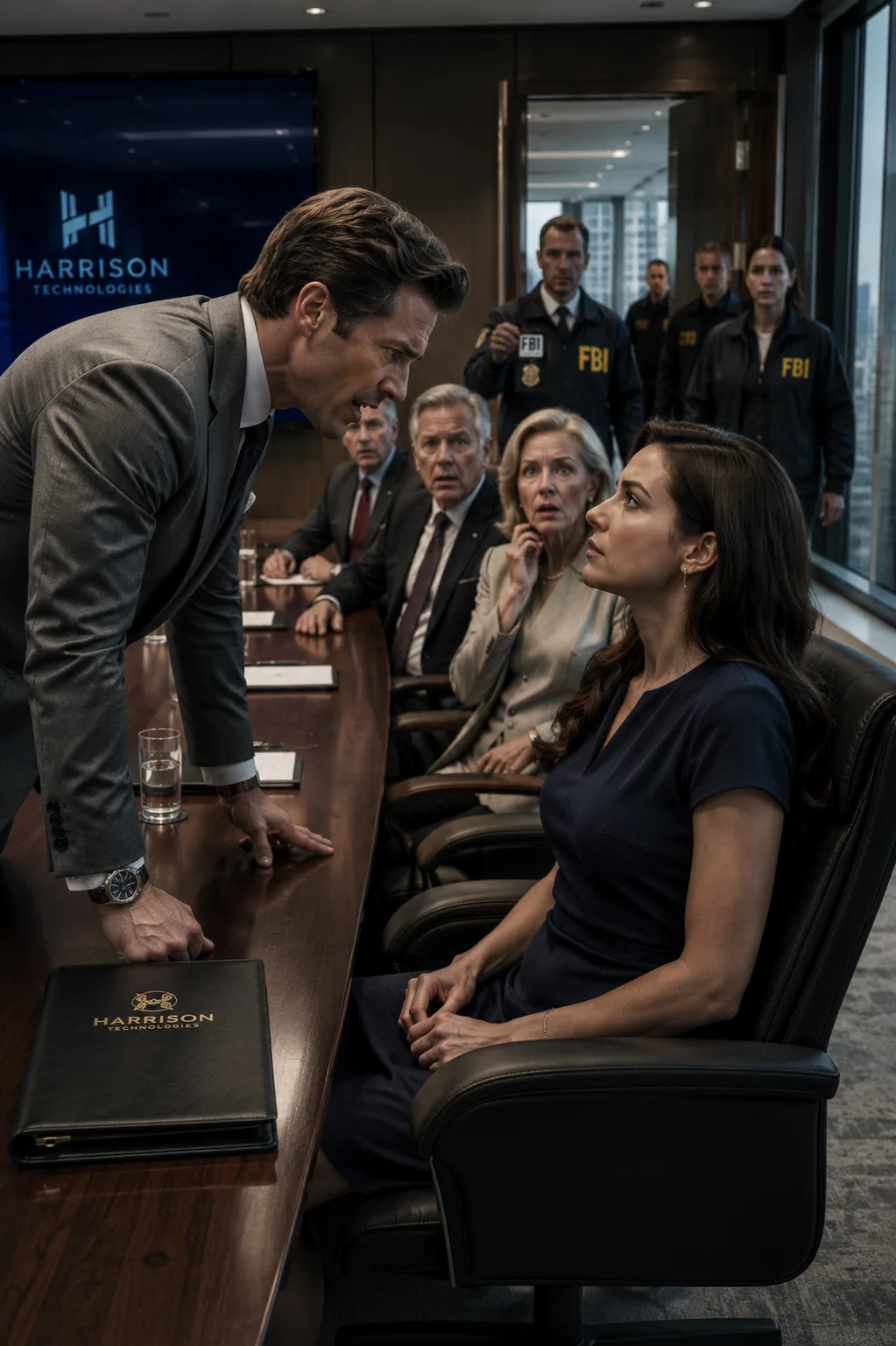
They Called Her Savings Pathetic Until Federal Agents Revealed She Secretly Owned The Company Her Brother Had Been Stealing From
Maya Harrison learned to stay quiet before she learned to drive.
Chapter 1
Maya Harrison learned to stay quiet before she learned to drive.
At family dinners, she sat near the end of the long walnut table while her brother Derek sat beside their father, laughing with investors, board members, and uncles who clapped him on the shoulder like he had already inherited the world. Derek always knew how to fill a room. He knew when to lower his voice, when to grin, when to make a joke just sharp enough to make people lean toward him instead of away.
Maya knew how to disappear.
She would help pass plates. She would refill water glasses. She would sit with her knees together and her hands folded in her lap while someone asked Derek about acquisitions, contracts, expansion, government deals, market share, the future.
Nobody asked Maya anything unless they needed the Wi-Fi password.
Her father, Robert Harrison, had built Harrison Technologies from a cramped rented office and three prototypes that barely worked. Thirty years
later, the company supplied industrial IoT sensors to manufacturers, defense contractors, shipping companies, and automated warehouses across the country. The Harrison name was printed on steel plaques, investor brochures, conference banners, and the glass wall behind the reception desk on the forty-second floor of their Seattle headquarters.
To Robert, that name had a future.
That future was Derek.
“Maya’s brilliant in her own way,” her mother liked to say when someone noticed the imbalance. “She’s just not really business-minded.”
Maya had heard that sentence so many times it no longer felt like an insult. It felt like furniture. Something heavy. Something everyone kept walking around.
She was sixteen when she built her first back-end system for a local logistics startup. Eighteen when she was paid more for a three-month freelance project than most of her college friends made in a year. Twenty-two when she graduated with a computer science degree
and asked her father, quietly and professionally, if there might be a place for her at Harrison Technologies.
Robert had been standing in his home office with a tumbler of scotch in his hand, staring at a framed photo of Derek shaking hands with a senator.
“You need more experience,” he said.
“I have experience.”
“In a real corporate environment, Maya.”
She opened the folder she had brought. System architecture. Data models. Predictive maintenance ideas for industrial sensors. A proposal she had stayed up three nights preparing.
Robert glanced at the first page.
Only the first.
“This is thoughtful,” he said, already closing it. “But Harrison isn’t a coding club.”
Maya looked at the folder in his hand.
Her folder.
Her work.
“Derek joined right after his MBA,” she said.
“Derek understands the company from the inside.”
“He was at Wharton.”
“He understands people.”
That was the end of it.
Two weeks later, Derek was announced as Vice President of Strategic Growth.
At the celebration dinner, her father raised a glass and said, “This company will be safe in Derek’s hands one day.”
Everyone stood.
Everyone toasted.
Maya stayed seated for half a second too long. Her grandmother noticed.
Eleanor Harrison was the only person in that house who watched more than she spoke. She was thin, silver-haired, and still wore her late husband’s signet ring on a chain around her neck. While the family praised Derek, Eleanor turned toward Maya and placed one wrinkled hand over hers.
“Don’t shrink for them,” she said.
Maya looked at her.
Nobody else heard.
Or nobody cared to.
When Eleanor died three years later, the family gathered in black and spoke in careful voices around expensive flowers. Derek inherited the Aspen vacation house, a cedar-and-glass monument to ski trips Maya had never enjoyed. Her mother inherited jewelry. Robert inherited old voting shares and family papers.
Maya received five hundred thousand dollars.
The will was specific.
For Maya Harrison’s entrepreneurial pursuits, with full confidence in her judgment.
Her mother dabbed her eyes with a linen handkerchief and said, “Your grandmother always worried about you.”
Derek hugged Maya with one arm.
“Nice little cushion,” he said near her ear. “Don’t blow it all on an app.”
Maya folded the check into her bag.
She did not answer.
That night, she sat on the floor of her apartment with her laptop open, a mug of cold coffee beside her, and the will spread out on the carpet. It was raining outside. A pipe in the wall kept making a clicking sound every few minutes. Her apartment was small, clean, and furnished mostly with things she had assembled herself from flat boxes.
She read the sentence again.
With full confidence in her judgment.
At 2:13 in the morning, Maya created the first legal file for Vantage Systems.
Not a hobby.
Not a coding project.
Not a little computer thing.
A company.
Vantage began as an AI-driven financial analysis platform. Maya built models that could detect irregularities in cash flow, spot hidden exposure in vendor networks, identify suspicious payments before auditors noticed them, and predict risk patterns across industries. She worked during the day at a software firm that underpaid her and praised her only when she saved someone else’s project. At night, she built Vantage until her wrists ached and the blue light from the screen made the walls look underwater.
Within six months, she had three clients.
Within a year, twelve.
Within eighteen months, a private equity group offered fifty million dollars for a forty percent stake.
Maya read the offer in a conference room that smelled like espresso and new carpet. Across from her sat two men who kept calling her “impressive for her age.”
She signed anyway.
Money was leverage.
Pride was optional.
The deal valued Vantage Systems at one hundred twenty-five million dollars. Maya retained control. She hired Elena Vasquez, a former Goldman Sachs CFO with sharp eyes and no patience for sentimental business decisions. Elena was the first person who looked at Maya’s numbers and did not ask who had helped her.
“You built this alone?” Elena asked.
“With contractors.”
“But the architecture is yours.”
“Yes.”
Elena studied her for another moment. “Your family knows?”
Maya closed her laptop.
“No.”
“Why?”
Outside the glass wall, engineers moved between desks, carrying coffee, keyboards, problems, deadlines. Maya watched them instead of answering right away.
“Because if they know, they’ll either want something or ruin it.”
Elena did not smile.
“That sounds like experience talking.”
“It is.”
So Maya stayed quiet.
At Thanksgiving, she drove to her parents’ house in her reliable gray Toyota and brought roasted carrots because her mother had assigned her “something simple.” Derek arrived twenty minutes late in a black Aston Martin with a woman named Bianca, who wore diamonds before sunset and called Maya “the tech sister.”
At dinner, Robert announced that Harrison Technologies had secured a fifty-million-dollar Department of Defense contract.
Derek lifted his glass and accepted the applause like a man accepting a crown.
Maya said congratulations.
She meant it.
Success did not bother her. Theft of attention did not bother her anymore. What bothered her was the ease with which everyone treated Derek’s success as proof of his worth and Maya’s silence as proof of her lack of it.
“How’s work?” Uncle Richard asked her halfway through dessert.
Before Maya could answer, her mother said, “She’s still doing consulting. Keeps her busy.”
Maya set her fork down.
Just once.
A tiny sound against porcelain.
Nobody noticed.
By the time Maya turned twenty-seven, Vantage Systems had expanded into healthcare analytics, manufacturing risk detection, and predictive finance for Fortune 500 clients. Its valuation crossed one hundred eighty million dollars. Maya owned sixty-one percent of it outright.
She lived in a nicer apartment but not a loud one. She wore tailored clothes but no obvious labels. She still drove the Toyota because it started every morning and asked nothing of her.
Her family saw exactly what they expected to see.
So did Derek.
And Derek, Maya discovered, had become expensive.
At first, it was gossip. A line in an industry newsletter about Derek’s crypto exposure. A friend of Elena’s mentioning a private poker room in Nevada where Derek had lost more in one weekend than most executives made in a year. A supplier complaining, off-record, that Harrison Technologies was taking longer to pay.
Maya did not investigate because Derek was her brother.
She investigated because Vantage Systems had begun tracking unusual activity in manufacturing companies, and Harrison Technologies appeared where it should not have appeared.
Small vendor payments.
Duplicate invoices.
Consulting fees to firms with no web presence.
A warehouse modernization contract routed through a company registered to a mailbox in Delaware.
One anomaly was noise.
Five were a pattern.
Twenty-seven were a crime.
Maya hired Marcus Chen, a private investigator who had once worked forensic fraud cases for federal prosecutors. Marcus was quiet, precise, and disliked adjectives. When he arrived at Vantage’s office three months later, he carried two binders and a drive sealed in a plastic evidence bag.
He placed them on Maya’s desk.
“Your brother is stealing.”
Maya looked at the binders.
“How much?”
“Confirmed? Four point two million over eighteen months.”
Her office overlooked Elliott Bay. A ferry moved across the water below, small and white and calm.
“Unconfirmed?”
“Could reach six if we include pending vendor contracts.”
Maya sat down.
Marcus opened the first binder.
Fake vendors. Inflated contracts. Kickbacks. Offshore transfers. Forged approvals. Several documents bore Robert Harrison’s signature, but Marcus had found timestamp conflicts, access logs, and draft metadata showing they had been generated from Derek’s office systems.
“Your father may be negligent,” Marcus said. “I don’t think he signed these.”
Maya touched the edge of one page.
Robert Harrison’s name looked confident even when forged.
“What happens if I take this to the board?” she asked.
“They bury it.”
“What happens if I take it to my father?”
Marcus paused.
“He protects his son until the evidence forces him not to.”
Maya closed the binder.
That was the problem with knowing your family too well. You could predict their failures before they committed them.
Elena came in after Marcus left. She did not ask what was in the binders. She had already seen Maya’s face.
“Is it Derek?”
Maya nodded.
“How bad?”
“Federal.”
Elena looked through the glass wall at the staff outside.
“What do you want to do?”
Maya opened the top drawer of her desk and removed another file. Harrison Technologies debt restructuring documents. Three years earlier, Robert had taken capital from a private equity vehicle after a failed sensor expansion. He had skimmed the terms. Derek had probably skimmed less. The debt had conversion rights if performance metrics were missed.
The metrics had been missed.
Vantage had bought the debt through a subsidiary.
The conversion had been executed.
For two and a half years, Maya had owned controlling interest in Harrison Technologies.
Her father never knew.
Derek never checked.
The board never asked the right question.
Maya slid the file across the desk to Elena.
“I already own the battlefield,” she said.
Elena read the first page. Her expression did not change, but one eyebrow lifted.
“Does your family know?”
“No.”
“Does Derek?”
“No.”
“Good.”
Maya looked at her.
Elena closed the file.
“Let him walk into the room believing he still owns it.”
Three weeks later, Robert called a special family board meeting.
Maya was not invited.
She learned about it from an automated alert first, because Harrison Technologies’ internal calendar metadata still synced with a vendor platform Vantage monitored through legitimate investor channels. The meeting title was short.
AI Expansion — Capital Strategy.
Family Board Only.
The next morning, Derek called.
Maya let it ring three times before answering.
“Hey,” Derek said, using the voice he reserved for donors, journalists, and people he intended to use. “You busy?”
“I’m at work.”
“Right, right. Your consulting stuff.”
Maya looked across her office at the Vantage logo etched into frosted glass.
“Yes.”
“So Dad’s holding a board meeting Friday. We’re discussing AI integration for Harrison sensors. Predictive analytics, maintenance forecasting, some automated risk modeling. Your area, technically.”
“Technically.”
“I thought it might be good for you to sit in. Offer insights.”
“Free insights?”
Derek laughed.
“Don’t be like that. It’s family.”
There it was.
Family meant Maya should give.
Family meant Derek should receive.
Family meant everyone pretended the exchange was love.
“I might be interested,” Maya said.
“Great.”
“As an investor.”
Silence.
A small one. But enough.
“You want to invest in Harrison Technologies?”
“If the company is moving into AI, I’d like to be involved.”
“How much are we talking?”
Maya looked at the framed copy of her grandmother’s will on the shelf behind her desk. Not displayed for visitors. Displayed for her.
“I could start with ten thousand.”
Derek laughed before he could stop himself.
Not a chuckle.
A laugh.
“Maya, we’re discussing a fifty-million-dollar expansion.”
“I know.”
“Ten thousand is…” He paused, searching for a word that sounded less cruel than the one he wanted. “Symbolic.”
“Still money.”
“Sure,” he said. “Come sit in. It’ll be good for you to see how these meetings work.”
After the call ended, Maya sat motionless for several seconds.
Elena, who had been standing in the doorway, crossed her arms.
“He took the bait?”
“He swallowed the hook.”
“Are you ready?”
Maya opened her leather portfolio. Inside were the documents Marcus had assembled, certified ownership records, SEC correspondence, bank records, chain-of-custody memos, forensic accounting summaries, board notices, and one thin envelope from a federal prosecutor confirming the timing of the warrant execution.
Ready was the wrong word.
She had been ready since she was sixteen and her father closed her folder after one page.
Friday arrived clear and cold.
Maya wore a navy dress, a charcoal coat, and low heels. No jewelry except the small pearl earrings her grandmother had given her at graduation. She parked in the visitor garage beneath Harrison Technologies because her executive pass had not yet been issued under her own name. The elevator mirror reflected a woman her family would not recognize because they had never looked long enough to memorize her.
On the forty-second floor, the receptionist smiled politely.
“Ms. Harrison. They’re expecting you.”
Maya nearly smiled at that.
They were not expecting her at all.
The boardroom was exactly as she remembered from childhood visits: glass walls, steel trim, expensive art chosen by a consultant, and a long mahogany table polished so well it reflected the ceiling lights. Seattle spread beyond the windows in gray-blue layers. On the far wall, a large screen displayed Derek’s opening slide. His name appeared under the title.
Derek Harrison
Chief Executive Officer
Maya arrived early.
Her father was already seated near the head of the table, reviewing printed materials without reading them. Her mother sat beside the window, adjusting a bracelet. Uncle Richard, company treasurer, typed something into his phone. Aunt Caroline, a board member by inheritance more than competence, arranged pens parallel to her notebook. James Sterling, corporate counsel, stood near the credenza with a paper cup of coffee he had not touched.
Derek stood at the head of the table.
Of course he did.
“Maya,” her mother said, rising to kiss her cheek. “I’m glad you came. Derek thought it would be nice to include you.”
Include.
As if Maya were a child allowed into the room after promising not to touch anything.
“Thank you,” Maya said.
She sat at the far end.
No one objected.
No one offered another chair.
Derek began five minutes later.
He was good at presentations. Maya would give him that. He moved smoothly through market analysis, competitor positioning, expected growth in AI-integrated industrial systems, predictive maintenance partnerships, acquisition targets, and a proposed IPO timeline that would value Harrison Technologies at five hundred million dollars by the following year.
A solid plan, built on stolen confidence and unstable books.
Maya listened without interrupting.
Her father nodded through every slide.
Her mother looked proud without understanding a word.
Uncle Richard seemed uneasy when the capital structure appeared.
Good, Maya thought.
At least one of them still knew how numbers worked.
Derek clicked to the final section.
“Capital requirements,” he said. “We need fifty million dollars to move fast enough. Forty million is already soft-committed from outside investors. The remaining ten should come from family and board insiders. It sends the right message before the IPO.”
Robert sat straighter.
“The family must show confidence.”
“Exactly,” Derek said. “I’m personally committing two million.”
Maya watched his hand as he said it.
His fingers tapped once against the clicker.
Lie.
“Dad, we’d like three from you. Richard, three. Caroline, one. The remaining one can be structured through smaller internal participation.”
No one looked at Maya.
That was deliberate.
She let the silence sit for a moment.
Then she placed her pen down.
Click.
It was a tiny sound, but the room noticed this time.
“I’d like to revise my investment offer,” she said.
Derek turned his head.
That smile came back.
The one he had practiced on people he considered beneath him.
“Maya, that’s generous, but we’re not passing around a donation basket.”
“I understand.”
Robert removed his glasses.
“What amount are you proposing?”
“Fifteen million dollars.”
The room stopped.
Not paused.
Stopped.
Her mother’s bracelet slipped halfway down her wrist.
Uncle Richard looked up.
James Sterling’s coffee cup lowered by an inch.
Derek stared at Maya like she had spoken in a language he disliked.
“I can wire it by Friday close of business,” Maya added.
Robert gave a short laugh.
“Maya.”
Just her name.
A warning.
A correction.
A dismissal.
“Dad?”
“Where would you get fifteen million dollars?”
“My company.”
“Your consulting?”
“My company,” Maya repeated.
Her mother leaned forward. “Sweetheart, I think there may be some confusion about scale.”
“No confusion.”
Derek set the clicker on the table.
The plastic made a dull tap.
“Maya, stop.”
She looked at him.
He walked down the side of the table toward her. Slow enough for performance. Fast enough to look irritated. His shoes made almost no sound on the carpet.
“You came here because I invited you,” he said. “Don’t embarrass yourself.”
Maya did not move.
Derek stopped beside her chair and placed one hand on the table. He leaned down, just enough to loom without touching her. His watch flashed silver under the lights.
“This is a two-hundred-million-dollar company,” he said. “Not a lemonade stand. We don’t need desperation money from someone pretending to play entrepreneur.”
Nobody stopped him.
Maya looked first at her father.
Robert looked down.
She looked at her mother.
Her mother pressed her lips together, apology shaped like silence.
Uncle Richard turned one page in his folder.
Aunt Caroline studied her pen.
Derek lowered his voice, but not enough.
“Keep your pathetic savings.”
There it was.
Years of dinners.
Years of closed folders.
Years of being the little computer girl.
All of it compressed into one sentence and placed on the table in front of witnesses.
Maya’s thumb moved under the flap of her leather portfolio.
Not fast.
Not dramatic.
Just enough.
“Are you finished?” she asked.
Derek smiled.
“I’m trying to help you.”
“No,” Maya said. “You’re trying to humiliate me while you still can.”
His smile thinned.
James Sterling cleared his throat.
“Perhaps we should take a brief recess.”
“No need,” Maya said.
A knock struck the boardroom door.
Three hard sounds.
Everyone turned.
Derek’s assistant opened the door only halfway. Her face had lost color.
“Mr. Harrison,” she said. “There are federal agents here.”
Derek straightened.
“What?”
“FBI. And SEC. They have a warrant.”
Robert stood so quickly his chair rolled back and hit the glass wall.
“What the hell is this?”
The door opened fully.
Special Agent Victoria Reeves entered first. She was in her fifties, compact, gray-suited, and calm in a way that made the room feel instantly smaller. Two SEC investigators followed her, one carrying a briefcase, the other holding a folder sealed with a red evidence label.
“Robert Harrison?” Agent Reeves asked.
Robert’s face reddened.
“I’m Robert Harrison.”
“Please remain where you are.”
“I demand to know—”
“You will.”
Her voice cut through his.
Derek took half a step back from Maya’s chair.
Maya opened her portfolio.
James Sterling looked from the agents to Maya, then to the portfolio, and something in his face shifted. Corporate attorneys spend their lives reading rooms. He had just realized he had been reading the wrong one.
Agent Reeves placed the warrant on the table.
“We’re executing a federal warrant concerning financial activity at Harrison Technologies, including wire fraud, securities fraud, embezzlement, and document forgery. The current confirmed amount is four point two million dollars.”
Maya’s mother made a small sound.
Derek forced a laugh.
It came out broken at the edges.
“This is insane. Who filed this?”
SEC Investigator Martin opened his folder.
“The complaint was filed by the majority shareholder.”
Robert slammed his hand on the table.
“I am the majority shareholder.”
“No, sir,” Martin said. “You are not.”
Silence spread quickly.
Martin removed one document and placed it beside the warrant.
“Current ownership records show that Robert Harrison holds twenty-three percent. Derek Harrison holds fifteen percent. The controlling sixty-one percent is held by Vantage Systems LLC.”
Nobody moved.
Not even Derek.
Maya slid her first document across the table.
The stock certificate stopped near the center, directly beneath the lights.
Vantage Systems LLC
Controlling Shareholder
Maya Harrison, Founder and Chief Executive Officer
Her mother reached for the paper with shaking hands.
“Maya,” she said. “What is this?”
Maya stood.
The room looked different from that height.
Not warmer.
Not kinder.
Just smaller.
“Three years ago, Harrison Technologies took debt financing from a private equity vehicle after the sensor expansion missed its revenue targets. The agreement included conversion rights if the company failed to meet performance metrics for two consecutive quarters.”
Robert stared at her.
“You wouldn’t know that.”
“I would,” Maya said. “I bought the debt.”
Derek’s mouth opened.
No words came.
“Through a Vantage subsidiary,” Maya continued. “The metrics were missed. The debt converted. Your positions were diluted. Mine became controlling.”
Her father looked at James Sterling.
James said nothing.
That was answer enough.
“You owned it?” Aunt Caroline said.
“For two and a half years.”
Uncle Richard whispered something under his breath.
Maya turned to Derek.
“You wanted my insight today. You wanted free strategy. Maybe you wanted to laugh at my ten thousand dollars before asking me to build models you could put into your pitch deck.”
Derek swallowed.
The sound was visible in his throat.
“You set this up.”
“I let you be yourself.”
Agent Reeves watched without interrupting.
Maya opened the second section of her portfolio and removed Marcus Chen’s report. She placed it in front of Derek.
He did not touch it.
So she opened it for him.
“Fake vendor accounts. Inflated consulting contracts. Kickbacks routed through shell companies. Offshore transfers. Forged authorization forms. Duplicate expense reimbursements. Four point two million dollars confirmed. More pending.”
Derek’s hand went to the back of a chair.
Robert turned to him slowly.
“Derek?”
For the first time, Derek did not look like the golden son. He looked like a man calculating exits in a room with none.
“Maya has always resented me,” he said.
It was almost impressive.
Even cornered, he reached for the oldest weapon.
“She’s twisting something. I don’t know what she thinks she found, but—”
Agent Reeves stepped closer.
“Mr. Harrison, we have bank records, device metadata, signed vendor approvals, offshore account links, and cooperating witnesses.”
Derek’s eyes snapped to her.
“Witnesses?”
Maya watched that word land.
Witnesses.
Plural.
Marcus had been right. People who steal always assume everyone else is loyal until the subpoena arrives.
Robert picked up one of the forged authorization forms. His own signature stared back at him.
“I didn’t sign this.”
“No,” Maya said. “He did.”
Derek turned on her.
“You don’t know that.”
“I know the document was created on your executive assistant’s workstation at 11:43 p.m. I know it was edited from your office terminal at 12:08. I know the vendor account was opened using a scanned copy of Dad’s signature pulled from a 2019 board resolution. I know the receiving entity was connected to a Nevada gambling syndicate and a Cayman account under a beneficial ownership trust.”
Derek’s face drained.
Maya closed the binder.
“I know because I build systems that find men like you.”
That sentence did what fifteen million dollars had not.
It made him believe her.
Agent Reeves removed handcuffs from her belt.
“Derek Harrison, you are under arrest on charges including wire fraud, securities fraud, embezzlement, and forgery. You have the right to remain silent.”
Derek stepped back.
“No.”
The chair behind him caught his leg.
He grabbed the table.
“No, wait. Dad.”
Robert did not move.
“Dad,” Derek said again. “Tell them.”
Robert looked at the forged signature in his hand.
The paper trembled.
Derek turned to his mother.
“Mom.”
She stood halfway, then sat again, her fingers pressed against her mouth.
The agent took Derek’s wrist.
The first cuff clicked.
Derek flinched like the sound had hit bone.
“Maya,” he said.
She looked at him.
Not away.
Not down.
At him.
“You can stop this.”
“No.”
“I’m your brother.”
“You were my brother when you stole from my company.”
His eyes flickered.
“I didn’t know it was yours.”
“That’s the first honest thing you’ve said today.”
The second cuff locked.
Derek leaned toward her as the agent pulled him back.
“If I had known—”
“You would have hidden it better.”
The room had no air left.
Derek’s polished confidence collapsed in pieces. First his posture. Then his voice. Then the face he wore for investors, family dinners, awards luncheons, charity photos. Underneath was something smaller and meaner.
“You wanted this,” he said. “You wanted to ruin me.”
Maya picked up the leather portfolio.
“No. I wanted you to stop stealing. You kept going.”
Agent Reeves guided him toward the door.
He twisted once more.
“Maya, please.”
She did not answer.
Derek looked at their father.
Robert’s chair sat crooked behind him.
For thirty years, Robert Harrison had built rooms where people waited for him to speak. Now no one needed him to.
The agents took Derek out.
The door closed.
A boardroom can hold many kinds of silence. Respectful silence. Awkward silence. Strategic silence.
This one was the silence after a dynasty realizes it has been using the wrong heir as decoration.
Maya remained standing.
Her mother was the first to speak.
“They took him.”
“Yes.”
“You let them take him.”
“He committed federal crimes.”
“He is your brother.”
“He was my brother when he called my savings pathetic.”
Her mother’s face twisted at the word.
Maybe she remembered not defending Maya.
Maybe she remembered every time she had translated cruelty into concern and called it motherhood.
Robert lowered himself into his chair.
“You owned the company,” he said.
“Yes.”
“All this time?”
“Yes.”
“Why didn’t you tell me?”
Maya looked at the man who had taught her that attention was a resource to be earned and never given.
“Because I wanted to know what you saw when you looked at me without money in the way.”
Robert closed his eyes.
“Maya.”
“No,” she said. “Not today.”
James Sterling stepped forward carefully.
“Ms. Harrison, as controlling shareholder, we need direction. Federal cooperation, disclosure obligations, board continuity, leadership structure—”
“Full cooperation,” Maya said. “Open every account. Preserve every record. Suspend all executives with financial access pending review. Notify outside counsel. Prepare an emergency disclosure plan.”
James nodded quickly.
Her voice did not shake.
“Derek is removed as CEO effective immediately. Uncle Richard resigns as treasurer pending investigation. Dad steps down as chairman.”
Robert looked up.
“Maya.”
“You didn’t know what Derek was doing,” she said. “That may keep you out of prison. It does not keep you in power.”
The sentence landed harder than she expected.
Not because it was cruel.
Because it was accurate.
Aunt Caroline folded her hands.
“And the board?”
“Reconstituted. Independent directors. No family members except me until the audit is complete.”
“You can’t just—”
“I can.”
Maya placed the ownership certificate beside the warrant.
“I am.”
Her mother looked at her like she had become someone else.
But Maya had not become someone else.
She had simply stopped performing smallness for people addicted to feeling taller.
Two months later, Derek pleaded guilty.
His attorneys fought first. Of course they did. They suggested miscommunication, unauthorized subordinates, procedural errors, clerical confusion. But Marcus’s evidence held. The SEC findings held. The FBI’s interviews held. Two fake vendors cooperated. A former finance manager admitted Derek had pressured him to approve backdated invoices. The offshore trails were ugly, but traceable.
Seven years in federal prison.
Restitution of four point two million dollars, plus penalties.
A permanent ban from serving as an officer or director of a public company.
Bianca sold the Aston Martin before sentencing.
Maya did not attend the hearing.
She read the transcript later in her office, alone, with a cup of coffee she forgot to drink.
Derek apologized to the court.
To investors.
To employees.
To his family.
His letter to Maya arrived three weeks after sentencing. It was six pages long. The first page said sorry. The next five explained why he had felt pressured, misunderstood, burdened by expectations, trapped by their father’s legacy, tempted by bad advice.
Maya placed it in a drawer.
She did not throw it away.
She did not answer.
Robert avoided criminal charges. Investigators confirmed the signatures had been forged, and while his negligence was painful, it was not prosecutable at the level they had feared. That did not save him from losing everything he cared about.
He resigned.
Sold the house.
Moved to Arizona.
The first time he called Maya after the move, he spoke about the weather for nine minutes.
“It’s dry here,” he said.
“I’ve heard.”
“The condo has a pool.”
“That’s good.”
Another pause.
“I saw your interview.”
Maya looked out over Seattle’s waterfront from her office.
“And?”
“You spoke well.”
“Thank you.”
A longer pause.
“I didn’t know you could speak like that.”
Maya almost laughed.
Not because it was funny.
Because it was still him.
“You never listened long enough,” she said.
He did not answer.
The next month, he called again.
Slowly, awkwardly, they began building something too fragile to name. Not forgiveness. Not reconciliation. Not yet. More like two people standing on opposite sides of a collapsed bridge, measuring the distance.
Her mother tried harder and worse.
She invited Maya to dinners. Sent articles about AI with highlighted passages she did not understand. Asked questions that sounded rehearsed. Once, over lunch at a quiet restaurant, she pulled out a notebook.
Maya looked at it.
“What is that?”
“I wrote down things I wanted to ask about your company.”
Maya stared at the notebook.
Her mother turned the page.
“I know I should have asked years ago.”
The waiter arrived with water.
Neither of them spoke until he left.
“Ask,” Maya said.
Her mother did.
Badly at first.
Then better.
Progress did not feel warm. It felt like scar tissue stretching.
Harrison Technologies became Vantage Industrial Systems six months after Derek’s arrest. Maya kept the engineers, the plant teams, the warehouse technicians, the sales staff who had done their jobs while executives played kings. She fired three senior finance officers, replaced the board, moved Vantage’s headquarters to Seattle, and integrated her AI platform into the industrial sensor network Derek had tried to pitch with stolen authority.
The results were brutal in the best way.
Manufacturing clients that had been considering leaving renewed. Two major healthcare logistics companies signed. The predictive maintenance system reduced downtime by twenty-three percent in pilot plants. Investor confidence returned faster than anyone expected because the fraud had been contained, exposed, and cleaned by the controlling shareholder herself.
One year after the boardroom arrest, Vantage Industrial Systems was valued at four hundred twenty million dollars.
The IPO projection moved from five hundred million to nine hundred.
Elena became COO.
Marcus stayed on retainer.
James Sterling stopped looking uncomfortable around Maya and started calling her “the only adult who was ever in that room.”
Maya finally replaced the Toyota.
Not because it failed.
Because one morning she sat in it outside the Vantage tower and realized she had kept it partly as armor. Proof she was not like them. Proof success had not changed her. Proof she could not be accused of becoming greedy, loud, entitled, Harrison.
She bought a Tesla in cash and drove it home without telling anyone.
That night, she took her grandmother’s will down from the shelf and read the sentence again.
With full confidence in her judgment.
She placed it back.
Not as a reminder anymore.
As evidence.
At her cousin’s wedding that spring, Maya arrived alone in a dark green dress and left after the cake was cut. Family members watched her differently now. Some with admiration. Some with resentment. Some with the nervous politeness people reserve for someone they once mistreated when she had no visible power.
Uncle Richard avoided her.
Aunt Caroline sent holiday cards with no personal note.
Her mother introduced her to a distant cousin as “my daughter, Maya, the CEO.”
Maya corrected her.
“Just Maya is fine.”
Her mother flushed.
But she nodded.
Near the bar, Robert stood with a glass of sparkling water in his hand. He looked older. Smaller. Less certain of the room.
“You look well,” he said.
“So do you.”
A lie, but not a cruel one.
He glanced across the ballroom at Derek’s empty place in the family photos.
“I thought I was building a legacy,” he said.
Maya followed his gaze.
“You were building a pedestal.”
He looked at her.
She expected him to argue.
He didn’t.
“That sounds right,” he said.
They stood there for a moment while music played too loudly and someone’s child crawled under a tablecloth.
“I’m sorry,” he said.
Maya had heard those words before.
From Derek in letters.
From her mother over lunch.
From relatives who suddenly remembered compliments they had never given.
But her father said it without explanation attached.
No defense.
No plea.
No request.
Just the words.
Maya set her glass on the bar.
“I know.”
It was not forgiveness.
But it was not nothing.
The night before the investor roadshow, Maya stayed late at the office. The building had emptied floor by floor until only the cleaning crew remained. Her office window reflected the room behind her: desk, chair, contracts, skyline, the pearl earrings in a small dish beside her laptop.
A new letter from Derek sat unopened near the edge of the desk.
She had brought it from home that morning, intending to read it between meetings. She had not.
At 10:47 p.m., she opened it.
This one was shorter.
No childhood excuse.
No father excuse.
No pressure excuse.
Just three paragraphs.
I called your savings pathetic because I needed you to stay small.
I stole because I thought consequences were for other people.
I do not expect you to answer.
Maya read it twice.
Then she folded it carefully and placed it in the drawer with the others.
Not forgiven.
Not erased.
Stored.
The next morning, she entered the investor presentation wearing the pearl earrings and a navy suit sharper than anything Derek had ever worn. Elena walked beside her with a stack of materials. James stood near the front. Engineers waited in the back row, nervous and proud.
The first slide appeared on the screen.
Vantage Industrial Systems
Predictive Intelligence for the Physical World
Maya looked at the room.
No family table.
No assigned seat at the end.
No one laughing before she finished speaking.
She began.
“Our company was built from two truths,” she said. “Machines tell you when something is failing long before people admit it. So do financial systems.”
A few investors leaned forward.
Good.
Let them.
She walked them through the platform. Sensor integration. Fraud detection. Predictive maintenance. Supply chain modeling. Risk exposure. Expansion. Revenue. Audits. Leadership transition. Compliance rebuild.
No apology.
No shrinking.
When the questions came, she answered them one by one. Clearly. Precisely. Without asking permission from the ghost of the man who once told her Harrison wasn’t a coding club.
Afterward, Elena found her near the windows.
“You know what your grandmother would say?”
Maya looked at the skyline.
“What?”
Elena smiled.
“She would say she invested early.”
Maya laughed then.
A real laugh.
Small, but hers.
Far below, traffic moved through Seattle in thin lines of red and white. Ferries crossed the water. Office lights blinked on in neighboring towers. Somewhere, her father was probably reading the financial news in an Arizona condo. Somewhere, her mother was underlining another article about AI. Somewhere, Derek was counting years in a place where charm had no market value.
Maya touched one pearl earring.
For most of her life, the Harrison family table had taught her that love was seating, inheritance, applause, and permission. Derek had been given the head chair before he earned it. Maya had been handed silence and told it suited her.
So she built another table.
Stronger wood.
Sharper edges.
Her own name at the top.
And this time, nobody could move her seat.
THE END.
Chapter complete
You have reached the end of this chapter.
Continue reading
A few more worlds to get lost in after this chapter.




