The last shovel of dirt hit my father’s coffin with a dull sound that made my stepmother check her watch.
Chapter 1
The last shovel of dirt hit my father’s coffin with a dull sound that made my stepmother check her watch.
She did it carefully, with her wrist turned toward her coat sleeve, like she was only adjusting the cuff. But I saw the gold face flash under the gray cemetery sky. Diane Carter had always been skilled at making disrespect look like good posture.
My half-sister Vanessa stood beside her, holding a black umbrella that did not have a single drop of rain on it. Her sunglasses were too large for the weather and too glossy for the cemetery. Every few minutes, she tilted her head toward one of the mourners, accepting quiet condolences with a soft nod, as if Dad had been hers to lose.
I stood on the other side of the grave.
No umbrella.
No sunglasses.
Just my black wool coat, the one Dad had bought me five years earlier because he said winter airports made everyone look like they had given up.
The collar still smelled
faintly of cedar from his hallway closet.
A cemetery worker stepped forward with a folded tarp. The priest closed his little book. People began to move away in small groups, shoes pressing into damp grass, voices lowering into polite murmurs.
Diane did not come to me.
Vanessa did.
Not close enough to touch. Close enough to be heard.
“Mom already arranged the car,” she said.
I looked past her toward the line of black vehicles near the cemetery road. Three town cars waited there. Dad had always hated funeral processions that looked like business meetings, but Diane had ordered the longest one anyway.
“Which one?” I asked.
Vanessa’s mouth curved.
“The family one.”
Two words.
Enough.
She walked away before I could answer. Her heels did not sink into the grass the way mine did. She had chosen better shoes for burying someone.
I stayed by the grave after everyone
else had begun to leave. The flowers leaned against the dark mound, white roses mixed with lilies, too expensive and too arranged. Dad had liked sunflowers from the grocery store, the ones wrapped in plastic with the stems still wet.
There were none.
I took one rose from the edge of the arrangement. Not because I wanted it. Because someone had paid too much for it and still made it feel cheap.
A hand touched my elbow.
I turned.
Mr. Alden, my father’s estate attorney, stood behind me with his black briefcase held in both hands. He was seventy, thin, and always smelled faintly of peppermint. His tie had a small crooked fold near the knot.
“Emma,” he said.
I had known him since I was eight. He had been at our kitchen table the day Dad signed the papers to put the old lake house in a trust. He
had brought me lemon cookies from a bakery three towns over whenever he visited because I once said they tasted like Christmas.
Diane called him “the paperwork man.”
Dad called him “the only person in the room who reads before he speaks.”
“Mr. Alden,” I said.
He looked toward Diane’s car. She was already standing beside the open rear door while Vanessa handed her umbrella to a driver. They were not looking at us.
“Your father left instructions,” he said.
My fingers tightened around the rose stem.
“For the will?”
“Not here.”
His eyes moved once toward Vanessa. She was watching now.
“Tomorrow,” he said. “My office. Ten sharp.”
I nodded.
He reached into his coat pocket and pulled out a small cream envelope. My name was written on the front in Dad’s handwriting.
Emma.
No last name.
Just mine.
I did not open it.
Mr. Alden’s hand stayed over the envelope for one second longer than necessary.
“Keep this with you,” he said.
“Should Diane know?”
His face did not change.
“Your father knew who needed to know.”
The words landed softly. Heavy anyway.
Vanessa called my name from the road. Not loudly. Just enough to make the people nearby glance over.
“Emma. We’re leaving.”
Mr. Alden stepped back. His polished shoes sank slightly into the grass.
“Tomorrow,” he said again.
I put the envelope into the inside pocket of my coat, where it rested against my ribs.
Then I walked toward the cars.
Diane had taken the first town car. Vanessa stood beside the second, one hand on the door, the other holding her phone.
The third car was gone.
I stopped.
Vanessa glanced down at the empty road behind me.
“Oh,” she said. “The other driver had to go.”
Diane sat inside the car with the door open, her cream funeral gloves folded on her lap. She did not look at me directly.
“There’s room,” I said.
There was. The back seat beside Vanessa was empty except for a small designer bag.
Vanessa lifted the bag and placed it in the middle seat.
“Not really.”
The driver stared straight ahead.
Diane finally turned her head. “We have to get to the airport. The arrangements have been exhausting.”
“The arrangements?” I asked.
Her eyes sharpened.
“I buried my husband today.”
My father.
Not hers first.
Not hers only.
But the cemetery was full of people who would have heard me if I said it, and Diane had always counted on my silence as if it were part of the inheritance.
I stepped back from the car door.
Vanessa smiled through the gap.
“You can ride with Mr. Alden.”
“He left.”
“Then call someone.”
Diane leaned forward just enough for the pearls at her throat to catch the weak afternoon light.
“Emma, not today. Please do not make grief about logistics.”
The driver closed the door before I moved.
The car pulled away slowly. Vanessa did not wave. Her face remained turned toward me until the tinted window swallowed it.
I stood near the cemetery road with one rose in my hand and one envelope in my coat.
The wind bent the ribbon on a wreath beside the gate. It read BELOVED HUSBAND in gold letters.
My phone buzzed fifteen minutes later.
A message from Diane.
Commercial flight changed. We are leaving from Terminal B. Be there by 6:30 if you want to return with us.
If.
I read it twice.
Then I called a rideshare.
The driver who came for me had a cracked phone mount and a pine air freshener swinging from the mirror. He did not ask why I was getting into his car from a cemetery alone. He only glanced at the rose in my hand and turned the heat up without a word.
That was kindness.
Small.
Real.
At the airport, Terminal B was bright enough to make everyone look pale. The floors shone. The departure boards flickered blue and white. Families moved around me with stuffed backpacks and coffee cups and children who had fallen asleep in strollers.
I found Diane and Vanessa near the airline counter.
Diane had changed.
Not entirely. The cream coat was the same, but the black funeral dress underneath was gone. She wore a silk blouse now, pale champagne, with a scarf tied at her neck. Vanessa had traded her cemetery shoes for white sneakers and had sunglasses pushed up into her hair.
The luggage at their feet looked expensive and coordinated.
My suitcase was black, old, and scuffed near one wheel. Dad had fixed that wheel twice with a screwdriver and too much confidence.
Diane noticed me, then looked at the suitcase.
“That’s all you brought?”
“It was a funeral, not a move.”
Vanessa’s mouth twitched.
Diane turned back to the counter agent. “Three seats under Carter.”
The agent typed.
I stepped closer.
Diane did not say my name.
The agent looked at her screen. “I have two seats confirmed.”
Diane gave a small laugh, the kind she used at charity luncheons when someone mispronounced a donor’s name.
“There should be three.”
The agent typed again. “Two confirmed. One reservation was canceled this afternoon.”
My hand moved to the envelope inside my coat.
Diane’s shoulders did not move, but Vanessa looked down at her phone.
Too fast.
I saw the reflection of the screen in her sunglasses. A confirmation page. A canceled itinerary.
My name.
She locked the phone.
“Must be a mistake,” Diane said.
The agent looked at me. “Do you have identification?”
I handed it over.
She checked. Her lips pressed together.
“I’m sorry. Your ticket was canceled by the purchaser.”
The purchaser.
Diane.
I turned to her.
She did not look embarrassed. That was the first thing I noticed. Not even mildly inconvenienced. She looked like a woman waiting for a waiter to remove a dirty plate.
“We couldn’t risk confusion,” she said.
“Confusion?”
“We have a lot to manage.”
Vanessa touched her mother’s arm. “Mom, boarding will start soon.”
I looked at the counter agent. “Can I buy another ticket?”
She checked the screen. “There are no available seats on this flight.”
Diane collected both boarding passes.
Both.
She slid one into Vanessa’s hand and tucked the other into her handbag.
“You can take the morning flight,” she said.
“With what card?”
Her gaze dropped to my purse.
“The one your father gave you.”
I opened my mouth. Closed it.
Dad had given me that card for emergencies when I was in college. Diane had canceled it two weeks after he went into the hospital. She had told me it was “for accounting reasons.”
Vanessa shifted her weight.
The counter agent looked between us and pretended not to hear.
I took my ID back.
Diane leaned closer. Her perfume smelled like white flowers and something metallic.
“Do not start a scene in an airport.”
A scene.
That was what she called truth whenever other people were close enough to hear it.
She turned away.
Vanessa followed.
I stayed at the counter until the agent cleared her throat.
“I’m sorry,” she said.
I nodded.
The rose from the cemetery had bent inside my coat pocket. One petal had broken loose and stuck to the lining.
I went to baggage claim because I had nowhere else to stand.
Dad used to say airports were honest places. People either ran toward someone or away from them. No one could fake direction for long.
I watched a father lift his daughter over the metal rail beside carousel four. I watched a woman in a red coat cry into the shoulder of a man who dropped both his bags to hold her properly. I watched a teenage boy roll his eyes at his mother, then reach back and take her carry-on anyway.
My suitcase came around alone.
The old black one.
It passed me once before I reached for it.
The wheel caught at the edge of the carousel. I pulled. It jerked free and hit my shin.
A sound came out of me. Small. Not a sob. Not quite a laugh.
I set the suitcase upright.
The cream envelope pressed against my ribs.
I took it out.
Dad’s handwriting looked unsteady, the letters thinner than usual, but still his. He had written with the same blue fountain pen he used for birthday cards, grocery lists, and angry notes to the electric company.
I opened the envelope with my thumb.
Inside was a folded sheet of his personal stationery.
Emma,
If you are reading this before Alden has spoken to you, then the people I feared would show you who they are have done it sooner than I hoped.
Do not argue with them in a place built for exits.
Look for Hayes.
He will hold your name.
Dad
I read it once.
Then again.
A boarding announcement echoed overhead. Someone laughed near the vending machines. A child cried because his balloon had hit the ceiling and stayed there.
Look for Hayes.
I lifted my head.
Drivers stood in a line near the glass doors beyond baggage claim, holding signs for arrivals. Some had printed logos. Some had tablets. One held flowers. One had a cardboard sign with a last name written in thick marker.
My eyes moved from face to face.
No Hayes.
I folded the letter and put it back into the envelope.
My phone buzzed.
A photo from Vanessa.
She had sent it in the family group chat.
Two champagne glasses on an airport lounge table. Diane’s hand in the corner, her diamond ring bright under the light.
Caption: Finally going home.
The group chat had three people in it.
Diane.
Vanessa.
Me.
I stared at the photo until the screen dimmed.
Then I typed nothing.
I put the phone in my coat pocket and pulled my suitcase toward the glass doors.
Outside, night had settled over the airport road. Headlights slid past in lines. The automatic doors opened and closed, letting in strips of cold air that smelled like gasoline and rain.
A black sedan waited at the curb.
Not a rideshare.
Not a taxi.
A long black sedan with tinted windows and a small silver emblem on the hood. The kind Dad used for business trips when he had meetings he did not want Diane to attend.
A man stood beside it.
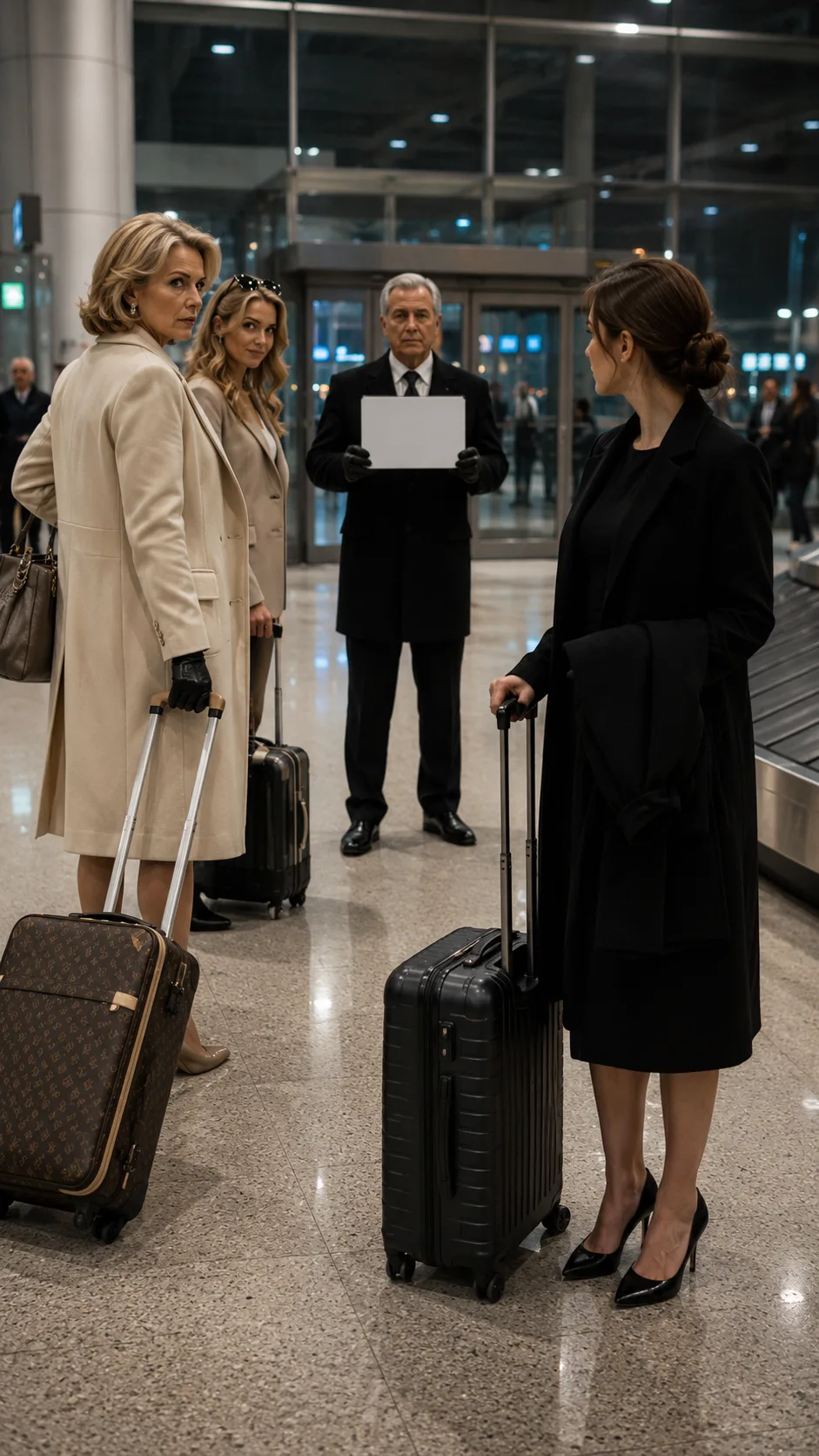
Silver hair. Black suit. Black overcoat. White gloves.
He held a sign.
Emma Margaret Carter.
My full name.
Margaret after my mother, the name Diane never used.
My hand went slack on the suitcase handle.
The driver looked at me, not past me, not through me.
“Miss Carter?”
I did not answer right away.
The automatic doors opened behind me.
Diane’s voice came through first.
“Emma?”
I turned.
She and Vanessa had not boarded.
Diane stood inside the terminal with her handbag in the crook of her elbow, her scarf still perfect. Vanessa was behind her, holding a coffee cup and her phone.
They must have seen me from the lounge balcony.
Or they saw the car.
Diane’s eyes went to the sign.
Not my face.
The sign.
Her mouth changed shape by a fraction.
Vanessa stepped closer, coffee forgotten in her hand.
“Who is that?” she said.
The driver lowered the sign slightly.
“My name is Thomas Hayes,” he said. “I drove for Mr. Carter for twenty-one years.”
Diane’s expression smoothed too quickly.
“Thomas,” she said. “You should have contacted me.”
He inclined his head. Not enough to be warm.
“Mr. Carter instructed me otherwise.”
Vanessa gave a small laugh. “Dad didn’t have a personal driver anymore.”
Hayes looked at her.
“He did when he needed privacy.”
The words were not loud.
They carried anyway.
A man near the door slowed with his luggage. A woman in a navy coat glanced over, then pretended to study the pickup signs. The airport kept moving, but the space around us had changed.
Diane stepped through the automatic doors.
Cold air touched her scarf and lifted one edge.
“This is inappropriate,” she said. “My husband died today.”
Hayes did not lower the sign.
“Yes, Mrs. Carter.”
“Then you understand this is a family matter.”
He looked at me.
Then back at her.
“I do.”
Vanessa moved around Diane, closer to the curb. Her eyes had gone to the car again.
“Is that Dad’s sedan?”
Hayes did not answer her.
Diane reached toward the sign.
Not violently. Diane never snatched in public. Her hand moved with the confidence of someone who expected objects to come to her.
Hayes shifted the sign out of reach.
The movement was small.
Clear.
Diane stopped.
Her fingers hung in the air for half a second before she lowered them.
“Give me that,” she said.
“No.”
The word sat between them.
Vanessa looked at her mother.
The woman in the navy coat stopped pretending.
Diane’s voice lowered. “You are still employed by the Carter estate.”
“No,” Hayes said. “I am employed by the Carter Trust.”
Diane’s eyes sharpened.
Vanessa’s coffee cup tilted. A dark line ran down the lid and onto her fingers. She did not notice.
The envelope inside my coat seemed to grow heavier.
Hayes reached under his arm and brought out a black leather folder.
Dad’s folder.
I knew it by the scratched brass corner. He had carried it to every meeting when I was little. Once, when I was nine, I had stuck a tiny blue star sticker on the inside flap. He never removed it.
Hayes opened it.
The sticker was still there.
My throat closed around nothing.
Diane saw it too.
Her face did not collapse. Diane was too practiced for that. But her hand moved to her scarf and held it.
Hayes turned the folder toward me.
“Your father asked me to meet you here if they left you behind.”
Vanessa’s head snapped toward Diane.
I looked at my stepmother.
Diane did not look at Vanessa.
That was answer enough.
Hayes removed a sealed envelope from the folder. Cream paper. Dad’s initials embossed in dark blue.
“He also asked me not to release this to anyone else.”
Diane stepped forward.
“That document belongs to the estate.”
Hayes kept the envelope in his gloved hand.
“No, ma’am.”
“Thomas.”
His name came out like a warning.
He did not move.
Vanessa finally found her voice. “That car belongs to the family.”
Hayes looked at her, then at the sedan, then at the sign with my name.
“That car is not for them.”
The automatic doors opened again behind Diane. A family with two suitcases came out, slowed, and split around us. The father glanced at Hayes. The mother looked at me. No one spoke.
Diane’s gloved hand dropped from her luggage handle.
Hayes turned toward me and held out the envelope.
“Mr. Carter said you would understand the name.”
I took it.
My fingers brushed the paper. It was thick and cold from the night air.
Diane said my name then.
Not Emma.
Not sweetheart, not dear, not any of the soft words she had used in front of guests.
“Emma Margaret.”
The full name sounded wrong in her mouth.
Hayes looked at her.
Diane’s face had gone pale under the airport lights.
Vanessa wiped coffee from her fingers with a napkin, but her eyes stayed on the envelope.
“What name?” she asked.
I opened it.
Inside was a single page and a key card.
The page was short.
Emma Margaret Carter,
If this reaches you at the airport, then I was right about one thing I wished I had been wrong about.
Hayes will take you home.
Not to Diane’s house.
To yours.
The Lake House Trust transferred on your twenty-seventh birthday. Alden has the filings. Hayes has the keys. The sedan is registered under the trust. The accounts tied to it are yours to manage.
I should have told you sooner.
I thought I had more time.
Dad
The key card rested against the fold.
Lake House Trust.
My twenty-seventh birthday had been two months ago.
Diane had hosted a dinner that night. Vanessa had blown out candles on a cake she said was “for both of us” because her birthday was close enough. Dad had been in the hospital. Diane had made me thank everyone for coming.
I remembered the phone call that evening.
Dad’s voice thin.
“Did you get anything from Alden today?”
“No,” I had said.
A pause.
“Check again tomorrow.”
There had been no tomorrow for that conversation. He was sedated the next morning.
I looked up from the letter.
Diane was staring at the key card.
Vanessa’s face had gone blank.
Hayes closed the folder halfway, but not before Diane saw the top page inside.
A title line.
TRANSFER OF CONTROL.
Her eyes moved across it.
Her hand tightened around the luggage handle again.
“No,” she said.
One word.
Not loud.
Bare.
Hayes slid the document back into the folder.
“Mr. Alden will see Miss Carter tomorrow at ten.”
Diane’s lips parted.
“That is not—”
She stopped.
The unfinished sentence hung in the cold air between the curb and the terminal doors.
Hayes opened the rear door of the sedan.
Not for Diane.
For me.
The inside light came on, warm and gold against the black leather seat.
I did not move right away.
My suitcase stood beside me with its crooked wheel turned outward. My black coat hung open. The cemetery rose had lost another petal somewhere between baggage claim and the curb.
Diane looked at the open car door.
Then at me.
For the first time that day, she seemed to understand that silence could belong to someone else.
Vanessa stepped closer to her mother.
“Mom,” she said.
Diane did not answer.
A shuttle bus hissed at the curb behind us. Someone called for Terminal C. The automatic doors opened and closed and opened again.
Hayes waited with one hand on the car door.
“Miss Carter,” he said. “It is cold.”
That sounded like Dad.
Not the words. The care inside the practical thing.
I put the letter back into the envelope. I placed the key card inside my purse. Then I took the handle of my suitcase.
The bad wheel dragged once.
Hayes reached for it.
I almost let him take it.
Then I shook my head and lifted the suitcase myself into the car’s footwell.
Diane watched.
Vanessa’s coffee cup bent slightly in her hand.
I turned before getting in.
“Did you cancel my ticket?” I asked.
Diane’s eyes flicked toward the people watching.
“That is not a conversation for here.”
“It became one when you left me here.”
Her jaw tightened.
Vanessa looked down.
There it was again.
The small truth.
Sharp.
I got into the car.
Hayes closed the door gently, like noise would have been disrespectful.
Through the window, Diane stood on the curb with her luggage beside her, her cream coat bright under the airport lights. Vanessa stood half behind her, no longer smiling. The sign with my name was gone now. Hayes had folded it and placed it in the front seat.
Diane said something to him before he walked around the car.
I could not hear it.
He answered with one sentence.
I saw the shape of it.
Mr. Carter was very clear.
Then he got into the driver’s seat.
The sedan pulled away from the curb.
Diane did not follow.
At the first traffic light outside the airport, Hayes reached toward the dashboard and turned the heat up. He did not ask if I was all right. He did not fill the car with words that would make him feel useful.
After a while, he said, “Your father kept a blanket in the back.”
I looked beside me.
A folded navy wool blanket sat on the seat. Old. Soft at the edges. I knew it immediately.
Lake house blanket.
Dad used to wrap it around my shoulders on the porch when I was little and refused to come inside after sunset.
I touched the corner of it.
The light turned green.
Hayes drove.
The city thinned into dark roads and quiet signs. Rain began softly against the windshield. The wipers moved with a steady rhythm.
The lake house was two hours away.
I had not been there in six years.
Diane had called it “impractical.” Vanessa had called it “creepy.” Dad had stopped taking me after one summer when Diane arrived uninvited and rearranged the kitchen before lunch.
But the house had been my mother’s first.
That was the piece Diane never liked.
Her books had stayed there. Her chipped blue mugs. Her garden gloves in the mudroom. Her handwriting on recipe cards in a wooden box near the stove.
Dad had kept it all.
Or I hoped he had.
We reached the house after midnight.
The porch light was on.
Hayes parked beside the old stone path. The lake was black beyond the trees. The house stood with its white siding damp from rain, windows dark except for one lamp glowing in the front room.
“I came yesterday,” Hayes said. “Mr. Carter asked me to make sure the heat worked.”
I looked at him.
“He planned this?”
Hayes kept both hands on the steering wheel.
“He prepared for it.”
Prepared.
Not planned.
There was a difference.
I stepped out of the car with the blanket over one arm and the envelope in my hand. Hayes took my suitcase from the footwell and set it on the porch. He did not carry it inside until I nodded.
The key card opened the front door.
The house smelled like wood polish, dust, and something faintly sweet.
Lemon.
On the kitchen counter sat a small white bakery box.
I walked toward it.
Inside were six lemon cookies.
A note from Mr. Alden rested beside them.
Ten sharp. Eat first.
I laughed once.
It came out rough.
Hayes set my suitcase near the stairs.
“I’ll be in the guest room above the garage,” he said. “Your father asked that I stay tonight.”
“Did he ask you to do everything?”
“No.”
He looked toward the front room, where the lamp cast warm light across the old rug.
“Some things were easy to offer.”
He left through the side door.
I stood alone in the kitchen.
Not abandoned.
Alone.
Different word.
Different room.
I took one cookie from the box and sat at the kitchen table. The chair wobbled. It had always wobbled. Dad used to say he would fix it next weekend.
He never did.
I ate the cookie slowly. Crumbs fell onto the table.
Then I took the cream envelope out again and read the letter one more time.
Not to Diane’s house.
To yours.
The next morning, Mr. Alden arrived at 9:58 with his crooked tie and a stack of documents in a brown case. Hayes brought coffee. No one sat at the head of the table. That chair stayed empty.
Alden explained the trust without drama.
The lake house belonged to me.
The sedan belonged to the trust.
A private account had been established for property taxes, maintenance, and legal fees.
Dad had transferred control on my birthday.
Diane had received notice through her attorney.
She had not told me.
There was more.
Alden removed a thin folder from the case and placed it on the table.
“Your father suspected interference with his medical access and correspondence,” he said.
I looked at the folder.
“He suspected Diane?”
“He documented Diane.”
The words were plain.
Alden opened the folder.
Copies of canceled appointments. Redirected mail. A hospital visitor log where my name had been marked “restricted” three times.
My fingers went cold around the coffee mug.
I had tried to see Dad those last two weeks.
Diane told me he was too weak.
Vanessa told me he asked for quiet.
The nurse at the desk had said family restrictions were in place.
Family.
Alden turned one page.
There was my canceled flight confirmation from the day before. Printed already. Time-stamped before the funeral.
“She planned it before we buried him,” I said.
Alden did not answer.
He did not need to.
At ten thirty-four, Diane called.
Her name lit up my phone on the kitchen table.
No one reached for it.
The call ended.
Then Vanessa called.
Then Diane again.
At ten forty-one, a message appeared.
We need to discuss this like adults.
Alden read it over my shoulder.
“Adults do not cancel funeral flights,” he said.
Hayes looked down into his coffee.
I turned the phone face-down.
The chair wobbled under me.
This time, I did not move to fix it.
By noon, Diane’s attorney had called Alden twice. By two, Vanessa had sent six messages. By evening, the family group chat had gone quiet.
The next week, Diane filed a petition challenging the trust transfer.
The court denied the emergency motion.
The week after that, the hospital released the visitor restriction records to Alden under a legal request.
Diane stopped texting me directly after that.
Vanessa did not.
Her last message came late on a Thursday.
Mom says you are doing this to punish us.
I looked at the words while standing on the lake house porch, wrapped in the navy blanket.
The water moved softly under the moon.
I typed one sentence.
I am doing what Dad asked.
Then I left the group chat.
In the spring, the cemetery grass grew back over Dad’s grave. I brought sunflowers in a grocery-store sleeve and placed them where the white roses had been.
Mr. Alden sent updates when needed. Diane’s petition failed fully in June. The court record stayed sealed in part, but enough remained for the family to understand why she had lost.
Vanessa moved out of Diane’s house before summer ended.
She sent me a card once. No apology. Just a line inside.
I didn’t know about the hospital.
I believed that.
I did not answer.
Believing a smaller wrong did not erase the bigger ones she had chosen with both eyes open.
Hayes stayed through the repairs.
The porch steps needed work. The kitchen window stuck. The upstairs bathroom faucet screamed whenever the hot water ran. He knew a man for each problem, and every man seemed to owe Dad a favor.
One afternoon, I found him in the garage polishing the sedan.
The white airport sign leaned against the wall.
Blank now.
No name.
I picked it up.
The cardboard had a crease along one corner from where he had folded it after the airport.
“Do you want me to throw it away?” he asked.
I looked at the sign.
At the blank space where my name had been.
“No,” I said.
I carried it inside and placed it on the shelf near the back door, beside my mother’s gardening gloves and Dad’s old flashlight.
That winter, I flew for the first time since the funeral.
Not because I was running from a grave.
Not because Diane had left me behind.
I went to visit a friend in Oregon. I packed one suitcase. The same black one, repaired properly now, the bad wheel replaced.
At the airport, drivers stood beyond the glass doors with signs for strangers.
I stopped for a second.
Just one.
Then I kept walking.
No one held my name.
No one needed to.
I had it.
Chapter complete
You have reached the end of this chapter.
Continue reading
A few more worlds to get lost in after this chapter.