The Woman Who Refused to Be Rescued
Michael Bennett had spent his entire adult life building things that were too large for ordinary people to ignore.
Chapter 1
The Woman Who Refused to Be Rescued
Michael Bennett had spent his entire adult life building things that were too large for ordinary people to ignore.
Bridges. Highways. Rail stations. Transit hubs. Riverfront districts. Public-private developments that reshaped entire neighborhoods before the families living there even understood what was happening.
By fifty-two, he was one of the most powerful infrastructure executives in America. Newspapers called him a builder of cities. Investors called him reliable. Politicians called him when they needed a project completed before an election cycle ended.
But in private, Michael knew another word followed him.
Ruthless.
He had earned it honestly.
He did not waste time on hesitation. He did not forgive incompetence. He did not let sentiment interfere with numbers. His company, Bennett Infrastructure Group, operated across half the country, and every contract, every acquisition, every ribbon-cutting ceremony had been built on one rule:
Move forward.
Never look back.
And yet there was one memory Michael Bennett had never managed to bury.
It came from a small fast-food restaurant in Riverbend City.
Ten
years earlier, Michael had stopped there during a site inspection. He had been younger then, still hungry for expansion, still convinced that success and greatness were the same thing. Riverbend had been nothing more than a troubled city on a spreadsheet: aging roads, flood-damaged neighborhoods, broken bus lines, abandoned factories, and a population that had grown used to being promised renewal by men who never returned.
Michael had entered that restaurant thinking about zoning restrictions.
Then he saw her.
A woman in a faded gray cardigan sat in a corner booth with two children. The boy was maybe eight. The girl looked six. On the table between them was one small burger, one order of fries, and three paper cups of water.
The woman cut the burger carefully into two halves and placed one half in front of each child.
“What about you, Mom?” the little girl asked.
The woman
smiled.
“I already ate earlier, sweetheart.”
Michael had heard lies before. Business lies. Political lies. Legal lies. He had built rooms around them.
But this lie was different.
It was soft. Protective. Desperate.
The boy lifted his burger with both hands and whispered, “Best birthday ever.”
Michael looked away because the words entered him too quickly.
He paid for their meal anonymously. Then, after standing near the door for almost a full minute, he handed his business card to the cashier and asked her to give it to the woman after he left.
On the back, he wrote:
If you ever need work, call me directly.
He walked out before the woman could see him.
For weeks afterward, he thought about her.
Then less often.
Then almost never.
Until ten years later, her name appeared on his boardroom screen and stopped his entire empire cold.
---
The boardroom on the
forty-second floor of Bennett Infrastructure’s Chicago headquarters looked like a place built for men who believed the world belonged to them.
Glass walls revealed the city below. The long walnut table shone beneath perfect lighting. Twelve executives sat in expensive chairs with tablets, coffee, and expressions trained to reveal nothing.
Michael stood at the head of the room while the finalists for the Riverbend Redevelopment Contract appeared on the screen.
It was one of the largest projects his company had pursued in years.
Flood-resistant roads. Public housing restoration. Riverfront transit terminals. A new commercial corridor. Bus network redesign. Federal funds. State funds. Private capital. Decades of influence.
Riverbend City was finally going to be rebuilt.
The question was who would control the rebuilding.
Michael scanned the names with practiced efficiency.
Then his eyes stopped.
Sloan Community Development Group
For a moment, the room disappeared.
Sloan.
His fingers tightened around the back of his chair.
“Michael?” asked Diane Mercer, his chief legal officer.
He did not answer.
The name pulled him backward ten years.
A woman in a gray cardigan.
Two children sharing one burger.
A mother pretending water was enough.
Michael forced his voice steady.
“Who are they?”
Greg Holloway, head of acquisitions, leaned forward with a faintly dismissive smile.
“Small regional firm. Founder-led. Strong community reputation. Not much scale, but their proposal scored higher than expected. Local hiring, housing protections, flood planning, public trust model. Very idealistic.”
Michael did not blink.
“Founder?”
Greg clicked to the next slide.
A photograph appeared.
Rebecca Sloan stood in front of a half-restored brick schoolhouse under bright daylight. Her hair was shorter now. There were faint lines around her eyes. But Michael knew her instantly.
It was the woman from the restaurant.
Only she was not broken.
She was standing straight, shoulders firm, eyes clear, as if life had tried to bury her and she had turned the weight into foundation.
Michael felt something shift inside him.
“She presents first,” he said.
Greg frowned. “You mean at the finalist meeting?”
“Yes.”
“But Bennett West is our internal favorite. We were planning—”
“Sloan presents first,” Michael repeated.
No one argued after that.
---
Five days later, Rebecca Sloan walked into Michael Bennett’s boardroom.
She did not come alone.
Beside her were three people: a financial officer, an urban planner, and a young man in a charcoal suit whose face made Michael’s breath catch.
The boy from the restaurant.
Older now. Taller. Nineteen, perhaps. His expression was calm, but his eyes were watchful.
Jonah Sloan.
Michael rose from his chair.
The rest of the board followed.
Rebecca shook hands down the line with professional calm. When she reached Michael, she looked directly at him.
For one second, recognition moved through her face.
Then it vanished.
“Mr. Bennett,” she said.
“Ms. Sloan.”
Her hand was steady in his.
No gratitude.
No accusation.
No mention of the past.
Somehow, that unsettled him more than anger would have.
Rebecca began her presentation without hesitation.
She did not speak like someone begging for approval. She spoke like someone who knew the city better than every consultant in the room.
She knew which neighborhoods flooded first.
She knew which bus routes failed working mothers.
She knew which underpasses children used to reach school even though they became dangerous after dark.
She knew which landlords were letting buildings decay because federal redevelopment money would eventually make them rich.
She knew which blocks survived because grandmothers, churches, food pantries, and tired neighbors quietly did the work that institutions had abandoned.
Then she clicked to a slide showing a map of Riverbend divided not by profit zones, but by human need.
“We are not here to decorate poverty with new sidewalks,” Rebecca said. “We are here to stop designing cities as if poor families are temporary obstacles.”
The room went silent.
Even Greg Holloway stopped tapping his pen.
Rebecca continued.
Sloan Community’s plan was bold. Public housing would be restored in phases so families were not displaced. Transit routes would be rebuilt around actual work schedules. Childcare centers would be placed near employment hubs. Local hiring requirements would be enforceable, not symbolic. Flood protections would begin in the neighborhoods that had always been sacrificed first.
It was expensive.
It was complicated.
It would reduce Bennett’s usual margins.
It was also the best proposal Michael had seen in years.
When Rebecca finished, the room remained quiet for several seconds.
Then the questions began.
Finance challenged the cost.
Rebecca answered precisely.
Legal questioned liability.
Her team responded cleanly.
Greg leaned back, smiling as if he had finally found the weakness.
“Ms. Sloan, your plan is passionate,” he said. “But passion does not build a transit system. Your company has never handled a project at this scale.”
Before Rebecca could answer, Jonah spoke.
“We scale through accountable partnerships,” he said. “Not by handing neighborhoods to subcontractors with histories of abuse.”
Greg’s smile thinned.
“That is a serious accusation.”
Jonah did not look away.
“It was meant to be.”
Rebecca’s jaw tightened slightly.
“Jonah.”
Michael leaned forward.
“No,” he said quietly. “Let him finish.”
Jonah opened a folder.
“Three subcontractors currently listed in the preliminary advisory brief for Riverbend have shell connections to Horizon Civic Works. Horizon has been cited twice for labor violations, material overbilling, and ghost payroll vendors. Several of those vendors connect through layered LLCs to a consulting branch currently retained by Bennett Infrastructure’s acquisitions office.”
The air left the room.
Greg’s face hardened.
“That is nonsense.”
Jonah reached into his folder and slid a flash drive across the table.
“We brought documentation.”
Rebecca looked at her son with a controlled expression, but Michael could see the truth.
They had not come to beg.
They had come prepared.
Michael picked up the flash drive.
His gaze moved slowly to Greg.
“Clear my afternoon,” he said.
---
Within forty-eight hours, Bennett Infrastructure began to bleed.
The audit started internally.
Then it became external.
Then it became public.
Horizon Civic Works was not just a questionable subcontractor. It was part of a network of inflated invoices, false labor records, hidden ownership structures, county-level bribery, and bid manipulation. Emails surfaced. Payment trails surfaced. A buried whistleblower memo surfaced.
And at the center of it all was Greg Holloway.
Michael had not approved it.
He had not known.
But that truth brought him no comfort.
Because Greg Holloway had not appeared out of nowhere. He had grown inside the culture Michael built. A culture that worshiped speed. A culture that rewarded winning. A culture where men learned that if a contract closed on time and profit expanded, no one asked too many questions about the people crushed underneath.
Michael sat alone in his office as the first news article broke.
Then the second.
Then the third.
By nightfall, state oversight boards were demanding review.
By morning, federal investigators had opened an inquiry.
Michael watched his company’s stock dip on a screen and felt nothing.
Then a photograph appeared in one of the articles.
Rebecca Sloan standing outside the old brick schoolhouse in Riverbend.
The headline read:
Small Community Firm Exposes Corruption Inside Infrastructure Giant
Michael turned off the screen.
For the first time in years, he did not call a lawyer.
He did not call an investor.
He did not call a crisis strategist.
He picked up his coat and drove to Riverbend himself.
---
Rain fell over Riverbend in silver sheets.
Michael drove without a chauffeur, without an assistant, without informing the press. The city appeared through the windshield like a place caught between ruin and resistance.
Boarded storefronts stood beside newly painted murals. Old houses leaned under the weight of decades. Children crossed streets with backpacks held over their heads. A bus stopped at a corner where there was no shelter, and three elderly women stepped into the rain without complaint.
Sloan Community Development occupied an old schoolhouse on the east side.
The building was modest, but alive.
Inside, phones rang. Maps covered walls. Volunteers moved between desks. A young woman argued gently but firmly with a contractor on speakerphone. Someone was making coffee in a back room. There were no marble floors. No glass walls. No expensive silence.
Rebecca met Michael in a conference room that had once been a classroom.
A scarred wooden table sat between them.
She did not offer coffee.
He did not ask.
For a long moment, neither spoke.
Then Michael reached into his coat pocket and placed an old business card on the table.
Rebecca looked at it.
The card was worn at the edges.
Her handwriting was still on the back.
Thank you for seeing us. But I don’t want my children learning that survival comes from being rescued by strangers. If we rise, it has to be on something we can stand on ourselves.
Rebecca’s expression changed for the first time.
“You kept it,” she said softly.
“Yes.”
“Why?”
Michael looked down at the card.
“I used to think it reminded me of something kind I had done.”
Rebecca waited.
His voice lowered.
“Now I think it reminded me of something I failed to understand.”
She sat across from him.
“Why are you here, Mr. Bennett?”
“Because I don’t know whether I came to apologize, negotiate, or ask for help.”
A faint smile touched Rebecca’s face.
“That may be the first honest sentence I’ve ever heard from a billionaire.”
Michael accepted the insult because it was not really an insult.
It was a measurement.
“You recognized me in the boardroom,” he said.
“Of course.”
“Why didn’t you say anything?”
“Because ten years ago, you were a man in a restaurant. Now you are an institution with lawyers.”
The words landed harder than he expected.
“I tried to help you,” Michael said.
“I know.”
“You knew?”
Rebecca leaned back.
“I knew about the meal. I knew about the job interview someone suddenly arranged. I knew about the assistance money that arrived through a private fund with no sender attached.”
Michael gave a humorless breath.
“I thought I was discreet.”
“You were a wealthy man trying to hide his wealth while helping a poor woman,” Rebecca said. “That always leaves fingerprints.”
He looked toward the rain-streaked window.
“Why refuse it?”
Rebecca’s face became still.
“Because my children were watching me. And because I had already learned that help from the wrong person can become a leash.”
“I never wanted that.”
“I believe you.”
Her answer surprised him.
“But intention is not the same as impact,” she continued. “You wanted to rescue us for a moment. I needed to build something my children could stand on for the rest of their lives.”
Michael had no defense against that.
So he asked the only question left.
“What happened after that night?”
Rebecca was quiet for a while.
Then she told him.
She told him about the eviction notice that became final three weeks later.
About sleeping in a church basement with Jonah and Paige while pretending it was an adventure.
About Paige getting sick one winter because the shelter heat failed.
About Jonah learning to read utility bills because he thought if he understood the numbers, he could protect his mother from them.
About working nights cleaning offices and taking community planning classes online during lunch breaks.
About her mother dying in a county hospital, apologizing for being one more burden.
About the first tenants’ meeting she organized in a church basement with twelve folding chairs and a borrowed coffee pot.
About discovering that poverty was rarely accidental. It was designed, maintained, ignored, and then blamed on the people trapped inside it.
About helping one block fight illegal evictions.
Then one neighborhood demand bus access.
Then one cooperative open a grocery fund.
Then one housing project expose a contractor who had been paid for repairs never completed.
That became Sloan Community Development.
Not through rescue.
Through refusal.
Through rage sharpened into strategy.
Through a mother who had once smiled over a cup of water so her children could eat.
Michael listened until he could no longer pretend he had come only to discuss business.
“When Jonah exposed Greg,” he said finally, “did you plan that?”
Rebecca’s eyes narrowed slightly.
“I planned to win the Riverbend contract.”
“But you brought evidence.”
“I brought protection.”
“From us?”
“From being erased by men who call exploitation efficiency.”
The room went still.
Michael looked at the maps on the walls.
“And now?”
Rebecca folded her hands.
“Now Riverbend still needs roads. It still needs housing. It still needs transit. It still needs flood protection. The difference is that this time, the people who live here will not be treated like dust on a blueprint.”
“And Bennett Infrastructure?”
“That depends.”
“On what?”
“On whether your company wants to repair what it helped make possible, or simply survive the scandal.”
Michael gave a tired smile.
“You don’t make partnership easy.”
Rebecca’s gaze did not soften.
“No. I make exploitation expensive.”
---
Three weeks later, every major news network sent cameras to Riverbend City.
A temporary stage had been built in front of the old municipal plaza. Behind it stood residents, union representatives, housing advocates, city officials, federal observers, and families who had spent years hearing promises that never became anything real.
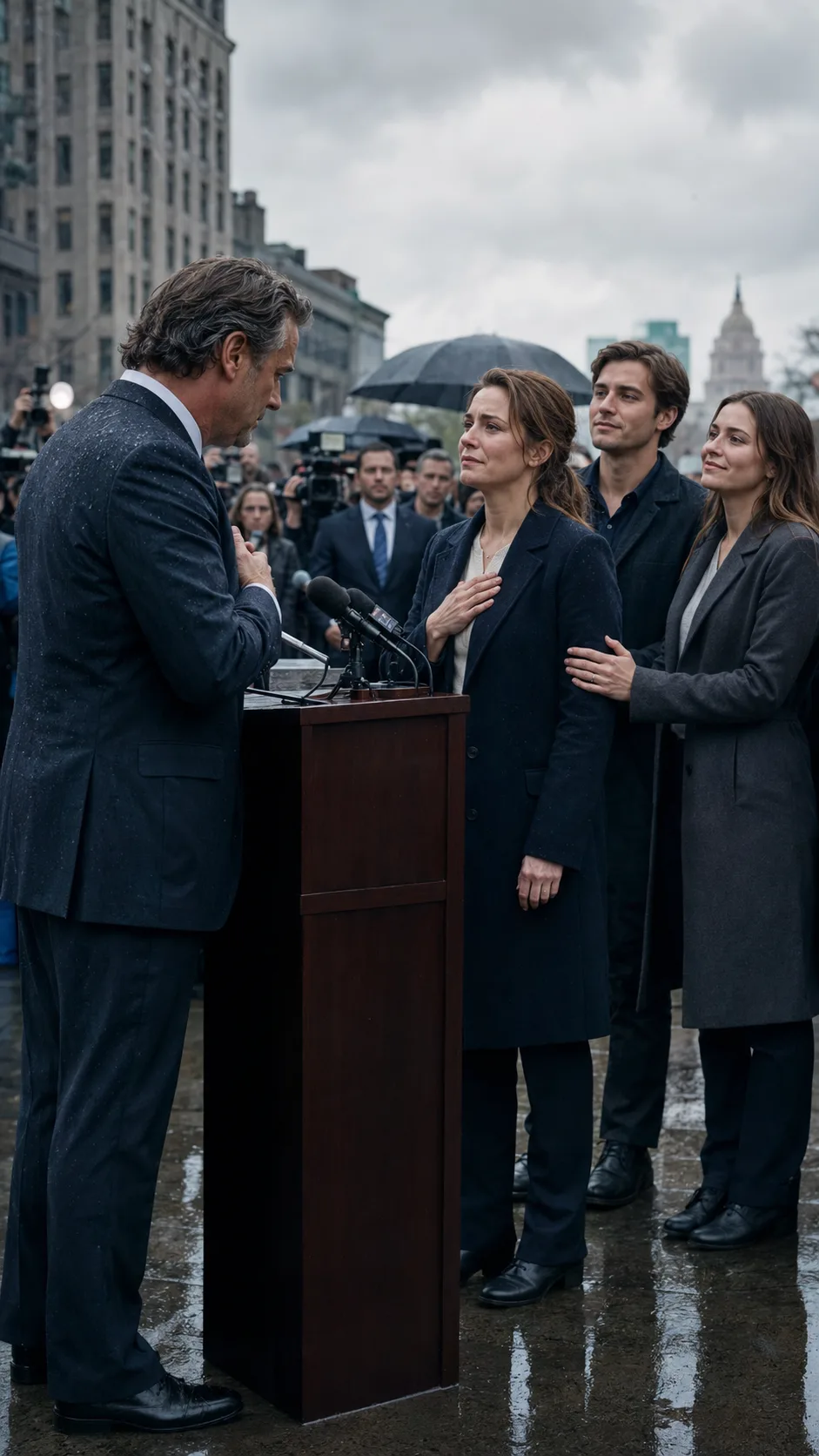
Michael Bennett stood at the podium.
He looked older than he had a month earlier.
Not weaker.
Just stripped of something.
Beside him stood Rebecca Sloan.
Jonah stood a few feet behind her. Paige was there too, grown now, sharp-eyed and confident, studying public health and looking at the crowd as if already measuring what still needed to be fixed.
Michael adjusted the microphone.
The cameras flashed.
“Over the past several weeks,” he began, “Bennett Infrastructure Group has uncovered serious corruption connected to several regional operations and subcontracting networks. The individuals involved have been terminated and referred to investigators. Two subsidiaries will be dissolved. Executive compensation will be capped during federal review. Independent auditing will be mandatory across all active public contracts.”
Reporters shouted questions.
Michael did not answer them yet.
He continued.
“I will step down as CEO at the end of this fiscal year.”
The crowd erupted.
Executives watching from Chicago felt the ground shift beneath them.
Investors called lawyers.
Analysts began typing.
But Michael was not finished.
“The Riverbend Redevelopment Project will not proceed under the old structure. Bennett Infrastructure will transfer controlling operational authority into a public trust led by Sloan Community Development, with full profit transparency, resident oversight, anti-displacement protections, and independent federal monitoring.”
This time, the silence was louder than the shouting.
No one had expected that.
Not from Michael Bennett.
Not from a man known for control.
Rebecca turned toward him, and for the first time, surprise crossed her face.
Michael stepped away from the podium, but the microphones still caught his voice.
“Ten years ago,” he said, “I saw a woman split one burger between her children and pretend she was not hungry.”
The plaza went still.
Rebecca did not move.
“I thought I had witnessed poverty,” Michael continued. “I was wrong.”
He looked at Rebecca.
“I had witnessed leadership.”
For a moment, no one clapped.
The sentence needed space to land.
Then Jonah began.
One slow clap.
Then Paige.
Then the residents behind them.
Then the crowd.
The applause spread across the plaza like weather.
Rebecca stood beneath the gray Riverbend sky, her expression unreadable, while cameras captured the moment the richest man in the city admitted that the woman he once thought needed saving had been stronger than his entire empire.
But the real shock came one hour later.
After the press conference ended.
After the headlines went live.
After Michael sat alone in the back of a black town car, exhausted and strangely calm.
His phone buzzed.
A federal memo had been released.
Michael opened it.
The document outlined the corruption timeline. Vendor trails. Shell networks. False invoices. Bid manipulation. Hidden consulting fees.
Then he reached the final appendix.
The original confidential source.
The person who had quietly begun feeding evidence to investigators three years earlier.
Not Jonah.
Not a Bennett employee.
Not a rival company.
Rebecca Sloan.
Michael read the name twice.
Then the car door opened.
Rebecca stood outside in the evening light.
“You started the investigation,” Michael said.
“Yes.”
“Three years ago.”
“Yes.”
“You knew it could reach me.”
“Yes.”
“And you still came to my boardroom.”
Rebecca looked past him toward Riverbend, where the streets glistened from rain and children were running across the plaza with paper cups of free lemonade from a community table.
“I had to know,” she said.
“Know what?”
“Whether the man from the restaurant still existed.”
Michael held her gaze.
“And?”
Rebecca was quiet.
Then she said, “That depends on what you do when no one is watching.”
She closed the car door before he could answer.
Michael sat alone as dusk settled over Riverbend.
The applause was gone.
The cameras were gone.
The title of CEO already felt like something that belonged to a man he was no longer certain he wanted to be.
In his hand was the old business card.
For ten years, he had believed he kept it because it reminded him of the day he helped a hungry family.
Now he understood the truth.
It had never been proof of his kindness.
It was evidence of her dignity.
Evidence that Rebecca Sloan had refused to be rescued because she was busy becoming powerful.
And long before she entered his boardroom, exposed his corruption, and forced his empire to kneel, she had already done the most impossible thing of all.
She had looked hunger in the face, smiled for her children, and begun building a future strong enough to come back for everything that had failed her.
THE END.
Chapter complete
You have reached the end of this chapter.
Continue reading
A few more worlds to get lost in after this chapter.




