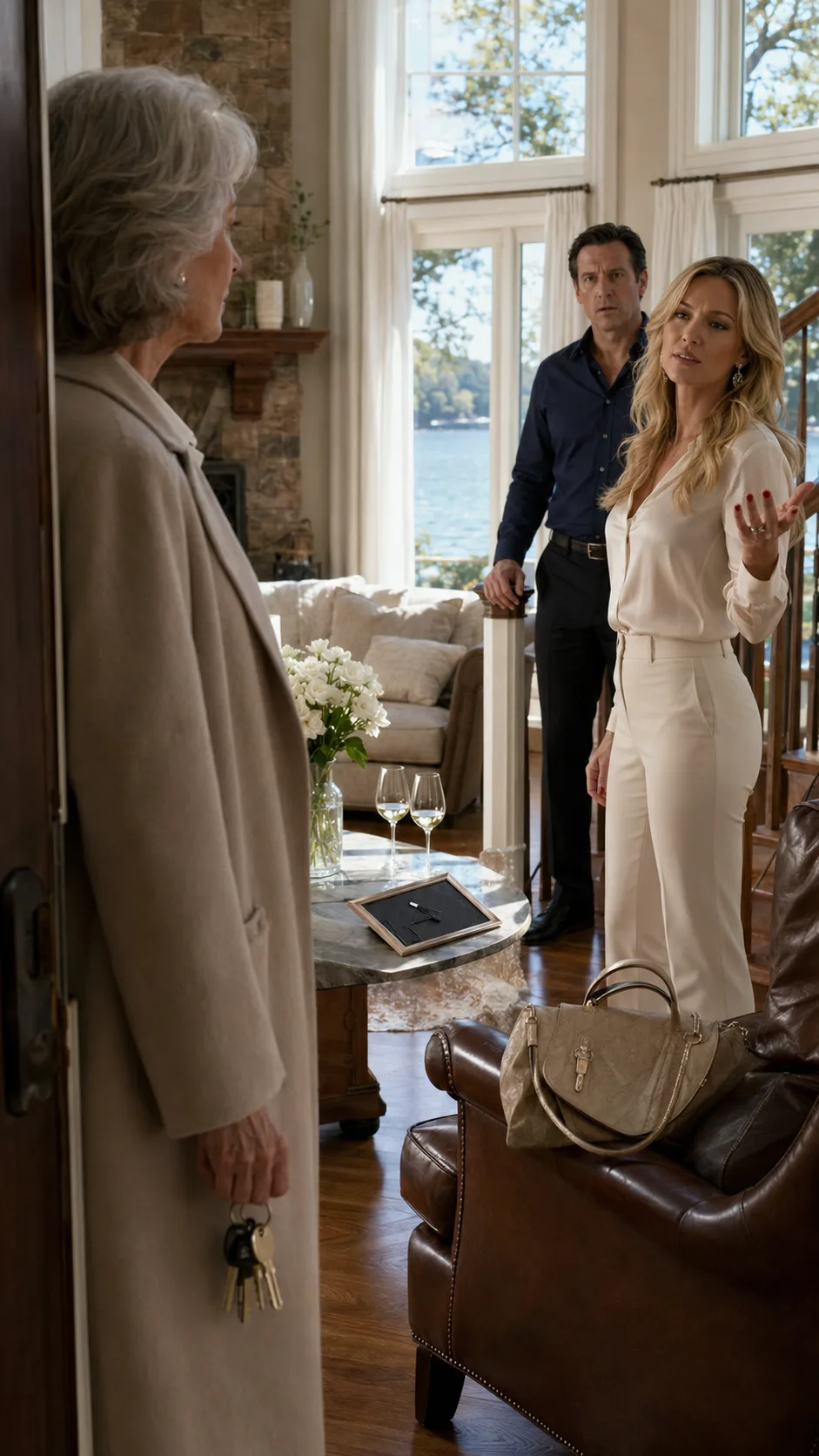
THE WOMAN MY SON BROUGHT INTO MY LAKE HOUSE CALLED ME THE MAID BEFORE SHE FOUND OUT I OWNED EVERY ROOM
PART 1
The first thing I noticed was my wedding photograph turned face down on the mantel.
Chapter 1
THE WOMAN MY SON BROUGHT INTO MY LAKE HOUSE CALLED ME THE MAID BEFORE SHE FOUND OUT I OWNED EVERY ROOM
PART 1
The first thing I noticed was my wedding photograph turned face down on the mantel.
Not broken. Not moved by accident. Turned down, like someone had decided my forty-three years of marriage were an inconvenience.
I stood in the doorway of my lake house at 11:37 on a Thursday night, one hand still holding my overnight bag, the other gripping the key my late husband had given me when we bought the place in 1989.
Then I heard laughter upstairs.
A woman’s laughter.
My son Daniel came down first, barefoot, pale, his shirt half-buttoned.
“Mom,” he said, like I had walked into his house.
Behind him, a young woman stepped onto the stairs wearing one of Daniel’s white dress shirts. She had long blond hair, red nails, and the kind of smile people wear when they have never been told no.
She looked me up and down—my gray sweater, my travel shoes, my silver hair pulled back.
Then she tilted her head and asked, “Are
you the housekeeper here?”
The room went silent.
Daniel’s face drained.
I looked at him, then at the woman, then at my wedding photo lying face down behind them.
“No,” I said quietly. “But I do clean up messes when my family leaves them in my house.”
The young woman laughed.
Daniel did not.
Because he knew something she clearly didn’t.
Every inch of that house belonged to me.
PART 2
Her name was Madison Vale.
I learned that less than five minutes later, when she walked down the staircase as if she were making an entrance at a hotel bar instead of trespassing through the heart of my family history.
She was twenty-nine, maybe thirty at the most, with glossy hair, a diamond tennis bracelet, and bare feet that stepped lightly across the floorboards my husband had sanded by hand one summer when Daniel was fourteen.
“You scared us,”
Madison said, picking up a wineglass from my coffee table. “Daniel didn’t mention anyone was coming.”
Daniel rubbed both hands over his face.
“Madison,” he said, “go upstairs.”
She looked at him, amused. “Why?”
“Just go upstairs.”
“No,” I said.
They both looked at me.
I placed my bag on the floor. Not loudly. Not dramatically. Just firmly enough that Daniel flinched.
“She can stay,” I said. “I’d like to understand why a stranger is drinking my wine, wearing my son’s shirt, and calling me staff in a home I paid for.”
Madison blinked once. Then she smiled again, but it wasn’t as smooth this time.
“Your home?”
Daniel stepped toward me. “Mom, please. Let me explain.”
“That would be refreshing,” I said. “You’ve been explaining a lot lately. Your mortgage stress. Your business expenses. Your children’s school fees. Your ‘temporary hardship.’ I’m starting to wonder which part was true.”
His jaw tightened.
That was when I knew.
A mother always knows the moment her child stops looking guilty and starts looking cornered.
“Mom,” he said, lowering his voice, “this isn’t what it looks like.”
I looked past him.
The framed photo of my husband, Richard, was still turned down on the mantel. A silk scarf I had never seen before hung over the arm of his old reading chair. Two plates sat on the
dining table. Candles had burned low. My grandmother’s quilt had been thrown on the floor near the fireplace.
“It looks like you brought another woman into the bedroom your father died in,” I said.
Madison’s smile disappeared.
Daniel whispered, “Don’t say it like that.”
“How should I say it?”
He glanced at Madison. “Claire and I have been unhappy for years.”
I laughed once, but there was no humor in it.
“Claire thinks you’re at a conference in Denver.”
Madison turned sharply toward him.
Daniel froze.
“Oh,” I said, looking at her. “He didn’t tell you his wife didn’t know?”
Madison folded her arms. “Daniel told me his marriage was basically over.”
“Basically,” I repeated. “That useful little word men use when they want the benefits of leaving without the courage to leave.”
Daniel’s face reddened.
“Mom, stop.”
“No. I think we’re past stopping.”
Madison lifted her chin. “With respect, Rose, this is between Daniel and me.”
That was the second time she made a mistake.
The first was calling me the housekeeper.
The second was believing she belonged in any sentence about my family.
“With respect,” I said, “you are standing in a house where my children learned to swim, where my husband took his last breath, where my grandchildren still sleep under handmade blankets. You are not between anything. You are passing through.”
Her nostrils flared.
Daniel stepped between us, though not close enough to protect either one of us from the truth.
“Mom, I was going to tell you.”
“When?”
He looked away.
I took a step toward the mantel and picked up my wedding photograph. Dust had gathered on the glass from where it had lain face down. I wiped it with my sleeve.
Madison watched me. “I turned that down.”
Daniel closed his eyes.
“You did what?” I asked.
She shrugged, though her fingers tightened around the stem of her wineglass.
“It felt awkward. I mean, Daniel said this place was going to be his eventually, and all the old photos made it feel like we were sleeping in a museum.”
My hand stopped moving.
Daniel whispered, “Madison.”
But she kept going.
“He said the house needed a new life. A younger energy. Honestly, it’s beautiful, but it could be so much better.”
I turned slowly.
“Better.”
She nodded, encouraged by her own arrogance. “The wallpaper upstairs is dated. The study is too dark. I told Daniel that room would make an amazing dressing room.”
For a moment, I couldn’t speak.
Not because I was weak.
Because rage, when it is old and deep enough, becomes very quiet.
My husband’s study.
The room where Richard wrote letters to our grandchildren. The room where he recorded birthday videos when his hands became too shaky to write. The room where he asked me, three weeks before he died, to promise that no one would ever sell this place unless it stopped feeling like love.
Daniel looked like he wanted to vanish.
I looked at my son and saw a boy who once ran through that hallway with scraped knees, begging his father to teach him how to tie fishing knots.
Then I saw the man he had become.
“How many times?” I asked.
Daniel swallowed. “What?”
“How many times have you brought her here?”
Madison answered before he could.
“Since February.”
It was October.
I looked at Daniel.
“Eight months?”
He said nothing.
I walked to the hallway closet and opened it. Inside, on the top shelf, was a designer suitcase I didn’t recognize. Beneath it were two pairs of women’s heels, a white coat, and a cosmetics bag.
Madison said, “I kept some things here. Daniel said it was fine.”
I nodded slowly.
Then I opened the drawer beneath the entry table.
The spare gate card was gone.
The bronze guest key was gone.
The lakeside garage remote was gone.
I turned back.
“Daniel.”
He lifted both hands. “I was going to put everything back.”
“When? After you finished redecorating my dead husband’s study?”
He flinched.
Madison set the wineglass down too hard. “You don’t have to talk to him like he’s a child.”
I smiled at that.
A small smile.
A dangerous one.
“Oh, Madison,” I said. “If he had acted like a child, I would have forgiven him faster.”
She opened her mouth, but Daniel cut in.
“Mom, I made a mistake.”
“No,” I said. “A mistake is taking the wrong exit. This had a suitcase.”
His shoulders slumped.
Then his phone buzzed on the table.
Neither of us moved at first.
It buzzed again.
I looked down.
The screen lit up with Claire’s name.
Daniel grabbed for it, but I reached it first.
“Mom, don’t.”
I answered.
“Rose?” Claire’s voice sounded tired. Soft. Trusting. “Is Daniel with you? He wasn’t answering.”
I looked at my son.
Madison stared at him.
“Yes,” I said. “He’s here.”
There was a pause.
“At the lake house?”
Daniel’s face twisted.
Claire’s voice changed. Just slightly. Just enough to break my heart.
“Rose,” she said, “is he alone?”
I closed my eyes.
“No, sweetheart.”
Silence.
Not empty silence. The kind where a life rearranges itself on the other end of the line.
Then Claire said, barely breathing, “He took her there?”
Her.
So Claire had suspected someone.
But she had not imagined this.
No one who loved our family would imagine this.
Madison’s face went pale, but she still tried to recover.
“Daniel,” she snapped, “you told me she knew.”
Daniel said, “I never said that.”
“You said it was understood.”
“It was complicated.”
I looked at him. “No. It was convenient.”
Claire was still on the phone.
I said, “I’m sorry.”
She gave a small, broken laugh. “For what? You didn’t bring her there.”
That was when Madison lost patience.
She stepped forward, chin high, voice sharp.
“You know what? This is ridiculous. Daniel is a grown man. This place is part of his family legacy, isn’t it? Maybe it’s time everyone stopped acting like he’s borrowing what he’s supposed to inherit.”
Daniel whispered, “Madison, stop talking.”
But she didn’t.
“Rose, I’m not trying to be disrespectful,” she said, while disrespecting me with every breath. “But you can’t keep holding on forever. Daniel told me this house would be his. He told me you were already talking about transferring things.”
I looked at Daniel.
His eyes fell to the floor.
There it was.
The third mistake.
He had not only brought her here.
He had promised her a future paid for by a mother he had been quietly draining.
I ended the call with Claire, but not before saying, “Come tomorrow morning if you can. Bring the children if you want. This house is still safe for you.”
Then I placed the phone down.
Daniel looked up quickly. “Mom, please don’t drag Claire into this.”
I stared at him.
“You dragged Madison into my bedroom. You dragged Claire into humiliation. You dragged your children’s school fees into your lies. Don’t you dare tell me who I’m dragging.”
His mouth opened, then closed.
I walked to the sideboard and opened the lower cabinet. Inside was a leather household binder—not legal papers, not threats, just the practical records of a woman who had learned that love without boundaries becomes an invitation to be used.
I took out the property maintenance sheet and the guest authorization card.
Madison rolled her eyes. “What is that supposed to prove?”
“Nothing,” I said. “I don’t need to prove anything in my own house.”
I held up the guest card.
“This is the only card that allows overnight guests. Daniel never had one.”
Madison turned to him. “You said you had full access.”
Daniel said nothing.
I looked at her.
“He had access because he was my son. That is not the same thing as ownership.”
She took a step back.
I continued, my voice calm enough to frighten even myself.
“The house is mine. The land is mine. The dock is mine. The road easement is mine. The furniture you moved is mine. The study you wanted to turn into a dressing room was my husband’s.”
Madison’s lips parted.
Daniel sat down hard on the arm of the sofa.
I walked to the front door and opened it.
Cold lake air rushed in.
“Madison,” I said, “you have fifteen minutes to gather whatever belongs to you.”
She looked at Daniel.
He didn’t move.
“Daniel,” I said, “you have the same fifteen minutes.”
His head snapped up.
“Mom.”
“You both leave tonight.”
“It’s almost midnight.”
“I noticed.”
“Where am I supposed to go?”
I looked at the woman he had brought into my home, then at the son who had forgotten what home meant.
“Wherever you told her your life was waiting.”
Madison’s eyes filled—not with regret, but with panic.
Daniel stood. “Can we talk privately?”
“No.”
“I’m your son.”
“And tonight, for the first time in your life, that is not enough.”
He stared at me like he had never met me before.
Maybe he hadn’t.
Maybe all those years, he had only known the mother who said yes.
The one who covered the late bill. Paid the emergency expense. Kept quiet at Thanksgiving. Smiled through small insults. Pretended not to notice when her son stopped visiting unless he needed something.
That woman was gone.
Or maybe she had simply stepped aside so I could finally stand up.
Madison ran upstairs.
Daniel remained in the living room, breathing hard.
“I made one mistake,” he said.
“No,” I said. “You made one woman feel replaceable, one mother feel foolish, one wife feel crazy, and one dead father’s memory feel disposable. That takes planning.”
He looked toward the mantel.
For the first time that night, he looked at his father’s photograph.
His face changed.
Good, I thought.
Let it hurt.
Madison came down dragging her suitcase. Her confidence was gone, replaced by trembling hands and mascara smudged under one eye.
At the door, she turned back and whispered, “Daniel, tell her.”
He swallowed.
I looked between them.
“Tell me what?”
Madison stared at him like she had just realized she was not the only person he had lied to.
Daniel’s voice came out thin.
“Mom, I borrowed against the education account.”
The room tilted.
My grandchildren’s education account.
The one I had funded after Richard died.
The one Daniel said needed “temporary flexibility” because tuition costs were rising.
I gripped the back of the chair.
Madison whispered, “You said that was your money.”
Daniel closed his eyes.
I looked at my son and finally understood the size of the mess.
He had not only betrayed his wife.
He had not only brought a stranger into my home.
He had used the future of his children to impress a woman who thought I was the help.
I opened the door wider.
“Get out,” I said.
Daniel’s face crumpled. “Mom—”
“Out.”
This time, he moved.
To be continued, Part 3 now
Chapter complete
You have reached the end of this chapter.
Continue reading
A few more worlds to get lost in after this chapter.




