The Woman I Was About to Marry Lifted Her Heel Over My Mother
I bought the tulips because my mother had stopped asking for anything.
Chapter 1
The Woman I Was About to Marry Lifted Her Heel Over My Mother
I bought the tulips because my mother had stopped asking for anything.
That morning, the florist on Madison Avenue tried to sell me white roses. “For the wedding?” she asked, already reaching for a ribbon the color of champagne. Everyone in the city seemed to know about the wedding. The papers called it a merger of beauty and power. Investors joked that I had negotiated my finest deal. My assistant had fielded three calls that week from lifestyle magazines wanting access to the reception.
I pointed instead to the yellow tulips in a dented metal bucket near the window.
“Those,” I said.
The florist blinked. “They’re not very bridal.”
“They’re not for the bride.”
She wrapped them in brown paper and tied the stems with rough string. A drop of water rolled off one leaf and darkened the cuff of my shirt. For some reason, I remember that more clearly than the meeting I left early, the phone calls I ignored, the
email from Daniel Mercer marked URGENT in capital letters.
I placed the flowers on the passenger seat of my car and drove home smiling like a man who still believed the day belonged to him.
My mother loved tulips because they did not pretend to last. She had told me that when I was eight, standing barefoot in our old kitchen while she trimmed stems with a steak knife because we had no flower shears. Back then, she was not the quiet woman who moved carefully through my marble hallways with a cane. She was Lillian Vale, investigative journalist, terror of crooked mayors, private nursing-home owners, and one unlucky senator who once made the mistake of calling her “sweetheart” on camera.
She kept that clip.
Even after arthritis curled her fingers and slowed her steps, she kept it in a drawer beside her reading glasses.
By the year I met
Sienna Blake, my mother’s hands had begun to shake when she poured tea. She hid it by lifting the cup with both hands. Sienna noticed.
Sienna noticed everything.
That was one of the reasons I loved her.
At least, that was what I called it then.
She was twenty-eight, elegant in a way that seemed both expensive and effortless, with the kind of smile people trusted before she had earned it. She came into my life through a charity gala for senior housing reform, introduced by Daniel Mercer, my CFO and closest friend in the company. Sienna ran a foundation that matched wealthy donors with care programs for elderly people living alone. She spoke about dignity, memory, and the cruelty of making old people beg for safety.
My mother watched her speech from table nine.
Afterward, I asked what she thought.
“She’s practiced,” my mother said.
I laughed. “That’s your
review?”
“She knows where every camera is.”
At the time, I took it as a compliment.
No.
I wanted it to be a compliment.
Sienna entered my life as if she had already been expected. Within six months, she knew the names of my board members’ spouses, the wine my mother tolerated, the exact angle that made photographers leave her cheekbones in shadow. She sent handwritten notes after dinners. She remembered which family stories were safe to repeat in public and which ones made my mother’s jaw tighten.
My world got louder around her.
My house filled with florists, caterers, stylists, planners, photographers, and people who spoke into headsets while pretending not to stare at the art on my walls. Three hundred guests. A string quartet from New York. Two Michelin-starred chefs arguing over the dessert course. An ice sculpture dispute that lasted forty-six minutes and ended with Sienna choosing orchids because swans were “too provincial.”
My mother sat through one tasting and ate half a spoonful of lemon sorbet.
Sienna leaned across the table and touched her wrist.
“You barely ate, Lillian.”
My mother looked at her hand.
“I’m not hungry.”
Sienna’s fingers stayed there one second too long.
I noticed. I did nothing.
At first, the changes were small enough to explain away. My mother stopped joining us for breakfast. Her cane appeared in strange places, once leaning near the back staircase, once inside the guest powder room with the door nearly closed. She said she had left it there. She said it too quickly.
One afternoon, I found her in the sitting room with a blanket over her knees, though the room was warm.
“Are you cold?”
“No.”
“You’re wearing your coat indoors.”
She looked down at herself as if the coat had arrived there without permission. Then she smiled at me. Not her old smile. A smaller one, made for ending conversations.
Sienna came in carrying a folder of seating charts.
“Your mother wants the Andersons moved away from the Whitcombs,” she said.
“I didn’t say that,” my mother replied.
Sienna did not turn her head. “You implied it.”
My mother’s fingers settled on the blanket.
I looked between them.
“It’s just seating,” I said.
My mother nodded once.
Sienna kissed my cheek and placed the folder in front of me. Her perfume smelled like white flowers and clean money. “Exactly. It’s just seating.”
That evening, a pair of pearl earrings went missing from my mother’s jewelry cabinet.
They had belonged to my grandmother. Nothing flashy. Small pearls, old gold backs, the kind of earrings women keep because another woman wore them through harder years. My mother told me about them at dinner, not as an accusation. More like she was placing a fact on the table.
Sienna frowned with perfect concern.
“Could you have moved them?”
“No.”
“Maybe one of the maids put them somewhere safe.”
“My jewelry cabinet is locked.”
Sienna’s face softened. “Lillian, memory can be cruel. My grandmother used to accuse nurses of stealing things too.”
My mother set down her fork.
Didn’t pick it up again.
I said Sienna’s name.
She looked wounded before I even finished the first syllable.
“I’m only trying to help.”
That sentence became her shield.
She used it when she told the staff my mother should not be allowed near the wedding gifts without supervision. She used it when she moved my mother’s favorite chair from the library because the fabric clashed with the rehearsal dinner photos. She used it when she told me my mother’s “episodes” were becoming more frequent.
“My mother does not have episodes.”
Sienna stood before my closet mirror, fastening an earring, calm as snowfall. “I know you don’t want to see it.”
“There’s nothing to see.”
She looked at my reflection instead of my face. “Then why is the staff uncomfortable?”
I turned from the cufflinks in my hand. “Which staff?”
She sighed.
There it was. The sigh that made me feel unreasonable without one word being raised.
“Adrian, I’m trying to protect her dignity.”
“By telling people she’s confused?”
“By preventing incidents.”
“What incidents?”
Sienna removed the earring and placed it on the vanity. “You’re tired.”
The conversation ended there because I let it.
That is the part I have replayed the most. Not the videos. Not the headlines. Not even the mediation room. The small exits. The moments when I could have stayed inside the question and did not. Every predator loves a busy man. He mistakes silence for peace because conflict costs time.
I had built a company from a rented office with bad heating and three employees who worked on folding tables. Care-tech, they called it now. Monitoring systems for elder-care facilities. Medication tracking. Remote wellness analytics. Tools that were supposed to protect vulnerable people. Daniel Mercer joined me in year two, when the company had more debt than furniture. He was disciplined, precise, and completely uninterested in applause. I trusted men like that.
He knew it.
Daniel knew which investors had bruised my pride. He knew which bank officer had laughed when I asked for bridge financing. He knew my mother had once sold “a few family pieces” when things were tight. He knew I had spent years trying to find the anonymous backer who had kept us alive.
“We build the future,” he used to say, tapping financial models with one finger.
I believed him.
The week before I bought the tulips, he pushed harder than usual for the merger. A multinational health-management firm wanted to fold our care-tech division into a global platform. The deal would double my net worth on paper and give Sienna’s foundation three advisory seats.
“Great optics,” Daniel said in my office.
“Optics are not a reason.”
“No,” he said, smiling. “But they are not poison either.”
He had an answer for every question. Risk models. Regulatory review. Foundation partnerships. Elder trusts. Expansion into assisted-living networks.
“After the wedding,” he said, “we can move fast.”
I stared at the projection on the glass wall of my conference room. Growth curves rose like obedient mountains.
“My mother thinks we’re rushing.”
Daniel’s pen stopped.
“Your mother was a journalist. Suspicion is muscle memory.”
“Maybe.”
“She loves you,” he said.
That was the hook. He knew which words made me stop defending her.
“She also doesn’t understand scale,” he added.
I signed nothing that day.
Daniel noticed.
So did Sienna.
The morning I came home early, I did it because my mother had skipped lunch two days in a row and lied badly about both. I told my driver I would take the car myself. I ignored my planner’s messages. I left Daniel’s urgent email unopened.
The tulips sat beside me like a small apology.
The house was too still when I arrived.
No vendors in the foyer. No headset voices. No laughter from the kitchen. Sunlight spread through the tall glass doors and turned the marble pale gold. The lilies from that morning’s wedding arrangements stood in tall vases on either side of the entry hall, stiff and white and expensive.
I opened the door quietly.
At first, I saw only Sienna.
She stood near the edge of the Persian rug in a cream dress and polished heels, one foot slightly lifted, her posture caught between action and performance. Her face was blank. Not startled. Not sorry.
Blank.
Then I saw my mother.
She was on the floor.
Her cane lay several feet away, half under the console table. One hand was raised over her face. Not dramatically. Not for effect. It was the kind of motion a body makes before pride catches up.
The tulips slipped from my hand.
They landed against the marble with a soft, wet sound.
Sienna looked down at my mother and said, “Why don’t you just disappear already?”
The sentence reached me before the meaning did.
I crossed the floor. My shoes slipped once on a fallen tulip leaf. I dropped to my knees beside my mother and touched her shoulder.
“Mom.”
She turned her face toward my jacket.
Her whole body shook once. Then she made herself still.
That control cut deeper than panic.
Sienna stepped toward us.
“Adrian, wait.”
I looked up.
“Don’t touch her.”
She froze.
For the first time since I had known her, Sienna’s face failed to choose a role quickly enough. Offense crossed it first. Then alarm. Then the wounded softness she used when waiters forgot her name or donors asked hard questions.
“She slipped,” she said. “I was trying to help.”
My mother’s fingers closed around my sleeve.
“Please,” she said.
Her voice was smaller than the room.
“Don’t make a scene.”
I looked down at her hand on my sleeve. The skin near her wrist was already darkening.
That was the last gentle minute I gave Sienna Blake.
I carried my mother to the sitting room. She protested once, then stopped. The physician arrived within twenty minutes. Security came in through the side entrance. Sienna followed us crying, but the tears sat on her face like jewelry.
The doctor checked my mother’s shoulder, wrist, hip. He asked questions. My mother answered only the ones she had to.
“Could she have fallen?” I asked.
He looked at me, then at the doorway where Sienna stood.
“She could have,” he said. “But the wrist marks concern me.”
Sienna stepped forward. “She grabbed me first.”
My mother closed her eyes.
The doctor put his stethoscope back into his bag.
Sienna kept talking. Stress. Misunderstanding. Wedding pressure. My mother’s confusion. My mother’s bitterness. My mother’s hostility. Each word arrived polished and placed, as if she had lined them up long before that afternoon.
I waited until she stopped.
“The wedding is over.”
The room shrank around the sentence.
Sienna’s tears stopped.
“You’re not serious.”
“I am.”
“You’re ending our life over a fall?”
“I walked in on you standing over my mother while she was on the floor.”
“You don’t know what happened.”
“No,” I said. “I know enough. I need to learn the rest.”
A small change moved behind her eyes.
Fear.
Not of losing me.
Of being found out.
By nightfall, she was out of the house. By morning, her attorney had called. By the next afternoon, the first story appeared online.
BILLIONAIRE GROOM CANCELS WEDDING NINE DAYS BEFORE CEREMONY.
The second came with a photo of Sienna leaving a townhouse in sunglasses.
DISCARDED FIANCÉE HIDES FROM PUBLIC AFTER FAMILY DISPUTE.
By the end of the week, the narrative had found its teeth.
Controlling groom. Fragile mother. Beautiful woman silenced by money. A private disagreement twisted by power. Sources close to Sienna. Friends of the couple. An unnamed wedding vendor who described the house as “cold.”
Sienna went on television in pale blue.
I watched it alone in my office after midnight, the sound low, the city behind the windows dark and enormous.
She did not accuse me directly. She did not have to.
“I loved him,” she told the host, eyes lowered. “I still care about his family. I just wish private pain had been handled privately.”
Private pain.
The phrase trended by breakfast.
My board requested an emergency call. Sponsors delayed commitments. Two donors withdrew from the foundation launch. Daniel sat across from me that afternoon with a cup of black coffee and a face arranged into concern.
“You need to respond.”
“No.”
“Silence looks guilty.”
“It also gives liars room.”
He leaned back. “That sounds noble. It’s bad strategy.”
“You worried about the merger?”
“I’m worried about the company.”
“Same thing?”
His eyes moved to mine.
“No.”
A tiny pause.
Too tiny for most people.
My mother would have heard it.
I began to collect what I should have collected months before. Staff statements. Security logs. Vendor access records. Household inventory. The jewelry cabinet list. Wedding LLC accounts.
Rot does not announce itself. It lifts paint one bubble at a time.
One of our wedding LLCs had an account I did not recognize. Three transfers had gone through it, each described as vendor deposits. The vendors denied receiving them. My mother’s missing pearl earrings were not the only pieces gone. A brooch. Two rings. A silver cigarette case that had belonged to my grandfather though no one in the family smoked anymore.
My assistant, Clara, sat in my office with both hands around a paper cup of coffee she never drank.
“I should have said something.”
“Say it now.”
She stared at the lid.
“Ms. Blake told us not to disturb Mrs. Vale in certain rooms.”
“What rooms?”
“The library. Your private study. The east sitting room.”
“Why?”
“She said Mrs. Vale was taking things. Moving papers. Getting confused.”
My office clock ticked once.
“And you believed her?”
Clara’s mouth tightened. “I believed she was going to be your wife.”
That was the trouble with power. It moved ahead of people and opened doors before truth reached the hallway.
A maid named Renata resigned without notice. Another, Felice, refused to speak unless her attorney was present. The housekeeper found my mother’s cane in a storage closet behind boxes of wedding linens. Not misplaced. Hidden.
My mother listened to these reports from the sitting room chair that had been moved back by the window. She kept her cane within reach now. Always.
One evening, I brought her tea. She watched me place the cup on the table.
“You’re angry.”
I sat opposite her.
“I am several things.”
“That can make a person stupid.”
I almost laughed. Almost.
“You were on the floor, Mom.”
“Yes.”
“She hurt you.”
My mother’s thumb moved along the handle of her cane. A habit. A measure.
“She is not the only one.”
The sentence sat between us.
“What does that mean?”
She looked toward the window. Outside, the garden lights had come on. They made the rain-dark shrubs look silver though it had not rained that day.
“I’m tired tonight.”
“You keep doing that.”
“What?”
“Closing doors.”
Her mouth curved, but not into a smile. “You learned from the best.”
I leaned forward. “Tell me what you know.”
She looked at me then. Really looked. The old journalist returned for half a second, sharp and assessing, asking whether the witness was ready to hear his own answer.
“Not yet.”
I stood.
“Mom.”
“Not yet,” she repeated.
Three weeks after the canceled wedding, Sienna demanded mediation.
Her legal team framed it as a civil attempt to resolve jointly purchased wedding assets, prenup disputes, and reputational harm. Her publicist leaked that she wanted peace. Her friends posted old photographs of us at charity dinners. Someone published a close-up of her engagement ring beside the caption: Some women lose more than a wedding.
Daniel called the mediation “unavoidable.”
“You should settle,” he said.
“For what?”
“Peace.”
“Whose?”
He looked away first.
I hired a forensic team the same day.
Not for Sienna’s phone. We did not have access to it. Not for Daniel either. I still had not allowed myself to put his name beside hers in my mind.
We started with the house.
The security system had been upgraded six months earlier because of the wedding. Most cameras were visible. Some were not. Sienna knew about the visible cameras. She had asked me to disable several near guest areas for “privacy.” The private foyer camera had not been on her list. It had been installed after a delivery dispute and forgotten by everyone except the man who handled physical security.
It showed everything.
The first time I watched it, I did not move after the footage ended.
My attorney, Mara Chen, sat beside me at the conference table.
“We need to be careful with this.”
I stared at the black screen.
“Play it again.”
“Adrian.”
“Again.”
She did.
There was my mother crossing the marble with her cane. Slow. Steady. There was Sienna stepping from the library corridor with a folder in one hand. There was the argument without audio for the first few seconds. Then Sienna moved closer, and the microphone caught fragments.
Transfer.
House.
Stop pretending.
My mother shook her head.
Sienna grabbed her wrist.
The body knows its own truth before the mind admits it. Mine went cold from the shoulders down.
Then Sienna shoved her.
My mother fell.
My hand curled so hard around the edge of the table that Mara touched my wrist.
“Breathe.”
I did not.
The audio caught the last sentence perfectly.
“Why don’t you just disappear already?”
The screen went black.
Mara waited.
“There’s more,” she said.
I turned to her.
“Forensics recovered deleted cloud-sync files from the tablet Sienna used during wedding planning. The account was connected to one of the shared event devices under the wedding LLC. It was sloppy.”
“Sienna isn’t sloppy.”
“No,” Mara said. “Someone thought the device had been wiped.”
She opened the second file.
A bridal suite. Champagne. Sienna in a robe I recognized from the wedding hotel. Daniel beside her, jacket off, sleeves rolled, looking younger than he ever looked in board meetings because greed had loosened his face.
I heard my name.
I heard the merger.
I heard care-tech division.
Foundation board seats.
Elder trusts.
Then Sienna leaned back on one hand and said, “His mother is the only real obstacle.”
Daniel lifted his glass.
“Then remove the obstacle.”
I stood so fast my chair struck the wall behind me.
Mara did not speak.
The city moved beyond the glass, unaware and insulting in its normalcy.
I walked to the window and pressed one hand flat against the cold pane.
Daniel.
The man who had sat beside me through bank refusals and investor meetings. The man who had known my mother packed lunches in paper bags for me when I was too broke to buy decent food near the office. The man who had held my company’s financial spine in his hands for nearly a decade.
Daniel had found Sienna.
No.
Daniel had placed Sienna.
When I returned to the table, Mara had closed the laptop.
“We can go criminal first,” she said. “Or civil. Or both.”
“They want a room.”
“Yes.”
“Give them the room.”
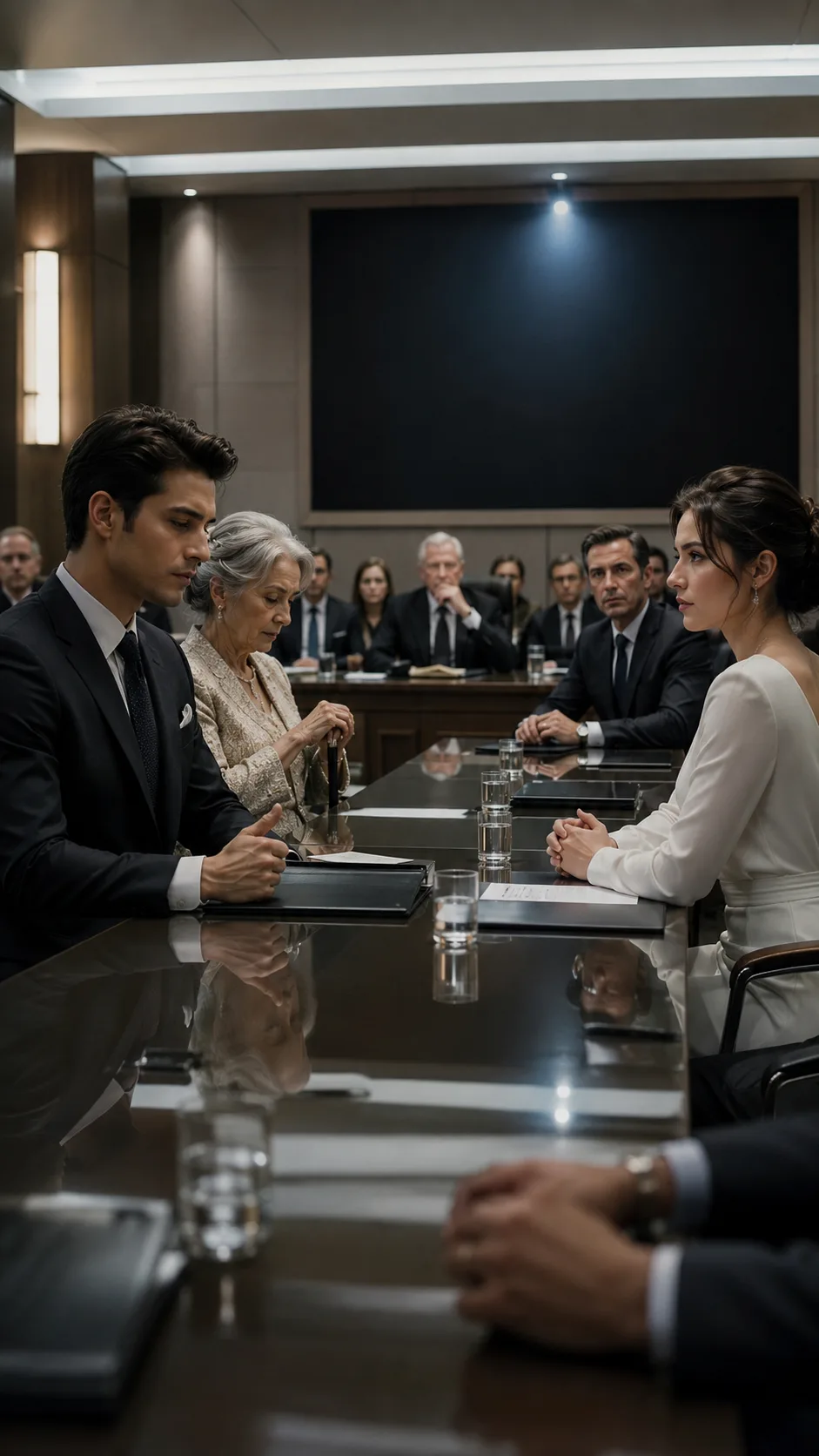
The mediation took place on a Thursday morning in a private legal suite downtown, the kind of place designed to make rich people feel their disputes were too clean to be ugly. Dark wood panels. Frosted glass. Bottled water at every seat. A seamless black presentation screen on one wall. No windows except a narrow strip near the ceiling, showing a slice of pale sky.
My mother arrived in a cream coat with a brooch at the collar.
Not one of the missing ones.
A cheap enamel tulip I had bought her from a museum gift shop when I was twelve. One petal was chipped. She wore it anyway.
“You don’t have to be in there,” I said near the elevator.
She adjusted the brooch.
“Yes, I do.”
“You’ve done enough.”
Her cane tapped once against the tile.
“That is not how enough works.”
Mara watched us from a few feet away, pretending to read a message on her phone.
My mother looked at me. “Do not shout.”
“I wasn’t planning to.”
“Do not enjoy it either.”
I had no answer for that.
Inside the mediation room, Sienna’s side had arrived early. Of course. Her attorney sat beside her. Her publicist sat two seats down with a leather notebook. Daniel sat near the end of the table, not beside Sienna, not far enough from her either. Two board members had come as observers. Family advisers. A retired judge hired to oversee the negotiation.
Sienna wore white.
A narrow dress with long sleeves and a high collar, tasteful enough for grief, bright enough for cameras if cameras had been allowed inside. Her hair was pinned back. Her hands rested folded on the table. The engagement ring was gone.
She looked at my mother first.
That was her mistake.
Not because my mother flinched.
Because she did not.
Sienna turned to me with a small, practiced breath.
“Adrian,” she said. “This never had to become war.”
I sat down.
“No.”
She waited for more.
I gave her nothing.
The retired judge began with neutral language. Resolution. Privacy. Damages. Reputational interests. Good faith. The words moved around the table with no blood in them. Papers shifted. Water caps cracked open. Daniel glanced at his watch.
Mara let the judge finish.
Then she rose.
“Before we proceed, there is evidence relevant to both the financial dispute and the public statements made by Ms. Blake.”
Sienna’s mouth curved.
“Evidence of what?”
I looked at her for the last time as the woman I had almost married.
Then I nodded once.
The black screen lit up.
The footage began without introduction.
Foyer. Marble. Morning light.
My mother with her cane.
Sienna stepping in front of her.
For two seconds, no one understood what they were seeing. Then the audio sharpened.
“Sign the transfer.”
Sienna’s publicist stopped writing.
On-screen, my mother tried to step around Sienna.
“Stop pretending this house belongs to you,” Sienna said.
The Sienna sitting across from me went still. Not frozen. Calculating. I could see the numbers moving behind her eyes: who was in the room, who had seen, what could still be denied.
On-screen, Sienna grabbed my mother’s wrist.
My mother inhaled beside me.
I did not turn. If I had, I might have stopped the video.
The shove came fast. Ugly in its efficiency. Not a dramatic push. Not rage. A practical motion, the way someone moves a chair blocking a doorway.
My mother fell.
A board member whispered something too low to catch.
The Sienna on-screen leaned over her.
“Why don’t you just disappear already?”
Silence entered the room like another witness.
No one moved.
Mara paused the video on the empty foyer after I had carried my mother out. The fallen tulips were visible near the edge of the frame, yellow against white marble.
My mother looked at them.
Sienna swallowed.
“This is edited.”
Her attorney turned toward her, very slowly.
Mara pressed another key.
The second video appeared.
This one was softer at first, warmer. A bridal suite. Champagne bucket. White robe. A city skyline behind sheer curtains.
Then Daniel came into frame.
His chair made a small sound in the real room.
Not loud.
Enough.
On-screen, Daniel poured champagne with the careless ease of a man who believed money could shut every door. Sienna sat on the edge of the bed, legs crossed, holding a folder with our wedding crest embossed on the front.
“Once Adrian signs the merger after the honeymoon,” she said, “we’ll have control of the care-tech division, the foundation board seats, and access to the elder trusts.”
Daniel handed her a glass.
“And his mother?”
Sienna smiled into the champagne.
“His mother is the only real obstacle.”
Daniel lifted his glass.
“Then remove the obstacle.”
Mara stopped the video.
Daniel stood so quickly his chair toppled backward.
The sound cracked across the room.
“Where did you get that?” he said.
Mara did not answer.
Sienna started crying. No buildup. No first tear. Just a switch flipped because another performance had been required.
“That’s not what it means,” she said. “That’s not—Adrian, you know me.”
I looked at my mother’s hand. It rested on the cane, steady.
Sienna reached toward me across the table.
“Please.”
Security entered before she could rise.
Daniel tried to gather his folders. One page slipped free and skated under the table. He bent for it, then stopped when one of the officers placed a hand near his shoulder.
No one shouted.
That made it worse.
The retired judge removed his glasses and folded them with both hands. My board members would not look at each other. Sienna’s publicist closed her notebook. Her attorney leaned back, staring at the ceiling for one long second.
My mother placed her hand over mine.
“Breathe,” she said.
So I did.
That should have been the end people wanted. The beautiful liar exposed. The loyal son vindicated. The traitor CFO dragged from the room with his expensive tie crooked and his mouth dry.
Clean endings are for press releases.
Investigators entered the care-tech division within forty-eight hours. What began as a conspiracy against my family widened into something uglier than personal betrayal.
Daniel had pushed our elder-monitoring partnerships into facilities tied to Sienna’s foundation donors. The foundation had referred elderly clients to legal guardianship consultants. Those consultants had pressured signatures. Some families had lost heirlooms. Some lost homes. Money moved through shell nonprofits and health-management contractors with names so bland they looked machine-generated.
My mother had found the first thread months earlier.
Not in a board report.
In a gala photograph.
She was sitting in the library when I brought the investigative file home. Not the formal library Sienna had tried to keep her out of. The smaller one near the east windows, where dust gathered no matter how much the staff cleaned and one lamp always buzzed when rain was coming.
I spread the documents across the table.
“You knew Mrs. Harrow?”
My mother adjusted her glasses.
“She lived down the street from us when you were little. She gave you a red mitten once because you lost yours in the snow.”
“I don’t remember.”
“You hated it. It had a bear on it.”
I looked down at the file. Evelyn Harrow. Eighty-one. Estate redirected three weeks before her death. Son contested the will and lost. Signature disputed.
“She was in Sienna’s gala photos.”
“Yes.”
“You recognized her?”
“Yes.”
“And you started investigating.”
My mother lifted one page from the table. “I started asking questions.”
“You should have told me.”
Her eyes stayed on the paper.
“Would you have believed me?”
I opened my mouth.
The answer did not come.
That was answer enough.
She set the paper down.
“Predators do not begin with cruelty. Cruelty is inefficient. Charm opens more doors.”
I sat across from her. There was a nick in the table between us, a tiny crescent mark from a letter opener I had dropped years ago. I rubbed my thumb against it because I needed somewhere to put my hand.
“You let her near you.”
“I let her underestimate me.”
“She hurt you.”
“Yes.”
“You could have been seriously injured.”
“I was already old, Adrian. That is the first thing people use against you. They think age makes every wound expected.”
I stared at the pages until the names blurred.
There were so many.
Families came forward after the first article broke. Caregivers. Adult children. Nieces who had been told they were greedy for questioning new wills. Neighbors who had seen moving vans. Nurses who had signed nondisclosure agreements too broad to be decent.
My company’s name was not on every document.
It was on enough.
The board wanted containment. Daniel removed. Sienna prosecuted. Internal review. Public statement. Continue the merger if possible. Separate bad actors from institutional value.
That phrase appeared in the draft statement.
Institutional value.
I crossed it out with a black pen.
“No merger,” I said.
The general counsel stared at me. “The merger is worth billions.”
“No merger.”
A board member named Halpern leaned forward. “Adrian, we can restructure. Delay. Preserve the upside.”
I looked at him. “Upside for whom?”
“For the shareholders.”
“And the people whose homes were liquidated through systems we helped legitimize?”
He glanced at the others.
“That liability has not been established.”
My mother had once told me that the easiest way to find a coward was to listen for passive voice.
Has not been established.
Mistakes were made.
Harm occurred.
I closed the folder.
“We killed it.”
The vote took four hours. I won by threatening to resign and take every public document with me. It was not graceful. It was not noble. It was leverage.
Leverage works.
The merger died on a Friday.
By Monday, I announced a foundation funded with the capital we had set aside for expansion. Legal aid for families fighting coercive guardianship. Emergency housing for elderly victims removed from unsafe arrangements. Forensic accounting support. Independent monitors for care facilities using our technology. A restitution fund.
The first donor dinner was quiet. People did not know whether to praise me or stay away from the blast radius. Reporters came anyway. They always do when there is money and blood in the same room.
My mother sat in the front row at the launch.
She wore the chipped tulip brooch again.
I stood backstage with a speech in my hand that Mara had helped edit and my communications team had tried to soften. Words like accountability survived. Words like complicity did not. I put them back.
A marshal approached before I went on.
“Mr. Vale.”
He handed me a sealed envelope.
“Mara said you should see this before the speech.”
Inside was a copy of Daniel Mercer’s final deposition.
I read the first page. Standard admissions. Meeting dates. Financial vehicles. Sienna’s foundation. Advisory seats. His role.
Then I reached the last section.
The paper made a small sound in my hand.
Daniel had not found Sienna.
My mother had.
Not recently.
Years ago.
After the speech, after the lights and reporters and handshakes, I took my mother to the garden behind the venue. The evening air smelled faintly of roses and wet stone though no rain had fallen. Caterers moved behind the glass doors carrying trays no one seemed to touch.
I held the deposition.
“It says Daniel wasn’t the one who first connected Sienna to our circle.”
My mother looked at the rose bushes.
“It says you introduced her to a donor network years ago.”
She said nothing.
“It says you sold the last of the heirlooms yourself.”
Her hand tightened around the cane.
“I did.”
My throat closed around the next words, but I forced them out.
“The pearl earrings. The brooches. The paintings. The silver.”
“Yes.”
“You told me some things were missing.”
“They were.”
“You let me think we had been robbed.”
She turned toward me then. Her face looked older under the garden lights. Not weak. Never that. Just tired in a way no speech could repair.
“I sold them to keep your company alive.”
The world did not tilt. That would have been too dramatic. It stayed exactly where it was, which was worse.
“When?”
“Year two. After the banks refused you. Before Daniel secured the bridge loan you thought saved us.”
“The anonymous backer.”
She nodded once.
I sat on the stone bench because standing required a version of myself I did not have.
“You saved me.”
“I gambled on you.”
“You sold grandmother’s things.”
“I sold dead women’s jewelry to give my living son a chance.”
I looked at her hands. Bent fingers. Pale knuckles. The same hands that had taught me how to hold a pencil, cut my sandwiches, circle lies in red ink on newspaper proofs.
“Why didn’t you tell me?”
“Because sacrifice changes when it asks to be admired.”
“That’s not fair.”
“No.”
A tiny smile touched her mouth and vanished.
“It rarely is.”
I stared toward the building where the foundation lights glowed through the glass. Inside, people were applauding something. A donor. A quote. A number large enough to feel moral.
“You investigated Sienna because you knew the signs.”
“Yes.”
“Because you had lied too.”
My mother did not look away.
“Yes.”
“For me.”
“For us.”
I let that sit. It deserved the room.
Then she said, “I did not investigate her only to stop her.”
I turned.
“I investigated her because one day you were going to inherit more than a company. You were going to inherit the cost of how it survived.”
A waiter passed near the garden door and dropped a spoon. It struck the stone path, bright and ridiculous. Neither of us moved until he picked it up and hurried away.
My mother reached into her coat pocket and took out a folded piece of brown paper.
The florist paper.
The one from the tulips I had dropped in the foyer.
“I kept this,” she said.
I stared at it.
“Why?”
She smoothed the crease with her thumb.
“Because that day was not only the day you saw her clearly. It was the day I saw you choose.”
I could not answer.
She placed the paper in my hand. It was dry now, faintly wrinkled, with one yellow stain from a crushed tulip petal.
“Go build something worthy of the price,” she said.
The trials lasted longer than the headlines. They always do. Headlines like the clean cut. Courts prefer slow stitching.
Sienna’s face changed on camera once the evidence became public. Not her features. The way she used them. The softness hardened. The trembling voice disappeared. She entered hearings in dark suits and left through side doors. Daniel aged badly under fluorescent light. He still looked expensive. Just less certain that expensive mattered.
Families testified.
A son brought his mother’s recipe box because it was the only thing left from her house. A nurse produced copies of forms she had been told not to read. A caregiver described how elderly clients were praised for being “independent” only after they signed away control.
My mother testified for two hours.
She brought no drama to it. No raised voice. No tidy rage. She answered questions, corrected dates, and once asked opposing counsel to repeat himself because “precision matters when people are dead.”
The courtroom liked that.
So did I.
Afterward, I found her in the hallway sitting on a bench near a vending machine that hummed too loudly. She had bought a packet of crackers and could not open it because her fingers would not cooperate.
I opened it for her.
She took one cracker.
“Don’t hover.”
“I’m not.”
“You are.”
I sat beside her.
For a while, we listened to the vending machine.
Then she said, “The tulips in the foyer were ruined.”
“I know.”
“You should buy more.”
So I did.
Not that day. The next morning.
Same florist. Same dented bucket. Same brown paper.
The florist did not ask if they were for the wedding.
There was no wedding.
The house changed after Sienna left, but not quickly. Her choices lingered in corners. A vase she had ordered. A chair she had moved. A drawer label written in her neat hand. We removed some things. Others stayed until they lost their power through ordinary use.
My mother returned to breakfast.
Not every day.
Enough.
Sometimes she read the paper and circled phrases with a red pen. Sometimes she passed me clippings about elder-care legislation with notes in the margin. Once, she wrote: weak verb, weak law.
The company survived. Smaller. Bruised. Watched more closely. Better for it.
I stopped saying we built the future.
The future does not need men in suits pretending they own it. It needs rooms where old people are believed before bruises become evidence. It needs signatures questioned. It needs sons who come home early before the flowers are just an apology.
On the first anniversary of the canceled wedding, I found my mother in the foyer.
She stood near the place where she had fallen, cane in one hand, the other resting lightly on the console table. Sunlight came through the glass doors and lay across the marble in a pale gold sheet.
I had tulips in my hand.
She looked at them.
“Yellow again?”
“Always.”
She held out the chipped enamel brooch. One tulip petal was missing now. It must have broken loose from the clasp.
“I thought you should have this.”
“I gave it to you.”
“And now I’m giving it back.”
I took it carefully. It weighed almost nothing.
My mother looked around the foyer. The lilies were gone. The wedding arrangements were gone. The house smelled faintly of coffee and furniture polish and something baking in the kitchen because Renata had come back on Tuesdays and insisted grief was improved by cinnamon.
“She wanted me gone,” my mother said.
I said nothing.
She tapped her cane once against the marble.
“Still here.”
Then she walked past me toward breakfast, slow but steady, leaving me alone in the doorway with the tulips, the brooch, and the sound of her cane moving deeper into the house.
Still here.
THE END.
Chapter complete
You have reached the end of this chapter.
Continue reading
A few more worlds to get lost in after this chapter.




