The first champagne glass broke before anyone mentioned my grandfather’s name.
Chapter 1
The first champagne glass broke before anyone mentioned my grandfather’s name.
It slipped from a waiter’s tray near the east archway and shattered across the marble like a warning nobody wanted to hear. Margaret barely turned her head. She lifted two fingers, and another waiter stepped forward with a napkin before the last piece stopped spinning.
“Quietly,” she said.
That was Margaret.
Even broken glass had to behave around her.
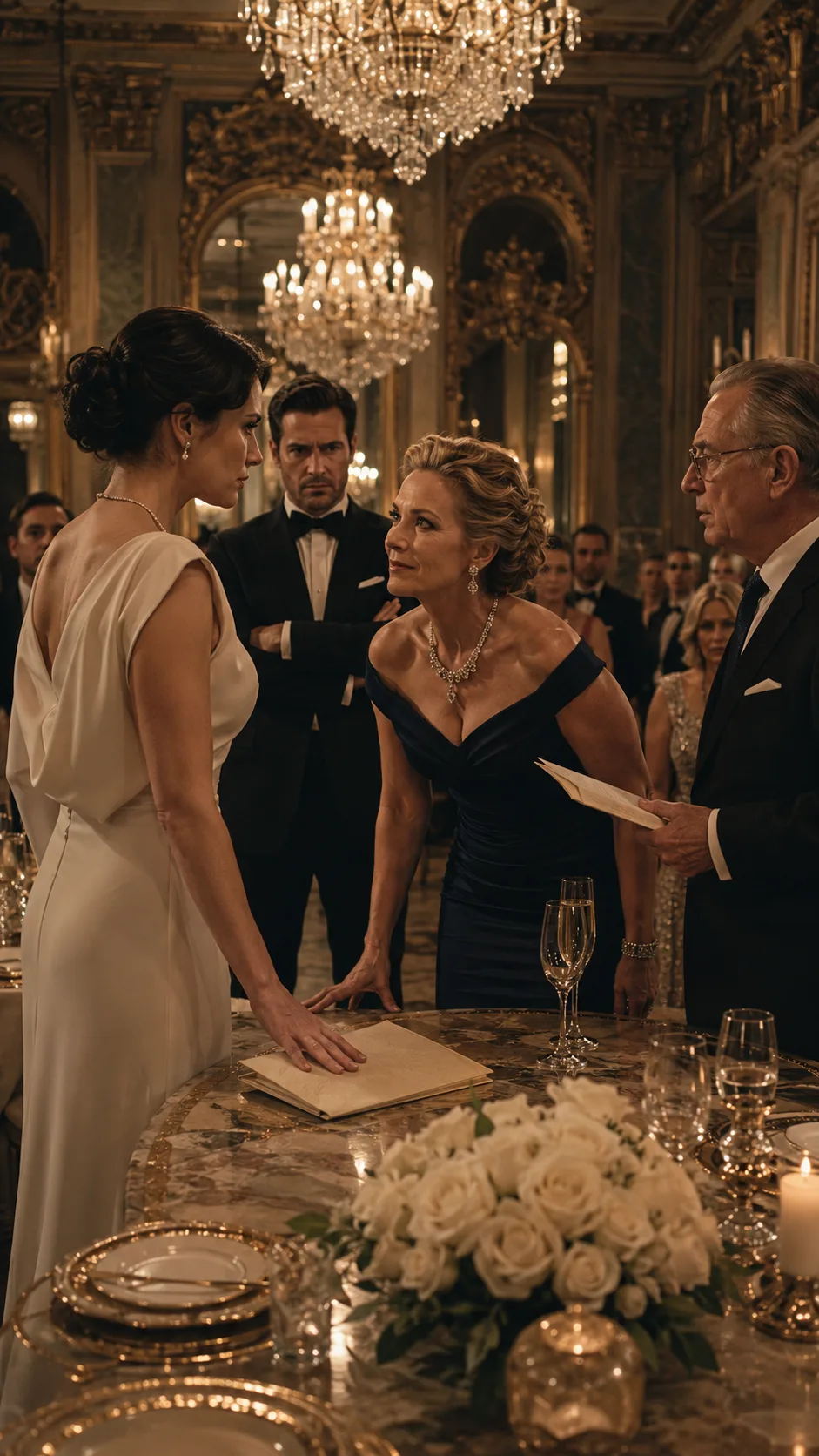
I stood near the ballroom doors with my coat still over one arm, watching the family pretend this was a celebration. White roses covered the long table where my grandfather used to host New Year’s dinners. The chandeliers were lit too bright. Gold-rimmed plates waited beneath folded linen napkins. A string quartet sat in the corner with their bows lowered, not playing.
Nobody had asked for music yet.
Maybe even they knew better.
My cousin Adrian saw me first. He stood behind Margaret with a champagne glass in one hand and
his other hand tucked into the pocket of his tuxedo. He smiled at me the way people smile at a locked door.
“Eleanor,” he said. “You came.”
“I was invited.”
His eyes dropped to the ivory letter case under my arm.
“Sentimental?”
“Old.”
He gave a small laugh and looked past me, already finished.
Margaret was seated at the center of the table, exactly where my grandfather used to sit. She had chosen a navy satin gown and diamonds heavy enough to announce themselves before she did. Her hair was pinned into a soft gold twist, every strand controlled. She did not stand when I entered.
“Eleanor,” she said. “You’re late.”
The clock above the fireplace had not struck eight.
“I’m on time.”
Margaret smiled. “For some people, that’s still late.”
A few relatives near the table looked down into their glasses.
No one laughed out loud.
They were saving
that for later.
Mr. Whitmore, the family notary, stood near the head of the table with a stack of papers in a leather folder. He was older than I remembered, with silver hair combed back and glasses that kept slipping down his nose. He had worked with my grandfather for thirty years. He had been at birthdays, funerals, quiet dinners, loud arguments.
He saw the ivory case.
His hand tightened on the folder.
Only for a second.
Then Margaret tapped the table with one manicured nail.
“Shall we begin?”
I took the empty seat near the far end, the one closest to the servants’ door. It was the kind of seat you give someone when you want them present but not included.
The ivory case rested in my lap.
My grandfather had given it to me six months before he died.
Not in the library. Not in the office. Not
in the formal rooms where portraits of men with narrow faces watched every conversation.
He gave it to me in the greenhouse behind the west wing, between rows of lemon trees and cracked clay pots.
“Don’t open it until they read the will,” he had said.
I had stared at the case. “Why?”
He had smiled, but not kindly. Not sadly either. It was the look of a man who had finally stopped pretending his family was better than it was.
“Because people show themselves when they think the ending has already been written.”
I did not open it.
Not after the funeral.
Not when Margaret took control of the guest list for the memorial.
Not when Adrian moved into my grandfather’s office before the flowers had been cleared from the church.
Not when three relatives called me separately to say they were “sorry about how things would look.”
I kept the case on the bottom shelf of my closet, under winter scarves I never wore.
Every night, I saw the edge of it.
Every night, I left it closed.
Now it sat against my knees while Margaret arranged her face for an audience.
Mr. Whitmore cleared his throat.
“This evening,” he began, “we gather to honor the final wishes of Charles Edmund Vale.”
The room became polished silence.
Adrian leaned back in his chair, already comfortable. My aunt Josephine dabbed at the corner of her mouth though she had eaten nothing. Cousins I had not seen in years stood along the walls, dressed in black and silver, pretending grief required diamonds.
Mr. Whitmore read through the formal lines first. Names. Dates. Declarations. The kind of language that turns a life into paragraphs.
Margaret listened with her chin slightly raised.
Adrian’s smile grew by degrees.
The lake house went to him.
The foundation seat went to Margaret.
The art collection would be managed through a family trust, administered jointly by Margaret and Adrian.
The west wing archives would remain under family supervision.
A few relatives glanced at me then.
Quickly.
Like they were checking whether a vase had cracked.
I sat still.
My name came near the bottom.
“To my granddaughter, Eleanor Vale, I leave the sapphire bracelet belonging to my late wife, Marianne Vale, as a token of private affection.”
Private affection.
That was all.
Margaret lowered her eyes in a show of respect. Adrian looked into his champagne glass as if there might be another inheritance floating inside it.
I felt the weight of the ivory case against my palms.
Mr. Whitmore turned a page.
There was no more.
He stopped reading.
The room did not react all at once. That would have been honest. Instead, it relaxed piece by piece. Shoulders lowered. Glasses lifted. A whisper traveled from the left side of the table to the right.
Margaret let it travel.
Then she set her champagne glass down.
The sound was small.
It reached every corner.
“Charles was very clear,” she said. “He valued order.”
I looked at her.
She did not look away.
“He valued loyalty,” Adrian added.
Margaret’s mouth curved.
“That too.”
My cousin Lydia, who had cried into my shoulder at the funeral, leaned toward her husband and whispered something. He covered his smile with two fingers.
Mr. Whitmore closed the will folder halfway.
“Mrs. Caldwell,” he said to Margaret, “there are still administrative—”
“Of course.” Margaret lifted a hand. “But the substance is clear.”
She turned toward me at last.
There it was.
The performance had found its audience.
“I know this may feel difficult,” she said. “But your grandfather understood the difference between affection and responsibility.”
Adrian gave a soft laugh through his nose.
Responsibility.
That word had always belonged to people who arrived after the work was done.
I remembered being seventeen, standing barefoot in the west library at midnight, sorting water-damaged letters after a pipe burst above the archive room. Margaret had been in Paris. Adrian had been skiing. My grandfather had fallen asleep at his desk, refusing to let anyone else touch Marianne’s papers.
I remembered carrying ledgers from the foundation office when the accountant quit without warning.
I remembered taking my grandmother’s old recipes to the kitchen staff because my grandfather would not eat after she died unless the soup tasted exactly right.
Private affection.
Margaret’s eyes dropped again to the case in my lap.
“What are you holding?”
The question sounded casual.
Her fingers did not.
They had tightened around the stem of the glass.
“Something Grandfather gave me.”
Adrian leaned forward. “Before he died?”
“Yes.”
A small shift moved through the room.
Margaret heard it too.
“He gave many sentimental things away near the end,” she said. “Grief makes men generous with trinkets.”
I stood.
My chair scraped the marble.
The sound was ugly in that beautiful room.
Margaret’s smile held.
Adrian’s did not.
Mr. Whitmore opened the folder again, just a little.
I walked toward the center of the table. No one moved to make room, so I stopped where I was, between Margaret’s chair and the place my grandfather’s chair should have been.
The table smelled faintly of roses and candle wax.
I placed the ivory case on the polished surface.
Not hard.
Not gently either.
Enough.
Margaret looked at it as if it had been brought in from the street.
“Eleanor,” she said, “this is not the time for theatrics.”
“It was his time,” I said. “He chose it.”
Adrian’s glass touched the table. He did not release it.
Mr. Whitmore stared at the initials pressed into the clasp.
C.E.V.
Three letters.
The room knew them better than it knew prayer.
Margaret leaned forward.
“What is inside?”
I did not answer her.
I looked at Mr. Whitmore.
“Read it again,” I said. “The part they left out.”
Adrian stood.
Too fast.
His chair struck the leg of the table behind him.
“There is no part left out.”
I kept my palm on the case.
Mr. Whitmore removed his glasses, cleaned them with a white cloth, and put them back on. His hands were careful now. Too careful.
“Where did you get this?”
“From him.”
“When?”
“In the greenhouse.”
Margaret’s face changed around the eyes.
Only there.
The rest stayed perfect.
“He was confused near the end,” she said.
Mr. Whitmore looked at her then.
Not long.
Long enough.
“No,” he said. “Not that day.”
The room stopped pretending not to listen.
Adrian’s jaw shifted.
“What day?”
Mr. Whitmore did not answer him.
He reached for the case.
Margaret’s hand moved first.
I saw it before anyone else did. Two fingers sliding across the tablecloth toward the clasp, quick and elegant, like she meant only to straighten it.
I put my palm flat on the case.
Her fingers stopped beside mine.
For one second, we looked at each other over my grandfather’s initials.
“Move your hand,” she said.
“No.”
The word landed plain.
No decoration.
Adrian stepped closer. “Eleanor.”
I turned my head slightly. “Sit down.”
He blinked.
No one had spoken to Adrian like that in years.
He did not sit.
But he stopped moving.
Mr. Whitmore placed his folder on the table and opened the ivory case himself.
The clasp gave a soft click.
Inside was a folded letter, cream paper, thick and slightly yellowed at the edges. A pressed wax mark held it closed. Not the family crest. Not the trust stamp.
My grandmother’s seal.
Margaret saw it.
Her hand drew back.
Aunt Josephine made a small sound behind her napkin.
Mr. Whitmore lifted the letter with both hands.
He did not open it immediately.
That hesitation said more than any speech.
Adrian leaned over the table. “This cannot override the will.”
“Nobody said it did,” I said.
His eyes cut to mine.
“What are you trying to do?”
“I’m not trying.”
Mr. Whitmore broke the seal.
The wax split with a dry sound.
I thought of the greenhouse. My grandfather’s hands. The lemon leaves brushing the glass. The way he had looked at the west lawn as if he was counting ghosts.
Mr. Whitmore unfolded the letter.
His eyes moved to the first line.
Then stopped.
The will folder lowered in his other hand until it touched the table.
Margaret’s chair creaked.
“What does it say?”
Mr. Whitmore did not answer.
He read further.
His lips pressed together.
Adrian reached toward the paper. “Let me see it.”
Mr. Whitmore pulled it back.
“No.”
That was the first time anyone at that table had denied Adrian anything.
Several guests turned fully now. Not toward me. Toward him.
Adrian noticed.
His fingers curled.
Margaret stood.
The navy satin of her gown caught the chandelier light and threw it back like metal.
“Mr. Whitmore,” she said, “you will read only documents relevant to the estate.”
“This is relevant.”
“To what?”
“To the legacy.”
The word moved through the room.
Legacy.
Not estate.
Not property.
Not trust.
Legacy.
Margaret’s face remained composed. Her necklace rose and fell once at her throat.
“Charles left no separate legacy instrument,” she said.
Mr. Whitmore looked down at the letter.
“He did.”
Adrian’s voice came lower. “That is impossible.”
I looked at him.
“You keep using that word for things you didn’t know.”
His hand closed around the back of his chair.
Mr. Whitmore turned the page slightly so the chandelier light fell across the ink.
“This letter is in Charles Edmund Vale’s hand,” he said. “Dated six months before his passing. Witnessed by Marianne Vale’s private seal and countersigned by myself.”
Margaret’s eyes went to him.
“Countersigned?”
He nodded once.
“You knew?”
“I was instructed not to disclose it until the will had been read in full.”
Margaret’s mouth opened.
No sound came out.
Adrian found his voice first. “Then why was it not included?”
Mr. Whitmore’s gaze returned to the page.
“Because it does not concern the estate.”
A cousin near the wall lowered his glass.
Mr. Whitmore continued.
“It concerns the Vale Legacy Archive.”
The room changed.
Not loudly.
A hundred small movements made one silence.
The Vale Legacy Archive was not the art collection. It was not the lake house. It was not the west wing furniture or the foundation seat Margaret wanted so badly she had already ordered new stationery.
It was older.
Letters. Journals. Unpublished manuscripts. Private family records. The original ledgers from the first Vale shipping company. Marianne’s diaries. Charles’s correspondence with donors, presidents, artists, ministers, and men who had smiled for newspapers while begging my grandfather for silence in private.
It was the family’s history.
It was the family’s leverage.
It was the only thing my grandfather had protected more fiercely than money.
Margaret sat back down slowly.
Adrian did not.
Mr. Whitmore read aloud.
“To Eleanor Vale, who kept what others displayed, who remembered what others used, and who came to the archive not to possess it but to preserve it, I leave the full guardianship of the Vale Legacy Archive, including the west library, the private records room, the sealed correspondence cabinets, and all rights of access, publication, preservation, and transfer.”
The words did not rush.
They walked across the table one by one.
Margaret’s hand went to the pearls at her neck, then dropped.
Adrian stared at Mr. Whitmore.
“No,” he said.
Mr. Whitmore continued.
“No member of the Caldwell branch, including Margaret Caldwell, nor any descendant acting through her instruction, shall access, remove, alter, sell, transfer, or restrict the archive without Eleanor’s written consent.”
Adrian’s eyes went to Margaret.
There.
A small thing.
But I saw it.
He had not known.
Margaret had.
I watched her face.
It gave almost nothing away.
Almost.
Mr. Whitmore turned the page.
“There is more,” he said.
Margaret’s chair scraped back.
“Enough.”
The word cracked through the ballroom.
Nobody moved.
Even Adrian looked at her.
She reached for the letter.
Mr. Whitmore stepped back from the table with it.
A notary in a dark suit, old enough to walk with care, holding one piece of paper like a locked gate.
Margaret’s hand remained suspended over the table.
Then she lowered it.
“Charles was ill,” she said. “He wrote things. He regretted things.”
“He wrote clearly,” Mr. Whitmore said.
“You do not know what was happening inside this family.”
Mr. Whitmore looked at me.
Then at her.
“I know what I witnessed.”
The silence after that was different.
It had edges.
Adrian turned to Margaret. “What did he mean by Caldwell branch?”
She looked at him too quickly.
“Legal language.”
“No.” His voice thinned. “He named you.”
“He named many things.”
“He named you.”
Margaret’s fingers found the champagne glass again. She lifted it, then set it down without drinking.
Mr. Whitmore read the final paragraph.
“If this letter is challenged, Eleanor is authorized to release the contents of Drawer Seven in the west records room to the trustees of the foundation and to the press liaison already named in my private instructions.”
Drawer Seven.
Margaret’s face lost its arrangement.
Not dramatically.
No gasp. No collapse.
Just one clean erasure.
The room saw it.
Adrian saw it too.
“What is Drawer Seven?” he asked.
I said nothing.
Margaret looked at me for the first time that night without performance.
There you are, I thought.
Mr. Whitmore folded the letter along its original crease and placed it on the table in front of me.
“The archive is yours to guard,” he said.
Not inherit.
Guard.
My grandfather had chosen the word.
Margaret stood again, slower this time.
“This is family business.”
Aunt Josephine leaned back from the table.
Lydia looked down.
Adrian’s wife turned her wedding ring around her finger.
The family had spent an hour laughing at my small line in the will. Now they were trying to remember where they had stood when Margaret raised her glass.
I picked up the letter.
The paper was warmer than I expected.
Margaret’s voice dropped. “You have no idea what you are holding.”
“I do.”
“You were never meant to carry this.”
I looked at the west doors.
The library was beyond them, three corridors away, past the portraits and the staircase and the room where my grandmother used to keep orange candies in a porcelain bowl.
“I already have.”
Adrian took a step toward me.
Mr. Whitmore closed his folder.
That small sound stopped him.
“Any interference with Ms. Vale’s access,” he said, “will be recorded as a violation of Charles Vale’s instructions.”
Adrian laughed once.
It sounded borrowed.
“You’re threatening us with paperwork?”
“No,” Mr. Whitmore said. “With his handwriting.”
The line settled over the table.
Margaret reached for her champagne glass again. Her hand missed the stem by half an inch.
Nobody helped her.
I noticed that most.
People who had rushed to collect broken glass now watched her fingers search empty air.
She pulled her hand back.
The ballroom was still full. The roses were still white. The chandeliers were still too bright. But the table no longer belonged to her.
I picked up the ivory case.
Mr. Whitmore placed the letter inside it.
The clasp clicked shut.
Margaret stared at the case as though it had bitten her.
“You will regret opening that room,” she said.
“I haven’t opened it yet.”
Her eyes lifted.
I held the case against my side.
“But I know who tried to empty it.”
Adrian turned sharply toward her.
The guests followed.
Not all at once.
One by one.
Margaret did not look away from me.
For a moment, I could almost see the woman my grandfather must have seen years ago. Not the diamonds. Not the posture. Not the careful hostess with the perfect guest lists.
A woman counting locked drawers.
A woman who had thought death would make paper easier to manage.
Mr. Whitmore stepped beside me.
“Eleanor,” he said, “the west library keys.”
He reached into his jacket and removed a small velvet pouch.
Margaret’s breath caught.
This time everyone heard it.
He placed the pouch in my palm.
The key inside was heavier than it looked.
Brass. Old. Warm from his hand.
My grandfather had carried it on a chain for as long as I could remember. When I was little, I thought it opened treasure. When I was older, I learned treasure was usually the thing people destroyed first.
I closed my fingers around it.
Adrian’s face had gone pale around the mouth.
“Margaret,” he said. “Tell me Drawer Seven is not what I think it is.”
She did not answer.
That answer was enough.
The first guests began to move away from her side of the table. Not far. Just a few inches. Chairs angled. Bodies turned. Allegiances learned how to walk.
Margaret noticed every inch.
I almost pitied her.
Almost.
Mr. Whitmore gathered the will papers, but he left the letter case in my hands.
“Ms. Vale,” he said, “I can escort you now.”
The word escort made Adrian step back.
Margaret stayed still.
“No,” I said.
Mr. Whitmore turned to me.
I looked at the family.
At the people who had watched me receive a bracelet and treated it like a public burial.
At the cousins who had smiled.
At the aunt who had whispered.
At Adrian, who had believed the archive would become another room he could unlock for profit.
At Margaret, who knew exactly which drawer had kept her awake.
“Not now,” I said.
Margaret’s eyes narrowed.
I placed the key pouch on top of the ivory case and held both against my chest.
“Tomorrow morning,” I said. “Nine o’clock. Everyone named in the foundation charter will meet in the west library.”
Adrian swallowed.
Margaret’s voice came thin and controlled. “For what purpose?”
I looked at Mr. Whitmore.
He understood before I spoke.
“To open Drawer Seven.”
A sound moved through the room.
Not a gasp.
Not quite.
Something quieter and worse.
Margaret’s hand closed around the back of her chair.
The chair held.
She did not.
Her knees bent slightly before she corrected herself.
The family saw that too.
I turned from the table.
No one stopped me.
The ballroom doors stood open. Beyond them, the hall stretched toward the west wing, lined with portraits in gold frames. My grandfather’s portrait hung at the far end, painted ten years before his death, one hand resting on the back of the library chair.
I had hated that portrait when I was younger. It made him look untouchable.
Tonight, under the low hallway light, he looked tired.
Human.
I walked past him with the key in my hand.
Behind me, the gala did not continue.
No music started.
No toast followed.
No one called my name.
The next morning, I arrived at the west library at eight-thirty.
The house was quieter in daylight. Without the chandeliers, the ballroom looked like a stage after the audience had gone home. Someone had removed the broken glass from the marble, but a tiny bright shard remained near the east archway.
I saw it when I passed.
I left it there.
Mr. Whitmore was already waiting outside the west library doors. He wore the same dark suit, a different tie, and the expression of a man who had slept badly but chosen not to mention it.
“Good morning,” he said.
“Is everyone coming?”
“Everyone who understands the stakes.”
“That means Margaret.”
“She arrived twenty minutes ago.”
Of course she had.
I unlocked the west library myself.
The key turned with resistance, then gave.
The smell came first.
Leather. Dust. Lemon oil. Old paper.
The room looked exactly as it had the night my grandfather gave me the case. Tall shelves. Green lamps. A wide desk with scratches along one edge from his ring. The brass ladder still leaned against the north wall. Marianne’s portrait hung above the fireplace, softer than all the others, her eyes turned slightly toward the archive door.
Margaret stood near Drawer Seven.
She did not touch it.
Adrian stood by the window, arms folded again, but it looked different now. Less like command. More like a man holding himself together.
Lydia sat in the corner with her hands clasped.
Aunt Josephine refused to sit.
Mr. Whitmore placed a recording device on the desk.
“No one speaks over anyone,” he said. “No one touches anything without permission.”
Margaret’s mouth tightened.
I walked to Drawer Seven.
The brass label was worn.
No name.
Just a number.
Seven.
My grandfather had never allowed anyone near it. Not even me.
I inserted the smaller key from the pouch.
Margaret looked at the floor.
Adrian looked at her.
The drawer opened with a low wooden scrape.
Inside were three folders, a bundle of letters tied with gray ribbon, and a photograph.
I picked up the photograph first.
It showed Margaret in the west library, younger by twenty years, standing beside a man I did not know. Between them sat an open archive box.
On the back, in my grandfather’s handwriting, was one line.
Margaret removed the Caldwell letters before the foundation vote.
Adrian stepped closer.
“What letters?”
Margaret said, “Old correspondence. Nothing relevant.”
I untied the gray ribbon.
Mr. Whitmore did not stop me.
The first letter was addressed to my grandfather from Margaret’s father. The second was from a donor. The third contained a list of payments made quietly through a shell charity that had never appeared in the official foundation records.
Adrian read over my shoulder.
His face changed slowly.
Not because he understood everything.
Because he understood enough.
“You used the foundation vote,” he said.
Margaret’s eyes stayed on the window.
“To protect the family.”
I set the letters on the desk.
“No,” I said. “To protect yourself.”
She looked at me then.
The room waited for her to deny it.
She didn’t.
That was the end.
Not legally. Not publicly. Not yet.
But inside that room, the end had already happened.
Mr. Whitmore collected the folders into archival sleeves. Lydia left before noon. Aunt Josephine called her driver without saying goodbye. Adrian stood for a long time by the window after Margaret walked out.
He did not apologize.
I did not ask him to.
By evening, the foundation trustees had been notified. By the end of the week, Margaret resigned from the foundation seat she had celebrated too early. The official explanation used careful words. Health. Privacy. Transition.
Drawer Seven used fewer words.
Dates. Names. Amounts.
Enough.
Adrian tried to call me twice.
I let both calls ring out.
The west library became mine in the only way that mattered. Not as a prize. Not as revenge. As work.
I hired two archivists. Repaired the humidity system. Removed Margaret’s private locks from the correspondence cabinets. Returned Marianne’s diaries to the top shelf where my grandfather had kept them before the west wing became a battlefield with velvet chairs.
The sapphire bracelet arrived in a small box three weeks later.
I had never seen it before.
It was beautiful.
I placed it in the archive beside Marianne’s portrait, not on my wrist.
Some things are not meant to be worn.
The next gala invitation came six months later.
Not from Margaret.
From the foundation board.
My name was printed at the top, beside the words Legacy Archive Address.
I almost threw it away.
Then I saw the tiny crease at the corner, where the paper had bent in the mail.
Small flaw.
Real thing.
I went.
The ballroom looked different with fewer flowers. The chandeliers were dimmer. The long table had been replaced with rows of simple chairs facing the west doors.
Nobody sat Margaret’s chair at the center.
There was no Margaret’s chair anymore.
Adrian attended. He stood near the back, older than he had looked six months before. When I passed him, he lowered his eyes to the ivory case in my hand.
“Eleanor,” he said.
I stopped.
His mouth worked once before he found the words.
“I didn’t know about the drawer.”
“I know.”
He nodded.
That was all.
Sometimes that is all people can afford.
Mr. Whitmore introduced me without ceremony. I stood beneath my grandfather’s portrait with the ivory case on the lectern and the west library key beside it.
I looked at the room.
Different faces now. Trustees. Archivists. Donors who had read the report and still chosen to come. A few relatives sat scattered among them, no longer grouped together like a wall.
Margaret was not there.
But her absence had weight.
I opened the case.
The letter lay inside, folded along the same lines.
I did not read the whole thing.
Only the last sentence.
“Guard what they cannot sell.”
Then I closed the case.
The clasp clicked softly.
No glass broke this time.
Chapter complete
You have reached the end of this chapter.
Continue reading
A few more worlds to get lost in after this chapter.