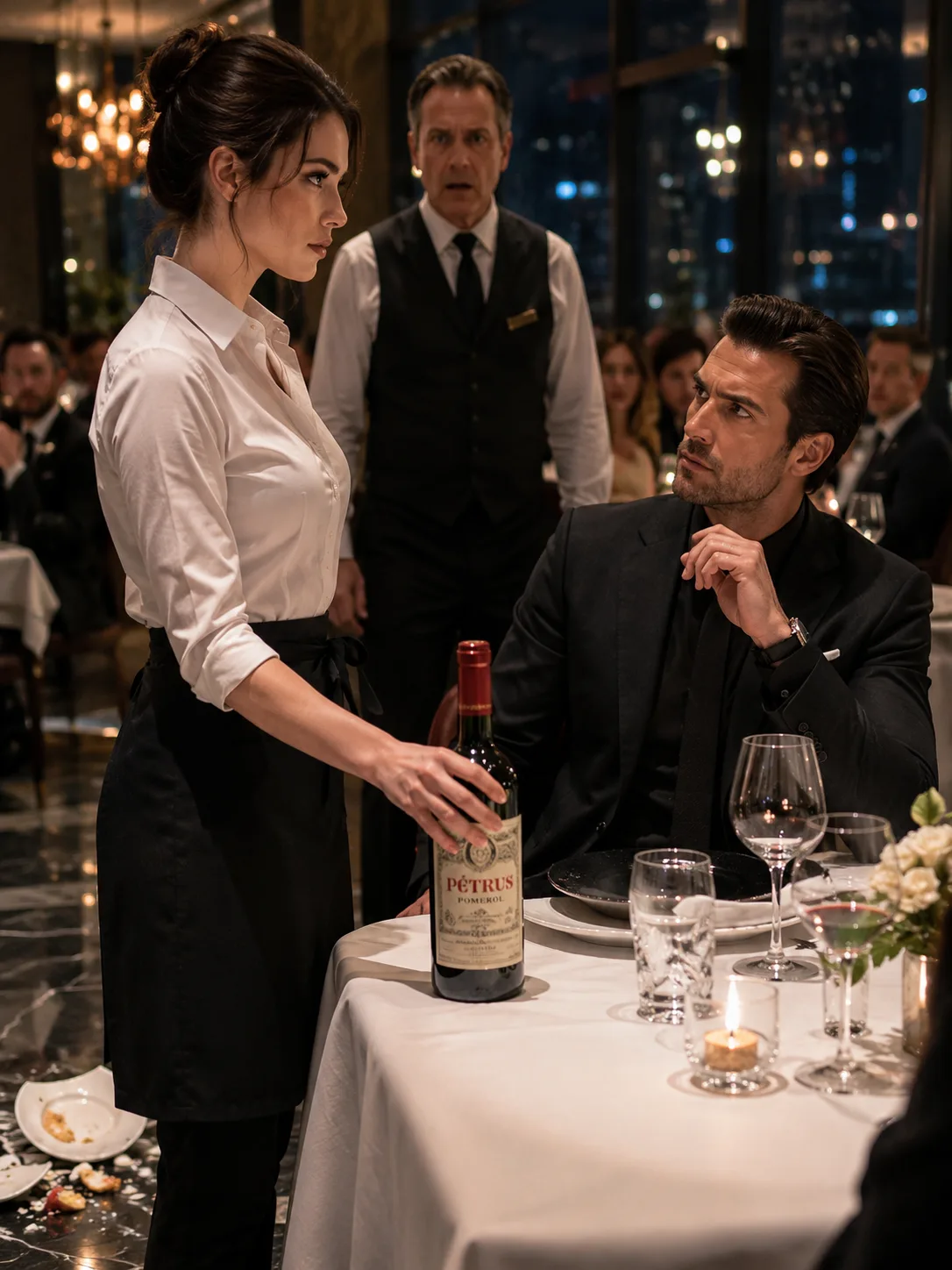
The Waitress Spoke One Forgotten Language, Then the Cruel Tycoon Made Her His Most Dangerous Weapon Overnight Against Enemies Watching
The first plate shattered at exactly 8:43 p.m.
Chapter 1
The first plate shattered at exactly 8:43 p.m.
Nora Carter knew the time because she had been staring at the brass clock above the service station, counting how many minutes remained before she could slip into the staff bathroom and call her mother’s care facility before visiting hours ended. The clock had a scratch across the glass, a thin white line through the Roman numeral VIII, and every night Nora promised herself she would stop noticing it.
She never did.
The sound of porcelain breaking cut through The Astoria Grill like a gunshot.
Forks stopped halfway to mouths. Champagne flutes froze in manicured fingers. A woman near the window pressed one hand to her pearls. The pianist, who had been coaxing something soft and forgettable from the baby grand, missed one note and then played quieter, as if the piano itself had offended someone.
At table one, beside the rain-streaked glass wall overlooking Columbus Circle, Milan Vuković sat
alone with his untouched appetizer and the kind of silence men bought when they had enough money to make entire rooms afraid of breathing too loudly.
He had not raised his voice once.
That made him worse.
A raised voice gave people something to react to. A tantrum had shape. This man’s cruelty came without heat, without effort, almost without interest. He wore a charcoal suit cut so precisely it looked less tailored than engineered. His watch flashed dull gold beneath the chandelier light whenever he moved his wrist. His hair was dark, neat, expensive. His face had the severe beauty of a statue made by someone who disliked softness.
The broken plate lay on the polished floor, sauce sliding between white shards.
Elliot, the senior server, stood beside the table with a folded napkin in his hand and bloodless lips.
“Sir,” Elliot said, keeping his voice smooth through what
Nora knew was fear. “We can replace that immediately.”
Milan looked at him.
Only looked.
Elliot’s throat moved.
“Replace?” Milan repeated. His accent sharpened the word until it sounded like something scraped against glass. “You believe the problem is the plate?”
The nearby guests pretended not to listen. They failed.
“The chef can prepare another course,” Elliot said.
Milan leaned back. His expression did not change.
“Your chef prepares decoration,” he said. “Your staff performs obedience. Your manager wears cologne that begs for approval. And now you stand here offering me another version of the same insult.”
Elliot lowered his eyes.
Nora watched from behind the service station, a stack of folded napkins pressed against her chest. She had seen rich people angry before. She had seen bankers throw cards at bartenders and actresses make hostesses cry. But Milan Vuković was different. He did not look like he wanted to
win.
He looked like he had already decided everyone had lost.
Graham Pritchard, the floor manager, appeared beside Nora with sweat darkening the collar of his shirt. He had spent twenty years cultivating the posture of a man born into better rooms than this one, though everyone on staff knew he had once been a busboy in Atlantic City and still lied about it after two drinks.
“Do not stare,” he hissed.
Nora lowered her eyes.
She still saw everything.
Graham’s right hand trembled as he adjusted his tie. His left hand held the wine list, open to a bottle whose price Nora had checked twice because she thought she had misread the number. Château Pétrus, 1982. More than her overdue rent, her mother’s monthly medication, and the last collection notice combined.
Milan had ordered it after rejecting three appetizers, two servers, and Graham’s attempt to welcome him personally.
Graham had returned from that welcome pale and smelling even stronger of cologne.
Now he stood at the service station scanning the staff like a man choosing which pawn to sacrifice.
Lucas from the bar suddenly became fascinated with a crate of lemons. Elliot was still near table one, trapped and fading. Ava, the sommelier, had disappeared into the cellar ten minutes earlier and had not returned. The new hostess was crying quietly behind a screen of menus.
Graham’s eyes landed on Nora.
She felt it before she looked up.
“No,” she said.
She had not meant to say it aloud.
Graham stepped closer. “Excuse me?”
Nora set the napkins down slowly. “I’m a runner.”
“You are staff.”
“I’m not trained to pour that.”
“You are trained to carry things from one place to another.” Graham picked up the bottle with both hands as if handling evidence. “Carry this to table one.”
Nora looked at the dining room. Every route to Milan’s table seemed too long.
“Mr. Pritchard, if I make a mistake—”
“You make mistakes every night,” he said under his breath. “Usually no one important notices.”
Nora’s fingers tightened against the edge of the counter.
He leaned nearer, smiling for the benefit of the guests who might glance over. His voice dropped lower.
“Listen carefully. That man is worth more than half the people in this room combined. If Ava goes and he humiliates her, it reflects on service. If Elliot goes again and fails, it reflects on training. If I go and he rejects me, it reflects on management.”
His hand closed around the bottle’s neck.
“If you fail,” he said, “it reflects on nobody.”
The word nobody landed without drama.
Nora took the bottle because refusing would cost her the shift. Maybe the job. Maybe the facility payment due Monday.
Her mother’s last message sat unread in her phone: They changed my room again. The new window faces a wall. Don’t worry, sweetheart.
Nora worried about everything.
She worried about the envelope in her locker with FINAL NOTICE printed in red. She worried about the voicemail from Queens Housing. She worried about the small tremor in her mother’s hand last Sunday when she tried to lift a spoon and laughed as if it were nothing.
She did not have room left to worry about pride.
Graham gave her a small shove between the shoulder blades.
“Go.”
The dining room stretched before her in gold and glass.
Nora walked.
The bottle felt heavier with every step. Rain streaked the windows in long silver lines beyond Milan’s table. His reflection hovered in the glass behind him, doubled and colder. The broken plate had not yet been cleared. A smear of dark sauce marked the floor beside it like something dragged.
Milan was speaking on the phone.
Not English.
Nora slowed.
Most people at The Astoria Grill treated foreign languages as part of the décor. French meant wine. Italian meant pasta. Russian meant danger. They heard shape, not meaning.
Nora heard consonants that struck stone.
She heard the old mountain rhythm buried under Milan’s controlled voice.
Serbian, yes. But not city Serbian. Not clean. Not polished. Not the version her father had used with diplomats at kitchen tables when she was small and half-asleep under chairs. This was older and rougher, full of clipped endings and swallowed vowels. It belonged to hill villages, woodsmoke, cracked hands, women shouting across courtyards.
Nora had not heard it in years.
Her nanny, Zora, had spoken that way while braiding Nora’s hair and calling her little sparrow. Zora had sung in that dialect during blackouts outside Belgrade, when Nora’s father told everyone the loud noises far away were only trucks.
Milan ended the call.
He set the phone facedown.
Then he looked at Nora as if she were a mistake delivered late.
“What now?”
Nora stopped beside his table. She positioned the bottle carefully. Her palms were dry. That surprised her.
“Your wine, sir.”
His eyes traveled from the bottle to her apron, her sleeves, the scuff on her left shoe.
“A child,” he said. “They send me a child with a king’s bottle.”
Nora heard Graham inhale behind her.
She reached for the foil cutter.
Milan’s hand came down on the table, not hard, but enough to stop her.
“Do not touch it.”
Nora lifted her hand away.
“I am leaving,” Milan said. “This restaurant is a museum of incompetence.”
He pushed back his chair.
That should have been the end.
Nora should have stepped away, let Graham apologize, let another rich man storm out with another story about bad service and American arrogance. She should have kept her head down. She had survived this long by becoming forgettable at the right moments.
But something in the way Milan said incompetence found the bruise Graham had left with nobody.
Maybe it was the plate on the floor.
Maybe it was Elliot standing stiff as furniture beside the wall.
Maybe it was the memory of Zora’s hands, rough and warm, turning Nora’s face toward her when she was six and saying, Never let a cruel man decide the size of your voice.
Nora put one hand on the bottle.
Milan paused.
The room seemed to lean.
Nora spoke in his dialect.
“The wine needs air,” she said. “If you walk away now, you insult the grapes, not the manager.”
Milan’s chair stopped moving.
No one else understood the sentence.
Everyone understood the change.
It went through Milan’s body like a wire pulled tight. His shoulders did not soften, exactly. His face did not warm. But the boredom vanished from his eyes. He turned his head slowly and looked at Nora for the first time as if she had stepped out from behind a wall.
The silence thickened around them.
Milan said something in the same dialect, low and sharp.
“Who are you?”
Nora picked up the corkscrew.
The staff watched. The guests watched. Graham watched hardest of all, his mouth slightly open.
Nora cut the foil cleanly. Her hands did not shake. She had opened hundreds of cheap bottles at closing for kitchen staff birthdays, anniversaries, breakups, bad news. This bottle cost more than anything she owned, but glass was glass, cork was cork, and men were men when they expected fear.
She drew the cork with one smooth pull.
Then she set it beside Milan’s glass.
“I am someone who knows expensive wine should not have to listen to cheap noise,” she said.
A sound broke from Milan.
One short laugh.
It startled the dining room more than his cruelty had.
Graham flinched.
Milan took the cork, smelled it, and looked at Nora again. “Where did you learn to speak like that?”
“My father worked in Belgrade,” Nora said. “A long time ago.”
“That is not Belgrade.”
“No.”
“Who taught you?”
“A woman from the mountains near Nikšić.”
Milan’s fingers closed around the cork.
For a moment, something moved across his face that looked almost human. Not kindness. Not sadness. Recognition, maybe. The sudden pain of hearing a locked room opened by a stranger.
“Nikšić,” he said.
The word did not sound like a place when he said it. It sounded like a wound.
Nora poured the wine.
Dark red slid into crystal. She turned her wrist at the end, no drip. Milan watched the movement as if recalculating her from the beginning.
From behind her, Graham finally remembered to breathe.
“Mr. Vuković,” he said, stepping forward with a desperate smile, “I’m pleased our staff has managed to—”
Milan lifted one finger.
Graham stopped.
“Bring another glass,” Milan said.
Graham blinked. “For whom, sir?”
Milan looked at Nora.
“For her.”
The whole restaurant changed temperature.
Nora kept her face still. “I’m on shift.”
“You are being promoted for ten minutes.”
“That is against policy,” Graham said, too quickly.
Milan turned his head.
Graham shrank without moving.
“I have endured your policy,” Milan said. “It tastes worse than the appetizer.”
A man near the window coughed into his napkin. His wife kicked him under the table.
Graham fetched the glass.
His hands trembled when he placed it down.
Milan poured for Nora himself.
“Sit,” he said.
Nora did not sit.
She had cleaned the velvet chairs. She had carried dropped napkins from under them. She had seen lipstick on the rims of glasses and crushed pills beneath tablecloths after business dinners. She knew where she belonged in that room because everyone had spent months teaching her.
Milan waited.
The entire dining room waited with him.
Nora sat.
Graham’s face hardened so quickly that only someone accustomed to being punished for small things would have seen it.
Nora saw.
Milan raised his glass. “To women who insult men accurately.”
Nora touched her glass to his.
She did not drink much. She needed her head clear.
Milan drank and studied her over the rim.
“What is your name?”
“Nora Carter.”
The glass stopped just before it touched the table.
“Carter,” he repeated.
Nora looked at him.
Most people recognized her father’s name in one of two ways: pity or accusation. Arthur Carter had once been a consultant with enough government contacts to make people return calls. Then he had become a cautionary tale. Bad investments. Gambling debts. A quiet death after a quiet disgrace.
Milan’s face showed neither pity nor accusation.
It showed calculation.
“Arthur Carter,” he said.
Nora’s spine stiffened. “He was my father.”
Milan set down the glass.
There it was again, that locked-room expression.
“Was.”
“Yes.”
“How long?”
“Three years.”
His jaw moved once.
“Did he die owing money?”
Nora almost stood.
That question did not belong in this restaurant, at this table, in front of Graham and Elliot and strangers pretending to eat. It belonged in hospital hallways and lawyer offices and her mother’s apartment when the electricity bill sat unopened.
“He died ashamed,” Nora said.
Milan’s eyes sharpened. “That is not an answer.”
“It’s the only one I have.”
A waiter dropped a spoon at another table. The sound rang too loud.
Milan leaned back. “Tomorrow morning I have a negotiation.”
Nora looked toward Graham, who was pretending not to listen from ten feet away.
“That has nothing to do with me.”
“It has everything to do with your ear.” Milan slid a black business card from his inner pocket and placed it on the linen. Heavy card stock. Gold letters. VUKOVIĆ INDUSTRIES. “There will be men in that room who speak English for contracts and Serbian for truth. They will expect my translator to understand grammar. I need someone who understands dirt.”
Nora stared at the card.
“No.”
“You have not heard the offer.”
“I don’t need to.”
“Everyone needs money.”
“Not everyone sells themselves for it.”
Milan smiled faintly. “That depends on how hungry the world has made them.”
Nora stood.
Graham moved instantly, sensing danger and opportunity. “Carter, return to the station.”
Milan did not look away from Nora.
“How much is left?” he asked.
Nora knew what he meant.
The debt.
Her father’s manufactured ruin, though she did not yet know it was manufactured. The unpaid interest. The care facility bills. The emergency loan from a man with a polite voice who called every Thursday and never forgot her name.
She said nothing.
Milan nodded as if she had answered.
“If you come tomorrow and do what I ask,” he said, “I will pay every dollar attached to your father’s name.”
The restaurant noise faded into a dull hum.
Nora looked at the card again.
“What kind of negotiation requires a waitress as a spy?”
“The kind where the men across the table hired men to kill me last month.”
The words were spoken quietly.
Too quietly.
Nora’s hand went cold around the stem of the glass.
Graham laughed once, thin and fake. “I’m sure Mr. Vuković is joking.”
Milan’s eyes moved to him.
Graham stopped laughing.
Before Nora could answer, the front doors opened.
Three men entered without removing their coats.
No reservation. No pause at the host stand. No glance at the maître d’. Their eyes scanned the room with professional emptiness. One had a scar splitting his eyebrow. One kept his hand inside his coat. The third looked straight at Milan and tapped two fingers against his thigh.
Milan’s expression became still in a new way.
“Do not turn around,” he said in Serbian.
Nora turned anyway, just enough to see.
The scarred man had begun walking.
Milan stood.
“Kitchen,” he said.
“What?”
He caught Nora’s wrist, not hard, but urgent.
“Now.”
The next seconds did not belong to fine dining.
A chair toppled. Someone gasped. Graham stepped into the scarred man’s path with both hands raised and the courage of someone who thought rules were armor.
“Gentlemen, you cannot—”
The scarred man shoved him aside.
Graham hit a service cart. Silverware spilled like hail.
Milan pulled Nora through the service doors.
Heat swallowed them.
The kitchen was steam and steel, flame and shouted timing. Cooks turned with pans in their hands. Chef Dale Mercer cursed once and loud. Nora kept moving. She knew this maze better than anyone: the slick patch near pastry, the loose tile by the walk-in, the broken latch on dry storage.
Behind them, the doors slammed open.
“Down,” Milan barked.
A deafening crack split the air above the prep station.
A saucepan dropped. Someone screamed. Flour burst from a bag and turned the air white.
Nora did not think.
She grabbed Milan’s sleeve and ran.
They cut through dry storage, past shelves of oil and rice, past a mop bucket that always smelled faintly of bleach no matter how often it was cleaned. Milan slipped; Nora yanked him upright. A bullet struck the metal shelving behind them, showering tins across the floor.
“At the end,” Nora said. “Emergency exit.”
“Alarm?”
“Yes.”
“Open it.”
She hit the bar with both palms.
The alarm screamed.
Cold rain slammed into her face as they stumbled into the alley.
For half a second, the city looked normal. Wet brick. Trash bags. Steam rising from a grate. A delivery bike chained to a pole with a plastic bag over its seat.
Then the kitchen door burst open behind them.
The scarred man came through with a gun in his hand.
Milan pulled Nora behind a dumpster. Brick chipped near her shoulder. She smelled rot, rain, old cardboard, expensive cologne ruined by panic.
“My car is on Fifty-Eighth,” Milan said.
“They’ll expect that.”
He looked at her.
Nora pointed up.
A rusted fire escape hung above the neighboring theater, just low enough to reach if someone jumped, just high enough to make wealthy men reconsider their life choices.
Milan stared at it.
“I own aircraft,” he said.
“Congratulations.”
Another shot struck the dumpster.
Milan jumped.
He caught the ladder, dragged it down with a metallic shriek, and shoved Nora toward it.
“Go.”
She climbed with the bottle of Pétrus still in one hand.
Milan noticed halfway up.
“You brought the wine?”
“You paid for it.”
He laughed once behind her, breathless and disbelieving.
On the roof, rain flattened Nora’s hair to her face. Her shirt clung to her back. Milan rolled over the ledge and lay there for two seconds, staring at the black sky.
“You are insane,” he said.
“You’re the one being shot at.”
“Yes, but I have enemies. You have a job.”
“Not after tonight.”
That made him sit up.
Below, the alley door opened again.
Milan’s humor vanished.
They crossed the roof, slipped down an interior stairwell that smelled of dust and old velvet, and exited through a side door into the crowd spilling from a late show. Milan’s car met them two blocks east, black and armored, driven by a man named Bruno who looked like a wall had learned to steer.
No one spoke until they reached the Mandarin Oriental.
Nora sat wrapped in a hotel robe forty minutes later, staring at herself in a marble bathroom larger than her apartment kitchen. Her uniform hung damp over the tub. Soot marked one sleeve. Her palms smelled faintly of cork and metal.
On the counter lay clothing that had not been there when she entered: a navy suit, silk blouse, dark heels, simple earrings, and an encrypted phone.
The suit fit.
That disturbed her more than the gunfire.
When she walked into the suite’s main room, Milan stood by the window. His jacket was gone. His shirt sleeves were rolled to the forearms. A thin cut marked his temple. He had poured the surviving Pétrus into a decanter.
Nora stopped at the sight of it.
“You brought it too.”
“You saved it,” he said. “It deserved ceremony.”
She folded her arms. “I’m going home.”
“No.”
“Excuse me?”
“No,” he repeated. “You were seen with me. They will check the restaurant roster by midnight. Your address will be found before breakfast.”
“My mother—”
“Already moved.”
Nora took one step forward.
Milan lifted a hand, not defensively, but carefully.
“To a private medical floor under another name. My people are with her. She is safe.”
Nora’s mouth opened. Nothing came out.
“You don’t get to rearrange my life because you dragged me through an alley.”
“I did not drag you. You pulled me.”
“That’s not better.”
“It is accurate.”
She looked toward the door. Bruno stood outside it. She could not see him. She knew he was there.
Milan picked up a folder from the table.
“Sit, Nora Carter.”
“No.”
He placed a photograph on the glass.
Nora saw her father.
Not the tired man from the last years. Not the man who had sat at the kitchen table with bills spread before him and apologized until apologies lost meaning. This was Arthur Carter younger, standing in a sun-burned street beside a dark-haired teenage girl and a boy with Milan’s eyes.
Nora touched the edge of the photograph.
“Where did you get this?”
“Belgrade,” Milan said. “1999.”
Her father’s smile in the photo was crooked. She had forgotten that.
“Who is the girl?”
“My sister.”
Nora looked up.
“Your father got her through a checkpoint when men with rifles were separating names from bodies. He bribed one guard, lied to another, and carried her when she could not walk. I was seventeen. I hated him because I thought all Americans came to watch other people burn and then leave. Arthur Carter stayed.”
Nora’s throat worked.
Milan placed another document beside the photo. Then another. Contracts. Transfers. Land maps. A scanned police file.
“Five years ago, your father found survey results tied to a valley in Montenegro. Lithium, cobalt, rare earth deposits. Enough to make poor landowners rich and rich men violent. He tried to warn them before shell companies bought the land for nothing.”
Nora stared at the pages.
No.
Her mind rejected the shape of it because accepting it would require rebuilding the last five years from the foundation.
“He gambled,” she said.
“No.”
“He borrowed money.”
“Documents were forged.”
“He lost everything.”
“It was taken.”
Nora pushed back from the table.
The chair legs screeched on the floor.
Milan did not soften his voice. That helped. Pity would have made her break.
“Caleb Donovan’s consortium framed him,” he said. “The same men meeting me tomorrow. The same men who sent hunters tonight. Your father would not sell his silence, so they bought his shame instead.”
Nora looked at the photograph again.
Her father, alive in sunlight.
She remembered his last week. How he had worn the same gray sweater three days in a row. How he had stopped correcting the news when reporters said something wrong about Eastern Europe. How he had looked at Nora’s mother when he thought no one saw, as if memorizing the damage.
“Why didn’t you help him?” Nora asked.
The question struck Milan. She saw it.
“I did not know until after he died.”
“Convenient.”
“Yes,” he said. “Cruel things often are.”
Nora turned away.
Rain blurred the city glass into streaks of silver and red. Somewhere below, people were ordering drinks, kissing in taxis, complaining about traffic. Her world had split open without asking permission.
“What do you want tomorrow?”
Milan slid the black card toward her again.
“They will use English when they want me comfortable. Serbian when they want precision. The old dialect when they think they are alone inside the room. You will sit beside me and write down every lie.”
“And if they find out?”
“They already tried to kill me once tonight.”
“That doesn’t answer me.”
Milan’s face hardened.
“If they find out, they will try to kill both of us.”
Nora laughed. It came out wrong.
Milan waited.
She picked up the photograph of her father.
For years, shame had been the air in her family’s apartment. It had lived in her mother’s silence, in Nora’s dropped classes, in the careful way old family friends stopped calling. If Milan was lying, he was monstrous. If he was telling the truth, the world was worse than she had believed.
Nora placed the photograph inside the folder.
“What time?”
“Nine.”
“I want my mother’s location.”
“You will have it.”
“I want all my father’s files.”
“Yes.”
“And if I do this, I don’t belong to you.”
Milan looked almost amused.
“No,” he said. “You become expensive.”
The meeting room in Suite 400 had no windows.
That was the first thing Nora noticed the next morning. Heavy curtains covered the glass wall, shutting out the city. The table was mahogany. The water glasses were crystal. The carpet swallowed footsteps. A bowl of green apples sat untouched in the center as if someone thought health could disguise extortion.
Milan sat at the head of the table.
Nora sat to his right in the navy suit.
The heels hurt already.
Bruno stood by the door with his hands folded in front of him and his eyes on everyone.
Caleb Donovan arrived at 9:07 with two lawyers, one translator, and the confidence of a man who had never had to clean up anything he broke. He was in his fifties, silver-haired, lean, and polished to the point of artificiality. His smile arrived before the rest of him and stayed too long.
“Milan,” Donovan said. “I heard last night became dramatic.”
Milan did not stand.
“New York service is declining.”
Donovan smiled wider. His eyes moved to Nora.
“And you brought company.”
“My consultant.”
“New?”
“Valuable.”
Donovan dismissed her with one glance.
Nora lowered her eyes to her notepad and let him.
The translator, Elena Marković, sat across from Nora. Elegant. Dark suit. Perfect nails. She opened a tablet and placed a red binder beside the English one.
They began.
For thirty minutes, nothing exploded.
That was worse.
Donovan spoke of land stabilization, infrastructure partnerships, legacy mining rights, environmental responsibility, community benefit structures. His lawyers nodded at the correct intervals. Elena translated into Serbian, clean and professional.
Too clean.
Nora heard the first distortion in clause four.
The English said temporary access road.
Elena’s Serbian version implied permanent logistical control.
Nora made a small X in the margin.
Clause seven became worse.
Shared geological data became unrestricted proprietary extraction review.
Another X.
Clause fourteen made her fingers stop.
Protective reinforcement became authority over subsurface structural intervention, a phrase broad enough to swallow the valley whole.
Nora made three Xs.
Milan did not look at her.
He heard her pencil.
That was enough.
Donovan slid the final binder forward near noon.
“A generous number,” he said. “One hundred million euros. More than fair for troublesome land with political complications.”
Milan picked up the pen.
Nora’s pulse moved once in her throat.
Donovan watched the pen the way starving men watched bread.
Milan set the tip against the signature line.
Then he stopped.
“I want water,” he said.
Donovan blinked. “Of course.”
“Nora.”
She rose.
The sideboard stood behind Donovan’s chair. Nora crossed to it with the pitcher. Her back turned to the table. In the reflection of the silver tray, she saw Donovan lean toward Elena.
He changed languages.
Not English.
Not formal Serbian.
The dirt language, as Milan had called it.
“This peasant is about to sell us his crown for candle wax,” Donovan said.
Elena’s mouth twitched.
“He thinks the girl beside him makes him look modern,” she answered.
Donovan chuckled.
Nora poured water into a glass she did not need.
“Just make sure clause fourteen survives the final copy,” Donovan said. “Once he signs, the valley is ours. If anyone objects, bury them in procedure.”
Elena’s voice lowered.
“What about Carter’s old files?”
Nora’s hand stopped.
Donovan exhaled through his nose.
“If that fool had kept quiet, he would have died with a pension instead of a reputation. Took too much work to fix him.”
The pitcher felt suddenly heavy.
Nora set it down.
She picked up the glass and returned to the table.
Her steps were even.
One. Then another.
She placed the water beside Milan.
Then she rested two fingers on the edge of his folder.
The signal.
Milan leaned back.
Nora remained standing.
“Before Mr. Vuković signs,” she said, “there is a translation issue in clause fourteen.”
Donovan looked at her as if a chair had begun speaking.
“I’m sorry?”
“No, you’re not.”
The room went silent.
One lawyer shifted in his seat.
Elena’s eyes snapped to Nora.
Milan said nothing.
Nora picked up the red binder.
“The English version grants temporary structural reinforcement access. The Serbian version grants effective geological control below the surface. That is not translation. That is theft with punctuation.”
Donovan’s smile thinned.
“Miss Carter, is it?”
Nora turned the page.
“Clause seven changes shared data into proprietary review. Clause four changes temporary access into permanent route authority. Clause eleven removes the consent trigger entirely.”
Elena’s face had gone pale beneath perfect makeup.
Donovan tapped one finger on the table.
“Milan, control your consultant.”
Milan looked at Nora.
“Continue.”
Nora closed the binder.
“And just now,” she said, “you discussed my father.”
Donovan’s finger stopped tapping.
The lawyers looked at him.
Elena looked down.
Nora switched into the mountain dialect.
The same one Donovan had used when he thought the room belonged to him.
“I am the daughter of the fool you fixed.”
No one moved.
Then Donovan reached inside his jacket.
Bruno was faster.
The table shook when Bruno pinned Donovan’s wrist to the wood. The lawyers lurched backward. Elena covered her mouth with one hand.
Milan rose slowly.
He unscrewed the fountain pen lying beside the unsigned contract. A tiny red light blinked inside.
“You confessed fraud,” Milan said. “You referenced Arthur Carter. You admitted the clause was intentional.”
Donovan’s face had lost all polish.
“You recorded privileged negotiation.”
“Not for court.”
Milan’s voice stayed calm.
That made it lethal.
“I am sending it first to your investors. Then to your insurers. Then to every landowner whose signature your shell companies purchased. The police can have what remains after your friends finish eating you.”
Donovan swallowed.
“They’ll kill me.”
Milan nodded once.
“Yes.”
The word sat there.
Nora looked at the man who had turned her father into a warning label.
He was smaller now. Not physically. Physically, he was the same silver-haired man in the same expensive suit. But the room no longer arranged itself around him. His power had required secrecy, and Nora had taken that from him with one sentence in a language he thought belonged to people beneath notice.
Milan slid a phone across the table.
“Five million dollars,” he said. “To Nora Carter. Now.”
One lawyer made a noise.
Milan did not look at him.
“Restitution,” Milan said. “A deposit.”
Donovan stared at the phone.
Bruno pressed harder on his wrist.
Donovan unlocked it.
The transfer took four minutes.
No one spoke during them.
Nora’s encrypted phone buzzed.
TRANSFER CONFIRMED: $5,000,000.
The number looked fake.
It looked like something printed on casino screens or movie props, not something attached to her name.
Milan took back the unsigned contract and tore the signature page in half.
“Get out,” he said.
Bruno released Donovan.
Donovan stood too fast and nearly fell. Elena gathered her tablet with shaking hands. The lawyers would not meet Nora’s eyes.
At the door, Donovan turned once.
Not toward Milan.
Toward Nora.
There was hatred there. Real hatred. The kind that did not end with humiliation.
Nora held his gaze until he looked away.
The door closed.
For the first time since morning, Nora sat down.
Her knees had begun to tremble.
Milan placed the torn signature page in the empty apple bowl.
“You did well.”
Nora laughed once, breathless. “That’s all?”
“What would you prefer?”
“I don’t know.”
“Most people don’t, after war.”
The suite doors exploded inward.
The blast threw the apple bowl off the table.
For one blank second, the room became dust and ringing silence. Then glass cracked. Wood splintered. Bruno drove Nora down behind the table with one arm while Milan pulled a compact pistol from beneath the chair frame.
Men poured through the smoke in black masks.
No shouting. No movie nonsense. Just movement.
Bruno fired twice. One attacker dropped behind a chair. Another slammed into the wall. Milan dragged Nora toward the side corridor as bullets tore through the curtains where they had been standing minutes earlier.
“Stay low,” he said.
“I am low.”
“Lower.”
They crawled through broken glass. Nora’s palm sliced on something sharp. She did not look at it. Milan shoved open the bedroom door and pushed her inside. He followed, locked three bolts, then pressed his thumb against a panel behind a painting.
The wall opened.
Nora stared.
Behind it stood a narrow steel room filled with monitors, weapons, radios, and body armor.
“You negotiate like this often?”
“Only with optimists.”
He keyed a radio.
“Ghost team. Now.”
Outside, gunfire cracked and thudded, then changed rhythm. Something heavy hit the suite floor. A helicopter sounded beyond the hidden steel walls, low and violent. Nora pressed her bleeding palm against her suit jacket and watched Milan’s face in the monitor light.
He was not afraid.
That was the terrible part.
He had expected some version of this. Maybe not here, not now, but somewhere inside him there had always been a room prepared for betrayal.
“You knew they might come.”
“I knew Donovan had employers.”
“You used me as bait.”
Milan turned.
“No.”
“You brought me into that room.”
“Yes.”
“You knew my father’s name would provoke him.”
“Yes.”
“That sounds like bait.”
He took one step toward her and stopped when she lifted her bleeding hand between them.
“I needed your truth,” he said. “Not your death.”
Nora let out a laugh with no humor in it.
Outside, the shooting slowed.
A voice came through the radio. “Clear.”
Milan exhaled.
The steel door opened.
The conference room beyond looked like a rich man’s nightmare. Curtains shredded. Table gouged. Water across the carpet. Green apples scattered under chairs. Bruno stood near the broken entrance with blood on his sleeve that did not seem to belong to him.
“Threats contained,” he said.
Nora stepped into the room.
Her heel crushed a shard of glass.
The torn contract page lay half-soaked near the wall. Donovan was gone, but his world had left claw marks.
Milan came up beside her.
“You can walk away,” he said.
Nora looked at him.
“My mother is safe?”
“Yes.”
“My father’s files?”
“Yours.”
“The men who did this?”
“Some are alive. They will talk.”
“And Donovan?”
Milan’s expression darkened. “He will run first. Then he will learn he has nowhere clean left to stand.”
Nora picked up one green apple from the carpet. It had a bruise along one side where it had hit the floor. She turned it in her hand.
For a strange second, she thought of The Astoria Grill. The brass clock. The scratched glass over the VIII. Graham’s voice telling her failure would reflect on nobody.
She set the apple on the ruined table.
“I’m not walking away.”
Milan watched her carefully.
“I’m not yours,” she said.
“No.”
“I’m not your consultant.”
“Not anymore.”
“I want in.”
His eyes narrowed.
“To what?”
“To everything that touched my father.”
Milan studied her long enough that Bruno looked between them.
Then Milan smiled.
It was not warm.
It was approval.
“Then we start with the restaurant.”
One year later, Graham Pritchard was yelling at a hostess about the angle of a reservation card when the front doors of The Astoria Grill opened.
The hostess stopped listening mid-sentence.
Graham followed her gaze and saw the woman in the cream coat.
For one second, he smiled automatically. That was what Graham did when money walked through the door. Then he recognized her.
His face changed.
Nora Carter stood beneath the chandelier with rain glittering on the shoulders of her coat. Her hair was down now, not hidden in a service bun. Diamond studs caught the light at her ears, simple enough to be tasteful, expensive enough to be understood. She wore no name tag. No apron. No shoes chosen for ten-hour shifts.
Behind her stood Milan Vuković, hands in the pockets of a dark overcoat, watching the room with faint amusement.
Graham’s mouth opened.
“Carter?”
Nora looked toward the service station.
Elliot was there. Older. Tired. Still folding napkins the way he had the night the plate broke. Lucas stood behind the bar. Ava had returned from wherever fear had sent her. The new runners watched Nora with the wary curiosity of people who had been taught not to expect rescue.
Nora stepped farther inside.
The restaurant smelled the same: butter, wine, expensive flowers, polish on stone.
But the brass clock above the service station had been replaced.
She noticed that first.
Graham recovered enough to smile.
“Ms. Carter, this is unexpected. If you need a table, I’m sure we can arrange—”
“I have a table.”
“Of course. Mr. Vuković, welcome back. We always value—”
Milan looked at Nora.
“This is your room.”
Graham’s smile cracked.
Nora removed her gloves finger by finger.
“I bought the building,” she said.
The hostess looked down at the reservation cards. Elliot’s hands stopped moving.
Graham blinked.
“I’m sorry?”
“You should be.”
The words were quiet.
That made the nearby staff hear them better.
Nora walked to table one.
The floor had been repaired where the plate shattered. The guests that night were long gone. The story had become rumor, then myth, then something staff told in lowered voices when managers were absent.
Nora touched the back of the chair Milan had occupied.
Then she turned.
“Effective today, staff wages increase by twenty percent. Full health benefits begin next month. Tips remain untouched. Kitchen staff share in event bonuses. Any manager who screams at employees will be removed before dessert service.”
No one moved.
Then Elliot put one hand over his mouth.
Lucas leaned on the bar as if his knees had failed.
Graham took a step forward.
“You can’t simply come in here and—”
Nora looked at him.
He stopped.
She walked close enough that only he heard the first sentence.
“You called me nobody.”
Graham’s throat worked.
“Nora, that was a stressful evening. Surely you understand the pressure—”
She handed him an envelope.
His name was printed on it.
“You’re dismissed.”
His fingers closed around it.
Milan watched from near the host stand, silent.
Graham looked toward him anyway, searching for mercy from the kind of man he thought understood hierarchy.
Milan gave him nothing.
Graham left through the same service corridor where he had once pushed Nora forward with a bottle in her hands.
No one applauded.
That would have been too simple.
Instead, the room breathed.
Nora went behind the service station and found the old scratch still visible on the wall where the brass clock had hung. No one had painted over it. A thin pale line, almost invisible unless you knew where to look.
Elliot approached her slowly.
“Miss Carter,” he said.
“Nora.”
His eyes shone, but he did not cry. He was too proud for that in uniform.
“You came back.”
Nora looked across the dining room.
At the windows.
At the tables.
At the staff waiting to see what kind of owner she would become.
Milan came beside her and set something on the counter.
The saved bottle of Pétrus. Empty now, cleaned and recorked, the label slightly damaged from rain and smoke and a rooftop escape that should have destroyed it.
Nora laughed under her breath.
“You kept it?”
“You carried it through gunfire,” Milan said. “It seemed rude to throw it away.”
She picked up the bottle and placed it on the highest shelf behind the service station, where every server would see it when the night became difficult.
Not as a trophy.
As a warning.
As a promise.
Then Nora rolled up the sleeves of her cream blouse and reached for a stack of menus.
Elliot stared at her. “What are you doing?”
She smiled.
“Opening service.”
The front doors swung open for the first reservation of the evening.
Nora looked at the staff.
No one lowered their eyes.
Not one of them.
“Let’s begin,” she said.
THE END.
Chapter complete
You have reached the end of this chapter.
Continue reading
A few more worlds to get lost in after this chapter.




