The Waitress Spoke Italian at Dinner and Uncovered the Secret the Heiress Tried to Bury
Lucia Moretti had learned very early that expensive restaurants had two kinds of silence.
Chapter 1
The Waitress Spoke Italian at Dinner and Uncovered the Secret the Heiress Tried to Bury
Lucia Moretti had learned very early that expensive restaurants had two kinds of silence.
There was the polite silence of wealthy people chewing slowly beneath crystal chandeliers, pretending not to notice the waiters refilling their glasses.
And then there was the dangerous silence.
The kind that fell when a rich woman decided a servant had forgotten her place.
That second silence arrived at Table Seven just before nine o’clock on a rainy Thursday night.
Bellavista was one of those Manhattan restaurants where the lighting was soft enough to hide wrinkles, the wine list was heavier than a Bible, and the staff were trained to move like ghosts. No tray was allowed to tremble. No glass could be set down loudly. No employee was supposed to become memorable.
Lucia had survived there for eight months by being forgettable.
She was twenty-six, tall, slim, with dark chestnut hair twisted into a neat bun and tired green eyes that missed more sleep than they admitted. Her black
uniform fit perfectly because she had altered it herself by hand after the restaurant refused to replace it. She spoke gently. She apologized quickly. She worked double shifts whenever someone else called in sick.
Most customers remembered her only as “the girl with the water.”
That was fine.
Invisible people heard everything.
And that night, Table Seven was impossible not to hear.
Lorenzo Bellandi sat with his mother, Signora Emilia Bellandi, and Vanessa Carroway, the woman every society blog had already decided he would marry. Lorenzo was thirty-one, tall, composed, and quietly powerful in a dark tailored suit that looked less like clothing and more like armor. His family owned hotels, galleries, and half the historic buildings people took photos of without knowing who collected the rent.
His mother, Emilia, was seventy, elegant and sharp-eyed, wearing a black silk dress, pearl earrings, and the expression of a woman who had
survived too many fools to be impressed by new ones.
Vanessa Carroway sat beside Lorenzo like she had already signed her name across his future. She was beautiful in the polished way money often creates: blonde hair, flawless makeup, diamond bracelet, expensive smile. But every time Lucia came near the table, Vanessa’s mouth tightened as if service workers were a stain on the evening.
“Still water,” Vanessa said without looking at Lucia.
Lucia poured.
“No, not that one,” Vanessa snapped. “The imported bottle. Honestly, do they train anyone here?”
Lucia replaced the bottle.
Vanessa sighed loudly.
Lorenzo’s eyes flicked upward, but he said nothing.
Lucia told herself not to care. People like Vanessa threw small knives because they knew people like Lucia were paid to smile while bleeding quietly.
Then Emilia spoke.
Not in English.
In Italian.
Not the neat textbook Italian Lucia had heard from tourists, but an old
Tuscan dialect, soft at the edges and sharp in the center. Emilia leaned toward Lorenzo and murmured something Lucia was not meant to understand.
“She has kind eyes,” Emilia said. “That one carries grief like a plate she cannot put down.”
Lucia’s hand froze around the wine bottle.
She should have pretended she heard nothing.
That was the rule.
The rule had kept her employed. The rule had paid part of her father’s hospital bill. The rule had kept food in the apartment and hope alive by a thread.
But Vanessa laughed.
“What did she say?” Vanessa asked.
Emilia turned her pale, amused eyes toward Lucia.
Lucia lowered her gaze.
“Nothing important, ma’am.”
Emilia’s eyebrows lifted.
“In my language,” she said softly, still in Italian, “nothing important usually means something worth hearing.”
Lucia swallowed.
Vanessa leaned back. “Is something funny?”
The manager, Gerard Pike, appeared from nowhere. He had a talent for smelling tension before it became expensive. His smile was thin and bright.
“Is everything satisfactory?”
Vanessa looked at Lucia the way someone might look at a cracked glass.
“Your waitress is hovering.”
“I apologize,” Gerard said quickly. “Lucia, step away.”
Lucia stepped back.
But Emilia did not release her.
“You understood me,” she said in Italian.
Every muscle in Lucia’s body tightened.
Lorenzo looked up fully now.
Vanessa blinked. “What is happening?”
Lucia forced a polite smile. “I only understood a little, Signora.”
Emilia smiled for the first time that evening.
“A little? Then answer this. Where did you learn?”
Gerard’s face turned pale.
“Lucia,” he whispered, “do not engage.”
But Emilia had already asked, and something inside Lucia—something exhausted, bruised, and done with shrinking—answered.
“My grandmother was from Lucca,” Lucia said in Italian. “My father was born near Siena. He taught me before I learned English properly.”
The dining room seemed to inhale.
Vanessa’s face changed.
“You speak Italian?” she said, offended, as if Lucia had stolen silverware.
“A little,” Lucia said.
Emilia’s smile deepened.
“What was your grandmother’s name?”
“Adelina Moretti.”
The old woman went still.
Not politely still.
Struck still.
Lorenzo noticed it immediately. “Mama?”
Emilia’s fingers tightened around her pearls.
“Adelina,” she repeated. “Adelina from Lucca?”
Lucia’s chest tightened. “Yes.”
Vanessa slapped her napkin onto the table.
“This is ridiculous. I came to dinner, not a family-history lesson from the waitress.”
The sentence cracked across the table.
Gerard grabbed Lucia lightly by the elbow, but his fingers pressed too hard.
“She’ll be removed immediately,” he said.
Lorenzo’s voice cut through the room.
“Take your hand off her.”
Gerard froze.
“Mr. Bellandi, I was only—”
“Now.”
Gerard let go.
Lucia’s skin burned where his fingers had been.
Vanessa laughed, but the sound had lost its confidence.
“Lorenzo, please. Are you really making a scene over staff?”
Lorenzo did not answer her. He looked at Lucia.
“Did you insult Miss Carroway?”
Lucia looked at Vanessa. Then at Emilia. Then at Gerard, whose eyes silently begged her to lie.
“No, sir,” Lucia said. “I answered your mother.”
Emilia leaned back, victorious.
“And beautifully.”
Vanessa stood.
“I want her fired.”
“No,” Emilia said.
The word fell with the weight of a closing door.
Vanessa stared at her. “Excuse me?”
“I said no.”
“She is a waitress.”
“She is the first person at this table tonight who spoke with dignity.”
Gerard cleared his throat. “Signora Bellandi, if the service has failed—”
“The service did not fail,” Emilia said. “Courage has been missing from this room, but not from her.”
A few nearby tables had stopped pretending not to listen.
Lorenzo turned to Gerard.
“Who owns Bellavista?”
Gerard blinked. “Mr. Harlan, sir.”
“For now,” Lorenzo said. “My company has held an acquisition option on this property for five months. I was undecided.”
Vanessa’s eyes widened.
Lorenzo’s gaze remained cold.
“I’m decided.”
Gerard’s mouth opened, then closed.
“You are not buying a restaurant because a waitress talked back,” Vanessa said.
“No,” Lorenzo replied. “I’m buying it because everyone here seems to believe money is a license to humiliate people.”
Lucia felt the floor tilt beneath her.
Lorenzo turned to her.
“You are not fired.”
She could barely breathe.
“And if you are willing,” Emilia said, pointing to the empty chair across from her, “sit down for five minutes.”
Lucia almost laughed from panic. “Signora, I can’t. I’m working.”
“Not for him anymore,” Emilia said, glancing at Gerard.
Vanessa looked as if Lucia had climbed onto the chandelier.
“She is wearing an apron.”
Emilia tapped her cane once against the floor.
“And you are wearing diamonds. Only one of you has impressed me tonight.”
Lucia should have refused.
People like her did not sit at tables like that. They carried plates to them. They apologized near them. They disappeared from them.
But Lorenzo’s eyes held no mockery, and Emilia’s face held something Lucia could not name.
Recognition.
So Lucia sat.
The chair was softer than anything she owned.
Lorenzo poured water into a clean glass and placed it before her.
“What did you do before Bellavista?” he asked.
Lucia hesitated.
The safe answer was nothing.
The truthful answer felt dangerous.
“I studied painting conservation in Florence,” she said. “I was six months from finishing my master’s degree.”
Emilia leaned forward. “Conservation?”
“Yes. Old canvases, frescoes, wooden panels. My father restored furniture. He taught me that age is not damage. It is memory.”
For the first time that night, Lorenzo’s expression shifted.
“My family has a portrait,” he said. “Seventeenth century, we think. It survived a fire, a flood, and three terrible restorers. Every expert wants to repaint half of it.”
Lucia forgot the restaurant.
“Repaint?” she said. “If the original layer remains, repainting would be a crime wearing good manners.”
Emilia laughed softly.
“There,” she said. “That is the Moretti blood.”
Lucia looked at her.
“What do you mean?”
But Vanessa interrupted.
“This is embarrassing. Lorenzo, my father is waiting on your call about the merger. Are you seriously risking that because a waitress knows old paint?”
Lorenzo’s eyes hardened.
“You are not my fiancée, Vanessa.”
The room went silent.
Vanessa’s face drained of color.
The sentence had not been loud, but it landed like a public execution of a fantasy.
Lucia stared at the table.
Vanessa grabbed her purse.
“You will regret this,” she whispered to Lucia.
Then she left, heels striking the marble floor like tiny gunshots.
No one moved for several seconds.
Then Emilia reached across the table and touched Lucia’s hand.
“You have made an enemy.”
Lucia gave a weak smile. “That doesn’t sound comforting.”
“It is. Only people who matter are worth attacking.”
By midnight, Lucia left Bellavista with her apron folded under one arm and her life rearranged in ways she did not yet understand.
Outside, rain blurred the city into silver and black.
Lorenzo stepped out behind her.
“My driver can take you home.”
“No, thank you. The subway is fine.”
“It’s late.”
“I’ve taken it later.”
“That does not make it safe.”
Lucia smiled tiredly. “Safety is expensive, Mr. Bellandi.”
Something softened in his face.
“Lorenzo,” he said.
She looked at him.
“My name is Lorenzo.”
That felt more dangerous than the limousine.
Before Lucia could answer, Emilia’s voice came from inside the waiting car.
“Get in, child. If you make me stand in the rain, I will become everyone’s problem.”
Lucia laughed despite herself.
Then she got in.
On the ride, Lorenzo asked about her father.
Not politely. Not casually. He listened.
Lucia told him about Marco Moretti’s failing heart, the delayed surgery, the forms, the bills, the hospital account that seemed to grow no matter how much she paid.
“My father sold his best tools to send me to Florence,” she said, watching the rain slide down the window. “He said old things deserve gentle hands. I came back before I finished because his hands started shaking.”
“You came back because he needed you,” Lorenzo said.
Lucia looked away.
The limousine stopped outside Saint Gabriel Medical Center.
Before she stepped out, Lorenzo said, “Come to Bellandi Tower tomorrow morning at nine. Look at the portrait. If it can be saved, I’ll hire you.”
Lucia nodded.
“I’ll be there.”
“And Lucia?”
She paused.
“If Vanessa tries anything, tell me.”
Lucia almost smiled.
“Women like Vanessa do not waste time on waitresses.”
Lorenzo’s expression darkened.
“That is exactly who they waste time on.”
He was right.
Lucia learned it twenty minutes later.
The night nurse met her near the elevator with worried eyes.
“Your father is stable,” she said quickly. “But administration called.”
Lucia’s stomach dropped.
“What happened?”
“There’s been a complaint about your payment documents. They froze the plan while they review it.”
“No. That’s impossible.”
“The note mentions an outside inquiry from Vanessa Carroway.”
The hallway lights suddenly felt too bright.
Lucia gripped the counter.
“What does that mean?”
“It means if the balance isn’t settled by noon tomorrow, they may move your father to another facility.”
Lucia knew the facility.
Everyone did.
Overcrowded. Understaffed. Too far. Too risky.
“She’s trying to punish me through him,” Lucia whispered.
The nurse’s face softened.
“Yes.”
Lucia went into her father’s room and sat beside his bed.
Marco Moretti looked smaller than he should have, his once-strong hands lying still on the blanket. Hands that had shaped walnut and cherrywood. Hands that had held hers when she left for Italy. Hands that had taught her patience.
For one hour, Lucia cried without sound.
Then she stopped.
Fear could fill a room, but it could not pay a bill.
Vanessa had influence.
Lorenzo had money.
But Lucia had skill.
And in the morning, skill would become her weapon.
At exactly nine, Lucia entered Bellandi Tower wearing her cleanest black dress and a borrowed coat.
The receptionist looked at her and frowned.
“Deliveries use the side entrance.”
“I have an appointment with Mr. Bellandi.”
“Of course you do.”
Before Lucia could reply, a voice came through the desk speaker.
“Send Miss Moretti up.”
The receptionist’s face went blank.
“Yes, Mr. Bellandi.”
The private elevator opened into a penthouse office overlooking Manhattan. In the center of the room stood an easel covered by a dark cloth.
Lorenzo stood beside it, sleeves rolled up, no tie, looking like he had not slept.
“You saw the article?” he asked.
“What article?”
His jaw tightened.
He handed her a tablet.
The headline was ugly.
WAITRESS TRAPS BILLIONAIRE AFTER HUMILIATING HEIRESS AT PRIVATE DINNER
Below it was a blurry photo of Lorenzo helping Lucia into the car.
Lucia’s throat closed.
“I didn’t—”
“I know,” Lorenzo said.
His anger was not aimed at her.
“The tip came through an account linked to Carroway Holdings.”
Lucia laughed once, bitterly. “She works quickly.”
“She works cruelly.”
“Yes,” Lucia said. “And she froze my father’s hospital account.”
The air changed.
Lorenzo went very still.
Lucia forced herself to continue before pride silenced her.
“I am not here to ask for rescue. I am here to ask for work. If your painting can be restored, I want a contract and an advance. Enough to stop the transfer. I will earn it.”
Lorenzo studied her for a long moment.
Then he pulled the cloth from the easel.
Lucia forgot how to breathe.
The portrait was badly damaged. Dark varnish. Flaking paint. A long scar near the lower edge. But beneath the ruin lived a woman in a blue dress holding a split pomegranate, her eyes steady, her face half-hidden by centuries of smoke and neglect.
Lucia stepped closer.
“May I examine it?”
Lorenzo nodded.
She studied the canvas, the stretcher, the surface cracks, the old patches.
“The varnish is oxidized. There’s grime trapped in the cracks. The tear is ugly but not fatal. Someone overcleaned part of the cheek, but the original layer may still survive.”
“Can it be saved?” Lorenzo asked.
Lucia turned to him.
“Yes. But not by someone trying to make it look new. The point is not to erase age. The point is to reveal what endured.”
Lorenzo’s expression changed.
“You’re hired.”
Lucia’s knees weakened.
“I need the advance today.”
“You’ll have it.”
“I mean—”
“I heard you.”
He called his attorney, drafted a restoration contract, arranged the advance, and contacted the hospital.
When Lucia tried to refuse the extra medical reserve, Lorenzo covered the phone and looked at her.
“Do you want to argue while your father is being transferred?”
Her pride rose like a wall.
Then she saw her father’s still hands in her mind.
“No,” she whispered.
“Then let me help in a way that lets you work.”
Three weeks changed the shape of Lucia’s life.
She moved between the hospital and a temporary conservation studio in Bellandi Tower. Her father improved. The surgery was scheduled. The portrait began to breathe again beneath her hands.
Lorenzo visited most evenings.
At first, Lucia thought he came to check progress.
But he rarely asked about deadlines.
He brought coffee. He loosened his tie. He sat quietly while she worked. Sometimes they spoke of Italy. Sometimes of fathers. Sometimes of grief.
One night, he asked, “Do you miss Florence?”
“Every day,” Lucia said. “Not just the place. The version of myself who believed the future was simple.”
“It can still be yours.”
“That is easy to say when the skyline knows your last name.”
He accepted the truth without flinching.
“My father built that skyline inside my head. When he died, grief became a board meeting that never ended.”
Lucia set down her brush.
“You don’t love the empire.”
“No.”
“Then why keep living inside it?”
“Because everyone expects me to.”
“That is a very expensive prison.”
Lorenzo smiled faintly.
“My mother would like that sentence.”
“Your mother already likes me.”
“My mother likes maybe six people. Three are dead.”
Lucia laughed.
It surprised them both.
Then, on the twenty-third day, Lucia found the inscription.
It was hidden on the lower stretcher bar under an old strip of linen tape. The writing was faded, but under angled light it became visible.
To Adelina M., who carried my son through smoke and sea when the soldiers searched the harbor. May our families never forget. —R.B., 1944.
Lucia sat down on the studio floor.
Adelina M.
Her grandmother.
When Lorenzo entered, he found her with one hand over her mouth.
“What happened?”
She pointed.
He crouched beside her and read the words.
The color left his face.
“My grandfather was a child in 1944,” he said slowly. “Family stories say a local woman hid him during a raid near the coast. No one ever knew her full name.”
“My grandmother was Adelina Moretti,” Lucia whispered. “She used to tell me stories about carrying a little boy wrapped in flour sacks. I thought they were fairy tales.”
Lorenzo looked at her.
“She saved my family.”
“And your family just saved mine.”
For a moment, neither of them moved.
The past had reached through a ruined painting and placed them in the same room.
Two nights before the Bellandi Foundation Gala, Vanessa returned.
She entered the studio in a red dress, smiling as if security existed for other people.
Lucia was photographing the inscription. Lorenzo stood beside her, reading an update from the hospital.
“Well,” Vanessa said, “the waitress found herself a fairy tale.”
Lorenzo stepped in front of Lucia.
“Leave.”
Vanessa’s smile shook at the edges.
“You think an old scribble changes what she is?”
Lucia stood.
“A professional you tried to destroy because you were embarrassed.”
“A nobody,” Vanessa snapped. “A broke nobody who attached herself to the first lonely rich man who looked at her twice.”
“You are trespassing,” Lorenzo said.
“And you are destroying a billion-dollar merger over a girl who poured wine for tips.”
“The merger ended this morning.”
Vanessa faltered.
“What?”
“I terminated negotiations with your father.”
For the first time, fear showed beneath her cruelty.
“You can’t.”
“I did.”
“My father will ruin you.”
“No,” Lorenzo said. “Your father will be busy explaining why his company was used to interfere with a patient’s hospital account.”
Vanessa’s eyes cut toward Lucia.
“You told him.”
Lucia lifted her chin.
“You did it.”
Vanessa’s hand slipped into her purse.
Lorenzo moved, but she was faster. She pulled out a small bottle of black ink and lunged toward the portrait.
“No!” Lucia shouted.
Lorenzo caught Vanessa’s wrist inches from the canvas. The bottle fell, shattered, and spilled across the tile like a dark wound.
Vanessa screamed.
Lorenzo’s voice was low.
“Touch that painting, and lawyers will be the gentlest problem you face.”
Vanessa breathed hard.
“You love her?” she spat. “Fine. Love her when every newspaper calls her a fraud. Love her when immigration reopens her file. Three days late on a renewal, Lucia? Tiny mistakes become deportations when the right people push.”
Lucia went cold.
Lorenzo’s grip tightened.
“Enough.”
“No,” Lucia said.
Both of them looked at her.
Lucia stepped around Lorenzo. Her hands were shaking, but she did not hide them.
“You think fear makes you powerful,” she said. “But fear only works while people are alone.”
Vanessa’s face twisted.
“You’ll regret this.”
Lucia held her gaze.
“No. I regret letting people like you think silence was agreement.”
Security removed Vanessa while she shouted threats down the hallway.
When the doors closed, Lucia nearly collapsed.
Lorenzo caught her.
“She can still hurt you,” Lucia whispered.
“She can try.”
“The gala—”
“She’ll come.”
“How do you know?”
“Because people like Vanessa cannot resist an audience.”
Lucia looked at the restored portrait.
“What do we do?”
Lorenzo took her hand.
“We tell the truth before she sells the lie.”
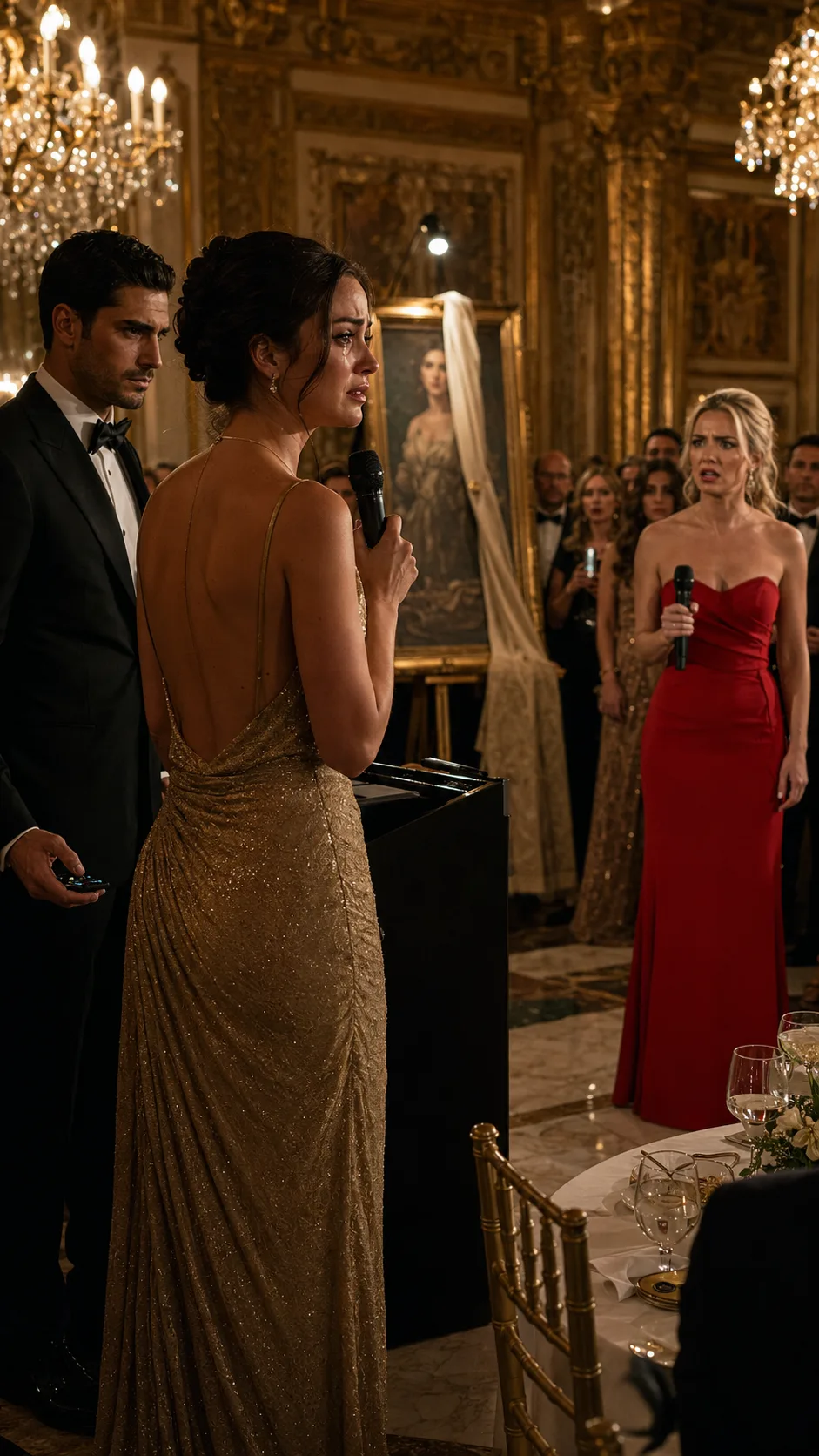
The Bellandi Foundation Gala filled the Plaza ballroom with diamonds, cameras, old money, and polished cruelty.
Lucia stood at the top of the staircase in a simple gold gown Emilia had chosen. Her grandmother’s small cross rested at her throat. Below, people whispered.
“That’s her.”
“The waitress.”
“Vanessa said there were immigration problems.”
“Is the father really sick?”
Beauty did not comfort Lucia.
She had carried trays through colder rooms than this. She had carried hospital bills in her bag. She had carried fear until her spine learned its shape.
This was only a ballroom.
Lorenzo offered his arm.
“Breathe.”
“I am breathing.”
“You look like you are threatening the air.”
She almost laughed.
At the center of the stage stood the veiled portrait.
Lorenzo took the microphone.
“Tonight, the Bellandi Foundation begins a new chapter. Before our family owned buildings, before our name opened doors, we survived because strangers showed courage. Our restored family portrait has uncovered a truth we had forgotten.”
A voice cut through the room.
“How convenient.”
Vanessa stepped from the side aisle with a stolen microphone.
She wore red again.
“Ladies and gentlemen,” she said, smiling too brightly, “before we crown the waitress as a saint of old paintings, perhaps we should ask what she really restored—her bank account.”
Phones rose.
Lorenzo’s jaw tightened, but Lucia touched his arm.
No.
She stepped forward and took the second microphone.
“Yes,” Lucia said.
The room fell silent.
Vanessa blinked.
Lucia faced the crowd.
“Yes, I was a waitress. I served bread. I poured water. I scrubbed stains from tablecloths after people like you went home. My father was sick. I needed money. I worked until my body hurt because love, when it has no trust fund, still has invoices.”
No one moved.
“If that makes me shameful,” Lucia continued, “then shame has more dignity than some pride in this room.”
Emilia smiled slowly.
Lucia turned to Vanessa.
“And yes, Lorenzo helped my father. Not because I tricked him. Because you used your family’s influence to freeze a sick man’s hospital account as punishment.”
Vanessa laughed. “Lies.”
Lorenzo lifted a small remote.
“No,” he said. “Evidence.”
The ballroom speakers crackled.
Vanessa’s recorded voice filled the room.
“A call to immigration could make things very simple.”
Then another line.
“Love her when every newspaper calls her a fraud.”
Then the sound of shattering glass.
The room froze.
Lorenzo spoke calmly.
“Security footage, hospital records, call logs, and sworn statements have been delivered to counsel. Miss Carroway interfered with medical care, trespassed on private property, threatened immigration retaliation, and attempted to destroy a historic artwork.”
Vanessa turned toward the front row.
Her father stood there, his face carved from stone.
For one second, she looked like a child waiting to be rescued.
He turned away.
That broke her more than the evidence.
“Lorenzo,” she whispered.
“My name is Lorenzo,” he said. “And you never loved me. You loved the doors my name could open.”
Security approached.
Vanessa backed away, shaking.
“This isn’t over.”
Emilia stood.
Every eye turned to her.
She took the microphone with queenly calm.
“No, Vanessa. For once, you are correct. It is not over.”
She pointed her cane toward the portrait.
“This painting survived war, water, fire, neglect, and arrogance. When Lucia Moretti restored it, she uncovered an inscription.”
Lorenzo removed the veil.
The ballroom gasped.
The woman with the pomegranate glowed beneath the lights, not young, not perfect, but true.
Beside it, an enlarged image of the inscription appeared.
Emilia’s voice trembled only slightly.
“Adelina Moretti was Lucia’s grandmother. She saved my husband’s father when he was a child. She refused money. She refused attention. She asked only that he live.”
The ballroom was utterly still.
“So when you call Lucia a gold digger,” Emilia said, looking directly at Vanessa, “you insult the blood that once saved ours.”
Vanessa had no answer.
There are moments when people lose not because someone defeats them, but because truth removes the costume they have been wearing.
This was Vanessa’s moment.
Security escorted her out quietly.
No screaming now.
Only the hollow click of heels beneath a thousand watching eyes.
Then applause began.
Not wild at first.
Careful.
Human.
At the back of the ballroom, Marco Moretti sat in a wheelchair, weak but alive, clapping with trembling hands.
Lucia saw him and nearly broke.
She walked down from the stage and knelt before him.
“Papa.”
He touched her cheek.
“Your nonna would say you cleaned more than a painting tonight.”
Lucia laughed through tears.
“What did I clean?”
“A dirty room.”
Six months later, Lucia opened the Moretti Conservation Studio in a sunlit building owned in her name. Her first apprentice was a girl from Queens who had been told art restoration was not for people like her.
Lucia told her, “Old things survive because someone patient believes they are worth saving.”
Marco recovered slowly, then stubbornly, then joyfully. He built Lucia a workbench from reclaimed walnut and carved a sentence beneath the edge where only she could see it.
Paint remembers. So do daughters.
Emilia visited every Thursday, criticized the coffee, praised the work, and pretended she had not brought pastries.
Lorenzo stepped away from daily control of the Bellandi empire and expanded the family foundation into a restoration fund for forgotten art, forgotten buildings, and forgotten people with gifted hands.
Almost a year after the dinner at Bellavista, Lucia and Lorenzo stood before the portrait in its permanent gallery.
The woman with the pomegranate watched over them.
Lorenzo took Lucia’s hand.
“My mother says I should ask before she loses patience and asks for me.”
Lucia smiled. “That sounds like her.”
“I had a speech.”
“Of course you did.”
“It was good.”
“I’m sure.”
“But then I remembered you prefer truth when it is simple.”
He took a small box from his pocket.
Inside was not a giant diamond.
It was an old gold ring set with a deep red stone, warm as a pomegranate seed.
“It belonged to the woman in the portrait,” Lorenzo said. “My mother wanted you to have it. I wanted to ask if you would let me spend my life proving that love is not rescue. It is partnership. It is respect. It is home.”
Lucia looked at him.
She thought of a restaurant where she had been invisible.
She thought of a cruel woman who believed money could make her untouchable.
She thought of her grandmother carrying a child through smoke and sea.
She thought of her father’s hands.
Then she thought of Lorenzo listening to her speak about varnish as if patience could change the world.
“Yes,” she said.
From the doorway, Emilia’s voice cut through the tenderness.
“Finally.”
Lucia laughed as Lorenzo slid the ring onto her finger.
Outside, rain washed the city clean.
Inside, beneath the gaze of a woman who had survived history, two families remembered what mattered.
Not wealth.
Not status.
Not the noise of people desperate to be seen.
Dignity.
Work.
Loyalty.
Courage.
And the quiet language of home.
Lucia had entered Lorenzo Bellandi’s life as a waitress carrying water.
But she stayed as the woman who restored what everyone else had nearly ruined.
THE END.
Chapter complete
You have reached the end of this chapter.
Continue reading
A few more worlds to get lost in after this chapter.




