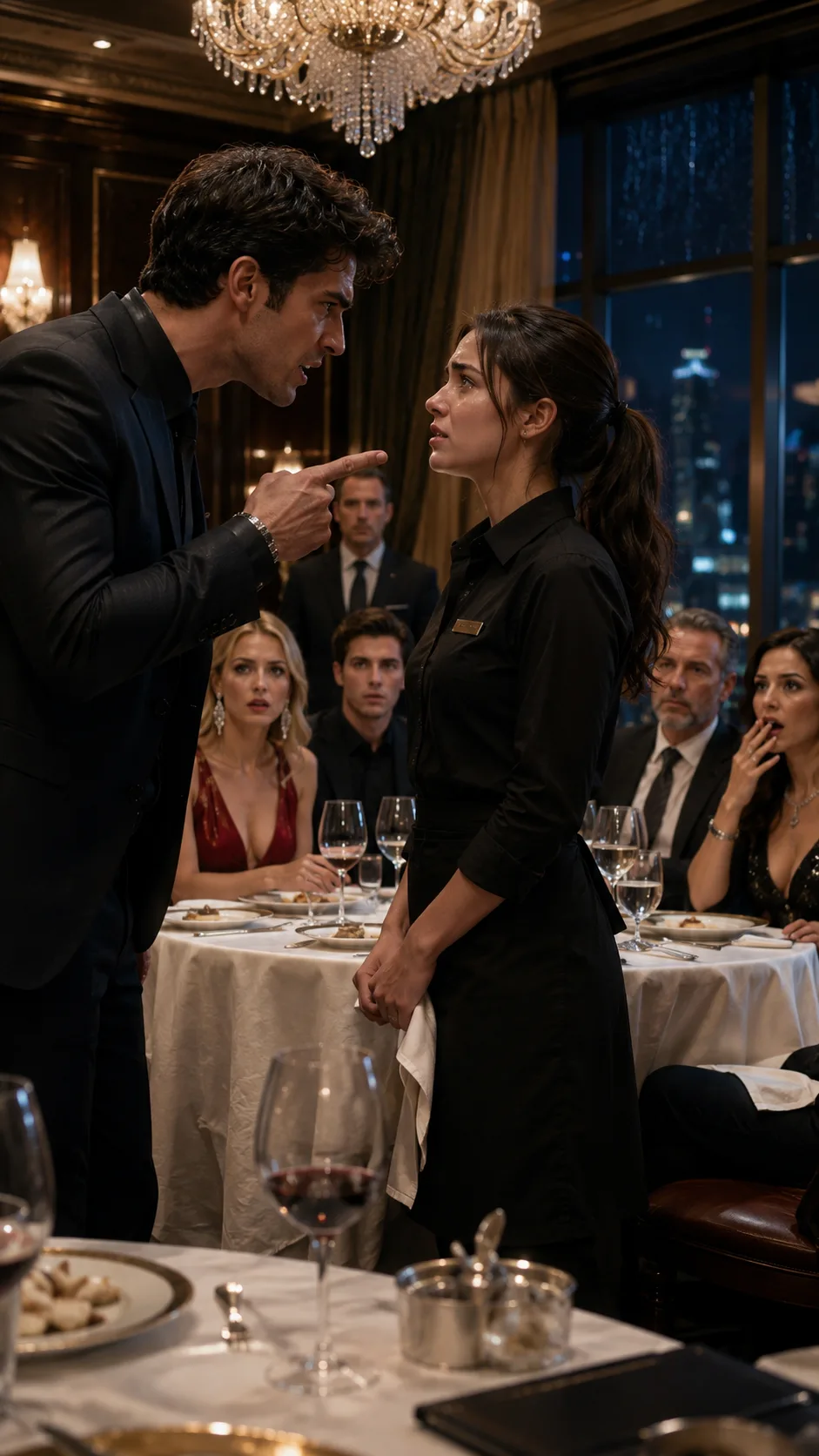
reached for the watch and found only empty linen.
A man like Dante Bellucci did not react to embarrassment like an ordinary man. He did not search quietly. He did not wonder whether he had misplaced something. He did not consider that one of his own guests might have moved it. His mind went to the easiest target in the room.
The girl in uniform.
Elena.
She had been the last server to approach the table before the watch disappeared. She had refilled Bianca’s glass, replaced a fallen napkin, cleared a bread plate, and stepped away silently. She had been polite, efficient, almost invisible.
Exactly the kind of person the rich forgot was human until they needed someone to blame.
“I said empty your pockets,” Dante said.
His voice was not loud.
That was what made it frightening.
A shouting man could be dismissed as drunk, emotional, out of control. Dante spoke with low precision, each word placed like a knife on the table.
Elena lowered her hand from her cheek.
“I already told you,” she said, her voice quiet but steady. “I did not take your watch.”
At the far end of the table, Marco Bellucci gave a short, ugly laugh.
Marco was Dante’s younger cousin, twenty-seven, soft from privilege but desperate to seem ruthless. His tie hung loose around his neck. Wine had flushed his face. He held a cigar case in one hand and arrogance in the other.
“They all say that,” Marco said.
Elena turned her gaze toward him. “Who is ‘they’?”
Marco smiled wider. “People who need money badly enough to steal.”
A few guests shifted in their seats. Nobody corrected him.
Bianca leaned back, red silk dress glimmering under the chandelier. Her blond hair fell in perfect waves over one shoulder, and her lips curved with the pleasure of watching someone else lose status.
“Don’t make this worse for yourself, sweetheart,” Bianca said. “Just give it back.”
Elena’s eyes moved to Bianca. “I have nothing to give back.”
Bianca sighed, as if bored by poverty itself. “Then you won’t mind being searched.”
The restaurant manager, Mr. Cavallo, stood near the wall, pale and visibly sweating. He had spent years managing Valentina’s by understanding power. Who received the corner table. Who preferred the left-handed steak knife. Which senator drank secretly. Which actress wanted no cameras near her. Which businessmen had to be treated like kings even when they behaved like animals.
Dante Bellucci was one of those men.
But tonight, Cavallo’s fear was different.
His eyes kept flicking toward Elena with a dread that had nothing to do with staff discipline.
“Mr. Bellucci,” Cavallo said carefully, stepping forward, “perhaps we should handle this in the office. Quietly. I can review the footage, speak with the staff, and—”
“No,” Dante said without looking at him. “She can empty her pockets here.”
Cavallo swallowed. “Sir, I really advise—”
Dante turned his head slowly.
Cavallo stopped speaking.
That was the effect Dante had on rooms. One look, and men remembered their salaries, their debts, their families, their fear.
Elena watched that exchange with a kind of tired sadness.
She had worked at Valentina’s for nearly six months under her mother’s maiden name. Not because she needed the paycheck. Not because she was running from anything. Not because her father had abandoned her.
She had asked for the job.
Her father had hated the idea.
“You want to serve men who would not recognize dignity if it poured their wine?” Lorenzo Moretti had asked her.
“I want to know what kind of world our money protects,” she had replied.
Lorenzo had gone silent after that.
For most of her life, Elena had grown up behind guarded gates, private schools, polished cars, and rooms where people lowered their voices when her father entered. But privilege had made her restless, not blind. She had watched her father invest in restaurants, hotels, clubs, and hospitality groups. She had seen reports about worker satisfaction, safety compliance, wage structures, and staff retention.
Numbers.
Charts.
Clean language hiding dirty realities.
So she asked to work the floor anonymously.
At Valentina’s.
The restaurant named after her late mother.
Her father agreed only after weeks of arguments, and only because Elena promised she would call him if anything ever became unsafe.
For six months, she learned.
She learned which guests said thank you and which guests snapped their fingers.
She learned which managers protected staff and which managers protected tips.
She learned how quickly a uniform made a woman disappear.
She learned that kindness was rare, cruelty was common, and silence was often mistaken for permission.
But until tonight, she had not understood how fast a room could agree to sacrifice one person to protect a powerful man’s pride.
Dante pointed toward her apron.
“Empty it.”
Elena stood still.
“No.”
The word was soft, but it struck the room harder than if she had screamed.
Marco’s brows lifted. “Did she just say no?”
Bianca gave a small laugh. “Apparently.”
Dante stepped closer. “You don’t get to refuse.”
Elena’s jaw tightened.
“I do when I am being treated like a criminal without proof.”
His gray eyes narrowed.
“You were near the table.”
“So were eleven other people.”
“You served the wine.”
“And your cousin leaned across the table twice.”
Marco’s smile vanished.
Dante looked at him briefly, then back at Elena. “Careful.”
Elena’s expression changed then. Not dramatically. Just enough.
A little less sadness.
A little more steel.
“I was careful,” she said. “That is why I did not touch what was not mine.”
Marco slammed his cigar case lightly against the table. “This is ridiculous. Dante, call the police.”
At the word police, several guests became interested in their glasses.
Wealthy people loved punishment until paperwork became involved.
Bianca looked at Dante. “Maybe she passed it to the kitchen.”
A young server near the wall flinched.
Elena noticed.
Dante did too, but he mistook the flinch for guilt.
“Bring out the kitchen staff,” Dante said.
Cavallo’s face went whiter. “Sir, please.”
“You have a thief in my restaurant.”
“My restaurant,” Cavallo said quietly, then immediately looked as if he regretted the words.
Dante slowly turned to him.
“What did you say?”
Cavallo’s lips parted, but no answer came.
Elena looked down at her apron.
Then she untied it.
The room watched.
She folded it once with careful hands and placed it over the back of the nearest chair.
Dante stared. “What are you doing?”
“I am no longer serving this table.”
Marco burst out laughing. “She thinks she can quit.”
Bianca tilted her head. “How dramatic.”
Elena looked at Dante.
“I was insulted. I was accused. I was struck. I will not keep pretending this is service.”
For the first time, something uncertain moved across Dante’s face.
Not guilt.
Not yet.
Irritation at a situation refusing to obey him.
“You’re not leaving,” he said.
“No,” Elena replied. “I’m waiting.”
“For what?”
Elena reached into the pocket of her black trousers and took out her phone.
Dante’s eyes dropped to it.
“Put that away.”
She unlocked the screen.
“Elena,” Cavallo whispered, his voice almost breaking.
She did not look at him.
“I said put it away,” Dante repeated.
Elena tapped one contact.
The line rang once.
Then a man answered.
The room could not hear the man clearly. Only the low sound of his voice through the speaker pressed near Elena’s ear. But they could see what happened to her face when she heard him.
Her expression did not soften.
It settled.
As if some invisible door had closed behind her, shutting out the room’s cruelty.
“Papa,” she said.
Dante blinked once.
Marco grinned. “Oh, this is precious.”
Elena ignored him.
“I’m at Valentina’s,” she said. “North private room.”
A pause.
Her eyes lifted to Dante.
“Mr. Bellucci accused me of stealing his watch.”
Another pause.
Then Elena said, very clearly, “And he hit me.”
Silence fell so completely that the rain against the windows became audible.
One soft breath escaped Cavallo.
The manager closed his eyes.
Dante saw it.
He also saw the way one of the older investors at the table suddenly straightened, as if a private memory had returned to him. He saw Bianca’s polished smile fade. He saw Marco’s amusement hesitate, then twitch back into place like a mask.
Elena listened for a moment.
“No,” she said. “I’m not badly hurt.”
The man on the phone spoke again.
Elena nodded once.
“Yes. I’ll wait.”
She ended the call.
Marco leaned back with theatrical boredom. “So Daddy is coming? Should we prepare another chair?”
Cavallo opened his eyes and whispered, “Marco, stop.”
Marco looked at him, annoyed. “Why does everyone keep acting like this is a funeral?”
Dante did not speak.
His gaze remained on Cavallo.
“Who is her father?”
The manager’s throat moved.
He looked at Elena as if asking permission.
Elena answered herself.
“Lorenzo Moretti.”
The name entered the room quietly.
Then it began to destroy it.
Not everyone reacted at once. That was the terrifying part.
Some guests only frowned, searching memory. Others stiffened immediately. The older investor nearest the window lowered his wineglass with such care it seemed heavy. Bianca’s face lost color beneath her makeup. Cavallo looked like a man waiting for a sentence to be carried out.
Dante stared at Elena.
“Say that again.”
“My father is Lorenzo Moretti.”
Marco scoffed. “And I’m the Pope.”
No one laughed.
Dante’s mind moved quickly now, too quickly for comfort.
Lorenzo Moretti.
The silent investor.
The name behind layered companies and private funds. The man whose money had quietly stabilized Dante’s hotel portfolio three years ago when a bank withdrew financing at the worst possible moment. The man who owned commercial real estate through holding companies, controlled liquor distribution through subsidiaries, and had influence in political rooms without appearing in photographs.
Dante had spoken to him only twice.
Both times over the phone.
Both times carefully.
He had never met Lorenzo’s daughter.
He had never asked whether Lorenzo even had one.
Because men like Dante often studied the powerful and ignored everyone standing near them.
“You’re lying,” Dante said.
Elena did not flinch.
“I wish that helped you.”
Bianca stood slowly. “Dante.”
Her voice had changed.
Gone was the amused cruelty.
In its place was caution.
Dante hated hearing fear from someone who had been laughing a minute earlier.
Cavallo stepped closer to Elena, positioning himself slightly beside her now, no longer between her and Dante but near her, as if allegiance had finally located itself.
Dante saw it.
“You knew,” he said.
Cavallo looked down. “Yes.”
“You knew who she was and let her serve my table?”
“She asked to work anonymously.”
Dante’s face hardened. “Why?”
Elena answered.
“To see what people do when they believe no one important is watching.”
That sentence moved through the room like cold water.
The young server near the wall stared at Elena.
So did the hostess by the service door.
For months, Elena had worked beside them, carried trays with them, stayed late with them, listened to them complain, laughed softly at their jokes, shared staff meals, and accepted the same tired looks from customers who believed the uniform erased identity.
None of them had known.
Elena felt their shock without turning around.
It hurt more than she expected.
She had not meant to deceive them cruelly. But truth, even for good reasons, could still leave bruises.
Dante stepped back half a pace, then caught himself.
“You should have said who you were.”
Elena looked at him.
“Before or after you slapped me?”
No one spoke.
Dante’s jaw tightened.
The question left him nowhere to stand.
Before he could answer, the door opened.
Not with drama.
Not with a crash.
Just a soft click.
Two men in dark suits entered first. They moved with the stillness of professionals who did not need to announce danger. One remained by the door. The other stepped aside.
Then Lorenzo Moretti entered the room.
He was fifty-four, tall, composed, and dressed in a dark navy overcoat over a gray suit. His hair was silver at the temples. His face was handsome in a calm, weathered way, with lines that suggested grief had visited him often but never ruled him. He did not rush. He did not shout. He did not scan the room like a gangster looking for enemies.
He looked first at Elena.
Only Elena.
The room seemed to understand that whatever happened next would begin there.
Lorenzo crossed to his daughter. His gaze moved to the red mark on her cheek. For a moment, no one else existed.
“Elena,” he said softly, “look at me.”
She did.
His hand lifted, but he did not touch her cheek without permission. He stopped just short of her skin.
“Are you hurt?”
“I’m all right.”
His eyes remained on the mark.
“That is not what I asked.”
Elena swallowed.
The first crack in her composure appeared then, small and human.
“It hurt,” she said.
Lorenzo’s expression did not change, but every person in the room felt something sharpen.
He lowered his hand.
Then he turned to Dante.
The two men faced each other across the expensive silence.
“Mr. Bellucci,” Lorenzo said.
His voice was quiet.
Dante straightened. “Mr. Moretti.”
“You struck my daughter?”
Dante could have lied.
He could have said it was accidental. He could have said she moved suddenly. He could have said he did not know who she was. He could have said tension was high, the watch was valuable, things happened too quickly.
But some rooms made lies sound small before they reached the air.
“Yes,” Dante said.
Bianca closed her eyes.
Marco looked away.
Lorenzo nodded once.
“Why?”
Dante’s mouth tightened.
“My watch was missing.”
“And that answered my question?”
Dante’s eyes flickered.
Lorenzo waited.
The wait was worse than anger.
“I believed she had taken it,” Dante said.
“You believed.”
“Yes.”
“Based on evidence?”
Dante did not answer.
Lorenzo turned his gaze slowly across the table.
“Did anyone see my daughter take the watch?”
Silence.
“Did anyone see it in her possession?”
Silence.
“Did anyone search the table properly before accusing her?”
No one looked at him now.
Lorenzo’s gaze returned to Dante.
“So a valuable object disappeared, and the easiest person to blame was the young woman serving you.”
Dante’s face flushed faintly.
“That is not—”
“That is exactly what happened.”
The calm interruption struck harder than a raised voice.
Marco suddenly leaned forward.
“This is getting out of hand. It was probably misplaced. Nobody knew she was your daughter.”
Lorenzo turned to him.
The room watched Marco’s confidence begin to die.
“And if she were not my daughter?” Lorenzo asked. “Would the slap have been acceptable?”
Marco opened his mouth.
Nothing came out.
Lorenzo looked at the cigar case in Marco’s hand.
“What is that?”
Marco blinked. “My cigar case.”
“Open it.”
Marco laughed once. It sounded fake.
“What?”
“Open it.”
Dante’s eyes narrowed.
“Marco.”
Marco looked at him. “You can’t be serious.”
“Open it,” Dante said.
The first bead of sweat appeared near Marco’s hairline.
Bianca took one step back from the table.
Marco’s fingers fumbled with the clasp. The cigar case opened.
Inside were four cigars wrapped in thin cedar sleeves.
And beneath them, half-hidden inside a folded cocktail napkin, was Dante’s platinum watch.
The room seemed to lose oxygen.
Dante stared at the watch.
Elena stared at Marco.
Lorenzo stared at no one. He simply absorbed the truth as if he had expected it from the beginning.
Marco’s face turned bright red.
“I didn’t steal it,” he said quickly. “I moved it. I was joking.”
Dante’s voice came out low. “You watched me accuse her.”
“I thought she’d just panic and then I’d give it back.”
Elena’s face did not move, but her fingers curled slightly at her side.
Marco looked around the room, desperate now.
“It was a joke. Come on. Nobody was supposed to get hurt.”
Elena finally spoke.
“But someone did.”
Marco’s eyes darted to her cheek, then away.
Dante stepped toward his cousin.
“You let me hit her.”
Marco snapped back, fear turning into anger. “You hit her because that’s who you are.”
The sentence cut through the room.
Dante stopped.
For once, nobody came to his rescue.
Not Bianca.
Not the investors.
Not Cavallo.
Not the silence.
Dante turned slowly back to Elena.
The first apology rose in him, but it had nowhere clean to go. Any words now would sound like a man trying to save himself from consequence. He knew it. Elena knew it. Lorenzo knew it.
Still, Dante forced the words out.
“I was wrong.”
Elena looked at him.
The red mark on her cheek looked darker now under the chandelier.
“Yes,” she said.
“I am sorry.”
“Would you be sorry,” Elena asked, “if my father were not standing here?”
Dante froze.
That was the question that mattered.
Not whether he regretted the slap.
Not whether he regretted being caught.
Not whether he feared Lorenzo Moretti.
Whether he would have seen a waitress as worthy of remorse if she had remained only a waitress.
The room waited for his answer.
Dante lowered his eyes.
Elena nodded once.
“Thank you for not lying.”
Lorenzo placed a hand gently on his daughter’s shoulder.
Then he looked at Cavallo.
“Close the restaurant for the evening.”
Cavallo nodded immediately. “Yes, sir.”
Dante looked up. “You can’t close the room in the middle of private service.”
Lorenzo turned toward him.
“I own the building.”
The words landed softly.
Dante said nothing.
“I also own the holding company that controls your primary liquor contracts,” Lorenzo continued. “I sit behind the fund that rescued your River North hotel. I hold voting leverage in two ventures you believe are independent. By tomorrow morning, every business relationship between my companies and yours will be under review.”
Bianca’s lips parted.
One of the investors stood abruptly, then seemed to realize he had nowhere to go.
Dante’s expression hardened in self-defense.
“You would burn years of business over one mistake?”
Lorenzo’s gaze sharpened for the first time.
“No,” he said. “I would burn years of business because tonight showed me what kind of man my money helped make powerful.”
Dante absorbed the blow.
There was no easy answer.
Because power had made him careless. Wealth had made him certain. Fear had made everyone around him quiet. And silence had made him believe he was right even when he had no proof.
Lorenzo turned to Marco.
“You will remain here until security reviews every camera angle and prepares a full incident report.”
Marco’s face twisted. “For what? Moving a watch?”
“For allowing an innocent employee to be accused of theft and physically assaulted while you concealed evidence.”
“It was a prank!”
Lorenzo’s voice dropped.
“My daughter’s humiliation is not your entertainment.”
Marco shut his mouth.
Elena looked down briefly.
Those words almost broke her.
Not because she needed rescuing.
Because the room had treated her dignity as optional until her father arrived and named it as something real.
Cavallo hurried out. Within minutes, staff members began gathering near the entrance to the private room: servers, bussers, the hostess, the head chef, dishwashers, junior managers. Some looked confused. Some frightened. Some already knew enough to understand that the night had changed.
Lorenzo faced them.
“I owe you an apology,” he said.
The staff stared at him.
Rich men did not apologize to staff. They donated. They instructed. They compensated. They did not stand in front of workers and admit failure.
Lorenzo continued.
“An employee was mistreated tonight under the roof of this restaurant. That employee was my daughter, but that is not why it matters. It matters because every person here should have been protected before anyone knew her name.”
The room was painfully silent.
Cavallo stood near the doorway, shame written across his face.
“I allowed a culture where managers feared wealthy guests more than they protected staff,” Lorenzo said. “That ends now.”
Elena looked at the workers.
Maria, a server in her forties who had trained her during her first week, held both hands clasped near her apron. Jonah, the busser who always joked during closing shift, looked stunned. Nina at the host stand had tears in her eyes.
Elena wanted to tell them she was sorry.
Sorry for hiding.
Sorry for watching.
Sorry that it took her pain to make the room visible.
But before she could speak, Maria stepped forward.
“Are you okay?” Maria asked softly.
That simple question nearly undid Elena more than the slap had.
She nodded.
“I will be.”
Maria’s eyes moved to the mark on her cheek, then to Dante, then back.
“You should not have had to be his lesson.”
Elena’s throat tightened.
“No,” she said. “But maybe we can make sure no one else is.”
Dante heard that.
It stayed with him.
Lorenzo turned back to Dante.
“My daughter will decide what happens next.”
Dante looked at Elena.
Something in him resisted. He was used to negotiating with fathers, lawyers, investors, men with equal power. Not with the woman he had wronged. Not with someone he had believed beneath him an hour earlier.
But that resistance shamed him now.
Elena stepped forward.
The room made space for her without being told.
“I don’t want flowers,” she said.
Dante listened.
“I don’t want a private check. I don’t want a quiet apology buried behind lawyers. I don’t want a donation with your name on it.”
Bianca watched from beside her chair, arms folded tightly.
Elena continued.
“I want written protections for every employee in every restaurant, club, hotel, and lounge tied to your name. I want managers trained to remove abusive customers, no matter how important they are. I want staff accusations handled through evidence, not humiliation. I want security footage preserved when theft is alleged. I want paid leave for employees harmed during service. I want anonymous reporting. And I want a public statement admitting why these changes are being made.”
Dante’s expression darkened.
“That would damage my reputation.”
Elena held his gaze.
“Then build one worth keeping.”
The words struck the room like a verdict.
Dante looked at Lorenzo.
Lorenzo said nothing.
This was not his negotiation.
Dante looked at Cavallo, at the staff, at Bianca, at Marco, at the watch sitting inside the open cigar case like a bright, useless confession.
Then he looked back at Elena.
“Done,” he said.
Elena did not soften.
“By noon tomorrow. In writing. Reviewed by my father’s legal team and by an independent labor attorney.”
Marco scoffed under his breath.
Lorenzo’s security guard looked at him.
Marco went silent.
Dante nodded once.
“By noon.”
Bianca moved toward him. “Dante, you need to think before agreeing to something this large.”
He looked at her.
For the first time that night, he saw her clearly too.
She had laughed when Elena was accused. She had encouraged the search. She had enjoyed the cruelty as long as it flowed downward. Now she was frightened only because consequences had begun moving upward.
“You laughed,” Dante said.
Bianca blinked. “What?”
“When I accused her. You laughed.”
Bianca’s face tightened. “So did half the room.”
“That does not make it better.”
“No,” Elena said quietly. “It makes it worse.”
Bianca turned to her.
For a moment, anger flashed in her eyes. Then embarrassment. Then something almost like shame.
“I’m sorry,” Bianca said.
Elena studied her.
“Are you sorry because you were cruel,” she asked, “or because you were seen being cruel?”
Bianca did not answer.
Elena nodded faintly.
“Figure that out before you apologize again.”
Bianca looked as if she had been slapped without being touched.
One by one, the guests began leaving.
The investors moved first, murmuring excuses. Then the socialites. Then Bianca, who paused once near Dante as if expecting him to follow. He did not. Finally, Lorenzo’s security escorted Marco to a side office where footage would be reviewed and statements taken.
The private dining room emptied until only Elena, Lorenzo, Dante, Cavallo, and two security men remained.
Dante picked up the platinum watch from the cigar case.
For a second, he looked at it with hatred.
So much had happened over this object.
But Elena knew the truth.
The watch had not caused any of it.
It had only revealed what was already present.
Pride.
Cruelty.
Cowardice.
Fear.
Silence.
Dante placed the watch on the table between them.
“I don’t know how to fix this,” he said.
Elena looked at the watch.
“Start by understanding that you are not the victim of what you did.”
His jaw tightened, but he nodded.
She picked up her folded apron from the chair.
The cloth felt heavier than it should have.
For months, that apron had been her disguise. Her experiment. Her entrance into a world that existed beneath the one she had been born into. Now it felt like evidence.
She laid it beside the watch.
“This is what you saw,” she said. “A uniform. Not a person.”
Dante looked at the apron.
Then at her.
“Yes.”
That single honest word mattered more than his earlier apology.
Elena turned to Cavallo.
“You failed me tonight.”
The manager’s eyes reddened.
“Yes.”
“You failed them too.” She nodded toward the staff beyond the door.
“I know.”
“Fear explains it,” she said. “It does not excuse it.”
Cavallo bowed his head.
“I understand.”
“Good,” Elena said. “Because if you stay here, you will have to become the kind of manager who stands between power and staff before someone important enters the room.”
Cavallo looked up.
“If I stay?”
Elena glanced at her father.
Lorenzo’s expression was unreadable.
“That will depend on what you do next,” Elena said.
Cavallo nodded slowly. “Then I’ll do better.”
“Don’t promise,” she said. “Prove it.”
Outside the restaurant, the rain had softened to a mist by the time Lorenzo walked Elena to the car.
A black sedan waited at the curb.
For the first time all night, Elena felt the cold.
Her body began shaking slightly now that she no longer had to hold herself perfectly still. Lorenzo noticed but said nothing until they were inside the car, away from every watching eye.
Then he removed his coat and placed it around her shoulders.
Elena stared out the window at the blurred streetlights.
“I thought I would be angrier,” she said.
Lorenzo sat beside her.
“You are angry.”
She shook her head.
“Not enough.”
He turned toward her.
“Elena.”
“I keep thinking about Maria. Jonah. Nina. Chef Andre. All of them. If it had been Maria, would anyone have called you? If it had been Jonah, would anyone have stopped Dante? If I weren’t your daughter, that room would have swallowed me.”
Lorenzo’s face tightened.
“Yes.”
The honesty hurt.
Elena closed her eyes.
“I wanted to learn what the reports couldn’t show me.”
“And did you?”
She opened her eyes.
“Yes.”
Lorenzo looked older in the passing streetlights.
“I am sorry,” he said.
She turned to him. “You didn’t slap me.”
“No. But my money helped give men like him rooms where they forgot consequences.”
Elena said nothing.
The car moved through the wet city.
At home, she did not sleep.
She sat in her mother’s old library until dawn, still wearing Lorenzo’s coat over her shoulders. On the desk in front of her lay the first draft of the employee protection framework that Lorenzo’s lawyers sent before sunrise. Elena read every line.
Then she rewrote half of it.
At 8:10 a.m., she added language requiring managers to intervene before physical escalation.
At 8:45, she added mandatory incident reporting.
At 9:20, she added paid recovery leave.
At 10:05, she added consequences for guests who abused staff.
At 10:40, she added independent review when an employee was accused of theft by a high-value client.
At 11:30, Dante Bellucci arrived at Lorenzo Moretti’s downtown office.
He looked as though he had not slept.
No entourage. No Bianca. No expensive performance of power.
Just Dante, pale and silent, holding a folder.
Elena sat across the conference table beside her father and two attorneys.
For a moment, Dante’s eyes moved to her cheek.
The mark had faded slightly but was still visible.
He looked away first.
“The documents are signed,” he said.
Lorenzo did not reach for them.
Elena did.
She opened the folder and read.
Dante waited.
Twenty minutes passed.
Then thirty.
No one spoke except the attorneys when Elena asked questions.
Finally, she closed the folder.
“This is a start,” she said.
Dante exhaled.
“A start,” she repeated. “Not redemption.”
“I understand.”
“I don’t think you do yet.”
He accepted that.
Elena leaned back slightly.
“There will be a staff meeting tonight at Valentina’s. You will attend. You will apologize to the employees in person. Not as a performance. Not for cameras. No press.”
Dante’s face tightened.
“You want me to stand in front of them?”
“Yes.”
“And say what?”
“The truth.”
His eyes held hers.
Elena did not look away.
That evening, Valentina’s remained closed to guests.
Every employee gathered in the main dining room. Some stood with arms crossed. Some whispered. Some looked angry. Others looked suspicious, as if expecting the whole event to become a polished corporate apology where nothing changed after dessert.
Dante stood near the bar.
He looked uncomfortable.
Elena was glad.
Comfort had never made him better.
Cavallo opened the meeting with a trembling apology of his own. He admitted he had failed to protect staff. He admitted fear had guided him. He promised new rules would not depend on courage alone but on clear authority.
Then Dante stepped forward.
The room went silent.
He did not use notes.
“My watch went missing,” he said. “I accused Elena because she was serving the table. I had no proof. I ignored her denial. I allowed my status to become evidence. Then I struck her.”
A few people looked down.
Others stared directly at him.
“I can say I was angry,” Dante continued. “I can say the watch mattered to me. I can say I was embarrassed. None of that explains what I did. It only explains how easily I became the kind of man who thought a uniform made someone less believable.”
Elena stood near the back beside Maria.
Maria whispered, “He looks like swallowing glass would be easier.”
Elena almost smiled.
Dante continued.
“The changes announced today are not charity. They are not generosity. They are consequences. You deserved protection before I was forced to recognize it.”
He paused.
“I am sorry.”
No applause followed.
That was good.
Some apologies deserved silence.
After the meeting, employees were invited to speak privately with independent reviewers. Many did. Stories came out that night that had never reached official reports.
A hostess cornered by drunk guests.
A busser accused of stealing cash that was later found in a customer’s coat.
A bartender threatened by a politician’s son.
A server fired from a previous venue after refusing to tolerate insults from a VIP.
Elena listened until almost midnight.
Each story felt like another light turning on in a room people had kept dark for years.
Over the next month, changes moved through Dante’s empire faster than anyone expected.
Some managers resisted.
They were removed.
Some guests mocked the new policies.
They were asked to leave.
One investor called Lorenzo privately and complained that “service culture” was becoming too sensitive.
Lorenzo ended the call in under a minute.
At Valentina’s, the difference showed first in small ways.
Staff stopped lowering their eyes so quickly.
Cavallo began walking the dining room differently, not as a man scanning for wealthy displeasure, but as a manager watching for staff safety.
A guest who snapped his fingers at Nina was politely warned.
A woman who threw a napkin at a server was escorted out.
A drunk businessman who grabbed Maria’s wrist found Dante Bellucci himself standing beside his table ten seconds later, voice cold and controlled.
“You can release her hand,” Dante said, “or security can help you.”
The man released her.
Maria later told Elena she had never seen anything so satisfying.
But transformation was never clean.
Two weeks after the incident, reporters began circling.
Someone leaked part of the story.
Not Elena’s name.
Not at first.
But enough.
“Restaurant Empire Reforms After Alleged Staff Assault.”
“Bellucci Group Announces Worker Protection Overhaul.”
“Silent Investor Forces Hospitality Shake-Up.”
Dante’s reputation suffered.
Some called him performative.
Some called him exposed.
Some praised the reforms.
Others asked why it took violence for basic dignity to become policy.
Elena read every article and felt no triumph.
Because the articles still turned people into symbols.
Dante became the fallen powerful man.
Lorenzo became the silent kingmaker.
Elena became “the waitress.”
No one wrote much about Maria, Jonah, Nina, or the dishwashers who worked until two in the morning with swollen feet and unpaid dignity.
So Elena wrote something herself.
Not a statement of revenge.
A letter.
It was posted on Valentina’s website and printed in the staff room.
She did not name Dante.
She did not describe the slap in detail.
She wrote about the danger of treating workers as scenery. About how humiliation often begins long before violence. About how silence from witnesses protects cruelty. About how dignity should never depend on hidden status.
The final line read:
“A person should not have to be powerful in secret to be treated as human in public.”
The line spread faster than the scandal.
People quoted it.
Workers shared it.
Other restaurants copied policy language from Valentina’s.
Within three months, Lorenzo created the Valentina Foundation for Hospitality Dignity, funded not by Dante’s watch alone, but by millions in redirected investment profits. The foundation offered legal support, emergency funds, and workplace safety training for service employees across the city.
The platinum watch was sold quietly at auction.
The money became the first deposit.
Dante did not attend the auction.
But he sent a note.
Elena almost threw it away unread.
Instead, she opened it.
It contained only one sentence.
“I am still learning what the watch cost.”
She folded the note and placed it in a drawer.
She did not forgive him that day.
Forgiveness, she decided, was not a performance either.
Months passed.
The mark on her cheek disappeared.
The memory did not.
One rainy evening nearly a year later, Elena returned to Valentina’s not as a waitress, not as a secret observer, but as the woman now overseeing the Moretti hospitality holdings.
The restaurant was full again.
Warm light. Low music. Glasses ringing softly. Servers moving with skill and confidence.
Near the host stand, Cavallo was speaking firmly to a guest who had raised his voice at Nina.
“I understand you are unhappy with the table,” Cavallo said, calm but immovable. “But you will speak respectfully or we will end your reservation.”
The guest stared, stunned.
Nina stood behind Cavallo, shoulders tense but eyes dry.
Elena watched from across the room.
Cavallo glanced at her.
She gave one small nod.
He did not need it anymore, but she gave it anyway.
At the bar, Maria appeared beside Elena with two glasses of sparkling water.
“You know,” Maria said, handing one to her, “when you first started, I thought you were too quiet to survive this place.”
Elena took the glass. “You weren’t wrong.”
Maria smiled. “No. I was. You were quiet because you were listening.”
Elena looked across the dining room.
At Jonah laughing with the bartender.
At Nina standing taller.
At Cavallo holding his ground.
At the small brass plaque now fixed near the entrance to the staff hallway.
It read:
Dignity is not reserved for the powerful.
Most guests never noticed it.
The staff always did.
The front door opened.
Dante Bellucci stepped inside.
The room did not freeze this time.
Some people recognized him. Some did not. He wore a dark suit, simpler than before. No entourage. No visible watch. No Bianca. No Marco.
He approached Elena slowly and stopped at a respectful distance.
“I have a reservation,” he said.
Elena raised an eyebrow. “Under your name?”
“Yes.”
“That’s brave.”
“Or stupid.”
“Possibly both.”
A faint smile touched his mouth, then disappeared.
“I came as a customer,” he said. “Not an owner. Not a partner. Not someone expecting special treatment.”
Elena looked at Cavallo.
Cavallo checked the reservation book, then nodded.
“You’ll be seated in the main dining room,” Elena said.
Dante accepted that without protest.
Before he followed the host, he turned back.
“I read your letter,” he said.
Elena did not respond.
“You were right,” he continued. “About silence. About uniforms. About how people like me turn service into obedience.”
“People like you?”
He nodded.
“Men trained to mistake fear for respect.”
Elena studied him.
There was less arrogance in him now. Not none. Men like Dante did not become saints in a year. But he looked more aware of the weight he carried into rooms. That mattered.
Not enough.
But it mattered.
“Enjoy your dinner,” Elena said.
He nodded and went to his table.
Maria watched him go.
“Do you forgive him?”
Elena took a slow sip of water.
“No.”
Maria looked at her.
Elena continued, “But I no longer need him destroyed to prove what happened mattered.”
Maria considered that.
“That sounds healthier.”
“It sounds annoying.”
Maria laughed.
Later that night, after the last guests left and the staff began closing, Elena walked alone into the north private room.
It was empty.
The chandelier glowed low over the long mahogany table. The windows reflected the room back at itself. Rain touched the glass softly, just as it had that night.
For a moment, Elena stood where she had stood when Dante slapped her.
She could almost hear it again.
The sharp sound.
The silence.
The demand to empty her pockets.
The laughter.
The phone call.
Her father’s voice.
Then she saw something else too.
Maria asking if she was okay.
Cavallo learning to stand up.
Nina finding her voice.
Jonah joking through fear.
Lorenzo apologizing to workers who never expected apology from men like him.
And Dante, standing before staff, forced to say the truth without polished excuses.
Elena touched the back of the chair where she had once laid her apron.
She no longer saw that apron as a disguise.
She saw it as evidence of the world she had entered and refused to leave unchanged.
Her father appeared in the doorway.
“I thought I’d find you here,” Lorenzo said.
Elena turned. “Checking on me?”
“Always.”
She smiled softly.
He walked inside and stood beside her.
For a while, they said nothing.
Then Lorenzo looked at the table.
“Your mother would have hated what happened here.”
“I know.”
“She would have loved what you did after.”
Elena’s eyes stung, but she held the tears back.
“I didn’t do it alone.”
“No,” Lorenzo said. “But you made everyone choose.”
Elena looked at him.
“Choose what?”
“Whether they were protecting power or protecting people.”
Outside, thunder rolled faintly over the city.
Elena looked once more around the room.
The place where she had been humiliated no longer belonged to that humiliation. It belonged to everything that followed. The truth. The apology. The policy. The plaque. The staff who stood taller now because someone had finally written into law what should have been obvious from the beginning.
A waitress was not less human than the man she served.
A uniform was not a confession.
Silence was not consent.
And power, if it was worth anything at all, had to protect the person everyone else thought they could hurt.
Elena walked to the door with her father.
Before leaving, she glanced back one last time.
The chandelier shimmered.
The table was clean.
The room was quiet.
But this time, the silence was not fear.
It was peace.
And somewhere in the city, men who once believed their money made them untouchable were beginning to understand that every room had witnesses.
Every insult left a mark.
Every act of cruelty carried a cost.
And sometimes, the shy waitress standing beside the table was not powerless at all.
Sometimes, she was the daughter of the man who owned the empire.
But Elena knew the deeper truth now.
She should never have needed to be.