The VIP Seat That Cost $1.3 Billion
The first champagne glass broke before anyone realized the evening had already begun to rot.
Chapter 1
The first champagne glass broke before anyone realized the evening had already begun to rot.
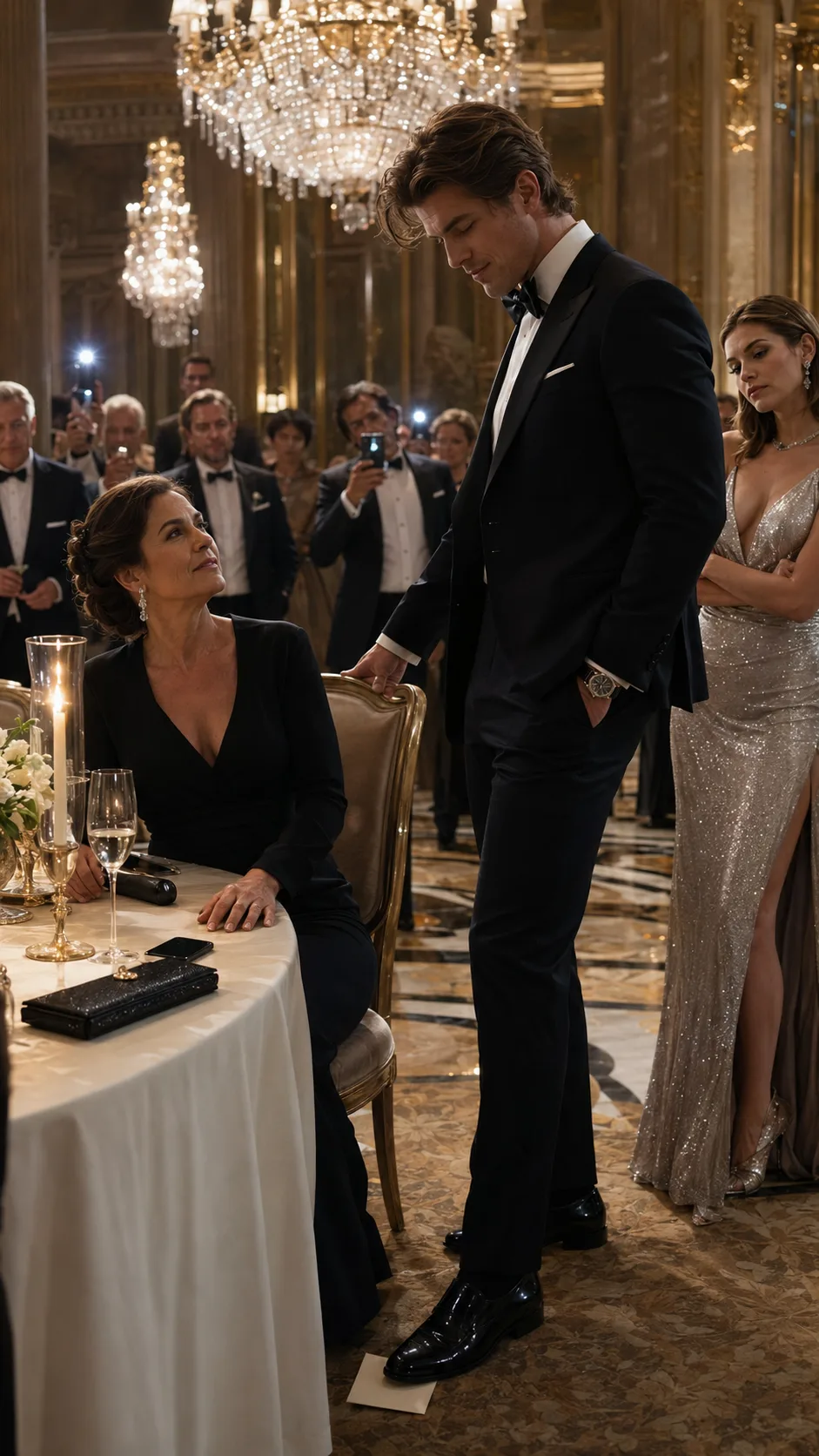
It slipped from a waiter’s tray near the west archway, struck the marble floor, and scattered into bright pieces under the glow of six crystal chandeliers. The sound cut through the Ashbourne Ballroom for half a second. Then the music covered it. The guests kept laughing. The cameras kept flashing. A woman in emerald silk lifted the hem of her dress away from the spill and smiled at a senator as if nothing in the world had ever fallen apart.
I watched the waiter crouch with a napkin in one hand and panic in his eyes.
No one thanked him.
That was the first thing worth noticing.
Not the flowers, though there were thousands of them. White orchids spilled from gold urns near the doors. Roses climbed the columns. Pale lilies floated in shallow bowls on every VIP table, their stems cut so short they looked more arranged than alive.
Not the music, either. A string quartet sat beneath a painted dome and played something elegant enough to be ignored.
Not the press line by the stage, where Victoria Vale stood in a white silk suit and let photographers capture her from the left side because someone on her staff had decided it softened her jaw.
The thing worth noticing was how carefully cruelty had been dressed for the evening.
It wore tuxedos. It wore diamonds. It wore perfume expensive enough to pretend it had never touched human skin.
I sat at table three with my black clutch beside my plate, my phone face down near my right hand, and an ivory name card standing in front of me.
Evelyn Ward.
The lettering was raised, black, simple.
No title.
That had been my request.
Victoria’s office had wanted something grander. Chairwoman. Founder. Managing partner. Private capital advisor. Any phrase that
might help her guests understand why table three had been placed directly beneath the largest chandelier, close enough to the stage for cameras to catch every reaction.
I declined all of it.
A name is enough when the room knows how to read.
This room did not.
That was useful.
Across the ballroom, Victoria Vale lifted a champagne flute she had not touched in twenty minutes and angled her body toward a cluster of politicians. Her silver-blonde hair was twisted into a knot so severe it looked engineered. Pearls sat against her ears. Her smile opened and closed on command.
The woman was a machine built out of manners.
For six months, her company had bled behind closed doors.
Vale Group’s European expansion had been sold to the market as a conquest. New logistics hubs in Rotterdam. Luxury development rights in Milan. A manufacturing partnership outside Lyon. A shipping corridor
through Lisbon. The press called it bold. Analysts called it ambitious. Her board called it transformative.
Her creditors called me.
Not directly, of course. Men like that never begin by admitting they are afraid. First came the polite calls. Then the private dinners. Then the documents. Then the version of the truth that arrives without perfume.
Vale Group needed capital.
Not next quarter.
Now.
One billion three hundred million dollars, wired into the first vehicle before midnight, would stabilize the debt covenant, preserve the expansion, calm the banks, and give Victoria one more year to make her empire look untouchable.
The authorization window was already open on my phone.
One tap.
A signature of liquidity.
Another rich woman’s rescue disguised as strategic confidence.
Layla sat beside me, her tablet angled across her lap. She was twenty-nine, composed, and observant in the way people become when they have spent years watching powerful men lie with their teeth. Her navy suit was sharp enough to make half the junior bankers look twice before they realized she was not there to be looked at.
“The revised wire memo came through,” she said.
I did not pick up my phone.
“Any changes?”
“Only language. They removed the phrase ‘urgent liquidity support.’ Replaced it with ‘growth partnership.’”
“Of course they did.”
“They also added a sentence about leadership continuity.”
That made me look across the room again.
Victoria stood beneath the Vale Group crest projected behind the stage: a gold V inside a laurel circle. Her late husband had used the same crest on the company jet, the annual reports, the leather folders sent to investors, the cufflinks worn by men who mistook logos for bloodlines.
“Leadership continuity,” I said.
Layla tapped once on her screen. “Her son is listed as future executive chairman in the internal deck.”
There it was.
Lucas Vale.
The heir.
The problem tucked inside the silk ribbon.
I had read his file twice.
Twenty-eight years old. Educated in three countries, disciplined in none. A history of failed ventures described as “creative exploration.” A yacht incident in Monaco scrubbed from tabloids. Two assault allegations settled quietly. A luxury fitness app that lost forty million dollars in eighteen months and was still presented at family events as “ahead of its time.”
His mother’s emails never mentioned him unless required.
That also told me enough.
“Has he arrived?” I asked.
Layla glanced toward the main entrance. “Not yet.”
The waiter returned with a dustpan for the broken glass. A guest stepped backward without looking and crushed one fragment under his heel. The waiter froze, then swept around the shoe.
No one moved for him.
I folded my napkin over my lap.
“Ms. Ward?”
Layla’s voice changed just slightly.
I followed her gaze toward the far doors.
Lucas Vale entered like a man who believed every room had been waiting.
He did not walk quickly. He did not need to. The room adjusted around him before he reached the first cluster of guests. A banker moved aside. A woman touched her hair. A councilman’s wife smiled too early. Two younger men near the bar straightened their shoulders as if posture might become currency.
Lucas wore a black tuxedo cut close to his body, the kind that announced tailoring before taste. His dark hair had been styled to look accidental. A watch flashed at his wrist each time he lifted his hand. Beside him walked a woman in a silver dress with diamond straps and the expression of someone who had learned that boredom looked expensive.
I knew her from the briefing notes.
Sienna Cole. Influencer. Socialite. Paid partnership history with three luxury brands, one skincare line, and an Italian hotel group that later sued her for breach of contract. She had no official role in Vale Group.
That would not stop her from taking a seat.
Lucas leaned down to kiss his mother’s cheek on the press line. Victoria’s hand touched his sleeve.
Just once.
A warning.
He missed it.
Or ignored it.
The photographers loved him. Of course they did. He gave them a grin wide enough to sell a lie and turned his jaw toward the lights. Victoria held her smile. Her fingers tightened around the stem of her champagne flute.
Layla saw it too.
“Bad night for him to perform,” she said.
“It may be the only thing he knows how to do.”
A man at the neighboring table leaned toward his wife and whispered something while looking at me. His wife gave me a quick assessment: dress, jewelry, posture, age, table placement. When she reached no satisfying conclusion, she looked away.
People hate what they cannot categorize.
At seven forty-three, Victoria took the stage.
The music softened. Applause rose in layers. Phones lifted. The press adjusted their lenses.
Victoria placed both hands on the acrylic podium and smiled like she had invented grace.
“Tonight,” she began, “we celebrate not only growth, not only generosity, but the kind of partnership that builds a future.”
I almost admired the sentence.
It meant nothing with remarkable confidence.
She spoke about community funding, scholarship programs, infrastructure, families, innovation, and trust. Especially trust. She used the word five times in seven minutes. Each time, her eyes drifted toward the VIP tables.
Toward me.
Not directly enough for the cameras to catch.
Directly enough for me.
The phone near my hand remained face down.
The authorization window would time out at eight.
Victoria knew that.
Her CFO knew that.
Her creditors knew that.
Layla knew that.
I looked down at my plate. The first course had arrived while Victoria spoke: a narrow crescent of smoked fish, three dots of sauce, one edible flower placed with tweezers by someone underpaid.
I did not touch it.
Lucas was near the bar now with Sienna tucked against his side. He had a glass in one hand and an audience around him. He said something that made the men laugh. One of them glanced toward Victoria as though checking whether laughter had permission.
Lucas did not check.
That was the difference between inherited power and earned authority.
Inherited power assumes the floor will hold.
Earned authority listens for cracks.
Victoria ended her speech to applause, camera flashes, and the warm artificial swell of strings. She stepped off the stage and was immediately surrounded. Senators. Bankers. Developers. Men with foundation pins on their lapels and offshore accounts behind their teeth.
Her assistant, a thin man named Peter whom I had met once in a conference room with no windows, looked toward my table.
I gave him no signal.
His throat moved.
Layla’s tablet buzzed.
She glanced down. “Peter.”
“Read it.”
“He says Victoria hopes you’re comfortable and looks forward to speaking before the final authorization.”
“Reply that I’m listening.”
Layla typed.
Across the ballroom, Lucas had begun moving.
Not toward his mother.
Toward us.
Sienna walked beside him, one hand brushing the side of her silver dress, her mouth set in a small line. She looked around the VIP section like someone disappointed by the arrangement of tribute.
At first, I thought he might pass behind our table.
He did not.
The conversation thinned before he arrived.
It always happens that way. A room senses entitlement before hearing it. Forks pause. Shoulders shift. People turn just enough to watch while pretending not to.
Lucas stopped behind my chair.
His hand landed on the carved gold back of it.
Not a tap.
A claim.
“This seat is taken,” he said.
Layla’s fingers stopped above her tablet.
I let a second pass. Then another.
The violinist drew a long note from somewhere near the fountain.
I looked up at Lucas.
He had the smooth, pleased face of a man entering a scene he had already won in his head. Sienna stood half a step behind him, eyes sliding over me, then Layla, then the table setting.
“Correct,” I said. “I’m sitting in it.”
A few people near table four heard.
Lucas laughed through his nose.
“It’s for my girlfriend.”
Sienna did not smile. She only shifted closer, as if the chair might recognize her.
“There appears to be another seat beside you,” I said.
“That one’s for a board member.”
“I see.”
“You should move to general seating.”
Layla turned her head. “Excuse me?”
Lucas did not look at her. That was his second mistake.
The first had been touching my chair.
“Ma’am,” he added.
The word was polished before he threw it.
A small silence gathered around the table.
People pretend they dislike public cruelty. They don’t. They dislike being forced to choose a side before the winner is clear.
I placed my fingertips on the stem of my water glass and turned it a quarter inch.
“Did your mother assign you this table?” I asked.
His smile thinned.
“My mother doesn’t handle seating.”
“No?”
“I do.”
That was a lie. A small one. The kind men like Lucas use as rehearsal for larger damage.
Layla’s tablet lit again.
Peter, probably.
I did not look.
Lucas leaned over the table just far enough for his cologne to cut through the lilies. Citrus, cedar, and money doing its best impression of discipline.
His eyes moved to the ivory card in front of me.
For one brief second, I thought he might read it.
He picked it up instead.
Two fingers.
Thumb and index.
Like something damp.
Layla inhaled.
Lucas lifted the card, turned it slightly, and held it between us.
He did not lower his eyes to the name.
The nearest table quieted completely.
A woman in blue satin placed her fork down without a sound. A young man beside her raised his phone slowly, angling it beneath the edge of the centerpiece. He thought he was being discreet. He was not.
Lucas looked at the card, but not the words.
Then he let it fall.
It flipped once and landed on the carpet beside my chair.
Face up.
Evelyn Ward.
The black lettering stared at the ceiling for half a breath.
Lucas moved his polished shoe forward and pressed his heel on top of it.
The card bent.
Not much.
Enough.
A sound came from Layla’s throat before she swallowed it.
The ballroom did not stop. That would have been too honest. The string quartet continued. A waiter crossed behind us with a tray of scallops. Someone near the stage laughed too loudly and then cut themselves off when nobody joined.
Lucas shifted more weight onto his heel.
The ivory stock flattened.
Sienna glanced at the card. Then at Lucas. Then at me. Her mouth did not move, but her eyes sharpened.
Even she understood that something had crossed a line.
Lucas did not.
He placed one hand in his pocket. His other hand remained on my chair.
“I think you misunderstood me,” he said. “The general seating is near the back. Run along.”
There it was.
Clean.
Public.
Unrecoverable.
I looked at his shoe.
Then at his face.
The phones were no longer hidden.
One guest at table five had his entire arm raised. Another pretended to adjust lipstick while recording through a compact mirror. Near the press line, two photographers lowered their cameras from the stage and turned toward us.
Lucas enjoyed the attention.
That was visible in the set of his shoulders. In the tilt of his chin. In the way he waited for me to shrink.
I did not shrink.
I laughed.
Not loudly.
Not long.
A single breath of sound left my mouth, small enough to fit beneath the music and sharp enough to make Lucas’s eyes flicker.
Layla turned toward me.
She knew that laugh.
She had heard it only twice before.
Once in Zurich, when a shipping magnate tried to hide debt inside a charitable foundation.
Once in Boston, when a CEO called a fraud inquiry “a personality conflict.”
Both men lost more than money.
Lucas’s smirk tightened.
“What’s funny?”
I lifted my napkin from my lap and placed it beside the untouched fish.
“Layla.”
“Yes, Ms. Ward.”
Her tablet was already awake.
Lucas’s eyes moved at last.
Not to the crushed card.
To Layla.
Then back to me.
“Ward?” he said.
The name did not land immediately.
It circled.
He was too used to rooms where importance came labeled, flattered, escorted, announced. He knew faces from covers, billionaires from panels, politicians from donor walls, influencers from party islands, and women from whether men stepped aside for them.
My face had never been useful to him.
That had been the point.
I turned my phone over.
The screen glowed against the white tablecloth.
Lucas saw color before comprehension: the authorization interface, the banking seal, the amount, the final confirmation window, the deadline marker pulsing at the corner.
His mouth opened slightly.
The young man at table five whispered, “Oh.”
Layla held her tablet still.
Sienna stepped closer, trying to see the screen.
“What is that?” she asked.
Lucas did not answer.
I picked up the phone with my right hand. My thumb hovered above the lower half of the screen.
The red option waited.
The room had finally begun to understand silence properly.
Victoria had not.
Not yet.
She stood twenty yards away, speaking to a senator and a hotel chairman. Her assistant Peter was beside her, staring at his phone, face draining by degrees. He looked at the screen. Then at me. Then at Lucas.
His lips parted.
Poor Peter.
He had been the first person at Vale Group to understand the night.
“What you just did,” I said, keeping my voice level, “just cost your mother one point three billion dollars.”
Lucas stared at me.
The words entered him one at a time.
Your mother.
One point three.
Billion.
Dollars.
His heel lifted a fraction from the card.
Too late.
My thumb pressed the red decline button.
The phone confirmed the cancellation with one clean pulse of green.
Then the screen returned to black.
No explosion.
No music cue.
No one screamed.
That is the strange thing about ruin. It often arrives with less sound than a dropped glass.
Sienna spoke first.
“Lucas,” she said, voice sharp now. “Who is this?”
Lucas still looked at the dark phone.
Layla tapped twice on her tablet.
“Cancellation logged,” she said.
A guest near table two covered her mouth. Not with fear. With appetite.
The story was happening in front of them, and every person in the ballroom knew it would outlive dessert.
From the stage area came a sound like a breath being cut in half.
Victoria Vale had looked at her phone.
Peter stood beside her, speaking quickly near her ear, one hand shaking around his device. Victoria did not move for three seconds. Then she turned.
Her eyes found Lucas first.
Then his shoe.
Then the card.
Then me.
I saw the exact instant she assembled the pieces.
Her shoulders dropped half an inch.
Only half.
Enough to show the cliff.
The crowd opened as she crossed the ballroom. No one told them to move. They moved because power in distress is still power, and everyone wants a clear view when it bleeds.
The string quartet stopped one instrument at a time until only the cello remained. Then that stopped too.
Victoria reached table three with her champagne still in hand.
She looked at Lucas.
“Move your foot.”
Her voice carried without effort.
Lucas looked down.
The card had stuck slightly to the sole of his shoe when he lifted it. It peeled free and fell back to the carpet, bent across the middle.
Evelyn Ward.
Plain.
Ruined.
Victoria closed her eyes.
Only briefly.
When she opened them, she was no longer the woman from the stage. The white silk, the pearls, the posture, the press smile—those remained. But the surface had cracked.
“Lucas,” she said.
“Mother, this woman was just in my seat—”
“Shut up.”
The words struck him harder than any raised hand could have.
His jaw snapped closed.
Sienna’s arms folded across her silver dress.
Victoria turned to me.
For the first time all evening, she did not perform warmth.
“Ms. Ward.”
I stood.
Not quickly.
The movement forced everyone to adjust their cameras.
“Victoria.”
Her fingers tightened around the champagne flute. A thin line of bubbles clung to the glass.
“There has been a catastrophic misunderstanding.”
“No.”
The single word made Peter flinch.
Victoria lowered her voice, though the phones would catch it anyway. “My son had no idea who you were.”
“That is not a defense.”
“He is young.”
“He is twenty-eight.”
“He was careless.”
“He was clear.”
Lucas swallowed. His gaze moved around the room, looking for an ally and finding only lenses.
A man who has lived on applause does not know what to do with documentation.
Victoria stepped closer to me, close enough that her perfume reached past the lilies.
“Evelyn,” she said.
The first name was deliberate.
I let it sit there and rot.
“Do not do that.”
Her lips pressed together.
She corrected herself.
“Ms. Ward. Please. We can repair this.”
“The authorization has been declined.”
“We can reopen the window.”
“You cannot.”
Peter’s shoulders folded inward.
Victoria looked at him.
He gave the smallest shake of his head.
That was when Lucas truly understood.
Not when I said the amount. Not when I touched the screen. Not when his mother crossed the room. It was Peter’s little head shake that finished the work.
Lucas took one step toward me.
“Wait.”
Layla stood at my side before he took another.
She said nothing.
She did not need to.
Lucas stopped.
“I didn’t know,” he said. “I didn’t know who you were.”
Every phone in the room leaned closer.
I looked at him.
His face had changed completely. The smirk was gone. The beautiful lazy confidence had collapsed into something damp and unfinished. Without arrogance, he looked younger. Not innocent. Just smaller.
“That,” I said, “is exactly the problem.”
He blinked.
“You thought I was nobody,” I said. “So you showed me exactly who you are.”
A flash went off behind him.
Then another.
Victoria’s head turned toward the photographers. “Stop recording.”
No one stopped.
The command belonged to an earlier version of the room.
One that no longer existed.
Sienna shifted away from Lucas. Not far. Enough for the cameras to see space.
That was the first smart thing she had done all night.
Victoria saw it too.
Her face hardened for one second, then smoothed.
“Ms. Ward,” she said, “Vale Group employs forty-three thousand people.”
“Yes.”
“Families depend on us.”
“They do.”
“This expansion failure will cost jobs.”
“Likely.”
A murmur passed through the ballroom.
Victoria’s eyes sharpened, finding what she thought was the moral angle. She had used it before, no doubt. Jobs. Families. Communities. The corporate veil lined with human faces when convenient.
“You know what happens if we lose that capital.”
“I know exactly what happens.”
“And you would do that because of a seating mistake?”
I looked down at the card on the floor.
Lucas had crushed the center, but the first letter of my name remained clear.
E.
“No,” I said. “I would do it because your chosen successor cannot identify value unless it flatters him.”
Victoria went still.
“And because everyone around him knows it,” I continued, “including you.”
Peter looked at the floor.
That was enough.
Victoria’s hand moved to the edge of the table. Her fingers touched the linen, then withdrew.
She wanted to be furious. She wanted to order something, fire someone, bend the room back into shape. But she had begged for my money in private and now her son had humiliated me in public. The cameras had converted arrogance into evidence.
There are doors even billionaires cannot reopen once witnesses gather.
Lucas tried again.
“I’ll apologize.”
“You already explained yourself.”
“I was wrong.”
“You were comfortable.”
He looked at his mother.
She did not look back.
“Tell her,” he said.
Victoria’s face remained forward.
“Tell her we can fix it.”
The room heard the child in him then.
Not a son grieving his mistake.
A boy demanding his mother restore the floor beneath his feet.
Victoria heard it too.
A small tremor moved through her mouth before she killed it.
“Lucas,” she said, “be quiet.”
He recoiled.
Sienna’s phone appeared in her hand. Not recording. Checking messages. Already elsewhere.
I picked up my clutch.
Layla gathered her tablet.
Peter stepped forward. “Ms. Ward, perhaps we could move to a private room.”
I looked at him.
He stepped back.
“No private room,” I said.
Victoria’s eyes flicked toward the cameras.
“This is not necessary.”
“None of it was.”
The waiter who had cleaned the broken glass earlier stood near the west archway with an empty tray. He watched me the way people watch a door they might be allowed to use.
I stepped around the chair.
Lucas moved instinctively out of my path.
The card remained on the floor between us.
I bent and picked it up.
A few people breathed in at once, as though the gesture meant forgiveness.
It did not.
The card had a shoe mark across the center, a gray curve pressed through my name. I held it between two fingers, the same way Lucas had done.
Then I placed it on the table beside the untouched fish.
Face up.
Victoria looked at it.
Lucas looked away.
“Your son was right about one thing,” I said.
No one moved.
“This seat was never his.”
I walked toward the exit.
Layla stayed half a step behind me, close enough to block anyone who tried to reach. Phones followed. The cameras turned. The ballroom parted with a politeness it had not offered the waiter, the staff, or anyone seated behind table twelve.
Near the doors, Victoria called after me.
“Evelyn.”
I stopped, but did not turn.
The use of my first name hung in the air, naked now.
She corrected herself too late.
“Ms. Ward.”
I turned my head slightly.
Her face had recovered some of its structure. The CEO had climbed back into the body. The mother remained trapped somewhere behind her eyes.
“If you walk out,” she said, “there may be no Vale Group by Monday.”
I looked at Lucas.
He stood beside the VIP table with his hands at his sides, surrounded by people who no longer knew how to admire him. Sienna had moved another step away. Peter was typing with both thumbs. The senator near the stage had already begun speaking to someone else.
The empire was still standing.
But everyone had heard the first beam crack.
“Then Monday will be honest,” I said.
I left through the oak doors.
They closed behind me with a sound too soft for the size of what had happened.
In the corridor outside, the music disappeared. Marble stretched ahead under lower light. Two security guards stood near the elevator bank, pretending they had not been listening through their earpieces. A banquet server held a tray of untouched champagne flutes beside a service door.
Layla walked beside me in silence until we reached the first turn.
Then she said, “Peter has called four times.”
“Let him.”
“Victoria twice.”
“Let her.”
“Three board members have emailed.”
“That was fast.”
“One says he always had concerns about Lucas.”
I stopped walking.
Layla stopped too.
The hallway smelled faintly of wax and lemon polish. Somewhere behind the wall, plates clattered in a service kitchen. The real work of the gala continued even while the illusion burned.
“Forward that email to legal,” I said.
Layla’s mouth curved once.
“Already did.”
The elevator arrived.
Inside, mirrored walls reflected us too many times: black dress, navy suit, phone, clutch, a crushed name card I had not realized I still held.
I looked down at it.
The heel mark ran through my last name.
Ward.
Not gone.
Just marked.
My phone buzzed in my hand.
Victoria.
Again.
I watched the name pulse until it stopped.
Then another call came through.
An unknown number.
Then another.
Then Peter.
Then a bank chairman from Geneva who never called anyone himself.
Layla looked at me in the elevator reflection.
“Do you want the car brought around?”
“No.”
“No?”
“We’ll take the main stairs.”
Her eyebrows lifted.
“That lobby is full of press.”
“I know.”
The elevator doors opened on the mezzanine.
We did not go down by elevator.
We took the marble staircase that curved into the hotel lobby beneath a second chandelier. By the time we reached the bottom, the first reporters had already gathered. Word travels faster than dignity when money is involved.
A woman in a red dress held out a microphone.
“Ms. Ward, did you just pull funding from Vale Group?”
I walked past her.
“Is this because of Lucas Vale?”
No answer.
“Will the European expansion collapse?”
No answer.
“Was Victoria Vale aware of the incident?”
I stopped at the hotel’s revolving doors.
The lobby stilled.
Layla looked at me once.
I turned toward the cameras.
“I have no comment on Vale Group’s internal discipline,” I said. “I will only say this: capital follows judgment.”
A dozen microphones surged forward.
I stepped through the revolving door before they could ask more.
Outside, the night air hit colder than expected.
The hotel awning glowed gold against the city. Black cars lined the curb. Drivers stood in clusters, checking phones. A police barricade held back photographers who had not been invited inside.
Our car pulled up.
Layla opened the rear door before the driver could get out.
I slid inside.
She followed.
The door closed.
For several seconds, neither of us spoke.
Through the tinted window, I could see the hotel entrance. Reporters moved like dark birds. A valet jogged across the drive. A woman in a pale gown came out laughing, then saw the cameras and stopped.
Layla’s tablet buzzed again.
She read silently.
Then she looked at me.
“Vale Group’s stock is already moving in after-hours chatter.”
“It’s not trading.”
“No. But everyone is pretending they know where it opens.”
“Good.”
“Victoria’s board is convening an emergency call.”
“That took too long.”
“Lucas is trending.”
That made me close my eyes for one breath.
Not because I pitied him.
Because trending is not justice. It is weather.
It passes over people, tears roofs away, and calls itself truth.
“What are they saying?” I asked.
“Mostly clips. Different angles. The name card. The shoe. Your phone. The line about one point three billion.”
Of course.
The cleanest sentence survives.
“What about the staff?” I asked.
Layla scrolled. “Nothing yet.”
I opened my eyes.
“Find the waiter from the broken glass.”
She looked up.
“Tonight?”
“Yes.”
“Why?”
“Because he saw the room before it understood itself.”
Layla held my gaze for a moment.
Then she typed.
The car moved into traffic.
Behind us, the Ashbourne Hotel shrank into light and glass and consequence.
By ten thirty, three board members had requested private calls.
By eleven, Victoria Vale released a statement describing the incident as “an unfortunate misunderstanding at a private philanthropic event.”
By eleven fourteen, someone leaked the full video.
Not the polished ten-second clip.
The whole thing.
Lucas’s hand on my chair.
The name card between his fingers.
The drop.
The heel.
Run along.
My laugh.
The phone.
His face after.
The internet did what it always does. It fed.
But the market cared less about manners than structure. Analysts began pulling apart Vale Group’s debt. Anonymous sources confirmed delayed payments. A European lender declined to comment too carefully. A logistics partner in Rotterdam postponed a press event. The Milan development office stopped answering calls.
By midnight, the phrase “leadership continuity” had been removed from Vale Group’s website.
I sat in my study with my shoes off, the crushed name card on the desk, and a cup of tea going cold beside a stack of documents.
Layla stayed in the leather chair across from me, laptop open.
“You should sleep,” she said.
“So should you.”
“I’m younger.”
“That is not an argument.”
“It’s the only one I have left.”
The printer on the side table produced another page.
She stood, took it, scanned it, and handed it to me.
“Emergency board resolution draft. They’re considering removing Lucas from all succession materials.”
“Considering.”
“Victoria is fighting it.”
“For him?”
“For control.”
That sounded more accurate.
I read the first paragraph. The language was cautious. Too cautious. Men in crisis still like to leave doors open for other men.
“Send this to Martin,” I said. “Tell him to watch the phrasing around interim authority.”
Layla nodded.
My phone buzzed again.
This time, the name on the screen was not Victoria.
Lucas Vale.
I looked at it until it stopped.
A message arrived a few seconds later.
I didn’t know who you were. Please. Just talk to me.
Another message followed.
My mother is going to destroy me.
I set the phone down.
Layla watched my hand.
“Do you want me to block him?”
“Not yet.”
“Why?”
“Because panic writes useful records.”
She nodded once.
At one fifteen, Victoria called from a different number.
I answered.
Not because I intended to reopen the deal.
Because a woman like Victoria reveals more when she believes she has already lost.
“Ms. Ward,” she said.
Her voice was stripped now. No ballroom polish. No podium warmth. Just the dry grain beneath.
“Victoria.”
“I will remove Lucas from all operating authority.”
“Temporary?”
“Permanent.”
I said nothing.
“He will not sit on the board. He will not be named successor. I will issue a formal apology.”
“To me?”
“To you, the board, the investors, and the guests.”
“What about the staff?”
Silence.
There it was again.
The fracture.
“What staff?” she asked.
“The waiter who cleaned broken glass while your guests stepped around him. The servers your son likely speaks to the way he spoke to me. The people your company uses as scenery until they become witnesses.”
Another pause.
Shorter this time.
“I can include broader language.”
“No.”
“Then what do you want?”
I looked at the name card.
The shoe mark had dried into the fibers.
“I wanted to know whether Vale Group had discipline beneath the marble.”
“And now?”
“Now I know it had marble.”
Her breath shifted against the receiver.
“Evelyn, forty-three thousand employees.”
“You used them already.”
“It is still true.”
“Yes. And truth does not become clean because you say it at the right time.”
She did not respond.
For the first time since I had known her, Victoria Vale had run out of sentences that sounded like strategy.
I let the silence do its work.
Finally, she said, “Is there any path back?”
I thought of Lucas’s hand on my chair.
The card between two fingers.
The heel.
The room waiting to see whether I would accept being made smaller.
“There may be a path for the company,” I said. “Not through you.”
Her inhale was quiet.
“You want me gone.”
“I want the board to make a decision without sentiment, fear, or family architecture.”
“That is an elegant way to say yes.”
“No,” I said. “It is a precise way.”
She laughed once. It had no humor in it.
“You would have made a brutal CEO.”
“I had better things to do.”
“Like ending them?”
“Like choosing them carefully.”
The call ended without goodbye.
At two in the morning, Layla found the waiter.
His name was Mateo Alvarez. Twenty-two. Hospitality student. Two jobs. Scheduled until one, held until three because the gala ran long. He had already seen the video. Everyone in the staff corridor had.
“He thought you were kind,” Layla said.
“I didn’t speak to him.”
“That may have helped.”
I almost smiled.
“Send him a note. No publicity. Offer tuition support through the foundation.”
“Anonymous?”
“Yes.”
“From which foundation?”
I looked at the files on my desk.
There were many things money could do badly.
There were a few it could do cleanly if no one was allowed to pose beside it.
“Use the Ward Education Trust.”
Layla typed.
The next morning, Vale Group opened wounded.
Not dead.
Wounded.
The stock fell hard enough to trigger every financial channel with a panel of men pretending surprise. They discussed leverage ratios, leadership risk, expansion exposure, succession instability, liquidity cliffs. They did not discuss a heel on a name card until the third segment, when one of them called it “symbolic.”
I turned the television off.
By noon, Victoria stepped down as CEO “to preserve strategic stability during a period of transition.”
That was the sentence her lawyers chose.
The board appointed an interim chair with a spine made of regulatory caution and no blood tie to Lucas. The European expansion was suspended. Two assets were prepared for sale. Three lenders extended terms after new management entered negotiations.
Not with me.
With people I trusted enough to recommend.
That distinction mattered.
Lucas released an apology on social media.
It was terrible.
Not because he failed to use the right words. He had plenty of those. Misjudgment. Respect. Reflection. Privacy. Accountability.
It was terrible because every sentence faced the camera.
By evening, Sienna Cole had deleted twelve photographs from her feed.
By Friday, Lucas Vale’s name disappeared from the company website.
By Monday, the hotel sent me a replacement name card from the gala.
Ivory stock. Raised black lettering.
Evelyn Ward.
No shoe mark.
No history.
I held it in my office for a while, then placed it in a drawer.
Not the top drawer.
Not the one with contracts, passports, old letters, and things worth keeping.
The lower one.
Where I put receipts.
Three weeks later, I returned to the Ashbourne Hotel for a breakfast meeting with the interim Vale board. Not in the ballroom. A smaller room upstairs, east-facing, with pale morning light and coffee that had gone lukewarm before anyone admitted the meeting was useful.
No chandeliers.
No orchids.
No cameras.
The new chair, a woman named Marion Bell, arrived ten minutes early and moved her own chair when the seating was wrong.
That told me something.
Not everything.
Enough to keep listening.
“We are not asking you to rescue the expansion,” Marion said after the first hour.
“Good.”
“We are asking whether you would consider financing the restructuring under independent controls.”
“Terms will be ugly.”
“They should be.”
I looked at her.
She did not flinch.
Outside the window, the city moved in ordinary lines. Delivery trucks. Office workers. A cyclist shouting at a cab. Nothing golden. Nothing staged.
“Send the draft,” I said.
Marion nodded once.
No performance.
Better.
As we left, I passed the open doors of the Ashbourne Ballroom.
The room was empty.
Without the guests, it looked almost honest. Tables gone. Stage dismantled. Chandeliers still burning above a floor being polished by two workers in gray uniforms. Near the west archway, a young man guided a machine over the marble in slow, careful lines.
Mateo Alvarez looked up.
He recognized me.
Only for a second.
Then he looked back at his work.
That was enough.
Layla stood beside me.
“You okay?”
I watched the machine pass over the place where the glass had broken that night.
No trace remained.
Of course not.
Rooms like that are built to forget.
People are harder.
“Send Marion the restructuring conditions,” I said.
“All of them?”
“All of them.”
“And Lucas?”
I glanced once toward the empty ballroom.
A chair leaned upside down on a folded table near the wall, its gold legs in the air.
“Lucas had his seat.”
Layla did not ask what I meant.
She rarely needed to.
We walked down the corridor into the morning light.
Behind us, the ballroom doors stayed open. THE END.
Chapter complete
You have reached the end of this chapter.
Continue reading
A few more worlds to get lost in after this chapter.




